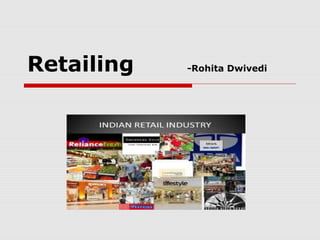
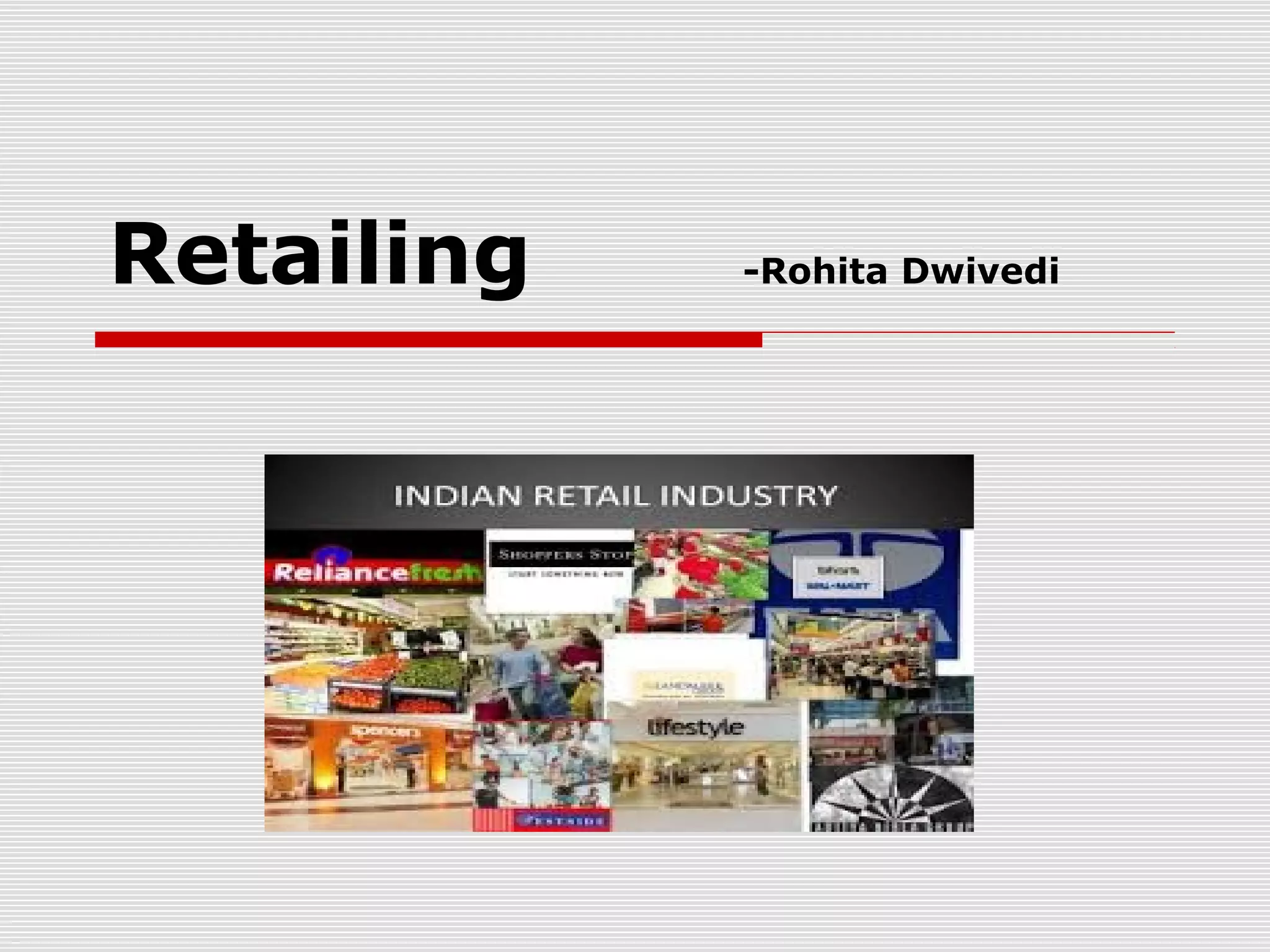
Retailing -Rohita Dwivedi
What is Retail?
 The word retail is derived from a
French word retaillier meaning to cut
off a piece or to break bulk.
 Retailing can hence be considered as
the last stage in the movement of
goods/ & services to the consumer
Retail Philosophy — “By The People,
For The People and Of The People”
 Retailing involves selling products and
services to consumers for their
individual or family use.
 As the final link between consumers
and manufacturers, retailers are a
vital part of the business world.
 Retailers add value to products by
making it easier for manufactures to
sell and consumers to buy.
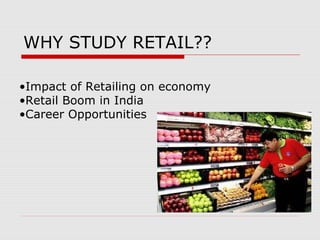
WHY STUDY RETAIL??
•Impact of Retailing on economy
•Retail Boom in India
•Career Opportunities
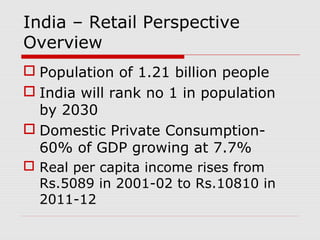
India – Retail Perspective
Overview
 Population of 1.21 billion people
 India will rank no 1 in population
by 2030
 Domestic Private Consumption-
60% of GDP growing at 7.7%
 Real per capita income rises from
Rs.5089 in 2001-02 to Rs.10810 in
2011-12
India – Retail Perspective
Overview…
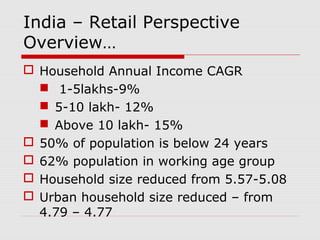
 Household Annual Income CAGR
 1-5lakhs-9%
 5-10 lakh- 12%
 Above 10 lakh- 15%
 50% of population is below 24 years
 62% population in working age group
 Household size reduced from 5.57-5.08
 Urban household size reduced – from
4.79 – 4.77
India – Retail Perspective
Overview…
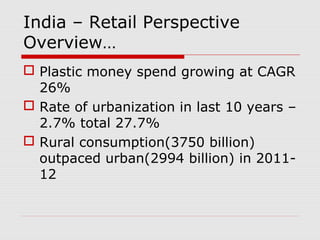
 Plastic money spend growing at CAGR
26%
 Rate of urbanization in last 10 years –
2.7% total 27.7%
 Rural consumption(3750 billion)
outpaced urban(2994 billion) in 2011-
12
India – Retail Perspective
Overview…
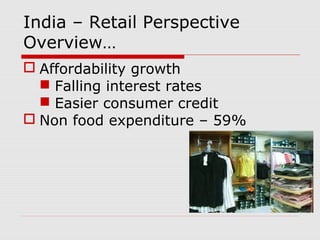
 Affordability growth
 Falling interest rates
 Easier consumer credit
 Non food expenditure – 59%
Indian Retail-An Overview
 Second largest industry after
agriculture- Rs.2,23,572 crore
 GDP contribution-10%
 Contribution to employment-8%
 Overall retail growth-16%
 Organized retail growth-26.8%
 Organized retail penetration -8%
Indian Retail-An Overview…
 GRDI index rates India 14th
in 2013
 2nd
largest growing economy
 3rd
largest economy in terms of GDP
 4th
largest economy in PPP
 Rated among top 10 FDI
destinations
The Changing Indian Consumer
 The urban consumer
 Getting exposed to international lifestyles
 Inclined to acquiring asset
 More discerning and demanding than ever
 Internet Explosion
 No longer need-based shopping
 Shopping is a family experience
 Changing Mindset
 Increasing tendency to spend
 Post Liberalization children coming of age
 100 mn 17-21 year olds*. Tend to spend
freely.
 Greater levels of education
Retail Realities: Beyond Urban
Boundaries
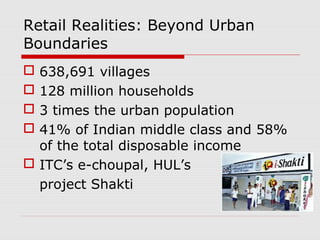
 638,691 villages
 128 million households
 3 times the urban population
 41% of Indian middle class and 58%
of the total disposable income
 ITC’s e-choupal, HUL’s
project Shakti
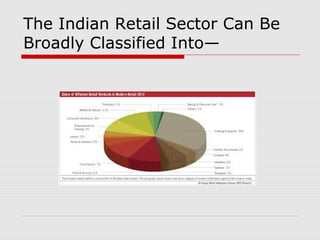
The Indian Retail Sector Can Be
Broadly Classified Into—
Unorganized Retail in India
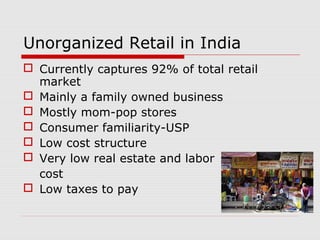
 Currently captures 92% of total retail
market
 Mainly a family owned business
 Mostly mom-pop stores
 Consumer familiarity-USP
 Low cost structure
 Very low real estate and labor
cost
 Low taxes to pay
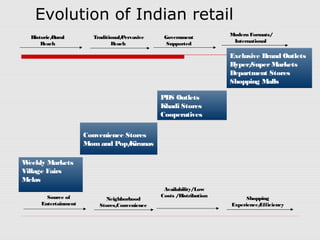
Weekly Markets
Village Fairs
Melas
Convenience Stores
Mom and Pop/Kiranas
PDS Outlets
Khadi Stores
Cooperatives
Exclusive Brand Outlets
Hyper/SuperMarkets
Department Stores
Shopping Malls
Traditional/Pervasive
Reach
Government
Supported
Historic/Rural
Reach
Modern Formats/
International
Evolution of Indian retail
Source of
Entertainment
Neighborhood
Stores/Convenience
Availability/Low
Costs /Distribution
Shopping
Experience/Efficiency
Industry Evolution
 Traditionally retailing in India can be traced to
 The emergence of the neighborhood ‘Kirana’ stores
catering to the convenience of the consumers
 Era of government support for rural retail:
Indigenous franchise model of store chains run by
Khadi & Village Industries Commission
 1980s experienced slow change as India began to open
up economy.
 Textiles sector with companies like Bombay Dyeing,
Raymond's, S Kumar's and Grasim first saw the
emergence of retail chains
 Later Titan successfully created an organized retailing
concept and established a series of showrooms for its
premium watches
 The latter half of the 1990s saw a fresh wave of entrants
with a shift from Manufactures to Pure Retailers
Industry Evolution…cont…
 For e.g. Food World, Subhiksha and Nilgiris in food
and FMCG; Planet M and Music World in music;
Crossword and Fountainhead in books.
 Post 1995 onwards saw an emergence of shopping
centers,
 mainly in urban areas, with facilities like car parking
 targeted to provide a complete destination
experience for all segments of society
 Emergence of hyper and super markets trying to provide
customer with 3 V’s - Value, Variety and Volume
 Expanding target consumer segment: The Sachet
revolution - example of reaching to the bottom of the
pyramid.
 At year end of 2000 the size of the Indian organized
retail industry was estimated at Rs. 13,000 crore
Stages of Lifecycle of Industry
 Introduction:
 Country that has just entered GRDI
 Retailers plan their entry strategies
 India in 1990s
 Kazakhastan in 2007
 Lasts for around 10 years depending on the
market attractiveness
 Example: African markets
 Strategy suggested:
 A rapid penetration strategy: low price, high
promotion, limited distribution, advertises for
awareness
Stages of Lifecycle of Industry..
 Growth:
 Market is developing quickly and is also ready
for modern retailing
 Retailers have a good chance of long term
success
 Retailers should enter through local
representation, sourcing offices and new stores
 Lasts for approx. 15-25 years
 Example: Indian market
 Strategy suggested: strength against
competitor, stronger distribution channel,
shift of advertising from product awareness
to product preference
Stages of Lifecycle of Industry..
 Maturity:
 Market is still big and growing but the space for
new entrant will become tighter
 Margins for error is thin
 Competition from international retailers
 Generally lasts for 5-10 years
 Example: South Asian markets
 Strategy suggested: enter new market
segments and innovative products and
offers
Stages of Lifecycle of Industry..
 Decline:
 Window of opportunity is closing fast and
organised retail is at 40 to 60 percent
 Existing retailers can enter through discount
formats or non food formats such as consumer
goods and apparels
 Lasts for around 5 to 10 years before reaching
saturation
 Example: Developed country markets
 Strategy suggested: identify weak
segments, maintaining investment levels
selectively, controlled advertising
Challenges In The Industry
 Low domestic competition
 Because of fragmented nature of industry
 Lack of exposure to global best practices
 Low entry barriers for unorganized
retailing
 Moderate entry barriers for organized
retailing
 Wholesale system under-invested leading to
20-40% wastage
 Non level playing field issues
 Wide differences in treatment of small and
large retailers
Challenges In The Industry…
 Real Estate low Availability and high cost
 Supply Chain Inconsistency
 Poor Infrastructure
 Lack of Skilled Manpower
 Complex tax Structure
 Heavy Stamp Duties
FDI in Indian retailing
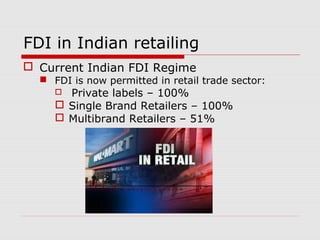
 Current Indian FDI Regime
 FDI is now permitted in retail trade sector:
 Private labels – 100%
 Single Brand Retailers – 100%
 Multibrand Retailers – 51%
Why FDI?
 Improve competition
 Develop the market
 Greater level of exports due to increased
sourcing by major players
 Sourcing by Wal-Mart from China improved
multifold after FDI permitted in China
 Similar increase in sourcing observed for Metro
in India
 Provides access to global markets for Indian
producers
Why FDI?...
 Investment in technology
 Cold storage chains solve the perennial problem of
wastage
 Greater investment in the food processing sector
technology
 Better operations in production cycle and distribution
 Better lifestyle
 Greater level of wages paid by international players
usually
 More product variety
 Newer product categories
 Economies of scale to help lower consumer price
 Increased purchasing capacity of consumers
Careers In Retailing
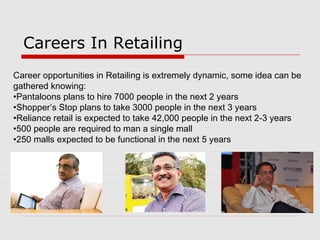
Career opportunities in Retailing is extremely dynamic, some idea can be
gathered knowing:
•Pantaloons plans to hire 7000 people in the next 2 years
•Shopper’s Stop plans to take 3000 people in the next 3 years
•Reliance retail is expected to take 42,000 people in the next 2-3 years
•500 people are required to man a single mall
•250 malls expected to be functional in the next 5 years
Careers In Retailing….
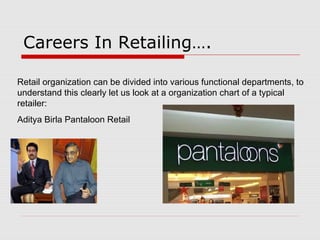
Retail organization can be divided into various functional departments, to
understand this clearly let us look at a organization chart of a typical
retailer:
Aditya Birla Pantaloon Retail
Careers In Retailing….
 Operations:
 Zonal managers
 Area managers
 Store managers
 Asst. Store managers
 Floor managers
 Department managers
 Category management
 Category managers
 Buyers
 Asst category managers
 Asst. Buyers
 Information Technology
 Software development managers
 Hardware maintenance managers
Careers In Retailing….
 Business development:
 Online retail managers
 Project managers
 Asst. Manager- projects
 Corporate sales manager
 Asst. Manager- corporate sales
 Supply chain management:
 Manager- supply chain
 Asst. Manager- supply chain
 Warehouse managers
 Asst manager- warehouse
 Customer service:
 Customer relationship managers
 Customer facilitators
Careers In Retailing….
 Marketing and advertising:
 Retail marketing managers
 Pr manager
 Asst manager- pr
 Pr executives
 Human resource development:
 Manager training
 Manager recruitment
 Hr manager
 Commerce:
 Manager- finance
 Manager- audit
 Manager- collections
 CAs, CSs
THANK YOU!!!!

Introduction to Retail

  • 1.
  • 2.
    What is Retail? The word retail is derived from a French word retaillier meaning to cut off a piece or to break bulk.  Retailing can hence be considered as the last stage in the movement of goods/ & services to the consumer
  • 3.
    Retail Philosophy —“By The People, For The People and Of The People”  Retailing involves selling products and services to consumers for their individual or family use.  As the final link between consumers and manufacturers, retailers are a vital part of the business world.  Retailers add value to products by making it easier for manufactures to sell and consumers to buy.
  • 4.
    WHY STUDY RETAIL?? •Impactof Retailing on economy •Retail Boom in India •Career Opportunities
  • 5.
    India – RetailPerspective Overview  Population of 1.21 billion people  India will rank no 1 in population by 2030  Domestic Private Consumption- 60% of GDP growing at 7.7%  Real per capita income rises from Rs.5089 in 2001-02 to Rs.10810 in 2011-12
  • 6.
    India – RetailPerspective Overview…  Household Annual Income CAGR  1-5lakhs-9%  5-10 lakh- 12%  Above 10 lakh- 15%  50% of population is below 24 years  62% population in working age group  Household size reduced from 5.57-5.08  Urban household size reduced – from 4.79 – 4.77
  • 7.
    India – RetailPerspective Overview…  Plastic money spend growing at CAGR 26%  Rate of urbanization in last 10 years – 2.7% total 27.7%  Rural consumption(3750 billion) outpaced urban(2994 billion) in 2011- 12
  • 8.
    India – RetailPerspective Overview…  Affordability growth  Falling interest rates  Easier consumer credit  Non food expenditure – 59%
  • 9.
    Indian Retail-An Overview Second largest industry after agriculture- Rs.2,23,572 crore  GDP contribution-10%  Contribution to employment-8%  Overall retail growth-16%  Organized retail growth-26.8%  Organized retail penetration -8%
  • 10.
    Indian Retail-An Overview… GRDI index rates India 14th in 2013  2nd largest growing economy  3rd largest economy in terms of GDP  4th largest economy in PPP  Rated among top 10 FDI destinations
  • 11.
    The Changing IndianConsumer  The urban consumer  Getting exposed to international lifestyles  Inclined to acquiring asset  More discerning and demanding than ever  Internet Explosion  No longer need-based shopping  Shopping is a family experience  Changing Mindset  Increasing tendency to spend  Post Liberalization children coming of age  100 mn 17-21 year olds*. Tend to spend freely.  Greater levels of education
  • 12.
    Retail Realities: BeyondUrban Boundaries  638,691 villages  128 million households  3 times the urban population  41% of Indian middle class and 58% of the total disposable income  ITC’s e-choupal, HUL’s project Shakti
  • 13.
    The Indian RetailSector Can Be Broadly Classified Into—
  • 14.
    Unorganized Retail inIndia  Currently captures 92% of total retail market  Mainly a family owned business  Mostly mom-pop stores  Consumer familiarity-USP  Low cost structure  Very low real estate and labor cost  Low taxes to pay
  • 15.
    Weekly Markets Village Fairs Melas ConvenienceStores Mom and Pop/Kiranas PDS Outlets Khadi Stores Cooperatives Exclusive Brand Outlets Hyper/SuperMarkets Department Stores Shopping Malls Traditional/Pervasive Reach Government Supported Historic/Rural Reach Modern Formats/ International Evolution of Indian retail Source of Entertainment Neighborhood Stores/Convenience Availability/Low Costs /Distribution Shopping Experience/Efficiency
  • 16.
    Industry Evolution  Traditionallyretailing in India can be traced to  The emergence of the neighborhood ‘Kirana’ stores catering to the convenience of the consumers  Era of government support for rural retail: Indigenous franchise model of store chains run by Khadi & Village Industries Commission  1980s experienced slow change as India began to open up economy.  Textiles sector with companies like Bombay Dyeing, Raymond's, S Kumar's and Grasim first saw the emergence of retail chains  Later Titan successfully created an organized retailing concept and established a series of showrooms for its premium watches  The latter half of the 1990s saw a fresh wave of entrants with a shift from Manufactures to Pure Retailers
  • 17.
    Industry Evolution…cont…  Fore.g. Food World, Subhiksha and Nilgiris in food and FMCG; Planet M and Music World in music; Crossword and Fountainhead in books.  Post 1995 onwards saw an emergence of shopping centers,  mainly in urban areas, with facilities like car parking  targeted to provide a complete destination experience for all segments of society  Emergence of hyper and super markets trying to provide customer with 3 V’s - Value, Variety and Volume  Expanding target consumer segment: The Sachet revolution - example of reaching to the bottom of the pyramid.  At year end of 2000 the size of the Indian organized retail industry was estimated at Rs. 13,000 crore
  • 18.
    Stages of Lifecycleof Industry  Introduction:  Country that has just entered GRDI  Retailers plan their entry strategies  India in 1990s  Kazakhastan in 2007  Lasts for around 10 years depending on the market attractiveness  Example: African markets  Strategy suggested:  A rapid penetration strategy: low price, high promotion, limited distribution, advertises for awareness
  • 19.
    Stages of Lifecycleof Industry..  Growth:  Market is developing quickly and is also ready for modern retailing  Retailers have a good chance of long term success  Retailers should enter through local representation, sourcing offices and new stores  Lasts for approx. 15-25 years  Example: Indian market  Strategy suggested: strength against competitor, stronger distribution channel, shift of advertising from product awareness to product preference
  • 20.
    Stages of Lifecycleof Industry..  Maturity:  Market is still big and growing but the space for new entrant will become tighter  Margins for error is thin  Competition from international retailers  Generally lasts for 5-10 years  Example: South Asian markets  Strategy suggested: enter new market segments and innovative products and offers
  • 21.
    Stages of Lifecycleof Industry..  Decline:  Window of opportunity is closing fast and organised retail is at 40 to 60 percent  Existing retailers can enter through discount formats or non food formats such as consumer goods and apparels  Lasts for around 5 to 10 years before reaching saturation  Example: Developed country markets  Strategy suggested: identify weak segments, maintaining investment levels selectively, controlled advertising
  • 22.
    Challenges In TheIndustry  Low domestic competition  Because of fragmented nature of industry  Lack of exposure to global best practices  Low entry barriers for unorganized retailing  Moderate entry barriers for organized retailing  Wholesale system under-invested leading to 20-40% wastage  Non level playing field issues  Wide differences in treatment of small and large retailers
  • 23.
    Challenges In TheIndustry…  Real Estate low Availability and high cost  Supply Chain Inconsistency  Poor Infrastructure  Lack of Skilled Manpower  Complex tax Structure  Heavy Stamp Duties
  • 24.
    FDI in Indianretailing  Current Indian FDI Regime  FDI is now permitted in retail trade sector:  Private labels – 100%  Single Brand Retailers – 100%  Multibrand Retailers – 51%
  • 25.
    Why FDI?  Improvecompetition  Develop the market  Greater level of exports due to increased sourcing by major players  Sourcing by Wal-Mart from China improved multifold after FDI permitted in China  Similar increase in sourcing observed for Metro in India  Provides access to global markets for Indian producers
  • 26.
    Why FDI?...  Investmentin technology  Cold storage chains solve the perennial problem of wastage  Greater investment in the food processing sector technology  Better operations in production cycle and distribution  Better lifestyle  Greater level of wages paid by international players usually  More product variety  Newer product categories  Economies of scale to help lower consumer price  Increased purchasing capacity of consumers
  • 27.
    Careers In Retailing Careeropportunities in Retailing is extremely dynamic, some idea can be gathered knowing: •Pantaloons plans to hire 7000 people in the next 2 years •Shopper’s Stop plans to take 3000 people in the next 3 years •Reliance retail is expected to take 42,000 people in the next 2-3 years •500 people are required to man a single mall •250 malls expected to be functional in the next 5 years
  • 28.
    Careers In Retailing…. Retailorganization can be divided into various functional departments, to understand this clearly let us look at a organization chart of a typical retailer: Aditya Birla Pantaloon Retail
  • 29.
    Careers In Retailing…. Operations:  Zonal managers  Area managers  Store managers  Asst. Store managers  Floor managers  Department managers  Category management  Category managers  Buyers  Asst category managers  Asst. Buyers  Information Technology  Software development managers  Hardware maintenance managers
  • 30.
    Careers In Retailing…. Business development:  Online retail managers  Project managers  Asst. Manager- projects  Corporate sales manager  Asst. Manager- corporate sales  Supply chain management:  Manager- supply chain  Asst. Manager- supply chain  Warehouse managers  Asst manager- warehouse  Customer service:  Customer relationship managers  Customer facilitators
  • 31.
    Careers In Retailing…. Marketing and advertising:  Retail marketing managers  Pr manager  Asst manager- pr  Pr executives  Human resource development:  Manager training  Manager recruitment  Hr manager  Commerce:  Manager- finance  Manager- audit  Manager- collections  CAs, CSs
  • 32.