
PRICING METHODS
Marketing Management
Pricing
An introduction

 Pricing method or strategy is the route taken by the
  firm in fixing the price.
 The method/strategy must be appropriate for achieving
  the desired pricing objectives.
Pricing methods

1. Cost Based Pricing
Types of cost based pricing

      Mark-Up Pricing(cost plus pricing)
      Absorption cost pricing (full cost pricing)
      Target rate of return pricing
      Marginal cost pricing
Mark-up pricing
• The selling price is fixed by adding Mark-up or
  Margin to its cost.
• Usually used by:
    Distributers, Marketing firms etc..
• Slower the turnaround of the product larger the
  margin and vice versa.
Example:
Supplyco.
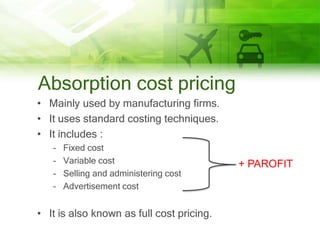
Absorption cost pricing
• Mainly used by manufacturing firms.
• It uses standard costing techniques.
• It includes :
   –   Fixed cost
   –   Variable cost                       + PAROFIT
   –   Selling and administering cost
   –   Advertisement cost


• It is also known as full cost pricing.
Target rate of return pricing
• Similar to Absorption cost pricing.
• The difference is in fixing the profit margin.
• The profit margin/ mark up is fixed by considering
  the ROI.
• Firm will have return objectives, like 5% of invested
  capital, or 10% of sales revenue.
• Then you arrange your price structure so as to achieve
  these target rates of return.
• Market leaders or monopolists uses this pricing strategy.
Marginal Cost Pricing
• It takes cost and demand into consideration while
  fixing the price.
• It aims at maximizing contribution towards fixed
  cost.
• It gives flexibility to recover the fixed cost
  depending on the market condition.
• It also gives flexibility in recovering a large portion
  of cost from certain segment and a small portion
  from some other segment.
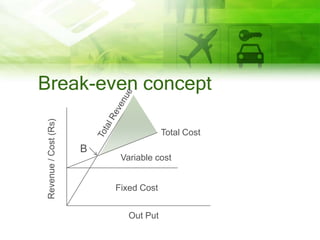
Break-even concept
 Revenue / Cost (Rs)


                                        Total Cost
                       B
                            Variable cost


                           Fixed Cost


                              Out Put
Pricing methods

2. Demand Based Pricing
 The pricing decision is also depending on Demand and
  supply of the commodity.
 More realistic .

Types of cost based pricing are:
• What the traffic can bear pricing
• Skimming pricing
• Penetration pricing
“What the traffic can bear”
• The seller sets the maximum price the buyers are
  willing to pay in giver circumstances.
• It will bring a high profit during this period.
• Chance of error in judgment are very high.
• Can be used in the following conditions.
   – Shortage of goods
   – Monopoly
   – Oligopoly
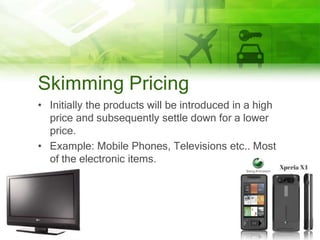
Skimming Pricing
• Initially the products will be introduced in a high
  price and subsequently settle down for a lower
  price.
• Example: Mobile Phones, Televisions etc.. Most
  of the electronic items.
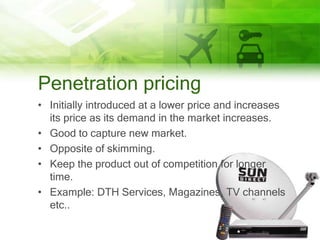
Penetration pricing
• Initially introduced at a lower price and increases
  its price as its demand in the market increases.
• Good to capture new market.
• Opposite of skimming.
• Keep the product out of competition for longer
  time.
• Example: DTH Services, Magazines, TV channels
  etc..
3. Competition Oriented Pricing
• It need not mean that pricing the commodity
  matching its competitors, it can also be the
  following:
   – Premium pricing
   – Discounted Pricing
   – Parity Pricing/going rate pricing
4.Product line pricing
• The products in a given product line are related to
  each other.
• The manufacturing cost of these products also will
  not be much different.
• The need not price the product optimally but it
  may price the product line optimally.
• It is mainly indented to get optimum profit from the
  line.
Example: Pulsar 150, 180, 200, 220
5.Tender pricing
• Industrial products
• The customers go by competitive bidding through
  sealed tenders.
• The seller can only get the best possible price.
• He should thoroughly analyze the competitors.
6. Affordability based Pricing
• Essential commodities
• Social welfare pricing
• The idea of this pricing is to make the product
  available to the targeted population at an
  affordable rate.
• Items usually distributed through public
  distribution system.
• Subsidies may be involved
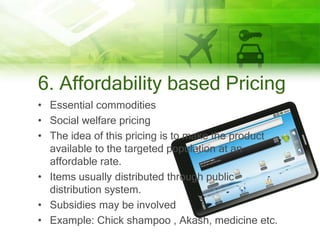
• Example: Chick shampoo , Akash, medicine etc.
7. Differentiated pricing
• Different price for the same product in different location.
  (SanDisk cruzer balde Pen-drive, Petrol )
• The price difference may also be made in the case of
  customer class.
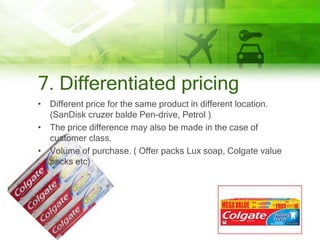
• Volume of purchase. ( Offer packs Lux soap, Colgate value
  packs etc)
Pricing methods..

Pricing methods..

  • 1.
  • 2.
    Pricing An introduction  Pricingmethod or strategy is the route taken by the firm in fixing the price.  The method/strategy must be appropriate for achieving the desired pricing objectives.
  • 3.
    Pricing methods 1. CostBased Pricing Types of cost based pricing  Mark-Up Pricing(cost plus pricing)  Absorption cost pricing (full cost pricing)  Target rate of return pricing  Marginal cost pricing
  • 4.
    Mark-up pricing • Theselling price is fixed by adding Mark-up or Margin to its cost. • Usually used by:  Distributers, Marketing firms etc.. • Slower the turnaround of the product larger the margin and vice versa. Example: Supplyco.
  • 5.
    Absorption cost pricing •Mainly used by manufacturing firms. • It uses standard costing techniques. • It includes : – Fixed cost – Variable cost + PAROFIT – Selling and administering cost – Advertisement cost • It is also known as full cost pricing.
  • 6.
    Target rate ofreturn pricing • Similar to Absorption cost pricing. • The difference is in fixing the profit margin. • The profit margin/ mark up is fixed by considering the ROI. • Firm will have return objectives, like 5% of invested capital, or 10% of sales revenue. • Then you arrange your price structure so as to achieve these target rates of return. • Market leaders or monopolists uses this pricing strategy.
  • 7.
    Marginal Cost Pricing •It takes cost and demand into consideration while fixing the price. • It aims at maximizing contribution towards fixed cost. • It gives flexibility to recover the fixed cost depending on the market condition. • It also gives flexibility in recovering a large portion of cost from certain segment and a small portion from some other segment.
  • 8.
    Break-even concept Revenue/ Cost (Rs) Total Cost B Variable cost Fixed Cost Out Put
  • 9.
    Pricing methods 2. DemandBased Pricing  The pricing decision is also depending on Demand and supply of the commodity.  More realistic . Types of cost based pricing are: • What the traffic can bear pricing • Skimming pricing • Penetration pricing
  • 10.
    “What the trafficcan bear” • The seller sets the maximum price the buyers are willing to pay in giver circumstances. • It will bring a high profit during this period. • Chance of error in judgment are very high. • Can be used in the following conditions. – Shortage of goods – Monopoly – Oligopoly
  • 11.
    Skimming Pricing • Initiallythe products will be introduced in a high price and subsequently settle down for a lower price. • Example: Mobile Phones, Televisions etc.. Most of the electronic items.
  • 12.
    Penetration pricing • Initiallyintroduced at a lower price and increases its price as its demand in the market increases. • Good to capture new market. • Opposite of skimming. • Keep the product out of competition for longer time. • Example: DTH Services, Magazines, TV channels etc..
  • 13.
    3. Competition OrientedPricing • It need not mean that pricing the commodity matching its competitors, it can also be the following: – Premium pricing – Discounted Pricing – Parity Pricing/going rate pricing
  • 14.
    4.Product line pricing •The products in a given product line are related to each other. • The manufacturing cost of these products also will not be much different. • The need not price the product optimally but it may price the product line optimally. • It is mainly indented to get optimum profit from the line. Example: Pulsar 150, 180, 200, 220
  • 15.
    5.Tender pricing • Industrialproducts • The customers go by competitive bidding through sealed tenders. • The seller can only get the best possible price. • He should thoroughly analyze the competitors.
  • 16.
    6. Affordability basedPricing • Essential commodities • Social welfare pricing • The idea of this pricing is to make the product available to the targeted population at an affordable rate. • Items usually distributed through public distribution system. • Subsidies may be involved • Example: Chick shampoo , Akash, medicine etc.
  • 17.
    7. Differentiated pricing •Different price for the same product in different location. (SanDisk cruzer balde Pen-drive, Petrol ) • The price difference may also be made in the case of customer class. • Volume of purchase. ( Offer packs Lux soap, Colgate value packs etc)