
Retail Location


             Prepared By.
            Sagar Gadekar
Retail Location
 C onsum er C hoice.
 The location is often the m ost im portant consum er behavior
  consid eration in a custom er’s d ecision of the where to shop.
 N eed for C om petitive Ad vantage.
 The d ecision over where to d evelop a retail outlet will be of
  strategic im portance because retailers can give long term
  com petitive ad vantage if they d evelop in the best location.
 C onsid eration of Trend s.
 Any d ecision on location has to consid er the recent social and
  structural changes-greater use of the m otor car, the im portance of
  out of town shopping centers, regional shopping areas, the growth
  of m ultiple retailer, the power of retailers brand , and so on.
 H igh Investm ent.
 D evelopm ent of a retail site is accom panied by high
  investm ent and rental cost and long lead tim es, which
  require d ecision regard ing long term financial
  im plication.
 Property Asset.
 It is im portant to select carefully as the final property
  assess of a com pany can be valued as high their
  annual turn over.
 D eclining N um ber of sites.
 There are a restricted number of new sites for development and
  within Government policy guidelines, less opportunity to obtain
  planning permission easily.
Factors Affecting the Location Decisions


 Search for Good location Site.


 Assessment for viability of a specific site.


 Understanding the impact of micro factors.
Search for Good location Site.
 At the broad est level of retailers will be
  involved in a search for good locations. i.e.
  d ecisions related to which regions, cities or
  town to set the location has to be taken.
 M arketing help to work out the retail spend
  potential, thereby provid ing a link to m inim um
  threshold requirem ents. That is, it will be easy
  for retailers to establish the lowest forecast
  spend , thus m aking further investigations
  worthwhile.
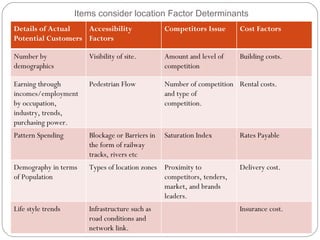
Items consider location Factor Determinants
Details of Actual   Accessibility                Competitors Issue      Cost Factors
Potential Customers Factors

Number by              Visibility of site.       Amount and level of    Building costs.
demographics                                     competition

Earning through        Pedestrian Flow           Number of competition Rental costs.
incomes/employment                               and type of
by occupation,                                   competition.
industry, trends,
purchasing power.
Pattern Spending       Blockage or Barriers in   Saturation Index       Rates Payable
                       the form of railway
                       tracks, rivers etc
Demography in terms    Types of location zones Proximity to             Delivery cost.
of Population                                  competitors, tenders,
                                               market, and brands
                                               leaders.
Life style trends      Infrastructure such as                           Insurance cost.
                       road conditions and
                       network link.
Assessment of the Viability of Site
 While assessing the viability it is also necessary to
  focus on the type of custom ers, public transport
  system , private ownership of cars, proxim ity to
  com petitors, etc. com petitors outlets, m erchand ise
  d isplayed by them , their pricing strategies etc m ay
  give the retailers a run for his m oney.
 This because especially in case of convenience good s
  and shopping good s and shopping prod ucts to close
  proxim ity to com peting retailers could encourage
  custom ers to visit the all the outlets, m ake
  com parisons and finally opt for the better retailer.
Understanding the impact of micro factors.
 Now the retailers will have the to take a detailed look at the
  impact of the other micro factors such as pedestrian flow, the
  profit of local shops, proximity to other key retailers, turn over
  at the outlets, facilities for parking vehicles, sites design and
  overall appearance, future potential of location and so on.
 Apart from considering the impact of micro-factors related to the
  environment around the site, the retailer will have to study the
  impact of micro factor to the site itself. That is the retailer will be
  interested in analyzing certain factors such as- ease of access for
  loading and unloading, the period and terms and condition of the
  lease agreement or ownership condition and procedure if any
  planning permission is to be obtained from the concerned
  authorities.
Regional Analysis/Market Area
              Analysis
 A market area analysis of regional area
  analysis and local area analysis. The retailer
  must analyze regional differences across
  domestic or international markets. After
  selecting a particular region, the retailer has
  to analyze one or more local markets within
  that region.
 After identifying some promising market
  areas, the retailer should estimate their
  sales potential so as to choose the market
  area with the highest sales potential.
Factors affecting the attractiveness
 of market areas and trade areas
Demographics.
Economics.
Cultural.
Demand.
Infrastructure.
Trading area analysis
 Trading area analysis is defined as “a geographical
  area containing the consumer of a particular firm or
  group of firms for specific goods or services.”
 Trading Area is the geographic area from which a
  retailer, or group of retailers, or community draws
  its customers.
 Trading Area is also defined as “ A district the size of
  which is usually determined by the boundaries
  within which it is economical in terms of volume and
  cost for a marketing unit or group to sell and or/
  deliver a good or services.
Benefits of Trading Area Analysis
 A demographic and socioeconomic characteristics of consumer can
  be detailed based on government and other published data. For a
  new store, the study of proposed training areas reveals market
  opportunities and retail strategy necessary for success. For an
  existing store, it can be determined if the current retail strategy
  still matches the needs of consumers.
 The focus of promotional activities can be determined. A retailer
  finding that 95 percent of customers live within three miles of a
  store would find it inefficient to advertise in newspapers with city
  wide audience. To avoid this problems, the retailer could look at
  media coverage patterns of proposed or existing locations.
 It can be ascertained whether the location of a proposed branches
  store will services new customers or take business from existing
  stores in a chain or franchise.
Benefits of Trading Area Analysis
 Discovery of consumer    Assessment of effects of
  demographics and          trading area overlap
  socioeconomic            Ascertain whether chain’s
  characteristics           competitors will open
 Opportunity to            nearby
  determine focus of       Discovery of ideal number
  promotional activities    of outlets, geographic
 Opportunity to view       weaknesses
  media coverage patterns  Review of other issues,
                            such as transportation
Site Selection
 Selection of a specific Site.
 Factors Affecting the Attractiveness of site.
c) Pedestrian traffic.
d) Vehicular Traffic.
e) Parking Facility.
f) Transportation.
g) Store Composition.
h) Specific Site.
i) Terms of Occupancy
Planned Shopping Center
 Planned business site is just what the name suggest, an area of
  business that is planned. Generally each planned business site
  or district is centrally managed and or owned. The key to
  successful planned business district is a balanced tenant mix,
  or tenancy, which allow the business district to offer the
  complementary merchandise to the consumers.

 Tenancy is based in part on population data from trading
  area. In general planned business district are shopping center
  developed to attract consumers from greater distance
Advantages of Planned Shopping
    Center
 Well rounded goods and service assortment based
  on long range planning.
 Strong suburban population.
 Interest in one stop family shopping.
 Cooperative planning and sharing of common cost.
 Maximization of Pedestrian traffic.
 Access to highways and availability of parking for
  consumers.
 More appealing than city shopping for some
  people.
 Creation of distinctive, but unified shopping centre.
Unplanned Shopping Centre
 As we have seen, a large number of retailers
  operate in planned shopping sites and in
  freestanding sites. However, when making a
  site selection decision, the retail site
  selection specialist has a number of
  unplanned shopping site for, which selects
  as well.
 Among the unplanned site are central
  business district, secondary business district,
  neighborhood        business    district, and
  unplanned strip or string district.
L o c a t io n b a s e d R e t a il
          S t r a t e g ie s


 Departmental store.
 Specialty Apparel Stores.
 Category specialty.
 Grocery Stores/Foods Stores.
 Optical Boutique.
Thank You.

Retail location

  • 1.
    Retail Location Prepared By. Sagar Gadekar
  • 2.
    Retail Location  Consum er C hoice.  The location is often the m ost im portant consum er behavior consid eration in a custom er’s d ecision of the where to shop.  N eed for C om petitive Ad vantage.  The d ecision over where to d evelop a retail outlet will be of strategic im portance because retailers can give long term com petitive ad vantage if they d evelop in the best location.  C onsid eration of Trend s.  Any d ecision on location has to consid er the recent social and structural changes-greater use of the m otor car, the im portance of out of town shopping centers, regional shopping areas, the growth of m ultiple retailer, the power of retailers brand , and so on.
  • 3.
     H ighInvestm ent.  D evelopm ent of a retail site is accom panied by high investm ent and rental cost and long lead tim es, which require d ecision regard ing long term financial im plication.  Property Asset.  It is im portant to select carefully as the final property assess of a com pany can be valued as high their annual turn over.  D eclining N um ber of sites.  There are a restricted number of new sites for development and within Government policy guidelines, less opportunity to obtain planning permission easily.
  • 4.
    Factors Affecting theLocation Decisions  Search for Good location Site.  Assessment for viability of a specific site.  Understanding the impact of micro factors.
  • 5.
    Search for Goodlocation Site.  At the broad est level of retailers will be involved in a search for good locations. i.e. d ecisions related to which regions, cities or town to set the location has to be taken.  M arketing help to work out the retail spend potential, thereby provid ing a link to m inim um threshold requirem ents. That is, it will be easy for retailers to establish the lowest forecast spend , thus m aking further investigations worthwhile.
  • 6.
    Items consider locationFactor Determinants Details of Actual Accessibility Competitors Issue Cost Factors Potential Customers Factors Number by Visibility of site. Amount and level of Building costs. demographics competition Earning through Pedestrian Flow Number of competition Rental costs. incomes/employment and type of by occupation, competition. industry, trends, purchasing power. Pattern Spending Blockage or Barriers in Saturation Index Rates Payable the form of railway tracks, rivers etc Demography in terms Types of location zones Proximity to Delivery cost. of Population competitors, tenders, market, and brands leaders. Life style trends Infrastructure such as Insurance cost. road conditions and network link.
  • 7.
    Assessment of theViability of Site  While assessing the viability it is also necessary to focus on the type of custom ers, public transport system , private ownership of cars, proxim ity to com petitors, etc. com petitors outlets, m erchand ise d isplayed by them , their pricing strategies etc m ay give the retailers a run for his m oney.  This because especially in case of convenience good s and shopping good s and shopping prod ucts to close proxim ity to com peting retailers could encourage custom ers to visit the all the outlets, m ake com parisons and finally opt for the better retailer.
  • 8.
    Understanding the impactof micro factors.  Now the retailers will have the to take a detailed look at the impact of the other micro factors such as pedestrian flow, the profit of local shops, proximity to other key retailers, turn over at the outlets, facilities for parking vehicles, sites design and overall appearance, future potential of location and so on.  Apart from considering the impact of micro-factors related to the environment around the site, the retailer will have to study the impact of micro factor to the site itself. That is the retailer will be interested in analyzing certain factors such as- ease of access for loading and unloading, the period and terms and condition of the lease agreement or ownership condition and procedure if any planning permission is to be obtained from the concerned authorities.
  • 9.
    Regional Analysis/Market Area Analysis  A market area analysis of regional area analysis and local area analysis. The retailer must analyze regional differences across domestic or international markets. After selecting a particular region, the retailer has to analyze one or more local markets within that region.  After identifying some promising market areas, the retailer should estimate their sales potential so as to choose the market area with the highest sales potential.
  • 10.
    Factors affecting theattractiveness of market areas and trade areas Demographics. Economics. Cultural. Demand. Infrastructure.
  • 11.
    Trading area analysis Trading area analysis is defined as “a geographical area containing the consumer of a particular firm or group of firms for specific goods or services.”  Trading Area is the geographic area from which a retailer, or group of retailers, or community draws its customers.  Trading Area is also defined as “ A district the size of which is usually determined by the boundaries within which it is economical in terms of volume and cost for a marketing unit or group to sell and or/ deliver a good or services.
  • 12.
    Benefits of TradingArea Analysis  A demographic and socioeconomic characteristics of consumer can be detailed based on government and other published data. For a new store, the study of proposed training areas reveals market opportunities and retail strategy necessary for success. For an existing store, it can be determined if the current retail strategy still matches the needs of consumers.  The focus of promotional activities can be determined. A retailer finding that 95 percent of customers live within three miles of a store would find it inefficient to advertise in newspapers with city wide audience. To avoid this problems, the retailer could look at media coverage patterns of proposed or existing locations.  It can be ascertained whether the location of a proposed branches store will services new customers or take business from existing stores in a chain or franchise.
  • 13.
    Benefits of TradingArea Analysis  Discovery of consumer  Assessment of effects of demographics and trading area overlap socioeconomic  Ascertain whether chain’s characteristics competitors will open  Opportunity to nearby determine focus of  Discovery of ideal number promotional activities of outlets, geographic  Opportunity to view weaknesses media coverage patterns  Review of other issues, such as transportation
  • 14.
    Site Selection  Selectionof a specific Site.  Factors Affecting the Attractiveness of site. c) Pedestrian traffic. d) Vehicular Traffic. e) Parking Facility. f) Transportation. g) Store Composition. h) Specific Site. i) Terms of Occupancy
  • 15.
    Planned Shopping Center Planned business site is just what the name suggest, an area of business that is planned. Generally each planned business site or district is centrally managed and or owned. The key to successful planned business district is a balanced tenant mix, or tenancy, which allow the business district to offer the complementary merchandise to the consumers.  Tenancy is based in part on population data from trading area. In general planned business district are shopping center developed to attract consumers from greater distance
  • 16.
    Advantages of PlannedShopping Center  Well rounded goods and service assortment based on long range planning.  Strong suburban population.  Interest in one stop family shopping.  Cooperative planning and sharing of common cost.  Maximization of Pedestrian traffic.  Access to highways and availability of parking for consumers.  More appealing than city shopping for some people.  Creation of distinctive, but unified shopping centre.
  • 17.
    Unplanned Shopping Centre As we have seen, a large number of retailers operate in planned shopping sites and in freestanding sites. However, when making a site selection decision, the retail site selection specialist has a number of unplanned shopping site for, which selects as well.  Among the unplanned site are central business district, secondary business district, neighborhood business district, and unplanned strip or string district.
  • 18.
    L o ca t io n b a s e d R e t a il S t r a t e g ie s  Departmental store.  Specialty Apparel Stores.  Category specialty.  Grocery Stores/Foods Stores.  Optical Boutique.
  • 19.