
CLASSIFICATION OF
RETAILING
What is retailing
 Retail involves the sale of goods from a single
point directly to the consumer in small
quantities for his end use.
 Retailing is transaction of goods between the
seller and the end user as a single unit (piece)
or in small quantities to satisfy the needs of
the individual and for his direct consumption.
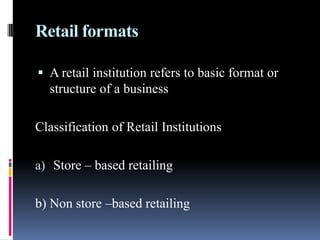
Retail formats
 A retail institution refers to basic format or
structure of a business
Classification of Retail Institutions
a) Store – based retailing
b) Non store –based retailing
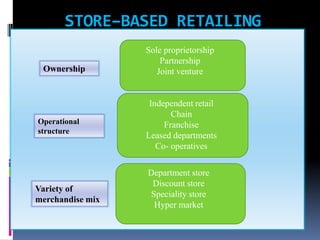
STORE–BASED RETAILING
Ownership
Operational
structure
Variety of
merchandise mix
Sole proprietorship
Partnership
Joint venture
Department store
Discount store
Speciality store
Hyper market
Independent retail
Chain
Franchise
Leased departments
Co- operatives
Sole proprietorship
 Owned and managed by single person
 Has day to day responsibility of running
business
 Owns all assets of the business and profit
generated by it
Partnership
 Two or more people share the ownership of a
single business
 Law does not distinguish between the business
and its owners in partnership
 There should be a legal agreement that sets
forth how decision will be made, profit will be
shared, how dispute will be resolved & how
partners will be admitted etc.
JOINT VENTURE
 Joint ventures are typically not a passive investment.
Generally the parties need to contribute skills as well as
money.
 Joint ventures are typically for a single business,
development or project rather than a long term
relationship between the co-ventures.
 Joint ventures usually are not the major activity of the
parties concerned. If they're individuals they'll have day
jobs. In the business world they'll have a core business to
which the joint venture is an adjunct typically. The joint
venture is a collaborative extension of their commercial
activities.
Independent Retail
 An independent retailer owns only one retail
unit.
 The management has direct contact with the
customers and can quickly respond to their
needs
Chain Retail Store
 A chain retailer operates multiple outlets under
common ownership.
 It usually engages in some level of centralized
purchasing and decision making
Franchise
 It involves a contractual arrangement between a franchisor
and a retail franchisee, which allows the franchisee to
conduct a given business under established name and
according to a given pattern of business.
 The franchisee pays an initial fee and a monthly share of
gross sales in exchange for the exclusive rights to sell goods
and services in a specified area.
 Franchising is a retail organizational form in which small
businesses can benefit being a part of a large retail
institution.
Lease Department
 Retail store rented to an outside party
 Proprietor of a leased department is
responsible for all aspects of the business.
 Existing store based retailers use this to
broaden their merchandise.
 E.g.:-beauty salons, watch repairs, cosmetics.
Co–operative Stores
 Owned and managed by co-operative societies
 It is a voluntary association of adult persons
registered under the Co-operative SocietiesAct.
 The capital is divided into shares of small value and
these shares are subscribed by its members.
 The liability of the member is limited to the extent of
face value of the shares subscribed by its members.
 It is controlled in a democratic set up.
 The accounts of the society are subject to audit by
the registrar of co-operative societies.
 One member has one vote irrespective of his holding
Department Store
 A departmental store is a large scale retail organization.
 It provides a large variety of merchandise from 'pin to plane'
at one place.
 Divided into several departments, each specializing in one line
of goods.
 Housed in an impressive building which is fully furnished and
well decorated.
 All departments function independently. But they are under a
centralized management and control.
 A departmental store offers restaurant, post, office, bank and
other facilities to customers to make shopping comfortable
 In order to attract customers in large numbers, a departmental
store makes extensive use of advertising.
 A departmental store requires huge investment of money.
Discount Store
 Type of department store, which sells products at
lower prices.
 Most discount department stores offer a wide
assortment of goods; others specialize in such
merchandise as jewelry, electronic equipment, or
electrical appliances.
 Are not variety stores, which sell goods at a single
price-point or multiples thereof (£1, $2, etc.).
 Discount stores differ from variety stores in that
they sell many name-brand products, and because
of the wide price range of the items offered
Specialty Store
 Specialty stores are small stores which specialize
in a specific range of merchandise and related
items.
 Most stores have an extensive depth of stock in
the item that they specialize in and provide high
levels of service and expertise.
 The pricing policy is generally in the medium to
high range, depending on factors like the type and
exclusivity of merchandise and ownership.
Hyper Market
 Hypermarket is a super store combining a
supermarket and a department store.
 The result is an expansive retail facility
carrying a wide range of products under one
roof, including full groceries lines and general
merchandise.
 Allow customers to satisfy all their routine
shopping needs in one trip.
Non Store Retailing
 Direct selling
 Television shopping
 Vending machine retailing
Direct Marketing
 It is a form of retailing in which a customer is
first exposed to a good or service through a
non-personnel medium
 Direct mail, broadcast or cable TV, radio,
magazine, newspaper are the mediums.
 Orders by mail, phone (usually a toll free
number), fax or by computer.
Television Shopping
 It is a retail format in which existing and
prospective customers watch a TV program
demonstrating products and then placing order
for the same by telephone ,e-mail and internet
Vending Machine Retailing
 It is a retailing format involving the coin or card
operated dispensing of hot and cold beverages and
food or snacks items.
 It eliminates the use of sales personnel.
 It allows round the clock sales.
 Location of the machines can be done according
customer’s convenience.
Classification of retailing

Classification of retailing

  • 1.
  • 2.
    What is retailing Retail involves the sale of goods from a single point directly to the consumer in small quantities for his end use.  Retailing is transaction of goods between the seller and the end user as a single unit (piece) or in small quantities to satisfy the needs of the individual and for his direct consumption.
  • 3.
    Retail formats  Aretail institution refers to basic format or structure of a business Classification of Retail Institutions a) Store – based retailing b) Non store –based retailing
  • 4.
    STORE–BASED RETAILING Ownership Operational structure Variety of merchandisemix Sole proprietorship Partnership Joint venture Department store Discount store Speciality store Hyper market Independent retail Chain Franchise Leased departments Co- operatives
  • 5.
    Sole proprietorship  Ownedand managed by single person  Has day to day responsibility of running business  Owns all assets of the business and profit generated by it
  • 6.
    Partnership  Two ormore people share the ownership of a single business  Law does not distinguish between the business and its owners in partnership  There should be a legal agreement that sets forth how decision will be made, profit will be shared, how dispute will be resolved & how partners will be admitted etc.
  • 7.
    JOINT VENTURE  Jointventures are typically not a passive investment. Generally the parties need to contribute skills as well as money.  Joint ventures are typically for a single business, development or project rather than a long term relationship between the co-ventures.  Joint ventures usually are not the major activity of the parties concerned. If they're individuals they'll have day jobs. In the business world they'll have a core business to which the joint venture is an adjunct typically. The joint venture is a collaborative extension of their commercial activities.
  • 8.
    Independent Retail  Anindependent retailer owns only one retail unit.  The management has direct contact with the customers and can quickly respond to their needs
  • 9.
    Chain Retail Store A chain retailer operates multiple outlets under common ownership.  It usually engages in some level of centralized purchasing and decision making
  • 10.
    Franchise  It involvesa contractual arrangement between a franchisor and a retail franchisee, which allows the franchisee to conduct a given business under established name and according to a given pattern of business.  The franchisee pays an initial fee and a monthly share of gross sales in exchange for the exclusive rights to sell goods and services in a specified area.  Franchising is a retail organizational form in which small businesses can benefit being a part of a large retail institution.
  • 11.
    Lease Department  Retailstore rented to an outside party  Proprietor of a leased department is responsible for all aspects of the business.  Existing store based retailers use this to broaden their merchandise.  E.g.:-beauty salons, watch repairs, cosmetics.
  • 12.
    Co–operative Stores  Ownedand managed by co-operative societies  It is a voluntary association of adult persons registered under the Co-operative SocietiesAct.  The capital is divided into shares of small value and these shares are subscribed by its members.  The liability of the member is limited to the extent of face value of the shares subscribed by its members.  It is controlled in a democratic set up.  The accounts of the society are subject to audit by the registrar of co-operative societies.  One member has one vote irrespective of his holding
  • 13.
    Department Store  Adepartmental store is a large scale retail organization.  It provides a large variety of merchandise from 'pin to plane' at one place.  Divided into several departments, each specializing in one line of goods.  Housed in an impressive building which is fully furnished and well decorated.  All departments function independently. But they are under a centralized management and control.  A departmental store offers restaurant, post, office, bank and other facilities to customers to make shopping comfortable  In order to attract customers in large numbers, a departmental store makes extensive use of advertising.  A departmental store requires huge investment of money.
  • 14.
    Discount Store  Typeof department store, which sells products at lower prices.  Most discount department stores offer a wide assortment of goods; others specialize in such merchandise as jewelry, electronic equipment, or electrical appliances.  Are not variety stores, which sell goods at a single price-point or multiples thereof (£1, $2, etc.).  Discount stores differ from variety stores in that they sell many name-brand products, and because of the wide price range of the items offered
  • 15.
    Specialty Store  Specialtystores are small stores which specialize in a specific range of merchandise and related items.  Most stores have an extensive depth of stock in the item that they specialize in and provide high levels of service and expertise.  The pricing policy is generally in the medium to high range, depending on factors like the type and exclusivity of merchandise and ownership.
  • 16.
    Hyper Market  Hypermarketis a super store combining a supermarket and a department store.  The result is an expansive retail facility carrying a wide range of products under one roof, including full groceries lines and general merchandise.  Allow customers to satisfy all their routine shopping needs in one trip.
  • 17.
    Non Store Retailing Direct selling  Television shopping  Vending machine retailing
  • 18.
    Direct Marketing  Itis a form of retailing in which a customer is first exposed to a good or service through a non-personnel medium  Direct mail, broadcast or cable TV, radio, magazine, newspaper are the mediums.  Orders by mail, phone (usually a toll free number), fax or by computer.
  • 19.
    Television Shopping  Itis a retail format in which existing and prospective customers watch a TV program demonstrating products and then placing order for the same by telephone ,e-mail and internet
  • 20.
    Vending Machine Retailing It is a retailing format involving the coin or card operated dispensing of hot and cold beverages and food or snacks items.  It eliminates the use of sales personnel.  It allows round the clock sales.  Location of the machines can be done according customer’s convenience.