


Optom. Ankit S. Varshney
B.Optom, M.Optom, Ph.D. in Optometry (pursuing) Fellow of IACLE (Aus.), Fellow of ASCO(Mum.)
Prof. at (Shree Bharatimaiya College of Optometry & Physiotherapy, Surat)
Life Member of Indian Optometric Association (IOA)
Associate Member of Association of Schools and Colleges of Optometry(ASCO)
Member of Optometry Council of India(OCI)
Educator Member of International Association of Contact lense Educators (Australia)(IACLE)
Mail id: ankitsvarshney@yahoo.com
Whatsapp no. +918155955820
 I have no affiliation, nor do I received financial
compensation from any of the companies or
brands used in this presentation.
14 July 2020 Optom.AnkitVarshney 2
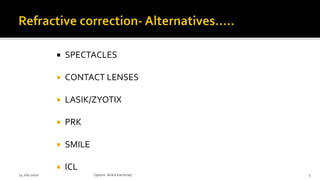
 SPECTACLES
 CONTACT LENSES
 LASIK/ZYOTIX
 PRK
 SMILE
 ICL
14 July 2020 Optom.AnkitVarshney 3
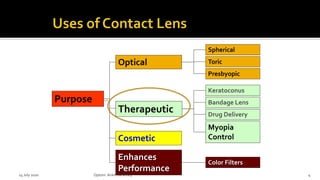
Purpose
Cosmetic
Spherical
Toric
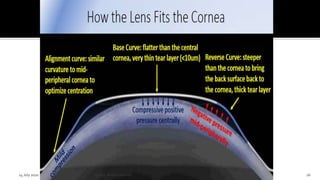
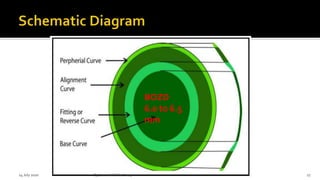
Presbyopic
Optical
Keratoconus
Bandage Lens
Drug Delivery
Myopia
Control
Therapeutic
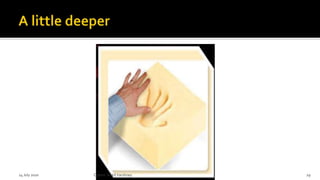
Enhances
Performance
Color Filters
14 July 2020 Optom.AnkitVarshney 4
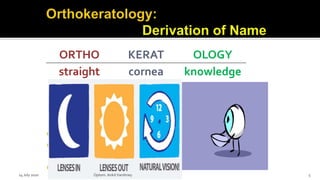
Greek derivation
 Aim is to ‘reshape’ the cornea
 Non-surgical, topographical
approach to effecting a correction
 Sometimes abbreviated to OK
ORTHO KERAT OLOGY
straight cornea knowledge
14 July 2020 Optom.AnkitVarshney 5
 Kerns (1976): ‘a purposeful attempt to
modify the corneal curvature to result in
a reduction or elimination of a refractive
anomaly by a programmed application
of contact lenses’
14 July 2020 Optom.AnkitVarshney 6
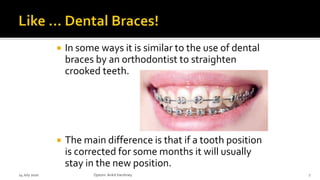
 In some ways it is similar to the use of dental
braces by an orthodontist to straighten
crooked teeth.
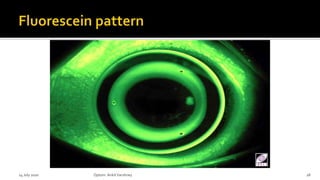
 The main difference is that if a tooth position
is corrected for some months it will usually
stay in the new position.
14 July 2020 Optom.AnkitVarshney 7
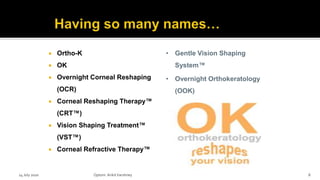
 Ortho-K
 OK
 Overnight Corneal Reshaping
(OCR)
 Corneal Reshaping Therapy™
(CRT™)
 Vision Shaping Treatment™
(VST™)
 Corneal Refractive Therapy™
• Gentle Vision Shaping
System™
• Overnight Orthokeratology
(OOK)
14 July 2020 Optom.AnkitVarshney 8
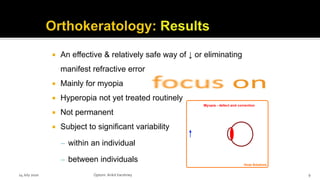
 An effective & relatively safe way of ↓ or eliminating
manifest refractive error
 Mainly for myopia
 Hyperopia not yet treated routinely
 Not permanent
 Subject to significant variability
‒ within an individual
‒ between individuals
14 July 2020 Optom.AnkitVarshney 9
14 July 2020 Optom.AnkitVarshney 10
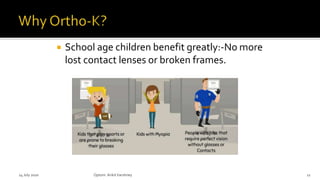
 School age children benefit greatly:-No more
lost contact lenses or broken frames.
14 July 2020 Optom.AnkitVarshney 11
 Contact lens wearers that have developed dry eyes,
discomfort or sensitivity to their lenses.
 Surgery is not in your comfort zone.
14 July 2020 Optom.AnkitVarshney 12
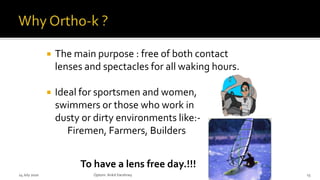
 The main purpose : free of both contact
lenses and spectacles for all waking hours.
 Ideal for sportsmen and women,
swimmers or those who work in
dusty or dirty environments like:-
Firemen, Farmers, Builders
To have a lens free day.!!!
14 July 2020 Optom.AnkitVarshney 13
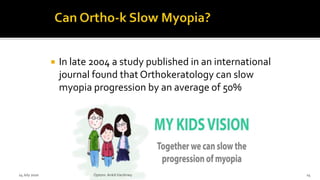
 In late 2004 a study published in an international
journal found that Orthokeratology can slow
myopia progression by an average of 50%
14 July 2020 Optom.AnkitVarshney 14
 Reversible
 Both eyes ‘altered’ at the same time
 No disruption to vision during treatment
 Less (or no) pain compared with Refractive Sx.
 Therapy can be halted if unfortunate effects are
experienced
 Option for children
 may slow myopia progression
ADVANTAGES OF OK
14 July 2020 Optom.AnkitVarshney 15
 Not a ‘permanent’ solution
 Patient may become a regular RGP
lens wearer, i.e. uses OK lens conventionally
 Amount of refractive error correctable by OK
is limited
 Potential for non-compliance
DISADVANTAGES OF OK
14 July 2020 Optom.AnkitVarshney 16
14 July 2020 Optom.AnkitVarshney 17
1508 Leonardo da Vinci illustrates the concept of contact lenses
1823 British astronomer Sir John Herschel conceptualizes practical lens design
1887 First contact lens manufactured from glass, and fitted to cover the entire eye
1939 Contact lenses first made from plastic
1948 Plastic contact lenses designed to cover only the eye's cornea
1971 Introduction of soft contact lenses
1978 Introduction of GP contact lenses
1981 FDA approval of new soft contact lenses for extended (overnight) wear
1986 Overnight wear of GP contact lenses becomes available
1987 Introduction of disposable soft contact lenses
1987 GP contacts available in next-generation fluorosilicone acrylate materials
1996 Introduction of one-day disposable soft lenses
2002 Silicone-hydrogel contact lenses first marketed
2002 Overnight orthokeratology approved by FDA
2010 Custom-manufactured silicone-hydrogel lenses become available
14 July 2020 Optom.AnkitVarshney 18
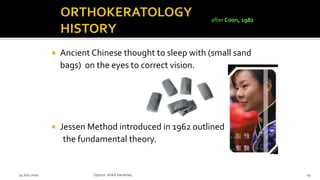
 Ancient Chinese thought to sleep with (small sand
bags) on the eyes to correct vision.
 Jessen Method introduced in 1962 outlined
the fundamental theory.
after Coon, 1982
14 July 2020 Optom.AnkitVarshney 19
 2002: Paragon CRT approved for O/N corneal
reshaping
 2004: Euclid Orthokeratology lens approved for
O/N corneal reshaping
 2004: B&L acquires Euclid (and its FDA approval)
 2004: JZS Orthokeratology lens licensed from
Euclid
14 July 2020 Optom.AnkitVarshney 20
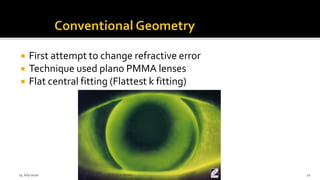
 First attempt to change refractive error
 Technique used plano PMMA lenses
 Flat central fitting (Flattest k fitting)
14 July 2020 Optom.AnkitVarshney 21
 Failed due to Disadvantages of PMMA lens
 Decentration of lens inducing astigmatism
 Took long time to achieve a small amount of reduction
 Lens fit was unstable
14 July 2020 Optom.AnkitVarshney 22
 Ortho-K is used for the temporary correction of low to
moderate myopia.
 It uses four- or five curve reverse-geometry lenses in high Dk
materials in an overnight lens-wearing modality
14 July 2020 Optom.AnkitVarshney 23
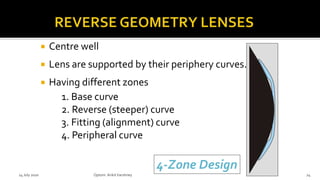
 Centre well
 Lens are supported by their periphery curves.
 Having different zones
1. Base curve
2. Reverse (steeper) curve
3. Fitting (alignment) curve
4. Peripheral curve
4-Zone Design
14 July 2020 Optom.AnkitVarshney 24
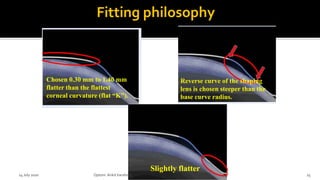
Chosen 0.30 mm to 1.40 mm
flatter than the flattest
corneal curvature (flat “K”).
Reverse curve of the shaping
lens is chosen steeper than the
base curve radius.
Slightly flatter
14 July 2020 Optom.AnkitVarshney 25
14 July 2020 Optom.AnkitVarshney 26
BOZD
6.0 to 6.5
mm
14 July 2020 Optom.AnkitVarshney 27
14 July 2020 Optom.AnkitVarshney 28
14 July 2020 Optom.AnkitVarshney 29
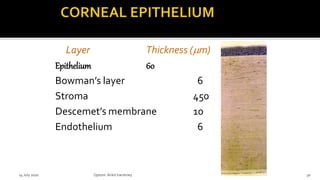
Layer Thickness (mm)
Epithelium 60
Bowman’s layer 6
Stroma 450
Descemet’s membrane 10
Endothelium 6
14 July 2020 Optom.AnkitVarshney 30
14 July 2020 Optom.AnkitVarshney 31
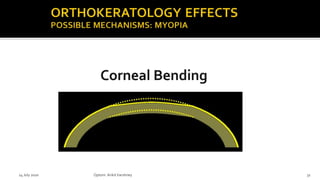
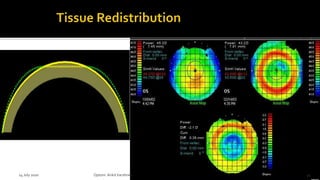
 Significant change in corneal curvature
 Topographical change in corneal thickness:
1. primarily epithelial
2. central thinning
3. mid-peripheral thickening
4. possible alteration to corneal sagittal height
14 July 2020 Optom.AnkitVarshney 32
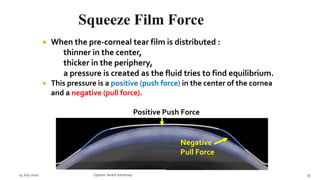
 When the pre-corneal tear film is distributed :
thinner in the center,
thicker in the periphery,
a pressure is created as the fluid tries to find equilibrium.
 This pressure is a positive (push force) in the center of the cornea
and a negative (pull force).
Positive Push Force
Negative
Pull Force
14 July 2020 Optom.AnkitVarshney 33
14 July 2020 Optom.AnkitVarshney 34
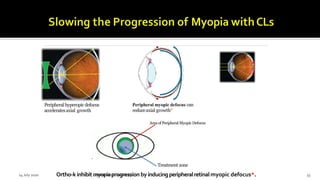
Ortho-k inhibit myopiaprogression byinducingperipheralretinalmyopic defocus*.
Peripheral hyperopic defocus
acceleratesaxial growth
Peripheral myopic defocus can
reduceaxial growth*
Ortho-K
Treatment zone
AreaofPeripheral Myopic Defocus
14 July 2020 Optom.AnkitVarshney 35
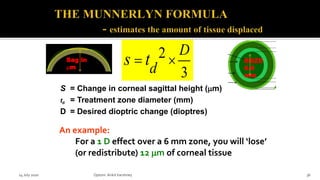
An example:
For a 1 D effect over a 6 mm zone, you will ‘lose’
(or redistribute) 12 mm of corneal tissue
S = Change in corneal sagittal height (mm)
td = Treatment zone diameter (mm)
D = Desired dioptric change (dioptres)
2
3
D
d
s t  BOZD
6.0
mm
Sag in
mm
14 July 2020 Optom.AnkitVarshney 36
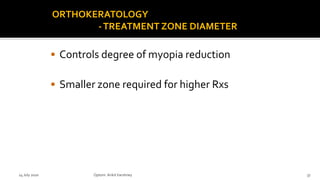
ORTHOKERATOLOGY
-TREATMENT ZONE DIAMETER
• Controls degree of myopia reduction
• Smaller zone required for higher Rxs
14 July 2020 Optom.AnkitVarshney 37
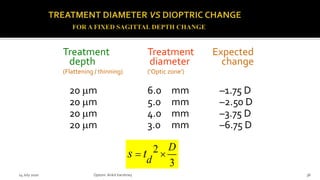
Treatment Treatment Expected
depth diameter change
(Flattening / thinning) (‘Optic zone’)
20 mm 6.0 mm –1.75 D
20 mm 5.0 mm –2.50 D
20 mm 4.0 mm –3.75 D
20 mm 3.0 mm –6.75 D
2
3
D
d
s t 
14 July 2020 Optom.AnkitVarshney 38
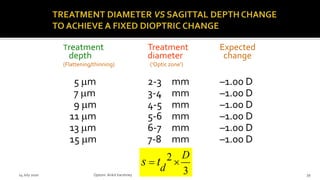
Treatment Treatment Expected
depth diameter change
(Flattening/thinning) (‘Optic zone’)
5 mm 2-3 mm –1.00 D
7 mm 3-4 mm –1.00 D
9 mm 4-5 mm –1.00 D
11 mm 5-6 mm –1.00 D
13 mm 6-7 mm –1.00 D
15 mm 7-8 mm –1.00 D
2
3
D
d
s t 
14 July 2020 Optom.AnkitVarshney 39
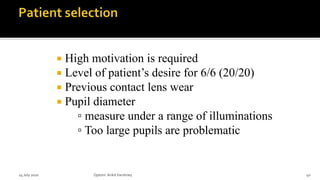
 High motivation is required
 Level of patient’s desire for 6/6 (20/20)
 Previous contact lens wear
 Pupil diameter
▫ measure under a range of illuminations
▫ Too large pupils are problematic
14 July 2020 Optom.AnkitVarshney 40
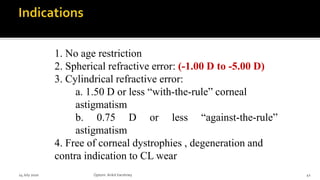
1. No age restriction
2. Spherical refractive error: (-1.00 D to -5.00 D)
3. Cylindrical refractive error:
a. 1.50 D or less “with-the-rule” corneal
astigmatism
b. 0.75 D or less “against-the-rule”
astigmatism
4. Free of corneal dystrophies , degeneration and
contra indication to CL wear
14 July 2020 Optom.AnkitVarshney 41
 Previous failure(s) with RGP lens wear
 Diseases of the cornea, conjunctiva, or adnexa
 e.g. dry eye
 Anterior chamber inflammation/infection
 Systemic disease that affect the eye or can be
worsened by lens wear
 e.g. diabetes
 Keratoconus
14 July 2020 Optom.AnkitVarshney 42
 Older patients (long-term CL wearers?)
 cornea less likely to respond well
 Unrealistic patient expectations
 Low sphere power with high cylinder
 Limbus to limbus astigmatism
14 July 2020 Optom.AnkitVarshney 43
 Very loose/flaccid lids
 Poor responder to initial lens wear trial
14 July 2020 Optom.AnkitVarshney 44
 Motivation
 What do they want from OrthoK
▪ No glasses or CL’s while awake
▪ Myopia control
▪ Slower eye growth with OrthoK (Walline J, et al Br J Ophthalmol
2009;93:1181-1185)
▪ CL induced dry eye relief
▪ Presbyopia
▪ Monovision
 Prior lens wear
 SCL can be fit now
 RGP fit after 3 weeks of lens removal
14 July 2020 Optom.AnkitVarshney 45
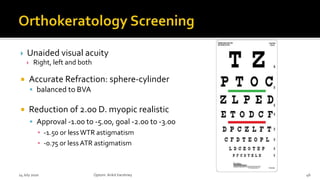
 Unaided visual acuity
 Right, left and both
 Accurate Refraction: sphere-cylinder
 balanced to BVA
 Reduction of 2.00 D. myopic realistic
 Approval -1.00 to -5.00, goal -2.00 to -3.00
▪ -1.50 or less WTR astigmatism
▪ -0.75 or less ATR astigmatism
14 July 2020 Optom.AnkitVarshney 46
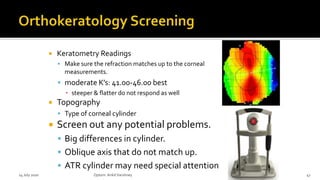
 Keratometry Readings
 Make sure the refraction matches up to the corneal
measurements.
 moderate K’s: 41.00-46.00 best
▪ steeper & flatter do not respond as well
 Topography
 Type of corneal cylinder
 Screen out any potential problems.
 Big differences in cylinder.
 Oblique axis that do not match up.
 ATR cylinder may need special attention
14 July 2020 Optom.AnkitVarshney 47
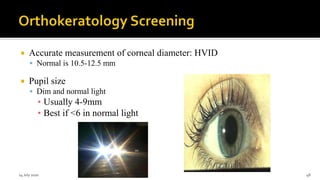
 Accurate measurement of corneal diameter: HVID
 Normal is 10.5-12.5 mm
 Pupil size
 Dim and normal light
▪ Usually 4-9mm
▪ Best if <6 in normal light
14 July 2020 Optom.AnkitVarshney 48
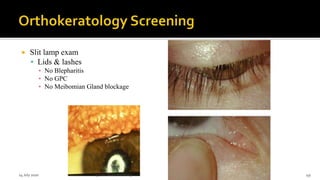
 Slit lamp exam
 Lids & lashes
▪ No Blepharitis
▪ No GPC
▪ No Meibomian Gland blockage
14 July 2020 Optom.AnkitVarshney 49
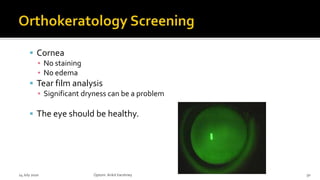
 Cornea
▪ No staining
▪ No edema
 Tear film analysis
▪ Significant dryness can be a problem
 The eye should be healthy.
14 July 2020 Optom.AnkitVarshney 50
 Custom designed lenses or trial set
 Define the Diameter & CurveWidths
 Calculate the AlignmentCurve
 Calculate the Peripheral Curve
 Calculate the Base Curve
 Calculate the Reverse Curve
14 July 2020 Optom.AnkitVarshney 51
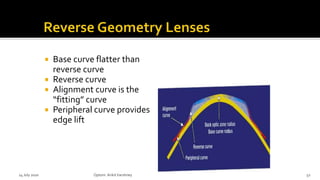
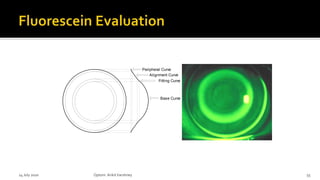
 Base curve flatter than
reverse curve
 Reverse curve
 Alignment curve is the
“fitting” curve
 Peripheral curve provides
edge lift
14 July 2020 Optom.AnkitVarshney 52
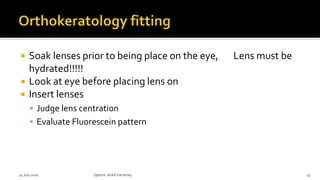
 Soak lenses prior to being place on the eye, Lens must be
hydrated!!!!!
 Look at eye before placing lens on
 Insert lenses
 Judge lens centration
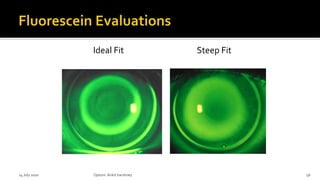
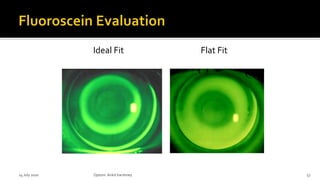
 Evaluate Fluorescein pattern
14 July 2020 Optom.AnkitVarshney 53
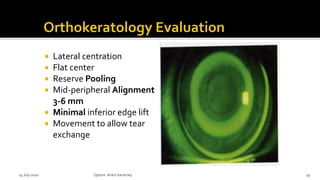
 Lateral centration
 Flat center
 Reserve Pooling
 Mid-peripheral Alignment
3-6 mm
 Minimal inferior edge lift
 Movement to allow tear
exchange
14 July 2020 Optom.AnkitVarshney 54
Peripheral Curve
Alignment Curve
Fitting Curve
Base Curve
14 July 2020 Optom.AnkitVarshney 55
Ideal Fit Steep Fit
14 July 2020 Optom.AnkitVarshney 56
Ideal Fit Flat Fit
14 July 2020 Optom.AnkitVarshney 57
 Lenses MUST center
 Better to be slightly tight & centered than loose & decentered
 Over-refraction
 Practice Insertion & Removal
 Sleep at least 6 hours wearing the lenses
 Return next day in morning
14 July 2020 Optom.AnkitVarshney 58
 Have PATIENCE
 No changes until one week post.
14 July 2020 Optom.AnkitVarshney 59
 Day 1
 Weeks 1-3
 Every 6 -12 months
 Check all
 Replace lenses
14 July 2020 Optom.AnkitVarshney 60
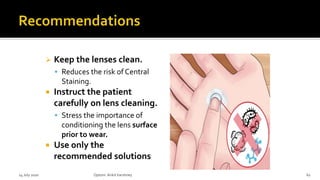
 Keep the lenses clean.
 Reduces the risk of Central
Staining.
 Instruct the patient
carefully on lens cleaning.
 Stress the importance of
conditioning the lens surface
prior to wear.
 Use only the
recommended solutions
14 July 2020 Optom.AnkitVarshney 61
 “The final contact lens that allows adequate
tear exchange and stable uncorrected vision is
considered to be the retainer lens.”
 Determine that the ‘end point’ has been
reached
 Finalize the treatment lenses
 Determine the wear schedule
 Consider ordering a spare pair
 cessation of wear for whatever reason will result
in regression of gains
14 July 2020 Optom.AnkitVarshney 62
 Final set of lenses used to achieve
and maintain desired result
 Overnight wear capability
 fitting characteristics
 need good centration
 oxygen supply
 lens adherence a consideration
 lenses removed in the morning after
one hour open eye
14 July 2020 Optom.AnkitVarshney 63
 Paragon CRT, ZCRT
(ParagonVis. Sci.: paflufocon B & D, tisilfocon A )
 Bausch & LombVST
(Bausch & Lomb Inc. : oprifoconA)
14 July 2020 Optom.AnkitVarshney 64
 The technique involves the provision of specialist
Orthokeratology contact lenses and a number of visits to your
practitioner.
 Each practitioner sets their own fees which may vary
dependent on the Rx being treated.
14 July 2020 Optom.AnkitVarshney 65
14 July 2020 Optom.AnkitVarshney 66

Orthokeratology by Optom Ankit Varshney

  • 1.
    Optom. Ankit S.Varshney B.Optom, M.Optom, Ph.D. in Optometry (pursuing) Fellow of IACLE (Aus.), Fellow of ASCO(Mum.) Prof. at (Shree Bharatimaiya College of Optometry & Physiotherapy, Surat) Life Member of Indian Optometric Association (IOA) Associate Member of Association of Schools and Colleges of Optometry(ASCO) Member of Optometry Council of India(OCI) Educator Member of International Association of Contact lense Educators (Australia)(IACLE) Mail id: ankitsvarshney@yahoo.com Whatsapp no. +918155955820
  • 2.
     I haveno affiliation, nor do I received financial compensation from any of the companies or brands used in this presentation. 14 July 2020 Optom.AnkitVarshney 2
  • 3.
     SPECTACLES  CONTACTLENSES  LASIK/ZYOTIX  PRK  SMILE  ICL 14 July 2020 Optom.AnkitVarshney 3
  • 4.
  • 5.
    Greek derivation  Aimis to ‘reshape’ the cornea  Non-surgical, topographical approach to effecting a correction  Sometimes abbreviated to OK ORTHO KERAT OLOGY straight cornea knowledge 14 July 2020 Optom.AnkitVarshney 5
  • 6.
     Kerns (1976):‘a purposeful attempt to modify the corneal curvature to result in a reduction or elimination of a refractive anomaly by a programmed application of contact lenses’ 14 July 2020 Optom.AnkitVarshney 6
  • 7.
     In someways it is similar to the use of dental braces by an orthodontist to straighten crooked teeth.  The main difference is that if a tooth position is corrected for some months it will usually stay in the new position. 14 July 2020 Optom.AnkitVarshney 7
  • 8.
     Ortho-K  OK Overnight Corneal Reshaping (OCR)  Corneal Reshaping Therapy™ (CRT™)  Vision Shaping Treatment™ (VST™)  Corneal Refractive Therapy™ • Gentle Vision Shaping System™ • Overnight Orthokeratology (OOK) 14 July 2020 Optom.AnkitVarshney 8
  • 9.
     An effective& relatively safe way of ↓ or eliminating manifest refractive error  Mainly for myopia  Hyperopia not yet treated routinely  Not permanent  Subject to significant variability ‒ within an individual ‒ between individuals 14 July 2020 Optom.AnkitVarshney 9
  • 10.
    14 July 2020Optom.AnkitVarshney 10
  • 11.
     School agechildren benefit greatly:-No more lost contact lenses or broken frames. 14 July 2020 Optom.AnkitVarshney 11
  • 12.
     Contact lenswearers that have developed dry eyes, discomfort or sensitivity to their lenses.  Surgery is not in your comfort zone. 14 July 2020 Optom.AnkitVarshney 12
  • 13.
     The mainpurpose : free of both contact lenses and spectacles for all waking hours.  Ideal for sportsmen and women, swimmers or those who work in dusty or dirty environments like:- Firemen, Farmers, Builders To have a lens free day.!!! 14 July 2020 Optom.AnkitVarshney 13
  • 14.
     In late2004 a study published in an international journal found that Orthokeratology can slow myopia progression by an average of 50% 14 July 2020 Optom.AnkitVarshney 14
  • 15.
     Reversible  Botheyes ‘altered’ at the same time  No disruption to vision during treatment  Less (or no) pain compared with Refractive Sx.  Therapy can be halted if unfortunate effects are experienced  Option for children  may slow myopia progression ADVANTAGES OF OK 14 July 2020 Optom.AnkitVarshney 15
  • 16.
     Not a‘permanent’ solution  Patient may become a regular RGP lens wearer, i.e. uses OK lens conventionally  Amount of refractive error correctable by OK is limited  Potential for non-compliance DISADVANTAGES OF OK 14 July 2020 Optom.AnkitVarshney 16
  • 17.
    14 July 2020Optom.AnkitVarshney 17
  • 18.
    1508 Leonardo daVinci illustrates the concept of contact lenses 1823 British astronomer Sir John Herschel conceptualizes practical lens design 1887 First contact lens manufactured from glass, and fitted to cover the entire eye 1939 Contact lenses first made from plastic 1948 Plastic contact lenses designed to cover only the eye's cornea 1971 Introduction of soft contact lenses 1978 Introduction of GP contact lenses 1981 FDA approval of new soft contact lenses for extended (overnight) wear 1986 Overnight wear of GP contact lenses becomes available 1987 Introduction of disposable soft contact lenses 1987 GP contacts available in next-generation fluorosilicone acrylate materials 1996 Introduction of one-day disposable soft lenses 2002 Silicone-hydrogel contact lenses first marketed 2002 Overnight orthokeratology approved by FDA 2010 Custom-manufactured silicone-hydrogel lenses become available 14 July 2020 Optom.AnkitVarshney 18
  • 19.
     Ancient Chinesethought to sleep with (small sand bags) on the eyes to correct vision.  Jessen Method introduced in 1962 outlined the fundamental theory. after Coon, 1982 14 July 2020 Optom.AnkitVarshney 19
  • 20.
     2002: ParagonCRT approved for O/N corneal reshaping  2004: Euclid Orthokeratology lens approved for O/N corneal reshaping  2004: B&L acquires Euclid (and its FDA approval)  2004: JZS Orthokeratology lens licensed from Euclid 14 July 2020 Optom.AnkitVarshney 20
  • 21.
     First attemptto change refractive error  Technique used plano PMMA lenses  Flat central fitting (Flattest k fitting) 14 July 2020 Optom.AnkitVarshney 21
  • 22.
     Failed dueto Disadvantages of PMMA lens  Decentration of lens inducing astigmatism  Took long time to achieve a small amount of reduction  Lens fit was unstable 14 July 2020 Optom.AnkitVarshney 22
  • 23.
     Ortho-K isused for the temporary correction of low to moderate myopia.  It uses four- or five curve reverse-geometry lenses in high Dk materials in an overnight lens-wearing modality 14 July 2020 Optom.AnkitVarshney 23
  • 24.
     Centre well Lens are supported by their periphery curves.  Having different zones 1. Base curve 2. Reverse (steeper) curve 3. Fitting (alignment) curve 4. Peripheral curve 4-Zone Design 14 July 2020 Optom.AnkitVarshney 24
  • 25.
    Chosen 0.30 mmto 1.40 mm flatter than the flattest corneal curvature (flat “K”). Reverse curve of the shaping lens is chosen steeper than the base curve radius. Slightly flatter 14 July 2020 Optom.AnkitVarshney 25
  • 26.
    14 July 2020Optom.AnkitVarshney 26
  • 27.
    BOZD 6.0 to 6.5 mm 14July 2020 Optom.AnkitVarshney 27
  • 28.
    14 July 2020Optom.AnkitVarshney 28
  • 29.
    14 July 2020Optom.AnkitVarshney 29
  • 30.
    Layer Thickness (mm) Epithelium60 Bowman’s layer 6 Stroma 450 Descemet’s membrane 10 Endothelium 6 14 July 2020 Optom.AnkitVarshney 30
  • 31.
    14 July 2020Optom.AnkitVarshney 31
  • 32.
     Significant changein corneal curvature  Topographical change in corneal thickness: 1. primarily epithelial 2. central thinning 3. mid-peripheral thickening 4. possible alteration to corneal sagittal height 14 July 2020 Optom.AnkitVarshney 32
  • 33.
     When thepre-corneal tear film is distributed : thinner in the center, thicker in the periphery, a pressure is created as the fluid tries to find equilibrium.  This pressure is a positive (push force) in the center of the cornea and a negative (pull force). Positive Push Force Negative Pull Force 14 July 2020 Optom.AnkitVarshney 33
  • 34.
    14 July 2020Optom.AnkitVarshney 34
  • 35.
    Ortho-k inhibit myopiaprogressionbyinducingperipheralretinalmyopic defocus*. Peripheral hyperopic defocus acceleratesaxial growth Peripheral myopic defocus can reduceaxial growth* Ortho-K Treatment zone AreaofPeripheral Myopic Defocus 14 July 2020 Optom.AnkitVarshney 35
  • 36.
    An example: For a1 D effect over a 6 mm zone, you will ‘lose’ (or redistribute) 12 mm of corneal tissue S = Change in corneal sagittal height (mm) td = Treatment zone diameter (mm) D = Desired dioptric change (dioptres) 2 3 D d s t  BOZD 6.0 mm Sag in mm 14 July 2020 Optom.AnkitVarshney 36
  • 37.
    ORTHOKERATOLOGY -TREATMENT ZONE DIAMETER •Controls degree of myopia reduction • Smaller zone required for higher Rxs 14 July 2020 Optom.AnkitVarshney 37
  • 38.
    Treatment Treatment Expected depthdiameter change (Flattening / thinning) (‘Optic zone’) 20 mm 6.0 mm –1.75 D 20 mm 5.0 mm –2.50 D 20 mm 4.0 mm –3.75 D 20 mm 3.0 mm –6.75 D 2 3 D d s t  14 July 2020 Optom.AnkitVarshney 38
  • 39.
    Treatment Treatment Expected depthdiameter change (Flattening/thinning) (‘Optic zone’) 5 mm 2-3 mm –1.00 D 7 mm 3-4 mm –1.00 D 9 mm 4-5 mm –1.00 D 11 mm 5-6 mm –1.00 D 13 mm 6-7 mm –1.00 D 15 mm 7-8 mm –1.00 D 2 3 D d s t  14 July 2020 Optom.AnkitVarshney 39
  • 40.
     High motivationis required  Level of patient’s desire for 6/6 (20/20)  Previous contact lens wear  Pupil diameter ▫ measure under a range of illuminations ▫ Too large pupils are problematic 14 July 2020 Optom.AnkitVarshney 40
  • 41.
    1. No agerestriction 2. Spherical refractive error: (-1.00 D to -5.00 D) 3. Cylindrical refractive error: a. 1.50 D or less “with-the-rule” corneal astigmatism b. 0.75 D or less “against-the-rule” astigmatism 4. Free of corneal dystrophies , degeneration and contra indication to CL wear 14 July 2020 Optom.AnkitVarshney 41
  • 42.
     Previous failure(s)with RGP lens wear  Diseases of the cornea, conjunctiva, or adnexa  e.g. dry eye  Anterior chamber inflammation/infection  Systemic disease that affect the eye or can be worsened by lens wear  e.g. diabetes  Keratoconus 14 July 2020 Optom.AnkitVarshney 42
  • 43.
     Older patients(long-term CL wearers?)  cornea less likely to respond well  Unrealistic patient expectations  Low sphere power with high cylinder  Limbus to limbus astigmatism 14 July 2020 Optom.AnkitVarshney 43
  • 44.
     Very loose/flaccidlids  Poor responder to initial lens wear trial 14 July 2020 Optom.AnkitVarshney 44
  • 45.
     Motivation  Whatdo they want from OrthoK ▪ No glasses or CL’s while awake ▪ Myopia control ▪ Slower eye growth with OrthoK (Walline J, et al Br J Ophthalmol 2009;93:1181-1185) ▪ CL induced dry eye relief ▪ Presbyopia ▪ Monovision  Prior lens wear  SCL can be fit now  RGP fit after 3 weeks of lens removal 14 July 2020 Optom.AnkitVarshney 45
  • 46.
     Unaided visualacuity  Right, left and both  Accurate Refraction: sphere-cylinder  balanced to BVA  Reduction of 2.00 D. myopic realistic  Approval -1.00 to -5.00, goal -2.00 to -3.00 ▪ -1.50 or less WTR astigmatism ▪ -0.75 or less ATR astigmatism 14 July 2020 Optom.AnkitVarshney 46
  • 47.
     Keratometry Readings Make sure the refraction matches up to the corneal measurements.  moderate K’s: 41.00-46.00 best ▪ steeper & flatter do not respond as well  Topography  Type of corneal cylinder  Screen out any potential problems.  Big differences in cylinder.  Oblique axis that do not match up.  ATR cylinder may need special attention 14 July 2020 Optom.AnkitVarshney 47
  • 48.
     Accurate measurementof corneal diameter: HVID  Normal is 10.5-12.5 mm  Pupil size  Dim and normal light ▪ Usually 4-9mm ▪ Best if <6 in normal light 14 July 2020 Optom.AnkitVarshney 48
  • 49.
     Slit lampexam  Lids & lashes ▪ No Blepharitis ▪ No GPC ▪ No Meibomian Gland blockage 14 July 2020 Optom.AnkitVarshney 49
  • 50.
     Cornea ▪ Nostaining ▪ No edema  Tear film analysis ▪ Significant dryness can be a problem  The eye should be healthy. 14 July 2020 Optom.AnkitVarshney 50
  • 51.
     Custom designedlenses or trial set  Define the Diameter & CurveWidths  Calculate the AlignmentCurve  Calculate the Peripheral Curve  Calculate the Base Curve  Calculate the Reverse Curve 14 July 2020 Optom.AnkitVarshney 51
  • 52.
     Base curveflatter than reverse curve  Reverse curve  Alignment curve is the “fitting” curve  Peripheral curve provides edge lift 14 July 2020 Optom.AnkitVarshney 52
  • 53.
     Soak lensesprior to being place on the eye, Lens must be hydrated!!!!!  Look at eye before placing lens on  Insert lenses  Judge lens centration  Evaluate Fluorescein pattern 14 July 2020 Optom.AnkitVarshney 53
  • 54.
     Lateral centration Flat center  Reserve Pooling  Mid-peripheral Alignment 3-6 mm  Minimal inferior edge lift  Movement to allow tear exchange 14 July 2020 Optom.AnkitVarshney 54
  • 55.
    Peripheral Curve Alignment Curve FittingCurve Base Curve 14 July 2020 Optom.AnkitVarshney 55
  • 56.
    Ideal Fit SteepFit 14 July 2020 Optom.AnkitVarshney 56
  • 57.
    Ideal Fit FlatFit 14 July 2020 Optom.AnkitVarshney 57
  • 58.
     Lenses MUSTcenter  Better to be slightly tight & centered than loose & decentered  Over-refraction  Practice Insertion & Removal  Sleep at least 6 hours wearing the lenses  Return next day in morning 14 July 2020 Optom.AnkitVarshney 58
  • 59.
     Have PATIENCE No changes until one week post. 14 July 2020 Optom.AnkitVarshney 59
  • 60.
     Day 1 Weeks 1-3  Every 6 -12 months  Check all  Replace lenses 14 July 2020 Optom.AnkitVarshney 60
  • 61.
     Keep thelenses clean.  Reduces the risk of Central Staining.  Instruct the patient carefully on lens cleaning.  Stress the importance of conditioning the lens surface prior to wear.  Use only the recommended solutions 14 July 2020 Optom.AnkitVarshney 61
  • 62.
     “The finalcontact lens that allows adequate tear exchange and stable uncorrected vision is considered to be the retainer lens.”  Determine that the ‘end point’ has been reached  Finalize the treatment lenses  Determine the wear schedule  Consider ordering a spare pair  cessation of wear for whatever reason will result in regression of gains 14 July 2020 Optom.AnkitVarshney 62
  • 63.
     Final setof lenses used to achieve and maintain desired result  Overnight wear capability  fitting characteristics  need good centration  oxygen supply  lens adherence a consideration  lenses removed in the morning after one hour open eye 14 July 2020 Optom.AnkitVarshney 63
  • 64.
     Paragon CRT,ZCRT (ParagonVis. Sci.: paflufocon B & D, tisilfocon A )  Bausch & LombVST (Bausch & Lomb Inc. : oprifoconA) 14 July 2020 Optom.AnkitVarshney 64
  • 65.
     The techniqueinvolves the provision of specialist Orthokeratology contact lenses and a number of visits to your practitioner.  Each practitioner sets their own fees which may vary dependent on the Rx being treated. 14 July 2020 Optom.AnkitVarshney 65
  • 66.
    14 July 2020Optom.AnkitVarshney 66