
Optom. Ankit S. Varshney
B.Optom,M.Optom,Ph.D.in Optometry(pursuing)Fellowof IACLE(Aus.),Fellowof ASCO(Mum.)
Prof.at (Shree BharatimaiyaCollegeof Optometry& Physiotherapy, Surat)
Life Member of Indian Optometric Association (IOA)
Associate Member of Association of Schools and Colleges of Optometry(ASCO)
Member of Optometry Council of India(OCI)
Educator Member of International Association of Contact lense Educators (Australia)(IACLE)
Mail id: ankitsvarshney@yahoo.com
Whatsapp no. +918155955820
EXTRA OCULAR MUSCLES
Introduction:
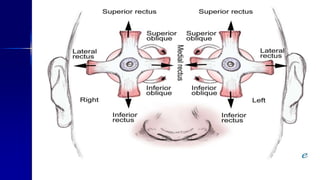
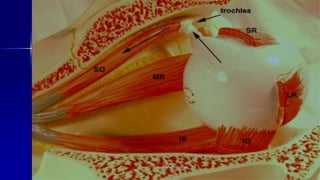
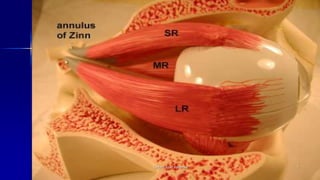
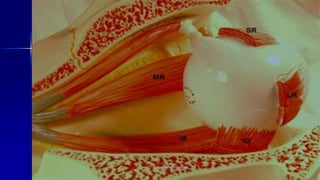
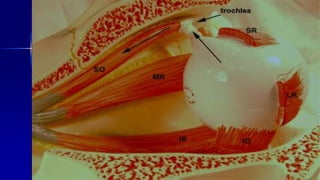
 The eyes are rotated by the action of six extraocular muscles,
which allows rotations in horizontal, vertical and torsional
directions.
 These are :-
1. Medial Rectus
2. Lateral Rectus
3. Superior Rectus
4. Inferior Rectus
5. Superior Oblique
6. Inferior Oblique
Optom. Ankit Varshney 2
Optom. Ankit Varshney 3
Optom. Ankit Varshney 4
Optom. Ankit Varshney 5
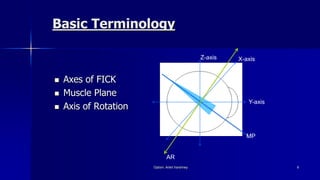
Basic Terminology
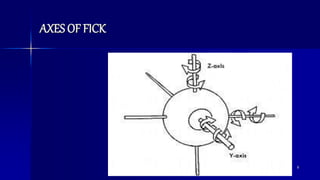
 Axes of FICK
 Muscle Plane
 Axis of Rotation
Optom. Ankit Varshney 6
Y-axis
Z-axis X-axis
MP
AR
 The theoretical center of rotation of the eye is at the
intersection of the three principal axes of Fick, around
which the eye performs rotatory movement
 The X-axis crosses the eye horizontally; the Y-axis passes
through the center of the pupil (through the ‘y’ sutures of
the lens); and the Z-axis crosses the eye vertically.
Optom. Ankit Varshney 7
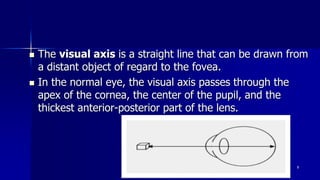
 The visual axis is a straight line that can be drawn from
a distant object of regard to the fovea.
 In the normal eye, the visual axis passes through the
apex of the cornea, the center of the pupil, and the
thickest anterior-posterior part of the lens.
Optom. Ankit Varshney 8
AXES OF FICK
Optom. Ankit Varshney 9
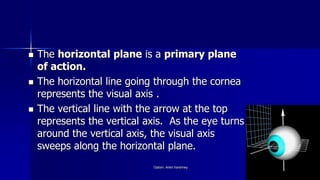
 The horizontal plane is a primary plane
of action.
 The horizontal line going through the cornea
represents the visual axis .
 The vertical line with the arrow at the top
represents the vertical axis. As the eye turns
around the vertical axis, the visual axis
sweeps along the horizontal plane.
Optom. Ankit Varshney 10
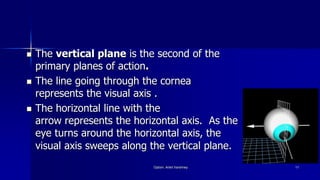
 The vertical plane is the second of the
primary planes of action.
 The line going through the cornea
represents the visual axis .
 The horizontal line with the
arrow represents the horizontal axis. As the
eye turns around the horizontal axis, the
visual axis sweeps along the vertical plane.
Optom. Ankit Varshney 11
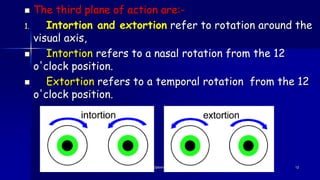
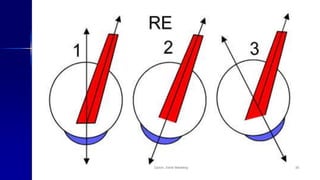
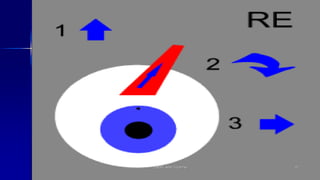
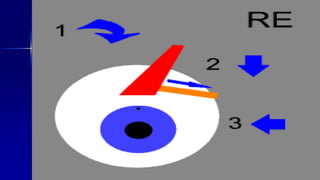
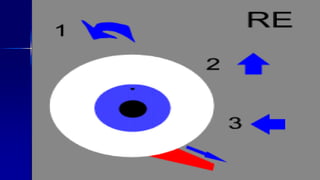
 The third plane of action are:-
1. Intortion and extortion refer to rotation around the
visual axis,
 Intortion refers to a nasal rotation from the 12
o'clock position.
 Extortion refers to a temporal rotation from the 12
o'clock position.
Optom. Ankit Varshney 12
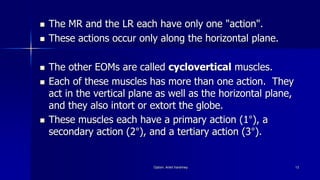
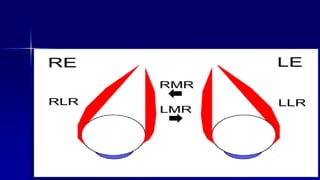
 The MR and the LR each have only one "action".
 These actions occur only along the horizontal plane.
 The other EOMs are called cyclovertical muscles.
 Each of these muscles has more than one action. They
act in the vertical plane as well as the horizontal plane,
and they also intort or extort the globe.
 These muscles each have a primary action (1°), a
secondary action (2°), and a tertiary action (3°).
Optom. Ankit Varshney 13
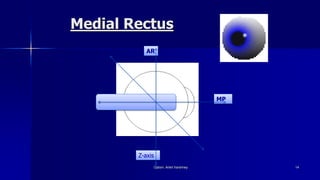
Medial Rectus
Optom. Ankit Varshney 14
Z-axis
AR
MP
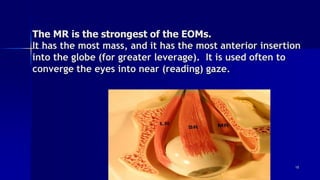
The MR is the strongest of the EOMs.
It has the most mass, and it has the most anterior insertion
into the globe (for greater leverage). It is used often to
converge the eyes into near (reading) gaze.
Optom. Ankit Varshney 15
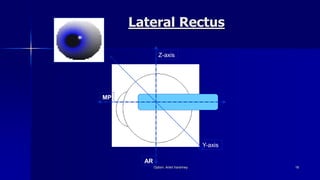
Lateral Rectus
Optom. Ankit Varshney 16
Y-axis
Z-axis
MP
AR
Optom. Ankit Varshney 17
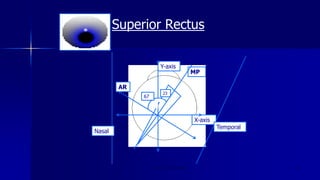
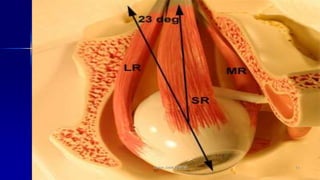
Superior Rectus
Optom. Ankit Varshney 18
Y-axis
MP
X-axis
23
67
Nasal
Temporal
AR
Optom. Ankit Varshney 19
Optom. Ankit Varshney 20
Optom. Ankit Varshney 21
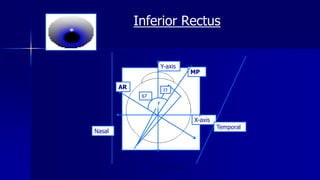
Inferior Rectus
Optom. Ankit Varshney 22
Y-axis
MP
X-axis
23
67
Nasal
Temporal
AR
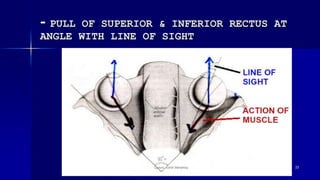
- PULL OF SUPERIOR & INFERIOR RECTUS AT
ANGLE WITH LINE OF SIGHT
Optom. Ankit Varshney 23
Optom. Ankit Varshney 24
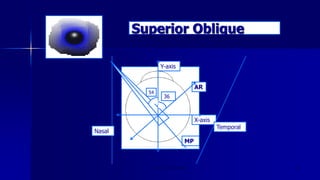
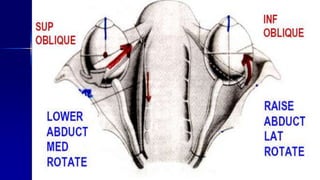
Superior Oblique
Optom. Ankit Varshney 25
Y-axis
MP
X-axis
Nasal
Temporal
AR
54
36
Optom. Ankit Varshney 26
Optom. Ankit Varshney 27
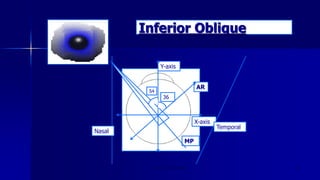
Inferior Oblique
Optom. Ankit Varshney 28
Y-axis
MP
X-axis
Nasal
Temporal
AR
54
36
Optom. Ankit Varshney 29
Optom. Ankit Varshney 30
Optom. Ankit Varshney 31
Optom. Ankit Varshney 32
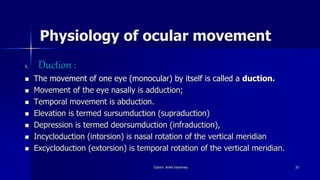
Physiology of ocular movement
1. Duction :
 The movement of one eye (monocular) by itself is called a duction.
 Movement of the eye nasally is adduction;
 Temporal movement is abduction.
 Elevation is termed sursumduction (supraduction)
 Depression is termed deorsumduction (infraduction),
 Incycloduction (intorsion) is nasal rotation of the vertical meridian
 Excycloduction (extorsion) is temporal rotation of the vertical meridian.
Optom. Ankit Varshney 33
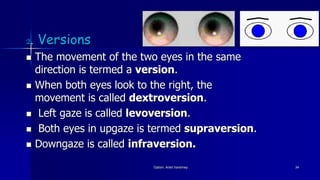
2. Versions
 The movement of the two eyes in the same
direction is termed a version.
 When both eyes look to the right, the
movement is called dextroversion.
 Left gaze is called levoversion.
 Both eyes in upgaze is termed supraversion.
 Downgaze is called infraversion.
Optom. Ankit Varshney 34
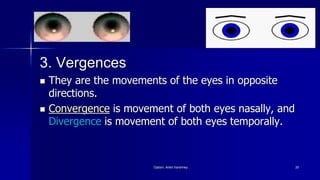
3. Vergences
 They are the movements of the eyes in opposite
directions.
 Convergence is movement of both eyes nasally, and
Divergence is movement of both eyes temporally.
Optom. Ankit Varshney 35
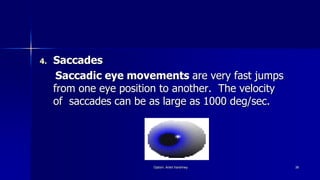
4. Saccades
Saccadic eye movements are very fast jumps
from one eye position to another. The velocity
of saccades can be as large as 1000 deg/sec.
Optom. Ankit Varshney 36
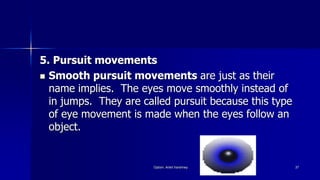
5. Pursuit movements
 Smooth pursuit movements are just as their
name implies. The eyes move smoothly instead of
in jumps. They are called pursuit because this type
of eye movement is made when the eyes follow an
object.
Optom. Ankit Varshney 37
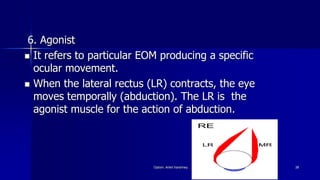
6. Agonist
 It refers to particular EOM producing a specific
ocular movement.
 When the lateral rectus (LR) contracts, the eye
moves temporally (abduction). The LR is the
agonist muscle for the action of abduction.
Optom. Ankit Varshney 38
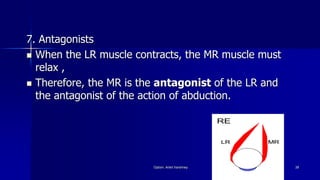
7. Antagonists
 When the LR muscle contracts, the MR muscle must
relax ,
 Therefore, the MR is the antagonist of the LR and
the antagonist of the action of abduction.
Optom. Ankit Varshney 39
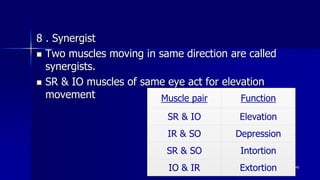
8 . Synergist
 Two muscles moving in same direction are called
synergists.
 SR & IO muscles of same eye act for elevation
movement
Optom. Ankit Varshney 40
Muscle pair Function
SR & IO Elevation
IR & SO Depression
SR & SO Intortion
IO & IR Extortion
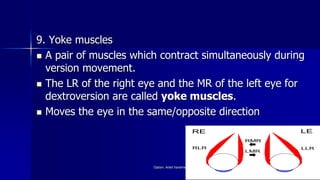
9. Yoke muscles
 A pair of muscles which contract simultaneously during
version movement.
 The LR of the right eye and the MR of the left eye for
dextroversion are called yoke muscles.
 Moves the eye in the same/opposite direction
Optom. Ankit Varshney 41
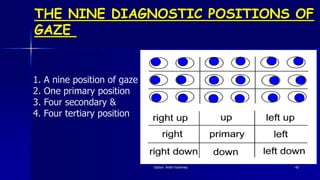
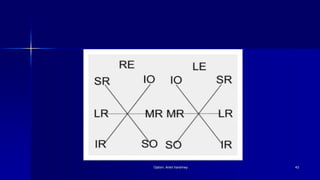
THE NINE DIAGNOSTIC POSITIONS OF
GAZE
Optom. Ankit Varshney 42
1. A nine position of gaze
2. One primary position
3. Four secondary &
4. Four tertiary position
Optom. Ankit Varshney 43
Laws of Ocular motility
1) Hering’s law of equal innervation
2) Sherrington’s law of reciprocal
innervation
CLINICAL APPLICATIONS :-
Optom. Ankit Varshney 44
WHY?
 Moving the eyes enables the field of view to
increase and allows the Fovea, the small region of
good vision, to move.
 Thus by this mechanisms we can lock on to track
the target, maintain foveal fixation and binocular
vision.
Optom. Ankit Varshney 45
THANK U
Optom. Ankit Varshney 46

Extra ocular muscles Eom by Optom Ankit Varshney

  • 1.
    Optom. Ankit S.Varshney B.Optom,M.Optom,Ph.D.in Optometry(pursuing)Fellowof IACLE(Aus.),Fellowof ASCO(Mum.) Prof.at (Shree BharatimaiyaCollegeof Optometry& Physiotherapy, Surat) Life Member of Indian Optometric Association (IOA) Associate Member of Association of Schools and Colleges of Optometry(ASCO) Member of Optometry Council of India(OCI) Educator Member of International Association of Contact lense Educators (Australia)(IACLE) Mail id: ankitsvarshney@yahoo.com Whatsapp no. +918155955820 EXTRA OCULAR MUSCLES
  • 2.
    Introduction:  The eyesare rotated by the action of six extraocular muscles, which allows rotations in horizontal, vertical and torsional directions.  These are :- 1. Medial Rectus 2. Lateral Rectus 3. Superior Rectus 4. Inferior Rectus 5. Superior Oblique 6. Inferior Oblique Optom. Ankit Varshney 2
  • 3.
  • 4.
  • 5.
  • 6.
    Basic Terminology  Axesof FICK  Muscle Plane  Axis of Rotation Optom. Ankit Varshney 6 Y-axis Z-axis X-axis MP AR
  • 7.
     The theoreticalcenter of rotation of the eye is at the intersection of the three principal axes of Fick, around which the eye performs rotatory movement  The X-axis crosses the eye horizontally; the Y-axis passes through the center of the pupil (through the ‘y’ sutures of the lens); and the Z-axis crosses the eye vertically. Optom. Ankit Varshney 7
  • 8.
     The visualaxis is a straight line that can be drawn from a distant object of regard to the fovea.  In the normal eye, the visual axis passes through the apex of the cornea, the center of the pupil, and the thickest anterior-posterior part of the lens. Optom. Ankit Varshney 8
  • 9.
    AXES OF FICK Optom.Ankit Varshney 9
  • 10.
     The horizontalplane is a primary plane of action.  The horizontal line going through the cornea represents the visual axis .  The vertical line with the arrow at the top represents the vertical axis. As the eye turns around the vertical axis, the visual axis sweeps along the horizontal plane. Optom. Ankit Varshney 10
  • 11.
     The verticalplane is the second of the primary planes of action.  The line going through the cornea represents the visual axis .  The horizontal line with the arrow represents the horizontal axis. As the eye turns around the horizontal axis, the visual axis sweeps along the vertical plane. Optom. Ankit Varshney 11
  • 12.
     The thirdplane of action are:- 1. Intortion and extortion refer to rotation around the visual axis,  Intortion refers to a nasal rotation from the 12 o'clock position.  Extortion refers to a temporal rotation from the 12 o'clock position. Optom. Ankit Varshney 12
  • 13.
     The MRand the LR each have only one "action".  These actions occur only along the horizontal plane.  The other EOMs are called cyclovertical muscles.  Each of these muscles has more than one action. They act in the vertical plane as well as the horizontal plane, and they also intort or extort the globe.  These muscles each have a primary action (1°), a secondary action (2°), and a tertiary action (3°). Optom. Ankit Varshney 13
  • 14.
    Medial Rectus Optom. AnkitVarshney 14 Z-axis AR MP
  • 15.
    The MR isthe strongest of the EOMs. It has the most mass, and it has the most anterior insertion into the globe (for greater leverage). It is used often to converge the eyes into near (reading) gaze. Optom. Ankit Varshney 15
  • 16.
    Lateral Rectus Optom. AnkitVarshney 16 Y-axis Z-axis MP AR
  • 17.
  • 18.
    Superior Rectus Optom. AnkitVarshney 18 Y-axis MP X-axis 23 67 Nasal Temporal AR
  • 19.
  • 20.
  • 21.
  • 22.
    Inferior Rectus Optom. AnkitVarshney 22 Y-axis MP X-axis 23 67 Nasal Temporal AR
  • 23.
    - PULL OFSUPERIOR & INFERIOR RECTUS AT ANGLE WITH LINE OF SIGHT Optom. Ankit Varshney 23
  • 24.
  • 25.
    Superior Oblique Optom. AnkitVarshney 25 Y-axis MP X-axis Nasal Temporal AR 54 36
  • 26.
  • 27.
  • 28.
    Inferior Oblique Optom. AnkitVarshney 28 Y-axis MP X-axis Nasal Temporal AR 54 36
  • 29.
  • 30.
  • 31.
  • 32.
  • 33.
    Physiology of ocularmovement 1. Duction :  The movement of one eye (monocular) by itself is called a duction.  Movement of the eye nasally is adduction;  Temporal movement is abduction.  Elevation is termed sursumduction (supraduction)  Depression is termed deorsumduction (infraduction),  Incycloduction (intorsion) is nasal rotation of the vertical meridian  Excycloduction (extorsion) is temporal rotation of the vertical meridian. Optom. Ankit Varshney 33
  • 34.
    2. Versions  Themovement of the two eyes in the same direction is termed a version.  When both eyes look to the right, the movement is called dextroversion.  Left gaze is called levoversion.  Both eyes in upgaze is termed supraversion.  Downgaze is called infraversion. Optom. Ankit Varshney 34
  • 35.
    3. Vergences  Theyare the movements of the eyes in opposite directions.  Convergence is movement of both eyes nasally, and Divergence is movement of both eyes temporally. Optom. Ankit Varshney 35
  • 36.
    4. Saccades Saccadic eyemovements are very fast jumps from one eye position to another. The velocity of saccades can be as large as 1000 deg/sec. Optom. Ankit Varshney 36
  • 37.
    5. Pursuit movements Smooth pursuit movements are just as their name implies. The eyes move smoothly instead of in jumps. They are called pursuit because this type of eye movement is made when the eyes follow an object. Optom. Ankit Varshney 37
  • 38.
    6. Agonist  Itrefers to particular EOM producing a specific ocular movement.  When the lateral rectus (LR) contracts, the eye moves temporally (abduction). The LR is the agonist muscle for the action of abduction. Optom. Ankit Varshney 38
  • 39.
    7. Antagonists  Whenthe LR muscle contracts, the MR muscle must relax ,  Therefore, the MR is the antagonist of the LR and the antagonist of the action of abduction. Optom. Ankit Varshney 39
  • 40.
    8 . Synergist Two muscles moving in same direction are called synergists.  SR & IO muscles of same eye act for elevation movement Optom. Ankit Varshney 40 Muscle pair Function SR & IO Elevation IR & SO Depression SR & SO Intortion IO & IR Extortion
  • 41.
    9. Yoke muscles A pair of muscles which contract simultaneously during version movement.  The LR of the right eye and the MR of the left eye for dextroversion are called yoke muscles.  Moves the eye in the same/opposite direction Optom. Ankit Varshney 41
  • 42.
    THE NINE DIAGNOSTICPOSITIONS OF GAZE Optom. Ankit Varshney 42 1. A nine position of gaze 2. One primary position 3. Four secondary & 4. Four tertiary position
  • 43.
  • 44.
    Laws of Ocularmotility 1) Hering’s law of equal innervation 2) Sherrington’s law of reciprocal innervation CLINICAL APPLICATIONS :- Optom. Ankit Varshney 44
  • 45.
    WHY?  Moving theeyes enables the field of view to increase and allows the Fovea, the small region of good vision, to move.  Thus by this mechanisms we can lock on to track the target, maintain foveal fixation and binocular vision. Optom. Ankit Varshney 45
  • 46.