EVALUATING THE CASES OF
ORTHOPTICS !
Optom. Ankit S. Varshney
B.Optom, M.Optom, Ph.D. in Optometry (pursuing) Fellow of IACLE (Aus.), Fellow of ASCO(Mum.)
Prof. at (Shree Bharatimaiya College of Optometry & Physiotherapy, Surat)
Life Member of Indian Optometric Association (IOA)
Associate Member of Association of Schools and Colleges of Optometry(ASCO)
Member of Optometry Council of India(OCI)
Educator Member of International Association of Contact lense Educators (Australia)(IACLE)
Mail id: ankitsvarshney@yahoo.com
Whatsapp no. +918155955820
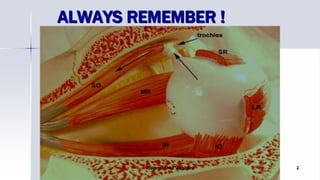
ALWAYS REMEMBER !
Optom. Ankit Varshney 2
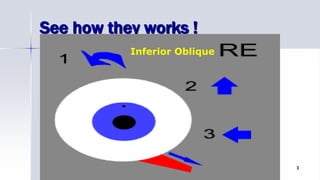
See how they works !
SURERIOR RECTUS
Optom. Ankit Varshney 3
Superior ObliqueInferior Oblique
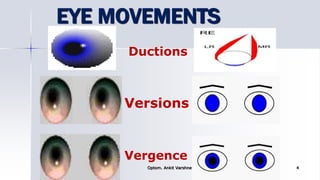
EYE MOVEMENTS
Optom. Ankit Varshney 4
Ductions
Versions
Vergence
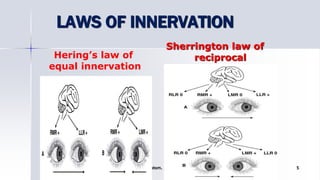
LAWS OF INNERVATION
Sherrington law of
reciprocal
innervation
Optom. Ankit Varshney 5
Hering’s law of
equal innervation
EVALUATION
INCLUDES
1. History
2. Visual acuity
3. General examination
4. Evaluation of the motor state
5. Evaluation of the sensory state
6. Anterior and Posterior segment
evaluation Optom. Ankit Varshney 6
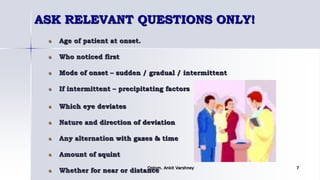
ASK RELEVANT QUESTIONS ONLY!
Age of patient at onset.
Who noticed first
Mode of onset – sudden / gradual / intermittent
If intermittent – precipitating factors
Which eye deviates
Nature and direction of deviation
Any alternation with gazes & time
Amount of squint
Whether for near or distanceOptom. Ankit Varshney 7
 CHIEF C/O
 PERSONAL H/O
 FAMILY H/O
 TREATMENT H/O
Optom. Ankit Varshney 8
History
History- subjective ocular complaints
Blurred Or Double Vision
Headache, Asthenopia
Diplopia, Past Pointing, Vertigo
Presence Of Face Turn, Head Tilt, Abnormal Head
Movement
Closure Of One Eye In Bright Sunlight
Optom. Ankit Varshney 9
History - precipitating causes
History of head or face injury
History of recent illness
Any eye disease prior to onset
necessitating occlusion of one eye with
pad.
Maternal history and birth history
Optom. Ankit Varshney 10
PERSONAL HISTORY
 ANTENATAL- DRUGS, ILLNESS
 PERINATAL- TYPE OF DELIVERY
PREMATURITY
BIRTH WT.
NEONATAL JAUNDICE,
CONVULSIONS..
 DEVELOPMENTAL H/O- MOTOR, SPEECH, HEALTH,
HANDEDNESS
Optom. Ankit Varshney 11
History - previous treatment
Spectacle correction and its effect on squint
Occlusion or orthoptic treatment
Surgery
Response To Treatment
Optom. Ankit Varshney 12
FAMILY HISTORY
 PARENTS, GRANDPARENTS, UNCLE,
AUNTS…
 SQUINTING
 HIGH REFRACTIVE ERROR
 TREATMENT TAKEN FOR SQUINTS.
Optom. Ankit Varshney 13
2. VISUAL ACUITY
Uniocular for distance and near, also
pinhole VA
With and without spectacles
Binocularly specially in patient
with nystagmus
Fixation pattern
Optom. Ankit Varshney 14
REFRACTION
 Refraction is a must for all patients with
strabismus
 Agent- <10yrs.- 1% Atropine sulphate
>10yrs.- 1% Cyclopentolate +
5% Homatropine
 Proper refractive error corrn. Reqd.
Optom. Ankit Varshney 15
FUNDUS EXAMINATION.
 MEDIA & FUNDUS EXAM. MUST BE DONE IN
ALL PATIENTS WITH STRABISMUS
 DIRECT OPHTHALMOSCOPE
ALSO USED IN BRUCKNER’S TEST
PUPILLARY REACTIONSOptom. Ankit Varshney 16
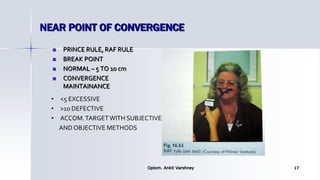
NEAR POINT OF CONVERGENCE
 PRINCE RULE, RAF RULE
 BREAK POINT
 NORMAL – 5 TO 10 cm
 CONVERGENCE
MAINTAINANCE
Optom. Ankit Varshney 17
• <5 EXCESSIVE
• >10 DEFECTIVE
• ACCOM.TARGETWITH SUBJECTIVE
AND OBJECTIVE METHODS
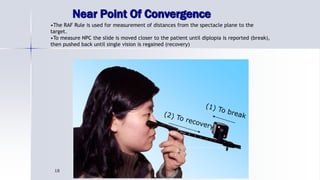
Near Point Of Convergence
Optom. Ankit Varshney
18
•The RAF Rule is used for measurement of distances from the spectacle plane to the
target.
•To measure NPC the slide is moved closer to the patient until diplopia is reported (break),
then pushed back until single vision is regained (recovery)
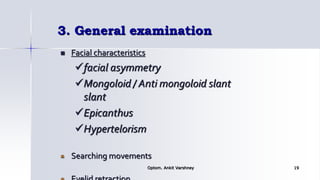
3. General examination
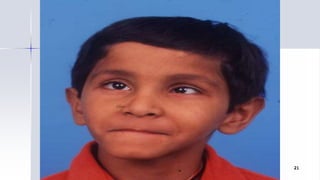
 Facial characteristics
facial asymmetry
Mongoloid / Anti mongoloid slant
slant
Epicanthus
Hypertelorism
Searching movements
Optom. Ankit Varshney 19
Head Posture
Head
tilt to right or left shoulder
Face
turn to right or left side
Chin
elevation or depressionOptom. Ankit Varshney 20
Optom. Ankit Varshney 21
MEASUREMENT OF DEVIATION
 OBJECTIVE TESTS :
MINIMAL COOPERATION REQUIRED
ONLY STEADY FIXATION
 SUBJECTIVE TESTS :
PT’S RESPONSE DETERMINES THE
RESULTS
CLINICAL EVALUATION OF SENSORY
STATUS Optom. Ankit Varshney 22
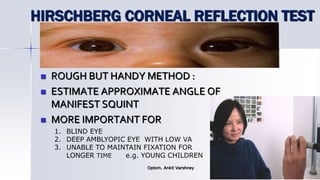
HIRSCHBERG CORNEAL REFLECTION TEST
 ROUGH BUT HANDY METHOD :
 ESTIMATE APPROXIMATE ANGLE OF
MANIFEST SQUINT
 MORE IMPORTANT FOR
Optom. Ankit Varshney 23
1. BLIND EYE
2. DEEP AMBLYOPIC EYE WITH LOW VA
3. UNABLE TO MAINTAIN FIXATION FOR
LONGER TIME e.g. YOUNG CHILDREN
Optom. Ankit Varshney 24
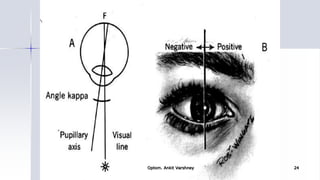
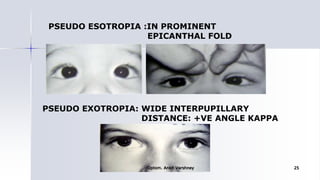
PSEUDO ESOTROPIA :IN PROMINENT
EPICANTHAL FOLD
PSEUDO EXOTROPIA: WIDE INTERPUPILLARY
DISTANCE: +VE ANGLE KAPPA
Optom. Ankit Varshney 25
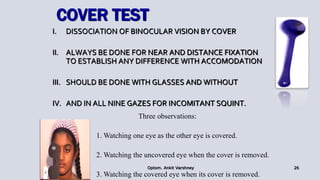
COVER TEST
I. DISSOCIATION OF BINOCULAR VISION BY COVER
II. ALWAYS BE DONE FOR NEAR AND DISTANCE FIXATION
TO ESTABLISH ANY DIFFERENCE WITH ACCOMODATION
III. SHOULD BE DONE WITH GLASSES AND WITHOUT
IV. AND IN ALL NINE GAZES FOR INCOMITANT SQUINT.
Optom. Ankit Varshney 26
Three observations:
1. Watching one eye as the other eye is covered.
2. Watching the uncovered eye when the cover is removed.
3. Watching the covered eye when its cover is removed.
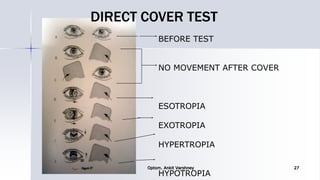
BEFORE TEST
NO MOVEMENT AFTER COVER
ESOTROPIA
EXOTROPIA
HYPERTROPIA
HYPOTROPIA
DIRECT COVER TEST
Optom. Ankit Varshney 27
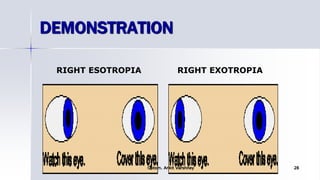
RIGHT ESOTROPIA RIGHT EXOTROPIA
DEMONSTRATION
Optom. Ankit Varshney 28
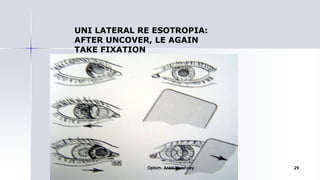
UNI LATERAL RE ESOTROPIA:
AFTER UNCOVER, LE AGAIN
TAKE FIXATION
Optom. Ankit Varshney 29
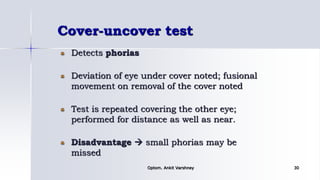
Cover-uncover test
Detects phorias
Deviation of eye under cover noted; fusional
movement on removal of the cover noted
Test is repeated covering the other eye;
performed for distance as well as near.
Disadvantage  small phorias may be
missed
Optom. Ankit Varshney 30
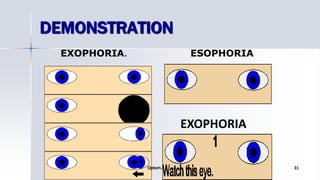
ESOPHORIAEXOPHORIA.
DEMONSTRATION
Optom. Ankit Varshney 31
EXOPHORIA
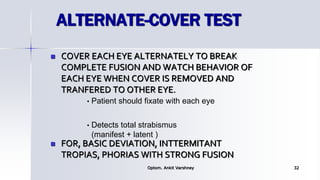
ALTERNATE-COVER TEST
 COVER EACH EYE ALTERNATELY TO BREAK
COMPLETE FUSION AND WATCH BEHAVIOR OF
EACH EYE WHEN COVER IS REMOVED AND
TRANFERED TO OTHER EYE.
 FOR, BASIC DEVIATION, INTTERMITANT
TROPIAS, PHORIAS WITH STRONG FUSION
Optom. Ankit Varshney 32
• Patient should fixate with each eye
• Detects total strabismus
(manifest + latent )
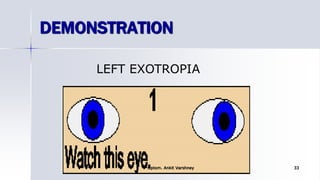
LEFT EXOTROPIA
DEMONSTRATION
Optom. Ankit Varshney 33
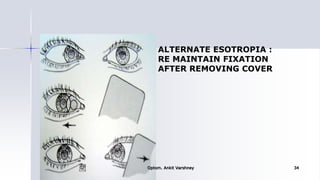
ALTERNATE ESOTROPIA :
RE MAINTAIN FIXATION
AFTER REMOVING COVER
Optom. Ankit Varshney 34
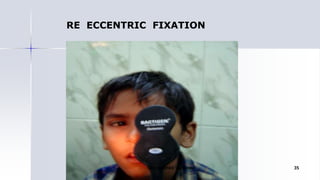
RE ECCENTRIC FIXATION
Optom. Ankit Varshney 35
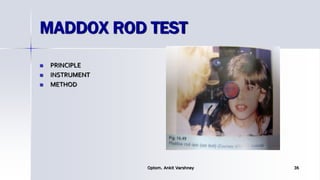
MADDOX ROD TEST
 PRINCIPLE
 INSTRUMENT
 METHOD
Optom. Ankit Varshney 36
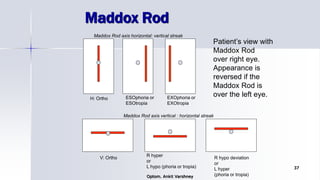
Maddox Rod
Optom. Ankit Varshney
37
H: Ortho ESOphoria or
ESOtropia
EXOphoria or
EXOtropia
V: Ortho
R hyper
or
L hypo (phoria or tropia)
R hypo deviation
or
L hyper
(phoria or tropia)
Patient’s view with
Maddox Rod
over right eye.
Appearance is
reversed if the
Maddox Rod is
over the left eye.
Maddox Rod axis horizontal: vertical streak
Maddox Rod axis vertical : horizontal streak
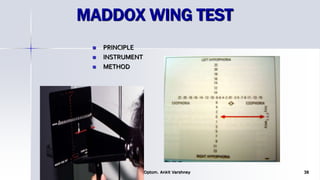
MADDOX WING TEST
 PRINCIPLE
 INSTRUMENT
 METHOD
Optom. Ankit Varshney 38
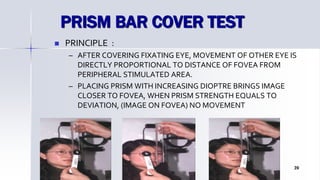
PRISM BAR COVER TEST
 PRINCIPLE :
– AFTER COVERING FIXATING EYE, MOVEMENT OF OTHER EYE IS
DIRECTLY PROPORTIONAL TO DISTANCE OF FOVEA FROM
PERIPHERAL STIMULATED AREA.
– PLACING PRISM WITH INCREASING DIOPTRE BRINGS IMAGE
CLOSER TO FOVEA, WHEN PRISM STRENGTH EQUALS TO
DEVIATION, (IMAGE ON FOVEA) NO MOVEMENT
Optom. Ankit Varshney 39
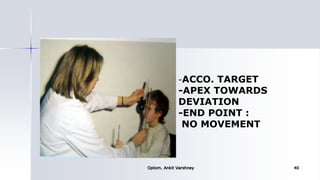
-ACCO. TARGET
-APEX TOWARDS
DEVIATION
-END POINT :
NO MOVEMENT
Optom. Ankit Varshney 40
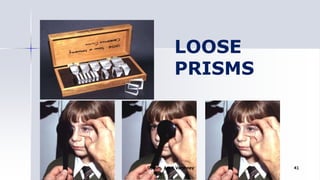
LOOSE
PRISMS
Optom. Ankit Varshney 41
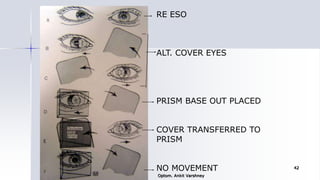
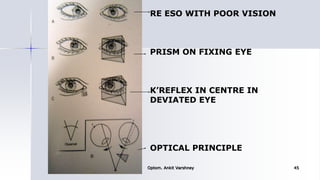
RE ESO
ALT. COVER EYES
PRISM BASE OUT PLACED
COVER TRANSFERRED TO
PRISM
NO MOVEMENT
Optom. Ankit Varshney
42
Prism-cover test
Advantages
 Accurate to within 2 prism diopters
 Provides complete dissociation thus
measure maximum deviation
 Gives comparison of angle at different
distance
Disadvantages
 Inaccurate in large deviation
 Cyclotropia can’t be measured
Optom. Ankit Varshney 43
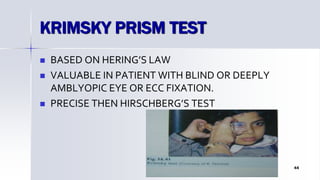
KRIMSKY PRISM TEST
 BASED ON HERING’S LAW
 VALUABLE IN PATIENT WITH BLIND OR DEEPLY
AMBLYOPIC EYE OR ECC FIXATION.
 PRECISE THEN HIRSCHBERG’S TEST
Optom. Ankit Varshney 44
RE ESO WITH POOR VISION
PRISM ON FIXING EYE
K’REFLEX IN CENTRE IN
DEVIATED EYE
OPTICAL PRINCIPLE
Optom. Ankit Varshney 45
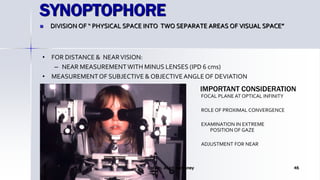
SYNOPTOPHORE
 DIVISION OF “ PHYSICAL SPACE INTO TWO SEPARATE AREAS OF VISUAL SPACE”
Optom. Ankit Varshney 46
• FOR DISTANCE & NEARVISION:
– NEAR MEASUREMENTWITH MINUS LENSES (IPD 6 cms)
• MEASUREMENTOF SUBJECTIVE & OBJECTIVEANGLE OF DEVIATION
FOCAL PLANE AT OPTICAL INFINITY
ROLE OF PROXIMAL CONVERGENCE
EXAMINATION IN EXTREME
POSITION OF GAZE
ADJUSTMENT FOR NEAR
IMPORTANT CONSIDERATION
ADAPTATION TO STRABISMUS
SUPPRESSION
AMBLYOPIA
ECCENTRIC FIXATION
ANOMALOUS RETINAL CORRESPONDENCE
Optom. Ankit Varshney 47
Sensory Evaluation
Goals: to establish
 Presence of diplopia or suppression
 Presence and degree of amblyopia
 Type of retinal correspondence
 Stereopsis
Optom. Ankit Varshney 48
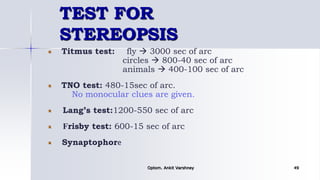
TEST FOR
STEREOPSIS
Titmus test: fly  3000 sec of arc
circles  800-40 sec of arc
animals  400-100 sec of arc
TNO test: 480-15sec of arc.
No monocular clues are given.
Lang’s test:1200-550 sec of arc
Frisby test: 600-15 sec of arc
Synaptophore
Optom. Ankit Varshney 49
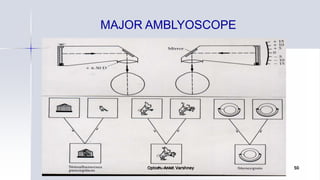
MAJOR AMBLYOSCOPE
Optom. Ankit Varshney 50
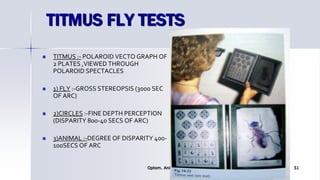
TITMUS FLY TESTS
 TITMUS :- POLAROID VECTO GRAPH OF
2 PLATES ,VIEWED THROUGH
POLAROID SPECTACLES
 1) FLY :-GROSS STEREOPSIS (3000 SEC
OF ARC)
 2)CIRCLES :-FINE DEPTH PERCEPTION
(DISPARITY 800-40 SECS OF ARC)
 3)ANIMAL :-DEGREE OF DISPARITY 400-
100SECS OF ARC
Optom. Ankit Varshney 51
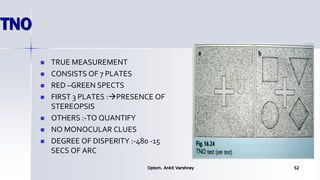
TNO
 TRUE MEASUREMENT
 CONSISTS OF 7 PLATES
 RED –GREEN SPECTS
 FIRST 3 PLATES :PRESENCE OF
STEREOPSIS
 OTHERS :-TO QUANTIFY
 NO MONOCULAR CLUES
 DEGREE OF DISPERITY :-480 -15
SECS OF ARC
Optom. Ankit Varshney 52
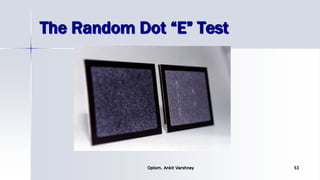
The Random Dot “E” Test
Optom. Ankit Varshney 53
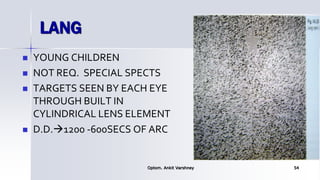
LANG
 YOUNG CHILDREN
 NOT REQ. SPECIAL SPECTS
 TARGETS SEEN BY EACH EYE
THROUGH BUILT IN
CYLINDRICAL LENS ELEMENT
 D.D.1200 -600SECS OF ARC
Optom. Ankit Varshney 54
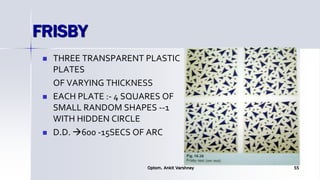
FRISBY
 THREE TRANSPARENT PLASTIC
PLATES
OF VARYING THICKNESS
 EACH PLATE :- 4 SQUARES OF
SMALL RANDOM SHAPES --1
WITH HIDDEN CIRCLE
 D.D. 600 -15SECS OF ARC
Optom. Ankit Varshney 55
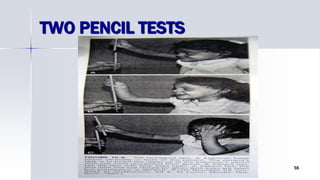
TWO PENCIL TESTS
Optom. Ankit Varshney 56
TESTs FOR SUPPRESSION
Worth’s 4 dot test
Bagolini Striated Glass Test
4 diopter base out prism test
Major amblyoscope
Optom. Ankit Varshney 57
TEST FOR ARC
WFDT
After image test
Bagolini’s striated glasses
Synoptophore
Red Filter Test
Optom. Ankit Varshney 58
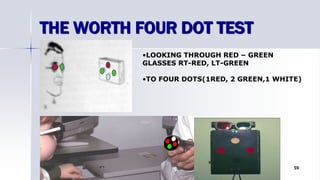
THE WORTH FOUR DOT TEST
Optom. Ankit Varshney 59
•LOOKING THROUGH RED – GREEN
GLASSES RT-RED, LT-GREEN
•TO FOUR DOTS(1RED, 2 GREEN,1 WHITE)
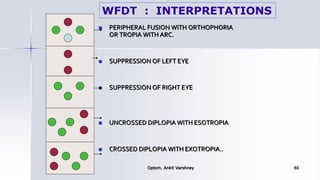
 PERIPHERAL FUSION WITH ORTHOPHORIA
OR TROPIA WITH ARC.
 SUPPRESSION OF LEFT EYE
 SUPPRESSION OF RIGHT EYE
 UNCROSSED DIPLOPIA WITH ESOTROPIA
 CROSSED DIPLOPIA WITH EXOTROPIA..
Optom. Ankit Varshney 60
WFDT : INTERPRETATIONS
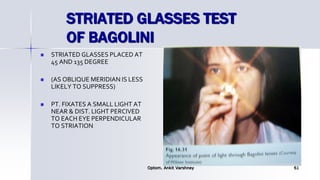
STRIATED GLASSES TEST
OF BAGOLINI
 STRIATED GLASSES PLACED AT
45 AND 135 DEGREE
 (AS OBLIQUE MERIDIAN IS LESS
LIKELY TO SUPPRESS)
 PT. FIXATES A SMALL LIGHT AT
NEAR & DIST. LIGHT PERCIVED
TO EACH EYE PERPENDICULAR
TO STRIATION.
Optom. Ankit Varshney 61
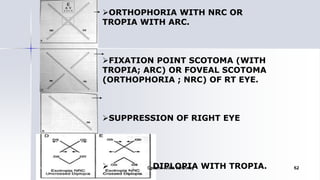
ORTHOPHORIA WITH NRC OR
TROPIA WITH ARC.
FIXATION POINT SCOTOMA (WITH
TROPIA; ARC) OR FOVEAL SCOTOMA
(ORTHOPHORIA ; NRC) OF RT EYE.
SUPPRESSION OF RIGHT EYE
 DIPLOPIA WITH TROPIA.Optom. Ankit Varshney 62
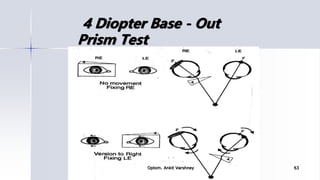
4 Diopter Base - Out
Prism Test
Optom. Ankit Varshney 63
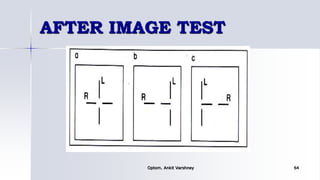
AFTER IMAGE TEST
Optom. Ankit Varshney 64
DIPLOPIA CHARTING
 PRINCIPLE
 PROCEDURE-
* RED-GREEN GOGGLES
* HEAD POSITION
* LIGHT SOURCE
* CLOSE EACH EYE ONEBYONE
* NINE DIAGNOSTIC POSITIONS OF GAZE
Optom. Ankit Varshney 65
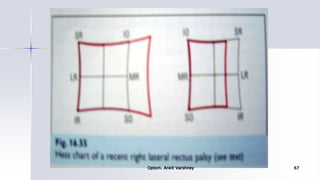
HESS CHARTING
PRINCIPLE
- foveal projection
- laws of innervation
- dissociation of eyes by means of complementary colors.
 ARCHITECTURE OF THE SCREEN :-DIAGNOSIS OF POSSIBLE
PARESIS OR PARALYSIS WITH NRC
– 3X31/2 FT. SCREEN LINES 50 ANGLE
– RED DOTS AT 150 AND 300
– EXAMINATION AT ½ METER DISTANCE
Optom. Ankit Varshney 66
Optom. Ankit Varshney 67
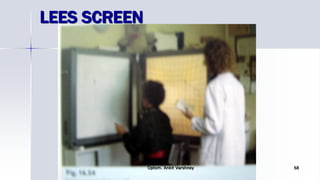
LEES SCREEN
Optom. Ankit Varshney 68
Thank You
Optom. Ankit Varshney 69

Orthoptics by ankit varshney

  • 1.
    EVALUATING THE CASESOF ORTHOPTICS ! Optom. Ankit S. Varshney B.Optom, M.Optom, Ph.D. in Optometry (pursuing) Fellow of IACLE (Aus.), Fellow of ASCO(Mum.) Prof. at (Shree Bharatimaiya College of Optometry & Physiotherapy, Surat) Life Member of Indian Optometric Association (IOA) Associate Member of Association of Schools and Colleges of Optometry(ASCO) Member of Optometry Council of India(OCI) Educator Member of International Association of Contact lense Educators (Australia)(IACLE) Mail id: ankitsvarshney@yahoo.com Whatsapp no. +918155955820
  • 2.
    ALWAYS REMEMBER ! Optom.Ankit Varshney 2
  • 3.
    See how theyworks ! SURERIOR RECTUS Optom. Ankit Varshney 3 Superior ObliqueInferior Oblique
  • 4.
    EYE MOVEMENTS Optom. AnkitVarshney 4 Ductions Versions Vergence
  • 5.
    LAWS OF INNERVATION Sherringtonlaw of reciprocal innervation Optom. Ankit Varshney 5 Hering’s law of equal innervation
  • 6.
    EVALUATION INCLUDES 1. History 2. Visualacuity 3. General examination 4. Evaluation of the motor state 5. Evaluation of the sensory state 6. Anterior and Posterior segment evaluation Optom. Ankit Varshney 6
  • 7.
    ASK RELEVANT QUESTIONSONLY! Age of patient at onset. Who noticed first Mode of onset – sudden / gradual / intermittent If intermittent – precipitating factors Which eye deviates Nature and direction of deviation Any alternation with gazes & time Amount of squint Whether for near or distanceOptom. Ankit Varshney 7
  • 8.
     CHIEF C/O PERSONAL H/O  FAMILY H/O  TREATMENT H/O Optom. Ankit Varshney 8 History
  • 9.
    History- subjective ocularcomplaints Blurred Or Double Vision Headache, Asthenopia Diplopia, Past Pointing, Vertigo Presence Of Face Turn, Head Tilt, Abnormal Head Movement Closure Of One Eye In Bright Sunlight Optom. Ankit Varshney 9
  • 10.
    History - precipitatingcauses History of head or face injury History of recent illness Any eye disease prior to onset necessitating occlusion of one eye with pad. Maternal history and birth history Optom. Ankit Varshney 10
  • 11.
    PERSONAL HISTORY  ANTENATAL-DRUGS, ILLNESS  PERINATAL- TYPE OF DELIVERY PREMATURITY BIRTH WT. NEONATAL JAUNDICE, CONVULSIONS..  DEVELOPMENTAL H/O- MOTOR, SPEECH, HEALTH, HANDEDNESS Optom. Ankit Varshney 11
  • 12.
    History - previoustreatment Spectacle correction and its effect on squint Occlusion or orthoptic treatment Surgery Response To Treatment Optom. Ankit Varshney 12
  • 13.
    FAMILY HISTORY  PARENTS,GRANDPARENTS, UNCLE, AUNTS…  SQUINTING  HIGH REFRACTIVE ERROR  TREATMENT TAKEN FOR SQUINTS. Optom. Ankit Varshney 13
  • 14.
    2. VISUAL ACUITY Uniocularfor distance and near, also pinhole VA With and without spectacles Binocularly specially in patient with nystagmus Fixation pattern Optom. Ankit Varshney 14
  • 15.
    REFRACTION  Refraction isa must for all patients with strabismus  Agent- <10yrs.- 1% Atropine sulphate >10yrs.- 1% Cyclopentolate + 5% Homatropine  Proper refractive error corrn. Reqd. Optom. Ankit Varshney 15
  • 16.
    FUNDUS EXAMINATION.  MEDIA& FUNDUS EXAM. MUST BE DONE IN ALL PATIENTS WITH STRABISMUS  DIRECT OPHTHALMOSCOPE ALSO USED IN BRUCKNER’S TEST PUPILLARY REACTIONSOptom. Ankit Varshney 16
  • 17.
    NEAR POINT OFCONVERGENCE  PRINCE RULE, RAF RULE  BREAK POINT  NORMAL – 5 TO 10 cm  CONVERGENCE MAINTAINANCE Optom. Ankit Varshney 17 • <5 EXCESSIVE • >10 DEFECTIVE • ACCOM.TARGETWITH SUBJECTIVE AND OBJECTIVE METHODS
  • 18.
    Near Point OfConvergence Optom. Ankit Varshney 18 •The RAF Rule is used for measurement of distances from the spectacle plane to the target. •To measure NPC the slide is moved closer to the patient until diplopia is reported (break), then pushed back until single vision is regained (recovery)
  • 19.
    3. General examination Facial characteristics facial asymmetry Mongoloid / Anti mongoloid slant slant Epicanthus Hypertelorism Searching movements Optom. Ankit Varshney 19
  • 20.
    Head Posture Head tilt toright or left shoulder Face turn to right or left side Chin elevation or depressionOptom. Ankit Varshney 20
  • 21.
  • 22.
    MEASUREMENT OF DEVIATION OBJECTIVE TESTS : MINIMAL COOPERATION REQUIRED ONLY STEADY FIXATION  SUBJECTIVE TESTS : PT’S RESPONSE DETERMINES THE RESULTS CLINICAL EVALUATION OF SENSORY STATUS Optom. Ankit Varshney 22
  • 23.
    HIRSCHBERG CORNEAL REFLECTIONTEST  ROUGH BUT HANDY METHOD :  ESTIMATE APPROXIMATE ANGLE OF MANIFEST SQUINT  MORE IMPORTANT FOR Optom. Ankit Varshney 23 1. BLIND EYE 2. DEEP AMBLYOPIC EYE WITH LOW VA 3. UNABLE TO MAINTAIN FIXATION FOR LONGER TIME e.g. YOUNG CHILDREN
  • 24.
  • 25.
    PSEUDO ESOTROPIA :INPROMINENT EPICANTHAL FOLD PSEUDO EXOTROPIA: WIDE INTERPUPILLARY DISTANCE: +VE ANGLE KAPPA Optom. Ankit Varshney 25
  • 26.
    COVER TEST I. DISSOCIATIONOF BINOCULAR VISION BY COVER II. ALWAYS BE DONE FOR NEAR AND DISTANCE FIXATION TO ESTABLISH ANY DIFFERENCE WITH ACCOMODATION III. SHOULD BE DONE WITH GLASSES AND WITHOUT IV. AND IN ALL NINE GAZES FOR INCOMITANT SQUINT. Optom. Ankit Varshney 26 Three observations: 1. Watching one eye as the other eye is covered. 2. Watching the uncovered eye when the cover is removed. 3. Watching the covered eye when its cover is removed.
  • 27.
    BEFORE TEST NO MOVEMENTAFTER COVER ESOTROPIA EXOTROPIA HYPERTROPIA HYPOTROPIA DIRECT COVER TEST Optom. Ankit Varshney 27
  • 28.
    RIGHT ESOTROPIA RIGHTEXOTROPIA DEMONSTRATION Optom. Ankit Varshney 28
  • 29.
    UNI LATERAL REESOTROPIA: AFTER UNCOVER, LE AGAIN TAKE FIXATION Optom. Ankit Varshney 29
  • 30.
    Cover-uncover test Detects phorias Deviationof eye under cover noted; fusional movement on removal of the cover noted Test is repeated covering the other eye; performed for distance as well as near. Disadvantage  small phorias may be missed Optom. Ankit Varshney 30
  • 31.
  • 32.
    ALTERNATE-COVER TEST  COVEREACH EYE ALTERNATELY TO BREAK COMPLETE FUSION AND WATCH BEHAVIOR OF EACH EYE WHEN COVER IS REMOVED AND TRANFERED TO OTHER EYE.  FOR, BASIC DEVIATION, INTTERMITANT TROPIAS, PHORIAS WITH STRONG FUSION Optom. Ankit Varshney 32 • Patient should fixate with each eye • Detects total strabismus (manifest + latent )
  • 33.
  • 34.
    ALTERNATE ESOTROPIA : REMAINTAIN FIXATION AFTER REMOVING COVER Optom. Ankit Varshney 34
  • 35.
  • 36.
    MADDOX ROD TEST PRINCIPLE  INSTRUMENT  METHOD Optom. Ankit Varshney 36
  • 37.
    Maddox Rod Optom. AnkitVarshney 37 H: Ortho ESOphoria or ESOtropia EXOphoria or EXOtropia V: Ortho R hyper or L hypo (phoria or tropia) R hypo deviation or L hyper (phoria or tropia) Patient’s view with Maddox Rod over right eye. Appearance is reversed if the Maddox Rod is over the left eye. Maddox Rod axis horizontal: vertical streak Maddox Rod axis vertical : horizontal streak
  • 38.
    MADDOX WING TEST PRINCIPLE  INSTRUMENT  METHOD Optom. Ankit Varshney 38
  • 39.
    PRISM BAR COVERTEST  PRINCIPLE : – AFTER COVERING FIXATING EYE, MOVEMENT OF OTHER EYE IS DIRECTLY PROPORTIONAL TO DISTANCE OF FOVEA FROM PERIPHERAL STIMULATED AREA. – PLACING PRISM WITH INCREASING DIOPTRE BRINGS IMAGE CLOSER TO FOVEA, WHEN PRISM STRENGTH EQUALS TO DEVIATION, (IMAGE ON FOVEA) NO MOVEMENT Optom. Ankit Varshney 39
  • 40.
    -ACCO. TARGET -APEX TOWARDS DEVIATION -ENDPOINT : NO MOVEMENT Optom. Ankit Varshney 40
  • 41.
  • 42.
    RE ESO ALT. COVEREYES PRISM BASE OUT PLACED COVER TRANSFERRED TO PRISM NO MOVEMENT Optom. Ankit Varshney 42
  • 43.
    Prism-cover test Advantages  Accurateto within 2 prism diopters  Provides complete dissociation thus measure maximum deviation  Gives comparison of angle at different distance Disadvantages  Inaccurate in large deviation  Cyclotropia can’t be measured Optom. Ankit Varshney 43
  • 44.
    KRIMSKY PRISM TEST BASED ON HERING’S LAW  VALUABLE IN PATIENT WITH BLIND OR DEEPLY AMBLYOPIC EYE OR ECC FIXATION.  PRECISE THEN HIRSCHBERG’S TEST Optom. Ankit Varshney 44
  • 45.
    RE ESO WITHPOOR VISION PRISM ON FIXING EYE K’REFLEX IN CENTRE IN DEVIATED EYE OPTICAL PRINCIPLE Optom. Ankit Varshney 45
  • 46.
    SYNOPTOPHORE  DIVISION OF“ PHYSICAL SPACE INTO TWO SEPARATE AREAS OF VISUAL SPACE” Optom. Ankit Varshney 46 • FOR DISTANCE & NEARVISION: – NEAR MEASUREMENTWITH MINUS LENSES (IPD 6 cms) • MEASUREMENTOF SUBJECTIVE & OBJECTIVEANGLE OF DEVIATION FOCAL PLANE AT OPTICAL INFINITY ROLE OF PROXIMAL CONVERGENCE EXAMINATION IN EXTREME POSITION OF GAZE ADJUSTMENT FOR NEAR IMPORTANT CONSIDERATION
  • 47.
    ADAPTATION TO STRABISMUS SUPPRESSION AMBLYOPIA ECCENTRICFIXATION ANOMALOUS RETINAL CORRESPONDENCE Optom. Ankit Varshney 47
  • 48.
    Sensory Evaluation Goals: toestablish  Presence of diplopia or suppression  Presence and degree of amblyopia  Type of retinal correspondence  Stereopsis Optom. Ankit Varshney 48
  • 49.
    TEST FOR STEREOPSIS Titmus test:fly  3000 sec of arc circles  800-40 sec of arc animals  400-100 sec of arc TNO test: 480-15sec of arc. No monocular clues are given. Lang’s test:1200-550 sec of arc Frisby test: 600-15 sec of arc Synaptophore Optom. Ankit Varshney 49
  • 50.
  • 51.
    TITMUS FLY TESTS TITMUS :- POLAROID VECTO GRAPH OF 2 PLATES ,VIEWED THROUGH POLAROID SPECTACLES  1) FLY :-GROSS STEREOPSIS (3000 SEC OF ARC)  2)CIRCLES :-FINE DEPTH PERCEPTION (DISPARITY 800-40 SECS OF ARC)  3)ANIMAL :-DEGREE OF DISPARITY 400- 100SECS OF ARC Optom. Ankit Varshney 51
  • 52.
    TNO  TRUE MEASUREMENT CONSISTS OF 7 PLATES  RED –GREEN SPECTS  FIRST 3 PLATES :PRESENCE OF STEREOPSIS  OTHERS :-TO QUANTIFY  NO MONOCULAR CLUES  DEGREE OF DISPERITY :-480 -15 SECS OF ARC Optom. Ankit Varshney 52
  • 53.
    The Random Dot“E” Test Optom. Ankit Varshney 53
  • 54.
    LANG  YOUNG CHILDREN NOT REQ. SPECIAL SPECTS  TARGETS SEEN BY EACH EYE THROUGH BUILT IN CYLINDRICAL LENS ELEMENT  D.D.1200 -600SECS OF ARC Optom. Ankit Varshney 54
  • 55.
    FRISBY  THREE TRANSPARENTPLASTIC PLATES OF VARYING THICKNESS  EACH PLATE :- 4 SQUARES OF SMALL RANDOM SHAPES --1 WITH HIDDEN CIRCLE  D.D. 600 -15SECS OF ARC Optom. Ankit Varshney 55
  • 56.
    TWO PENCIL TESTS Optom.Ankit Varshney 56
  • 57.
    TESTs FOR SUPPRESSION Worth’s4 dot test Bagolini Striated Glass Test 4 diopter base out prism test Major amblyoscope Optom. Ankit Varshney 57
  • 58.
    TEST FOR ARC WFDT Afterimage test Bagolini’s striated glasses Synoptophore Red Filter Test Optom. Ankit Varshney 58
  • 59.
    THE WORTH FOURDOT TEST Optom. Ankit Varshney 59 •LOOKING THROUGH RED – GREEN GLASSES RT-RED, LT-GREEN •TO FOUR DOTS(1RED, 2 GREEN,1 WHITE)
  • 60.
     PERIPHERAL FUSIONWITH ORTHOPHORIA OR TROPIA WITH ARC.  SUPPRESSION OF LEFT EYE  SUPPRESSION OF RIGHT EYE  UNCROSSED DIPLOPIA WITH ESOTROPIA  CROSSED DIPLOPIA WITH EXOTROPIA.. Optom. Ankit Varshney 60 WFDT : INTERPRETATIONS
  • 61.
    STRIATED GLASSES TEST OFBAGOLINI  STRIATED GLASSES PLACED AT 45 AND 135 DEGREE  (AS OBLIQUE MERIDIAN IS LESS LIKELY TO SUPPRESS)  PT. FIXATES A SMALL LIGHT AT NEAR & DIST. LIGHT PERCIVED TO EACH EYE PERPENDICULAR TO STRIATION. Optom. Ankit Varshney 61
  • 62.
    ORTHOPHORIA WITH NRCOR TROPIA WITH ARC. FIXATION POINT SCOTOMA (WITH TROPIA; ARC) OR FOVEAL SCOTOMA (ORTHOPHORIA ; NRC) OF RT EYE. SUPPRESSION OF RIGHT EYE  DIPLOPIA WITH TROPIA.Optom. Ankit Varshney 62
  • 63.
    4 Diopter Base- Out Prism Test Optom. Ankit Varshney 63
  • 64.
    AFTER IMAGE TEST Optom.Ankit Varshney 64
  • 65.
    DIPLOPIA CHARTING  PRINCIPLE PROCEDURE- * RED-GREEN GOGGLES * HEAD POSITION * LIGHT SOURCE * CLOSE EACH EYE ONEBYONE * NINE DIAGNOSTIC POSITIONS OF GAZE Optom. Ankit Varshney 65
  • 66.
    HESS CHARTING PRINCIPLE - fovealprojection - laws of innervation - dissociation of eyes by means of complementary colors.  ARCHITECTURE OF THE SCREEN :-DIAGNOSIS OF POSSIBLE PARESIS OR PARALYSIS WITH NRC – 3X31/2 FT. SCREEN LINES 50 ANGLE – RED DOTS AT 150 AND 300 – EXAMINATION AT ½ METER DISTANCE Optom. Ankit Varshney 66
  • 67.
  • 68.
  • 69.