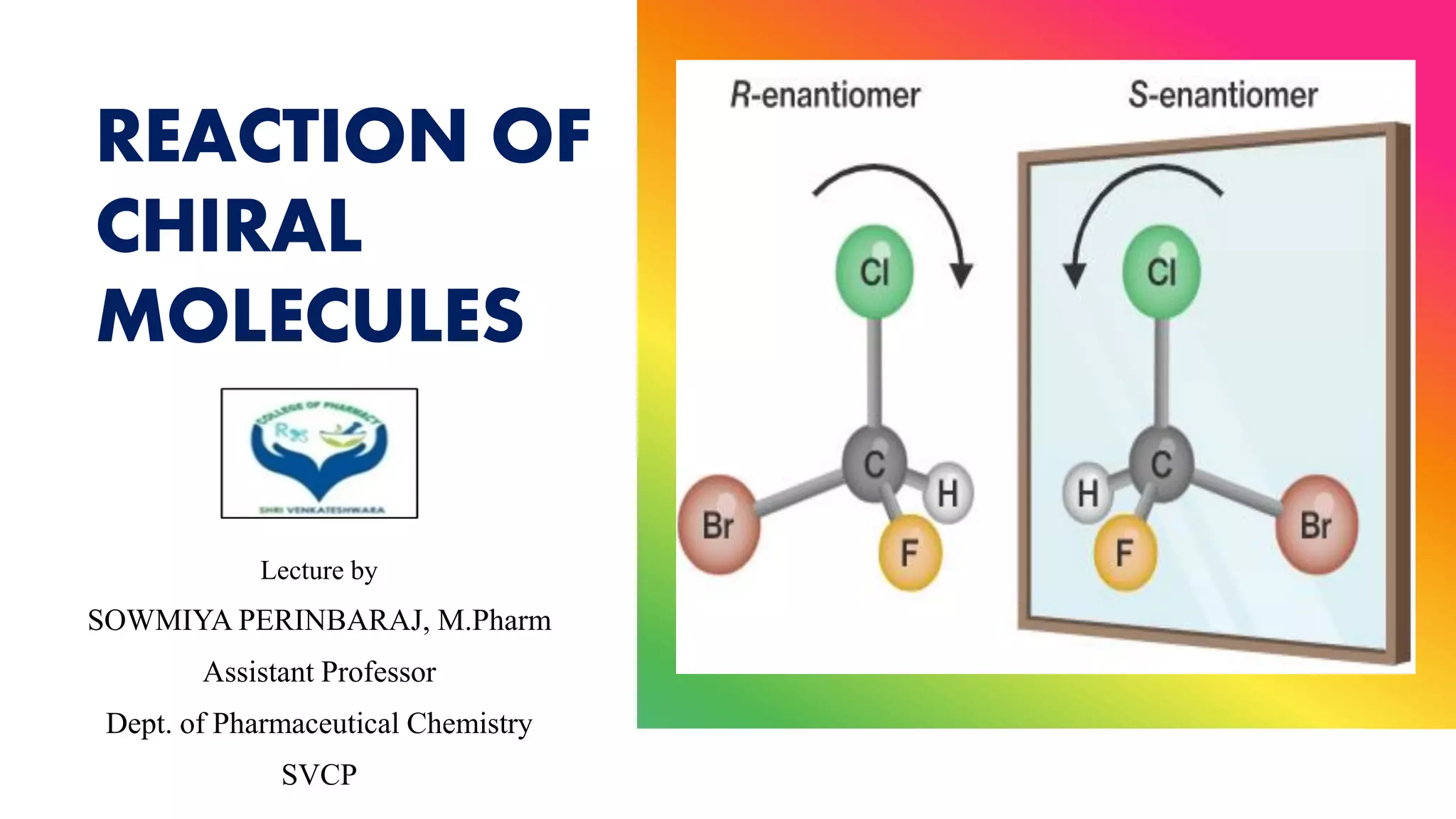
REACTION OF
CHIRAL
MOLECULES
Lecture by
SOWMIYA PERINBARAJ, M.Pharm
Assistant Professor
Dept. of Pharmaceutical Chemistry
SVCP
Introduction
❖ Chiral molecules undergoes three major reactions
at the chiral centre.
1)Inversion
2)Retention
3)Racemisation
2
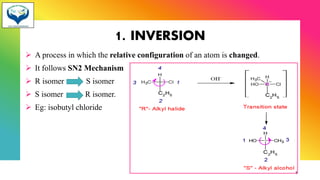
1. INVERSION
➢ A process in which the relative configuration of an atom is changed.
➢ It follows SN2 Mechanism
➢ R isomer S isomer
➢ S isomer R isomer.
➢ Eg: isobutyl chloride
3
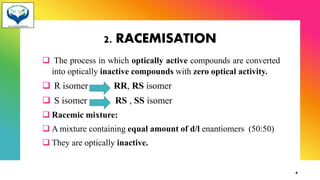
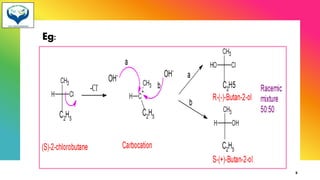
2. RACEMISATION
❑ The process in which optically active compounds are converted
into optically inactive compounds with zero optical activity.
❑ R isomer RR, RS isomer
❑ S isomer RS , SS isomer
❑ Racemic mixture:
❑ A mixture containing equal amount of d/l enantiomers (50:50)
❑ They are optically inactive.
4
Eg:
5
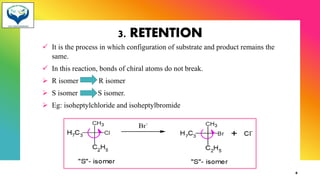
3. RETENTION
✓ It is the process in which configuration of substrate and product remains the
same.
✓ In this reaction, bonds of chiral atoms do not break.
➢ R isomer R isomer
➢ S isomer S isomer.
➢ Eg: isoheptylchloride and isoheptylbromide
6
Racemic
Modification &
Resolution of
Racemic mixture
Sample footer text 3/1/20XX 7
Racemic modification
❑ Racemic modification is the process of mixing of equal amounts
of a pair of enantiomers and is optically inactive due to external
compensation.
❑ Such a mixture is called Racemic mixture represented as dl or (+-)
❑ When enantiomers are mixed together, the rotation caused by a
molecule of one isomer is exactly balanced by an equal and
opposite rotation caused by another molecule of its enantiomer.
8
Preparation of Racemic modification
1) By Mixing
❖ This is done by mixing of exactly equal amounts of two
enantiomers (d/l or (+-).
❖ Louis Pasteur studied a sample of (+-) –sodium
ammonium tartrate (racemic mixture) which contains
50% (+) – enantiomers and 50% (-) –enantiomers.
9
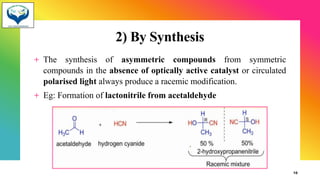
2) By Synthesis
+ The synthesis of asymmetric compounds from symmetric
compounds in the absence of optically active catalyst or circulated
polarised light always produce a racemic modification.
+ Eg: Formation of lactonitrile from acetaldehyde
10
3) By Racemisation
➢ Racemisation is the process of converting an optically active (d/l)
compound into the racemic modification.
➢ Racemization is the process of production of racemic modification
starting with one of the pure enantiomers.
➢ Important mechanisms for racemisation are
A) Thermal racemisation
B) By anion formation
C) By cation formation
D) By reversible formation of stable inactive
intermediates
E) By walden inversion
F) By chemical transformation
11
A) THERMAL RACEMISATION
o Heating at a higher temperature make homolytic splitting of one of the four
bonds attached to the asymmetric carbon atoms.
o Eg: The racemization of a α-phenethyl chloride on distillation at atmospheric
pressure may be of this type.
B) By Anion formation
o Since the carbanions are generally planar, they are optically inactive. The
formation of carbanion intermediates is the common practice of racemisation.
o The ease of racemisation depends upon the acidity of hydrogen atom
o The more liable and acidic the hydrogen atom , the greater is ease of
racemisation.
Sample footer text 3/1/20XX 12
c) By cation formation
✓ Formation of cation as intermediates results in racemisation.
✓ Eg: (+)-1-chloroethylbenzene racemises on treatment with antimony
pentasulphide.
D) By reversible formation of stable inactive
intermediates
✓ Mechanism is same as that of anion and cation formation, but here
symmetrical, non-ionic stable intermediate is formed.
✓ Eg: optically active 1-chloroethylbenzene racemises easily in liquid
SO2, By a dehydrohalogenation process.
13
E) By Walden inversion
▪ Certain SN2 reactions involving symmetric centres proceed with
inversion of configuration and thus may cause racemisation of the
original optically active compound.
▪ Eg: The racemization of 2-iodooctane by potassium iodide in
refluxing acetone.
F) By Chemical transformation
▪ In this method, an enantiomer is converted into racemic modification
without breaking any of the bond.
▪ Eg: 5-methyl-2-cyclohexyl acid phthalate has been racemised in
aqueous acetone at 100 °C.
14
Resolution of Racemic
modification
➢ The process of separating a racemic modification into its pure
enantiomers is known as resolution.
➢ The enantiomers of the racemate must be temporarily converted
into diastereomers.
➢ It is quantitative and sometimes only one isomer will be
isolated.
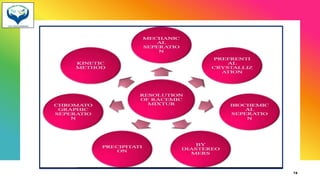
➢ Several methods have been developed and type of separation
will be selected depending upon the nature of compound.
15
16
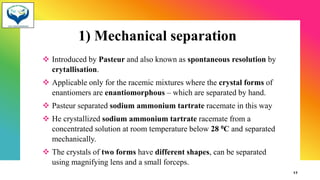
1) Mechanical separation
❖ Introduced by Pasteur and also known as spontaneous resolution by
crytallisation.
❖ Applicable only for the racemic mixtures where the crystal forms of
enantiomers are enantiomorphous – which are separated by hand.
❖ Pasteur separated sodium ammonium tartrate racemate in this way
❖ He crystallized sodium ammonium tartrate racemate from a
concentrated solution at room temperature below 28 0C and separated
mechanically.
❖ The crystals of two forms have different shapes, can be separated
using magnifying lens and a small forceps.
17
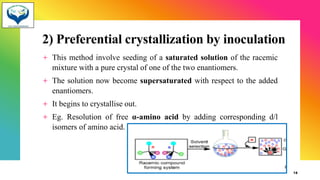
2) Preferential crystallization by inoculation
+ This method involve seeding of a saturated solution of the racemic
mixture with a pure crystal of one of the two enantiomers.
+ The solution now become supersaturated with respect to the added
enantiomers.
+ It begins to crystallise out.
+ Eg. Resolution of free α-amino acid by adding corresponding d/l
isomers of amino acid.
18
3) Biochemical separation
+ It was introduced by Pasteur in 1858.
+ This method is based on fact that when certain micro
organisms like bacteria, fungi, yeast, moulds, etc are grown in
dilute solution of racemic mixture, they eat up one
enantiomer rapidly than other.
+ Example: the mould Penicillium glaucum preferentially
destroys the (+) isomer of racemic ammonium tartarate
leaving (-) ammonium tartarate in solution.9
19
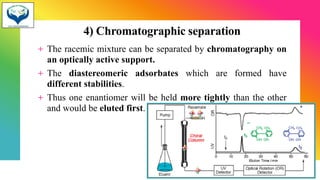
4) Chromatographic separation
+ The racemic mixture can be separated by chromatography on
an optically active support.
+ The diastereomeric adsorbates which are formed have
different stabilities.
+ Thus one enantiomer will be held more tightly than the other
and would be eluted first.10
20
5) Kinetic method
+ This method is based on the fact that one of the enantiomer of
racemic mixture reacts faster than other with optically active
compound.
+ Eg: Menthol reacts faster with (+) mandelic acid than with (-)
mandelic acid.
+ Thus with difference in kinetics of reaction, racemic mixture
can be separated.
3/1/20XX 21
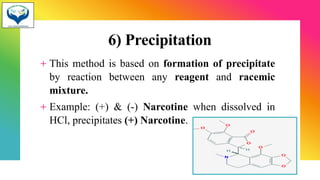
6) Precipitation
+ This method is based on formation of precipitate
by reaction between any reagent and racemic
mixture.
+ Example: (+) & (-) Narcotine when dissolved in
HCl, precipitates (+) Narcotine.
22
7) By Diastereomers
+ When racemic mixture is allowed to interact with optically
active material, it give a diastereomeric derivatives.
+ Diastereomer have different physical properties and hence
can easily separated into two component by fractional
crystallization.
23
Asymmetric
Synthesis:
Partial &
Absolute
Sample footer text 3/1/20XX 24
Asymmetric Synthesis
+ The direct synthesis of an optically active compound from a
symmetric compound (optically inactive) with or without the
use of optically active reagent is known as asymmetric
synthesis.
The major approaches of asymmetric synthesis:
+ These are of two types
1) Partial asymmetric synthesis
2) Absolute asymmetric synthesis
Sample footer text 3/1/20XX 25
A) Partial Asymmetric synthesis
+ An optically active compound synthesised directly from
symmetric (achiral) compound by the intermediate use of semi
optically active compound is known as partial asymmetric
synthesis.
+ Examples:
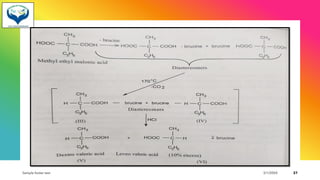
1) Preparation of valeric acid from methyl ethyl malonic acid
with the aid of brucine.
Sample footer text 3/1/20XX 26
Sample footer text 3/1/20XX 27
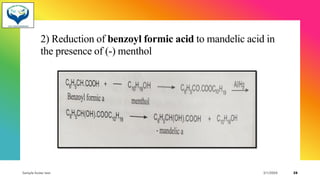
2) Reduction of benzoyl formic acid to mandelic acid in
the presence of (-) menthol
Sample footer text 3/1/20XX 28
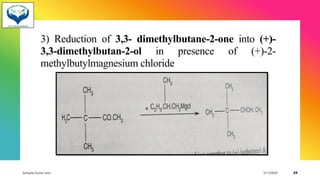
3) Reduction of 3,3- dimethylbutane-2-one into (+)-
3,3-dimethylbutan-2-ol in presence of (+)-2-
methylbutylmagnesium chloride
Sample footer text 3/1/20XX 29
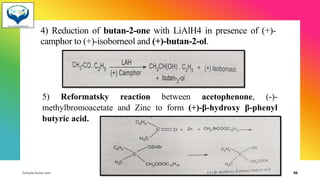
4) Reduction of butan-2-one with LiAlH4 in presence of (+)-
camphor to (+)-isoborneol and (+)-butan-2-ol.
Sample footer text 3/1/20XX 30
5) Reformatsky reaction between acetophenone, (-)-
methylbromoacetate and Zinc to form (+)-β-hydroxy β-phenyl
butyric acid.
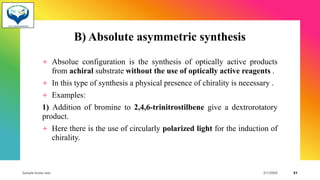
B) Absolute asymmetric synthesis
+ Absolue configuration is the synthesis of optically active products
from achiral substrate without the use of optically active reagents .
+ In this type of synthesis a physical presence of chirality is necessary .
+ Examples:
1) Addition of bromine to 2,4,6-trinitrostilbene give a dextrorotatory
product.
+ Here there is the use of circularly polarized light for the induction of
chirality.
Sample footer text 3/1/20XX 31
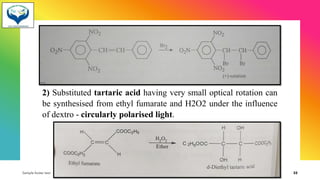
2) Substituted tartaric acid having very small optical rotation can
be synthesised from ethyl fumarate and H2O2 under the influence
of dextro - circularly polarised light.
Sample footer text 3/1/20XX 32
The way to get
started is to quit
talking and
begin doing.
Walt Disney
33

Optical isomerism

  • 1.
    REACTION OF CHIRAL MOLECULES Lecture by SOWMIYAPERINBARAJ, M.Pharm Assistant Professor Dept. of Pharmaceutical Chemistry SVCP
  • 2.
    Introduction ❖ Chiral moleculesundergoes three major reactions at the chiral centre. 1)Inversion 2)Retention 3)Racemisation 2
  • 3.
    1. INVERSION ➢ Aprocess in which the relative configuration of an atom is changed. ➢ It follows SN2 Mechanism ➢ R isomer S isomer ➢ S isomer R isomer. ➢ Eg: isobutyl chloride 3
  • 4.
    2. RACEMISATION ❑ Theprocess in which optically active compounds are converted into optically inactive compounds with zero optical activity. ❑ R isomer RR, RS isomer ❑ S isomer RS , SS isomer ❑ Racemic mixture: ❑ A mixture containing equal amount of d/l enantiomers (50:50) ❑ They are optically inactive. 4
  • 5.
  • 6.
    3. RETENTION ✓ Itis the process in which configuration of substrate and product remains the same. ✓ In this reaction, bonds of chiral atoms do not break. ➢ R isomer R isomer ➢ S isomer S isomer. ➢ Eg: isoheptylchloride and isoheptylbromide 6
  • 7.
    Racemic Modification & Resolution of Racemicmixture Sample footer text 3/1/20XX 7
  • 8.
    Racemic modification ❑ Racemicmodification is the process of mixing of equal amounts of a pair of enantiomers and is optically inactive due to external compensation. ❑ Such a mixture is called Racemic mixture represented as dl or (+-) ❑ When enantiomers are mixed together, the rotation caused by a molecule of one isomer is exactly balanced by an equal and opposite rotation caused by another molecule of its enantiomer. 8
  • 9.
    Preparation of Racemicmodification 1) By Mixing ❖ This is done by mixing of exactly equal amounts of two enantiomers (d/l or (+-). ❖ Louis Pasteur studied a sample of (+-) –sodium ammonium tartrate (racemic mixture) which contains 50% (+) – enantiomers and 50% (-) –enantiomers. 9
  • 10.
    2) By Synthesis +The synthesis of asymmetric compounds from symmetric compounds in the absence of optically active catalyst or circulated polarised light always produce a racemic modification. + Eg: Formation of lactonitrile from acetaldehyde 10
  • 11.
    3) By Racemisation ➢Racemisation is the process of converting an optically active (d/l) compound into the racemic modification. ➢ Racemization is the process of production of racemic modification starting with one of the pure enantiomers. ➢ Important mechanisms for racemisation are A) Thermal racemisation B) By anion formation C) By cation formation D) By reversible formation of stable inactive intermediates E) By walden inversion F) By chemical transformation 11
  • 12.
    A) THERMAL RACEMISATION oHeating at a higher temperature make homolytic splitting of one of the four bonds attached to the asymmetric carbon atoms. o Eg: The racemization of a α-phenethyl chloride on distillation at atmospheric pressure may be of this type. B) By Anion formation o Since the carbanions are generally planar, they are optically inactive. The formation of carbanion intermediates is the common practice of racemisation. o The ease of racemisation depends upon the acidity of hydrogen atom o The more liable and acidic the hydrogen atom , the greater is ease of racemisation. Sample footer text 3/1/20XX 12
  • 13.
    c) By cationformation ✓ Formation of cation as intermediates results in racemisation. ✓ Eg: (+)-1-chloroethylbenzene racemises on treatment with antimony pentasulphide. D) By reversible formation of stable inactive intermediates ✓ Mechanism is same as that of anion and cation formation, but here symmetrical, non-ionic stable intermediate is formed. ✓ Eg: optically active 1-chloroethylbenzene racemises easily in liquid SO2, By a dehydrohalogenation process. 13
  • 14.
    E) By Waldeninversion ▪ Certain SN2 reactions involving symmetric centres proceed with inversion of configuration and thus may cause racemisation of the original optically active compound. ▪ Eg: The racemization of 2-iodooctane by potassium iodide in refluxing acetone. F) By Chemical transformation ▪ In this method, an enantiomer is converted into racemic modification without breaking any of the bond. ▪ Eg: 5-methyl-2-cyclohexyl acid phthalate has been racemised in aqueous acetone at 100 °C. 14
  • 15.
    Resolution of Racemic modification ➢The process of separating a racemic modification into its pure enantiomers is known as resolution. ➢ The enantiomers of the racemate must be temporarily converted into diastereomers. ➢ It is quantitative and sometimes only one isomer will be isolated. ➢ Several methods have been developed and type of separation will be selected depending upon the nature of compound. 15
  • 16.
  • 17.
    1) Mechanical separation ❖Introduced by Pasteur and also known as spontaneous resolution by crytallisation. ❖ Applicable only for the racemic mixtures where the crystal forms of enantiomers are enantiomorphous – which are separated by hand. ❖ Pasteur separated sodium ammonium tartrate racemate in this way ❖ He crystallized sodium ammonium tartrate racemate from a concentrated solution at room temperature below 28 0C and separated mechanically. ❖ The crystals of two forms have different shapes, can be separated using magnifying lens and a small forceps. 17
  • 18.
    2) Preferential crystallizationby inoculation + This method involve seeding of a saturated solution of the racemic mixture with a pure crystal of one of the two enantiomers. + The solution now become supersaturated with respect to the added enantiomers. + It begins to crystallise out. + Eg. Resolution of free α-amino acid by adding corresponding d/l isomers of amino acid. 18
  • 19.
    3) Biochemical separation +It was introduced by Pasteur in 1858. + This method is based on fact that when certain micro organisms like bacteria, fungi, yeast, moulds, etc are grown in dilute solution of racemic mixture, they eat up one enantiomer rapidly than other. + Example: the mould Penicillium glaucum preferentially destroys the (+) isomer of racemic ammonium tartarate leaving (-) ammonium tartarate in solution.9 19
  • 20.
    4) Chromatographic separation +The racemic mixture can be separated by chromatography on an optically active support. + The diastereomeric adsorbates which are formed have different stabilities. + Thus one enantiomer will be held more tightly than the other and would be eluted first.10 20
  • 21.
    5) Kinetic method +This method is based on the fact that one of the enantiomer of racemic mixture reacts faster than other with optically active compound. + Eg: Menthol reacts faster with (+) mandelic acid than with (-) mandelic acid. + Thus with difference in kinetics of reaction, racemic mixture can be separated. 3/1/20XX 21
  • 22.
    6) Precipitation + Thismethod is based on formation of precipitate by reaction between any reagent and racemic mixture. + Example: (+) & (-) Narcotine when dissolved in HCl, precipitates (+) Narcotine. 22
  • 23.
    7) By Diastereomers +When racemic mixture is allowed to interact with optically active material, it give a diastereomeric derivatives. + Diastereomer have different physical properties and hence can easily separated into two component by fractional crystallization. 23
  • 24.
  • 25.
    Asymmetric Synthesis + Thedirect synthesis of an optically active compound from a symmetric compound (optically inactive) with or without the use of optically active reagent is known as asymmetric synthesis. The major approaches of asymmetric synthesis: + These are of two types 1) Partial asymmetric synthesis 2) Absolute asymmetric synthesis Sample footer text 3/1/20XX 25
  • 26.
    A) Partial Asymmetricsynthesis + An optically active compound synthesised directly from symmetric (achiral) compound by the intermediate use of semi optically active compound is known as partial asymmetric synthesis. + Examples: 1) Preparation of valeric acid from methyl ethyl malonic acid with the aid of brucine. Sample footer text 3/1/20XX 26
  • 27.
    Sample footer text3/1/20XX 27
  • 28.
    2) Reduction ofbenzoyl formic acid to mandelic acid in the presence of (-) menthol Sample footer text 3/1/20XX 28
  • 29.
    3) Reduction of3,3- dimethylbutane-2-one into (+)- 3,3-dimethylbutan-2-ol in presence of (+)-2- methylbutylmagnesium chloride Sample footer text 3/1/20XX 29
  • 30.
    4) Reduction ofbutan-2-one with LiAlH4 in presence of (+)- camphor to (+)-isoborneol and (+)-butan-2-ol. Sample footer text 3/1/20XX 30 5) Reformatsky reaction between acetophenone, (-)- methylbromoacetate and Zinc to form (+)-β-hydroxy β-phenyl butyric acid.
  • 31.
    B) Absolute asymmetricsynthesis + Absolue configuration is the synthesis of optically active products from achiral substrate without the use of optically active reagents . + In this type of synthesis a physical presence of chirality is necessary . + Examples: 1) Addition of bromine to 2,4,6-trinitrostilbene give a dextrorotatory product. + Here there is the use of circularly polarized light for the induction of chirality. Sample footer text 3/1/20XX 31
  • 32.
    2) Substituted tartaricacid having very small optical rotation can be synthesised from ethyl fumarate and H2O2 under the influence of dextro - circularly polarised light. Sample footer text 3/1/20XX 32
  • 33.
    The way toget started is to quit talking and begin doing. Walt Disney 33