
STEREOCHEMISTRY
Dr. Ashwani Dhingra
Associate Professor
GGSCOP, Yamunanagar
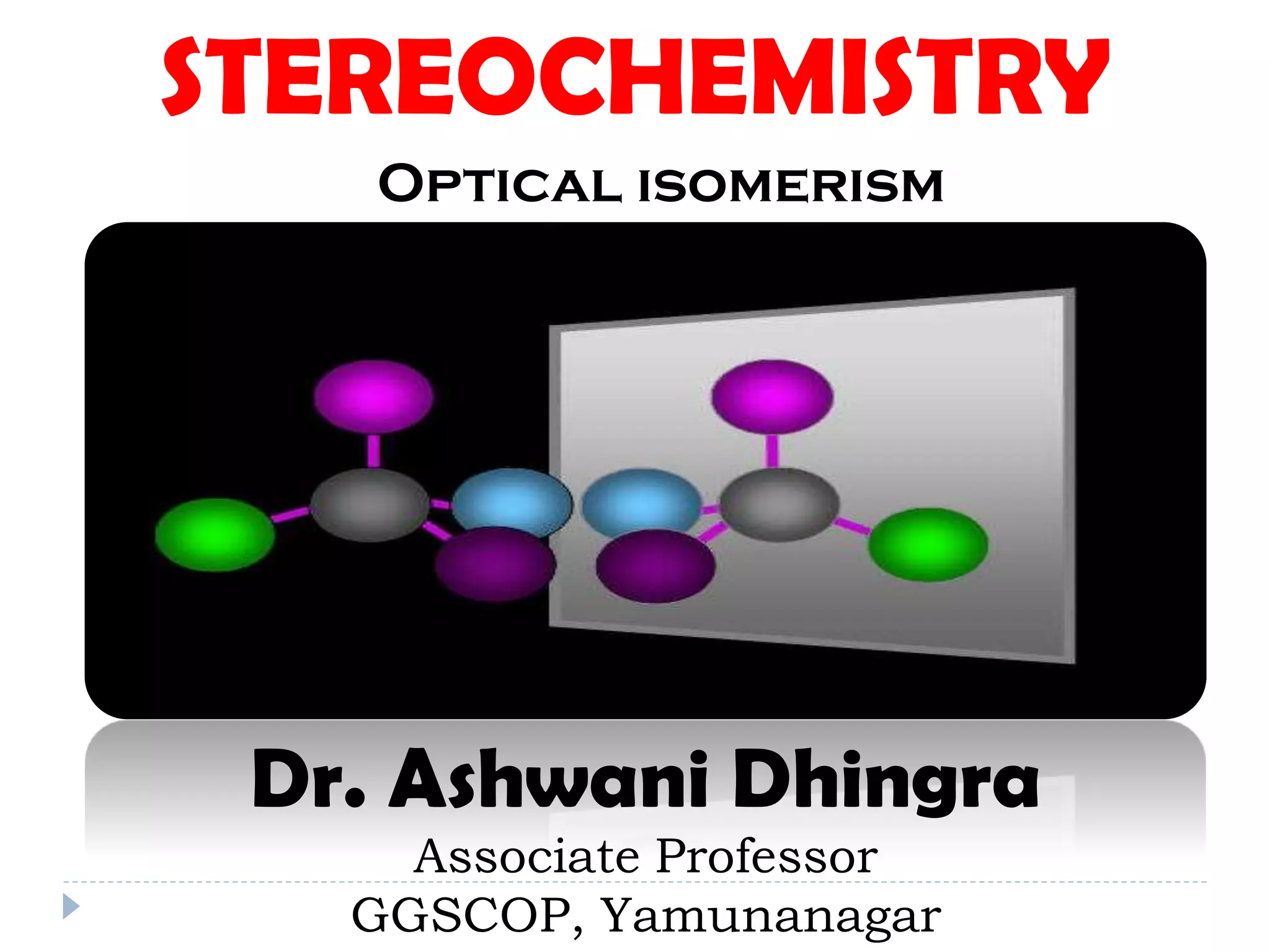
Optical isomerism
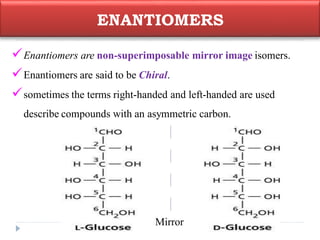
Enantiomers are non-superimposable mirror image isomers.
Enantiomers are said to be Chiral.
sometimes the terms right-handed and left-handed are used
describe compounds with an asymmetric carbon.
ENANTIOMERS
Mirror
Characteristic of enantiomers
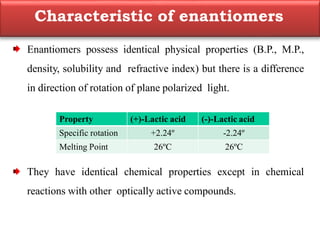
Enantiomers possess identical physical properties (B.P., M.P.,
density, solubility and refractive index) but there is a difference
in direction of rotation of plane polarized light.
They have identical chemical properties except in chemical
reactions with other optically active compounds.
Property (+)-Lactic acid (-)-Lactic acid
Specific rotation +2.24º -2.24º
Melting Point 26ºC 26ºC
Characteristic of enantiomers
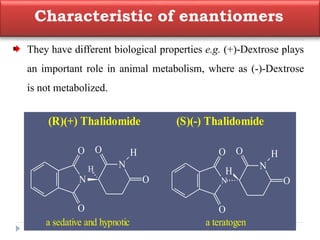
They have different biological properties e.g. (+)-Dextrose plays
an important role in animal metabolism, where as (-)-Dextrose
is not metabolized.
(R)(+) Thalidomide (S)(-) Thalidomide
N
N
O
O
O
O
H
H
a sedative and hypnotic a teratogen
N
N
O
O
O
O
H
H
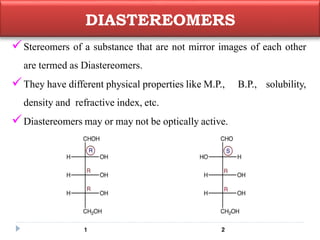
Stereomers of a substance that are not mirror images of each other
are termed as Diastereomers.
They have different physical properties like M.P., B.P., solubility,
density and refractive index, etc.
Diastereomers may or may not be optically active.
DIASTEREOMERS
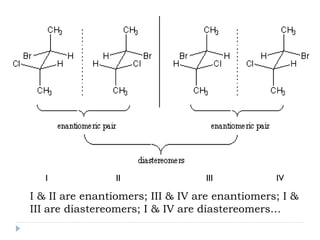
I II III IV
I & II are enantiomers; III & IV are enantiomers; I &
III are diastereomers; I & IV are diastereomers…
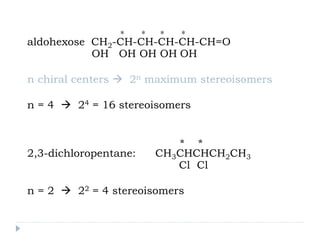
* * * *
aldohexose CH2-CH-CH-CH-CH-CH=O
OH OH OH OH OH
n chiral centers  2n maximum stereoisomers
n = 4  24 = 16 stereoisomers
* *
2,3-dichloropentane: CH3CHCHCH2CH3
Cl Cl
n = 2  22 = 4 stereoisomers
A molecule will not be chiral if it possesses:
 plane of symmetry (s)
 center of symmetry (c)
 n fold alternating axis of symmetry (Sn or Cn) where n is an even
number.
 The presence of a single chiral center indicates chirality of a
molecule. Another way to recognize chirality is to detect the
presence of some symmetry elements.
Symmetry Elements and Chirality
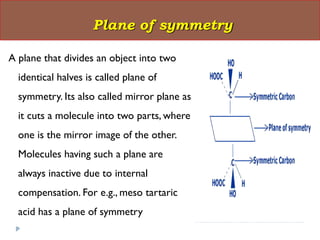
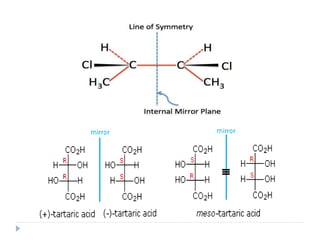
A plane that divides an object into two
identical halves is called plane of
symmetry. Its also called mirror plane as
it cuts a molecule into two parts, where
one is the mirror image of the other.
Molecules having such a plane are
always inactive due to internal
compensation. For e.g., meso tartaric
acid has a plane of symmetry
Plane of symmetry
MESO COMPOUND
The compounds which are having internal plane of symmetry are
known as Meso compounds.
Meso compounds are achiral compounds with multiple chiral
centers.
Meso compounds are optically inactive.
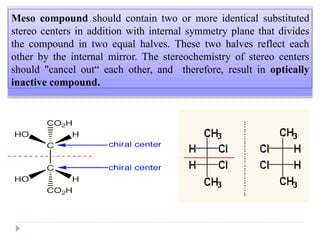
Meso compound should contain two or more identical substituted
stereo centers in addition with internal symmetry plane that divides
the compound in two equal halves. These two halves reflect each
other by the internal mirror. The stereochemistry of stereo centers
should "cancel out“ each other, and therefore, result in optically
inactive compound.
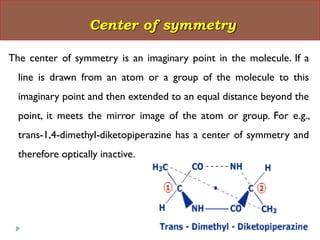
The center of symmetry is an imaginary point in the molecule. If a
line is drawn from an atom or a group of the molecule to this
imaginary point and then extended to an equal distance beyond the
point, it meets the mirror image of the atom or group. For e.g.,
trans-1,4-dimethyl-diketopiperazine has a center of symmetry and
therefore optically inactive.
Center of symmetry
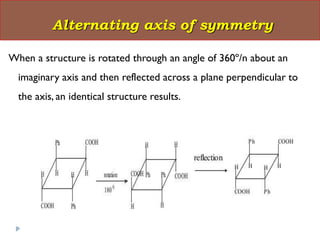
When a structure is rotated through an angle of 360º/n about an
imaginary axis and then reflected across a plane perpendicular to
the axis, an identical structure results.
Alternating axis of symmetry
RACEMIC MIXTURE
An equimolar mixture of two enantiomers is known as racemic
mixture or racemic modification.
It is denoted by the prefix (±)- or dl- (for sugars the prefix DL- may
be used), indicating an equal (1:1) mixture of dextro and levo
isomers. Also the prefix symbols RS and SR (all in italic letters) are
used.
The process of separation individual enantiomers from racemic
mixture is known as Resolution.
The following are various methods used for resolution of racemic
mixtures:
Mechanical Separation
Preferential Crystallization
Biochemical Method
Chemical Method
Chromatographic Method
Resolution
Mechanical separation
 This method is based on mechanically separation of
the individual crystals of enantiomers from racemic
mixture on the basis of differences in their
shapes/structure.
 This method was first of all used by Pasteur. He
separated crystals of sodium ammonium tartarete
racemate by using lens and forceps (mechanical
separation) in 1848.
 This is very time consuming method.
Below a certain temperature the enantiomorphs
crystallize separately. Above this temperature they
crystallize as the racemic variety. Preferential
crystallization can be carried out with the help of
addition solvent known as co-solvents. The nature of
the co-solvents affects the temperature. This method is
not popular nowadays because it gives rise to
experimental difficulties.
Preferential Crystallization
Biochemical separation
Separation of enantiomers from racemic mixture with the help of
microorganisms. Pasteur was the first to try out this method in 1858.
In this method one of the optical isomers can be destroyed
selectively at a faster rate by the action of bacteria, moulds or fungi.
For e.g., when Pencillium glaucum (green mould) is grown in an (±)-
ammonium tartrate racemate solution, it destroys the (+)-tartrate by
assimilation wheras the (-) tartrate remains unaffected.
Disadvantages: One isomer is completely lost.
Advantage: One isomer obtain of 100% purity.
Chemical Method
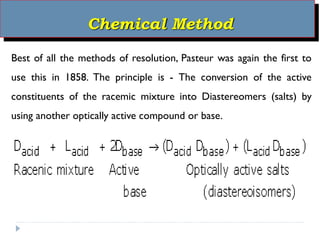
Best of all the methods of resolution, Pasteur was again the first to
use this in 1858. The principle is - The conversion of the active
constituents of the racemic mixture into Diastereomers (salts) by
using another optically active compound or base.
Chromatographic Method
The separation of individual compound from mixture with the help
of mobile phase and stationary phase is known as chromatography.
Optically active adsorbents can selectively adsorb some other
optically active substances. For e.g., Henderson and Rule in 1939
used dextro-lactose as an adsorbent to separate active constituents
of racemic camphor.
Thank
You

Stereochemistry (Optical Isomerism)

  • 1.
    STEREOCHEMISTRY Dr. Ashwani Dhingra AssociateProfessor GGSCOP, Yamunanagar Optical isomerism
  • 2.
    Enantiomers are non-superimposablemirror image isomers. Enantiomers are said to be Chiral. sometimes the terms right-handed and left-handed are used describe compounds with an asymmetric carbon. ENANTIOMERS Mirror
  • 3.
    Characteristic of enantiomers Enantiomerspossess identical physical properties (B.P., M.P., density, solubility and refractive index) but there is a difference in direction of rotation of plane polarized light. They have identical chemical properties except in chemical reactions with other optically active compounds. Property (+)-Lactic acid (-)-Lactic acid Specific rotation +2.24º -2.24º Melting Point 26ºC 26ºC
  • 4.
    Characteristic of enantiomers Theyhave different biological properties e.g. (+)-Dextrose plays an important role in animal metabolism, where as (-)-Dextrose is not metabolized. (R)(+) Thalidomide (S)(-) Thalidomide N N O O O O H H a sedative and hypnotic a teratogen N N O O O O H H
  • 5.
    Stereomers of asubstance that are not mirror images of each other are termed as Diastereomers. They have different physical properties like M.P., B.P., solubility, density and refractive index, etc. Diastereomers may or may not be optically active. DIASTEREOMERS
  • 6.
    I II IIIIV I & II are enantiomers; III & IV are enantiomers; I & III are diastereomers; I & IV are diastereomers…
  • 7.
    * * ** aldohexose CH2-CH-CH-CH-CH-CH=O OH OH OH OH OH n chiral centers  2n maximum stereoisomers n = 4  24 = 16 stereoisomers * * 2,3-dichloropentane: CH3CHCHCH2CH3 Cl Cl n = 2  22 = 4 stereoisomers
  • 8.
    A molecule willnot be chiral if it possesses:  plane of symmetry (s)  center of symmetry (c)  n fold alternating axis of symmetry (Sn or Cn) where n is an even number.  The presence of a single chiral center indicates chirality of a molecule. Another way to recognize chirality is to detect the presence of some symmetry elements. Symmetry Elements and Chirality
  • 9.
    A plane thatdivides an object into two identical halves is called plane of symmetry. Its also called mirror plane as it cuts a molecule into two parts, where one is the mirror image of the other. Molecules having such a plane are always inactive due to internal compensation. For e.g., meso tartaric acid has a plane of symmetry Plane of symmetry
  • 11.
    MESO COMPOUND The compoundswhich are having internal plane of symmetry are known as Meso compounds. Meso compounds are achiral compounds with multiple chiral centers. Meso compounds are optically inactive.
  • 12.
    Meso compound shouldcontain two or more identical substituted stereo centers in addition with internal symmetry plane that divides the compound in two equal halves. These two halves reflect each other by the internal mirror. The stereochemistry of stereo centers should "cancel out“ each other, and therefore, result in optically inactive compound.
  • 13.
    The center ofsymmetry is an imaginary point in the molecule. If a line is drawn from an atom or a group of the molecule to this imaginary point and then extended to an equal distance beyond the point, it meets the mirror image of the atom or group. For e.g., trans-1,4-dimethyl-diketopiperazine has a center of symmetry and therefore optically inactive. Center of symmetry
  • 14.
    When a structureis rotated through an angle of 360º/n about an imaginary axis and then reflected across a plane perpendicular to the axis, an identical structure results. Alternating axis of symmetry
  • 15.
    RACEMIC MIXTURE An equimolarmixture of two enantiomers is known as racemic mixture or racemic modification. It is denoted by the prefix (±)- or dl- (for sugars the prefix DL- may be used), indicating an equal (1:1) mixture of dextro and levo isomers. Also the prefix symbols RS and SR (all in italic letters) are used. The process of separation individual enantiomers from racemic mixture is known as Resolution.
  • 16.
    The following arevarious methods used for resolution of racemic mixtures: Mechanical Separation Preferential Crystallization Biochemical Method Chemical Method Chromatographic Method Resolution
  • 17.
    Mechanical separation  Thismethod is based on mechanically separation of the individual crystals of enantiomers from racemic mixture on the basis of differences in their shapes/structure.  This method was first of all used by Pasteur. He separated crystals of sodium ammonium tartarete racemate by using lens and forceps (mechanical separation) in 1848.  This is very time consuming method.
  • 18.
    Below a certaintemperature the enantiomorphs crystallize separately. Above this temperature they crystallize as the racemic variety. Preferential crystallization can be carried out with the help of addition solvent known as co-solvents. The nature of the co-solvents affects the temperature. This method is not popular nowadays because it gives rise to experimental difficulties. Preferential Crystallization
  • 19.
    Biochemical separation Separation ofenantiomers from racemic mixture with the help of microorganisms. Pasteur was the first to try out this method in 1858. In this method one of the optical isomers can be destroyed selectively at a faster rate by the action of bacteria, moulds or fungi. For e.g., when Pencillium glaucum (green mould) is grown in an (±)- ammonium tartrate racemate solution, it destroys the (+)-tartrate by assimilation wheras the (-) tartrate remains unaffected. Disadvantages: One isomer is completely lost. Advantage: One isomer obtain of 100% purity.
  • 20.
    Chemical Method Best ofall the methods of resolution, Pasteur was again the first to use this in 1858. The principle is - The conversion of the active constituents of the racemic mixture into Diastereomers (salts) by using another optically active compound or base.
  • 21.
    Chromatographic Method The separationof individual compound from mixture with the help of mobile phase and stationary phase is known as chromatography. Optically active adsorbents can selectively adsorb some other optically active substances. For e.g., Henderson and Rule in 1939 used dextro-lactose as an adsorbent to separate active constituents of racemic camphor.
  • 22.