Unit II
GEOMETRICAL
ISOMERISM
Lecture by
SOWMIYA PERINBARAJ, M.Pharm
Assistant Professor
Dept. of Pharmaceutical Chemistry
SVCP
INTRODUCTION
+ In 1875, Vant’t Hoff and Le Bel recognised another type of stereoisomerism in
organic molecules having two differently substituted atoms to each other by
means of a double bond (C=C).
+ The geometrical isomerism arises when atoms or groups are arranged
differently in space due to restricted rotation of a double bond in a molecule.
+ The carbon-carbon double bonds consist of σ bond and π bond.
+ The presence of π bond locks the molecule in one position, therefore rotation
around the C=C bond is not possible.
+ Geometrical isomer have same molecular formula and structural formula
+ But it has different orientation (spatial arrangement of atoms) due to presence of
double bonds or rings.
2
+ In general Geometrical isomerism is shown by alkenes or their
derivatives in which two different atoms or groups are attached to
each carbon containing the double bond.
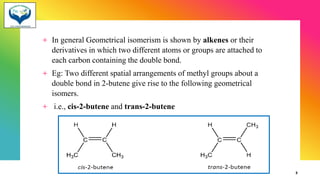
+ Eg: Two different spatial arrangements of methyl groups about a
double bond in 2-butene give rise to the following geometrical
isomers.
+ i.e., cis-2-butene and trans-2-butene
3
NOMENCLATURE OF GEOMETRICAL
ISOMERISM
+ To represent the various geometrical isomers following nomenclatures are used.
❖ Cis-Trans nomenclature
❖ E-Z nomenclature
❖ Syn-Anti nomenclature
Cis-Trans nomenclature:
✓ Geometrical isomerism is commonly known as Cis-Trans isomerism.
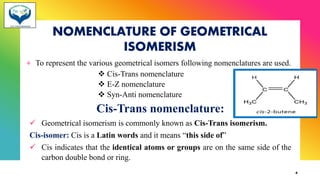
Cis-isomer: Cis is a Latin words and it means “this side of”
✓ Cis indicates that the identical atoms or groups are on the same side of the
carbon double bond or ring.
4
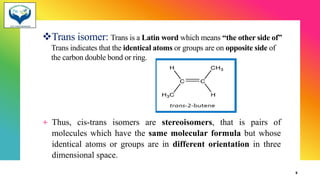
❖Trans isomer: Trans is a Latin word which means “the other side of”
Trans indicates that the identical atoms or groups are on opposite side of
the carbon double bond or ring.
+ Thus, cis-trans isomers are stereoisomers, that is pairs of
molecules which have the same molecular formula but whose
identical atoms or groups are in different orientation in three
dimensional space.
5
Examples:
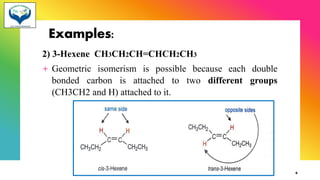
2) 3-Hexene CH3CH2CH=CHCH2CH3
+ Geometric isomerism is possible because each double
bonded carbon is attached to two different groups
(CH3CH2 and H) attached to it.
6
Examples:
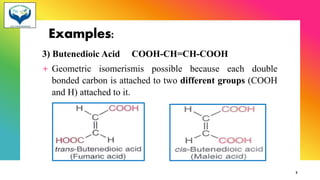
3) Butenedioic Acid COOH-CH=CH-COOH
+ Geometric isomerismis possible because each double
bonded carbon is attached to two different groups (COOH
and H) attached to it.
7
Properties:
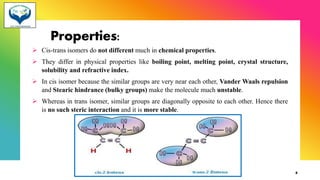
➢ Cis-trans isomers do not different much in chemical properties.
➢ They differ in physical properties like boiling point, melting point, crystal structure,
solubility and refractive index.
➢ In cis isomer because the similar groups are very near each other, Vander Waals repulsion
and Stearic hindrance (bulky groups) make the molecule much unstable.
➢ Whereas in trans isomer, similar groups are diagonally opposite to each other. Hence there
is no such steric interaction and it is more stable.
8
Properties:
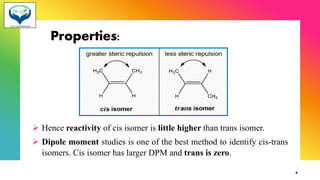
➢ Hence reactivity of cis isomer is little higher than trans isomer.
➢ Dipole moment studies is one of the best method to identify cis-trans
isomers. Cis isomer has larger DPM and trans is zero.
9
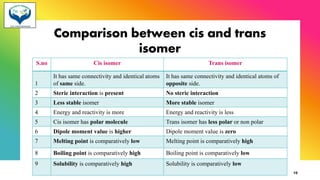
Comparison between cis and trans
isomer
S.no Cis isomer Trans isomer
1
It has same connectivity and identical atoms
of same side.
It has same connectivity and identical atoms of
opposite side.
2 Steric interaction is present No steric interaction
3 Less stable isomer More stable isomer
4 Energy and reactivity is more Energy and reactivity is less
5 Cis isomer has polar molecule Trans isomer has less polar or non polar
6 Dipole moment value is higher Dipole moment value is zero
7 Melting point is comparatively low Melting point is comparatively high
8 Boiling point is comparatively high Boiling point is comparatively low
9 Solubility is comparatively high Solubility is comparatively low
10
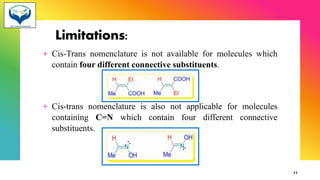
Limitations:
+ Cis-Trans nomenclature is not available for molecules which
contain four different connective substituents.
+ Cis-trans nomenclature is also not applicable for molecules
containing C=N which contain four different connective
substituents.
11
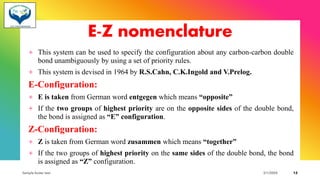
E-Z nomenclature
+ This system can be used to specify the configuration about any carbon-carbon double
bond unambiguously by using a set of priority rules.
+ This system is devised in 1964 by R.S.Cahn, C.K.Ingold and V.Prelog.
E-Configuration:
+ E is taken from German word entgegen which means “opposite”
+ If the two groups of highest priority are on the opposite sides of the double bond,
the bond is assigned as “E” configuration.
Z-Configuration:
+ Z is taken from German word zusammen which means “together”
+ If the two groups of highest priority on the same sides of the double bond, the bond
is assigned as “Z” configuration.
Sample footer text 3/1/20XX 12
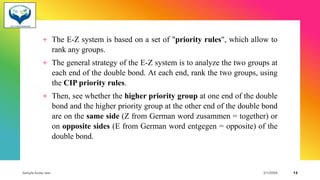
+ The E-Z system is based on a set of "priority rules", which allow to
rank any groups.
+ The general strategy of the E-Z system is to analyze the two groups at
each end of the double bond. At each end, rank the two groups, using
the CIP priority rules.
+ Then, see whether the higher priority group at one end of the double
bond and the higher priority group at the other end of the double bond
are on the same side (Z from German word zusammen = together) or
on opposite sides (E from German word entgegen = opposite) of the
double bond.
Sample footer text 3/1/20XX 13
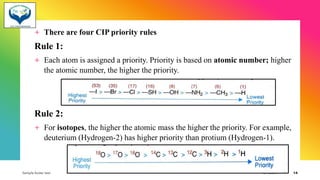
+ There are four CIP priority rules
Rule 1:
+ Each atom is assigned a priority. Priority is based on atomic number; higher
the atomic number, the higher the priority.
Rule 2:
+ For isotopes, the higher the atomic mass the higher the priority. For example,
deuterium (Hydrogen-2) has higher priority than protium (Hydrogen-1).
Sample footer text 3/1/20XX 14
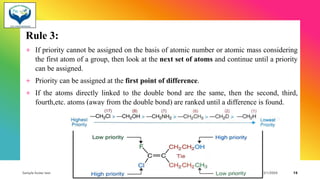
Rule 3:
+ If priority cannot be assigned on the basis of atomic number or atomic mass considering
the first atom of a group, then look at the next set of atoms and continue until a priority
can be assigned.
+ Priority can be assigned at the first point of difference.
+ If the atoms directly linked to the double bond are the same, then the second, third,
fourth,etc. atoms (away from the double bond) are ranked until a difference is found.
Sample footer text 3/1/20XX 15
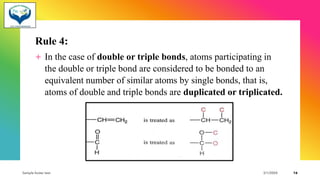
Rule 4:
+ In the case of double or triple bonds, atoms participating in
the double or triple bond are considered to be bonded to an
equivalent number of similar atoms by single bonds, that is,
atoms of double and triple bonds are duplicated or triplicated.
Sample footer text 3/1/20XX 16
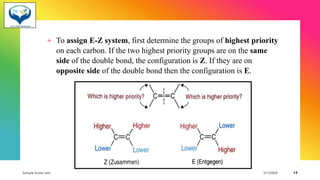
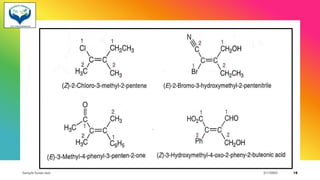
+ To assign E-Z system, first determine the groups of highest priority
on each carbon. If the two highest priority groups are on the same
side of the double bond, the configuration is Z. If they are on
opposite side of the double bond then the configuration is E.
Sample footer text 3/1/20XX 17
Sample footer text 3/1/20XX 18
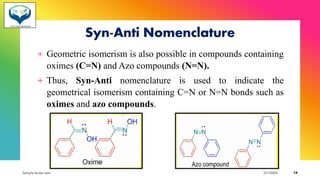
Syn-Anti Nomenclature
+ Geometric isomerism is also possible in compounds containing
oximes (C=N) and Azo compounds (N=N).
+ Thus, Syn-Anti nomenclature is used to indicate the
geometrical isomerism containing C=N or N=N bonds such as
oximes and azo compounds.
Sample footer text 3/1/20XX 19
Syn-Anti Nomenclature
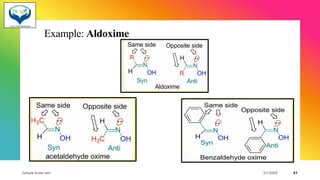
+ In aldoxime, the syn or anti configuration is determined by the position
of the lone pair of electrons on nitrogen atom with respect to alkyl (R)
or aryl (Ar) group.
Syn configuration:
+ In aldoxime, syn configuration is one in which the lone pair on nitrogen
and the alkyl or aryl group on same side or H and OH is present in
same side.
Anti configuration:
+ In aldoxime, anti configuration is one in which the lone pair on nitrogen
and the alkyl or aryl group on opposite side or H and OH is present in
opposite side.
Sample footer text 3/1/20XX 20
Example: Aldoxime
Sample footer text 3/1/20XX 21
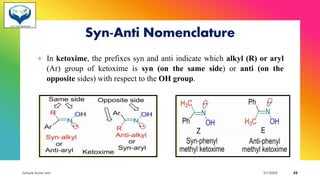
Syn-Anti Nomenclature
+ In ketoxime, the prefixes syn and anti indicate which alkyl (R) or aryl
(Ar) group of ketoxime is syn (on the same side) or anti (on the
opposite sides) with respect to the OH group.
Sample footer text 3/1/20XX 22
Syn-Anti Nomenclature
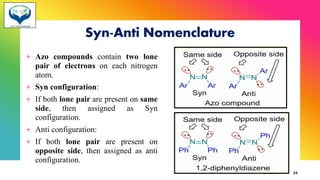
+ Azo compounds contain two lone
pair of electrons on each nitrogen
atom.
+ Syn configuration:
+ If both lone pair are present on same
side, then assigned as Syn
configuration.
+ Anti configuration:
+ If both lone pair are present on
opposite side, then assigned as anti
configuration.
3/1/20XX 23
Methods of
determination of
configuration of
geometrical isomers
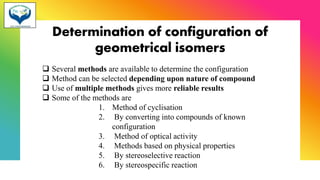
Determination of configuration of
geometrical isomers
❑ Several methods are available to determine the configuration
❑ Method can be selected depending upon nature of compound
❑ Use of multiple methods gives more reliable results
❑ Some of the methods are
1. Method of cyclisation
2. By converting into compounds of known
configuration
3. Method of optical activity
4. Methods based on physical properties
5. By stereoselective reaction
6. By stereospecific reaction
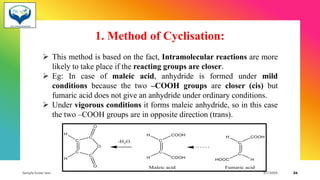
1. Method of Cyclisation:
➢ This method is based on the fact, Intramolecular reactions are more
likely to take place if the reacting groups are closer.
➢ Eg: In case of maleic acid, anhydride is formed under mild
conditions because the two –COOH groups are closer (cis) but
fumaric acid does not give an anhydride under ordinary conditions.
➢ Under vigorous conditions it forms maleic anhydride, so in this case
the two –COOH groups are in opposite direction (trans).
Sample footer text 3/1/20XX 26
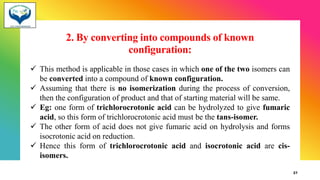
2. By converting into compounds of known
configuration:
✓ This method is applicable in those cases in which one of the two isomers can
be converted into a compound of known configuration.
✓ Assuming that there is no isomerization during the process of conversion,
then the configuration of product and that of starting material will be same.
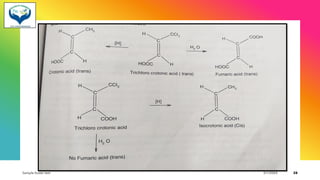
✓ Eg: one form of trichlorocrotonic acid can be hydrolyzed to give fumaric
acid, so this form of trichlorocrotonic acid must be the tans-isomer.
✓ The other form of acid does not give fumaric acid on hydrolysis and forms
isocrotonic acid on reduction.
✓ Hence this form of trichlorocrotonic acid and isocrotonic acid are cis-
isomers.
27
Sample footer text 3/1/20XX 28
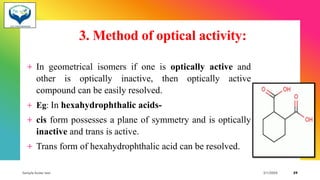
3. Method of optical activity:
+ In geometrical isomers if one is optically active and
other is optically inactive, then optically active
compound can be easily resolved.
+ Eg: In hexahydrophthalic acids-
+ cis form possesses a plane of symmetry and is optically
inactive and trans is active.
+ Trans form of hexahydrophthalic acid can be resolved.
Sample footer text 3/1/20XX 29
4. Methods based on physical
properties
A) Dipole moment:
+ The dipole moment of cis form is generally higher than that of trans
form
+ Eg: In the case of 1,2 dichloroethylene cis isomer is generally have
1.80 D and trans isomer have zero dipole moment.
Sample footer text 3/1/20XX 30
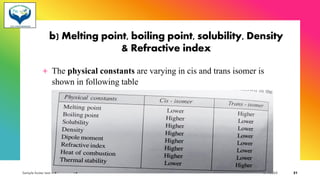
b) Melting point, boiling point, solubility, Density
& Refractive index
+ The physical constants are varying in cis and trans isomer is
shown in following table
Sample footer text 3/1/20XX 31
Sample footer text 3/1/20XX 32
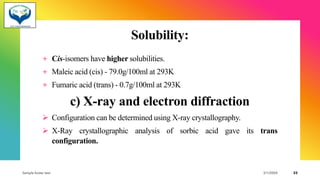
Solubility:
+ Cis-isomers have higher solubilities.
+ Maleic acid (cis) - 79.0g/100ml at 293K
+ Fumaric acid (trans) - 0.7g/100ml at 293K
c) X-ray and electron diffraction
➢ Configuration can be determined using X-ray crystallography.
➢ X-Ray crystallographic analysis of sorbic acid gave its trans
configuration.
Sample footer text 3/1/20XX 33
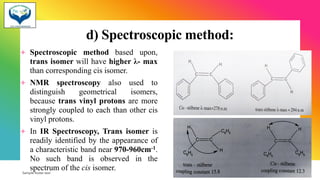
d) Spectroscopic method:
+ Spectroscopic method based upon,
trans isomer will have higher λ- max
than corresponding cis isomer.
+ NMR spectroscopy also used to
distinguish geometrical isomers,
because trans vinyl protons are more
strongly coupled to each than other cis
vinyl protons.
+ In IR Spectroscopy, Trans isomer is
readily identified by the appearance of
a characteristic band near 970-960cm-1.
No such band is observed in the
spectrum of the cis isomer.
Sample footer text 3/1/20XX 34
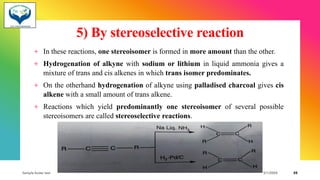
5) By stereoselective reaction
+ In these reactions, one stereoisomer is formed in more amount than the other.
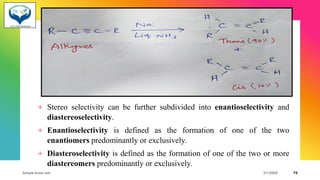
+ Hydrogenation of alkyne with sodium or lithium in liquid ammonia gives a
mixture of trans and cis alkenes in which trans isomer predominates.
+ On the otherhand hydrogenation of alkyne using palladised charcoal gives cis
alkene with a small amount of trans alkene.
+ Reactions which yield predominantly one stereoisomer of several possible
stereoisomers are called stereoselective reactions.
Sample footer text 3/1/20XX 35
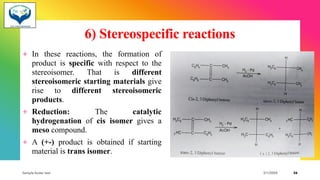
6) Stereospecific reactions
+ In these reactions, the formation of
product is specific with respect to the
stereoisomer. That is different
stereoisomeric starting materials give
rise to different stereoisomeric
products.
+ Reduction: The catalytic
hydrogenation of cis isomer gives a
meso compound.
+ A (+-) product is obtained if starting
material is trans isomer.
Sample footer text 3/1/20XX 36
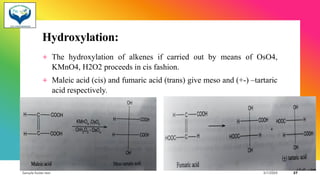
Hydroxylation:
+ The hydroxylation of alkenes if carried out by means of OsO4,
KMnO4, H2O2 proceeds in cis fashion.
+ Maleic acid (cis) and fumaric acid (trans) give meso and (+-) –tartaric
acid respectively.
Sample footer text 3/1/20XX 37
Conformational isomerism
+ Conformational isomerism is a form of stereo isomerism in which the
isomers can be interconverted just by rotations about single bonds.
+ Conformational isomers or conformers are different shapes of the
same molecule resulting from rotation around a single C-C bond.
+ They are not different compounds (i.e. they have the same physical
and chemical properties) and are readily interconvertible.
+ It is unstable and exchange in short time duration to another
conformer.
Sample footer text 3/1/20XX 38
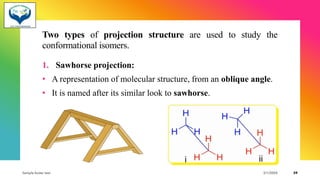
Two types of projection structure are used to study the
conformational isomers.
1. Sawhorse projection:
• A representation of molecular structure, from an oblique angle.
• It is named after its similar look to sawhorse.
Sample footer text 3/1/20XX 39
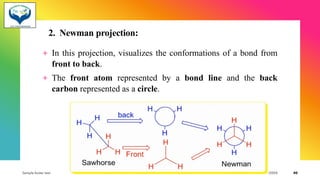
2. Newman projection:
+ In this projection, visualizes the conformations of a bond from
front to back.
+ The front atom represented by a bond line and the back
carbon represented as a circle.
Sample footer text 3/1/20XX 40
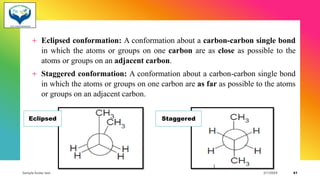
+ Eclipsed conformation: A conformation about a carbon-carbon single bond
in which the atoms or groups on one carbon are as close as possible to the
atoms or groups on an adjacent carbon.
+ Staggered conformation: A conformation about a carbon-carbon single bond
in which the atoms or groups on one carbon are as far as possible to the atoms
or groups on an adjacent carbon.
Sample footer text 3/1/20XX 41
Eclipsed Staggered
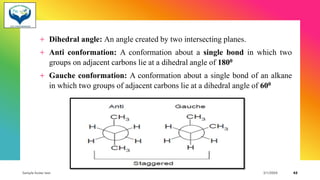
+ Dihedral angle: An angle created by two intersecting planes.
+ Anti conformation: A conformation about a single bond in which two
groups on adjacent carbons lie at a dihedral angle of 1800
+ Gauche conformation: A conformation about a single bond of an alkane
in which two groups of adjacent carbons lie at a dihedral angle of 600
Sample footer text 3/1/20XX 42
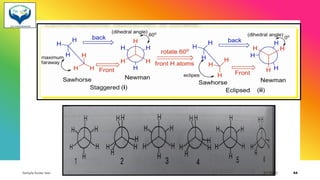
CONFORMATION OF ETHANE
+ The molecular formula of ethane is C2 H6
+ If one of the methyl groups is allowed to rotate along the C-C axis
keeping the rest of the molecule undisturbed, an infinite number of possible
arrangements of the rotated methyl group with respect to the undisturbed
methyl group is generated.
+ Each of these possible arrangement represents a conformation.
+ So, six possible conformations are obtained, out of which three are
staggered form in which the two hydrogen atoms on the different carbon
atoms are as far as possible (1,3,5).
+ Other Three are eclipsed in which the two hydrogen atoms on the different
carbon are as close as possible (2,4,6).
Sample footer text 3/1/20XX 43
Sample footer text 3/1/20XX 44
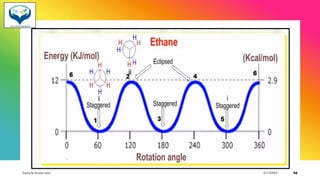
Energy barrier diagram of ethane
+ Staggered and eclipsed conformer have different energy.
+ Staggered conformer has least energy due to least steric hindrance and
it is most stable conformer.
+ Eclipsed conformer has highest energy due to maximum steric
hindrance and it is least stable conformer.
+ Torsional energy: Eclipsed conformer has 3 kcal/mole (12.6 kJ/mol)
than staggered. This energy is known as torsional energy.
+ Torsional angle: The angle between the front and back hydrogen is
dihedral (or torsional) angle.
Sample footer text 3/1/20XX 45
Sample footer text 3/1/20XX 46
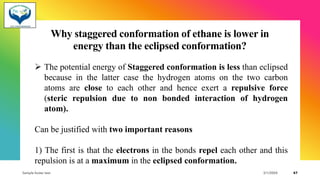
Why staggered conformation of ethane is lower in
energy than the eclipsed conformation?
➢ The potential energy of Staggered conformation is less than eclipsed
because in the latter case the hydrogen atoms on the two carbon
atoms are close to each other and hence exert a repulsive force
(steric repulsion due to non bonded interaction of hydrogen
atom).
Can be justified with two important reasons
1) The first is that the electrons in the bonds repel each other and this
repulsion is at a maximum in the eclipsed conformation.
Sample footer text 3/1/20XX 47
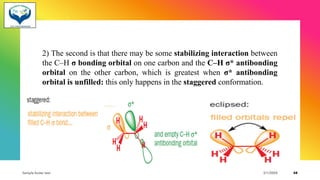
2) The second is that there may be some stabilizing interaction between
the C–H σ bonding orbital on one carbon and the C–H σ* antibonding
orbital on the other carbon, which is greatest when σ* antibonding
orbital is unfilled: this only happens in the staggered conformation.
Sample footer text 3/1/20XX 48
Sample footer text 3/1/20XX 49
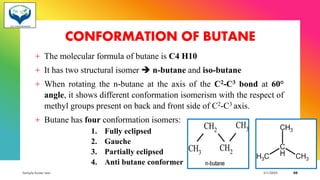
CONFORMATION OF BUTANE
+ The molecular formula of butane is C4 H10
+ It has two structural isomer ➔ n-butane and iso-butane
+ When rotating the n-butane at the axis of the C2-C3 bond at 60°
angle, it shows different conformation isomerism with the respect of
methyl groups present on back and front side of C2-C3 axis.
+ Butane has four conformation isomers:
1. Fully eclipsed
2. Gauche
3. Partially eclipsed
4. Anti butane conformer
Sample footer text 3/1/20XX 50
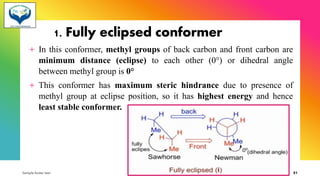
1. Fully eclipsed conformer
+ In this conformer, methyl groups of back carbon and front carbon are
minimum distance (eclipse) to each other (0°) or dihedral angle
between methyl group is 0°
+ This conformer has maximum steric hindrance due to presence of
methyl group at eclipse position, so it has highest energy and hence
least stable conformer.
Sample footer text 3/1/20XX 51
2. Gauche (staggered conformer)
+ In this conformer, methyl groups of back and front carbon are 60°
angle or dihedral angle between methyl group is 60°
+ This type of conformation is more stable and has less conformer
energy as there is a little steric hindrance between the same
molecules like Me-Me and H-H and Me-H.
Sample footer text 3/1/20XX 52
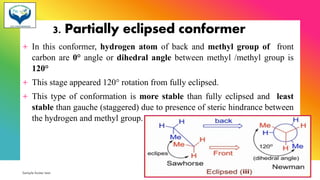
3. Partially eclipsed conformer
+ In this conformer, hydrogen atom of back and methyl group of front
carbon are 0° angle or dihedral angle between methyl /methyl group is
120°
+ This stage appeared 120° rotation from fully eclipsed.
+ This type of conformation is more stable than fully eclipsed and least
stable than gauche (staggered) due to presence of steric hindrance between
the hydrogen and methyl group.
Sample footer text 3/1/20XX 53
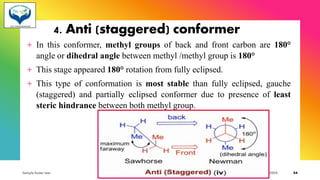
4. Anti (staggered) conformer
+ In this conformer, methyl groups of back and front carbon are 180°
angle or dihedral angle between methyl /methyl group is 180°
+ This stage appeared 180° rotation from fully eclipsed.
+ This type of conformation is most stable than fully eclipsed, gauche
(staggered) and partially eclipsed conformer due to presence of least
steric hindrance between both methyl group.
Sample footer text 3/1/20XX 54
Energy barrier diagram of butane
+ Energy order:
+ Anti < Gauche <
partially Eclipsed
< fully eclipsed
+ Stability order:
+ Anti > Gauche >
partially Eclipsed
> fully eclipsed
Sample footer text 3/1/20XX 55
Sample footer text 3/1/20XX 56
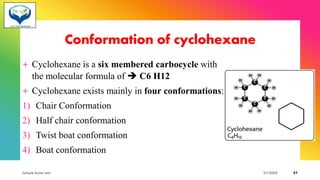
Conformation of cyclohexane
+ Cyclohexane is a six membered carbocycle with
the molecular formula of ➔ C6 H12
+ Cyclohexane exists mainly in four conformations:
1) Chair Conformation
2) Half chair conformation
3) Twist boat conformation
4) Boat conformation
Sample footer text 3/1/20XX 57
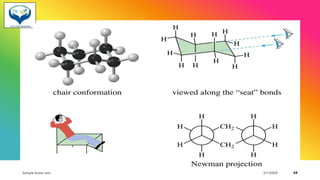
1. Chair conformation
+ Cyclohexane exist in puckered conformation when it
achieves tetrahedral bond angle ➔109.5º and staggered
conformation.
+ There is no steric hindrance, so it has minimum energy
and maximum stability.
Sample footer text 3/1/20XX 58
Sample footer text 3/1/20XX 59
2. Half chair conformation
+ It has both angle strain and torsional
angle, so less stable than chair form.
+ Energy ➔ 50 KJ/mol
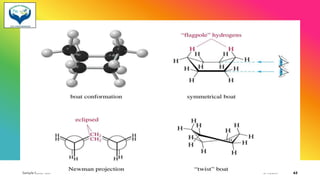
3. Twist boat conformation
+ More stable than boat conformation by
about energy ➔ 22 KJ/mol but less
stable than chair conformation.
Sample footer text 3/1/20XX 60
4. Boat conformation
+ Eclipsed conformer
+ Due to steric interaction between the non-bonding atom, it is
less stable than chair conformation and has highest energy.
+ Energy ➔ 28 KJ/mol
61
Sample footer text 3/1/20XX 62
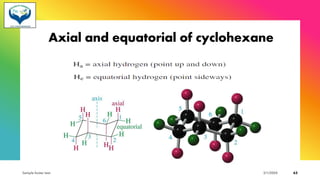
Axial and equatorial of cyclohexane
Sample footer text 3/1/20XX 63
Energy diagram of cyclohexane
Sample footer text 3/1/20XX 64
Energy order:
chair < twist
boat < boat <
half chair
Stability order:
chair > twist
boat > boat >
half chair
Stereoisomers in biphenyl compounds
(Atropisomerism)
+ Atropisomers can be defined as isomers that can be isolated due to prevention or
restriction of rotation about a single bond, usually between two planar
moieties.
+ The term atropisomerism comes from the words a, Greek ➔ not (absence)
+ tropos, Greek ➔ turn.
+ Bulky group on ortho position of bi-phenyl leads to strained ring structural
features.
+ Bulky substituents or strained rings may enhance the barrier to rotation
between two distinct conformations to such an extent as to allow observation of
atropisomers. 65
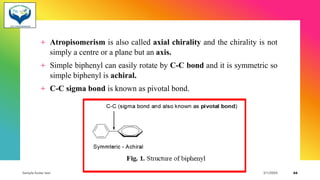
+ Atropisomerism is also called axial chirality and the chirality is not
simply a centre or a plane but an axis.
+ Simple biphenyl can easily rotate by C-C bond and it is symmetric so
simple biphenyl is achiral.
+ C-C sigma bond is known as pivotal bond.
Sample footer text 3/1/20XX 66
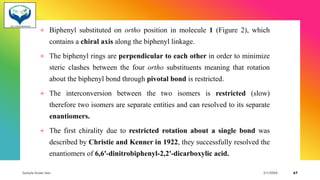
+ Biphenyl substituted on ortho position in molecule 1 (Figure 2), which
contains a chiral axis along the biphenyl linkage.
+ The biphenyl rings are perpendicular to each other in order to minimize
steric clashes between the four ortho substituents meaning that rotation
about the biphenyl bond through pivotal bond is restricted.
+ The interconversion between the two isomers is restricted (slow)
therefore two isomers are separate entities and can resolved to its separate
enantiomers.
+ The first chirality due to restricted rotation about a single bond was
described by Christie and Kenner in 1922, they successfully resolved the
enantiomers of 6,6'-dinitrobiphenyl-2,2'-dicarboxylic acid.
Sample footer text 3/1/20XX 67
Sample footer text 3/1/20XX 68
Conditions of Atropisomerism (optical activity):
1. A rotationally stable axis
2. Presence of different substituents on both sides of the axis
3. The configurational stability of axially chiral biaryl compounds is
mainly determined by three following factors:
i. The combined steric demand of the substituent in the combined steric
demand of the substituents in the proximity of the axis.
ii. The existence, length and rigidity of bridges.
iii. Atropisomerisation mechanism different from a merely physical rotation
about the axis, e.g. photo chemically or chemically induced processes.
Sample footer text 3/1/20XX 69
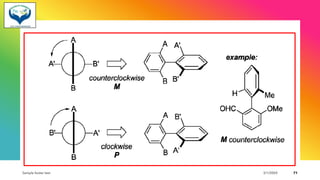
Stereochemical assignment:
+ Determining the axial stereochemistry of biaryl atropisomers can be
accomplished through the use of a Newman projection along the axis
of hindered rotation.
+ The ortho, and in some cases meta substituents are first assigned
priority based on Cahn–Ingold–Prelog priority rules.
+ Starting with the substituent of highest priority in the closest ring and
moving along the shortest path to the substituent of highest priority in
the other ring, the absolute configuration is assigned P or Δ for
clockwise and M or Λ for counterclockwise.
Sample footer text 3/1/20XX 70
Sample footer text 3/1/20XX 71
Stereoselective Reactions
+ A reaction that yields predominantly one stereoisomer (or one pair of
enantiomers) of several possible diastereomeric possibilities is called a
stereoselective reaction.
+ In a stereoselective reaction, one stereoisomer is formed (or destroyed)
more rapidly than another, thus resulting in predominance of the favoured
stereoisomer in the mixture of products.
+ Due to differences either in the free energies of activation of the reaction
or thermodynamic stabilities of the products, one isomer is formed
predominantly.
+ A ➔ B + C
+ B is formed more than C whereas B and C are stereo isomers.
Sample footer text 3/1/20XX 72
+ Stereo selectivity can be further subdivided into enantioselectivity and
diastereoselectivity.
+ Enantioselectivity is defined as the formation of one of the two
enantiomers predominantly or exclusively.
+ Diasteroselectivity is defined as the formation of one of the two or more
diastereomers predominantly or exclusively.
Sample footer text 3/1/20XX 73
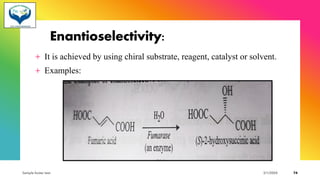
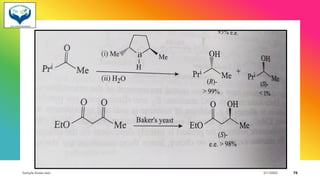
Enantioselectivity:
+ It is achieved by using chiral substrate, reagent, catalyst or solvent.
+ Examples:
Sample footer text 3/1/20XX 74
Sample footer text 3/1/20XX 75
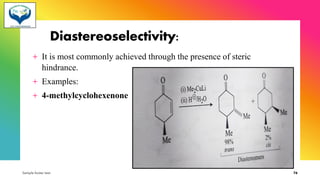
Diastereoselectivity:
+ It is most commonly achieved through the presence of steric
hindrance.
+ Examples:
+ 4-methylcyclohexenone
Sample footer text 76
+ Epoxidation of cyclic alkenes:
+ 4-methylcyclopentene
Sample footer text 3/1/20XX 77
Stereospecific Reactions
+ A reaction in which stereochemically different reactants gives
sterochemically different products is called a stereospecific
reaction.
+ A reaction or synthesis in which a particular stereoisomer reacts to
give one specific stereoisomer of the product is called a sterospecific
reaction.
+ Such a reaction is said to display stereospecificity.
+ A ➔ B
+ C ➔ D
+ A and C are stereoisomers; B and D are stereoisomers.
Sample footer text 3/1/20XX 78
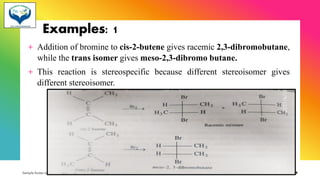
Examples: 1
+ Addition of bromine to cis-2-butene gives racemic 2,3-dibromobutane,
while the trans isomer gives meso-2,3-dibromo butane.
+ This reaction is stereospecific because different stereoisomer gives
different stereoisomer.
Sample footer text 3/1/20XX 79
Examples: 2
+ The formation of epoxides from alkenes on treatment with peracids is a
stereospecific reaction.
+ Cis-2-butene gives cis-2,3-dimethyloxirane, while trans-2-butene gives
trans-2,3-dimethyloxirane.
Sample footer text 3/1/20XX 80
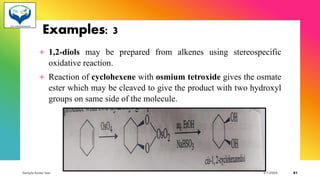
Examples: 3
+ 1,2-diols may be prepared from alkenes using stereospecific
oxidative reaction.
+ Reaction of cyclohexene with osmium tetroxide gives the osmate
ester which may be cleaved to give the product with two hydroxyl
groups on same side of the molecule.
Sample footer text 3/1/20XX 81
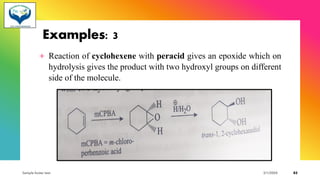
Examples: 3
+ Reaction of cyclohexene with peracid gives an epoxide which on
hydrolysis gives the product with two hydroxyl groups on different
side of the molecule.
Sample footer text 3/1/20XX 82
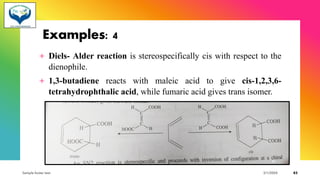
Examples: 4
+ Diels- Alder reaction is stereospecifically cis with respect to the
dienophile.
+ 1,3-butadiene reacts with maleic acid to give cis-1,2,3,6-
tetrahydrophthalic acid, while fumaric acid gives trans isomer.
Sample footer text 3/1/20XX 83
The way to get
started is to quit
talking and
begin doing.
Walt Disney
Sample footer text 3/1/20XX 84

Unit II Geometrical isomerism

  • 1.
    Unit II GEOMETRICAL ISOMERISM Lecture by SOWMIYAPERINBARAJ, M.Pharm Assistant Professor Dept. of Pharmaceutical Chemistry SVCP
  • 2.
    INTRODUCTION + In 1875,Vant’t Hoff and Le Bel recognised another type of stereoisomerism in organic molecules having two differently substituted atoms to each other by means of a double bond (C=C). + The geometrical isomerism arises when atoms or groups are arranged differently in space due to restricted rotation of a double bond in a molecule. + The carbon-carbon double bonds consist of σ bond and π bond. + The presence of π bond locks the molecule in one position, therefore rotation around the C=C bond is not possible. + Geometrical isomer have same molecular formula and structural formula + But it has different orientation (spatial arrangement of atoms) due to presence of double bonds or rings. 2
  • 3.
    + In generalGeometrical isomerism is shown by alkenes or their derivatives in which two different atoms or groups are attached to each carbon containing the double bond. + Eg: Two different spatial arrangements of methyl groups about a double bond in 2-butene give rise to the following geometrical isomers. + i.e., cis-2-butene and trans-2-butene 3
  • 4.
    NOMENCLATURE OF GEOMETRICAL ISOMERISM +To represent the various geometrical isomers following nomenclatures are used. ❖ Cis-Trans nomenclature ❖ E-Z nomenclature ❖ Syn-Anti nomenclature Cis-Trans nomenclature: ✓ Geometrical isomerism is commonly known as Cis-Trans isomerism. Cis-isomer: Cis is a Latin words and it means “this side of” ✓ Cis indicates that the identical atoms or groups are on the same side of the carbon double bond or ring. 4
  • 5.
    ❖Trans isomer: Transis a Latin word which means “the other side of” Trans indicates that the identical atoms or groups are on opposite side of the carbon double bond or ring. + Thus, cis-trans isomers are stereoisomers, that is pairs of molecules which have the same molecular formula but whose identical atoms or groups are in different orientation in three dimensional space. 5
  • 6.
    Examples: 2) 3-Hexene CH3CH2CH=CHCH2CH3 +Geometric isomerism is possible because each double bonded carbon is attached to two different groups (CH3CH2 and H) attached to it. 6
  • 7.
    Examples: 3) Butenedioic AcidCOOH-CH=CH-COOH + Geometric isomerismis possible because each double bonded carbon is attached to two different groups (COOH and H) attached to it. 7
  • 8.
    Properties: ➢ Cis-trans isomersdo not different much in chemical properties. ➢ They differ in physical properties like boiling point, melting point, crystal structure, solubility and refractive index. ➢ In cis isomer because the similar groups are very near each other, Vander Waals repulsion and Stearic hindrance (bulky groups) make the molecule much unstable. ➢ Whereas in trans isomer, similar groups are diagonally opposite to each other. Hence there is no such steric interaction and it is more stable. 8
  • 9.
    Properties: ➢ Hence reactivityof cis isomer is little higher than trans isomer. ➢ Dipole moment studies is one of the best method to identify cis-trans isomers. Cis isomer has larger DPM and trans is zero. 9
  • 10.
    Comparison between cisand trans isomer S.no Cis isomer Trans isomer 1 It has same connectivity and identical atoms of same side. It has same connectivity and identical atoms of opposite side. 2 Steric interaction is present No steric interaction 3 Less stable isomer More stable isomer 4 Energy and reactivity is more Energy and reactivity is less 5 Cis isomer has polar molecule Trans isomer has less polar or non polar 6 Dipole moment value is higher Dipole moment value is zero 7 Melting point is comparatively low Melting point is comparatively high 8 Boiling point is comparatively high Boiling point is comparatively low 9 Solubility is comparatively high Solubility is comparatively low 10
  • 11.
    Limitations: + Cis-Trans nomenclatureis not available for molecules which contain four different connective substituents. + Cis-trans nomenclature is also not applicable for molecules containing C=N which contain four different connective substituents. 11
  • 12.
    E-Z nomenclature + Thissystem can be used to specify the configuration about any carbon-carbon double bond unambiguously by using a set of priority rules. + This system is devised in 1964 by R.S.Cahn, C.K.Ingold and V.Prelog. E-Configuration: + E is taken from German word entgegen which means “opposite” + If the two groups of highest priority are on the opposite sides of the double bond, the bond is assigned as “E” configuration. Z-Configuration: + Z is taken from German word zusammen which means “together” + If the two groups of highest priority on the same sides of the double bond, the bond is assigned as “Z” configuration. Sample footer text 3/1/20XX 12
  • 13.
    + The E-Zsystem is based on a set of "priority rules", which allow to rank any groups. + The general strategy of the E-Z system is to analyze the two groups at each end of the double bond. At each end, rank the two groups, using the CIP priority rules. + Then, see whether the higher priority group at one end of the double bond and the higher priority group at the other end of the double bond are on the same side (Z from German word zusammen = together) or on opposite sides (E from German word entgegen = opposite) of the double bond. Sample footer text 3/1/20XX 13
  • 14.
    + There arefour CIP priority rules Rule 1: + Each atom is assigned a priority. Priority is based on atomic number; higher the atomic number, the higher the priority. Rule 2: + For isotopes, the higher the atomic mass the higher the priority. For example, deuterium (Hydrogen-2) has higher priority than protium (Hydrogen-1). Sample footer text 3/1/20XX 14
  • 15.
    Rule 3: + Ifpriority cannot be assigned on the basis of atomic number or atomic mass considering the first atom of a group, then look at the next set of atoms and continue until a priority can be assigned. + Priority can be assigned at the first point of difference. + If the atoms directly linked to the double bond are the same, then the second, third, fourth,etc. atoms (away from the double bond) are ranked until a difference is found. Sample footer text 3/1/20XX 15
  • 16.
    Rule 4: + Inthe case of double or triple bonds, atoms participating in the double or triple bond are considered to be bonded to an equivalent number of similar atoms by single bonds, that is, atoms of double and triple bonds are duplicated or triplicated. Sample footer text 3/1/20XX 16
  • 17.
    + To assignE-Z system, first determine the groups of highest priority on each carbon. If the two highest priority groups are on the same side of the double bond, the configuration is Z. If they are on opposite side of the double bond then the configuration is E. Sample footer text 3/1/20XX 17
  • 18.
    Sample footer text3/1/20XX 18
  • 19.
    Syn-Anti Nomenclature + Geometricisomerism is also possible in compounds containing oximes (C=N) and Azo compounds (N=N). + Thus, Syn-Anti nomenclature is used to indicate the geometrical isomerism containing C=N or N=N bonds such as oximes and azo compounds. Sample footer text 3/1/20XX 19
  • 20.
    Syn-Anti Nomenclature + Inaldoxime, the syn or anti configuration is determined by the position of the lone pair of electrons on nitrogen atom with respect to alkyl (R) or aryl (Ar) group. Syn configuration: + In aldoxime, syn configuration is one in which the lone pair on nitrogen and the alkyl or aryl group on same side or H and OH is present in same side. Anti configuration: + In aldoxime, anti configuration is one in which the lone pair on nitrogen and the alkyl or aryl group on opposite side or H and OH is present in opposite side. Sample footer text 3/1/20XX 20
  • 21.
  • 22.
    Syn-Anti Nomenclature + Inketoxime, the prefixes syn and anti indicate which alkyl (R) or aryl (Ar) group of ketoxime is syn (on the same side) or anti (on the opposite sides) with respect to the OH group. Sample footer text 3/1/20XX 22
  • 23.
    Syn-Anti Nomenclature + Azocompounds contain two lone pair of electrons on each nitrogen atom. + Syn configuration: + If both lone pair are present on same side, then assigned as Syn configuration. + Anti configuration: + If both lone pair are present on opposite side, then assigned as anti configuration. 3/1/20XX 23
  • 24.
  • 25.
    Determination of configurationof geometrical isomers ❑ Several methods are available to determine the configuration ❑ Method can be selected depending upon nature of compound ❑ Use of multiple methods gives more reliable results ❑ Some of the methods are 1. Method of cyclisation 2. By converting into compounds of known configuration 3. Method of optical activity 4. Methods based on physical properties 5. By stereoselective reaction 6. By stereospecific reaction
  • 26.
    1. Method ofCyclisation: ➢ This method is based on the fact, Intramolecular reactions are more likely to take place if the reacting groups are closer. ➢ Eg: In case of maleic acid, anhydride is formed under mild conditions because the two –COOH groups are closer (cis) but fumaric acid does not give an anhydride under ordinary conditions. ➢ Under vigorous conditions it forms maleic anhydride, so in this case the two –COOH groups are in opposite direction (trans). Sample footer text 3/1/20XX 26
  • 27.
    2. By convertinginto compounds of known configuration: ✓ This method is applicable in those cases in which one of the two isomers can be converted into a compound of known configuration. ✓ Assuming that there is no isomerization during the process of conversion, then the configuration of product and that of starting material will be same. ✓ Eg: one form of trichlorocrotonic acid can be hydrolyzed to give fumaric acid, so this form of trichlorocrotonic acid must be the tans-isomer. ✓ The other form of acid does not give fumaric acid on hydrolysis and forms isocrotonic acid on reduction. ✓ Hence this form of trichlorocrotonic acid and isocrotonic acid are cis- isomers. 27
  • 28.
    Sample footer text3/1/20XX 28
  • 29.
    3. Method ofoptical activity: + In geometrical isomers if one is optically active and other is optically inactive, then optically active compound can be easily resolved. + Eg: In hexahydrophthalic acids- + cis form possesses a plane of symmetry and is optically inactive and trans is active. + Trans form of hexahydrophthalic acid can be resolved. Sample footer text 3/1/20XX 29
  • 30.
    4. Methods basedon physical properties A) Dipole moment: + The dipole moment of cis form is generally higher than that of trans form + Eg: In the case of 1,2 dichloroethylene cis isomer is generally have 1.80 D and trans isomer have zero dipole moment. Sample footer text 3/1/20XX 30
  • 31.
    b) Melting point,boiling point, solubility, Density & Refractive index + The physical constants are varying in cis and trans isomer is shown in following table Sample footer text 3/1/20XX 31
  • 32.
    Sample footer text3/1/20XX 32
  • 33.
    Solubility: + Cis-isomers havehigher solubilities. + Maleic acid (cis) - 79.0g/100ml at 293K + Fumaric acid (trans) - 0.7g/100ml at 293K c) X-ray and electron diffraction ➢ Configuration can be determined using X-ray crystallography. ➢ X-Ray crystallographic analysis of sorbic acid gave its trans configuration. Sample footer text 3/1/20XX 33
  • 34.
    d) Spectroscopic method: +Spectroscopic method based upon, trans isomer will have higher λ- max than corresponding cis isomer. + NMR spectroscopy also used to distinguish geometrical isomers, because trans vinyl protons are more strongly coupled to each than other cis vinyl protons. + In IR Spectroscopy, Trans isomer is readily identified by the appearance of a characteristic band near 970-960cm-1. No such band is observed in the spectrum of the cis isomer. Sample footer text 3/1/20XX 34
  • 35.
    5) By stereoselectivereaction + In these reactions, one stereoisomer is formed in more amount than the other. + Hydrogenation of alkyne with sodium or lithium in liquid ammonia gives a mixture of trans and cis alkenes in which trans isomer predominates. + On the otherhand hydrogenation of alkyne using palladised charcoal gives cis alkene with a small amount of trans alkene. + Reactions which yield predominantly one stereoisomer of several possible stereoisomers are called stereoselective reactions. Sample footer text 3/1/20XX 35
  • 36.
    6) Stereospecific reactions +In these reactions, the formation of product is specific with respect to the stereoisomer. That is different stereoisomeric starting materials give rise to different stereoisomeric products. + Reduction: The catalytic hydrogenation of cis isomer gives a meso compound. + A (+-) product is obtained if starting material is trans isomer. Sample footer text 3/1/20XX 36
  • 37.
    Hydroxylation: + The hydroxylationof alkenes if carried out by means of OsO4, KMnO4, H2O2 proceeds in cis fashion. + Maleic acid (cis) and fumaric acid (trans) give meso and (+-) –tartaric acid respectively. Sample footer text 3/1/20XX 37
  • 38.
    Conformational isomerism + Conformationalisomerism is a form of stereo isomerism in which the isomers can be interconverted just by rotations about single bonds. + Conformational isomers or conformers are different shapes of the same molecule resulting from rotation around a single C-C bond. + They are not different compounds (i.e. they have the same physical and chemical properties) and are readily interconvertible. + It is unstable and exchange in short time duration to another conformer. Sample footer text 3/1/20XX 38
  • 39.
    Two types ofprojection structure are used to study the conformational isomers. 1. Sawhorse projection: • A representation of molecular structure, from an oblique angle. • It is named after its similar look to sawhorse. Sample footer text 3/1/20XX 39
  • 40.
    2. Newman projection: +In this projection, visualizes the conformations of a bond from front to back. + The front atom represented by a bond line and the back carbon represented as a circle. Sample footer text 3/1/20XX 40
  • 41.
    + Eclipsed conformation:A conformation about a carbon-carbon single bond in which the atoms or groups on one carbon are as close as possible to the atoms or groups on an adjacent carbon. + Staggered conformation: A conformation about a carbon-carbon single bond in which the atoms or groups on one carbon are as far as possible to the atoms or groups on an adjacent carbon. Sample footer text 3/1/20XX 41 Eclipsed Staggered
  • 42.
    + Dihedral angle:An angle created by two intersecting planes. + Anti conformation: A conformation about a single bond in which two groups on adjacent carbons lie at a dihedral angle of 1800 + Gauche conformation: A conformation about a single bond of an alkane in which two groups of adjacent carbons lie at a dihedral angle of 600 Sample footer text 3/1/20XX 42
  • 43.
    CONFORMATION OF ETHANE +The molecular formula of ethane is C2 H6 + If one of the methyl groups is allowed to rotate along the C-C axis keeping the rest of the molecule undisturbed, an infinite number of possible arrangements of the rotated methyl group with respect to the undisturbed methyl group is generated. + Each of these possible arrangement represents a conformation. + So, six possible conformations are obtained, out of which three are staggered form in which the two hydrogen atoms on the different carbon atoms are as far as possible (1,3,5). + Other Three are eclipsed in which the two hydrogen atoms on the different carbon are as close as possible (2,4,6). Sample footer text 3/1/20XX 43
  • 44.
    Sample footer text3/1/20XX 44
  • 45.
    Energy barrier diagramof ethane + Staggered and eclipsed conformer have different energy. + Staggered conformer has least energy due to least steric hindrance and it is most stable conformer. + Eclipsed conformer has highest energy due to maximum steric hindrance and it is least stable conformer. + Torsional energy: Eclipsed conformer has 3 kcal/mole (12.6 kJ/mol) than staggered. This energy is known as torsional energy. + Torsional angle: The angle between the front and back hydrogen is dihedral (or torsional) angle. Sample footer text 3/1/20XX 45
  • 46.
    Sample footer text3/1/20XX 46
  • 47.
    Why staggered conformationof ethane is lower in energy than the eclipsed conformation? ➢ The potential energy of Staggered conformation is less than eclipsed because in the latter case the hydrogen atoms on the two carbon atoms are close to each other and hence exert a repulsive force (steric repulsion due to non bonded interaction of hydrogen atom). Can be justified with two important reasons 1) The first is that the electrons in the bonds repel each other and this repulsion is at a maximum in the eclipsed conformation. Sample footer text 3/1/20XX 47
  • 48.
    2) The secondis that there may be some stabilizing interaction between the C–H σ bonding orbital on one carbon and the C–H σ* antibonding orbital on the other carbon, which is greatest when σ* antibonding orbital is unfilled: this only happens in the staggered conformation. Sample footer text 3/1/20XX 48
  • 49.
    Sample footer text3/1/20XX 49
  • 50.
    CONFORMATION OF BUTANE +The molecular formula of butane is C4 H10 + It has two structural isomer ➔ n-butane and iso-butane + When rotating the n-butane at the axis of the C2-C3 bond at 60° angle, it shows different conformation isomerism with the respect of methyl groups present on back and front side of C2-C3 axis. + Butane has four conformation isomers: 1. Fully eclipsed 2. Gauche 3. Partially eclipsed 4. Anti butane conformer Sample footer text 3/1/20XX 50
  • 51.
    1. Fully eclipsedconformer + In this conformer, methyl groups of back carbon and front carbon are minimum distance (eclipse) to each other (0°) or dihedral angle between methyl group is 0° + This conformer has maximum steric hindrance due to presence of methyl group at eclipse position, so it has highest energy and hence least stable conformer. Sample footer text 3/1/20XX 51
  • 52.
    2. Gauche (staggeredconformer) + In this conformer, methyl groups of back and front carbon are 60° angle or dihedral angle between methyl group is 60° + This type of conformation is more stable and has less conformer energy as there is a little steric hindrance between the same molecules like Me-Me and H-H and Me-H. Sample footer text 3/1/20XX 52
  • 53.
    3. Partially eclipsedconformer + In this conformer, hydrogen atom of back and methyl group of front carbon are 0° angle or dihedral angle between methyl /methyl group is 120° + This stage appeared 120° rotation from fully eclipsed. + This type of conformation is more stable than fully eclipsed and least stable than gauche (staggered) due to presence of steric hindrance between the hydrogen and methyl group. Sample footer text 3/1/20XX 53
  • 54.
    4. Anti (staggered)conformer + In this conformer, methyl groups of back and front carbon are 180° angle or dihedral angle between methyl /methyl group is 180° + This stage appeared 180° rotation from fully eclipsed. + This type of conformation is most stable than fully eclipsed, gauche (staggered) and partially eclipsed conformer due to presence of least steric hindrance between both methyl group. Sample footer text 3/1/20XX 54
  • 55.
    Energy barrier diagramof butane + Energy order: + Anti < Gauche < partially Eclipsed < fully eclipsed + Stability order: + Anti > Gauche > partially Eclipsed > fully eclipsed Sample footer text 3/1/20XX 55
  • 56.
    Sample footer text3/1/20XX 56
  • 57.
    Conformation of cyclohexane +Cyclohexane is a six membered carbocycle with the molecular formula of ➔ C6 H12 + Cyclohexane exists mainly in four conformations: 1) Chair Conformation 2) Half chair conformation 3) Twist boat conformation 4) Boat conformation Sample footer text 3/1/20XX 57
  • 58.
    1. Chair conformation +Cyclohexane exist in puckered conformation when it achieves tetrahedral bond angle ➔109.5º and staggered conformation. + There is no steric hindrance, so it has minimum energy and maximum stability. Sample footer text 3/1/20XX 58
  • 59.
    Sample footer text3/1/20XX 59
  • 60.
    2. Half chairconformation + It has both angle strain and torsional angle, so less stable than chair form. + Energy ➔ 50 KJ/mol 3. Twist boat conformation + More stable than boat conformation by about energy ➔ 22 KJ/mol but less stable than chair conformation. Sample footer text 3/1/20XX 60
  • 61.
    4. Boat conformation +Eclipsed conformer + Due to steric interaction between the non-bonding atom, it is less stable than chair conformation and has highest energy. + Energy ➔ 28 KJ/mol 61
  • 62.
    Sample footer text3/1/20XX 62
  • 63.
    Axial and equatorialof cyclohexane Sample footer text 3/1/20XX 63
  • 64.
    Energy diagram ofcyclohexane Sample footer text 3/1/20XX 64 Energy order: chair < twist boat < boat < half chair Stability order: chair > twist boat > boat > half chair
  • 65.
    Stereoisomers in biphenylcompounds (Atropisomerism) + Atropisomers can be defined as isomers that can be isolated due to prevention or restriction of rotation about a single bond, usually between two planar moieties. + The term atropisomerism comes from the words a, Greek ➔ not (absence) + tropos, Greek ➔ turn. + Bulky group on ortho position of bi-phenyl leads to strained ring structural features. + Bulky substituents or strained rings may enhance the barrier to rotation between two distinct conformations to such an extent as to allow observation of atropisomers. 65
  • 66.
    + Atropisomerism isalso called axial chirality and the chirality is not simply a centre or a plane but an axis. + Simple biphenyl can easily rotate by C-C bond and it is symmetric so simple biphenyl is achiral. + C-C sigma bond is known as pivotal bond. Sample footer text 3/1/20XX 66
  • 67.
    + Biphenyl substitutedon ortho position in molecule 1 (Figure 2), which contains a chiral axis along the biphenyl linkage. + The biphenyl rings are perpendicular to each other in order to minimize steric clashes between the four ortho substituents meaning that rotation about the biphenyl bond through pivotal bond is restricted. + The interconversion between the two isomers is restricted (slow) therefore two isomers are separate entities and can resolved to its separate enantiomers. + The first chirality due to restricted rotation about a single bond was described by Christie and Kenner in 1922, they successfully resolved the enantiomers of 6,6'-dinitrobiphenyl-2,2'-dicarboxylic acid. Sample footer text 3/1/20XX 67
  • 68.
    Sample footer text3/1/20XX 68
  • 69.
    Conditions of Atropisomerism(optical activity): 1. A rotationally stable axis 2. Presence of different substituents on both sides of the axis 3. The configurational stability of axially chiral biaryl compounds is mainly determined by three following factors: i. The combined steric demand of the substituent in the combined steric demand of the substituents in the proximity of the axis. ii. The existence, length and rigidity of bridges. iii. Atropisomerisation mechanism different from a merely physical rotation about the axis, e.g. photo chemically or chemically induced processes. Sample footer text 3/1/20XX 69
  • 70.
    Stereochemical assignment: + Determiningthe axial stereochemistry of biaryl atropisomers can be accomplished through the use of a Newman projection along the axis of hindered rotation. + The ortho, and in some cases meta substituents are first assigned priority based on Cahn–Ingold–Prelog priority rules. + Starting with the substituent of highest priority in the closest ring and moving along the shortest path to the substituent of highest priority in the other ring, the absolute configuration is assigned P or Δ for clockwise and M or Λ for counterclockwise. Sample footer text 3/1/20XX 70
  • 71.
    Sample footer text3/1/20XX 71
  • 72.
    Stereoselective Reactions + Areaction that yields predominantly one stereoisomer (or one pair of enantiomers) of several possible diastereomeric possibilities is called a stereoselective reaction. + In a stereoselective reaction, one stereoisomer is formed (or destroyed) more rapidly than another, thus resulting in predominance of the favoured stereoisomer in the mixture of products. + Due to differences either in the free energies of activation of the reaction or thermodynamic stabilities of the products, one isomer is formed predominantly. + A ➔ B + C + B is formed more than C whereas B and C are stereo isomers. Sample footer text 3/1/20XX 72
  • 73.
    + Stereo selectivitycan be further subdivided into enantioselectivity and diastereoselectivity. + Enantioselectivity is defined as the formation of one of the two enantiomers predominantly or exclusively. + Diasteroselectivity is defined as the formation of one of the two or more diastereomers predominantly or exclusively. Sample footer text 3/1/20XX 73
  • 74.
    Enantioselectivity: + It isachieved by using chiral substrate, reagent, catalyst or solvent. + Examples: Sample footer text 3/1/20XX 74
  • 75.
    Sample footer text3/1/20XX 75
  • 76.
    Diastereoselectivity: + It ismost commonly achieved through the presence of steric hindrance. + Examples: + 4-methylcyclohexenone Sample footer text 76
  • 77.
    + Epoxidation ofcyclic alkenes: + 4-methylcyclopentene Sample footer text 3/1/20XX 77
  • 78.
    Stereospecific Reactions + Areaction in which stereochemically different reactants gives sterochemically different products is called a stereospecific reaction. + A reaction or synthesis in which a particular stereoisomer reacts to give one specific stereoisomer of the product is called a sterospecific reaction. + Such a reaction is said to display stereospecificity. + A ➔ B + C ➔ D + A and C are stereoisomers; B and D are stereoisomers. Sample footer text 3/1/20XX 78
  • 79.
    Examples: 1 + Additionof bromine to cis-2-butene gives racemic 2,3-dibromobutane, while the trans isomer gives meso-2,3-dibromo butane. + This reaction is stereospecific because different stereoisomer gives different stereoisomer. Sample footer text 3/1/20XX 79
  • 80.
    Examples: 2 + Theformation of epoxides from alkenes on treatment with peracids is a stereospecific reaction. + Cis-2-butene gives cis-2,3-dimethyloxirane, while trans-2-butene gives trans-2,3-dimethyloxirane. Sample footer text 3/1/20XX 80
  • 81.
    Examples: 3 + 1,2-diolsmay be prepared from alkenes using stereospecific oxidative reaction. + Reaction of cyclohexene with osmium tetroxide gives the osmate ester which may be cleaved to give the product with two hydroxyl groups on same side of the molecule. Sample footer text 3/1/20XX 81
  • 82.
    Examples: 3 + Reactionof cyclohexene with peracid gives an epoxide which on hydrolysis gives the product with two hydroxyl groups on different side of the molecule. Sample footer text 3/1/20XX 82
  • 83.
    Examples: 4 + Diels-Alder reaction is stereospecifically cis with respect to the dienophile. + 1,3-butadiene reacts with maleic acid to give cis-1,2,3,6- tetrahydrophthalic acid, while fumaric acid gives trans isomer. Sample footer text 3/1/20XX 83
  • 84.
    The way toget started is to quit talking and begin doing. Walt Disney Sample footer text 3/1/20XX 84