ASYMMETRIC SYNTHESIS
Presented By-
PROTTAY DUTTA
M.PHARM IN PHARMACEUTICAL CHEMISTRY
Roll -MPH/10055/20
BIRLA INSTITUTE OF TECHNOLOGY, MESRA
INTRODUCTION[1]
• Asymmetric synthesis or Stereo selective synthesis chemical reaction (or
reaction sequence) in which one or more new elements of chirality are
formed in a substrate molecule and which produces the stereo isomeric
(enantiomeric or diastereoisomeric) products in unequal amounts.
• Production of a specific enantiomer from achiral compound or racemic
mixture
• More simply: it is the synthesis of a compound by a method that favours the
formation of chiral molecules in unequal amounts.
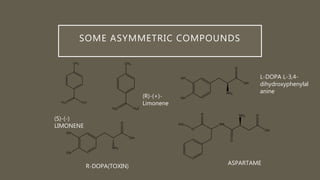
• The smells of orange and lemon differ in being the left- and righthanded
versions of the same molecule,
• Limonene. (R)-(+)-Limonene smells rounded and orangey whereas (S)-(–)-
limonene is sharp and lemony.
SOME ASYMMETRIC COMPOUNDS
(S)-(-)
LIMONENE
ASPARTAME
R-DOPA(TOXIN)
L-DOPA L-3,4-
dihydroxyphenylal
anine
(R)-(+)-
Limonene
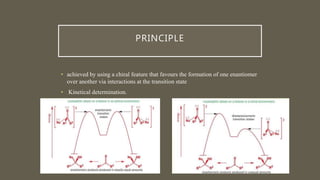
PRINCIPLE
• achieved by using a chiral feature that favours the formation of one enantiomer
over another via interactions at the transition state
• Kinetical determination.
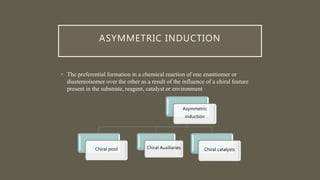
ASYMMETRIC INDUCTION
• The preferential formation in a chemical reaction of one enantiomer or
diastereoisomer over the other as a result of the influence of a chiral feature
present in the substrate, reagent, catalyst or environment
Asymmetric
induction
Chiral pool Chiral Auxiliaries Chiral catalysts
DIFFERENT
APPROACHES[3]
Chiral pool synthesis - Internal asymmetric
induction: chiral center bound to the reaction
center used Chiral pool synthesis
Chiral auxiliaries - Relayed asymmetric
induction: chirality introduced in separate
step Chiral auxiliaries
Chiral reagents, Chiral catalysts and chiral
ligands - External asymmetric induction:
chiral information at transition state
CHIRAL POOL
• simplest and oldest approaches for enantioselective synthesis
• Uses an enantiomerically pure natural product as a starting material,
• The chiral pool—Nature’s ‘ready-made’ chiral centres :pure natural products,
usually amino acids or sugars, from which pieces containing the required chiral
centres can be taken and incorporated into the product.
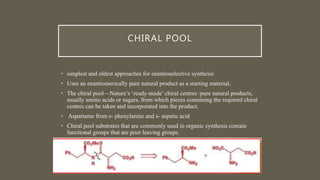
• Aspartame from s- phenylanine and s- aspatic acid
• Chiral pool substrates that are commonly used in organic synthesis contain
functional groups that are poor leaving groups.
CHIRAL
AUXILIARIES
• Diastereoselective reactions work just as well
whether the starting material is racemic or
enantiomerically pure.
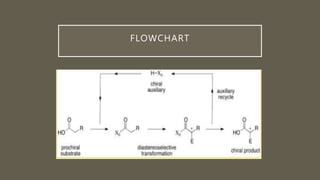
• Chiral Auxiliary assists the substrate to react in a
diastereoselective way such that only one of the two
possible products is allowed to form.
• The chiral auxiliary is enantiomerically pure to start
with, so the product must be diastereoisomerically
and enantiomerically pure.
• Start with enantiomerically pure material you get
enantiomerically pure product.
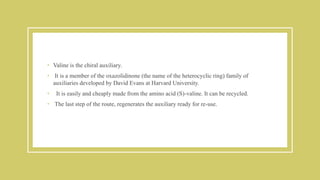
• Valine is the chiral auxiliary.
• It is a member of the oxazolidinone (the name of the heterocyclic ring) family of
auxiliaries developed by David Evans at Harvard University.
• It is easily and cheaply made from the amino acid (S)-valine. It can be recycled.
• The last step of the route, regenerates the auxiliary ready for re-use.
FLOWCHART
ASYMETRIC SYNTHESIS USING CHIRAL
AUXILARY[ 2 ]
• The product of a Diels–Alder reaction between cyclopentadiene and benzyl
acrylate must racemic as both reagents are achiral.
• Chiral auxiliary : amide derived from valine via reaction to give asymmetric
product
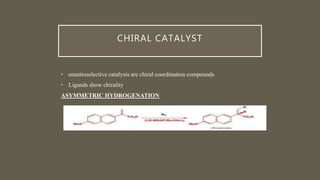
CHIRAL CATALYST
• enantioselective catalysis are chiral coordination compounds
• Ligands show chirality
ASYMMETRIC HYDROGENATION
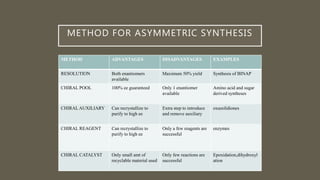
METHOD FOR ASYMMETRIC SYNTHESIS
METHOD ADVANTAGES DISADVANTAGES EXAMPLES
RESOLUTION Both enantiomers
available
Maximum 50% yield Synthesis of BINAP
CHIRAL POOL 100% ee guaranteed Only 1 enantiomer
available
Amino acid and sugar
derived syntheses
CHIRAL AUXILIARY Can recrystallize to
purify to high ee
Extra step to introduce
and remove auxiliary
oxazolidiones
CHIRAL REAGENT Can recrystallize to
purify to high ee
Only a few reagents are
successful
enzymes
CHIRAL CATALYST Only small amt of
recyclable material used
Only few reactions are
successful
Epoxidation,dihydroxyl
ation
ENATIOPURE SEPARATION AND STEREO
SELECTIVE SYNTHESIS[ 4 ]
• An enantiopure drug is a
pharmaceutical that is available in
one specific enantiomeric form. Most
biological molecules (proteins,
sugars, etc.) are present in only one
of many chiral forms, so different
enantiomers of a chiral drug molecule
bind differently (or not at all) to
target receptors.
• Enantioselective synthesis, also called
asymmetric synthesis.
• It is a form of chemical synthesis.
• It is defined by IUPAC as: a chemical
reaction (or reaction sequence) in which
one or more new elements of chirality are
formed in a substrate molecule and which
produces the stereo isomeric
(enantiomeric or diastereoisomeric)
products in unequal amounts.
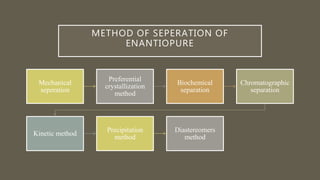
METHOD OF SEPERATION OF
ENANTIOPURE
Mechanical
seperation
Preferential
crystallization
method
Biochemical
separation
Chromatographic
separation
Kinetic method
Precipitation
method
Diastereomers
method
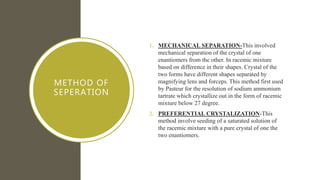
METHOD OF
SEPERATION
1. MECHANICAL SEPARATION-This involved
mechanical separation of the crystal of one
enantiomers from the other. In racemic mixture
based on difference in their shapes. Crystal of the
two forms have different shapes separated by
magnifying lens and forceps. This method first used
by Pasteur for the resolution of sodium ammonium
tartrate which crystallize out in the form of racemic
mixture below 27 degree.
2. PREFERENTIAL CRYSTALIZATION-This
method involve seeding of a saturated solution of
the racemic mixture with a pure crystal of one the
two enantiomers.
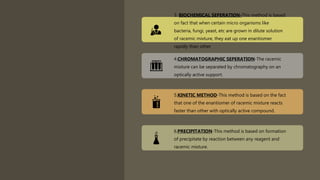
3. BIOCHEMICAL SEPERATION-This method is based
on fact that when certain micro organisms like
bacteria, fungi, yeast, etc are grown in dilute solution
of racemic mixture, they eat up one enantiomer
rapidly than other
4.CHROMATOGRAPHIC SEPERATION-The racemic
mixture can be separated by chromatography on an
optically active support.
5.KINETIC METHOD-This method is based on the fact
that one of the enantiomer of racemic mixture reacts
faster than other with optically active compound.
6.PRECIPITATION-This method is based on formation
of precipitate by reaction between any reagent and
racemic mixture.
7. DIASTEREOMERS-When racemic mixture is allowed
to interact with optically active material, it give a
diastereomeric derivatives. Diastereomer have different
physical properties and hence can easily separated into two
component by fractional crystallization
REFERENCE
1. Nasipuri, D. Stereochemistry of Organic Compounds: Principles and
Applications, 2nd Edition. New Age International Pvt. Ltd. New Delhi.
1994.
2. Finar, I. L. Organic Chemistry : Stereo Chemistry and Chemistry of
Natural Products (vol:2), 5 th Edition. Dorling Kindersley Pvt. Ltd. Noida,
India. 1975.
3. Organic Chemistry 2nd edition Jonathan Clayden, Nick Greeves, and
Stuart Warren
4. Enatiopure separation and stereo selective synthesis FOR PHARMACY
STU… (slideshare.net)
Asymmetric synthesis | chemistry presentation | 2021

Asymmetric synthesis | chemistry presentation | 2021

  • 1.
    ASYMMETRIC SYNTHESIS Presented By- PROTTAYDUTTA M.PHARM IN PHARMACEUTICAL CHEMISTRY Roll -MPH/10055/20 BIRLA INSTITUTE OF TECHNOLOGY, MESRA
  • 2.
    INTRODUCTION[1] • Asymmetric synthesisor Stereo selective synthesis chemical reaction (or reaction sequence) in which one or more new elements of chirality are formed in a substrate molecule and which produces the stereo isomeric (enantiomeric or diastereoisomeric) products in unequal amounts. • Production of a specific enantiomer from achiral compound or racemic mixture • More simply: it is the synthesis of a compound by a method that favours the formation of chiral molecules in unequal amounts. • The smells of orange and lemon differ in being the left- and righthanded versions of the same molecule, • Limonene. (R)-(+)-Limonene smells rounded and orangey whereas (S)-(–)- limonene is sharp and lemony.
  • 3.
    SOME ASYMMETRIC COMPOUNDS (S)-(-) LIMONENE ASPARTAME R-DOPA(TOXIN) L-DOPAL-3,4- dihydroxyphenylal anine (R)-(+)- Limonene
  • 4.
    PRINCIPLE • achieved byusing a chiral feature that favours the formation of one enantiomer over another via interactions at the transition state • Kinetical determination.
  • 5.
    ASYMMETRIC INDUCTION • Thepreferential formation in a chemical reaction of one enantiomer or diastereoisomer over the other as a result of the influence of a chiral feature present in the substrate, reagent, catalyst or environment Asymmetric induction Chiral pool Chiral Auxiliaries Chiral catalysts
  • 6.
    DIFFERENT APPROACHES[3] Chiral pool synthesis- Internal asymmetric induction: chiral center bound to the reaction center used Chiral pool synthesis Chiral auxiliaries - Relayed asymmetric induction: chirality introduced in separate step Chiral auxiliaries Chiral reagents, Chiral catalysts and chiral ligands - External asymmetric induction: chiral information at transition state
  • 7.
    CHIRAL POOL • simplestand oldest approaches for enantioselective synthesis • Uses an enantiomerically pure natural product as a starting material, • The chiral pool—Nature’s ‘ready-made’ chiral centres :pure natural products, usually amino acids or sugars, from which pieces containing the required chiral centres can be taken and incorporated into the product. • Aspartame from s- phenylanine and s- aspatic acid • Chiral pool substrates that are commonly used in organic synthesis contain functional groups that are poor leaving groups.
  • 8.
    CHIRAL AUXILIARIES • Diastereoselective reactionswork just as well whether the starting material is racemic or enantiomerically pure. • Chiral Auxiliary assists the substrate to react in a diastereoselective way such that only one of the two possible products is allowed to form. • The chiral auxiliary is enantiomerically pure to start with, so the product must be diastereoisomerically and enantiomerically pure. • Start with enantiomerically pure material you get enantiomerically pure product.
  • 9.
    • Valine isthe chiral auxiliary. • It is a member of the oxazolidinone (the name of the heterocyclic ring) family of auxiliaries developed by David Evans at Harvard University. • It is easily and cheaply made from the amino acid (S)-valine. It can be recycled. • The last step of the route, regenerates the auxiliary ready for re-use.
  • 10.
  • 11.
    ASYMETRIC SYNTHESIS USINGCHIRAL AUXILARY[ 2 ] • The product of a Diels–Alder reaction between cyclopentadiene and benzyl acrylate must racemic as both reagents are achiral. • Chiral auxiliary : amide derived from valine via reaction to give asymmetric product
  • 12.
    CHIRAL CATALYST • enantioselectivecatalysis are chiral coordination compounds • Ligands show chirality ASYMMETRIC HYDROGENATION
  • 13.
    METHOD FOR ASYMMETRICSYNTHESIS METHOD ADVANTAGES DISADVANTAGES EXAMPLES RESOLUTION Both enantiomers available Maximum 50% yield Synthesis of BINAP CHIRAL POOL 100% ee guaranteed Only 1 enantiomer available Amino acid and sugar derived syntheses CHIRAL AUXILIARY Can recrystallize to purify to high ee Extra step to introduce and remove auxiliary oxazolidiones CHIRAL REAGENT Can recrystallize to purify to high ee Only a few reagents are successful enzymes CHIRAL CATALYST Only small amt of recyclable material used Only few reactions are successful Epoxidation,dihydroxyl ation
  • 14.
    ENATIOPURE SEPARATION ANDSTEREO SELECTIVE SYNTHESIS[ 4 ] • An enantiopure drug is a pharmaceutical that is available in one specific enantiomeric form. Most biological molecules (proteins, sugars, etc.) are present in only one of many chiral forms, so different enantiomers of a chiral drug molecule bind differently (or not at all) to target receptors. • Enantioselective synthesis, also called asymmetric synthesis. • It is a form of chemical synthesis. • It is defined by IUPAC as: a chemical reaction (or reaction sequence) in which one or more new elements of chirality are formed in a substrate molecule and which produces the stereo isomeric (enantiomeric or diastereoisomeric) products in unequal amounts.
  • 15.
    METHOD OF SEPERATIONOF ENANTIOPURE Mechanical seperation Preferential crystallization method Biochemical separation Chromatographic separation Kinetic method Precipitation method Diastereomers method
  • 16.
    METHOD OF SEPERATION 1. MECHANICALSEPARATION-This involved mechanical separation of the crystal of one enantiomers from the other. In racemic mixture based on difference in their shapes. Crystal of the two forms have different shapes separated by magnifying lens and forceps. This method first used by Pasteur for the resolution of sodium ammonium tartrate which crystallize out in the form of racemic mixture below 27 degree. 2. PREFERENTIAL CRYSTALIZATION-This method involve seeding of a saturated solution of the racemic mixture with a pure crystal of one the two enantiomers.
  • 17.
    3. BIOCHEMICAL SEPERATION-Thismethod is based on fact that when certain micro organisms like bacteria, fungi, yeast, etc are grown in dilute solution of racemic mixture, they eat up one enantiomer rapidly than other 4.CHROMATOGRAPHIC SEPERATION-The racemic mixture can be separated by chromatography on an optically active support. 5.KINETIC METHOD-This method is based on the fact that one of the enantiomer of racemic mixture reacts faster than other with optically active compound. 6.PRECIPITATION-This method is based on formation of precipitate by reaction between any reagent and racemic mixture.
  • 18.
    7. DIASTEREOMERS-When racemicmixture is allowed to interact with optically active material, it give a diastereomeric derivatives. Diastereomer have different physical properties and hence can easily separated into two component by fractional crystallization
  • 19.
    REFERENCE 1. Nasipuri, D.Stereochemistry of Organic Compounds: Principles and Applications, 2nd Edition. New Age International Pvt. Ltd. New Delhi. 1994. 2. Finar, I. L. Organic Chemistry : Stereo Chemistry and Chemistry of Natural Products (vol:2), 5 th Edition. Dorling Kindersley Pvt. Ltd. Noida, India. 1975. 3. Organic Chemistry 2nd edition Jonathan Clayden, Nick Greeves, and Stuart Warren 4. Enatiopure separation and stereo selective synthesis FOR PHARMACY STU… (slideshare.net)