By:
Sheikh Khalida Banu,
K.J. Somaiya College of Sci. and Com.
Introduction
 Racemisation is the process when the
enantiomer is converted into racemic
modification
 Resolution is the process when a racemic
modification is separated into its
constituent enantiomers.
 Racemisation and Resolution are
complementary to each other.
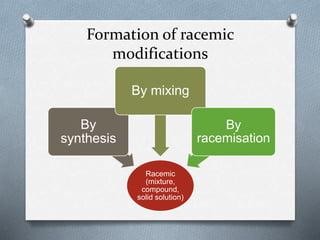
Formation of racemic
modifications
Racemic
(mixture,
compound,
solid solution)
By
synthesis
By mixing
By
racemisation
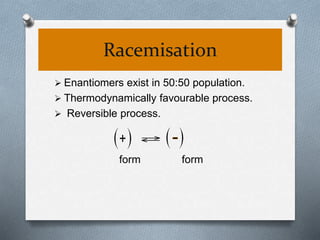
Racemisation
 Enantiomers exist in 50:50 population.
 Thermodynamically favourable process.
 Reversible process.
form form
+
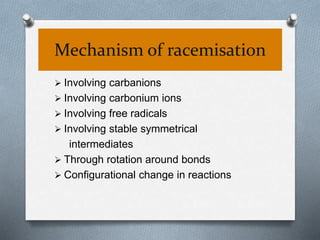
Mechanism of racemisation
 Involving carbanions
 Involving carbonium ions
 Involving free radicals
 Involving stable symmetrical
intermediates
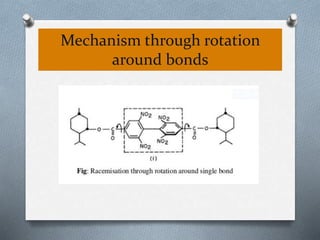
 Through rotation around bonds
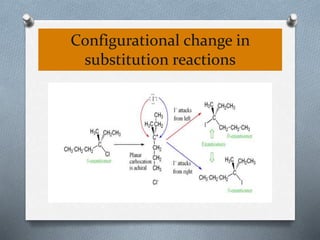
 Configurational change in reactions
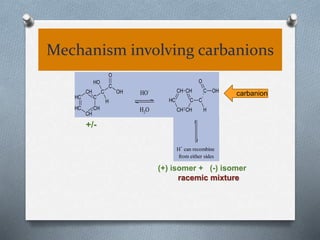
Mechanism involving carbanions
OH
O
OH
C
CH
CH
CH
CH
CH C
C
H
HO-
H2O
OH
O
C
C
CHCH
CH
CH CH
C
-
H
H+
can recombine
from either sides
+/-
(+) isomer + (-) isomer
racemic mixture
carbanion
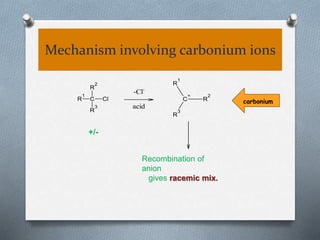
Mechanism involving carbonium ions
Recombination of
anion
gives racemic mix.
R
1
R
2
C
R
3
Cl R
2
C
+
R
1
R
3
-Cl-
acid
+/-
carbonium
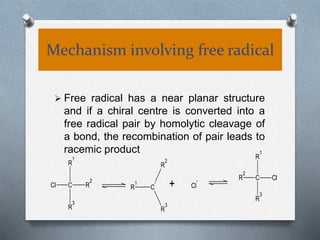
Mechanism involving free radical
 Free radical has a near planar structure
and if a chiral centre is converted into a
free radical pair by homolytic cleavage of
a bond, the recombination of pair leads to
racemic product
R
1
R
2
C
R
3
+ Cl
R
2
C
R
1
R
3
Cl
Cl C
R
3
R
1
R
2
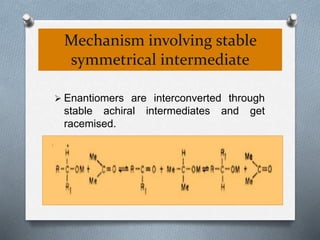
Mechanism involving stable
symmetrical intermediate
 Enantiomers are interconverted through
stable achiral intermediates and get
racemised.
Mechanism through rotation
around bonds
Configurational change in
substitution reactions
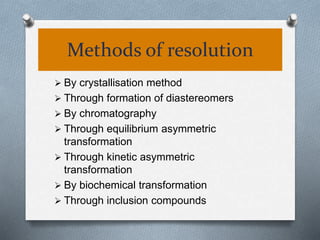
Methods of resolution
 By crystallisation method
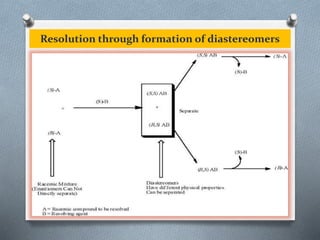
 Through formation of diastereomers
 By chromatography
 Through equilibrium asymmetric
transformation
 Through kinetic asymmetric
transformation
 By biochemical transformation
 Through inclusion compounds
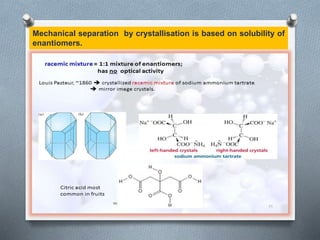
Mechanical separation by crystallisation is based on solubility of
enantiomers.
Resolution through formation of diastereomers
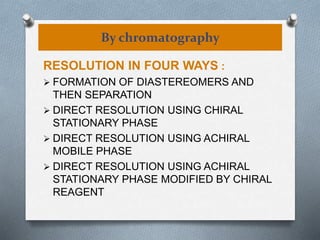
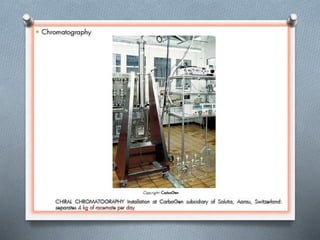
By chromatography
RESOLUTION IN FOUR WAYS :
 FORMATION OF DIASTEREOMERS AND
THEN SEPARATION
 DIRECT RESOLUTION USING CHIRAL
STATIONARY PHASE
 DIRECT RESOLUTION USING ACHIRAL
MOBILE PHASE
 DIRECT RESOLUTION USING ACHIRAL
STATIONARY PHASE MODIFIED BY CHIRAL
REAGENT
Resolution through equilibrium
asymmetric transformation
In this, resolution involve 2 steps:
1. Epimerisation of diastereotopic species
2. Precipitation of the predominant epimer
This combination of epimerisation and
precipitation is known as second order
asymmetric transformation.
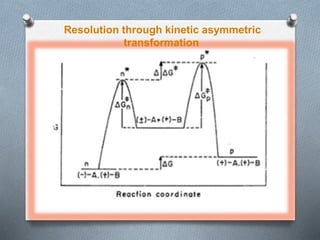
Resolution through kinetic asymmetric
transformation
Resolution by biochemical transformation
 Chiral reagents are replaced by
microorganisms or enzymes which are
stereoselective in their reactions.
 It is mainly used in resolution in amino
acids.
Through inclusion compounds
 An inclusion compound is a complex in
which one chemical compound (the
"host") forms a cavity in which molecules
of a second "guest" compound are
located.
 If the spaces in the host lattice are
enclosed on all sides so that the guest
species is ‘trapped’ as in a cage, the
compound is known as a clathrate.
 This method is of little practical use.
Racemisation n resolution

Racemisation n resolution

  • 1.
    By: Sheikh Khalida Banu, K.J.Somaiya College of Sci. and Com.
  • 2.
    Introduction  Racemisation isthe process when the enantiomer is converted into racemic modification  Resolution is the process when a racemic modification is separated into its constituent enantiomers.  Racemisation and Resolution are complementary to each other.
  • 3.
    Formation of racemic modifications Racemic (mixture, compound, solidsolution) By synthesis By mixing By racemisation
  • 4.
    Racemisation  Enantiomers existin 50:50 population.  Thermodynamically favourable process.  Reversible process. form form +
  • 5.
    Mechanism of racemisation Involving carbanions  Involving carbonium ions  Involving free radicals  Involving stable symmetrical intermediates  Through rotation around bonds  Configurational change in reactions
  • 6.
    Mechanism involving carbanions OH O OH C CH CH CH CH CHC C H HO- H2O OH O C C CHCH CH CH CH C - H H+ can recombine from either sides +/- (+) isomer + (-) isomer racemic mixture carbanion
  • 7.
    Mechanism involving carboniumions Recombination of anion gives racemic mix. R 1 R 2 C R 3 Cl R 2 C + R 1 R 3 -Cl- acid +/- carbonium
  • 8.
    Mechanism involving freeradical  Free radical has a near planar structure and if a chiral centre is converted into a free radical pair by homolytic cleavage of a bond, the recombination of pair leads to racemic product R 1 R 2 C R 3 + Cl R 2 C R 1 R 3 Cl Cl C R 3 R 1 R 2
  • 9.
    Mechanism involving stable symmetricalintermediate  Enantiomers are interconverted through stable achiral intermediates and get racemised.
  • 10.
  • 11.
  • 12.
    Methods of resolution By crystallisation method  Through formation of diastereomers  By chromatography  Through equilibrium asymmetric transformation  Through kinetic asymmetric transformation  By biochemical transformation  Through inclusion compounds
  • 13.
    Mechanical separation bycrystallisation is based on solubility of enantiomers.
  • 14.
  • 15.
    By chromatography RESOLUTION INFOUR WAYS :  FORMATION OF DIASTEREOMERS AND THEN SEPARATION  DIRECT RESOLUTION USING CHIRAL STATIONARY PHASE  DIRECT RESOLUTION USING ACHIRAL MOBILE PHASE  DIRECT RESOLUTION USING ACHIRAL STATIONARY PHASE MODIFIED BY CHIRAL REAGENT
  • 17.
    Resolution through equilibrium asymmetrictransformation In this, resolution involve 2 steps: 1. Epimerisation of diastereotopic species 2. Precipitation of the predominant epimer This combination of epimerisation and precipitation is known as second order asymmetric transformation.
  • 18.
    Resolution through kineticasymmetric transformation
  • 19.
    Resolution by biochemicaltransformation  Chiral reagents are replaced by microorganisms or enzymes which are stereoselective in their reactions.  It is mainly used in resolution in amino acids.
  • 20.
    Through inclusion compounds An inclusion compound is a complex in which one chemical compound (the "host") forms a cavity in which molecules of a second "guest" compound are located.  If the spaces in the host lattice are enclosed on all sides so that the guest species is ‘trapped’ as in a cage, the compound is known as a clathrate.  This method is of little practical use.