
RESAMPLING
It is defined as!
“The process of deriving pixel values for a new image from an existing image is called as
resampling.”
Resampling is usually done for the digitizing the pixel values from the existing cell values. It
exhibit two types of resolution based on their input and output i.e.
 Input raster will be a finer resolution
 Output raster will be a coarser resolution
Input (with different cell size)
Map algebra operation
Output (Output cell center identifies the input value)
NEAREST NEIGHBOR
For the nearest neighbor, the output image pixel value is calculated from the nearest pixel of
the input image (Brandsma and Können, 2005).
PROPERTIES
 Pixel values for output image resemble those of the
input image (Roberts, 2011).
 It is recommended to use with discrete (categorical)
data.
 It produces blocky results.
BILINEAR INTERPOLATION
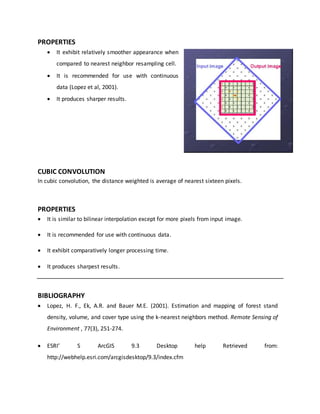
In bilinear interpolation, the distance weighted is average of nearest four pixels.
PROPERTIES
 It exhibit relatively smoother appearance when
compared to nearest neighbor resampling cell.
 It is recommended for use with continuous
data (Lopez et al, 2001).
 It produces sharper results.
CUBIC CONVOLUTION
In cubic convolution, the distance weighted is average of nearest sixteen pixels.
PROPERTIES
 It is similar to bilinear interpolation except for more pixels from input image.
 It is recommended for use with continuous data.
 It exhibit comparatively longer processing time.
 It produces sharpest results.
BIBLIOGRAPHY
 Lopez, H. F., Ek, A.R. and Bauer M.E. (2001). Estimation and mapping of forest stand
density, volume, and cover type using the k-nearest neighbors method. Remote Sensing of
Environment , 77(3), 251-274.
 ESRI’ S ArcGIS 9.3 Desktop help Retrieved from:
http://webhelp.esri.com/arcgisdesktop/9.3/index.cfm
 Roberts, J. (2011). Resampling pixel values.
 Brandsma, T. and Können, G. P. (2005). Application of nearest-neighbor resampling for
homogenizing temperature records on a daily to sub-daily level. International Journal of
Climatology , 26(1), 75-89.

Resampling- GIS

  • 1.
    RESAMPLING It is definedas! “The process of deriving pixel values for a new image from an existing image is called as resampling.” Resampling is usually done for the digitizing the pixel values from the existing cell values. It exhibit two types of resolution based on their input and output i.e.  Input raster will be a finer resolution  Output raster will be a coarser resolution Input (with different cell size) Map algebra operation Output (Output cell center identifies the input value) NEAREST NEIGHBOR For the nearest neighbor, the output image pixel value is calculated from the nearest pixel of the input image (Brandsma and Können, 2005). PROPERTIES  Pixel values for output image resemble those of the input image (Roberts, 2011).  It is recommended to use with discrete (categorical) data.  It produces blocky results. BILINEAR INTERPOLATION In bilinear interpolation, the distance weighted is average of nearest four pixels.
  • 2.
    PROPERTIES  It exhibitrelatively smoother appearance when compared to nearest neighbor resampling cell.  It is recommended for use with continuous data (Lopez et al, 2001).  It produces sharper results. CUBIC CONVOLUTION In cubic convolution, the distance weighted is average of nearest sixteen pixels. PROPERTIES  It is similar to bilinear interpolation except for more pixels from input image.  It is recommended for use with continuous data.  It exhibit comparatively longer processing time.  It produces sharpest results. BIBLIOGRAPHY  Lopez, H. F., Ek, A.R. and Bauer M.E. (2001). Estimation and mapping of forest stand density, volume, and cover type using the k-nearest neighbors method. Remote Sensing of Environment , 77(3), 251-274.  ESRI’ S ArcGIS 9.3 Desktop help Retrieved from: http://webhelp.esri.com/arcgisdesktop/9.3/index.cfm
  • 3.
     Roberts, J.(2011). Resampling pixel values.  Brandsma, T. and Können, G. P. (2005). Application of nearest-neighbor resampling for homogenizing temperature records on a daily to sub-daily level. International Journal of Climatology , 26(1), 75-89.