Climate Change
Created by: Sadia Rahat
Definitions
USA EPA:
Climate change refers to any significant
change in the measures of climate
lasting for an extended period of time. In
other words, climate change includes
major changes in temperature,
precipitation, or wind patterns, among
other effects, that occur over several
decades or longer.
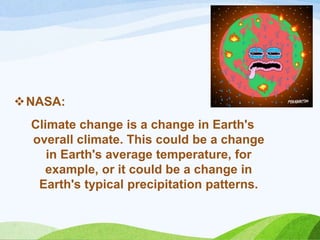
NASA:
Climate change is a change in Earth's
overall climate. This could be a change
in Earth's average temperature, for
example, or it could be a change in
Earth's typical precipitation patterns.
History
 20 hottest years in the last and present century
occurred after 1980.
 1998, 2003, 2004, 2005, 2006 were the hottest
years.
 The level of CO2 at present is highest in the last
6,50,000 years.
 According to National Climatic Data Centre in
2006, the temp of earth was 2.2°F higher than
the average temperature of the 20th century.
 The summer season of 2003 was hottest in
Europe in the last 500 years.
 The temperature shot up to 100.2°F (37.88°C) in
England and 104°F (40°C) in France. This heat
wave killed 35000 persons in Europe.
 Since 1970 the number of Hurricanes of 4 and 5
category have doubled compared to earlier
period.
 The monsoons storm episodes between 1951
and 2000 increased considerably resulting in
extensive landslides, devastating floods and
serious damage to crops.
 More than 300 million peasants in Western
China are now facing the possibility of receiving
less water from disappearing glaciers.
 Since the beginning of nineteenth century half
of total CO2 released due to natural and
anthropogenic activities has dissolved in water.
At present sea water stores 120 billion tons of
CO2.
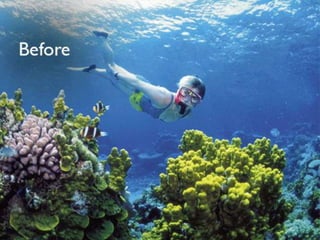
 Since industrial revolution the pH of seas has
increased by 30%. This will lead to extinction of
some species. The carbonate shelled organism
will suffer due to higher pH.
 Sea level rose by 4 to 8 inches the last century.
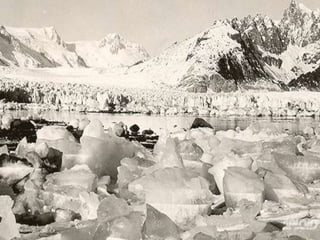
 In 1850 Montana’s Glacier National Park had 150
glaciers now only 27 glaciers are left.
 If the present trend continues, by 2050 due to
increasing temperature 35% on land plants and
animals may disappear.
 Due to polar amplification the air temp in Arctic
increased by 9oF (-12.77°C) (WWF).
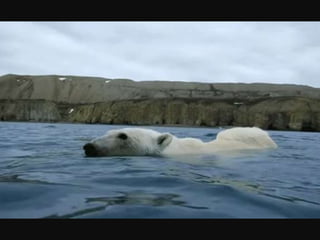
 Local people in Arctic depend on Whale, Seal,
Walrus and Polar Bear. But due to global
warming their migratory patterns are changing
threatening the native human communities.
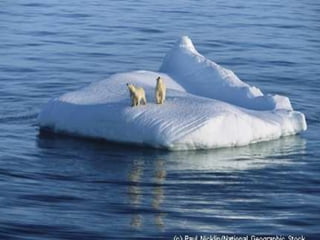
 If western Antarctic ice melts the Sealed level
will rise by 16 feet, due to which Washington
D.C, London and Mumbai, much of Bangladesh
and many other low lying coastal cities will go
under water.
 If Greenland ice melts the sea level will rise by
23 feet effecting Florida.
Kyoto Protocol
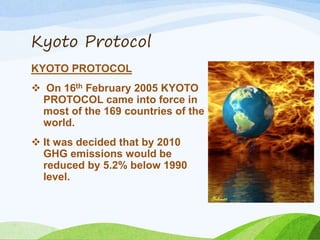
KYOTO PROTOCOL
 On 16th February 2005 KYOTO
PROTOCOL came into force in
most of the 169 countries of the
world.
 It was decided that by 2010
GHG emissions would be
reduced by 5.2% below 1990
level.
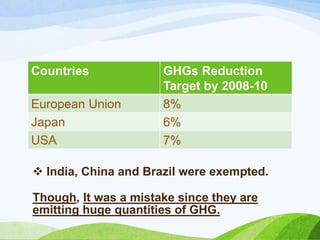
 India, China and Brazil were exempted.
Though, It was a mistake since they are
emitting huge quantities of GHG.
Countries GHGs Reduction
Target by 2008-10
European Union 8%
Japan 6%
USA 7%
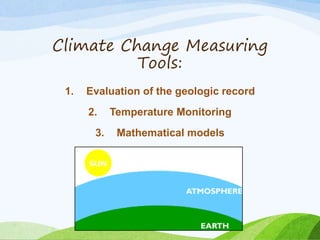
Climate Change Measuring
Tools:
1. Evaluation of the geologic record
2. Temperature Monitoring
3. Mathematical models
Interesting Facts
1. 80% of CO2 built up is due to Industrial countries.
2. Since 1950 U.S has emitted 50.7 billion tons of
carbon.
3. China emitted 15.7 billion tons of carbon.
4. India emitted 4.2 billion tons of carbon.
5. Annually >60% CO2 is emitted by Industrial
countries (where 20% of the world’s population
lives).
6. U.S with 4% population)
emits 20 times “C” per
capita compared to India
and 7 times higher than
China & 12 times higher
than Brazil.
7. Russia emits 17% CO2
1. The temp of world’s oceans are approaching
27°C or higher which results in more H20
evaporation and formation of Hurricanes.
2. Permafrost thawing will increase global
warming by emitting CH4 & CO2.
3. Massive extinction of species could result.
4. Science 2002, reported alarming increase in
outbreaks of epidemics and diseases
throughout the world (land & ocean) wildlife due
to climate change.
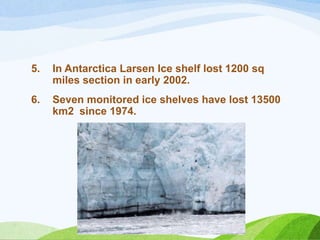
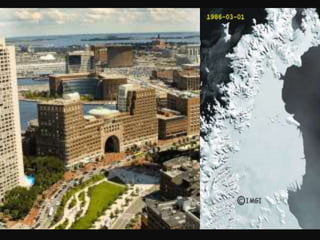
5. In Antarctica Larsen Ice shelf lost 1200 sq
miles section in early 2002.
6. Seven monitored ice shelves have lost 13500
km2 since 1974.
GHGs:
1. Water vapor (H. 2O)
2. Carbon dioxide (CO2)
3. Methane (CH4)
4. Nitrous oxide (N2O)
5. Ozone (O3)
6. Chloro-fluorocarbons (CFCs)
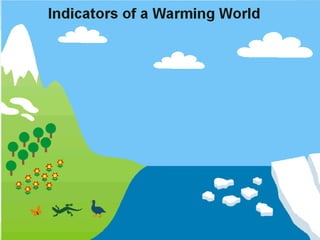
Indicators of Climate Change
Climate Change is Real
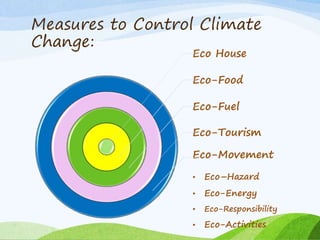
Measures to Control Climate
Change
Measures to Control Climate
Change:
Eco House
Eco-Food
Eco-Fuel
Eco-Tourism
Eco-Movement
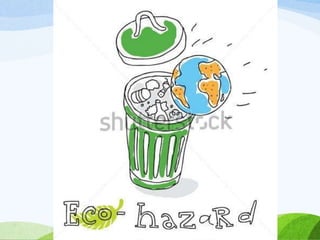
• Eco–Hazard
• Eco-Energy
• Eco-Responsibility
• Eco-Activities
Any Question?

Climate Change

  • 1.
  • 3.
    Definitions USA EPA: Climate changerefers to any significant change in the measures of climate lasting for an extended period of time. In other words, climate change includes major changes in temperature, precipitation, or wind patterns, among other effects, that occur over several decades or longer.
  • 4.
    NASA: Climate change isa change in Earth's overall climate. This could be a change in Earth's average temperature, for example, or it could be a change in Earth's typical precipitation patterns.
  • 6.
    History  20 hottestyears in the last and present century occurred after 1980.  1998, 2003, 2004, 2005, 2006 were the hottest years.  The level of CO2 at present is highest in the last 6,50,000 years.
  • 7.
     According toNational Climatic Data Centre in 2006, the temp of earth was 2.2°F higher than the average temperature of the 20th century.  The summer season of 2003 was hottest in Europe in the last 500 years.  The temperature shot up to 100.2°F (37.88°C) in England and 104°F (40°C) in France. This heat wave killed 35000 persons in Europe.
  • 8.
     Since 1970the number of Hurricanes of 4 and 5 category have doubled compared to earlier period.  The monsoons storm episodes between 1951 and 2000 increased considerably resulting in extensive landslides, devastating floods and serious damage to crops.  More than 300 million peasants in Western China are now facing the possibility of receiving less water from disappearing glaciers.
  • 9.
     Since thebeginning of nineteenth century half of total CO2 released due to natural and anthropogenic activities has dissolved in water. At present sea water stores 120 billion tons of CO2.  Since industrial revolution the pH of seas has increased by 30%. This will lead to extinction of some species. The carbonate shelled organism will suffer due to higher pH.  Sea level rose by 4 to 8 inches the last century.
  • 10.
     In 1850Montana’s Glacier National Park had 150 glaciers now only 27 glaciers are left.  If the present trend continues, by 2050 due to increasing temperature 35% on land plants and animals may disappear.  Due to polar amplification the air temp in Arctic increased by 9oF (-12.77°C) (WWF).  Local people in Arctic depend on Whale, Seal, Walrus and Polar Bear. But due to global warming their migratory patterns are changing threatening the native human communities.
  • 11.
     If westernAntarctic ice melts the Sealed level will rise by 16 feet, due to which Washington D.C, London and Mumbai, much of Bangladesh and many other low lying coastal cities will go under water.  If Greenland ice melts the sea level will rise by 23 feet effecting Florida.
  • 12.
    Kyoto Protocol KYOTO PROTOCOL On 16th February 2005 KYOTO PROTOCOL came into force in most of the 169 countries of the world.  It was decided that by 2010 GHG emissions would be reduced by 5.2% below 1990 level.
  • 13.
     India, Chinaand Brazil were exempted. Though, It was a mistake since they are emitting huge quantities of GHG. Countries GHGs Reduction Target by 2008-10 European Union 8% Japan 6% USA 7%
  • 14.
    Climate Change Measuring Tools: 1.Evaluation of the geologic record 2. Temperature Monitoring 3. Mathematical models
  • 15.
    Interesting Facts 1. 80%of CO2 built up is due to Industrial countries. 2. Since 1950 U.S has emitted 50.7 billion tons of carbon. 3. China emitted 15.7 billion tons of carbon. 4. India emitted 4.2 billion tons of carbon. 5. Annually >60% CO2 is emitted by Industrial countries (where 20% of the world’s population lives).
  • 16.
    6. U.S with4% population) emits 20 times “C” per capita compared to India and 7 times higher than China & 12 times higher than Brazil. 7. Russia emits 17% CO2

  • 17.
    1. The tempof world’s oceans are approaching 27°C or higher which results in more H20 evaporation and formation of Hurricanes. 2. Permafrost thawing will increase global warming by emitting CH4 & CO2. 3. Massive extinction of species could result. 4. Science 2002, reported alarming increase in outbreaks of epidemics and diseases throughout the world (land & ocean) wildlife due to climate change.
  • 18.
    5. In AntarcticaLarsen Ice shelf lost 1200 sq miles section in early 2002. 6. Seven monitored ice shelves have lost 13500 km2 since 1974.
  • 19.
    GHGs: 1. Water vapor(H. 2O) 2. Carbon dioxide (CO2) 3. Methane (CH4) 4. Nitrous oxide (N2O) 5. Ozone (O3) 6. Chloro-fluorocarbons (CFCs)
  • 22.
  • 24.
  • 45.
    Measures to ControlClimate Change
  • 56.
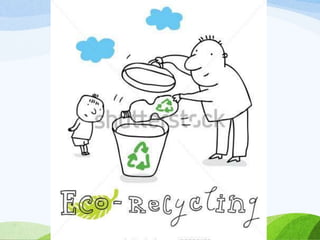
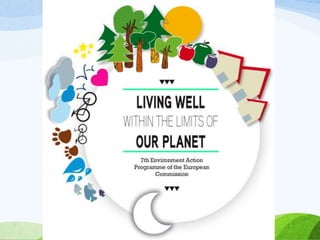
    Measures to ControlClimate Change: Eco House Eco-Food Eco-Fuel Eco-Tourism Eco-Movement • Eco–Hazard • Eco-Energy • Eco-Responsibility • Eco-Activities
  • 71.

Editor's Notes

  • #5 NASA: National Aeronautics and Space Administration Updated: Sept. 16, 2015
  • #18 Permafrost refers to a layer of soil or rock that is frozen all year round. As long as this organic matter remains frozen, it will stay in the permafrost. However, if it thaws, it will decay, releasing carbon dioxide or methane into the atmosphere.
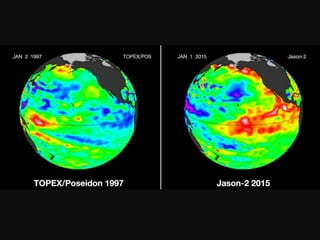
  • #20 El Niño Conditions: An irregularly occurring and complex series of climatic changes affecting the equatorial Pacific region and beyond every few years, characterized by the appearance of unusually warm, nutrient-poor water off northern Peru and Ecuador, typically in late December. The effects of El Niño include reversal of wind patterns across the Pacific, drought in Australasia, and unseasonal heavy rain in South America.