VISUAL IMAGE
INTERPRETATION
Prof. Samirsinh P Parmar
Asst. Prof. Dharmsinh Desai University, Nadiad, Gujarat, India
Mail: samirddu@gmail.com
Special Thanks to
iirs dehradun
Disclaimer:
 This presentation is compilation of the study material provided from IIRS
Dehradun, India and on the net as just study material.
 The aim of this presentation is to let students, researchers, professors, teachers to
know, “ What is Visual Image interpretation?”
 As knowledge is not slave of human being, the copyright laws are fully violated and
not subjected to any jurisdiction, so kindly consider it as study material only.
 Thanks
 Author
2
Advance Surveying, Sem-III, B.Tech Civil, Prof. Samirsinh P Parmar
IMAGE INTERPRETATION
Act of examining images to identify objects and judge their
significance.
Information extraction process from the images.
An interpreter is a specialist trained in study of photography or
imagery, in addition to his own discipline.
Aerial photographs and remote Sensing images employ electro
magnetic energy as the mean of detecting and measuring target
characteristics.
Involves a considerable amount of subjective judgment
Highly dependent on capability of mind to generalize
Takes place at different levels of complexity
3
Advance Surveying, Sem-III, B.Tech Civil, Prof. Samirsinh P Parmar
Image is a pictorial representation of an object or a
scene.
Image can be analog or digital.
Aerial photographs are generally analog, while satellite
data is in digital form.
A digital image is made up of square or rectangular
areas called pixels.
Each pixel has an associated pixel value which depends
on the amount reflected energy from the ground.
4
IMAGE INTERPRETATION
Advance Surveying, Sem-III, B.Tech Civil, Prof. Samirsinh P Parmar
Advantages of aerial photographs/Satellite
Images over ground observation
Synoptic view
Time freezing ability
Permanent record
Spectral resolution
Spatial resolution
Cost and time effective
Stereoscopic view
Brings out relationship between objects
5
Advance Surveying, Sem-III, B.Tech Civil, Prof. Samirsinh P Parmar
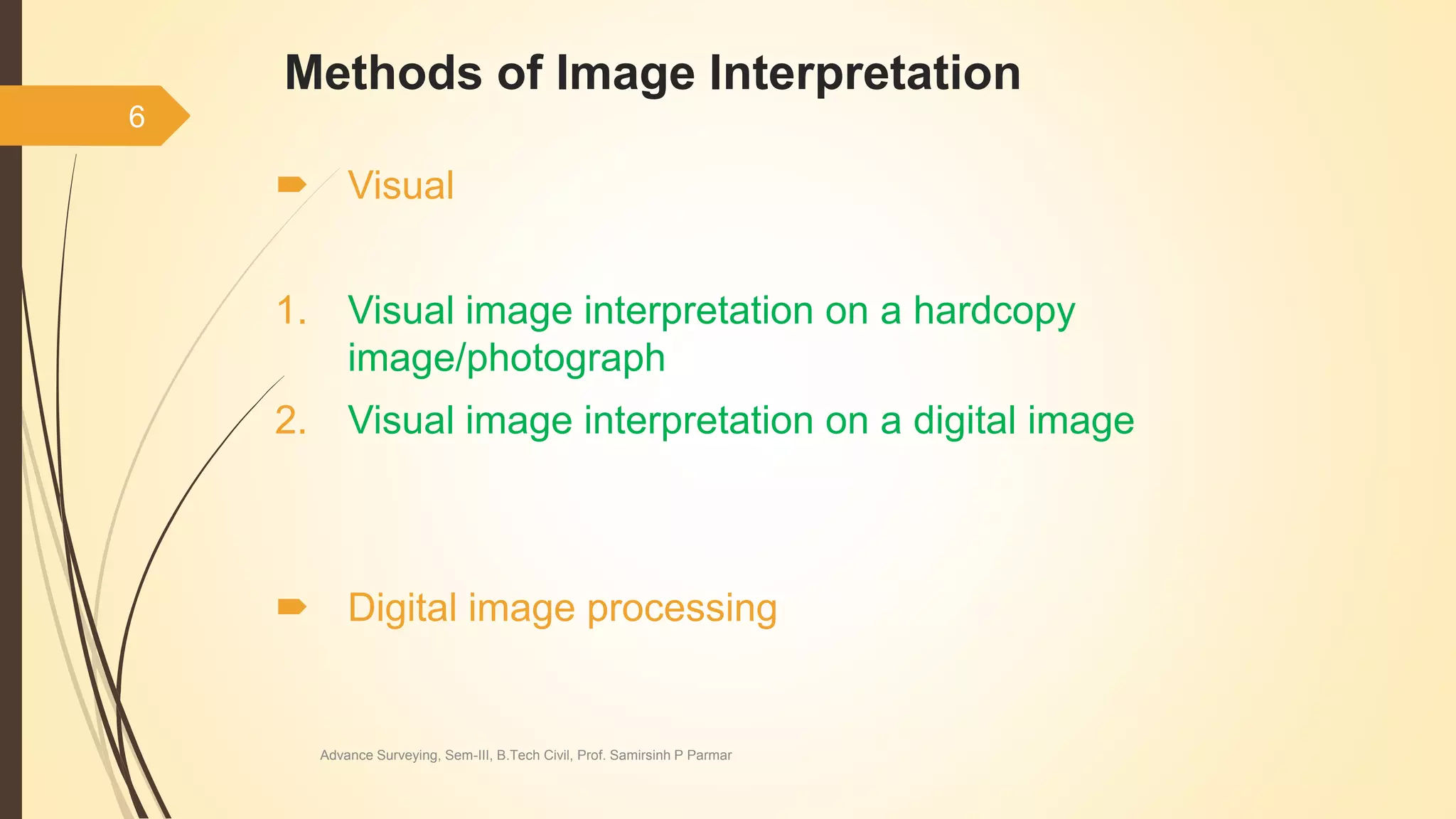
Methods of Image Interpretation
 Visual
1. Visual image interpretation on a hardcopy
image/photograph
2. Visual image interpretation on a digital image
 Digital image processing
6
Advance Surveying, Sem-III, B.Tech Civil, Prof. Samirsinh P Parmar
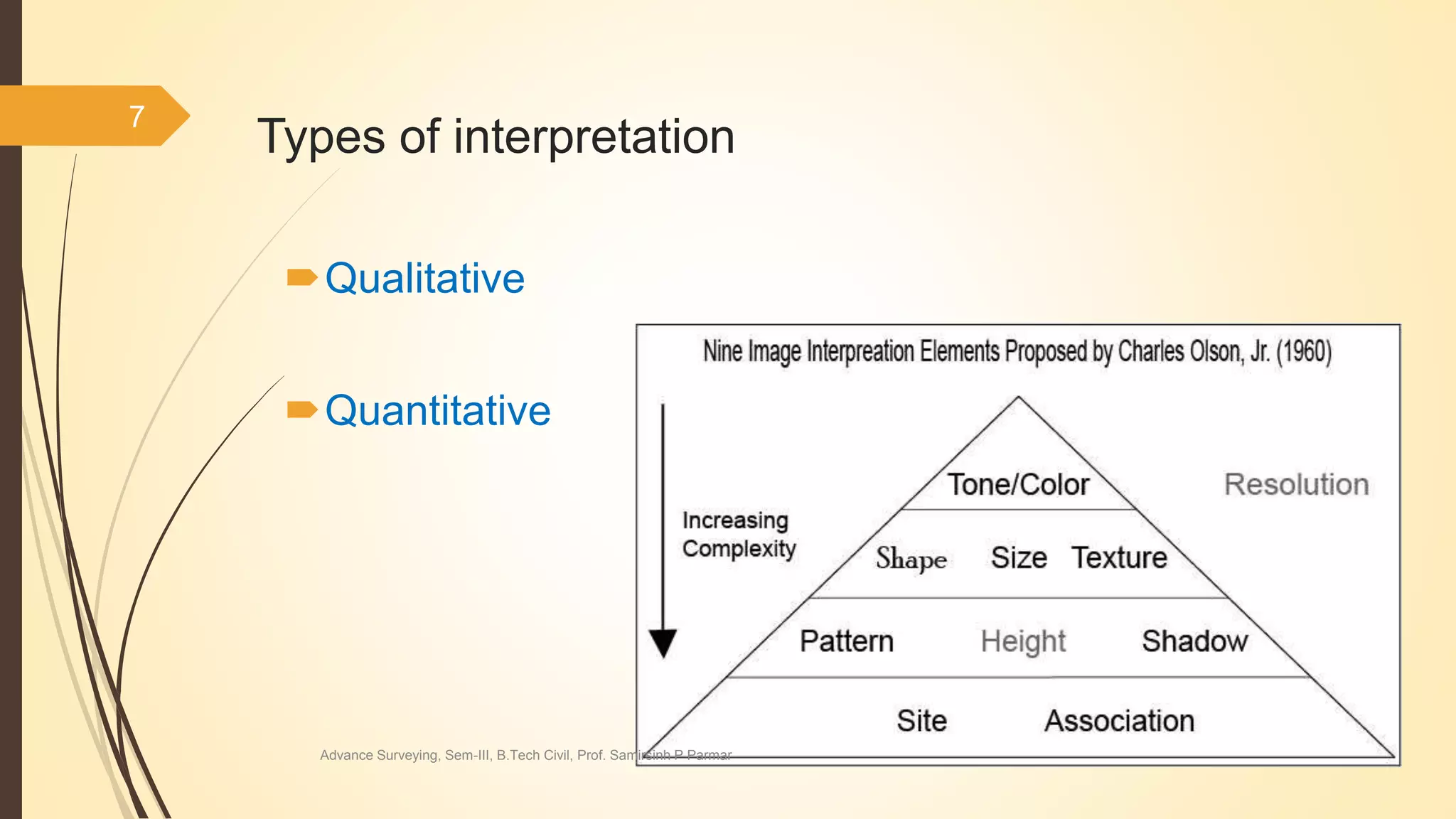
Types of interpretation
Qualitative
Quantitative
7
Advance Surveying, Sem-III, B.Tech Civil, Prof. Samirsinh P Parmar
8
Advance Surveying, Sem-III, B.Tech Civil, Prof. Samirsinh P Parmar
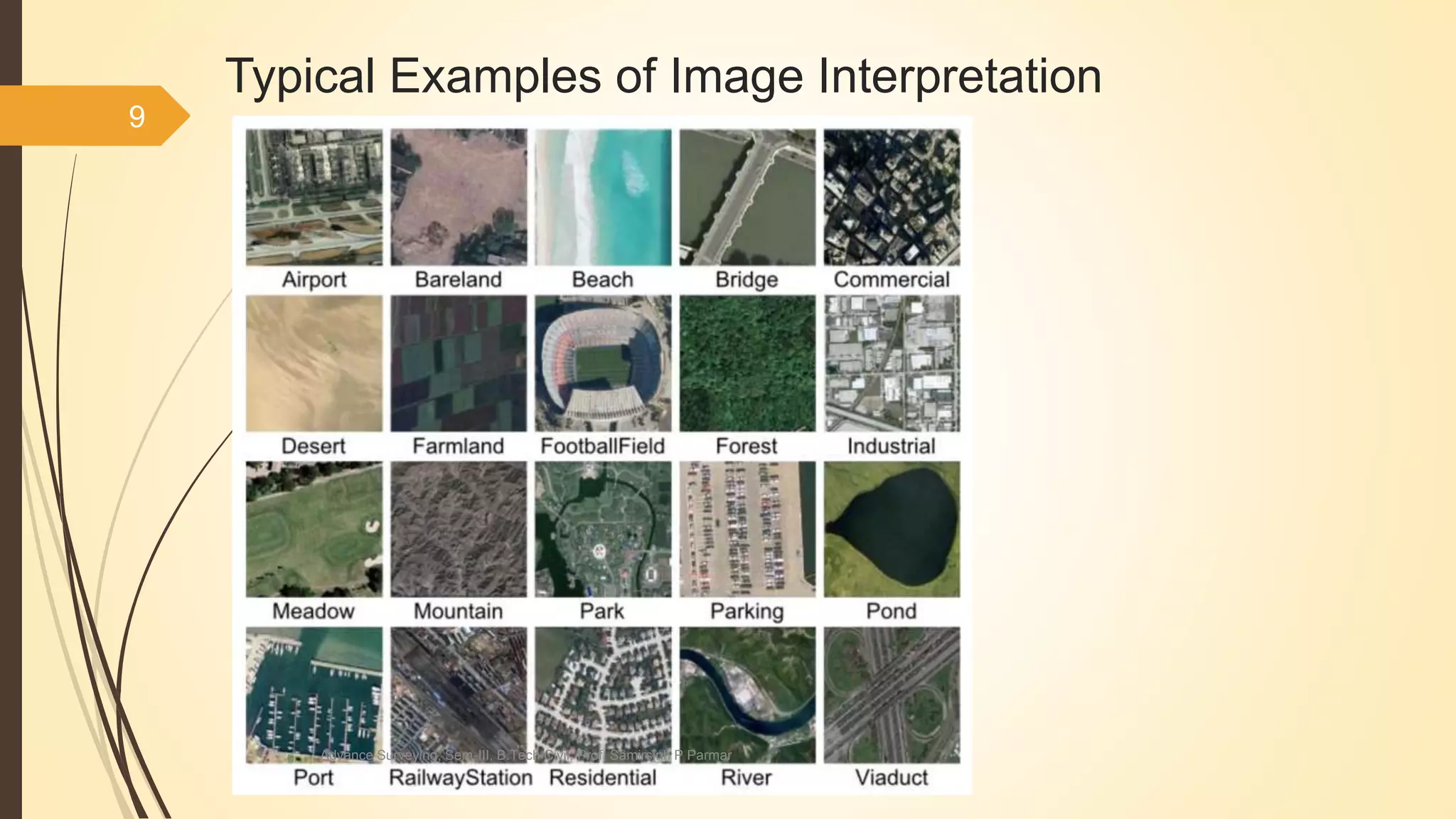
Typical Examples of Image Interpretation
9
Advance Surveying, Sem-III, B.Tech Civil, Prof. Samirsinh P Parmar
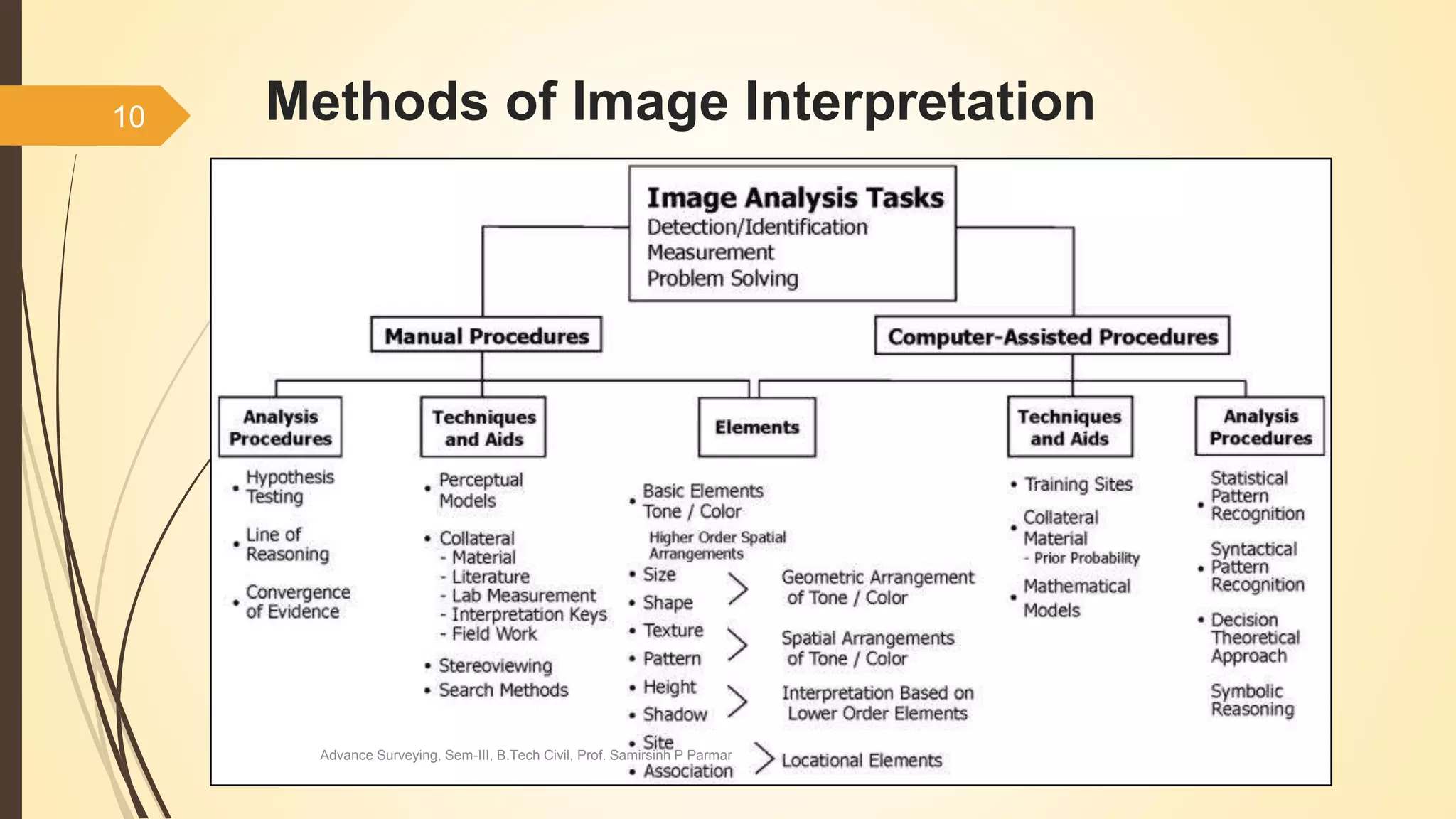
Methods of Image Interpretation
10
Advance Surveying, Sem-III, B.Tech Civil, Prof. Samirsinh P Parmar
Basic Principle of Image Interpretation
• Image is a pictorial representation of pattern of landscape.
• Pattern indicates type of objects and their physical, biological, and
cultural relationships
• Similar objects under similar conditions reflect similarly.
• A systematic examination of photos and supporting material.
• Interpretation is made of physical nature of the object.
• Information extracted is proportional to knowledge, skill and
experience of analyst; the methods and equipment used.
11
Advance Surveying, Sem-III, B.Tech Civil, Prof. Samirsinh P Parmar
Factors governing interpretability
Training, Experience
Nature of object or phenomenon
Quality of photographs
Equipment and method of interpretation
Interpretation keys, guides, manuals and
other aids
Prior knowledge of the area.
12
Advance Surveying, Sem-III, B.Tech Civil, Prof. Samirsinh P Parmar
Techniques of visual image interpretation
 The development of interpretation techniques has been mainly
by the empirical method.
 The gap between the photo image on the one hand and the
reference level, i.e. the level of knowledge in a specific field, in
the human mind on the other hand, is bridged by the use of
image-interpretation.
 The techniques adopted for one discipline may differ from those
adopted for another.
 The sequence of activity and the search method may have to
be modified to suit the specific requirements.
13
Advance Surveying, Sem-III, B.Tech Civil, Prof. Samirsinh P Parmar
Image interpretation comprises at least three mental acts
that may or may not be performed simultaneously:

i. The measurement of images of objects
ii. Identification of the objects imaged
iii. Appropriate use of this information in the solution of the
problem.
14 Techniques of visual image interpretation
Advance Surveying, Sem-III, B.Tech Civil, Prof. Samirsinh P Parmar
Methodology depends on………
 Kind of information to be interpreted
 Accuracy of the results to be obtained
 The reference level of the person executing the interpretation
 Kind and type of imagery or photographs available
 Instruments available
 Scale and other requirements of the final map
 External knowledge available and any other sensory surveys that
have been or will be made in the near future in the same area.
15
Advance Surveying, Sem-III, B.Tech Civil, Prof. Samirsinh P Parmar
ACTIVITIES OF IMAGE
INTERPRETATION
Detection
Recognition
Analysis
Deduction
Classification
Idealization
Convergence of evidence
16
Advance Surveying, Sem-III, B.Tech Civil, Prof. Samirsinh P Parmar
METHOD OF SEARCH
Interpreter should work methodologically
From general information to specific object
From known to unknown
 Fishing Expedition- Examination of each and every object
 Logical Search- Quick scanning and selective intensive study
17
BASIC METHODS
Advance Surveying, Sem-III, B.Tech Civil, Prof. Samirsinh P Parmar
INTERPRETATION KEYS-TYPES OF
INTERPRETATION KEYS
Item key
Subject key
Regional key
Analogous area key
Scope of image interpretation
Technical level image interpretation
 Technical
 Non-Technical
18
Advance Surveying, Sem-III, B.Tech Civil, Prof. Samirsinh P Parmar
Intrinsic character of image interpretation:
 Direct key
 Association key
Manner of organization:
 Selective
1. Essay key
2. File key
3. Photo key
4. Integrated selected key
 Elimination
1. Disk key
2. Punch card
3. Dichotomous key
19
INTERPRETATION KEYS-TYPES OF
INTERPRETATION KEYS
Advance Surveying, Sem-III, B.Tech Civil, Prof. Samirsinh P Parmar
Methods of analysis and reference levels
Monocular and stereo analysis
Densitometry analysis
Multiple images
Multi band images
Multi date images
Multi stage images
20
Advance Surveying, Sem-III, B.Tech Civil, Prof. Samirsinh P Parmar
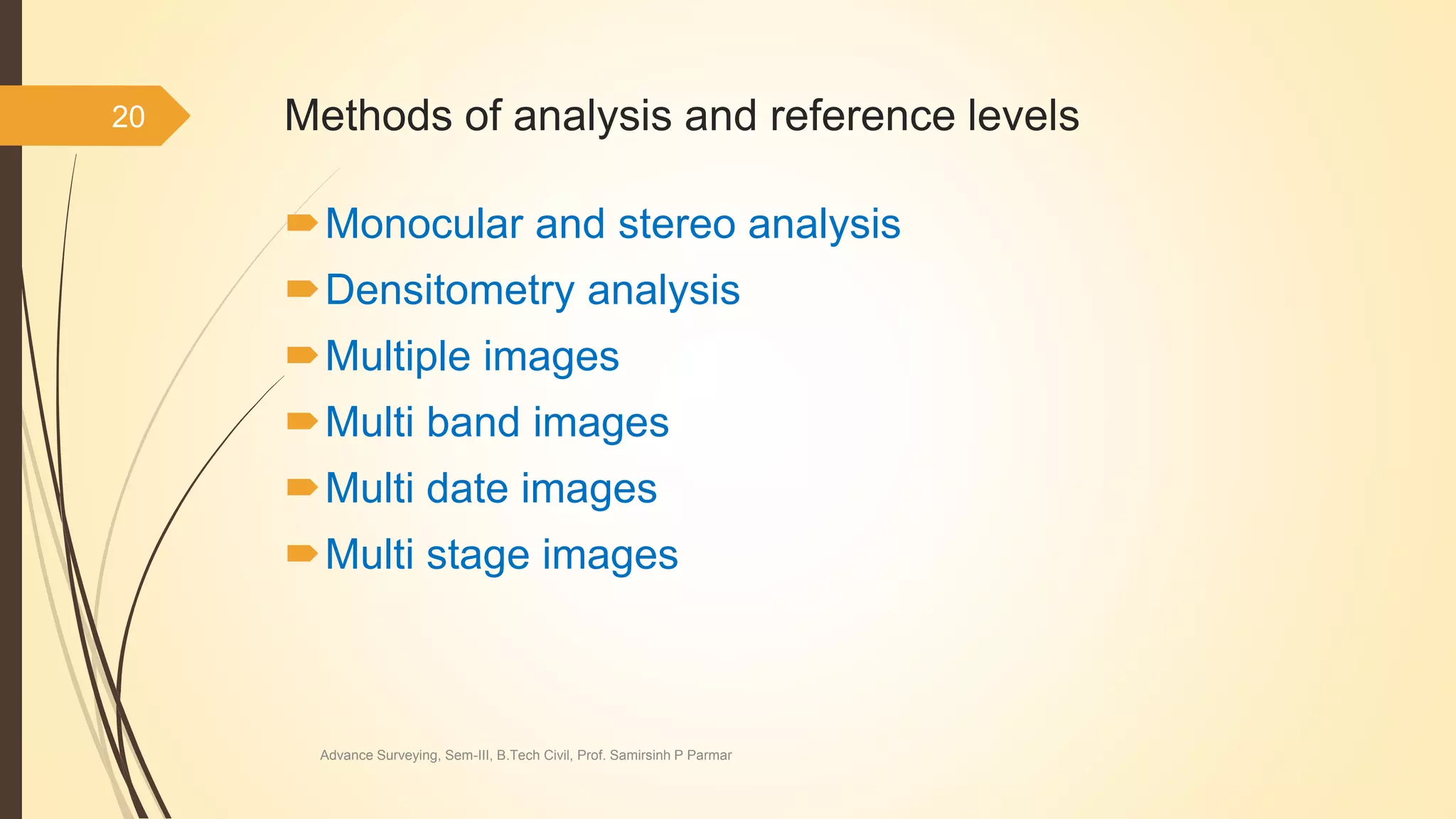
Sensors in photographic Image Interpretation
Black and white panchromatic
Black and white infrared
Colour
Colour infrared/ false colour
21
Advance Surveying, Sem-III, B.Tech Civil, Prof. Samirsinh P Parmar
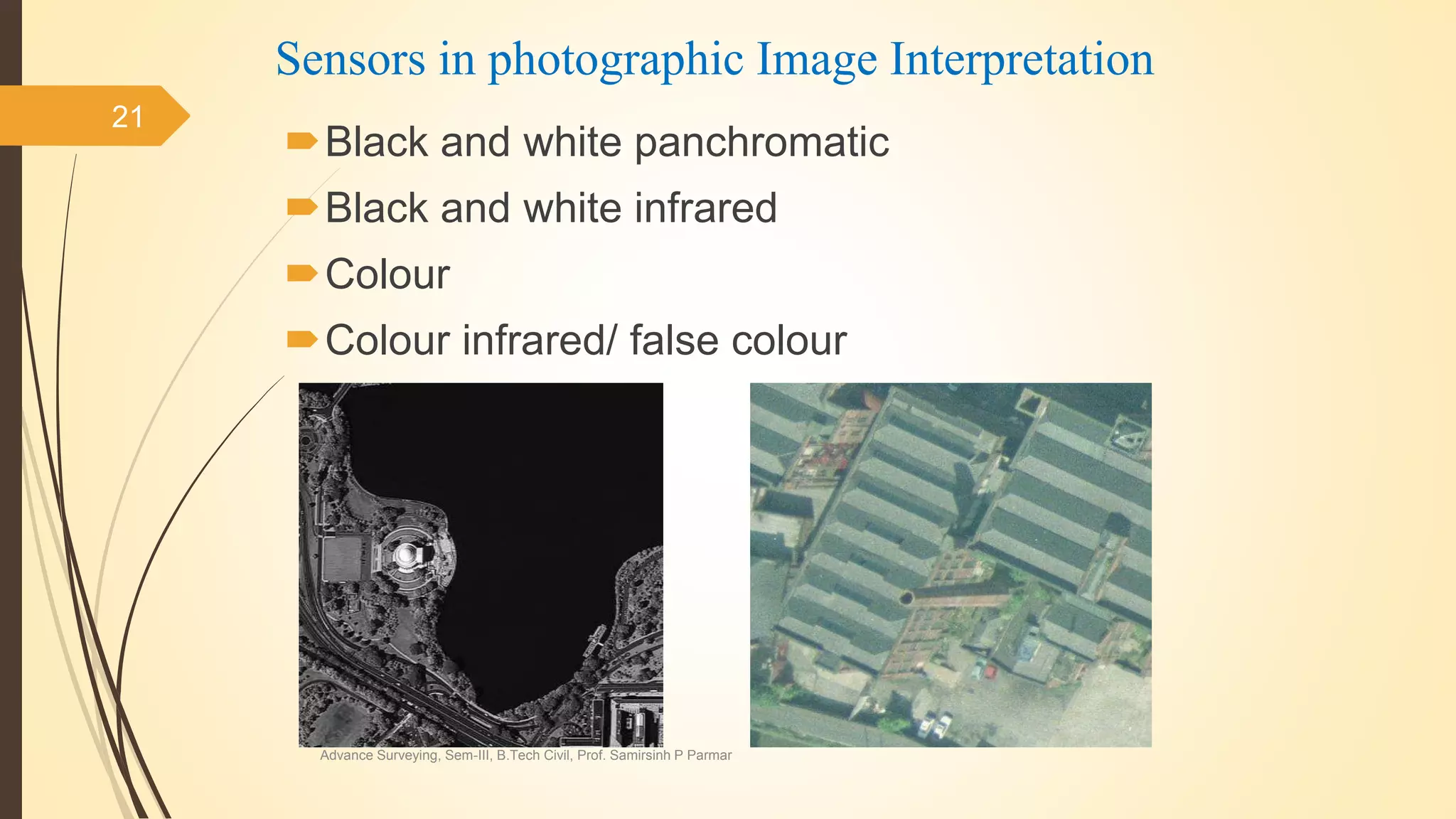
In the upper right corner there is
a hydrofoil ship. The other big
ship is a tanker delivering fresh
water to the island
B/W Aerial Photo
The image is stored on
photographic film that is,
generally speaking, sensitive to
electromagnetic radiation from
0.3 µm to 0.9 µm. Panchromatic
films, producing black and white
images, is the most common
type of film used for aerial
photography.
22
Advance Surveying, Sem-III, B.Tech Civil, Prof. Samirsinh P Parmar
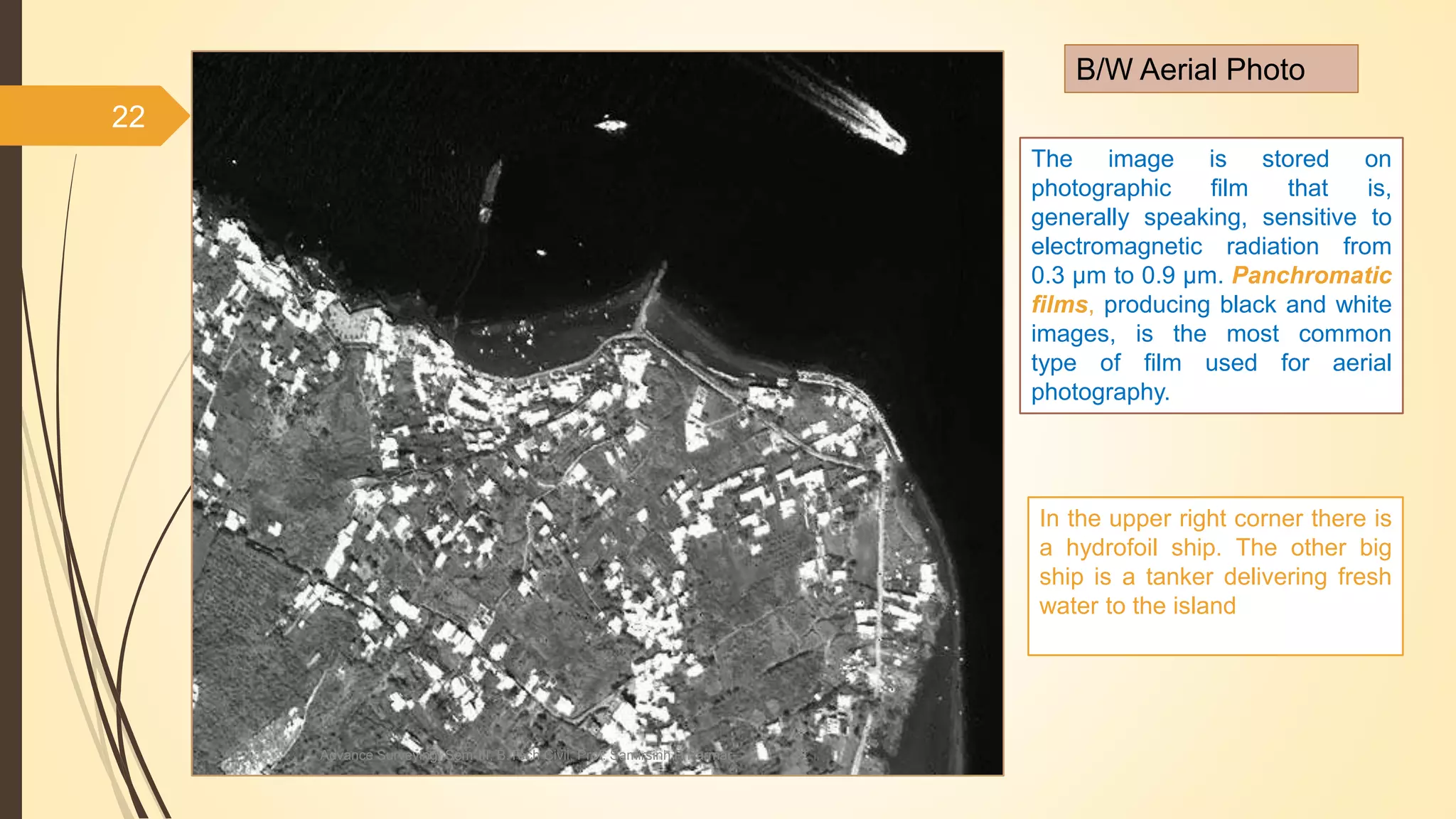
Colour and false colour (or colour infrared) photography involves the use of a three layer
film with each layer sensitive to different ranges of light. For a normal colour photograph, the layers
are sensitive to blue, green, and red light - the same as our eyes. Accordingly, these photos appear
to us the same way that our eyes see the environment. The colours resemble those which would
appear to us as "normal" (i.e. trees appear green, etc.).
23
Advance Surveying, Sem-III, B.Tech Civil, Prof. Samirsinh P Parmar
In color infrared (CIR)
photography, the three
emulsion layers are sensitive
to green, red, and the
photographic portion of near-
infrared radiation (up to 0.9
µm), which are processed to
appear as blue, green, and
red, respectively. In a false
color photograph, targets with
high near-infrared reflectance
appear red, those with a high
red reflectance appear green,
and those with a high green
reflectance appear blue, thus
giving us a "false"
presentation of the targets
relative to the color we
normally perceive them to be.
Mid-Infrared Image of Stromboli Island.
24
Advance Surveying, Sem-III, B.Tech Civil, Prof. Samirsinh P Parmar
Image interpretation for Multispectral imagery
•Resolution
•Stereoscopic ability
•Individual Band Interpretation
•Temporal data
25
Advance Surveying, Sem-III, B.Tech Civil, Prof. Samirsinh P Parmar
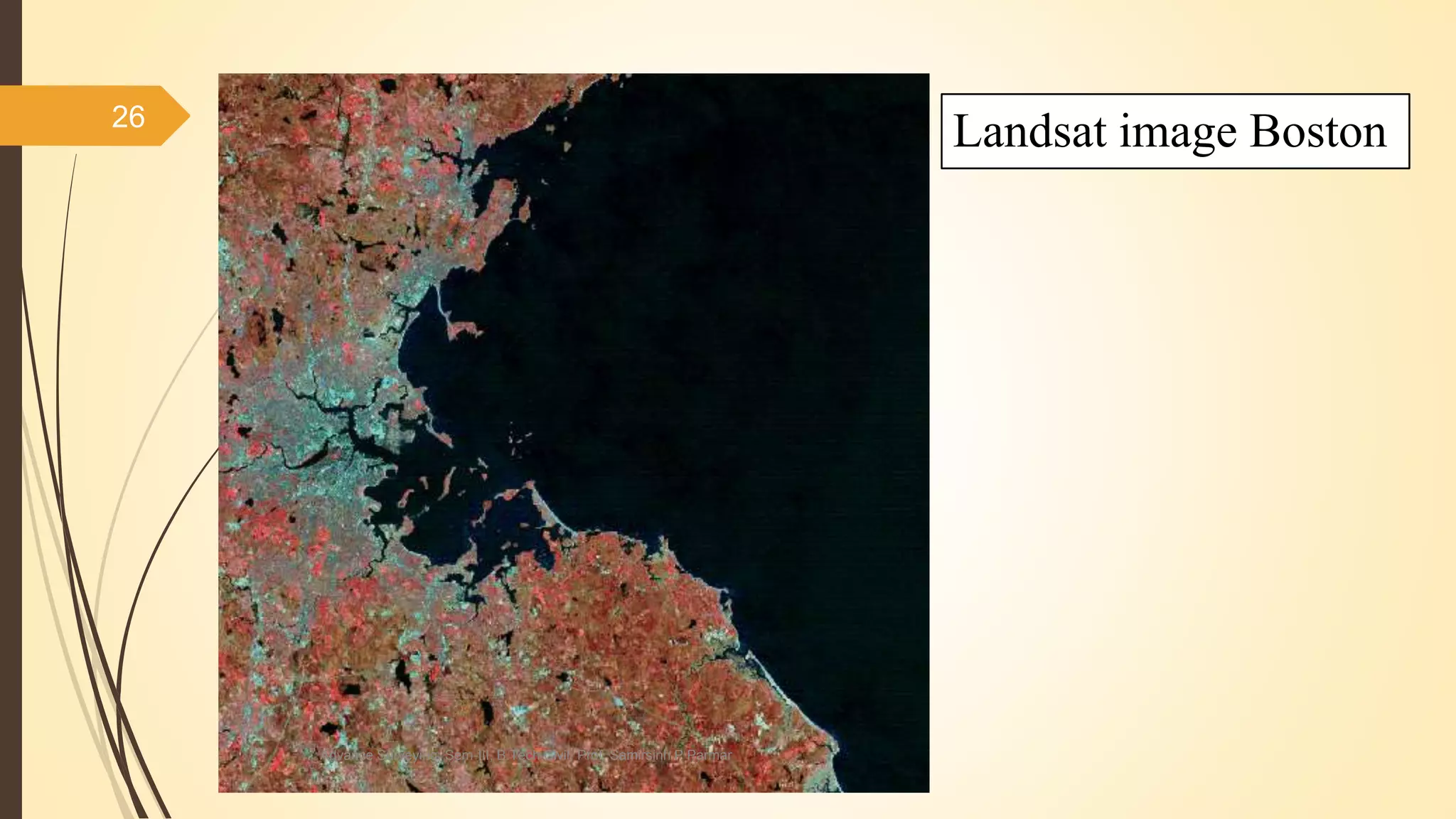
Landsat image Boston
26
Advance Surveying, Sem-III, B.Tech Civil, Prof. Samirsinh P Parmar
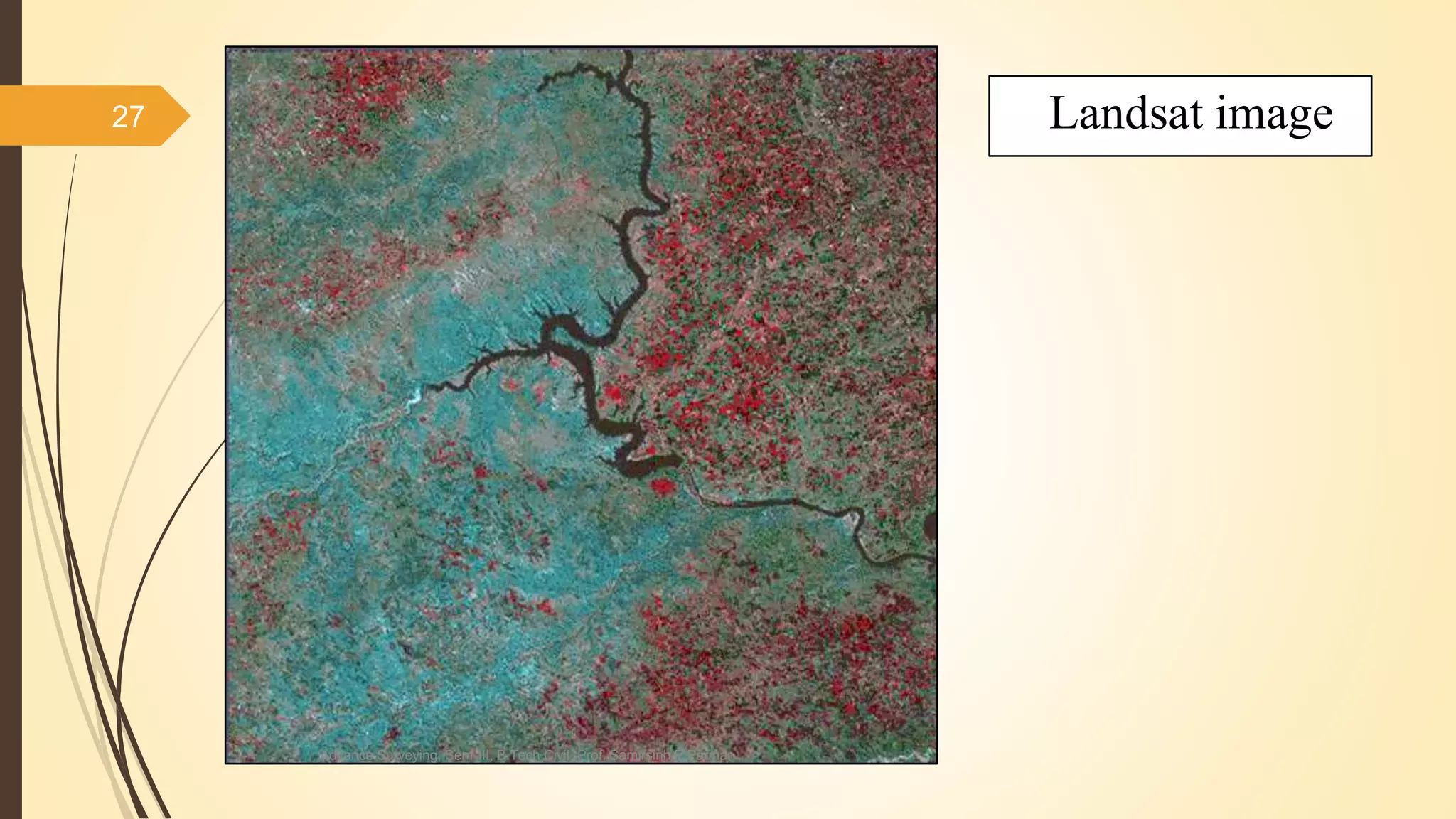
Landsat image
27
Advance Surveying, Sem-III, B.Tech Civil, Prof. Samirsinh P Parmar
Saudi Arabia
Sensor : IRS1C LISS III
The circular features indicate
sprinkler irrigation systems.
Red color indicates crop &
dark color fallow land.
28
Advance Surveying, Sem-III, B.Tech Civil, Prof. Samirsinh P Parmar
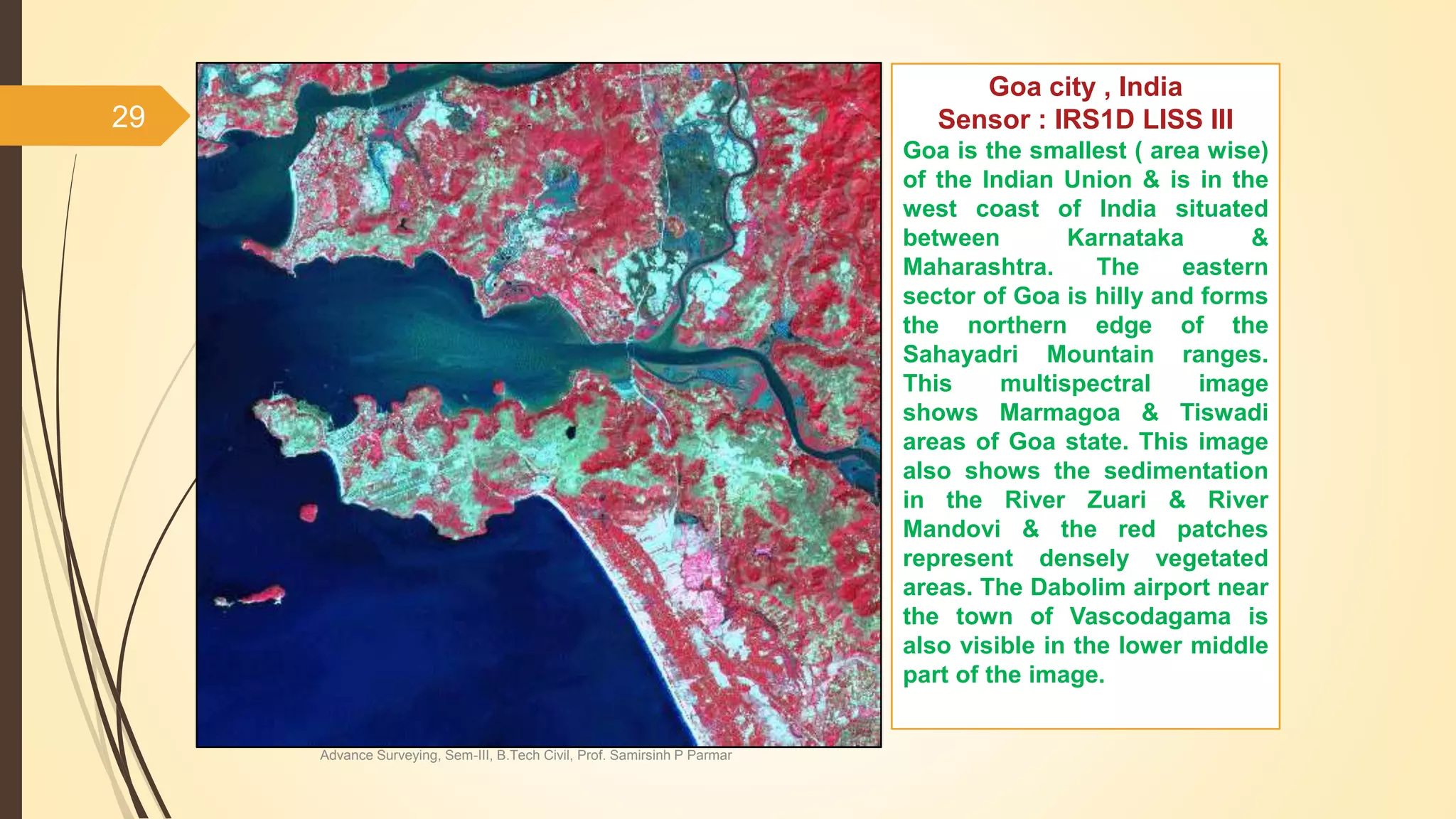
Goa city , India
Sensor : IRS1D LISS III
Goa is the smallest ( area wise)
of the Indian Union & is in the
west coast of India situated
between Karnataka &
Maharashtra. The eastern
sector of Goa is hilly and forms
the northern edge of the
Sahayadri Mountain ranges.
This multispectral image
shows Marmagoa & Tiswadi
areas of Goa state. This image
also shows the sedimentation
in the River Zuari & River
Mandovi & the red patches
represent densely vegetated
areas. The Dabolim airport near
the town of Vascodagama is
also visible in the lower middle
part of the image.
29
Advance Surveying, Sem-III, B.Tech Civil, Prof. Samirsinh P Parmar
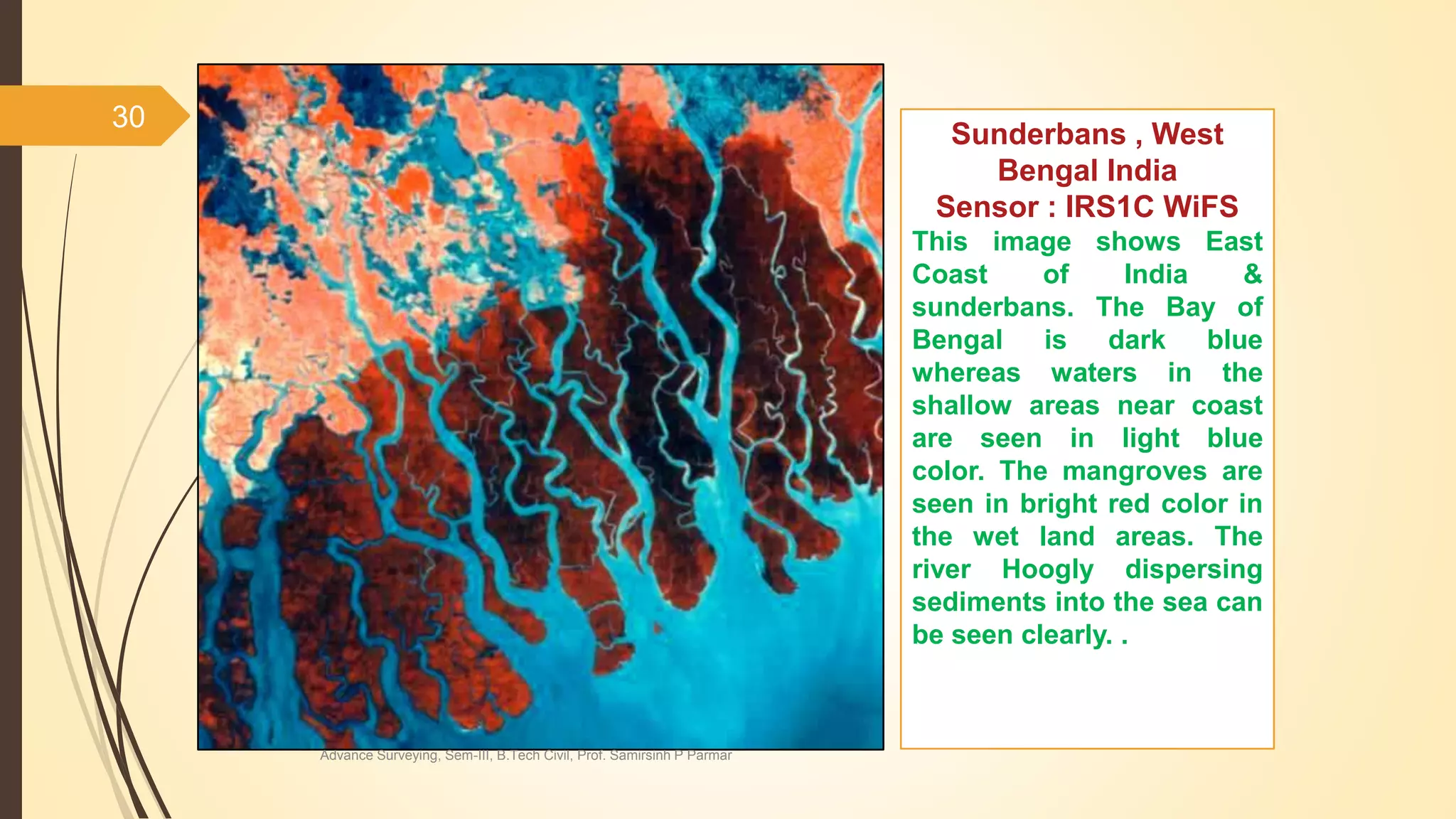
Sunderbans , West
Bengal India
Sensor : IRS1C WiFS
This image shows East
Coast of India &
sunderbans. The Bay of
Bengal is dark blue
whereas waters in the
shallow areas near coast
are seen in light blue
color. The mangroves are
seen in bright red color in
the wet land areas. The
river Hoogly dispersing
sediments into the sea can
be seen clearly. .
30
Advance Surveying, Sem-III, B.Tech Civil, Prof. Samirsinh P Parmar
Part of Oman
Sensor : IRS1D WiFS
The gulf of Oman is seen
here. The mountains &
rocky terrain of the area
are seen through WiFS
sensor .
31
Advance Surveying, Sem-III, B.Tech Civil, Prof. Samirsinh P Parmar
Dhaka , Bangladesh
Sensor : IRS1C LISS
III+PAN
This image shows part of
Dhaka city & its environments.
Features like stadium & city
airport are clearly seen.
32
Advance Surveying, Sem-III, B.Tech Civil, Prof. Samirsinh P Parmar
Rome , Italy
Sensor : IRS1C LISS
III+PAN
This image shows part of
Rome. The runways of the
'h' shaped airport can also
be seen.
33
Advance Surveying, Sem-III, B.Tech Civil, Prof. Samirsinh P Parmar
Spot multi-
sensor image
Roads, rivers,
water bodies,
topography and
urban areas can
all be
distinguished.
34
Advance Surveying, Sem-III, B.Tech Civil, Prof. Samirsinh P Parmar
35
IIRS, Dehradun
Advance Surveying, Sem-III, B.Tech Civil, Prof. Samirsinh P Parmar
Image interpretation
=
relating images to reality
36
Advance Surveying, Sem-III, B.Tech Civil, Prof. Samirsinh P Parmar
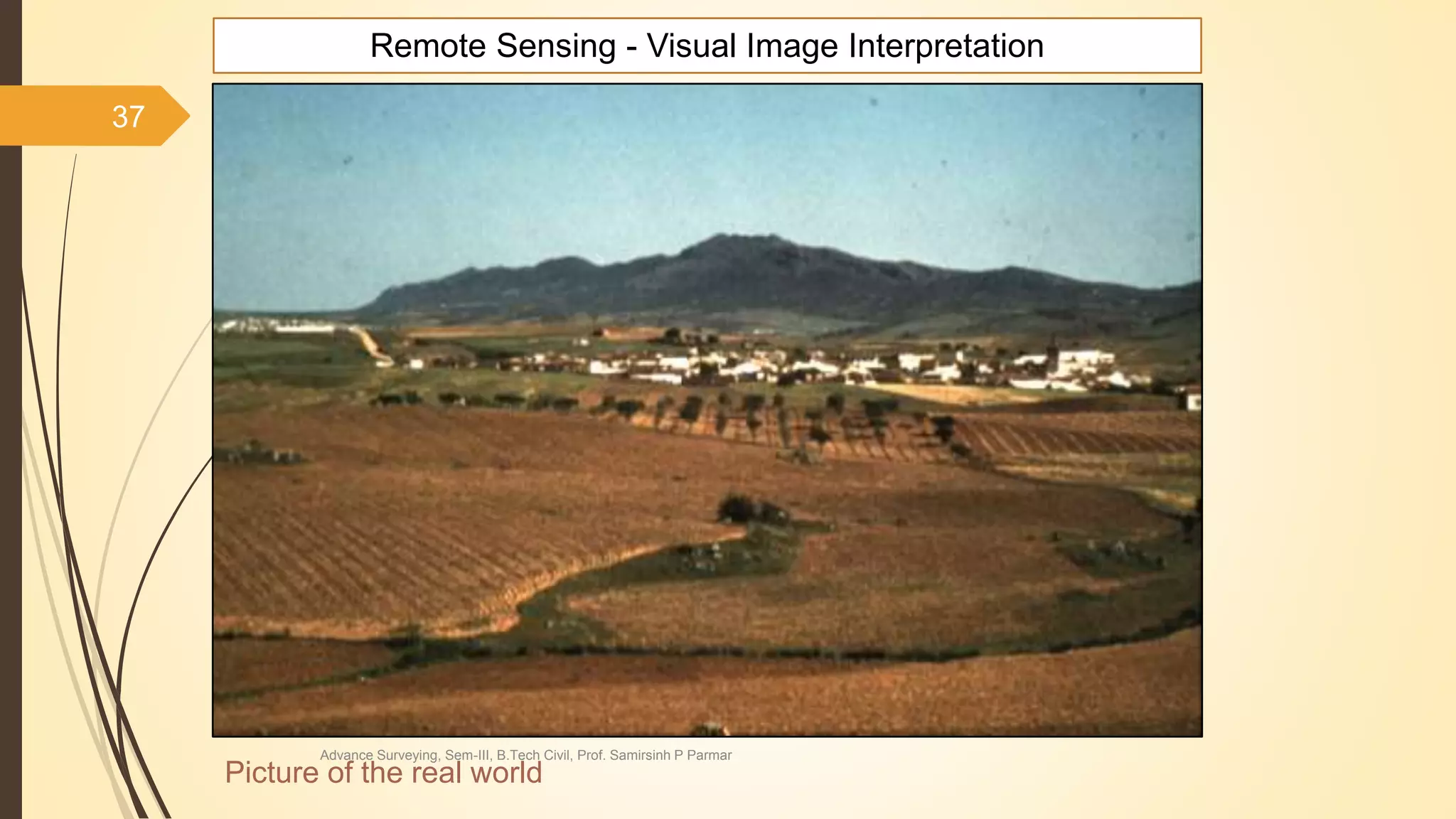
Remote Sensing - Visual Image Interpretation
Picture of the real world
37
Advance Surveying, Sem-III, B.Tech Civil, Prof. Samirsinh P Parmar
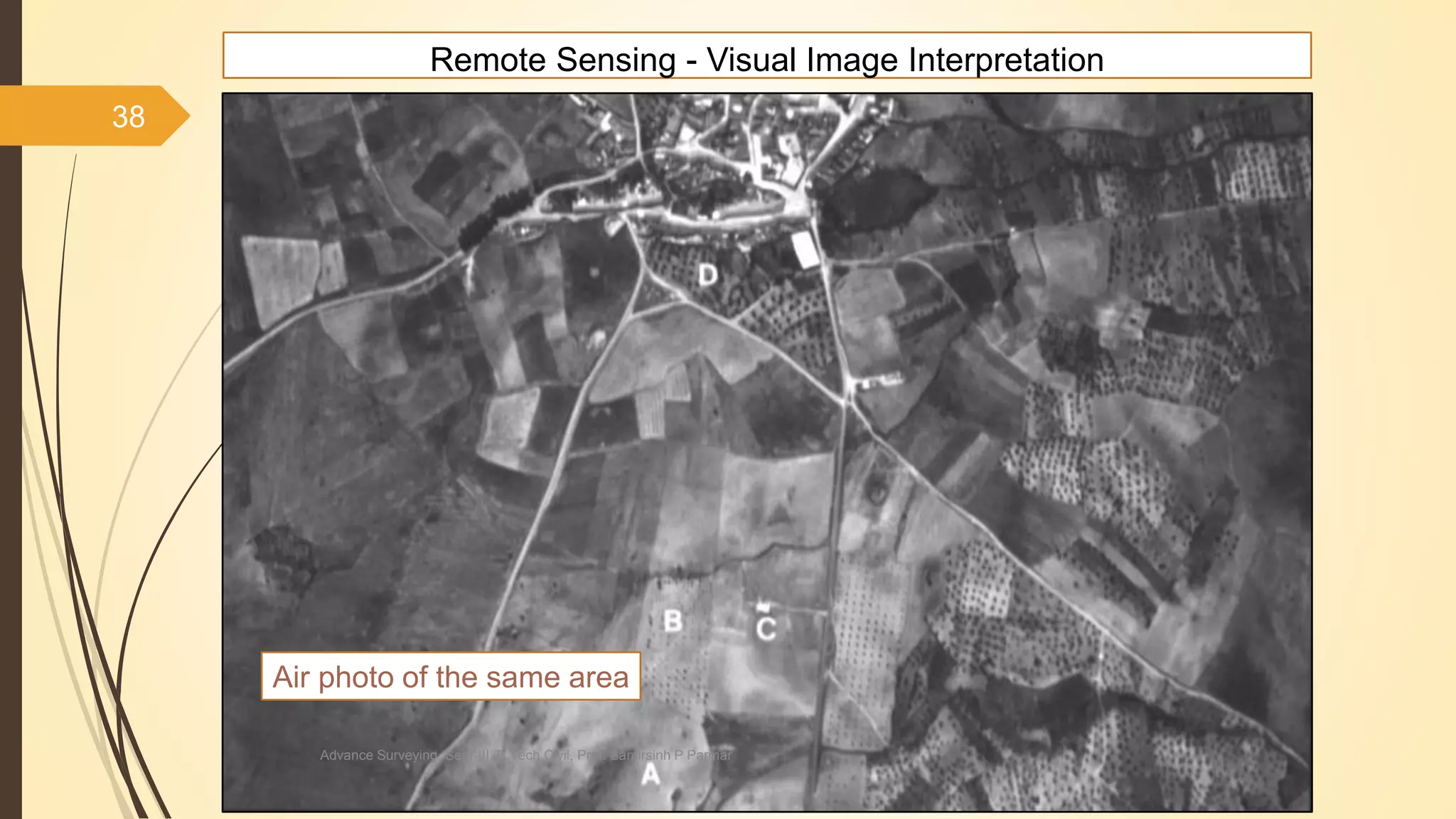
Remote Sensing - Visual Image Interpretation
Air photo of the same area
38
Advance Surveying, Sem-III, B.Tech Civil, Prof. Samirsinh P Parmar
In image interpretation use is made of
Image characteristics
or
Interpretation elements
39
Advance Surveying, Sem-III, B.Tech Civil, Prof. Samirsinh P Parmar
The image characteristics
can be distinguished into:
• spectral characteristics
• spatial characteristics
• stereo characteristics
• associated features
40 Remote Sensing Visual Image Interpretation
Advance Surveying, Sem-III, B.Tech Civil, Prof. Samirsinh P Parmar
Spectral characteristics are:
• grey tone
• colour
41 Remote Sensing Visual Image Interpretation
Advance Surveying, Sem-III, B.Tech Civil, Prof. Samirsinh P Parmar
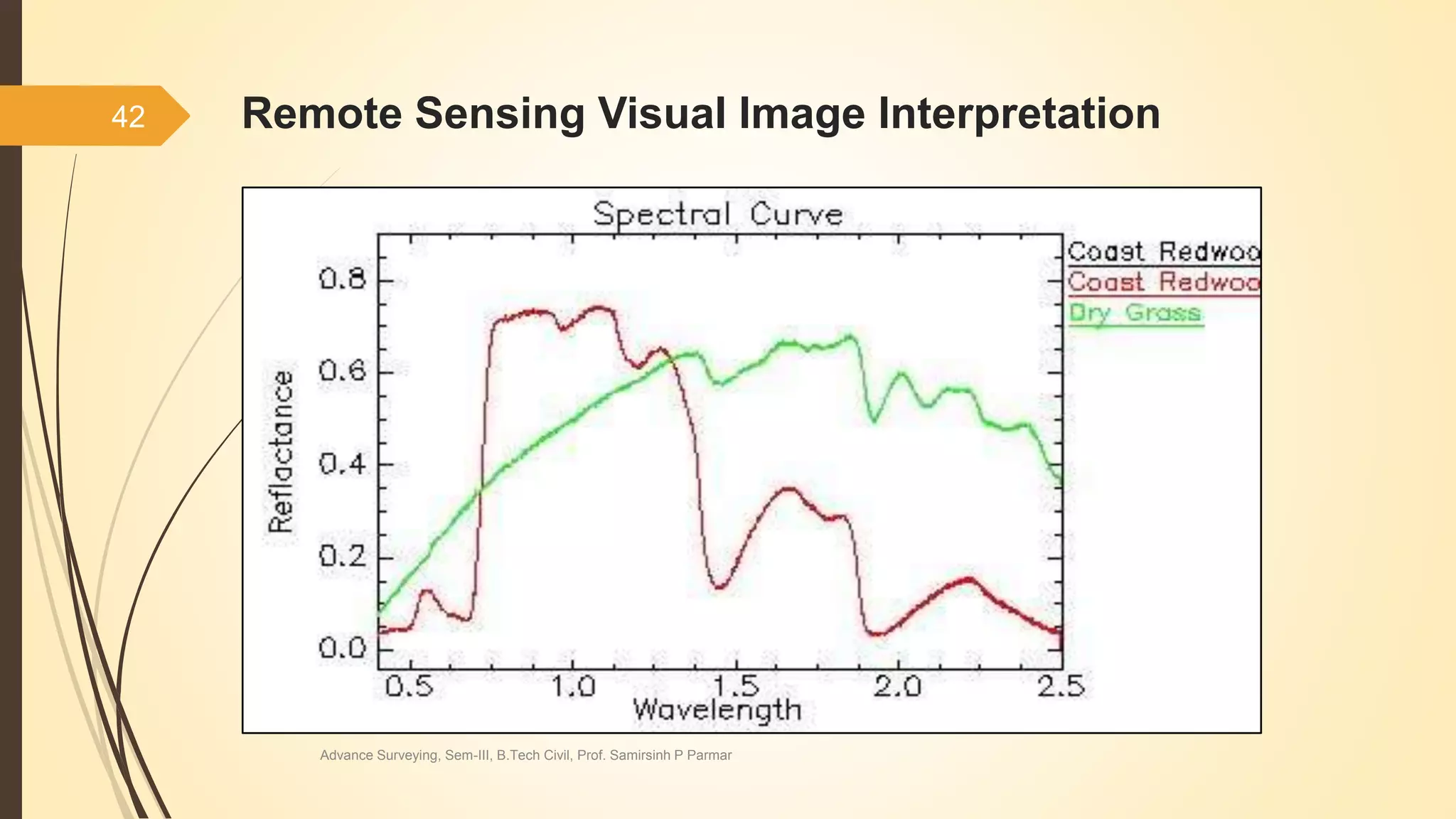
42 Remote Sensing Visual Image Interpretation
Advance Surveying, Sem-III, B.Tech Civil, Prof. Samirsinh P Parmar
Remote Sensing Visual Image Interpretation
Spatial characteristics are:
• shape
• size
• shadow
• pattern
• texture
43
Advance Surveying, Sem-III, B.Tech Civil, Prof. Samirsinh P Parmar
Different aspects of greytone
44 Remote Sensing Visual Image Interpretation
Advance Surveying, Sem-III, B.Tech Civil, Prof. Samirsinh P Parmar
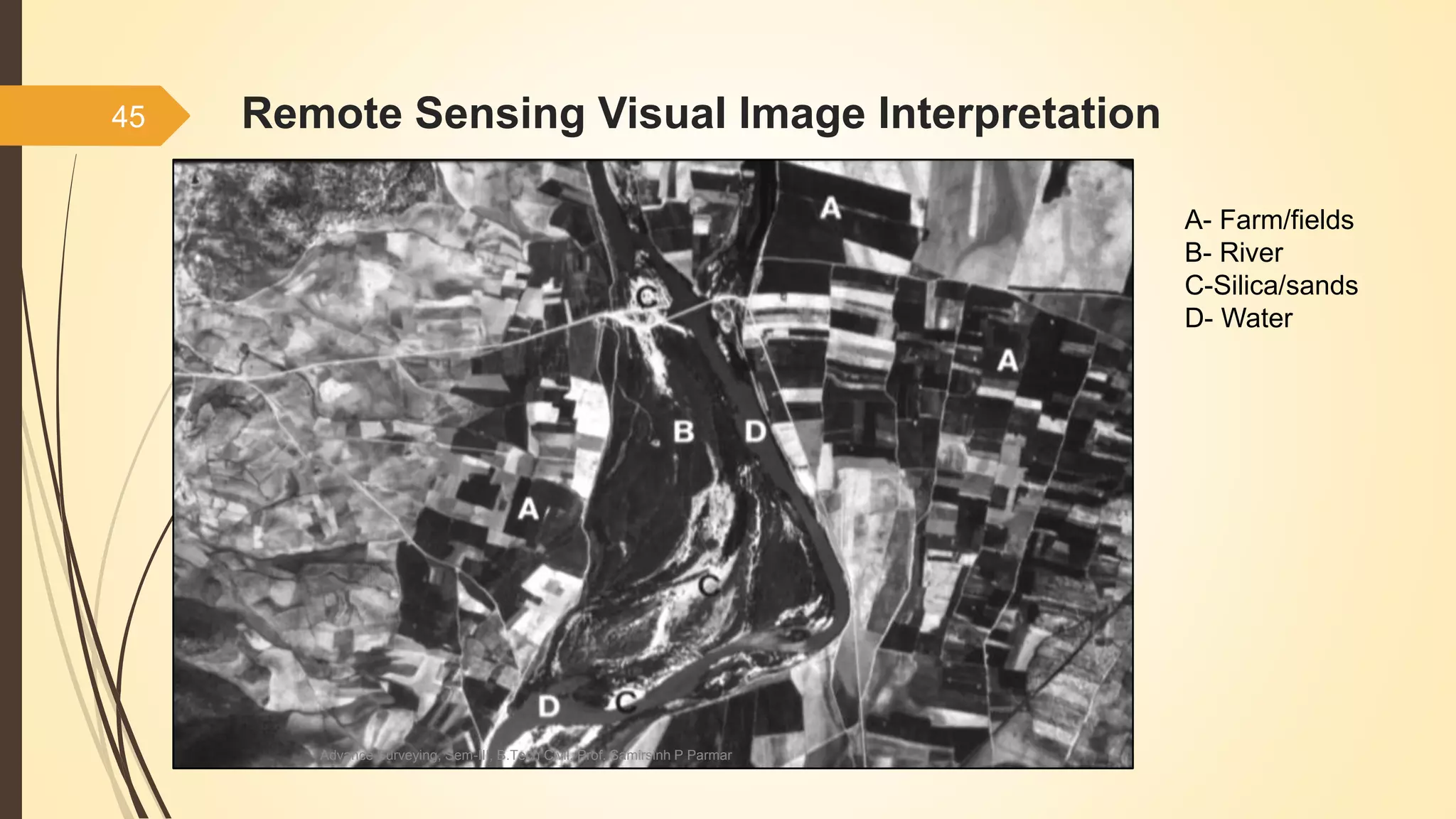
45 Remote Sensing Visual Image Interpretation
A- Farm/fields
B- River
C-Silica/sands
D- Water
Advance Surveying, Sem-III, B.Tech Civil, Prof. Samirsinh P Parmar
46
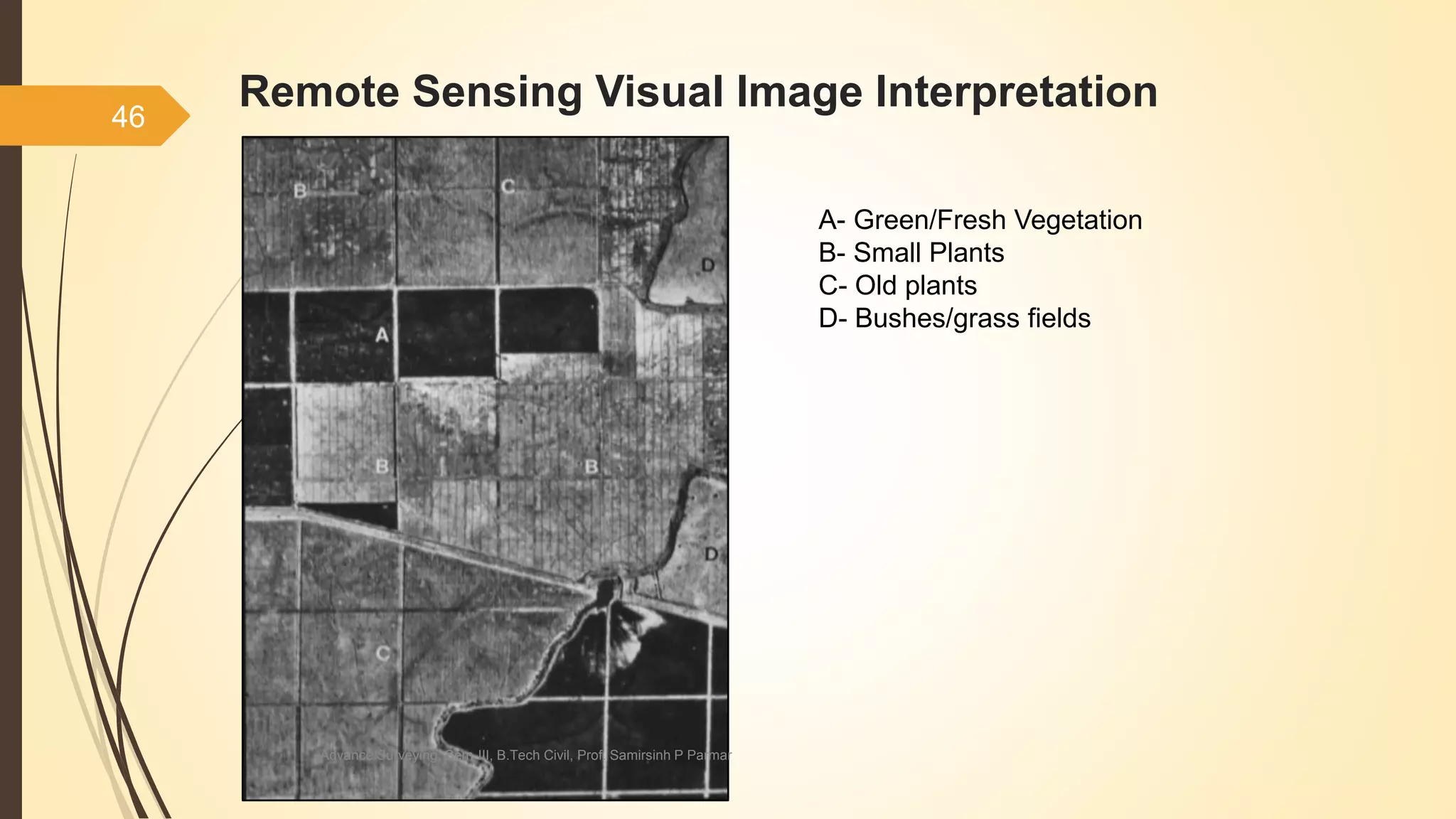
Remote Sensing Visual Image Interpretation
A- Green/Fresh Vegetation
B- Small Plants
C- Old plants
D- Bushes/grass fields
Advance Surveying, Sem-III, B.Tech Civil, Prof. Samirsinh P Parmar
47
Remote Sensing Visual Image Interpretation
Advance Surveying, Sem-III, B.Tech Civil, Prof. Samirsinh P Parmar
48 Remote Sensing Visual Image Interpretation
Advance Surveying, Sem-III, B.Tech Civil, Prof. Samirsinh P Parmar
49
Remote Sensing Visual Image Interpretation
Advance Surveying, Sem-III, B.Tech Civil, Prof. Samirsinh P Parmar
50 Remote Sensing Visual Image Interpretation
Advance Surveying, Sem-III, B.Tech Civil, Prof. Samirsinh P Parmar
Full colour Panchromatic
51
Remote Sensing Visual Image Interpretation
Advance Surveying, Sem-III, B.Tech Civil, Prof. Samirsinh P Parmar
Shape and size
52 Remote Sensing Visual Image Interpretation
Advance Surveying, Sem-III, B.Tech Civil, Prof. Samirsinh P Parmar
53 Remote Sensing Visual Image Interpretation
Advance Surveying, Sem-III, B.Tech Civil, Prof. Samirsinh P Parmar
Remote Sensing - Visual Image Interpretation
54
Advance Surveying, Sem-III, B.Tech Civil, Prof. Samirsinh P Parmar
B
A
D
C
55
Remote Sensing Visual Image Interpretation
Advance Surveying, Sem-III, B.Tech Civil, Prof. Samirsinh P Parmar
56
Remote Sensing Visual Image Interpretation
Advance Surveying, Sem-III, B.Tech Civil, Prof. Samirsinh P Parmar
Shadow
57 Remote Sensing Visual Image Interpretation
Advance Surveying, Sem-III, B.Tech Civil, Prof. Samirsinh P Parmar
58
Remote Sensing Visual Image Interpretation
Advance Surveying, Sem-III, B.Tech Civil, Prof. Samirsinh P Parmar
Remote Sensing - Visual Image Interpretation
59
Advance Surveying, Sem-III, B.Tech Civil, Prof. Samirsinh P Parmar
60
Remote Sensing Visual Image Interpretation
Advance Surveying, Sem-III, B.Tech Civil, Prof. Samirsinh P Parmar
61
Remote Sensing Visual Image Interpretation
Advance Surveying, Sem-III, B.Tech Civil, Prof. Samirsinh P Parmar
62 Remote Sensing Visual Image Interpretation
Advance Surveying, Sem-III, B.Tech Civil, Prof. Samirsinh P Parmar
63
Remote Sensing Visual Image Interpretation
Advance Surveying, Sem-III, B.Tech Civil, Prof. Samirsinh P Parmar
64
Remote Sensing Visual Image Interpretation
Advance Surveying, Sem-III, B.Tech Civil, Prof. Samirsinh P Parmar
Pattern and Texture
65 Remote Sensing Visual Image Interpretation
Advance Surveying, Sem-III, B.Tech Civil, Prof. Samirsinh P Parmar
Pattern
Texture Texture
M.C.Esscher
66
Remote Sensing Visual Image Interpretation
Advance Surveying, Sem-III, B.Tech Civil, Prof. Samirsinh P Parmar
67
Remote Sensing Visual Image Interpretation
Advance Surveying, Sem-III, B.Tech Civil, Prof. Samirsinh P Parmar
68
Remote Sensing Visual Image Interpretation
Advance Surveying, Sem-III, B.Tech Civil, Prof. Samirsinh P Parmar
69
Remote Sensing Visual Image Interpretation
Advance Surveying, Sem-III, B.Tech Civil, Prof. Samirsinh P Parmar
70
Remote Sensing Visual Image Interpretation
Advance Surveying, Sem-III, B.Tech Civil, Prof. Samirsinh P Parmar
71
Remote Sensing Visual Image Interpretation
Advance Surveying, Sem-III, B.Tech Civil, Prof. Samirsinh P Parmar
72
Remote Sensing Visual Image Interpretation
Advance Surveying, Sem-III, B.Tech Civil, Prof. Samirsinh P Parmar
73
Remote Sensing Visual Image Interpretation
Advance Surveying, Sem-III, B.Tech Civil, Prof. Samirsinh P Parmar
In addition to the spectral, spatial and
stereo image characteristics
Associated Features
are of importance in image interpretation
74 Remote Sensing Visual Image Interpretation
Advance Surveying, Sem-III, B.Tech Civil, Prof. Samirsinh P Parmar
A
A
B
B
C
C
75
Remote Sensing Visual Image Interpretation
Advance Surveying, Sem-III, B.Tech Civil, Prof. Samirsinh P Parmar
A
A
B
B
C
C
76
Remote Sensing Visual Image Interpretation
A
Advance Surveying, Sem-III, B.Tech Civil, Prof. Samirsinh P Parmar
 Act of examining images to identify objects and judge their
significance
 Information extraction process from the images
 An interpreter is a specialist trained in study of photography
or imagery, in addition to his own discipline
 Aerial photographs and Remote Sensing images employ
electro magnetic energy as the mean of detecting and
measuring target characteristics
 Involves a considerable amount of subjective judgment
 Highly dependent on capability of mind to generalize
 Takes place at different levels of complexity
IMAGE INTERPRETATION
77
Remote Sensing Visual Image Interpretation
Advance Surveying, Sem-III, B.Tech Civil, Prof. Samirsinh P Parmar
Image interpretation comprises at least three mental
acts that may or may not be performed
simultaneously:
I) Measurement of images of objects
ii) Identification of the objects imaged
iii) Appropriate use of this information in the solution of the
problem
78 Remote Sensing Visual Image Interpretation
Advance Surveying, Sem-III, B.Tech Civil, Prof. Samirsinh P Parmar
ACTIVITIES OF IMAGE INTERPRETATION
(SEQUENCE OF INTERPRETATION)
1.Detection
2.Recognition and Identification
3.Analysis
4.Deduction
5.Classification
6.Idealization
7.Convergence of evidence
79 Remote Sensing Visual Image Interpretation
Advance Surveying, Sem-III, B.Tech Civil, Prof. Samirsinh P Parmar
Image Representation or Interpretation
For facilitating mental process [ procedures] we use some mental representations
say rules for knowledge formation in particular domain.
So, what can be the mental representations :
= Logical propositions, Thoughts, Percepts,
Rules, Concepts, Idea, Impressions,
Schemas
80 Remote Sensing Visual Image Interpretation
Advance Surveying, Sem-III, B.Tech Civil, Prof. Samirsinh P Parmar
81 Remote Sensing Visual Image Interpretation
Advance Surveying, Sem-III, B.Tech Civil, Prof. Samirsinh P Parmar
A
B
C
82 Remote Sensing Visual Image Interpretation
Advance Surveying, Sem-III, B.Tech Civil, Prof. Samirsinh P Parmar
A
B
C
D
E
F
G
83
Remote Sensing Visual Image Interpretation
Rudra Prayag , Uttarakhand, India
Advance Surveying, Sem-III, B.Tech Civil, Prof. Samirsinh P Parmar
84
Remote Sensing Visual Image Interpretation
Hrishikesh, Uttarakhand, INDIA
Advance Surveying, Sem-III, B.Tech Civil, Prof. Samirsinh P Parmar
IIRS,
Dehradun
85 Remote Sensing Visual Image Interpretation
Advance Surveying, Sem-III, B.Tech Civil, Prof. Samirsinh P Parmar
IIRS as seen by IKONOS Clock Tower
86
Remote Sensing Visual Image Interpretation
Advance Surveying, Sem-III, B.Tech Civil, Prof. Samirsinh P Parmar
87 Remote Sensing Visual Image Interpretation
Lava Flow
Molten Lava Flow
Advance Surveying, Sem-III, B.Tech Civil, Prof. Samirsinh P Parmar
88
ikonos-vancouver-canada-web
Advance Surveying, Sem-III, B.Tech Civil, Prof. Samirsinh P Parmar
89
Advance Surveying, Sem-III, B.Tech Civil, Prof. Samirsinh P Parmar

VISUAL IMAGE INTERPRETATION.pptx

  • 1.
    VISUAL IMAGE INTERPRETATION Prof. SamirsinhP Parmar Asst. Prof. Dharmsinh Desai University, Nadiad, Gujarat, India Mail: samirddu@gmail.com Special Thanks to iirs dehradun
  • 2.
    Disclaimer:  This presentationis compilation of the study material provided from IIRS Dehradun, India and on the net as just study material.  The aim of this presentation is to let students, researchers, professors, teachers to know, “ What is Visual Image interpretation?”  As knowledge is not slave of human being, the copyright laws are fully violated and not subjected to any jurisdiction, so kindly consider it as study material only.  Thanks  Author 2 Advance Surveying, Sem-III, B.Tech Civil, Prof. Samirsinh P Parmar
  • 3.
    IMAGE INTERPRETATION Act ofexamining images to identify objects and judge their significance. Information extraction process from the images. An interpreter is a specialist trained in study of photography or imagery, in addition to his own discipline. Aerial photographs and remote Sensing images employ electro magnetic energy as the mean of detecting and measuring target characteristics. Involves a considerable amount of subjective judgment Highly dependent on capability of mind to generalize Takes place at different levels of complexity 3 Advance Surveying, Sem-III, B.Tech Civil, Prof. Samirsinh P Parmar
  • 4.
    Image is apictorial representation of an object or a scene. Image can be analog or digital. Aerial photographs are generally analog, while satellite data is in digital form. A digital image is made up of square or rectangular areas called pixels. Each pixel has an associated pixel value which depends on the amount reflected energy from the ground. 4 IMAGE INTERPRETATION Advance Surveying, Sem-III, B.Tech Civil, Prof. Samirsinh P Parmar
  • 5.
    Advantages of aerialphotographs/Satellite Images over ground observation Synoptic view Time freezing ability Permanent record Spectral resolution Spatial resolution Cost and time effective Stereoscopic view Brings out relationship between objects 5 Advance Surveying, Sem-III, B.Tech Civil, Prof. Samirsinh P Parmar
  • 6.
    Methods of ImageInterpretation  Visual 1. Visual image interpretation on a hardcopy image/photograph 2. Visual image interpretation on a digital image  Digital image processing 6 Advance Surveying, Sem-III, B.Tech Civil, Prof. Samirsinh P Parmar
  • 7.
    Types of interpretation Qualitative Quantitative 7 AdvanceSurveying, Sem-III, B.Tech Civil, Prof. Samirsinh P Parmar
  • 8.
    8 Advance Surveying, Sem-III,B.Tech Civil, Prof. Samirsinh P Parmar
  • 9.
    Typical Examples ofImage Interpretation 9 Advance Surveying, Sem-III, B.Tech Civil, Prof. Samirsinh P Parmar
  • 10.
    Methods of ImageInterpretation 10 Advance Surveying, Sem-III, B.Tech Civil, Prof. Samirsinh P Parmar
  • 11.
    Basic Principle ofImage Interpretation • Image is a pictorial representation of pattern of landscape. • Pattern indicates type of objects and their physical, biological, and cultural relationships • Similar objects under similar conditions reflect similarly. • A systematic examination of photos and supporting material. • Interpretation is made of physical nature of the object. • Information extracted is proportional to knowledge, skill and experience of analyst; the methods and equipment used. 11 Advance Surveying, Sem-III, B.Tech Civil, Prof. Samirsinh P Parmar
  • 12.
    Factors governing interpretability Training,Experience Nature of object or phenomenon Quality of photographs Equipment and method of interpretation Interpretation keys, guides, manuals and other aids Prior knowledge of the area. 12 Advance Surveying, Sem-III, B.Tech Civil, Prof. Samirsinh P Parmar
  • 13.
    Techniques of visualimage interpretation  The development of interpretation techniques has been mainly by the empirical method.  The gap between the photo image on the one hand and the reference level, i.e. the level of knowledge in a specific field, in the human mind on the other hand, is bridged by the use of image-interpretation.  The techniques adopted for one discipline may differ from those adopted for another.  The sequence of activity and the search method may have to be modified to suit the specific requirements. 13 Advance Surveying, Sem-III, B.Tech Civil, Prof. Samirsinh P Parmar
  • 14.
    Image interpretation comprisesat least three mental acts that may or may not be performed simultaneously:  i. The measurement of images of objects ii. Identification of the objects imaged iii. Appropriate use of this information in the solution of the problem. 14 Techniques of visual image interpretation Advance Surveying, Sem-III, B.Tech Civil, Prof. Samirsinh P Parmar
  • 15.
    Methodology depends on……… Kind of information to be interpreted  Accuracy of the results to be obtained  The reference level of the person executing the interpretation  Kind and type of imagery or photographs available  Instruments available  Scale and other requirements of the final map  External knowledge available and any other sensory surveys that have been or will be made in the near future in the same area. 15 Advance Surveying, Sem-III, B.Tech Civil, Prof. Samirsinh P Parmar
  • 16.
  • 17.
    METHOD OF SEARCH Interpretershould work methodologically From general information to specific object From known to unknown  Fishing Expedition- Examination of each and every object  Logical Search- Quick scanning and selective intensive study 17 BASIC METHODS Advance Surveying, Sem-III, B.Tech Civil, Prof. Samirsinh P Parmar
  • 18.
    INTERPRETATION KEYS-TYPES OF INTERPRETATIONKEYS Item key Subject key Regional key Analogous area key Scope of image interpretation Technical level image interpretation  Technical  Non-Technical 18 Advance Surveying, Sem-III, B.Tech Civil, Prof. Samirsinh P Parmar
  • 19.
    Intrinsic character ofimage interpretation:  Direct key  Association key Manner of organization:  Selective 1. Essay key 2. File key 3. Photo key 4. Integrated selected key  Elimination 1. Disk key 2. Punch card 3. Dichotomous key 19 INTERPRETATION KEYS-TYPES OF INTERPRETATION KEYS Advance Surveying, Sem-III, B.Tech Civil, Prof. Samirsinh P Parmar
  • 20.
    Methods of analysisand reference levels Monocular and stereo analysis Densitometry analysis Multiple images Multi band images Multi date images Multi stage images 20 Advance Surveying, Sem-III, B.Tech Civil, Prof. Samirsinh P Parmar
  • 21.
    Sensors in photographicImage Interpretation Black and white panchromatic Black and white infrared Colour Colour infrared/ false colour 21 Advance Surveying, Sem-III, B.Tech Civil, Prof. Samirsinh P Parmar
  • 22.
    In the upperright corner there is a hydrofoil ship. The other big ship is a tanker delivering fresh water to the island B/W Aerial Photo The image is stored on photographic film that is, generally speaking, sensitive to electromagnetic radiation from 0.3 µm to 0.9 µm. Panchromatic films, producing black and white images, is the most common type of film used for aerial photography. 22 Advance Surveying, Sem-III, B.Tech Civil, Prof. Samirsinh P Parmar
  • 23.
    Colour and falsecolour (or colour infrared) photography involves the use of a three layer film with each layer sensitive to different ranges of light. For a normal colour photograph, the layers are sensitive to blue, green, and red light - the same as our eyes. Accordingly, these photos appear to us the same way that our eyes see the environment. The colours resemble those which would appear to us as "normal" (i.e. trees appear green, etc.). 23 Advance Surveying, Sem-III, B.Tech Civil, Prof. Samirsinh P Parmar
  • 24.
    In color infrared(CIR) photography, the three emulsion layers are sensitive to green, red, and the photographic portion of near- infrared radiation (up to 0.9 µm), which are processed to appear as blue, green, and red, respectively. In a false color photograph, targets with high near-infrared reflectance appear red, those with a high red reflectance appear green, and those with a high green reflectance appear blue, thus giving us a "false" presentation of the targets relative to the color we normally perceive them to be. Mid-Infrared Image of Stromboli Island. 24 Advance Surveying, Sem-III, B.Tech Civil, Prof. Samirsinh P Parmar
  • 25.
    Image interpretation forMultispectral imagery •Resolution •Stereoscopic ability •Individual Band Interpretation •Temporal data 25 Advance Surveying, Sem-III, B.Tech Civil, Prof. Samirsinh P Parmar
  • 26.
    Landsat image Boston 26 AdvanceSurveying, Sem-III, B.Tech Civil, Prof. Samirsinh P Parmar
  • 27.
    Landsat image 27 Advance Surveying,Sem-III, B.Tech Civil, Prof. Samirsinh P Parmar
  • 28.
    Saudi Arabia Sensor :IRS1C LISS III The circular features indicate sprinkler irrigation systems. Red color indicates crop & dark color fallow land. 28 Advance Surveying, Sem-III, B.Tech Civil, Prof. Samirsinh P Parmar
  • 29.
    Goa city ,India Sensor : IRS1D LISS III Goa is the smallest ( area wise) of the Indian Union & is in the west coast of India situated between Karnataka & Maharashtra. The eastern sector of Goa is hilly and forms the northern edge of the Sahayadri Mountain ranges. This multispectral image shows Marmagoa & Tiswadi areas of Goa state. This image also shows the sedimentation in the River Zuari & River Mandovi & the red patches represent densely vegetated areas. The Dabolim airport near the town of Vascodagama is also visible in the lower middle part of the image. 29 Advance Surveying, Sem-III, B.Tech Civil, Prof. Samirsinh P Parmar
  • 30.
    Sunderbans , West BengalIndia Sensor : IRS1C WiFS This image shows East Coast of India & sunderbans. The Bay of Bengal is dark blue whereas waters in the shallow areas near coast are seen in light blue color. The mangroves are seen in bright red color in the wet land areas. The river Hoogly dispersing sediments into the sea can be seen clearly. . 30 Advance Surveying, Sem-III, B.Tech Civil, Prof. Samirsinh P Parmar
  • 31.
    Part of Oman Sensor: IRS1D WiFS The gulf of Oman is seen here. The mountains & rocky terrain of the area are seen through WiFS sensor . 31 Advance Surveying, Sem-III, B.Tech Civil, Prof. Samirsinh P Parmar
  • 32.
    Dhaka , Bangladesh Sensor: IRS1C LISS III+PAN This image shows part of Dhaka city & its environments. Features like stadium & city airport are clearly seen. 32 Advance Surveying, Sem-III, B.Tech Civil, Prof. Samirsinh P Parmar
  • 33.
    Rome , Italy Sensor: IRS1C LISS III+PAN This image shows part of Rome. The runways of the 'h' shaped airport can also be seen. 33 Advance Surveying, Sem-III, B.Tech Civil, Prof. Samirsinh P Parmar
  • 34.
    Spot multi- sensor image Roads,rivers, water bodies, topography and urban areas can all be distinguished. 34 Advance Surveying, Sem-III, B.Tech Civil, Prof. Samirsinh P Parmar
  • 35.
    35 IIRS, Dehradun Advance Surveying,Sem-III, B.Tech Civil, Prof. Samirsinh P Parmar
  • 36.
    Image interpretation = relating imagesto reality 36 Advance Surveying, Sem-III, B.Tech Civil, Prof. Samirsinh P Parmar
  • 37.
    Remote Sensing -Visual Image Interpretation Picture of the real world 37 Advance Surveying, Sem-III, B.Tech Civil, Prof. Samirsinh P Parmar
  • 38.
    Remote Sensing -Visual Image Interpretation Air photo of the same area 38 Advance Surveying, Sem-III, B.Tech Civil, Prof. Samirsinh P Parmar
  • 39.
    In image interpretationuse is made of Image characteristics or Interpretation elements 39 Advance Surveying, Sem-III, B.Tech Civil, Prof. Samirsinh P Parmar
  • 40.
    The image characteristics canbe distinguished into: • spectral characteristics • spatial characteristics • stereo characteristics • associated features 40 Remote Sensing Visual Image Interpretation Advance Surveying, Sem-III, B.Tech Civil, Prof. Samirsinh P Parmar
  • 41.
    Spectral characteristics are: •grey tone • colour 41 Remote Sensing Visual Image Interpretation Advance Surveying, Sem-III, B.Tech Civil, Prof. Samirsinh P Parmar
  • 42.
    42 Remote SensingVisual Image Interpretation Advance Surveying, Sem-III, B.Tech Civil, Prof. Samirsinh P Parmar
  • 43.
    Remote Sensing VisualImage Interpretation Spatial characteristics are: • shape • size • shadow • pattern • texture 43 Advance Surveying, Sem-III, B.Tech Civil, Prof. Samirsinh P Parmar
  • 44.
    Different aspects ofgreytone 44 Remote Sensing Visual Image Interpretation Advance Surveying, Sem-III, B.Tech Civil, Prof. Samirsinh P Parmar
  • 45.
    45 Remote SensingVisual Image Interpretation A- Farm/fields B- River C-Silica/sands D- Water Advance Surveying, Sem-III, B.Tech Civil, Prof. Samirsinh P Parmar
  • 46.
    46 Remote Sensing VisualImage Interpretation A- Green/Fresh Vegetation B- Small Plants C- Old plants D- Bushes/grass fields Advance Surveying, Sem-III, B.Tech Civil, Prof. Samirsinh P Parmar
  • 47.
    47 Remote Sensing VisualImage Interpretation Advance Surveying, Sem-III, B.Tech Civil, Prof. Samirsinh P Parmar
  • 48.
    48 Remote SensingVisual Image Interpretation Advance Surveying, Sem-III, B.Tech Civil, Prof. Samirsinh P Parmar
  • 49.
    49 Remote Sensing VisualImage Interpretation Advance Surveying, Sem-III, B.Tech Civil, Prof. Samirsinh P Parmar
  • 50.
    50 Remote SensingVisual Image Interpretation Advance Surveying, Sem-III, B.Tech Civil, Prof. Samirsinh P Parmar
  • 51.
    Full colour Panchromatic 51 RemoteSensing Visual Image Interpretation Advance Surveying, Sem-III, B.Tech Civil, Prof. Samirsinh P Parmar
  • 52.
    Shape and size 52Remote Sensing Visual Image Interpretation Advance Surveying, Sem-III, B.Tech Civil, Prof. Samirsinh P Parmar
  • 53.
    53 Remote SensingVisual Image Interpretation Advance Surveying, Sem-III, B.Tech Civil, Prof. Samirsinh P Parmar
  • 54.
    Remote Sensing -Visual Image Interpretation 54 Advance Surveying, Sem-III, B.Tech Civil, Prof. Samirsinh P Parmar
  • 55.
    B A D C 55 Remote Sensing VisualImage Interpretation Advance Surveying, Sem-III, B.Tech Civil, Prof. Samirsinh P Parmar
  • 56.
    56 Remote Sensing VisualImage Interpretation Advance Surveying, Sem-III, B.Tech Civil, Prof. Samirsinh P Parmar
  • 57.
    Shadow 57 Remote SensingVisual Image Interpretation Advance Surveying, Sem-III, B.Tech Civil, Prof. Samirsinh P Parmar
  • 58.
    58 Remote Sensing VisualImage Interpretation Advance Surveying, Sem-III, B.Tech Civil, Prof. Samirsinh P Parmar
  • 59.
    Remote Sensing -Visual Image Interpretation 59 Advance Surveying, Sem-III, B.Tech Civil, Prof. Samirsinh P Parmar
  • 60.
    60 Remote Sensing VisualImage Interpretation Advance Surveying, Sem-III, B.Tech Civil, Prof. Samirsinh P Parmar
  • 61.
    61 Remote Sensing VisualImage Interpretation Advance Surveying, Sem-III, B.Tech Civil, Prof. Samirsinh P Parmar
  • 62.
    62 Remote SensingVisual Image Interpretation Advance Surveying, Sem-III, B.Tech Civil, Prof. Samirsinh P Parmar
  • 63.
    63 Remote Sensing VisualImage Interpretation Advance Surveying, Sem-III, B.Tech Civil, Prof. Samirsinh P Parmar
  • 64.
    64 Remote Sensing VisualImage Interpretation Advance Surveying, Sem-III, B.Tech Civil, Prof. Samirsinh P Parmar
  • 65.
    Pattern and Texture 65Remote Sensing Visual Image Interpretation Advance Surveying, Sem-III, B.Tech Civil, Prof. Samirsinh P Parmar
  • 66.
    Pattern Texture Texture M.C.Esscher 66 Remote SensingVisual Image Interpretation Advance Surveying, Sem-III, B.Tech Civil, Prof. Samirsinh P Parmar
  • 67.
    67 Remote Sensing VisualImage Interpretation Advance Surveying, Sem-III, B.Tech Civil, Prof. Samirsinh P Parmar
  • 68.
    68 Remote Sensing VisualImage Interpretation Advance Surveying, Sem-III, B.Tech Civil, Prof. Samirsinh P Parmar
  • 69.
    69 Remote Sensing VisualImage Interpretation Advance Surveying, Sem-III, B.Tech Civil, Prof. Samirsinh P Parmar
  • 70.
    70 Remote Sensing VisualImage Interpretation Advance Surveying, Sem-III, B.Tech Civil, Prof. Samirsinh P Parmar
  • 71.
    71 Remote Sensing VisualImage Interpretation Advance Surveying, Sem-III, B.Tech Civil, Prof. Samirsinh P Parmar
  • 72.
    72 Remote Sensing VisualImage Interpretation Advance Surveying, Sem-III, B.Tech Civil, Prof. Samirsinh P Parmar
  • 73.
    73 Remote Sensing VisualImage Interpretation Advance Surveying, Sem-III, B.Tech Civil, Prof. Samirsinh P Parmar
  • 74.
    In addition tothe spectral, spatial and stereo image characteristics Associated Features are of importance in image interpretation 74 Remote Sensing Visual Image Interpretation Advance Surveying, Sem-III, B.Tech Civil, Prof. Samirsinh P Parmar
  • 75.
    A A B B C C 75 Remote Sensing VisualImage Interpretation Advance Surveying, Sem-III, B.Tech Civil, Prof. Samirsinh P Parmar
  • 76.
    A A B B C C 76 Remote Sensing VisualImage Interpretation A Advance Surveying, Sem-III, B.Tech Civil, Prof. Samirsinh P Parmar
  • 77.
     Act ofexamining images to identify objects and judge their significance  Information extraction process from the images  An interpreter is a specialist trained in study of photography or imagery, in addition to his own discipline  Aerial photographs and Remote Sensing images employ electro magnetic energy as the mean of detecting and measuring target characteristics  Involves a considerable amount of subjective judgment  Highly dependent on capability of mind to generalize  Takes place at different levels of complexity IMAGE INTERPRETATION 77 Remote Sensing Visual Image Interpretation Advance Surveying, Sem-III, B.Tech Civil, Prof. Samirsinh P Parmar
  • 78.
    Image interpretation comprisesat least three mental acts that may or may not be performed simultaneously: I) Measurement of images of objects ii) Identification of the objects imaged iii) Appropriate use of this information in the solution of the problem 78 Remote Sensing Visual Image Interpretation Advance Surveying, Sem-III, B.Tech Civil, Prof. Samirsinh P Parmar
  • 79.
    ACTIVITIES OF IMAGEINTERPRETATION (SEQUENCE OF INTERPRETATION) 1.Detection 2.Recognition and Identification 3.Analysis 4.Deduction 5.Classification 6.Idealization 7.Convergence of evidence 79 Remote Sensing Visual Image Interpretation Advance Surveying, Sem-III, B.Tech Civil, Prof. Samirsinh P Parmar
  • 80.
    Image Representation orInterpretation For facilitating mental process [ procedures] we use some mental representations say rules for knowledge formation in particular domain. So, what can be the mental representations : = Logical propositions, Thoughts, Percepts, Rules, Concepts, Idea, Impressions, Schemas 80 Remote Sensing Visual Image Interpretation Advance Surveying, Sem-III, B.Tech Civil, Prof. Samirsinh P Parmar
  • 81.
    81 Remote SensingVisual Image Interpretation Advance Surveying, Sem-III, B.Tech Civil, Prof. Samirsinh P Parmar
  • 82.
    A B C 82 Remote SensingVisual Image Interpretation Advance Surveying, Sem-III, B.Tech Civil, Prof. Samirsinh P Parmar
  • 83.
    A B C D E F G 83 Remote Sensing VisualImage Interpretation Rudra Prayag , Uttarakhand, India Advance Surveying, Sem-III, B.Tech Civil, Prof. Samirsinh P Parmar
  • 84.
    84 Remote Sensing VisualImage Interpretation Hrishikesh, Uttarakhand, INDIA Advance Surveying, Sem-III, B.Tech Civil, Prof. Samirsinh P Parmar
  • 85.
    IIRS, Dehradun 85 Remote SensingVisual Image Interpretation Advance Surveying, Sem-III, B.Tech Civil, Prof. Samirsinh P Parmar
  • 86.
    IIRS as seenby IKONOS Clock Tower 86 Remote Sensing Visual Image Interpretation Advance Surveying, Sem-III, B.Tech Civil, Prof. Samirsinh P Parmar
  • 87.
    87 Remote SensingVisual Image Interpretation Lava Flow Molten Lava Flow Advance Surveying, Sem-III, B.Tech Civil, Prof. Samirsinh P Parmar
  • 88.
    88 ikonos-vancouver-canada-web Advance Surveying, Sem-III,B.Tech Civil, Prof. Samirsinh P Parmar
  • 89.
    89 Advance Surveying, Sem-III,B.Tech Civil, Prof. Samirsinh P Parmar