DIGITAL IMAGE CLASSIFICATION TECHNIQUES
Digital Image Classification Techniques group pixels to represent land cover
features. Land cover could be forested, urban, agricultural and other types of
features. There are three main image classification techniques.
IMAGE CLASSIFICATION TECHNIQUES IN REMOTE SENSING:
 Unsupervised image classification
 Supervised image classification
UNSUPERVISED IMAGE CLASSIFICATION
In this, the Pixels are grouped based on the reflectance properties of pixels.
These groupings are called “clusters.”
In this classification technique the user manually identifies each cluster with land
cover classes. It’s often the case that multiple clusters represent a single land
cover class. The user merges clusters into a land cover type. The unsupervised
classification image classification technique is commonly used when no sample
sites exist.
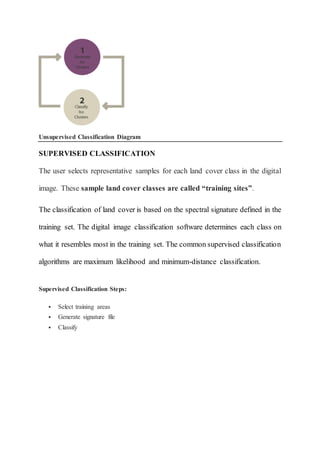
Unsupervised Classification Steps:
 Generate clusters
 Assign classes
Unsupervised Classification Diagram
SUPERVISED CLASSIFICATION
The user selects representative samples for each land cover class in the digital
image. These sample land cover classes are called “training sites”.
The classification of land cover is based on the spectral signature defined in the
training set. The digital image classification software determines each class on
what it resembles most in the training set. The common supervised classification
algorithms are maximum likelihood and minimum-distance classification.
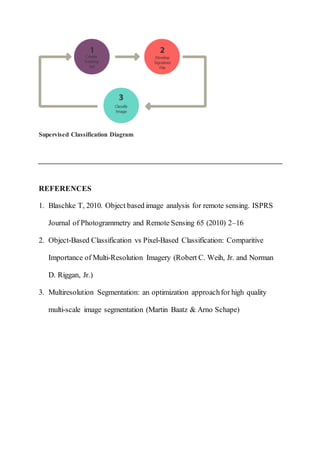
Supervised Classification Steps:
 Select training areas
 Generate signature file
 Classify
Supervised Classification Diagram
REFERENCES
1. Blaschke T, 2010. Object based image analysis for remote sensing. ISPRS
Journal of Photogrammetry and Remote Sensing 65 (2010) 2–16
2. Object-Based Classification vs Pixel-Based Classification: Comparitive
Importance of Multi-Resolution Imagery (Robert C. Weih, Jr. and Norman
D. Riggan, Jr.)
3. Multiresolution Segmentation: an optimization approachfor high quality
multi-scale image segmentation (Martin Baatz & Arno Schape)

Image Classification Techniques in GIS

  • 1.
    DIGITAL IMAGE CLASSIFICATIONTECHNIQUES Digital Image Classification Techniques group pixels to represent land cover features. Land cover could be forested, urban, agricultural and other types of features. There are three main image classification techniques. IMAGE CLASSIFICATION TECHNIQUES IN REMOTE SENSING:  Unsupervised image classification  Supervised image classification UNSUPERVISED IMAGE CLASSIFICATION In this, the Pixels are grouped based on the reflectance properties of pixels. These groupings are called “clusters.” In this classification technique the user manually identifies each cluster with land cover classes. It’s often the case that multiple clusters represent a single land cover class. The user merges clusters into a land cover type. The unsupervised classification image classification technique is commonly used when no sample sites exist. Unsupervised Classification Steps:  Generate clusters  Assign classes
  • 2.
    Unsupervised Classification Diagram SUPERVISEDCLASSIFICATION The user selects representative samples for each land cover class in the digital image. These sample land cover classes are called “training sites”. The classification of land cover is based on the spectral signature defined in the training set. The digital image classification software determines each class on what it resembles most in the training set. The common supervised classification algorithms are maximum likelihood and minimum-distance classification. Supervised Classification Steps:  Select training areas  Generate signature file  Classify
  • 3.
    Supervised Classification Diagram REFERENCES 1.Blaschke T, 2010. Object based image analysis for remote sensing. ISPRS Journal of Photogrammetry and Remote Sensing 65 (2010) 2–16 2. Object-Based Classification vs Pixel-Based Classification: Comparitive Importance of Multi-Resolution Imagery (Robert C. Weih, Jr. and Norman D. Riggan, Jr.) 3. Multiresolution Segmentation: an optimization approachfor high quality multi-scale image segmentation (Martin Baatz & Arno Schape)