Reproduction in Bacteria
Content
Introduction
Reproduction types
Vegetative reproduction
Asexual reproduction
Sexual reproduction
Introduction
Bacteria are the simplest,the smallest and the
most successful microorganisms.
They were discovered by Anton Leeuwenhoek
{1676}.
In the five kingdom classification, they are
placed in kingdom Monera.
Reproduction types
Vegetative reproduction
Asexual reproduction
Sexual reproduction
Vegetative reproduction-
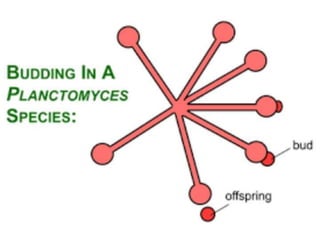
Budding
In this case, a small protuberance, called bud
develops at one end of the cell.
Genome replication follows, and one copy of
the genome gets into the bud.
Then the bud enlarges, eventually Become a
Daughter cell and finally gets separated from
the parent cell.
Vegetative Reproduction-
Fragmentation
Mostly during unfavorable conditions, bacterial
protoplasm undergoes compartmentalization on d
subsequent fragmentation , forming minute bodies
called gonidia.
Under favourable conditions,each gonidium grows to
a new bacterium.
It becomes apparent that prior to fragmentation the
bacterial genome had to undergo repeated replication
so that each fragment gets a copy of it .
Vegetative reproduction-
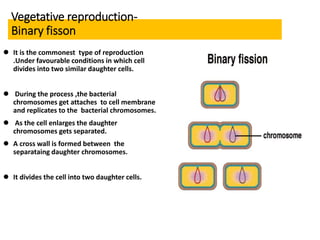
Binary fisson
 It is the commonest type of reproduction
.Under favourable conditions in which cell
divides into two similar daughter cells.
 During the process ,the bacterial
chromosomes get attaches to cell membrane
and replicates to the bacterial chromosomes.
 As the cell enlarges the daughter
chromosomes gets separated.
 A cross wall is formed between the
separataing daughter chromosomes.
 It divides the cell into two daughter cells.
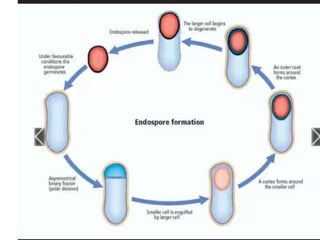
Endospore Formation
Endospore are resting spores formed in some gram positive bacteria {
Bacillus and clostridium during unfavorable conditions.
They are formed within the cells.
During this process a part of the protoplast becomes concentrated
around the chromosome.
A hard resistant wall is secreted around it.
The rest of the bacterial cell degenerates ; endospore are very resistant
to extreme physical conditions and chemicals.
During favourable conditions the spore wall gets reputed and the mass
gives rise to a new bacterium.
Conidia
Some Bacteria such as streotomyces
considered as true gram positive bacteria
produce conidia in chain.
Each conidium germinates to give rise a
new bacterial thallus.
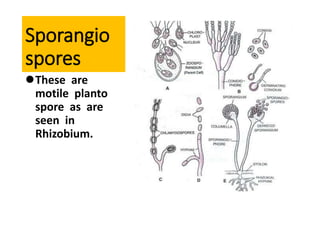
Sporangio
spores
These are
motile planto
spore as are
seen in
Rhizobium.
Sexual Reproduction
Sexual reproduction occurs in the form of
genetic recombination.
There are three methods of genetic
recombination:-
1. Transformation
2. Conjugation
3. Transduction
Transformation
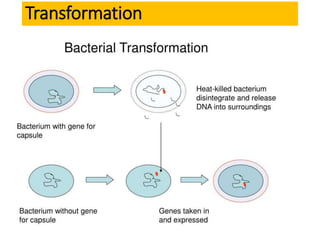
This was first studied by Griffith {1928}
in diplococous pneumonia.
In transformation ,DNA from the donor
cells initiates heritable change in
recipient cells.
The transformation involves only one
trait,though several may be acquired
independently in this way.
Transformation
• It was first of all reported in salmonella
tyohimeurium by zinder and Lederberg
{1952}.
• In this method , genetic material of one
bacterial cell goes to other bacterial cell
by agency of bacteriophages or phases ,
{virus ,infecting bacteria}.
Conjugation
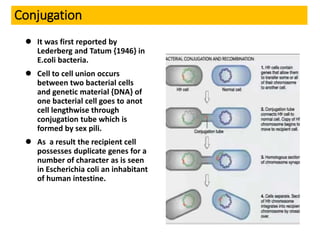
 It was first reported by
Lederberg and Tatum {1946} in
E.coli bacteria.
 Cell to cell union occurs
between two bacterial cells
and genetic material {DNA} of
one bacterial cell goes to anot
cell lengthwise through
conjugation tube which is
formed by sex pili.
 As a result the recipient cell
possesses duplicate genes for a
number of character as is seen
in Escherichia coli an inhabitant
of human intestine.
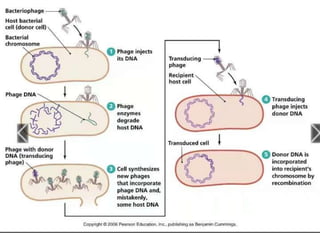
Transduction
 It was first of all reported in
salmonella typhimeurium by Zinder and
Lederberg.
In this method ,genetic material of one
bacterial cell goes to other bacterial cell
by agency of bacteriophages or phages .
(virus, infecting bacteria)
Reference
Botany for degree student by: P.D.Sharma
Plant pathology by : B.P.Pandey
https :// en.m. Wikipedia. org
https : // WWW. slideshare. net
Thank You

Reproduction in bacteria

  • 1.
  • 2.
  • 3.
    Introduction Bacteria are thesimplest,the smallest and the most successful microorganisms. They were discovered by Anton Leeuwenhoek {1676}. In the five kingdom classification, they are placed in kingdom Monera.
  • 4.
  • 5.
    Vegetative reproduction- Budding In thiscase, a small protuberance, called bud develops at one end of the cell. Genome replication follows, and one copy of the genome gets into the bud. Then the bud enlarges, eventually Become a Daughter cell and finally gets separated from the parent cell.
  • 7.
    Vegetative Reproduction- Fragmentation Mostly duringunfavorable conditions, bacterial protoplasm undergoes compartmentalization on d subsequent fragmentation , forming minute bodies called gonidia. Under favourable conditions,each gonidium grows to a new bacterium. It becomes apparent that prior to fragmentation the bacterial genome had to undergo repeated replication so that each fragment gets a copy of it .
  • 8.
    Vegetative reproduction- Binary fisson It is the commonest type of reproduction .Under favourable conditions in which cell divides into two similar daughter cells.  During the process ,the bacterial chromosomes get attaches to cell membrane and replicates to the bacterial chromosomes.  As the cell enlarges the daughter chromosomes gets separated.  A cross wall is formed between the separataing daughter chromosomes.  It divides the cell into two daughter cells.
  • 9.
    Endospore Formation Endospore areresting spores formed in some gram positive bacteria { Bacillus and clostridium during unfavorable conditions. They are formed within the cells. During this process a part of the protoplast becomes concentrated around the chromosome. A hard resistant wall is secreted around it. The rest of the bacterial cell degenerates ; endospore are very resistant to extreme physical conditions and chemicals. During favourable conditions the spore wall gets reputed and the mass gives rise to a new bacterium.
  • 11.
    Conidia Some Bacteria suchas streotomyces considered as true gram positive bacteria produce conidia in chain. Each conidium germinates to give rise a new bacterial thallus.
  • 12.
  • 13.
    Sexual Reproduction Sexual reproductionoccurs in the form of genetic recombination. There are three methods of genetic recombination:- 1. Transformation 2. Conjugation 3. Transduction
  • 14.
    Transformation This was firststudied by Griffith {1928} in diplococous pneumonia. In transformation ,DNA from the donor cells initiates heritable change in recipient cells. The transformation involves only one trait,though several may be acquired independently in this way.
  • 15.
    Transformation • It wasfirst of all reported in salmonella tyohimeurium by zinder and Lederberg {1952}. • In this method , genetic material of one bacterial cell goes to other bacterial cell by agency of bacteriophages or phases , {virus ,infecting bacteria}.
  • 16.
    Conjugation  It wasfirst reported by Lederberg and Tatum {1946} in E.coli bacteria.  Cell to cell union occurs between two bacterial cells and genetic material {DNA} of one bacterial cell goes to anot cell lengthwise through conjugation tube which is formed by sex pili.  As a result the recipient cell possesses duplicate genes for a number of character as is seen in Escherichia coli an inhabitant of human intestine.
  • 17.
    Transduction  It wasfirst of all reported in salmonella typhimeurium by Zinder and Lederberg. In this method ,genetic material of one bacterial cell goes to other bacterial cell by agency of bacteriophages or phages . (virus, infecting bacteria)
  • 19.
    Reference Botany for degreestudent by: P.D.Sharma Plant pathology by : B.P.Pandey https :// en.m. Wikipedia. org https : // WWW. slideshare. net
  • 20.