Prokaryotes
Course- B.Sc. (Agri.)
Subject- Principles of plant pathology
Unit-3
Prokaryote
A prokaryote is a single-celled
organism that lacks a membrane-bound
nucleus (karyon), mitochondria, or any other
membrane-bound organelle. All the
intracellular water-soluble components
(proteins, DNA and metabolites) are located
together in the same volume enclosed by the
cell membrane, rather than in separate cellular
compartments. Prokaryotes, however, do
possess protein-based microcompartments,
which are thought to act as primitive
organelles (protein-bounded and lipid-
bounded organelles). Some prokaryotes also
have multicellular stages in their life cycles,
such as myxobacteria, or create large colonies,
like cyanobacteria
Fig. 1
Fig.- 2
Capsule - Found in some bacterial cells, this additional outer
covering protects the cell when it is engulfed by other
organisms, assists in retaining moisture, and helps the cell
adhere to surfaces and nutrients.
Cell Wall - Outer covering of most cells that protects the
bacterial cell and gives it shape.
Cytoplasm - A gel-like substance composed mainly of water that
also contains enzymes, salts, cell components, and various
organic molecules.
Cell Membrane or Plasma Membrane - Surrounds the cell's
cytoplasm and regulates the flow of substances in and out of
the cell.
• Pili - Hair-like structures on the surface of the cell
that attach to other bacterial cells. Shorter pili called
fimbriae help bacteria attach to surfaces.
Flagella - Long, whip-like protrusion that aids in
cellular locomotion.
Ribosomes - Cell structures responsible for protein
production.
Plasmids - Gene carrying, circular DNA structures
that are not involved in reproduction.
Nucleiod Region - Area of the cytoplasm that
contains the single bacterial DNA molecule.
Most prokaryotes reproduce asexually through a
process called binary fission. During binary fission,
the single DNA molecule replicates and the original
cell is divided into two identical cells.
Binary fission begins with the single DNA molecule
replicating and both copies attaching to the cell
membrane.
Next, the cell membrane begins to grow between the
two DNA molecules. Once the bacterium just about
doubles its original size, the cell membrane begins
to pinch inward.
A cell wall then forms between the two DNA
molecules dividing the original cell into two
identical daughter cells.
Reproduction in bacteria
Fig. 3
Reproduction
• When conditions are favourable bacteria can
reproduce every 20 minutes
• In 48 hours a single bacterial cell could
become culture 4000 times the mass of the
earth
• Thankfully the food supply is limited and this
does not happen
Binary Fission
• When a cell has almost doubled in size it will
replicate its DNA and divide in half
• This produces 2 identical daughter cells
• Binary fission is a form of asexual
reproduction
• Asexual reproduction does not invovle the
exchange of genetic material
Conjugation
• Is a form of sexual reproduciton
• Genetic Information is exchanged between
individuals
• A long bridge of proteins forms between two
bacterial cells
• DNA is transferred from one cell (donor) to
another (recipient)
1- Donor cell produces
pilus. 2- Pilus attaches to
recipient cell and brings
the two cells together.
3- The mobile plasmid is
nicked and a single strand
of DNA is then
transferred to the recipient
cell.
4- Both cells synthesize a
complementary strand to
produce a double stranded
circular plasmid and also
reproduce pili; both cells
are now viable donors.
Fig. 4
Spore Formation
• Bacteria form spores during unfavourable
conditions
• One type is called an endospore
– Cell forms a thick internal wall the encloses its
DNA
• Spores can remain dormant for months until
conditions improve
Fig. 5
Fig. 6
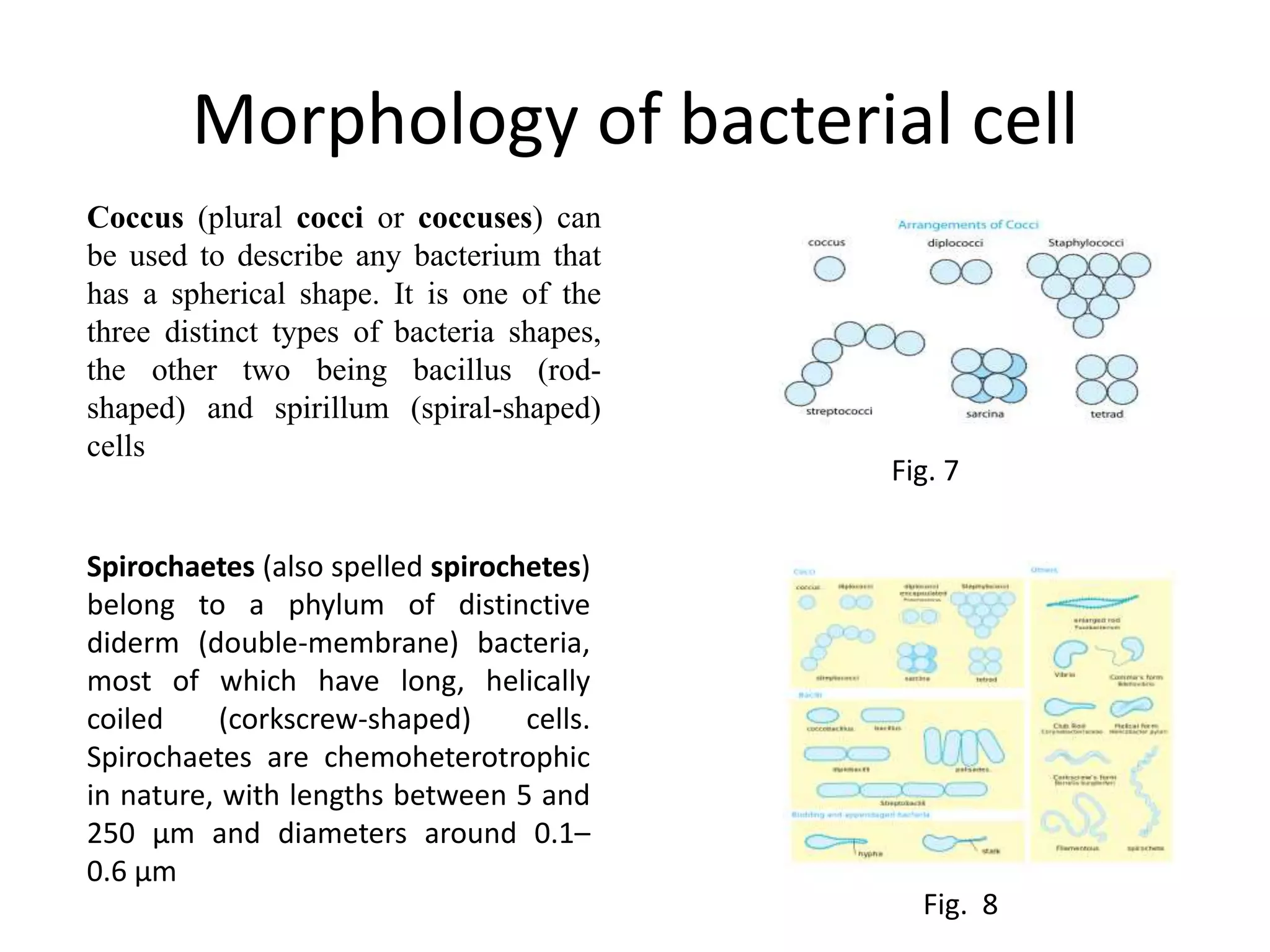
Morphology of bacterial cell
Coccus (plural cocci or coccuses) can
be used to describe any bacterium that
has a spherical shape. It is one of the
three distinct types of bacteria shapes,
the other two being bacillus (rod-
shaped) and spirillum (spiral-shaped)
cells
Spirochaetes (also spelled spirochetes)
belong to a phylum of distinctive
diderm (double-membrane) bacteria,
most of which have long, helically
coiled (corkscrew-shaped) cells.
Spirochaetes are chemoheterotrophic
in nature, with lengths between 5 and
250 µm and diameters around 0.1–
0.6 µm
Fig. 7
Fig. 8
Vibrio is a genus of Gram-negative
bacteria possessing a curved-rod shape
(comma shape), several species of
which can cause foodborne infection,
usually associated with eating
undercooked seafood. Typically found
in saltwater, Vibrio species are
facultative anaerobes that test positive
for oxidase and do not form spores. All
members of the genus are motile and
have polar flagella with sheaths.
Fig. 9
Reference
Books
Plant Pathology by G N Agrios
Web Sources
http://agridr.in/tnauEAgri/eagri50/PATH171/index.html
http:// agriinfo.com
http:// wekipedia.org
Image References
Fig.1 http://en.wikipedia.org/wiki/Bacterial_cell_structure
Fig-2 http://micro.magnet.fsu.edu/cells/bacteriacell.html
Fig-3 http://media-1.web.britannica.com/eb-media//93/130893-050-5B4B3040.jpg
Fig-4 http://upload.wikimedia.org/wikipedia/commons/thumb/3/3e/Conjugation.svg/2000px-
Conjugation.svg.png
Fig-5 http://images.tutorvista.com/content/cell-structure/prokaryote-and-eukaryote-cell.jpeg
Fig-6 http://3.bp.blogspot.com/-LYYiLl2sLQU/Ux34riE3DvI/AAAAAAAABy4/7LoImQQpflI/s1600/gram-
bacteria1-copy.png
Fig-7
http://en.wikipedia.org/wiki/Bacterial_cellular_morphologies#mediaviewer/File:Bacterial_morpholog
y_diagram.svg
Fig-8
http://upload.wikimedia.org/wikipedia/commons/thumb/6/69/Bacterial_morphology_diagram.svg/2
000px-Bacterial_morphology_diagram.svg.png
Fig-9
http://upload.wikimedia.org/wikipedia/commons/thumb/d/db/Vibrio_cholerae_01.jpg/240px-
Vibrio_cholerae_01.jpg

B.sc agriculture i principles of plant pathology u 3 prokaryotes

  • 1.
    Prokaryotes Course- B.Sc. (Agri.) Subject-Principles of plant pathology Unit-3
  • 3.
    Prokaryote A prokaryote isa single-celled organism that lacks a membrane-bound nucleus (karyon), mitochondria, or any other membrane-bound organelle. All the intracellular water-soluble components (proteins, DNA and metabolites) are located together in the same volume enclosed by the cell membrane, rather than in separate cellular compartments. Prokaryotes, however, do possess protein-based microcompartments, which are thought to act as primitive organelles (protein-bounded and lipid- bounded organelles). Some prokaryotes also have multicellular stages in their life cycles, such as myxobacteria, or create large colonies, like cyanobacteria Fig. 1
  • 4.
  • 5.
    Capsule - Foundin some bacterial cells, this additional outer covering protects the cell when it is engulfed by other organisms, assists in retaining moisture, and helps the cell adhere to surfaces and nutrients. Cell Wall - Outer covering of most cells that protects the bacterial cell and gives it shape. Cytoplasm - A gel-like substance composed mainly of water that also contains enzymes, salts, cell components, and various organic molecules. Cell Membrane or Plasma Membrane - Surrounds the cell's cytoplasm and regulates the flow of substances in and out of the cell.
  • 6.
    • Pili -Hair-like structures on the surface of the cell that attach to other bacterial cells. Shorter pili called fimbriae help bacteria attach to surfaces. Flagella - Long, whip-like protrusion that aids in cellular locomotion. Ribosomes - Cell structures responsible for protein production. Plasmids - Gene carrying, circular DNA structures that are not involved in reproduction. Nucleiod Region - Area of the cytoplasm that contains the single bacterial DNA molecule.
  • 7.
    Most prokaryotes reproduceasexually through a process called binary fission. During binary fission, the single DNA molecule replicates and the original cell is divided into two identical cells. Binary fission begins with the single DNA molecule replicating and both copies attaching to the cell membrane. Next, the cell membrane begins to grow between the two DNA molecules. Once the bacterium just about doubles its original size, the cell membrane begins to pinch inward. A cell wall then forms between the two DNA molecules dividing the original cell into two identical daughter cells. Reproduction in bacteria Fig. 3
  • 8.
    Reproduction • When conditionsare favourable bacteria can reproduce every 20 minutes • In 48 hours a single bacterial cell could become culture 4000 times the mass of the earth • Thankfully the food supply is limited and this does not happen
  • 9.
    Binary Fission • Whena cell has almost doubled in size it will replicate its DNA and divide in half • This produces 2 identical daughter cells • Binary fission is a form of asexual reproduction • Asexual reproduction does not invovle the exchange of genetic material
  • 10.
    Conjugation • Is aform of sexual reproduciton • Genetic Information is exchanged between individuals • A long bridge of proteins forms between two bacterial cells • DNA is transferred from one cell (donor) to another (recipient)
  • 11.
    1- Donor cellproduces pilus. 2- Pilus attaches to recipient cell and brings the two cells together. 3- The mobile plasmid is nicked and a single strand of DNA is then transferred to the recipient cell. 4- Both cells synthesize a complementary strand to produce a double stranded circular plasmid and also reproduce pili; both cells are now viable donors. Fig. 4
  • 12.
    Spore Formation • Bacteriaform spores during unfavourable conditions • One type is called an endospore – Cell forms a thick internal wall the encloses its DNA • Spores can remain dormant for months until conditions improve
  • 13.
  • 14.
  • 15.
    Morphology of bacterialcell Coccus (plural cocci or coccuses) can be used to describe any bacterium that has a spherical shape. It is one of the three distinct types of bacteria shapes, the other two being bacillus (rod- shaped) and spirillum (spiral-shaped) cells Spirochaetes (also spelled spirochetes) belong to a phylum of distinctive diderm (double-membrane) bacteria, most of which have long, helically coiled (corkscrew-shaped) cells. Spirochaetes are chemoheterotrophic in nature, with lengths between 5 and 250 µm and diameters around 0.1– 0.6 µm Fig. 7 Fig. 8
  • 16.
    Vibrio is agenus of Gram-negative bacteria possessing a curved-rod shape (comma shape), several species of which can cause foodborne infection, usually associated with eating undercooked seafood. Typically found in saltwater, Vibrio species are facultative anaerobes that test positive for oxidase and do not form spores. All members of the genus are motile and have polar flagella with sheaths. Fig. 9
  • 17.
    Reference Books Plant Pathology byG N Agrios Web Sources http://agridr.in/tnauEAgri/eagri50/PATH171/index.html http:// agriinfo.com http:// wekipedia.org
  • 18.
    Image References Fig.1 http://en.wikipedia.org/wiki/Bacterial_cell_structure Fig-2http://micro.magnet.fsu.edu/cells/bacteriacell.html Fig-3 http://media-1.web.britannica.com/eb-media//93/130893-050-5B4B3040.jpg Fig-4 http://upload.wikimedia.org/wikipedia/commons/thumb/3/3e/Conjugation.svg/2000px- Conjugation.svg.png Fig-5 http://images.tutorvista.com/content/cell-structure/prokaryote-and-eukaryote-cell.jpeg Fig-6 http://3.bp.blogspot.com/-LYYiLl2sLQU/Ux34riE3DvI/AAAAAAAABy4/7LoImQQpflI/s1600/gram- bacteria1-copy.png Fig-7 http://en.wikipedia.org/wiki/Bacterial_cellular_morphologies#mediaviewer/File:Bacterial_morpholog y_diagram.svg Fig-8 http://upload.wikimedia.org/wikipedia/commons/thumb/6/69/Bacterial_morphology_diagram.svg/2 000px-Bacterial_morphology_diagram.svg.png Fig-9 http://upload.wikimedia.org/wikipedia/commons/thumb/d/db/Vibrio_cholerae_01.jpg/240px- Vibrio_cholerae_01.jpg