Bacterial Blight of
Paddy
CONTENTS
• Introduction
• Symptoms
• Causal organism
• Disease cycle
• Disease control
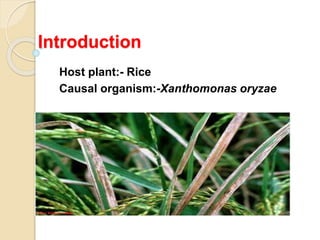
Introduction
Host plant:- Rice
Causal organism:-Xanthomonas oryzae
• Bacterial blight is a very common and
widespread disease of paddy in Asia.
• The disease was first reported from
Japan in 1881.
• In India, the disease was first reported in
1951 from Bombay.
SYMPTOMS
• It is a foliar disease
which appears in early
or late august and
causes maximum
damage during the
heading stage.
• It first appears as
water-soaked ,
translucent spots on
the leaf blade and leaf
sheath.
• The spots gradually increase to form
elongated yellow to straw colored streaks
which may coalesce to form white blotches
the streaks usually develop form the tip
towards the base.
• In severally infected fields, infection may
reach the grains.
• The glumes become discolored and water
soaked spots developed on them.
CAUSAL ORGANISM
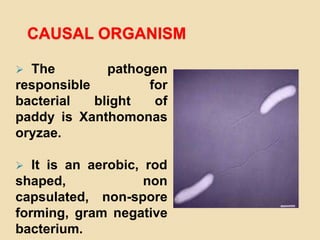
 The pathogen
responsible for
bacterial blight of
paddy is Xanthomonas
oryzae.
 It is an aerobic, rod
shaped, non
capsulated, non-spore
forming, gram negative
bacterium.
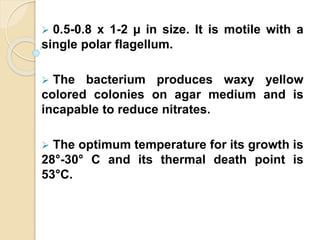
 0.5-0.8 x 1-2 µ in size. It is motile with a
single polar flagellum.
 The bacterium produces waxy yellow
colored colonies on agar medium and is
incapable to reduce nitrates.
 The optimum temperature for its growth is
28°-30° C and its thermal death point is
53°C.
Disease cycle
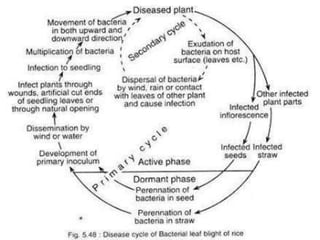
• It is principally a vesicular disease.
• Seeds and disease stubbles are mainly the
primary sources of infection.
• The secondary infection spreads due to
wind-borne rain splashes and gains entry
into the host through wounds and stomata.
• High doses of nitrate, silicate and
magnesium in the soil.
Disease control
The following measures can be adopted to
control the disease incidence:
• One if the good measures is to treat seeds
with 0.025 percent water solution of agrimycin
plus 0.05 percent wettable ceresan for 12
hours and then transfer them to hot water at
52°-54° C for 3 minutes.
• Initial infection can be checked by dipping
seeds for 8 hours in o.1 percent ceresan wet
plus streptomycin (0.3 gm in 2.5 gallons of
water.)
• Spraying agrimycin plus copper oxychloride
for 5 times at 12 day intervals prevent
secondary spread.
• Chlorination of irrigation water also helps in
reducing infection.
• Burning of infected straw and stubble to
destroy the bacteria present is also a good
measure.
• By sowing of nursery beds in disease free
isolated areas to prevent the inflow of
primary inoculums into fields.
• Pruning of top portions of the host should
be avoid.
• By cultivating resistant varieties such as
sathi, N-22, IR-20, IR-22, W-529, W 348 and
Ratna.
Reference
1. https://WWW.forestryimages.org
2. Plant pathology, by
B.P.PANDEY.
Bacterial blight of paddy

Bacterial blight of paddy

  • 1.
  • 2.
    CONTENTS • Introduction • Symptoms •Causal organism • Disease cycle • Disease control
  • 3.
    Introduction Host plant:- Rice Causalorganism:-Xanthomonas oryzae
  • 4.
    • Bacterial blightis a very common and widespread disease of paddy in Asia. • The disease was first reported from Japan in 1881. • In India, the disease was first reported in 1951 from Bombay.
  • 5.
    SYMPTOMS • It isa foliar disease which appears in early or late august and causes maximum damage during the heading stage. • It first appears as water-soaked , translucent spots on the leaf blade and leaf sheath.
  • 6.
    • The spotsgradually increase to form elongated yellow to straw colored streaks which may coalesce to form white blotches the streaks usually develop form the tip towards the base. • In severally infected fields, infection may reach the grains. • The glumes become discolored and water soaked spots developed on them.
  • 7.
    CAUSAL ORGANISM  Thepathogen responsible for bacterial blight of paddy is Xanthomonas oryzae.  It is an aerobic, rod shaped, non capsulated, non-spore forming, gram negative bacterium.
  • 8.
     0.5-0.8 x1-2 µ in size. It is motile with a single polar flagellum.  The bacterium produces waxy yellow colored colonies on agar medium and is incapable to reduce nitrates.  The optimum temperature for its growth is 28°-30° C and its thermal death point is 53°C.
  • 9.
    Disease cycle • Itis principally a vesicular disease. • Seeds and disease stubbles are mainly the primary sources of infection. • The secondary infection spreads due to wind-borne rain splashes and gains entry into the host through wounds and stomata. • High doses of nitrate, silicate and magnesium in the soil.
  • 11.
    Disease control The followingmeasures can be adopted to control the disease incidence: • One if the good measures is to treat seeds with 0.025 percent water solution of agrimycin plus 0.05 percent wettable ceresan for 12 hours and then transfer them to hot water at 52°-54° C for 3 minutes. • Initial infection can be checked by dipping seeds for 8 hours in o.1 percent ceresan wet plus streptomycin (0.3 gm in 2.5 gallons of water.)
  • 12.
    • Spraying agrimycinplus copper oxychloride for 5 times at 12 day intervals prevent secondary spread. • Chlorination of irrigation water also helps in reducing infection. • Burning of infected straw and stubble to destroy the bacteria present is also a good measure.
  • 13.
    • By sowingof nursery beds in disease free isolated areas to prevent the inflow of primary inoculums into fields. • Pruning of top portions of the host should be avoid. • By cultivating resistant varieties such as sathi, N-22, IR-20, IR-22, W-529, W 348 and Ratna.
  • 14.