REPRODUCTION IN
BACTERIA
R.NAGALAKSHMI
ASST. PROF
THE OXFORD COLLEGE OF PHARMACY
BANGALORE
Bacteria reproduce by Vegetative, Asexual and Sexual methods.
Vegetative reproduction includes Budding, Fragmentation and Binary fission.
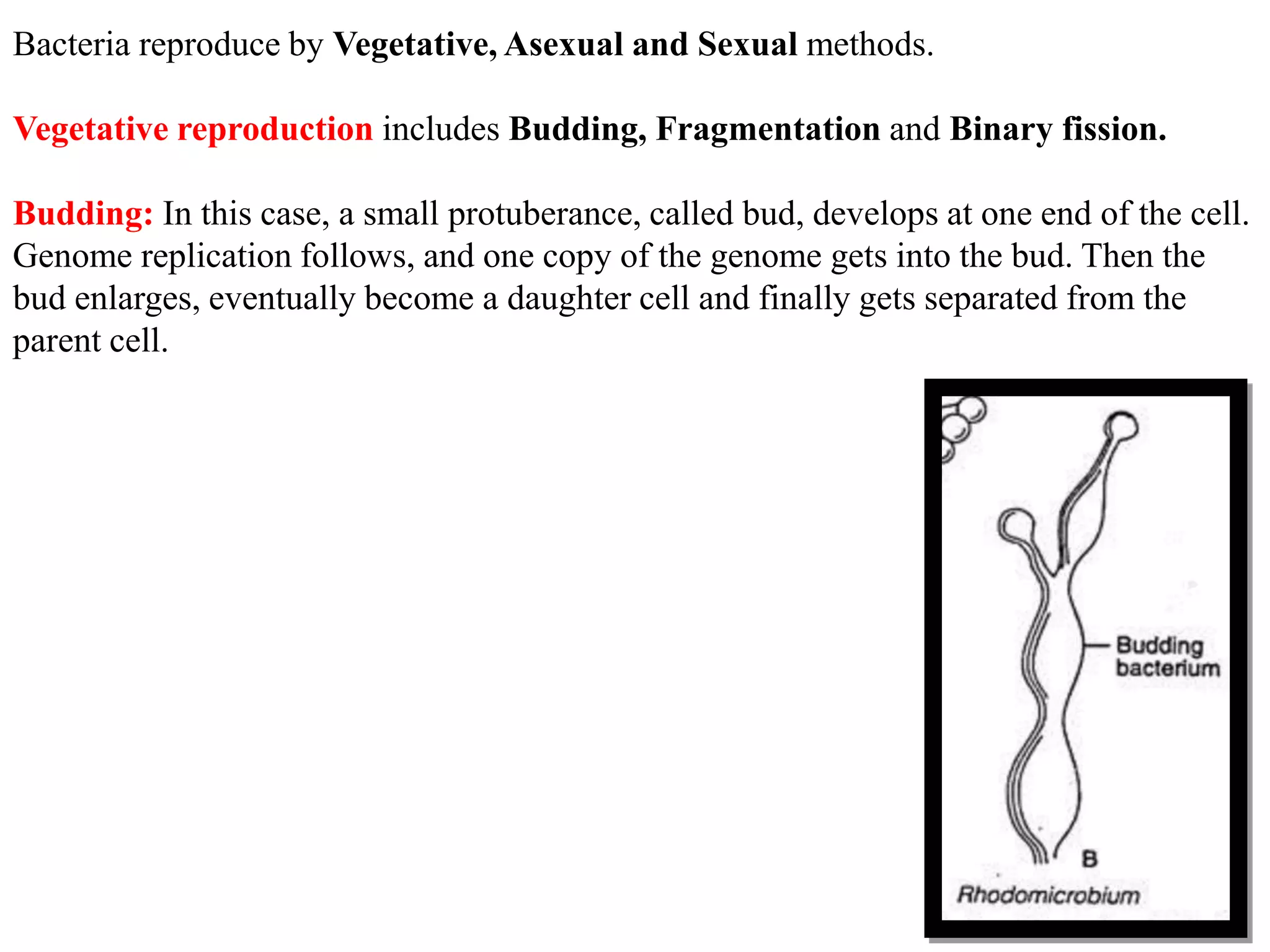
Budding: In this case, a small protuberance, called bud, develops at one end of the cell.
Genome replication follows, and one copy of the genome gets into the bud. Then the
bud enlarges, eventually become a daughter cell and finally gets separated from the
parent cell.
Fragmentation: Mostly during unfavorable conditions, bacterial protoplasm
undergoes compartmentalization and subsequent fragmentation, forming minute bodies
called gonidia. Under favorable conditions, each gonidium grows to a new bacterium.
It becomes apparent that prior to fragmentation the bacterial genome has to undergo
repeated replication so that each fragment gets a copy of it.
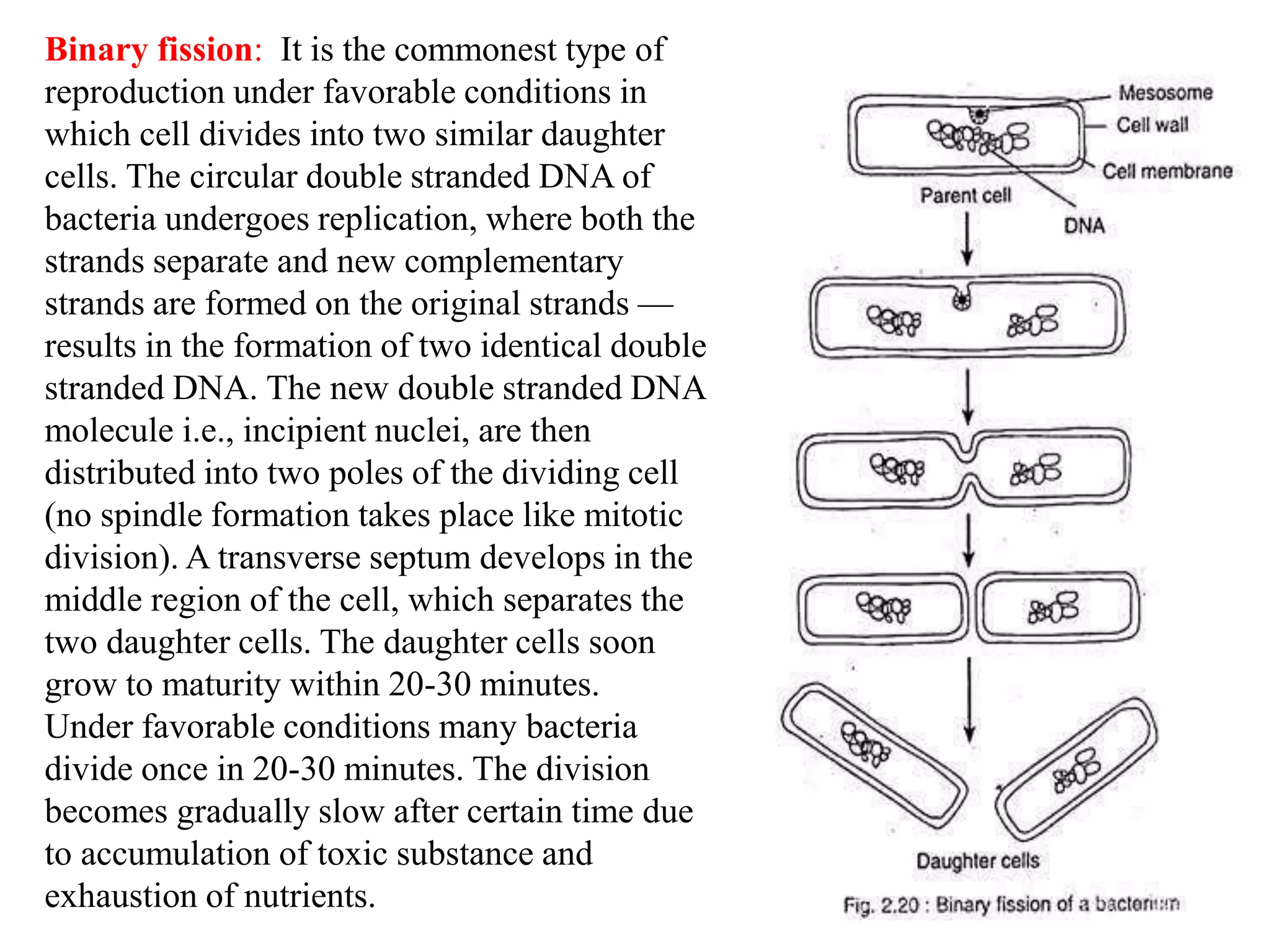
Binary fission: It is the commonest type of
reproduction under favorable conditions in
which cell divides into two similar daughter
cells. The circular double stranded DNA of
bacteria undergoes replication, where both the
strands separate and new complementary
strands are formed on the original strands —
results in the formation of two identical double
stranded DNA. The new double stranded DNA
molecule i.e., incipient nuclei, are then
distributed into two poles of the dividing cell
(no spindle formation takes place like mitotic
division). A transverse septum develops in the
middle region of the cell, which separates the
two daughter cells. The daughter cells soon
grow to maturity within 20-30 minutes.
Under favorable conditions many bacteria
divide once in 20-30 minutes. The division
becomes gradually slow after certain time due
to accumulation of toxic substance and
exhaustion of nutrients.
• Formation of endospore: The endospore formation does not take place during
active phase of growth. The sporulation starts in conditions unfavorable for the
growth due to starvation, desiccation, high temperature etc. The sporulation can
also be induced by depleting S, C, N, Fe and PO4 from culture medium.
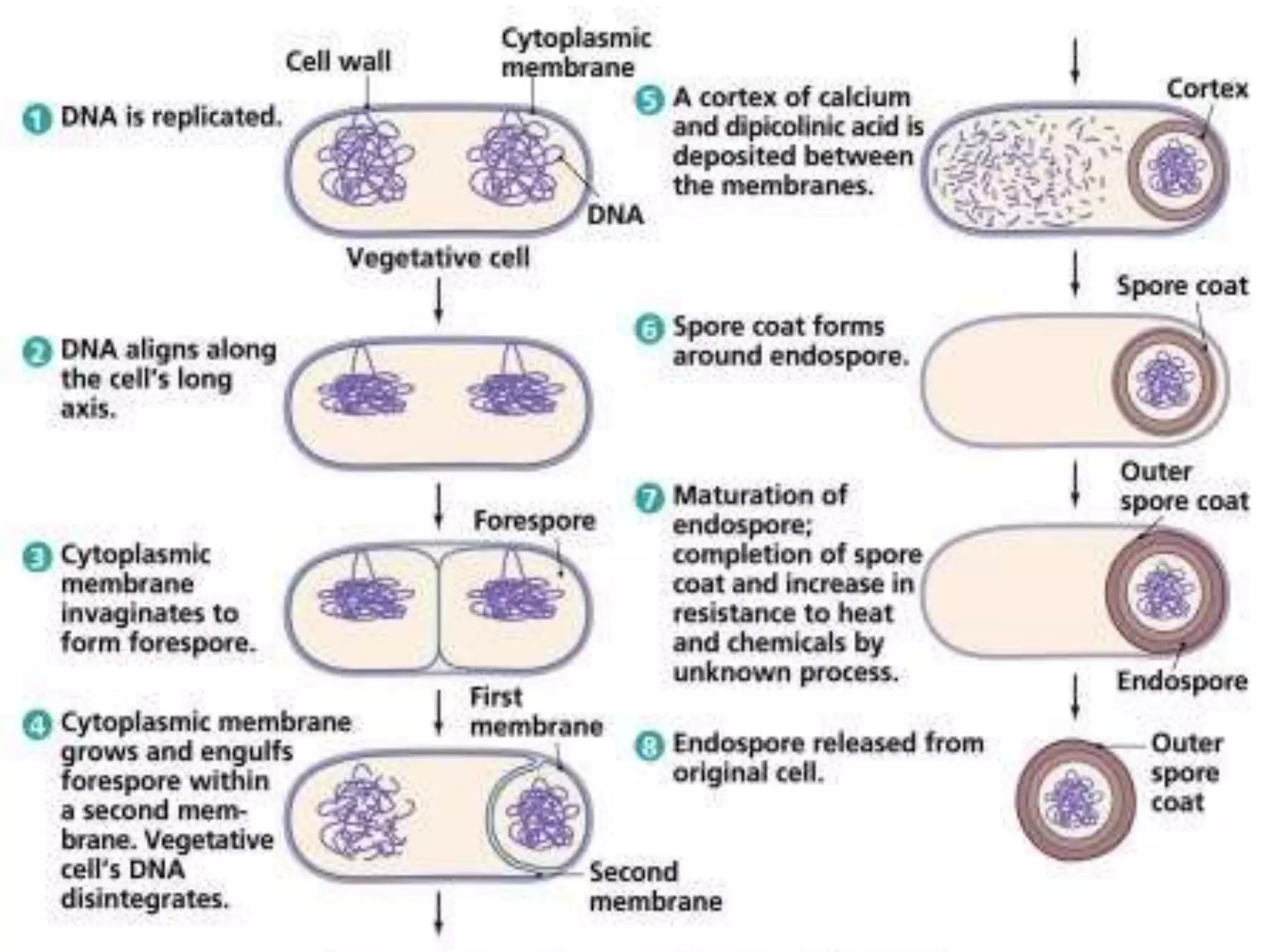
• During sporulation, the first detectable change is the conversion of compact
nucleoid into an axial chromatin filament (Fig. 2.24). Then a transverse septum is
laid down towards one pole, which separates into small and large portion. The
small portion with its cytoplasm and DNA forms the fore spore, which later on
develops into a spore.
• The membrane of large portion gradually grows around the fore spore. The fore
spore increases in size, which becomes opaque and highly refractive, called the
endospore. The entire process of sporulation takes place within 16 to 20 hours.
The cell in which spore is formed, called sporangium, which remains viable for
short period of time after maturation of spore. The spore is liberated by autolysis
of sporangium. The spores can survive in different adverse conditions like heat,
drying, freezing, toxic chemicals and radiations. Some bacilli can resist a
temperature higher than 150°C.
Asexual reproduction takes place by endospore formation, conidia and zoo spores.
The endospores germinate under favorable condition which consists of three
stages:
• (i) Activation: It takes place by the induction of one or more factors such as acidic
pH, heat (60°C for 1 hour), compounds containing free SH groups or through
abrasion.
• (ii) Initiation: Binding of any effector substance like L-alanine, adenosine etc. of
the medium with the spore coat activates to form an autolysin. The autolysin
destroys the peptidoglycan of the cortex. Thereafter, water is taken up and calcium
dipicolonate is released. Dipicolonic acid helps to stabilise the spore protein, and
both dipicolonic acid and Ca ions provide resistance to heat.
• (iii) Outgrowth:
• The swelling of spore wall and disintegration of the cortex help to emerge a germ
cell after breaking the spore coat, which behaves like a vegetative cell.
• Each cell forms only one endospore and persists during unfavourable condition.
During favourable condition, it germinates and gives rise to a single bacterial cell.
So the spore is a perennating organ and the process is called perennation rather than
multiplication.
Conidia:
• Conidia formation takes place in filamentous bacteria like Streptomyces etc., by the
formation of a transverse septum at the apex of the filament . The part of this
filament which bears conidia is called conidiophore. After detachment from the
mother and getting contact with suitable substratum, the conidium germinates and
gives rise to new mycelium.
Sexual reproduction occurs in the form of genetic recombination. There are
three main methods of Genetic Recombination: Transformation, Transduction
and Conjugation.
• Conjugation: It was first reported by Lederberg and Tatum (1946) in E.coli
bacteria. Cell to cell union occurs between two bacterial cells and genetic
material (DNA) of one bacterial cell goes to another cell lengthwise through
conjugation tube which is formed by sex pili.
• Transformation: Here genetic material of one bacterial cell goes into another
bacterial cell by some unknown mechanism and it converts one type of
bacterium into another type (non capsulated to capsulated form). This was first
studied by Griffith (1928) in Diplococcus pneumonia.
• Transduction: In this method, genetic material of one bacterial cell goes to
other bacterial cell by agency of bacteriophages or phages (viruses, infecting
bacteria). It was first of all reported in Salmonella typhimeurium by Zinder and
Lederberg (1952).
• Conjugation:
• The bacterium with F plasmid is the donor, F+ve or male. Fertility factor genes
confer bacteria with the ability to transfer genetic material to the recipient cell. The
bacterium without F factor is the recipient or F-ve strain or recipient. In E.coli,
both these strains are present, one with F factor, F+ve or male and other without F
plasmid, F-ve or female.
• Remember, in bacterial conjugation, F plasmids are generally transferred, not the
entire bacterial genome.
• Step 1: F+ cells produces hair like appendenges called sex pili which facilitates cell
to cell contact with F- strain by forming a conjugation tube. The formation of sex pili
is governed by genes of F factor.
• Step 2: Replication of F factor making a copy
• Step 3: Transfer of copy of F plasmid to the recipient cell via conjugation tube.
• Step 4: Conjugation tube dissolves
• Now the F- strain is also F+. Remember, here bacterial genome is not involved.
Transformation: It is the direct uptake of exogenous DNA from its surroundings and
taken up through the cell membrane .
• Transformation occurs naturally in some species of bacteria, but it can also be
effected by artificial treatment in other species.
• Cells that have undergone this treatment are said to be competent.
• Any DNA that is not integrated into he chromosome will be degraded.
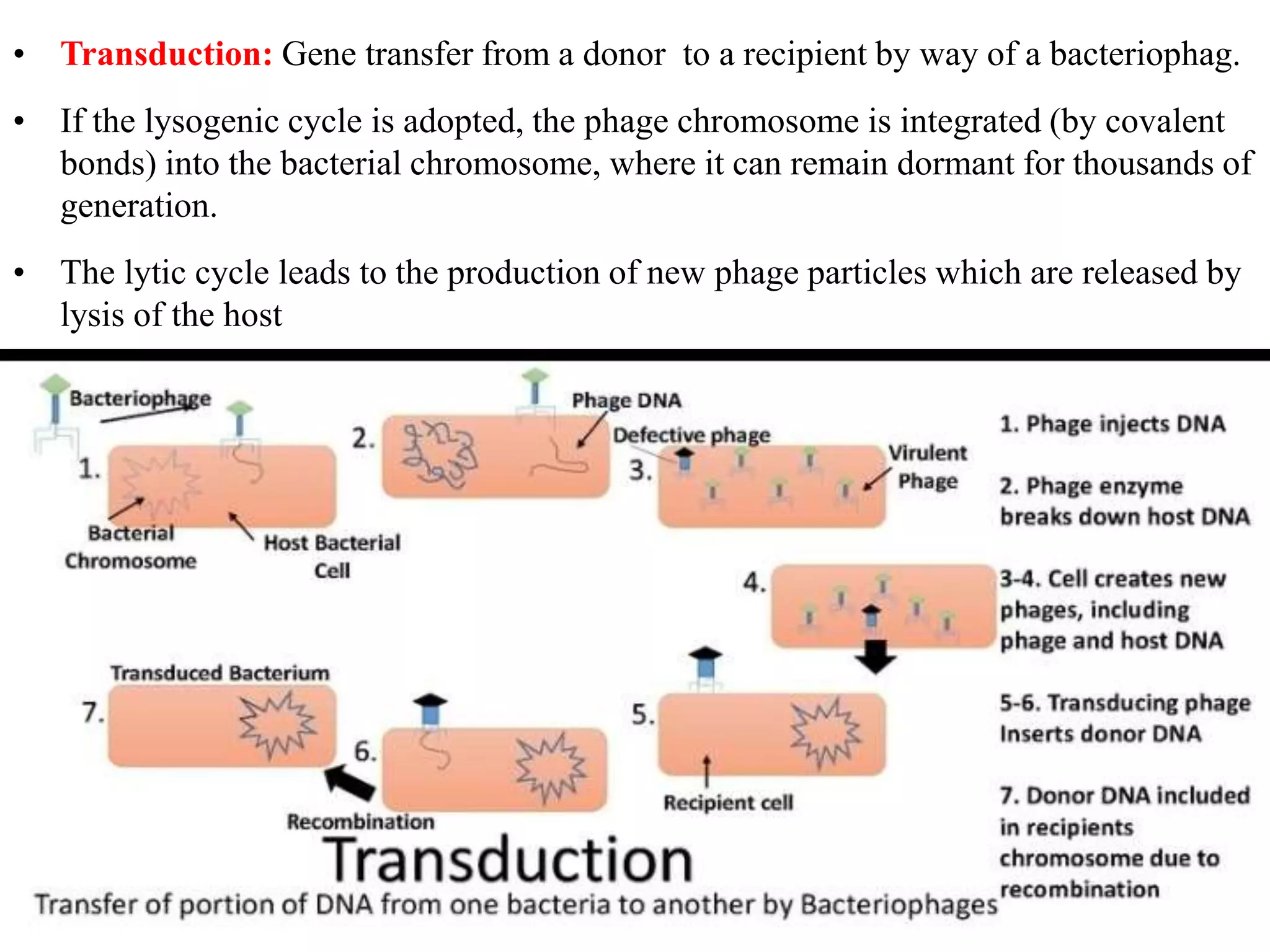
• Transduction: Gene transfer from a donor to a recipient by way of a bacteriophag.
• If the lysogenic cycle is adopted, the phage chromosome is integrated (by covalent
bonds) into the bacterial chromosome, where it can remain dormant for thousands of
generation.
• The lytic cycle leads to the production of new phage particles which are released by
lysis of the host
References:
Biology Exams 4 U_ Bacterial conjugation - Conjugation between F+ and F-
cell.mhtml
Reproduction in Bacteria_ 5 Methods (With Diagram).mhtml
THANK YOU

Reproduction in bacteria

  • 1.
    REPRODUCTION IN BACTERIA R.NAGALAKSHMI ASST. PROF THEOXFORD COLLEGE OF PHARMACY BANGALORE
  • 2.
    Bacteria reproduce byVegetative, Asexual and Sexual methods. Vegetative reproduction includes Budding, Fragmentation and Binary fission. Budding: In this case, a small protuberance, called bud, develops at one end of the cell. Genome replication follows, and one copy of the genome gets into the bud. Then the bud enlarges, eventually become a daughter cell and finally gets separated from the parent cell.
  • 3.
    Fragmentation: Mostly duringunfavorable conditions, bacterial protoplasm undergoes compartmentalization and subsequent fragmentation, forming minute bodies called gonidia. Under favorable conditions, each gonidium grows to a new bacterium. It becomes apparent that prior to fragmentation the bacterial genome has to undergo repeated replication so that each fragment gets a copy of it.
  • 4.
    Binary fission: Itis the commonest type of reproduction under favorable conditions in which cell divides into two similar daughter cells. The circular double stranded DNA of bacteria undergoes replication, where both the strands separate and new complementary strands are formed on the original strands — results in the formation of two identical double stranded DNA. The new double stranded DNA molecule i.e., incipient nuclei, are then distributed into two poles of the dividing cell (no spindle formation takes place like mitotic division). A transverse septum develops in the middle region of the cell, which separates the two daughter cells. The daughter cells soon grow to maturity within 20-30 minutes. Under favorable conditions many bacteria divide once in 20-30 minutes. The division becomes gradually slow after certain time due to accumulation of toxic substance and exhaustion of nutrients.
  • 5.
    • Formation ofendospore: The endospore formation does not take place during active phase of growth. The sporulation starts in conditions unfavorable for the growth due to starvation, desiccation, high temperature etc. The sporulation can also be induced by depleting S, C, N, Fe and PO4 from culture medium. • During sporulation, the first detectable change is the conversion of compact nucleoid into an axial chromatin filament (Fig. 2.24). Then a transverse septum is laid down towards one pole, which separates into small and large portion. The small portion with its cytoplasm and DNA forms the fore spore, which later on develops into a spore. • The membrane of large portion gradually grows around the fore spore. The fore spore increases in size, which becomes opaque and highly refractive, called the endospore. The entire process of sporulation takes place within 16 to 20 hours. The cell in which spore is formed, called sporangium, which remains viable for short period of time after maturation of spore. The spore is liberated by autolysis of sporangium. The spores can survive in different adverse conditions like heat, drying, freezing, toxic chemicals and radiations. Some bacilli can resist a temperature higher than 150°C. Asexual reproduction takes place by endospore formation, conidia and zoo spores.
  • 7.
    The endospores germinateunder favorable condition which consists of three stages: • (i) Activation: It takes place by the induction of one or more factors such as acidic pH, heat (60°C for 1 hour), compounds containing free SH groups or through abrasion. • (ii) Initiation: Binding of any effector substance like L-alanine, adenosine etc. of the medium with the spore coat activates to form an autolysin. The autolysin destroys the peptidoglycan of the cortex. Thereafter, water is taken up and calcium dipicolonate is released. Dipicolonic acid helps to stabilise the spore protein, and both dipicolonic acid and Ca ions provide resistance to heat. • (iii) Outgrowth: • The swelling of spore wall and disintegration of the cortex help to emerge a germ cell after breaking the spore coat, which behaves like a vegetative cell. • Each cell forms only one endospore and persists during unfavourable condition. During favourable condition, it germinates and gives rise to a single bacterial cell. So the spore is a perennating organ and the process is called perennation rather than multiplication.
  • 8.
    Conidia: • Conidia formationtakes place in filamentous bacteria like Streptomyces etc., by the formation of a transverse septum at the apex of the filament . The part of this filament which bears conidia is called conidiophore. After detachment from the mother and getting contact with suitable substratum, the conidium germinates and gives rise to new mycelium.
  • 9.
    Sexual reproduction occursin the form of genetic recombination. There are three main methods of Genetic Recombination: Transformation, Transduction and Conjugation. • Conjugation: It was first reported by Lederberg and Tatum (1946) in E.coli bacteria. Cell to cell union occurs between two bacterial cells and genetic material (DNA) of one bacterial cell goes to another cell lengthwise through conjugation tube which is formed by sex pili. • Transformation: Here genetic material of one bacterial cell goes into another bacterial cell by some unknown mechanism and it converts one type of bacterium into another type (non capsulated to capsulated form). This was first studied by Griffith (1928) in Diplococcus pneumonia. • Transduction: In this method, genetic material of one bacterial cell goes to other bacterial cell by agency of bacteriophages or phages (viruses, infecting bacteria). It was first of all reported in Salmonella typhimeurium by Zinder and Lederberg (1952).
  • 10.
    • Conjugation: • Thebacterium with F plasmid is the donor, F+ve or male. Fertility factor genes confer bacteria with the ability to transfer genetic material to the recipient cell. The bacterium without F factor is the recipient or F-ve strain or recipient. In E.coli, both these strains are present, one with F factor, F+ve or male and other without F plasmid, F-ve or female. • Remember, in bacterial conjugation, F plasmids are generally transferred, not the entire bacterial genome. • Step 1: F+ cells produces hair like appendenges called sex pili which facilitates cell to cell contact with F- strain by forming a conjugation tube. The formation of sex pili is governed by genes of F factor. • Step 2: Replication of F factor making a copy • Step 3: Transfer of copy of F plasmid to the recipient cell via conjugation tube. • Step 4: Conjugation tube dissolves • Now the F- strain is also F+. Remember, here bacterial genome is not involved.
  • 12.
    Transformation: It isthe direct uptake of exogenous DNA from its surroundings and taken up through the cell membrane . • Transformation occurs naturally in some species of bacteria, but it can also be effected by artificial treatment in other species. • Cells that have undergone this treatment are said to be competent. • Any DNA that is not integrated into he chromosome will be degraded.
  • 13.
    • Transduction: Genetransfer from a donor to a recipient by way of a bacteriophag. • If the lysogenic cycle is adopted, the phage chromosome is integrated (by covalent bonds) into the bacterial chromosome, where it can remain dormant for thousands of generation. • The lytic cycle leads to the production of new phage particles which are released by lysis of the host
  • 14.
    References: Biology Exams 4U_ Bacterial conjugation - Conjugation between F+ and F- cell.mhtml Reproduction in Bacteria_ 5 Methods (With Diagram).mhtml THANK YOU