Bacteria reproduce asexually through four main modes: binary fission, budding, fragmentation, and sporulation. Binary fission, the most common mode, involves a single cell dividing into two identical daughter cells. Budding occurs when a small protuberance forms on the parent cell and eventually separates into a new cell. Fragmentation involves the parent cell breaking into multiple fragments that each develop into new bacteria. Sporulation is the formation of spores, such as conidiospores or sporangiospores, which detach and germinate into new mycelium under suitable conditions. Examples of each mode of reproduction are provided.
Modes of Reproductionin Bacteria- Fission,
Budding, Fragmentation and Sporulation
Dr. Dhanya KC
Assistant Professor
Department of Microbiology
St. Mary’s College
Thrissur-680020
Kerala
2.
Bacteria are prokaryoticorganisms - reproduce asexually
Asexual reproduction - offspring arise from a single parent
Offspring - Physically and genetically identical to each
other and to parent
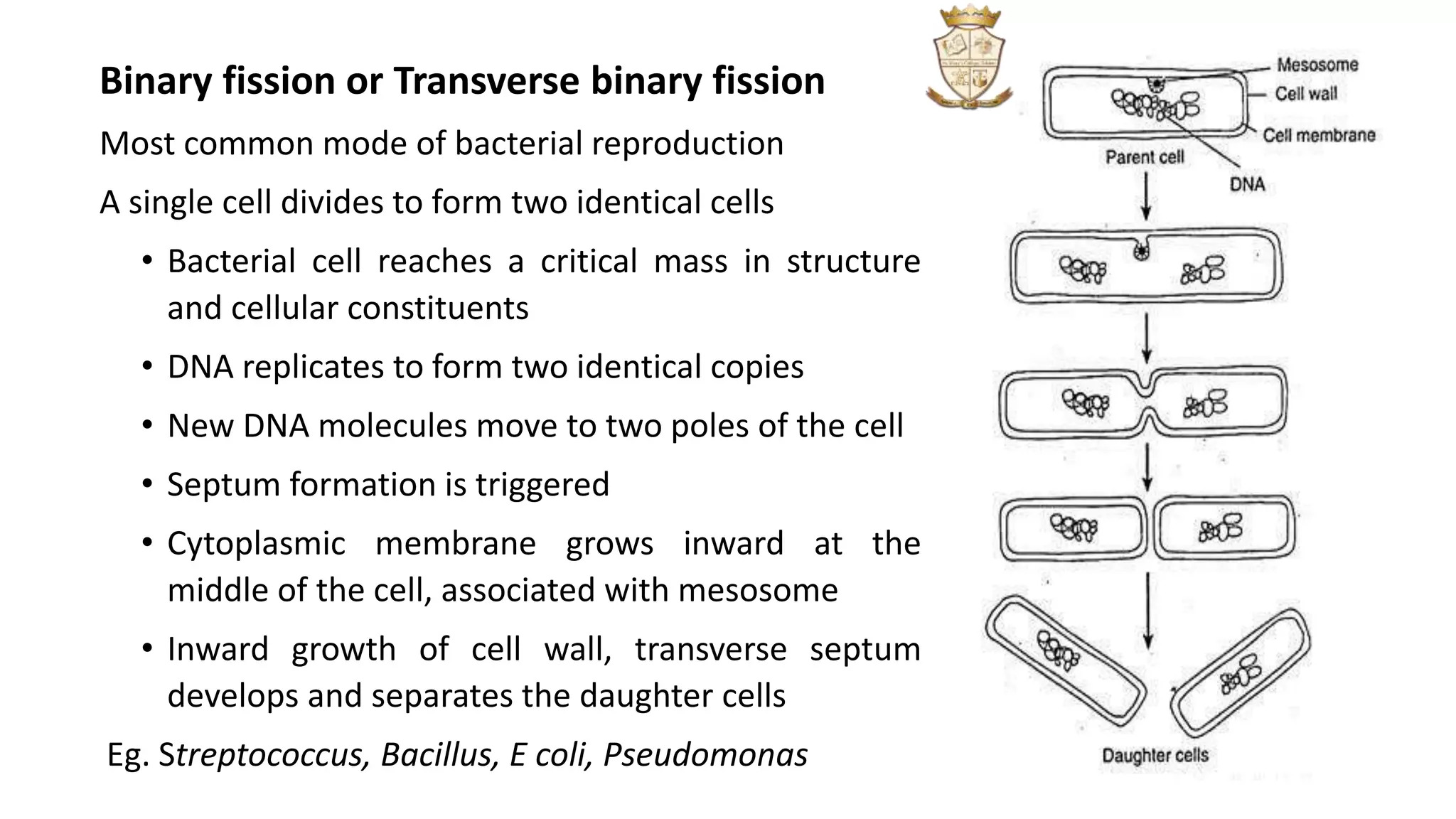
Binary fission orTransverse binary fission
Most common mode of bacterial reproduction
A single cell divides to form two identical cells
• Bacterial cell reaches a critical mass in structure
and cellular constituents
• DNA replicates to form two identical copies
• New DNA molecules move to two poles of the cell
• Septum formation is triggered
• Cytoplasmic membrane grows inward at the
middle of the cell, associated with mesosome
• Inward growth of cell wall, transverse septum
develops and separates the daughter cells
Eg. Streptococcus, Bacillus, E coli, Pseudomonas
5.
Fragmentation
Also known asSplitting
Cell breaks into several fragments – each develop into complete organism
• The bacterial protoplasm undergoes compartmentalization and
subsequent fragmentation
• Results in minute bacillary or coccoid cells
• Each bacillary or coccoid cell grow to form a new bacterium
Eg. Filamentous Cyanobacteria and Nocardia
6.
Budding
• The bacterialcell develops small swelling or
protuberance at one end
• DNA divides, one remains with the parent and other
one with some cytoplasm goes to the bud
• Bud gradually increases in size - eventually develops
into a new cell
• Gets separated from the parent cell
Eg. Rhodopseudomonas acidophila, Planctomycetes,
Firmicutes and prosthecate Proteobacteria
Some bacteria such as Hyphomicrobium form the bud at the
end of prostheca.
7.
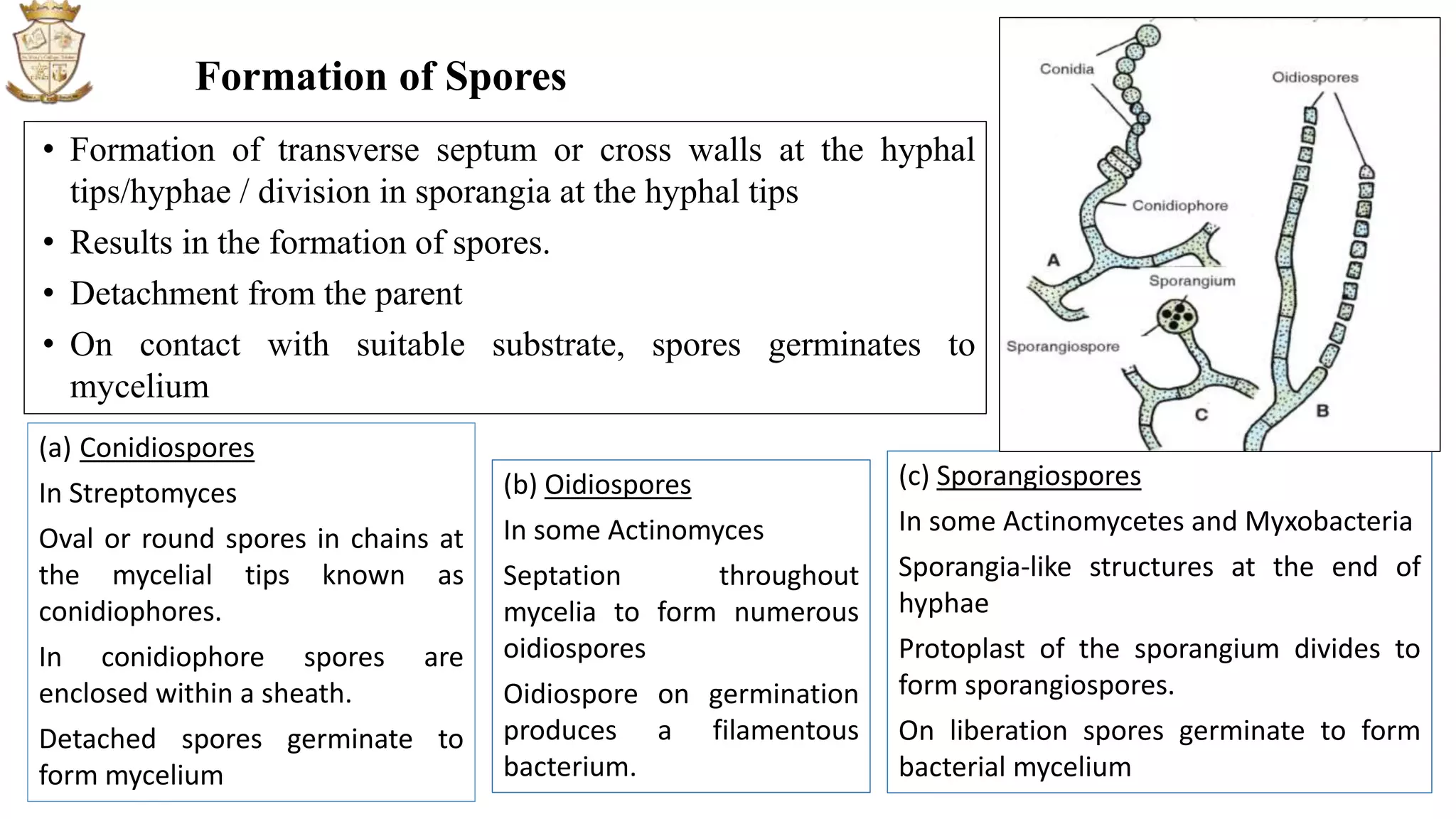
• Formation oftransverse septum or cross walls at the hyphal
tips/hyphae / division in sporangia at the hyphal tips
• Results in the formation of spores.
• Detachment from the parent
• On contact with suitable substrate, spores germinates to
mycelium
Formation of Spores
(a) Conidiospores
In Streptomyces
Oval or round spores in chains at
the mycelial tips known as
conidiophores.
In conidiophore spores are
enclosed within a sheath.
Detached spores germinate to
form mycelium
(b) Oidiospores
In some Actinomyces
Septation throughout
mycelia to form numerous
oidiospores
Oidiospore on germination
produces a filamentous
bacterium.
(c) Sporangiospores
In some Actinomycetes and Myxobacteria
Sporangia-like structures at the end of
hyphae
Protoplast of the sporangium divides to
form sporangiospores.
On liberation spores germinate to form
bacterial mycelium
8.
G. Formation ofconidiospores in Streptomyces
A. Transverse binary fission in Bacillus subtilis
B. Transverse binary fission in Streptococcus faecalis
C. Transverse binary fission in prosthecate bacterium
Prosthecobacter fusiformis
D. Budding in Rhodopseudomonas acidophila
E. Budding in prosthecate bacterium Hyphomicrobium
F. Fragmentation in Nocardia
9.
References
1. Text Bookof Microbiology By Michael J. Pelczar
2. https://www.ck12.org/book/cbse_biology_book_class_x/section/3.3/
3. http://www.biologydiscussion.com/bacteria/how-does-bacteria-reproduce-
with-diagram-microbiology/64010
4. Botany for Degree Students Fungi by A K Sinha