Nephrology!!
Objectives
 Basics of AKI
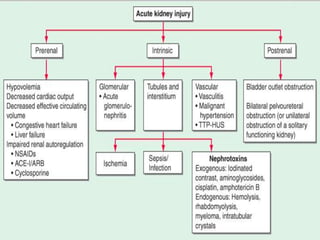
 Renal causes of AKI
 PD peritonitis
 A few interesting cases
 Things to consider for a renal patient
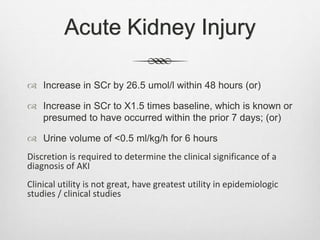
Acute Kidney Injury
 Increase in SCr by 26.5 umol/l within 48 hours (or)
 Increase in SCr to X1.5 times baseline, which is known or
presumed to have occurred within the prior 7 days; (or)
 Urine volume of <0.5 ml/kg/h for 6 hours
Discretion is required to determine the clinical significance of a
diagnosis of AKI
Clinical utility is not great, have greatest utility in epidemiologic
studies / clinical studies
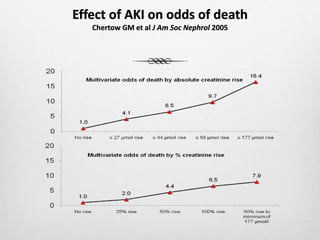
Effect of AKI on odds of death
Chertow GM et al J Am Soc Nephrol 2005
Things that don’t diagnose
AKI
 Urea – not specific
 eGFR – used in Chronic Kidney disease
 Electrolytes disturbance
 A result of AKI, but not specific
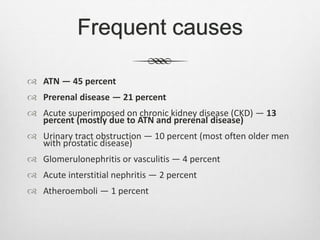
Frequent causes
 ATN — 45 percent
 Prerenal disease — 21 percent
 Acute superimposed on chronic kidney disease (CKD) — 13
percent (mostly due to ATN and prerenal disease)
 Urinary tract obstruction — 10 percent (most often older men
with prostatic disease)
 Glomerulonephritis or vasculitis — 4 percent
 Acute interstitial nephritis — 2 percent
 Atheroemboli — 1 percent
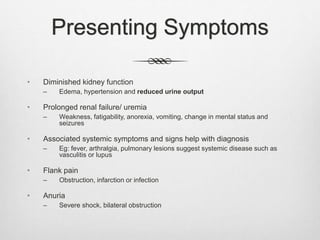
Presenting Symptoms
• Diminished kidney function
– Edema, hypertension and reduced urine output
• Prolonged renal failure/ uremia
– Weakness, fatigability, anorexia, vomiting, change in mental status and
seizures
• Associated systemic symptoms and signs help with diagnosis
– Eg: fever, arthralgia, pulmonary lesions suggest systemic disease such as
vasculitis or lupus
• Flank pain
– Obstruction, infarction or infection
• Anuria
– Severe shock, bilateral obstruction
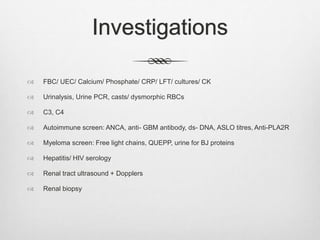
Investigations
 FBC/ UEC/ Calcium/ Phosphate/ CRP/ LFT/ cultures/ CK
 Urinalysis, Urine PCR, casts/ dysmorphic RBCs
 C3, C4
 Autoimmune screen: ANCA, anti- GBM antibody, ds- DNA, ASLO titres, Anti-PLA2R
 Myeloma screen: Free light chains, QUEPP, urine for BJ proteins
 Hepatitis/ HIV serology
 Renal tract ultrasound + Dopplers
 Renal biopsy
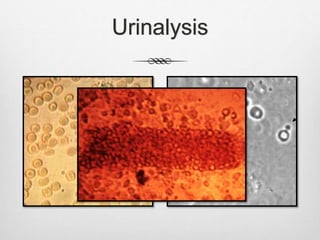
Urinalysis
Management
 Volume depletion- (pre-renal)
 IV fluids
 CSL theoretically preferred in acidosis
 Consider IV bicarbonate if severely acidotic but not
overloaded
 Volume overload
 Can occur from aggressive correction of dehydration
 Use diuretics dialysis if no response
Management
 Post renal cause: obstruction needs to be relieved
asap the more the delay, the greater the chance of
poor recovery
 Intrinsic renal cause: Rx is complex; largely depends
on underlying causes which is usually determined on
renal biopsy
Management: Indications for urgent
dialysis
Life threatening fluid and electrolyte abnormalities:
 Refractory hyperkalemia (ECG)
 Refractory acidosis
 Acute pulmonary edema
 Uremic encephalopathy
 Uremic pericarditis
Acute Tubular Necrosis
 Most common form of intra- renal AKI in hospitalized patients
 Sustained period of ischemia/exposure to nephrotoxics
 May resolve over 1-4 weeks or may result in permanent ESKD
depending on duration and severity of insult
 U/A: muddy brown casts
 Aim MAP of 65mmHg
 No benefit of low dose dopamine
 Diuretics do not improve outcome
 ATN + multi- organ failure 50- 80% mortality rate!
Contrast Induced
Nephropathy
 Rise in creatinine 24-48 hours post contrast
 Usually non- oliguric AKI
 Renal recovery occurs in 1-2 weeks
 GFR <60 at high risk
 Prevention better than cure: IV hydration, withhold
nephrotoxics (metformin, NSAIDS, ACE), NAC controversial
 Use of low osmolar/ iso-osmolar/ non ionic contrast
 MRI: gadolinium contrast NSF if GFR <40
Nephrotic Syndrome
 Proteinuria (3.5gm/day), hypoalbuminemia, edema,
dyslipidemia
 Types: MCD, FSGS, membranous
 Important secondary causes: DM, myeloma, SLE, drugs like
NSAIDS/ palmidronate, malignancie, amyloidosis, HIV
 Renal function may be normal
 Urine dipstick: protein +++, NO blood check urine PCR/ACR
 Usually commenced on diuretics and ACEI with O/P follow up +
renal biopsy to determine cause
 Idiopathic causes are usually treated with immunosupression
Nephritic syndrome
 Hypertension, edema, oliguria +/- hematuria
 Urine: RBC +++, protein +/-,
 Entity of RPGN (urgent evaluation and treatment)
 ANCA vasculitis
 Anti GBM antibody (Renal failure with pulmonary
hemorrhage)
 Other causes
 SLE, Post Strep GN, IgA nephropathy, HUS/TTP
Multiple myeloma
 Elderly age group
 Anemia, hypercalcemia, renal failure, bone pains/ susceptibility
to fractures usually vertebral
 LFTs may show raised globulins
 Discrepancy between urine PCR and ACR
 Cast nephropathy most common: from deposition of light
chains in the tubules
 Bone marrow biopsy + renal biopsy
 Rx: Chemotherapy, dialysis
PD Peritonitis
 Leading complication of PD; each episode damages the
membrane
 Morbidity and sometimes mortality
 Usually due to technique failure
 Cloudy effluent +/- abdominal pain +/- systemic symptoms
 Send PD fluid for MCS and gram stain (important for yeast
detection  anti fungal)
 Swab exit site as needed
 WCC >100 with >50% PMN is diagnostic
PD peritonitis
 Treatment is time critical
 Empirical IP antibiotics: Vancomycin 2gm + Gentamicin
80mg
 Further Abx therapy depends on organism cultured
 Most common: coag negative Staphylococcus
 S.aureus and P. aeroginosa: severe peritonitis
 Single gram negative rods: due to contamination/ exit site
infection/ transmural migration from constipation/ colitis
PD catheter removal
 Refractory peritonitis: failure to respond to therapy
within 5 days
 Fungal peritonitis
 Multi- organism peritonitis indicates bowel
perforation  urgent surgical review
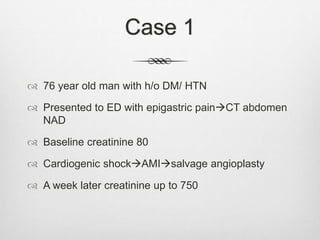
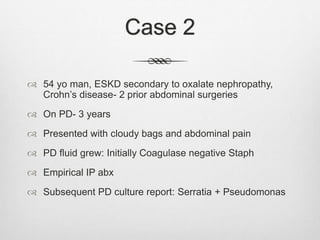
Case 1
 76 year old man with h/o DM/ HTN
 Presented to ED with epigastric painCT abdomen
NAD
 Baseline creatinine 80
 Cardiogenic shockAMIsalvage angioplasty
 A week later creatinine up to 750
Xray
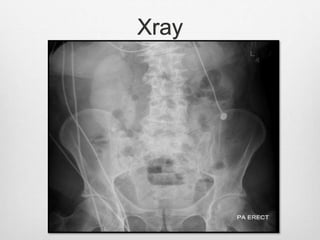
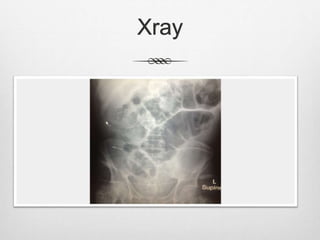
Case 2
 54 yo man, ESKD secondary to oxalate nephropathy,
Crohn’s disease- 2 prior abdominal surgeries
 On PD- 3 years
 Presented with cloudy bags and abdominal pain
 PD fluid grew: Initially Coagulase negative Staph
 Empirical IP abx
 Subsequent PD culture report: Serratia + Pseudomonas
Xray
Case 3
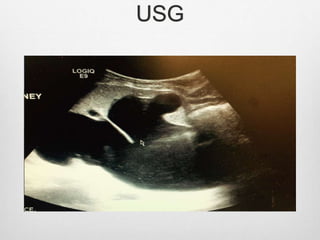
 44 yo man, sent in by GP with creatinine of 1100
 No prior blood tests to compare
 Catheter sample ++ protein, + blood
 Referred to renal from peripheral centre
 Initial thoughts?
 On arrival gross hematuria
USG
Case 4
 68 yo man, referred by GP for raised creatinine of 256
 B/g of DM-2 on insulin
 Self medicating with prednisolone for the past 3 weeks
for ‘headaches’. No features of sepsis.
 Vague h/o ?GCA several years ago; no biopsy; Rx with
prednisolone for 2 years
 Within 4 days, creatinine rose to 412
 Clinically euvolemic
Case 4
 Urine dipstick: blood +++
 Urine microscopy: RBC >100, PCR: 65 (<13)
 Complements: normal
 QUEPP: negative
 ANCA: 7 (<4 units)
 P- ANCA +ve , ELISA: Myeloperoxidase +Ve
 Renal biopsy: Pauci immune cresenteric GN
 Rx with steroids and cyclophosphamide with good
effect. Creatinine now stable at 200.
Case 5
 72 yo lady presented with N+V and 5 kg weight loss 10
days post endoscopy for investigation of anemia
 Creatinine 474 (baseline 5 months ago- 110)
 Initially Rx with IV hydration, anti-emetics fluid
overloaded creatinine increased to ~600
 Urine: ++ protein, ++ blood
 PCR: 500
 Complements: Normal
Case 5
 Renal biopsy: Cast nephropathy
 Positive serum and urine paraproteins
 Bone marrow biopsy confirmed myeloma
 Currently on hemo- dialysis and chemo therapy
 Poor recovery of renal function
Case 6
 68 yo man with known b/l renal artery stenosis
 Chronically atrophic left kidney
 Stent to right renal artery 6 years ago
 Presented with acute onset anuria for 18 hours
 Creatinine- baseline of 200  588
 What next?
The renal patient
 No IVCs in the cubital fossa
 In AKI; dipstick urine
 A baseline creatinine is always very useful
 Sudden onset anuria usually implies a post renal cause scan
and usually call urology. Get a non contrast CT KUB if no USG
available
 PD peritonitis: treatment is time critical, usually don’t need
admission
 Dialysis and transplant patients can get unwell pretty quickly-
low threshold to call HDU/ICU
 Initial Rx for most conditions in dialysis patients works as for
anyone else; just watch for fluid overload
Nuances
 No need to worry about contrast if patient already
established on dialysis
 ESKD usually used to refer to patient already on
RRT
 Renal dose medications; bear in mind interactions
with tacrolimus/ cyclosporine
 We rarely withhold immunosuppressant medications
for Tx patients
Thank you!

Renal Emergencies

  • 2.
  • 3.
    Objectives  Basics ofAKI  Renal causes of AKI  PD peritonitis  A few interesting cases  Things to consider for a renal patient
  • 4.
    Acute Kidney Injury Increase in SCr by 26.5 umol/l within 48 hours (or)  Increase in SCr to X1.5 times baseline, which is known or presumed to have occurred within the prior 7 days; (or)  Urine volume of <0.5 ml/kg/h for 6 hours Discretion is required to determine the clinical significance of a diagnosis of AKI Clinical utility is not great, have greatest utility in epidemiologic studies / clinical studies
  • 5.
    Effect of AKIon odds of death Chertow GM et al J Am Soc Nephrol 2005
  • 6.
    Things that don’tdiagnose AKI  Urea – not specific  eGFR – used in Chronic Kidney disease  Electrolytes disturbance  A result of AKI, but not specific
  • 8.
    Frequent causes  ATN— 45 percent  Prerenal disease — 21 percent  Acute superimposed on chronic kidney disease (CKD) — 13 percent (mostly due to ATN and prerenal disease)  Urinary tract obstruction — 10 percent (most often older men with prostatic disease)  Glomerulonephritis or vasculitis — 4 percent  Acute interstitial nephritis — 2 percent  Atheroemboli — 1 percent
  • 9.
    Presenting Symptoms • Diminishedkidney function – Edema, hypertension and reduced urine output • Prolonged renal failure/ uremia – Weakness, fatigability, anorexia, vomiting, change in mental status and seizures • Associated systemic symptoms and signs help with diagnosis – Eg: fever, arthralgia, pulmonary lesions suggest systemic disease such as vasculitis or lupus • Flank pain – Obstruction, infarction or infection • Anuria – Severe shock, bilateral obstruction
  • 10.
    Investigations  FBC/ UEC/Calcium/ Phosphate/ CRP/ LFT/ cultures/ CK  Urinalysis, Urine PCR, casts/ dysmorphic RBCs  C3, C4  Autoimmune screen: ANCA, anti- GBM antibody, ds- DNA, ASLO titres, Anti-PLA2R  Myeloma screen: Free light chains, QUEPP, urine for BJ proteins  Hepatitis/ HIV serology  Renal tract ultrasound + Dopplers  Renal biopsy
  • 11.
  • 12.
    Management  Volume depletion-(pre-renal)  IV fluids  CSL theoretically preferred in acidosis  Consider IV bicarbonate if severely acidotic but not overloaded  Volume overload  Can occur from aggressive correction of dehydration  Use diuretics dialysis if no response
  • 13.
    Management  Post renalcause: obstruction needs to be relieved asap the more the delay, the greater the chance of poor recovery  Intrinsic renal cause: Rx is complex; largely depends on underlying causes which is usually determined on renal biopsy
  • 14.
    Management: Indications forurgent dialysis Life threatening fluid and electrolyte abnormalities:  Refractory hyperkalemia (ECG)  Refractory acidosis  Acute pulmonary edema  Uremic encephalopathy  Uremic pericarditis
  • 15.
    Acute Tubular Necrosis Most common form of intra- renal AKI in hospitalized patients  Sustained period of ischemia/exposure to nephrotoxics  May resolve over 1-4 weeks or may result in permanent ESKD depending on duration and severity of insult  U/A: muddy brown casts  Aim MAP of 65mmHg  No benefit of low dose dopamine  Diuretics do not improve outcome  ATN + multi- organ failure 50- 80% mortality rate!
  • 16.
    Contrast Induced Nephropathy  Risein creatinine 24-48 hours post contrast  Usually non- oliguric AKI  Renal recovery occurs in 1-2 weeks  GFR <60 at high risk  Prevention better than cure: IV hydration, withhold nephrotoxics (metformin, NSAIDS, ACE), NAC controversial  Use of low osmolar/ iso-osmolar/ non ionic contrast  MRI: gadolinium contrast NSF if GFR <40
  • 17.
    Nephrotic Syndrome  Proteinuria(3.5gm/day), hypoalbuminemia, edema, dyslipidemia  Types: MCD, FSGS, membranous  Important secondary causes: DM, myeloma, SLE, drugs like NSAIDS/ palmidronate, malignancie, amyloidosis, HIV  Renal function may be normal  Urine dipstick: protein +++, NO blood check urine PCR/ACR  Usually commenced on diuretics and ACEI with O/P follow up + renal biopsy to determine cause  Idiopathic causes are usually treated with immunosupression
  • 18.
    Nephritic syndrome  Hypertension,edema, oliguria +/- hematuria  Urine: RBC +++, protein +/-,  Entity of RPGN (urgent evaluation and treatment)  ANCA vasculitis  Anti GBM antibody (Renal failure with pulmonary hemorrhage)  Other causes  SLE, Post Strep GN, IgA nephropathy, HUS/TTP
  • 19.
    Multiple myeloma  Elderlyage group  Anemia, hypercalcemia, renal failure, bone pains/ susceptibility to fractures usually vertebral  LFTs may show raised globulins  Discrepancy between urine PCR and ACR  Cast nephropathy most common: from deposition of light chains in the tubules  Bone marrow biopsy + renal biopsy  Rx: Chemotherapy, dialysis
  • 20.
    PD Peritonitis  Leadingcomplication of PD; each episode damages the membrane  Morbidity and sometimes mortality  Usually due to technique failure  Cloudy effluent +/- abdominal pain +/- systemic symptoms  Send PD fluid for MCS and gram stain (important for yeast detection  anti fungal)  Swab exit site as needed  WCC >100 with >50% PMN is diagnostic

  • 21.
    PD peritonitis  Treatmentis time critical  Empirical IP antibiotics: Vancomycin 2gm + Gentamicin 80mg  Further Abx therapy depends on organism cultured  Most common: coag negative Staphylococcus  S.aureus and P. aeroginosa: severe peritonitis  Single gram negative rods: due to contamination/ exit site infection/ transmural migration from constipation/ colitis
  • 22.
    PD catheter removal Refractory peritonitis: failure to respond to therapy within 5 days  Fungal peritonitis  Multi- organism peritonitis indicates bowel perforation  urgent surgical review
  • 23.
    Case 1  76year old man with h/o DM/ HTN  Presented to ED with epigastric painCT abdomen NAD  Baseline creatinine 80  Cardiogenic shockAMIsalvage angioplasty  A week later creatinine up to 750
  • 24.
  • 25.
    Case 2  54yo man, ESKD secondary to oxalate nephropathy, Crohn’s disease- 2 prior abdominal surgeries  On PD- 3 years  Presented with cloudy bags and abdominal pain  PD fluid grew: Initially Coagulase negative Staph  Empirical IP abx  Subsequent PD culture report: Serratia + Pseudomonas
  • 26.
  • 27.
    Case 3  44yo man, sent in by GP with creatinine of 1100  No prior blood tests to compare  Catheter sample ++ protein, + blood  Referred to renal from peripheral centre  Initial thoughts?  On arrival gross hematuria
  • 28.
  • 29.
    Case 4  68yo man, referred by GP for raised creatinine of 256  B/g of DM-2 on insulin  Self medicating with prednisolone for the past 3 weeks for ‘headaches’. No features of sepsis.  Vague h/o ?GCA several years ago; no biopsy; Rx with prednisolone for 2 years  Within 4 days, creatinine rose to 412  Clinically euvolemic
  • 30.
    Case 4  Urinedipstick: blood +++  Urine microscopy: RBC >100, PCR: 65 (<13)  Complements: normal  QUEPP: negative  ANCA: 7 (<4 units)  P- ANCA +ve , ELISA: Myeloperoxidase +Ve  Renal biopsy: Pauci immune cresenteric GN  Rx with steroids and cyclophosphamide with good effect. Creatinine now stable at 200.
  • 31.
    Case 5  72yo lady presented with N+V and 5 kg weight loss 10 days post endoscopy for investigation of anemia  Creatinine 474 (baseline 5 months ago- 110)  Initially Rx with IV hydration, anti-emetics fluid overloaded creatinine increased to ~600  Urine: ++ protein, ++ blood  PCR: 500  Complements: Normal
  • 32.
    Case 5  Renalbiopsy: Cast nephropathy  Positive serum and urine paraproteins  Bone marrow biopsy confirmed myeloma  Currently on hemo- dialysis and chemo therapy  Poor recovery of renal function
  • 33.
    Case 6  68yo man with known b/l renal artery stenosis  Chronically atrophic left kidney  Stent to right renal artery 6 years ago  Presented with acute onset anuria for 18 hours  Creatinine- baseline of 200  588  What next?
  • 34.
    The renal patient No IVCs in the cubital fossa  In AKI; dipstick urine  A baseline creatinine is always very useful  Sudden onset anuria usually implies a post renal cause scan and usually call urology. Get a non contrast CT KUB if no USG available  PD peritonitis: treatment is time critical, usually don’t need admission  Dialysis and transplant patients can get unwell pretty quickly- low threshold to call HDU/ICU  Initial Rx for most conditions in dialysis patients works as for anyone else; just watch for fluid overload
  • 35.
    Nuances  No needto worry about contrast if patient already established on dialysis  ESKD usually used to refer to patient already on RRT  Renal dose medications; bear in mind interactions with tacrolimus/ cyclosporine  We rarely withhold immunosuppressant medications for Tx patients
  • 36.

Editor's Notes

  • #8 Post renal: Anuric AKI usually an indication for urgent imaging and referral to urology