WELCOME TO MORNING SESSION
DR.MD.SAZZAD HOSSAIN SAJAL
INTERN DOCTOR
MEDICINE DEPARTMENT
TMMC&H
Hypertensive encephalopathy
and
Hypertensive Emergencies
HYPERTENSIVE ENCEPHALOPATHY
• Definition:-
• Hypertensive encephalopathy is a rare
condition characterized by high BP and
neurological symptoms, including transient
disturbances of speech or vision,
paraesthesiae, disorientation, fits ,loss of
consciousness and papilloedema.
• Hypertensive encephalopathy is a neurological
dysfunction induced by malignant
hypertension.
• Malignant hypertension is commonly defined
as sustained, elevated arterial blood pressure,
with diastolic levels of 130 mm Hg or greater
and systolic pressure in excess of 200 mm Hg.
(cecil)
Historical note and terminology
The term “hypertensive encephalopathy” was
introduced by Oppenheimer and Fishberg
(Oppenheimer and Fishberg 1928). They
described essential clinical characteristics of
acute malignant hypertension. Ten years prior,
Volhard was the first to separate clearly acute
hypertension-induced neurologic dysfunction
from a uremic state and introduced the term
“pseudouremia” to refer to hypertensive
encephalopathy (Volhard 1918).
PATHOGENESIS:-
• The pathogenesis of hypertensive encephalopathy
remains unclear.
• Pathologic findings include purpura in the brain, retinal
hemorrhages, papilledema,and fibrinoid arteriolar lesions
of the glomeruli.
• Diffuse fibrinoid necrosis and thrombotic occlusion of
arterioles cause micro infarctions and petechial
hemorrhages, and these changes lead to distal ischemia.
• Ring hemorrhage around a thrombosed precapillary is the
characteristic microscopic lesion of hypertensive
encephalopathy. Multiple, compacted petechiae can
resemble a hematoma.
HTN Encephalopathy
• Symptoms
– Severe headache
– Nausea and vomiting
– Visual disturbances
– Confusion
– focal or generalized
weakness
- irritability and altered
mental status due to
cerebrovascular spasm
• Signs
– Disorientation
– Focal neurologic defects
– Focal or generalized
seizures
– nystagmus
Investigations:-
• CT scan of the brain often shows haemorrhage
in and around the basal ganglia; however, the
neurological deficit is usually reversible if the
hypertension is properly controlled.
• Urine for blood, protein and glucose
• Blood urea, electrolytes and creatinine
• Blood glucose
• Serum total and HDL cholesterol
• Thyroid function tests
• 12-lead ECG (left ventricular hypertrophy, coronary
artery disease)
Diagnosis:-
• Differential diagnosis of hypertensive
encephalopathy include hemorrhagic and
ischemic strokes. Focal neurologic signs
predominate in these other conditions, whereas
mental status changes are characteristic of
hypertensive encephalopathy.
• In increased intracranial pressure from
obstructive hydrocephalus ,brain tumor or
subdural hematoma can elevate blood pressure
and slow the pulse, but encephalopathy and
markedly elevated blood pressure are absent
Treatment:-
• Lowering BP too quickly may compromise tissue
perfusion and can cause cerebral damage, including
occipital blindness, and precipitate coronary or
renal insufficiency.
• In hypertensive encephalopathy, a controlled
reduction to a level of about 150/90 mmHg over a
period of 24–48 hours
• Oral Therapy:-
sublingual captopril can
substantially lower the BP within 10 to 30 minutes in
many patients
• Parenteral therapy :- must be given under
careful supervision and in a high dependency
unit-
• Intravenous or intramuscular labetalol (2
mg/min to a maximum of 200 mg),
• intravenous glyceryl trinitrate (0.6–1.2 mg/hr),
• intramuscular hydralazine (5 or 10 mg
repeated at half hourly intervals)
• intravenous sodium nitroprusside (0.3–1.0
µg/kg body weight/min)
Control of fits and Seizures:-
• Seizures Can usually be stopped with
intravenous diazepam (10 mg); in
eclamptic patients fosphenytoin (15 to 20
mg phenytoin equivalent per kilogram
intravenously)
• It is important to remember that
rarely hypertensive encephalopathy
may present with primary brainstem
edema with or without occipital
involvement. This so-called
“brainstem hypertensive
encephalopathy” may not respond to
simple blood pressure lowering, and
surgical intervention may be life-
saving.
• Prognosis:-
• Patients with hypertensive encephalopathy
who are promptly treated usually recover
without deficit. However, if treatment is not
administered, the condition can lead to death.
• Hypertensive Emergency
– Hypertensive emergencies are acute, often
severe, elevations in blood pressure,
accompanied by rapidly progressive
target organ dysfunction, such as myocardial
or cerebral ischemia or infarction, pulmonary
edema, or renal failure.
– BP should be controlled within hours and requires
admission to a critical care setting
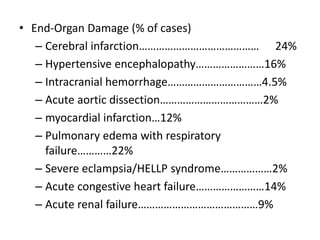
• End-Organ Damage (% of cases)
– Cerebral infarction…………………………………… 24%
– Hypertensive encephalopathy……………………16%
– Intracranial hemorrhage……………………………4.5%
– Acute aortic dissection………………………………2%
– myocardial infarction…12%
– Pulmonary edema with respiratory
failure…………22%
– Severe eclampsia/HELLP syndrome………………2%
– Acute congestive heart failure……………………14%
– Acute renal failure……………………………………9%
Pathophysiology
• Hypertensive Emergency
– Failure of normal autoregulatory function
– Leads to a sharp increase in systemic vascular
resistance
– Endovascular injury with arteriole necrosis
– Ischemia, platelet deposition and release of
vasoactive substances
– Further loss of autoregulatory mechanism
– Exposes organs to increased pressure
Clinical feature
• hypertensive emergency is a critically ill patient who
presents with a blood pressure above 220/140 mm
Hg,
• headaches,
• confusion,
• blurred vision,
• nausea and vomiting,
• seizures,
• pulmonary
edema,
• oliguria and
• grade 3 or grade 4 hypertensive retinopathy
Diagnosis and Recognition
• Presentation
– Always present with a new onset symptom
• Take a good history
– History of HTN and previous control
– Medications with dosage and compliance
– Illicit drug use, OTC drugs
Diagnosis and Recognition
• Physical
– Confirm BP in more than one extremity
– Ensure appropriate cuff size
– Pulses in all extremities
– Lungs examination—look for pulmonary edema
– Cardiac—murmurs or gallops, angina, EKG
– Renal—renal artery bruit, hematuria
– Neurologic—focal deficits, HA, altered MS
– Fundoscopic exam—retinopathy, hemorrhage
Diagnosis and Recognition
• Laboratory/Radiologic evaluations
– BUN
– CBC with smear (hemolytic anemia)
– Urine (proteinuria, hematuria)
– S. creatinin
– ECG to look for ischemia
– CXR to look for pulmonary edema if dyspnea
– Head CT for evaluation of stroke
– MRI chest if unequal pulses and wide
mediastinum to look for aortic dissection
Treatment
• Hypertensive Emergency
– Goal: Lower DBP by 10-15% in 30-60 min
– controlled reduction to a level of about 150/90 mmHg
over a period of 24–48 hours is ideal
– Initiate oral therapy and IV medications down
• Intravenous or intramuscular labetalol (2 mg/min to a
maximum of 200 mg),
• intravenous glyceryl trinitrate (0.6–1.2 mg/hr),
• intramuscular hydralazine (5 or 10 mg aliquots repeated at
half hourly intervals)
• intravenous sodium nitroprusside (0.3–1.0 µg/kg body
weight/min)
Medications
• Preferred agents by end organ damage
– Pulmonary Edema (systolic)—Nicardipine
– Pulmonary Edema (diastolic)—Esmolol
– Myocardial ischemia and infarction
Nicardipine plus esmolol
Nitroglycerin plus labetalol
Nitroglycerin plus esmolol
– Hypertensive Encephalopathy—Labetolol
– Acute Aortic Dissection—Labetolol
– Eclampsia—Labetolol or Nicardipine
– Acute kidney injury
Fenoldopam
Nicardipine
– Sympathetic Crisis/Cocaine—Verapamil or Diltiazem
References
• Davidson’s principles and practice of medicine
• Kumar & Clark's Clinical Medicine, 7th Edition
• Goldman's Cecil Medicine, 24th
• CURRENT Medical Diagnosis and Treatment
2015
• www.wekipidea.com
• Flanigan, J. and Vitberg, D. “Hypertensive Emergency and
Severe Hypertension: What to Treat, Who to Treat, and
How to Treat.” The Medical Clinics of North America. Vol
90 (2006) pp. 439-451.

Hypertensive Encephalopathy and Emergencies

  • 1.
  • 2.
    DR.MD.SAZZAD HOSSAIN SAJAL INTERNDOCTOR MEDICINE DEPARTMENT TMMC&H
  • 3.
  • 4.
    HYPERTENSIVE ENCEPHALOPATHY • Definition:- •Hypertensive encephalopathy is a rare condition characterized by high BP and neurological symptoms, including transient disturbances of speech or vision, paraesthesiae, disorientation, fits ,loss of consciousness and papilloedema.
  • 5.
    • Hypertensive encephalopathyis a neurological dysfunction induced by malignant hypertension. • Malignant hypertension is commonly defined as sustained, elevated arterial blood pressure, with diastolic levels of 130 mm Hg or greater and systolic pressure in excess of 200 mm Hg. (cecil)
  • 6.
    Historical note andterminology The term “hypertensive encephalopathy” was introduced by Oppenheimer and Fishberg (Oppenheimer and Fishberg 1928). They described essential clinical characteristics of acute malignant hypertension. Ten years prior, Volhard was the first to separate clearly acute hypertension-induced neurologic dysfunction from a uremic state and introduced the term “pseudouremia” to refer to hypertensive encephalopathy (Volhard 1918).
  • 7.
    PATHOGENESIS:- • The pathogenesisof hypertensive encephalopathy remains unclear. • Pathologic findings include purpura in the brain, retinal hemorrhages, papilledema,and fibrinoid arteriolar lesions of the glomeruli. • Diffuse fibrinoid necrosis and thrombotic occlusion of arterioles cause micro infarctions and petechial hemorrhages, and these changes lead to distal ischemia. • Ring hemorrhage around a thrombosed precapillary is the characteristic microscopic lesion of hypertensive encephalopathy. Multiple, compacted petechiae can resemble a hematoma.
  • 8.
    HTN Encephalopathy • Symptoms –Severe headache – Nausea and vomiting – Visual disturbances – Confusion – focal or generalized weakness - irritability and altered mental status due to cerebrovascular spasm • Signs – Disorientation – Focal neurologic defects – Focal or generalized seizures – nystagmus
  • 9.
    Investigations:- • CT scanof the brain often shows haemorrhage in and around the basal ganglia; however, the neurological deficit is usually reversible if the hypertension is properly controlled. • Urine for blood, protein and glucose • Blood urea, electrolytes and creatinine • Blood glucose • Serum total and HDL cholesterol • Thyroid function tests • 12-lead ECG (left ventricular hypertrophy, coronary artery disease)
  • 10.
    Diagnosis:- • Differential diagnosisof hypertensive encephalopathy include hemorrhagic and ischemic strokes. Focal neurologic signs predominate in these other conditions, whereas mental status changes are characteristic of hypertensive encephalopathy. • In increased intracranial pressure from obstructive hydrocephalus ,brain tumor or subdural hematoma can elevate blood pressure and slow the pulse, but encephalopathy and markedly elevated blood pressure are absent
  • 11.
    Treatment:- • Lowering BPtoo quickly may compromise tissue perfusion and can cause cerebral damage, including occipital blindness, and precipitate coronary or renal insufficiency. • In hypertensive encephalopathy, a controlled reduction to a level of about 150/90 mmHg over a period of 24–48 hours • Oral Therapy:- sublingual captopril can substantially lower the BP within 10 to 30 minutes in many patients
  • 12.
    • Parenteral therapy:- must be given under careful supervision and in a high dependency unit- • Intravenous or intramuscular labetalol (2 mg/min to a maximum of 200 mg), • intravenous glyceryl trinitrate (0.6–1.2 mg/hr), • intramuscular hydralazine (5 or 10 mg repeated at half hourly intervals) • intravenous sodium nitroprusside (0.3–1.0 µg/kg body weight/min)
  • 13.
    Control of fitsand Seizures:- • Seizures Can usually be stopped with intravenous diazepam (10 mg); in eclamptic patients fosphenytoin (15 to 20 mg phenytoin equivalent per kilogram intravenously)
  • 14.
    • It isimportant to remember that rarely hypertensive encephalopathy may present with primary brainstem edema with or without occipital involvement. This so-called “brainstem hypertensive encephalopathy” may not respond to simple blood pressure lowering, and surgical intervention may be life- saving.
  • 15.
    • Prognosis:- • Patientswith hypertensive encephalopathy who are promptly treated usually recover without deficit. However, if treatment is not administered, the condition can lead to death.
  • 16.
    • Hypertensive Emergency –Hypertensive emergencies are acute, often severe, elevations in blood pressure, accompanied by rapidly progressive target organ dysfunction, such as myocardial or cerebral ischemia or infarction, pulmonary edema, or renal failure. – BP should be controlled within hours and requires admission to a critical care setting
  • 17.
    • End-Organ Damage(% of cases) – Cerebral infarction…………………………………… 24% – Hypertensive encephalopathy……………………16% – Intracranial hemorrhage……………………………4.5% – Acute aortic dissection………………………………2% – myocardial infarction…12% – Pulmonary edema with respiratory failure…………22% – Severe eclampsia/HELLP syndrome………………2% – Acute congestive heart failure……………………14% – Acute renal failure……………………………………9%
  • 18.
    Pathophysiology • Hypertensive Emergency –Failure of normal autoregulatory function – Leads to a sharp increase in systemic vascular resistance – Endovascular injury with arteriole necrosis – Ischemia, platelet deposition and release of vasoactive substances – Further loss of autoregulatory mechanism – Exposes organs to increased pressure
  • 19.
    Clinical feature • hypertensiveemergency is a critically ill patient who presents with a blood pressure above 220/140 mm Hg, • headaches, • confusion, • blurred vision, • nausea and vomiting, • seizures, • pulmonary edema, • oliguria and • grade 3 or grade 4 hypertensive retinopathy
  • 20.
    Diagnosis and Recognition •Presentation – Always present with a new onset symptom • Take a good history – History of HTN and previous control – Medications with dosage and compliance – Illicit drug use, OTC drugs
  • 21.
    Diagnosis and Recognition •Physical – Confirm BP in more than one extremity – Ensure appropriate cuff size – Pulses in all extremities – Lungs examination—look for pulmonary edema – Cardiac—murmurs or gallops, angina, EKG – Renal—renal artery bruit, hematuria – Neurologic—focal deficits, HA, altered MS – Fundoscopic exam—retinopathy, hemorrhage
  • 22.
    Diagnosis and Recognition •Laboratory/Radiologic evaluations – BUN – CBC with smear (hemolytic anemia) – Urine (proteinuria, hematuria) – S. creatinin – ECG to look for ischemia – CXR to look for pulmonary edema if dyspnea – Head CT for evaluation of stroke – MRI chest if unequal pulses and wide mediastinum to look for aortic dissection
  • 23.
    Treatment • Hypertensive Emergency –Goal: Lower DBP by 10-15% in 30-60 min – controlled reduction to a level of about 150/90 mmHg over a period of 24–48 hours is ideal – Initiate oral therapy and IV medications down • Intravenous or intramuscular labetalol (2 mg/min to a maximum of 200 mg), • intravenous glyceryl trinitrate (0.6–1.2 mg/hr), • intramuscular hydralazine (5 or 10 mg aliquots repeated at half hourly intervals) • intravenous sodium nitroprusside (0.3–1.0 µg/kg body weight/min)
  • 24.
    Medications • Preferred agentsby end organ damage – Pulmonary Edema (systolic)—Nicardipine – Pulmonary Edema (diastolic)—Esmolol – Myocardial ischemia and infarction Nicardipine plus esmolol Nitroglycerin plus labetalol Nitroglycerin plus esmolol – Hypertensive Encephalopathy—Labetolol – Acute Aortic Dissection—Labetolol – Eclampsia—Labetolol or Nicardipine – Acute kidney injury Fenoldopam Nicardipine – Sympathetic Crisis/Cocaine—Verapamil or Diltiazem
  • 25.
    References • Davidson’s principlesand practice of medicine • Kumar & Clark's Clinical Medicine, 7th Edition • Goldman's Cecil Medicine, 24th • CURRENT Medical Diagnosis and Treatment 2015 • www.wekipidea.com • Flanigan, J. and Vitberg, D. “Hypertensive Emergency and Severe Hypertension: What to Treat, Who to Treat, and How to Treat.” The Medical Clinics of North America. Vol 90 (2006) pp. 439-451.