

Dr. Hamed Ezzat El-Eraky
Nephrology Specialist
Mansoura International Hospital
Hematuria
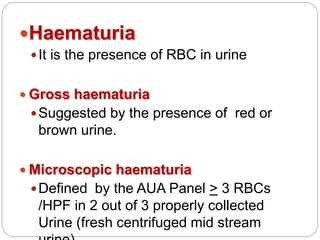
Haematuria
It is the presence of RBC in urine
 Gross haematuria
Suggested by the presence of red or
brown urine.
 Microscopic haematuria
Defined by the AUA Panel > 3 RBCs
/HPF in 2 out of 3 properly collected
Urine (fresh centrifuged mid stream
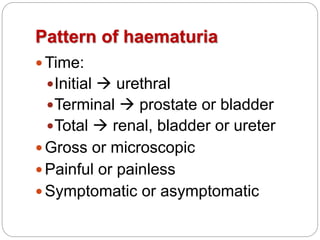
Pattern of haematuria
 Time:
Initial  urethral
Terminal  prostate or bladder
Total  renal, bladder or ureter
 Gross or microscopic
 Painful or painless
 Symptomatic or asymptomatic
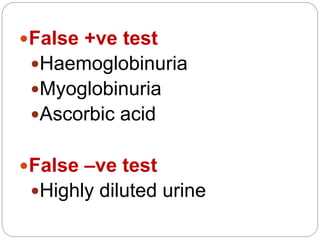
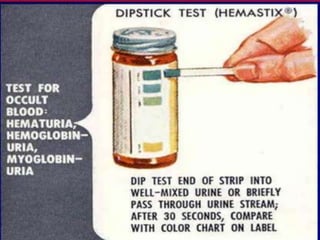
False +ve test
Haemoglobinuria
Myoglobinuria
Ascorbic acid
False –ve test
Highly diluted urine
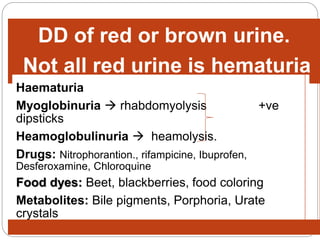
DD of red or brown urine.
Not all red urine is hematuria
Haematuria
Myoglobinuria  rhabdomyolysis +ve
dipsticks
Heamoglobulinuria  heamolysis.
Drugs: Nitrophorantion., rifampicine, Ibuprofen,
Desferoxamine, Chloroquine
Food dyes: Beet, blackberries, food coloring
Metabolites: Bile pigments, Porphoria, Urate
crystals
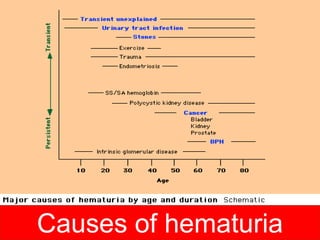
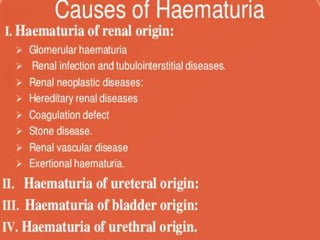
Causes of hematuria
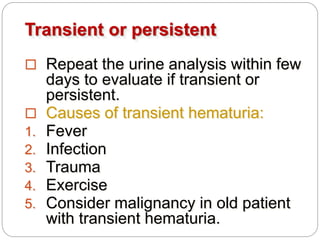
Transient or persistent
 Repeat the urine analysis within few
days to evaluate if transient or
persistent.
 Causes of transient hematuria:
1. Fever
2. Infection
3. Trauma
4. Exercise
5. Consider malignancy in old patient
with transient hematuria.
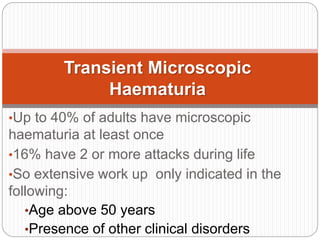
•Up to 40% of adults have microscopic
haematuria at least once
•16% have 2 or more attacks during life
•So extensive work up only indicated in the
following:
•Age above 50 years
•Presence of other clinical disorders
Transient Microscopic
Haematuria
Exercise induced hematuria:
 Microscopic or gross hematuria can occur
after exercise.
 It is common after football, boxing, direct
trauma to the kidney and long distance
running.
 DD of exercise induced gross hematuria is
march hemoglobulinuria, myoglobulinuria
due to rhabdomyolysis.
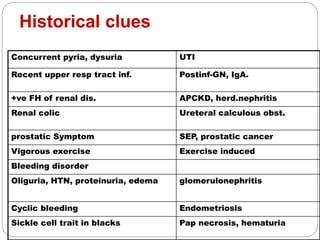
Historical clues
Concurrent pyria, dysuria UTI
Recent upper resp tract inf. Postinf-GN, IgA.
+ve FH of renal dis. APCKD, herd.nephritis
Renal colic Ureteral calculous obst.
prostatic Symptom SEP, prostatic cancer
Vigorous exercise Exercise induced
Bleeding disorder
Oliguria, HTN, proteinuria, edema glomerulonephritis
Cyclic bleeding Endometriosis
Sickle cell trait in blacks Pap necrosis, hematuria
Unexplained hematuria
 The term unexplained hematuria is
defined if no diagnosis from history,
urinalysis, radiologic tests or
cystoscopy.
Causes of unexplained
hematuria
 Mild GN: mostly IgA, thin BM dis.
 Predisposition to stone as hypercalciuria,
hyperurecosuria.
 A-V malformation and fistula.
 Loin pain hematuria syndrome.
 Undiagnosed carcinoma of UT.
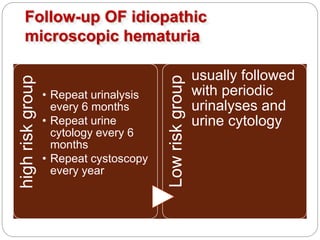
Follow-up OF idiopathic
microscopic hematuria
highriskgroup
• Repeat urinalysis
every 6 months
• Repeat urine
cytology every 6
months
• Repeat cystoscopy
every year
Lowriskgroup
usually followed
with periodic
urinalyses and
urine cytology
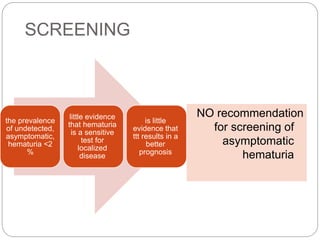
SCREENING
NO recommendation
for screening of
asymptomatic
hematuria
the prevalence
of undetected,
asymptomatic,
hematuria <2
%
little evidence
that hematuria
is a sensitive
test for
localized
disease
is little
evidence that
ttt results in a
better
prognosis
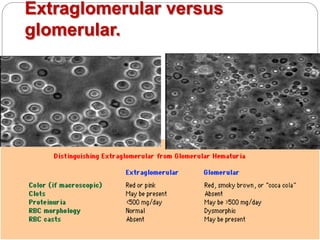
Extraglomerular versus
glomerular.
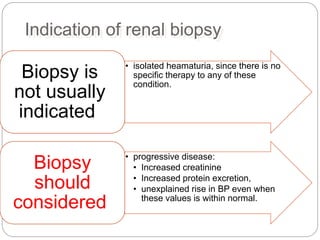
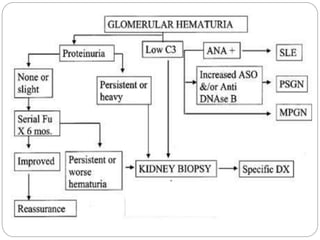
Indication of renal biopsy
• isolated heamaturia, since there is no
specific therapy to any of these
condition.
Biopsy is
not usually
indicated
• progressive disease:
• Increased creatinine
• Increased protein excretion,
• unexplained rise in BP even when
these values is within normal.
Biopsy
should
considered
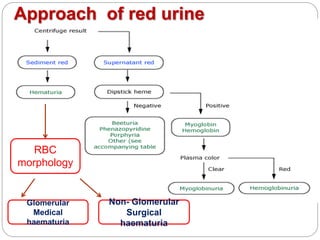
Approach of red urine
RBC
morphology
Non- Glomerular
Surgical
haematuria
Glomerular
Medical
haematuria
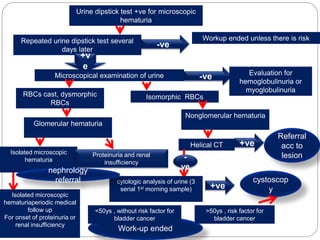
Work-up ended
Urine dipstick test +ve for microscopic
hematuria
Repeated urine dipstick test several
days later
Workup ended unless there is risk
factors-ve
+v
e
Microscopical examination of urine -ve Evaluation for
hemoglobulinuria or
myoglobulinuria
RBCs cast, dysmorphic
RBCs
Isomorphic RBCs
Glomerular hematuria
Nonglomerular hematuria
Isolated microscopic
hematuria
Isolated microscopic
hematuriaperiodic medical
follow up
For onset of proteinuria or
renal insufficiency
Proteinuria and renal
insufficiency
Helical CT +ve
Referral
acc to
lesion-
ve
cytologic analysis of urine (3
serial 1st morning sample) +ve
cystoscop
y
nephrology
referral
>50ys , risk factor for
bladder cancer
<50ys , without risk factor for
bladder cancer
Hamaturiad haned
Hamaturiad haned
Hamaturiad haned

Hamaturiad haned

  • 1.
    Dr. Hamed EzzatEl-Eraky Nephrology Specialist Mansoura International Hospital Hematuria
  • 2.
    Haematuria It is thepresence of RBC in urine  Gross haematuria Suggested by the presence of red or brown urine.  Microscopic haematuria Defined by the AUA Panel > 3 RBCs /HPF in 2 out of 3 properly collected Urine (fresh centrifuged mid stream
  • 3.
    Pattern of haematuria Time: Initial  urethral Terminal  prostate or bladder Total  renal, bladder or ureter  Gross or microscopic  Painful or painless  Symptomatic or asymptomatic
  • 4.
    False +ve test Haemoglobinuria Myoglobinuria Ascorbicacid False –ve test Highly diluted urine
  • 5.
    DD of redor brown urine. Not all red urine is hematuria Haematuria Myoglobinuria  rhabdomyolysis +ve dipsticks Heamoglobulinuria  heamolysis. Drugs: Nitrophorantion., rifampicine, Ibuprofen, Desferoxamine, Chloroquine Food dyes: Beet, blackberries, food coloring Metabolites: Bile pigments, Porphoria, Urate crystals
  • 7.
  • 12.
    Transient or persistent Repeat the urine analysis within few days to evaluate if transient or persistent.  Causes of transient hematuria: 1. Fever 2. Infection 3. Trauma 4. Exercise 5. Consider malignancy in old patient with transient hematuria.
  • 13.
    •Up to 40%of adults have microscopic haematuria at least once •16% have 2 or more attacks during life •So extensive work up only indicated in the following: •Age above 50 years •Presence of other clinical disorders Transient Microscopic Haematuria
  • 14.
    Exercise induced hematuria: Microscopic or gross hematuria can occur after exercise.  It is common after football, boxing, direct trauma to the kidney and long distance running.  DD of exercise induced gross hematuria is march hemoglobulinuria, myoglobulinuria due to rhabdomyolysis.
  • 15.
    Historical clues Concurrent pyria,dysuria UTI Recent upper resp tract inf. Postinf-GN, IgA. +ve FH of renal dis. APCKD, herd.nephritis Renal colic Ureteral calculous obst. prostatic Symptom SEP, prostatic cancer Vigorous exercise Exercise induced Bleeding disorder Oliguria, HTN, proteinuria, edema glomerulonephritis Cyclic bleeding Endometriosis Sickle cell trait in blacks Pap necrosis, hematuria
  • 16.
    Unexplained hematuria  Theterm unexplained hematuria is defined if no diagnosis from history, urinalysis, radiologic tests or cystoscopy.
  • 17.
    Causes of unexplained hematuria Mild GN: mostly IgA, thin BM dis.  Predisposition to stone as hypercalciuria, hyperurecosuria.  A-V malformation and fistula.  Loin pain hematuria syndrome.  Undiagnosed carcinoma of UT.
  • 18.
    Follow-up OF idiopathic microscopichematuria highriskgroup • Repeat urinalysis every 6 months • Repeat urine cytology every 6 months • Repeat cystoscopy every year Lowriskgroup usually followed with periodic urinalyses and urine cytology
  • 19.
    SCREENING NO recommendation for screeningof asymptomatic hematuria the prevalence of undetected, asymptomatic, hematuria <2 % little evidence that hematuria is a sensitive test for localized disease is little evidence that ttt results in a better prognosis
  • 20.
  • 21.
    Indication of renalbiopsy • isolated heamaturia, since there is no specific therapy to any of these condition. Biopsy is not usually indicated • progressive disease: • Increased creatinine • Increased protein excretion, • unexplained rise in BP even when these values is within normal. Biopsy should considered
  • 22.
    Approach of redurine RBC morphology Non- Glomerular Surgical haematuria Glomerular Medical haematuria
  • 23.
    Work-up ended Urine dipsticktest +ve for microscopic hematuria Repeated urine dipstick test several days later Workup ended unless there is risk factors-ve +v e Microscopical examination of urine -ve Evaluation for hemoglobulinuria or myoglobulinuria RBCs cast, dysmorphic RBCs Isomorphic RBCs Glomerular hematuria Nonglomerular hematuria Isolated microscopic hematuria Isolated microscopic hematuriaperiodic medical follow up For onset of proteinuria or renal insufficiency Proteinuria and renal insufficiency Helical CT +ve Referral acc to lesion- ve cytologic analysis of urine (3 serial 1st morning sample) +ve cystoscop y nephrology referral >50ys , risk factor for bladder cancer <50ys , without risk factor for bladder cancer