Chapter - five
Reliability and Maintainability
Reliability – ability to provide what was promised
Assurance – knowledge and courtesy of employees
and ability to convey trust
Tangibles – physical facilities and appearance of
personnel
Empathy – degree of caring and individual attention
Responsiveness – willingness to help customers and
provide prompt service
Cont.….
16-2
Key Dimensions of Quality
16-3
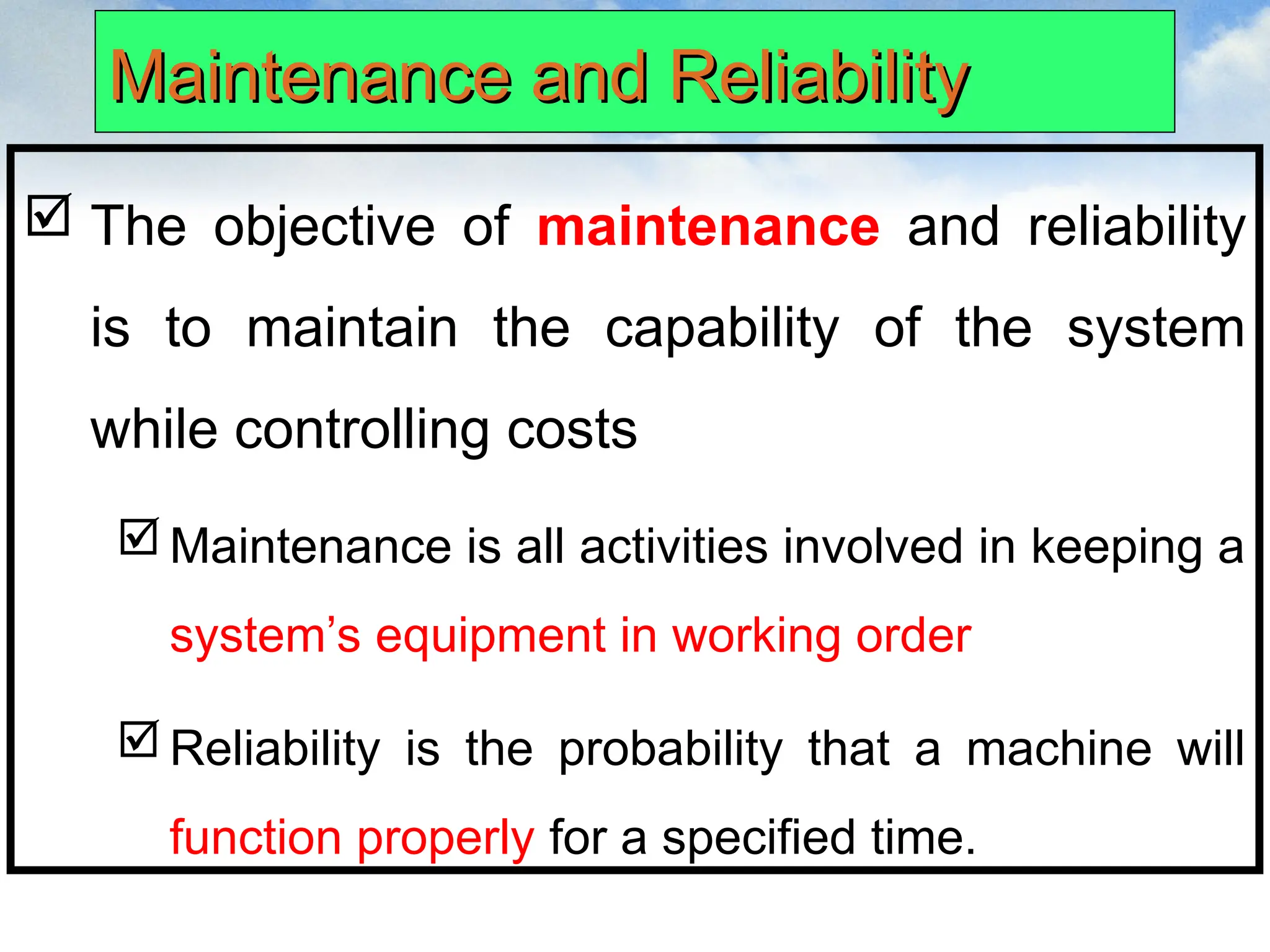
Maintenance and Reliability
 The objective of maintenance and reliability
is to maintain the capability of the system
while controlling costs
Maintenance is all activities involved in keeping a
system’s equipment in working order
Reliability is the probability that a machine will
function properly for a specified time.
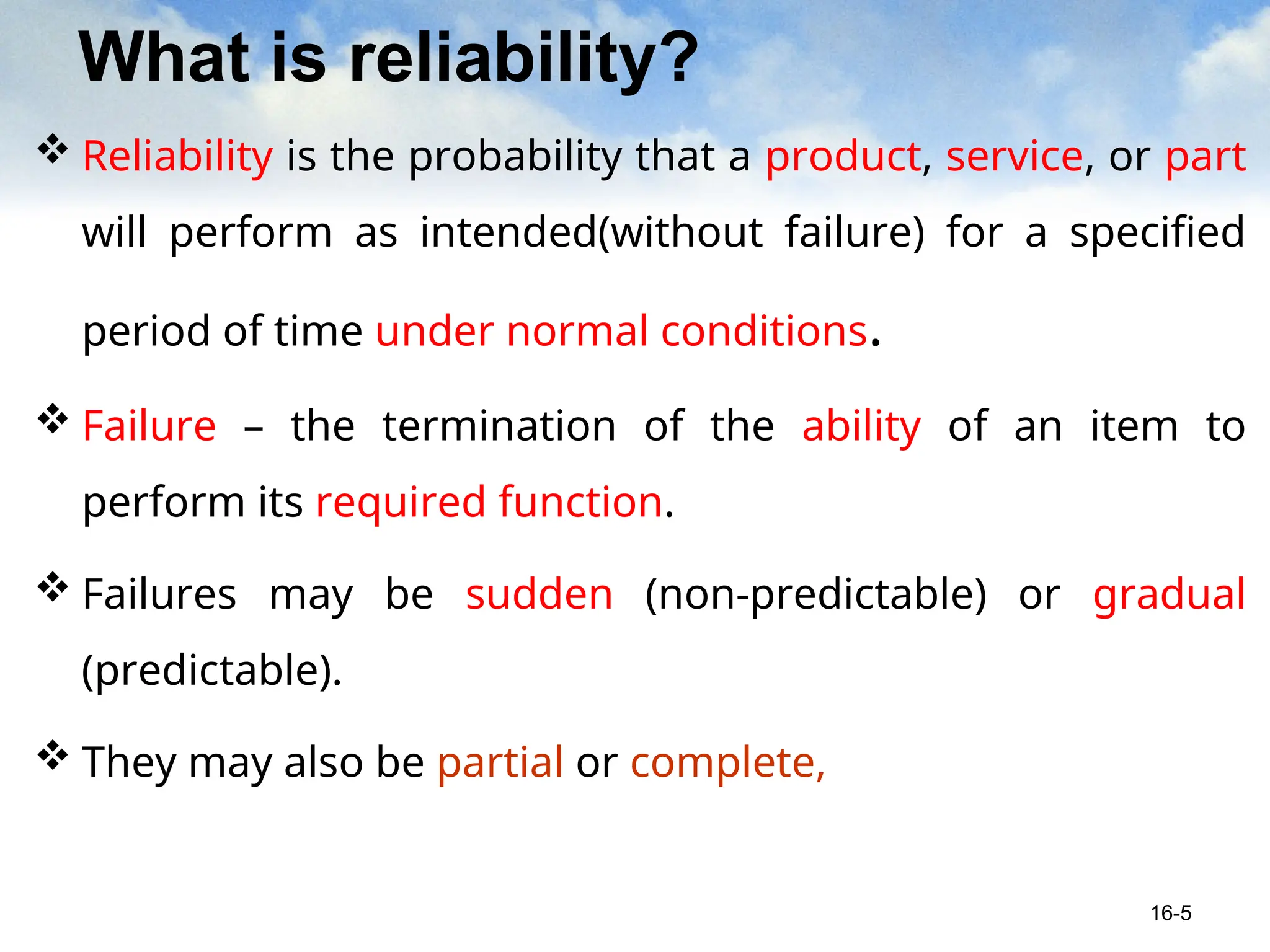
What is reliability?
 Reliability is the probability that a product, service, or part
will perform as intended(without failure) for a specified
period of time under normal conditions.
 Failure – the termination of the ability of an item to
perform its required function.
 Failures may be sudden (non-predictable) or gradual
(predictable).
 They may also be partial or complete,
16-5
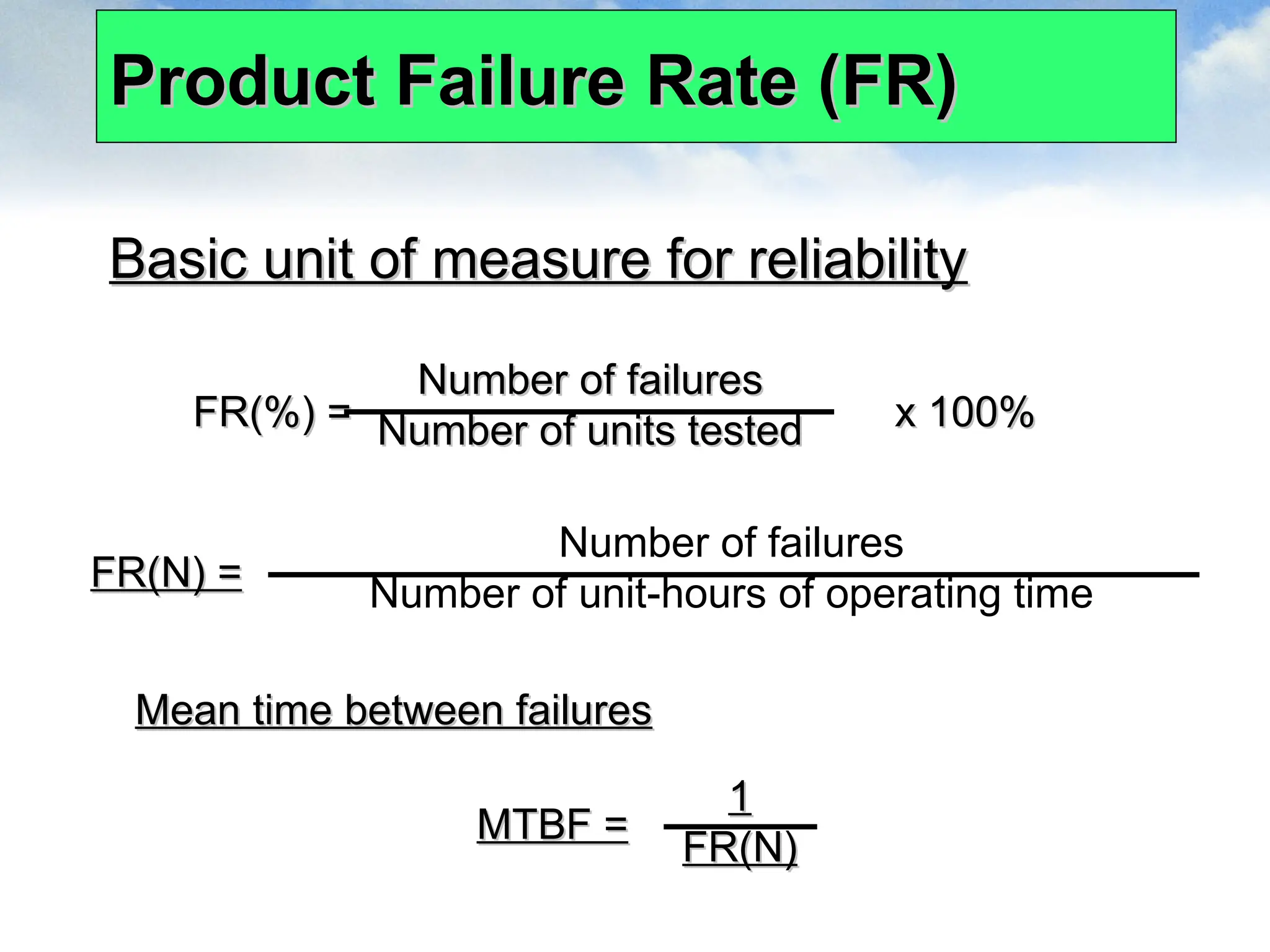
Product Failure Rate (FR)
Basic unit of measure for reliability
FR(%) = x 100%
FR(%) = x 100%
Number of failures
Number of failures
Number of units tested
FR(N) =
FR(N) =
Number of failures
Number of unit-hours of operating time
Mean time between failures
MTBF =
MTBF =
1
1
FR(N)
FR(N)
Failure Rate Example
20 air conditioning units designed for use in NASA
20 air conditioning units designed for use in NASA space
shuttles operated for 1,000 hours One failed after 200 hours and
one after 600 hours
one after 600 hours
FR(%) = (
FR(%) = (100%) = 10%
%) = 10%
2
2
20
20
FR(N) = = .000106 failure/unit hr.
2
2
20,000 - 1,200
MTBF = = 9,434 hrs.
1
.
.000106
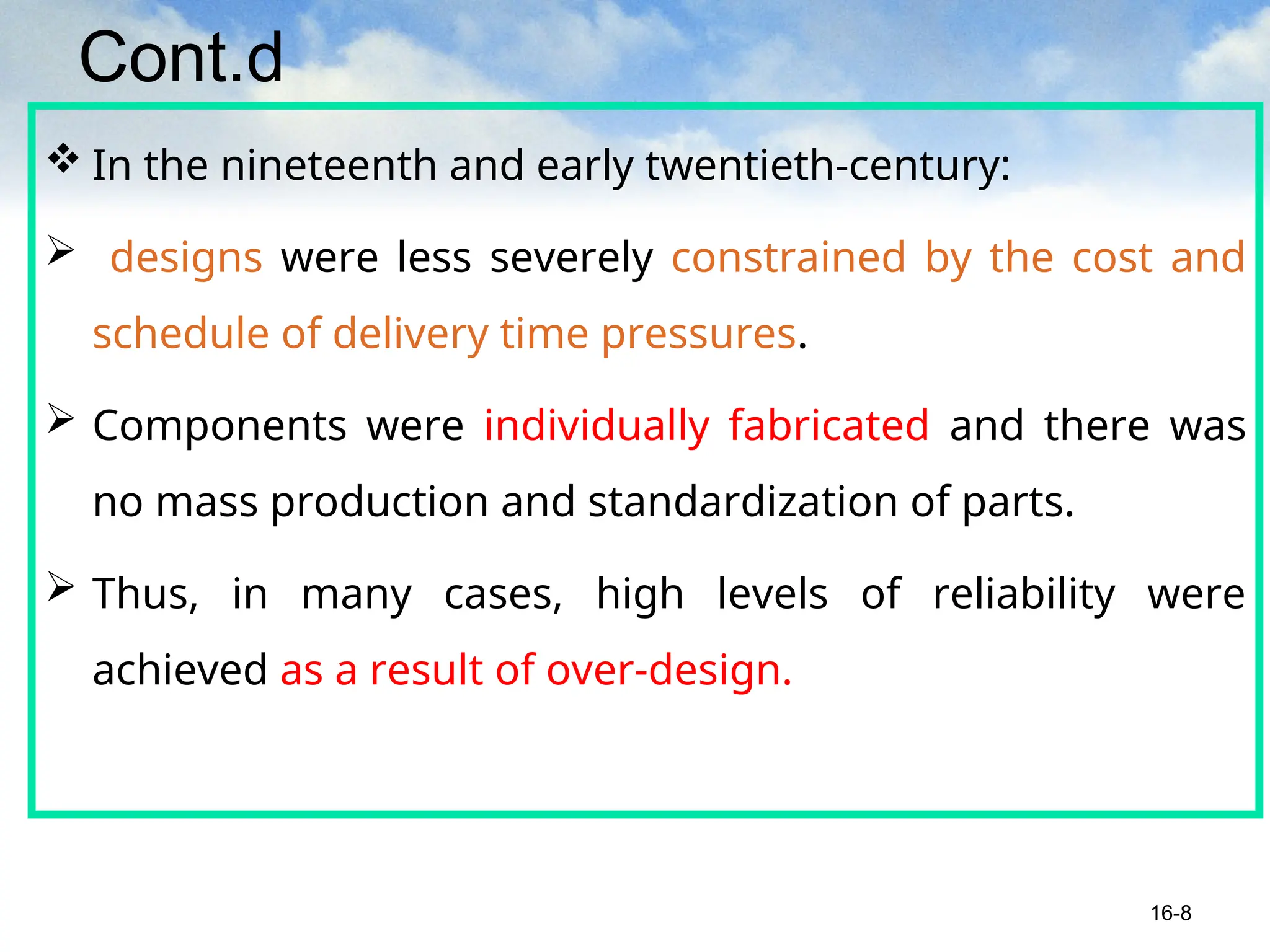
Cont.d
 In the nineteenth and early twentieth-century:
 designs were less severely constrained by the cost and
schedule of delivery time pressures.
 Components were individually fabricated and there was
no mass production and standardization of parts.
 Thus, in many cases, high levels of reliability were
achieved as a result of over-design.
16-8
Cont.
 Nowadays, modern technology has developed capacity to
design and manufacture equipment and systems of greater
capital cost, sophistication, complexity, and capacity.
• The consequences of low availability and high maintenance
cost of such systems led to the desire for:
high reliability,
high maintainability, and
low mean time to support (easily maintainable).
16-9
Cont.
• This can be achieved by considering the above points in
designing products to meet customer specifications.
 As it is difficult to give guarantee for a product with 100
percent certainty to function properly, reliability can only
be maximized.
• Hence, for customer-oriented companies attaining a high
reliability is an important part of quality and they should
build this into their product design
16-10
Cont.
• Reliability is a probability, a likelihood, or a chance.
• observed reliability is empirically defined as the ratio of
items which perform their function for the stated period to
the total number in the sample
• For example, a product with a 90 percent reliability has a
90 percent chance of functioning as intended. Or,
• the probability that the product will fail is 1 - .90 = .10, or
10 percent. This also means that 1 out of 10 products will
not function as expected.
16-11
Cont.
 The reliability of a product is a direct function of the reliability
of its component parts.
 The probability that a garment will perform as intended is,
therefore, a function of the reliabilities of its fabric, sewing
thread, buttons, zip and other parts.
 If all the parts in a product must work for the product to
function, then the reliability of the system is computed as the
product of the reliabilities of the individual components:
16-12
Cont.
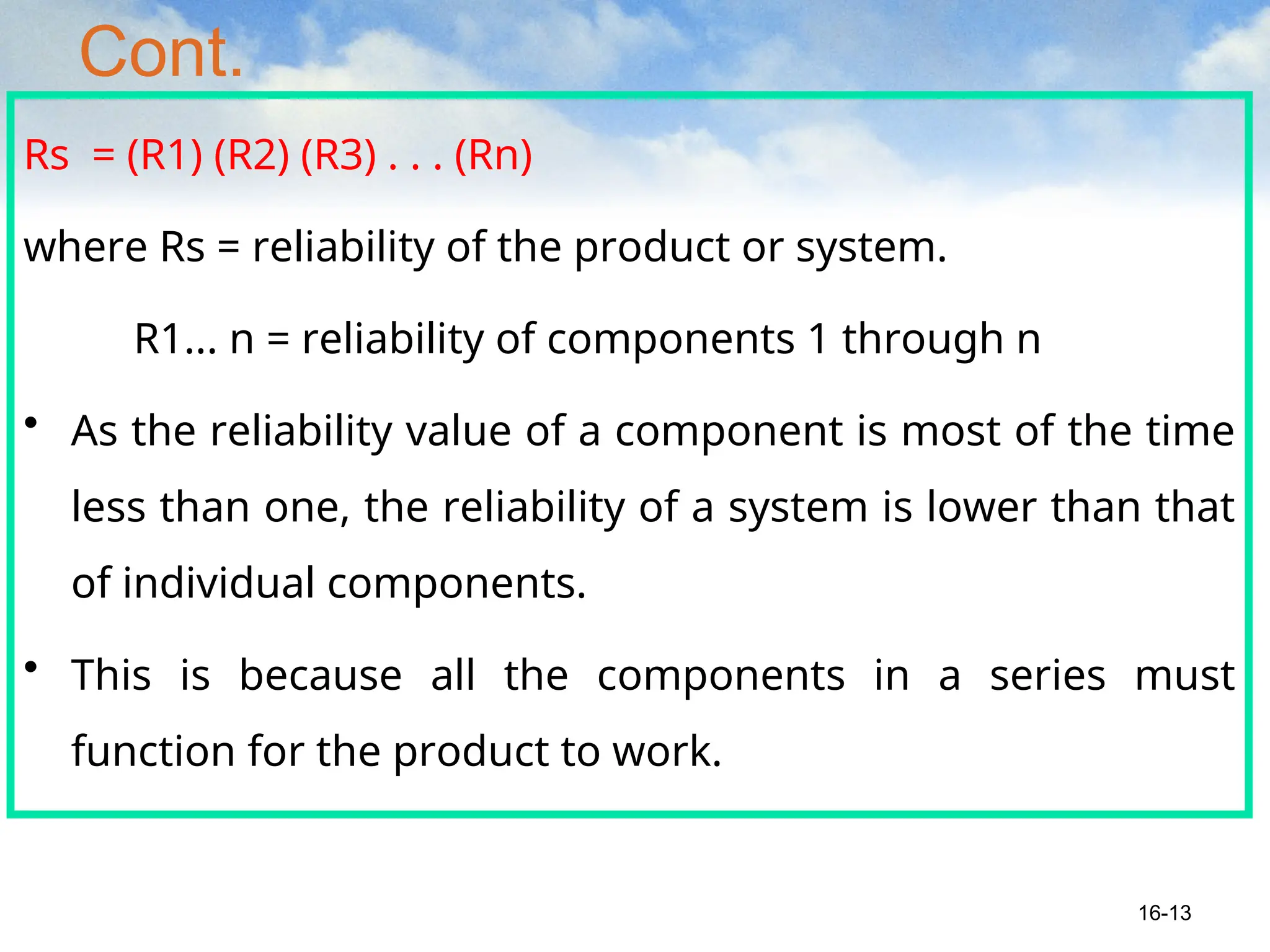
Rs = (R1) (R2) (R3) . . . (Rn)
where Rs = reliability of the product or system.
R1... n = reliability of components 1 through n
• As the reliability value of a component is most of the time
less than one, the reliability of a system is lower than that
of individual components.
• This is because all the components in a series must
function for the product to work.
16-13
Cont.
• If only one component doesn’t work, the entire product
doesn’t work.
• The more components a product has, the lower its
reliability.
• For example, a system with five components in series,
each with a reliability of .90, has a reliability of only (.90)
(.90)(.90)(.90)(.90) = 0.59.
16-14
Cont.
Rs = Reliability of 1st
Component + (Reliability of 2nd
Component * Probability of needing 2nd
Component)
Where: Probability of needing 2nd
Component =
probability of the 1st
component failing
16-15
Reliability can be increased by:
 Reducing Complexity: The fewer component parts and the
fewer types of material involved, the greater is the
likelihood of a reliable item.
• Modern equipment, so often condemned for its unreliability,
is frequently composed of thousands of component parts all
of which interact within various tolerances
 Duplication/replication: the use of additional, redundant,
parts
16-16
Cont.
• But it adds capital cost, weight, Spares, Space,
preventive maintenance and power consumption
 Excess strength: Deliberate design to withstand
stresses higher than are anticipated will reduce failure
rates.
• Again this also incurs additional costs
16-17
Quality and reliability
 Quality: conformance to specification
 Reliability: the probability of non-failure in a given period
 Maintainability: the probability that a failed item will be
restored to operational effectiveness within a given period
of time when the repair action is performed in accordance
with prescribed procedures.
 This, in turn, can be paraphrased as ‘The probability of
repair in a given time’.
16-18
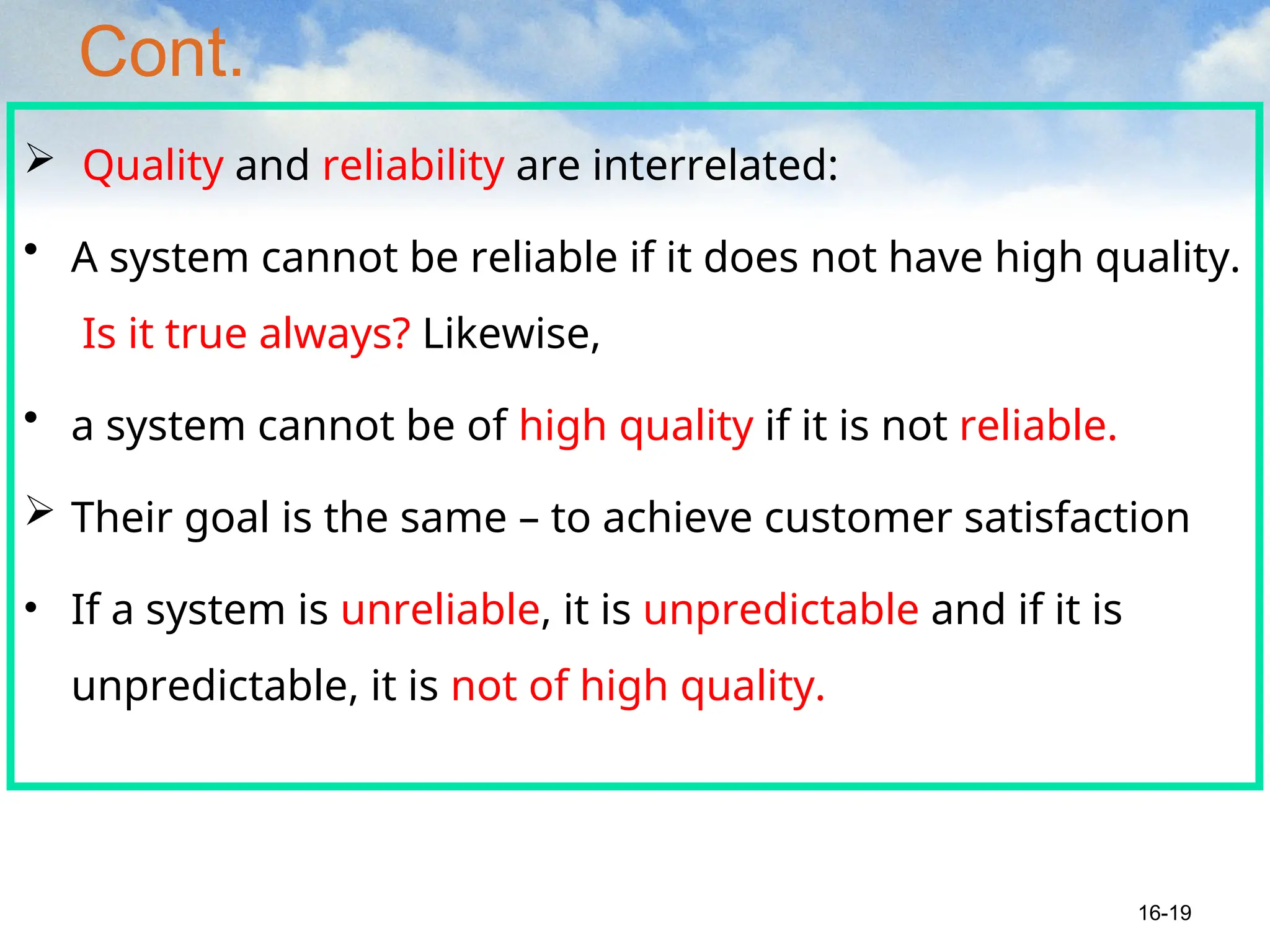
Cont.
 Quality and reliability are interrelated:
• A system cannot be reliable if it does not have high quality.
Is it true always? Likewise,
• a system cannot be of high quality if it is not reliable.
 Their goal is the same – to achieve customer satisfaction
• If a system is unreliable, it is unpredictable and if it is
unpredictable, it is not of high quality.
16-19
Factors affecting reliability
 customer's reliability requirements evolve over time and
are not static – has a dynamic nature.
 Reliability is influenced by the market environment partly
as a result of the introduction of new products with new
features by competitors and partly as a result of new
legislatures
 So reliability can be maximized by reducing complexity,
duplication (spare production) and allowing excess
strength in designing
16-20
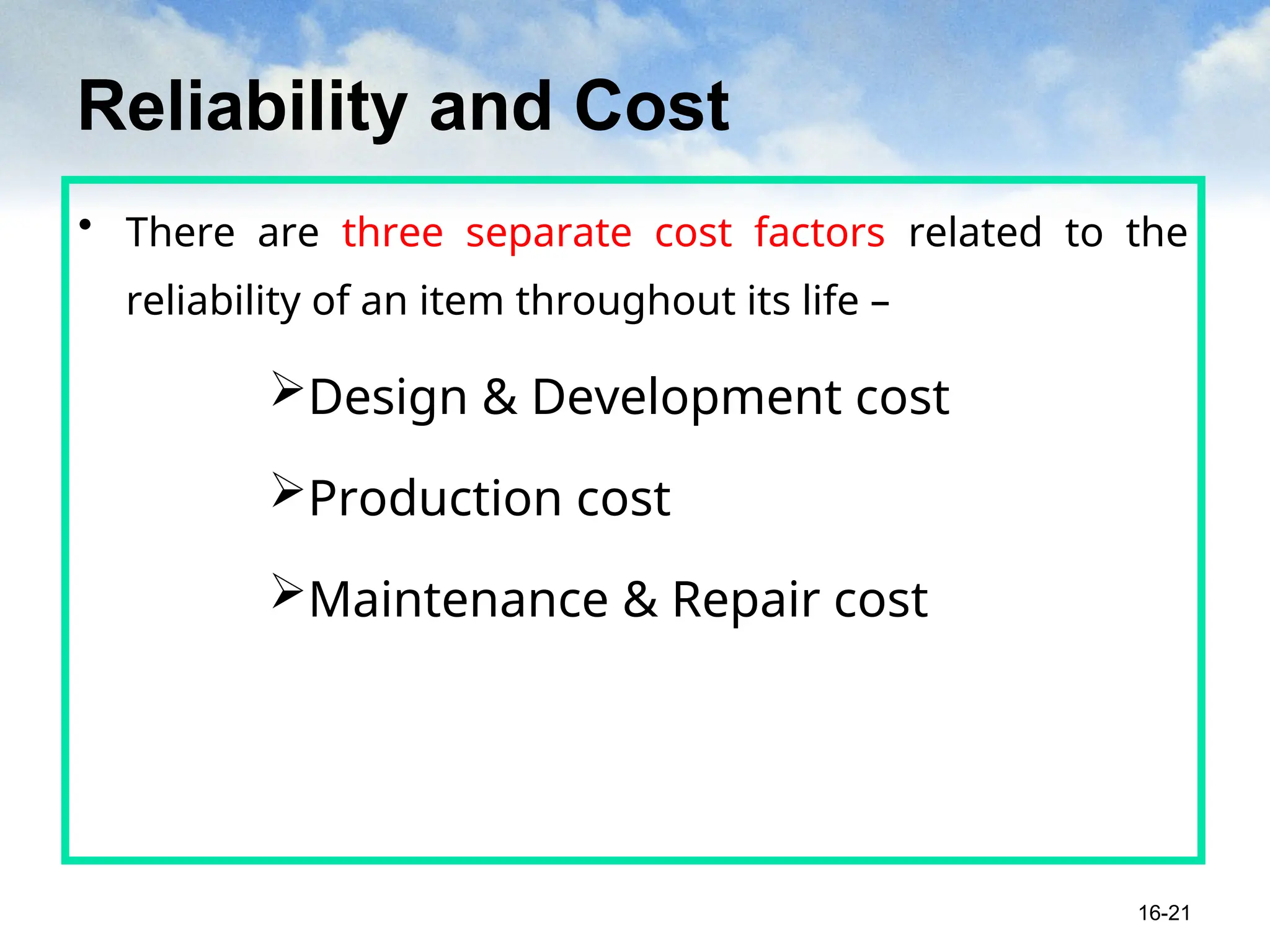
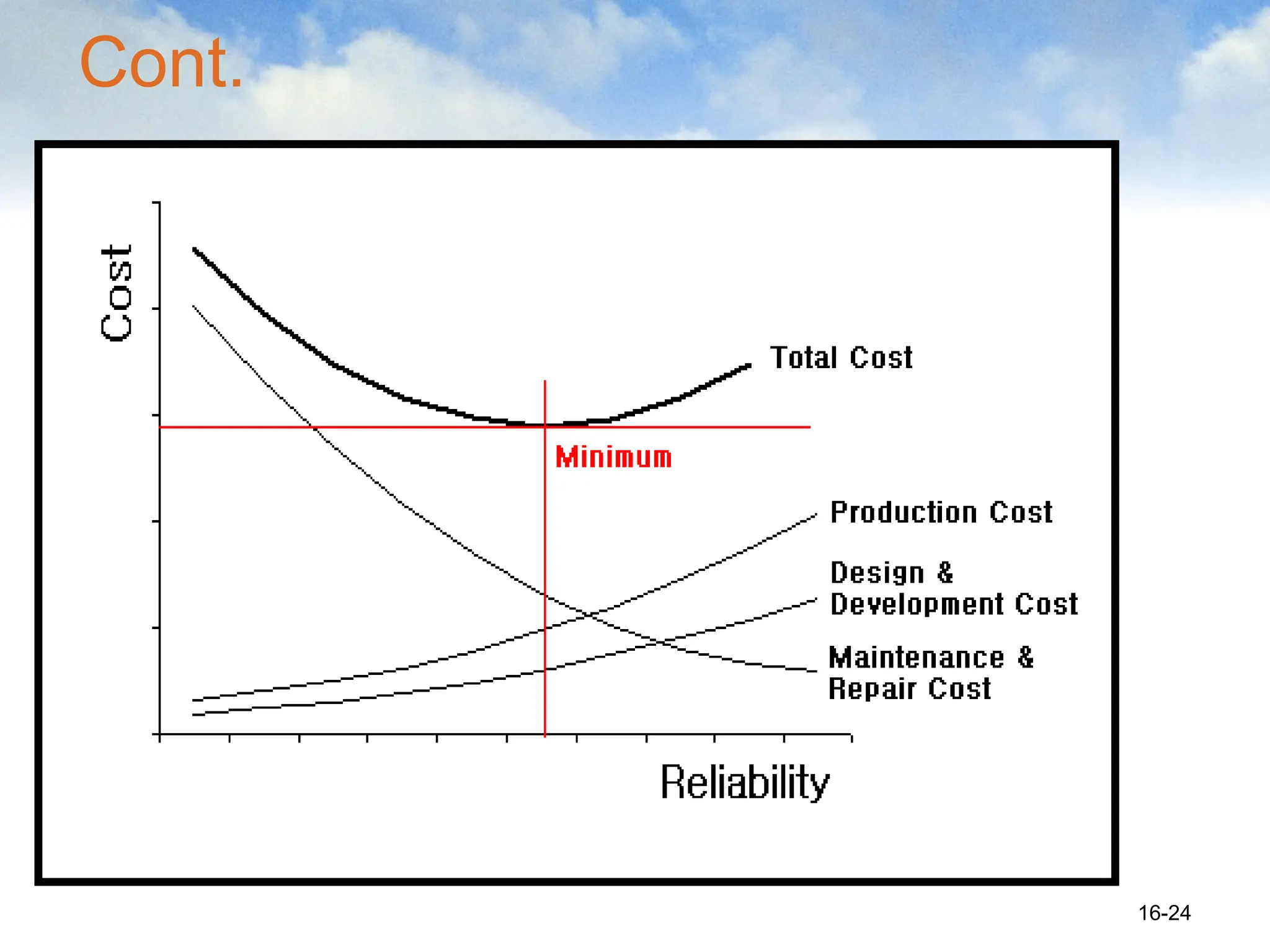
Reliability and Cost
• There are three separate cost factors related to the
reliability of an item throughout its life –
Design & Development cost
Production cost
Maintenance & Repair cost
16-21
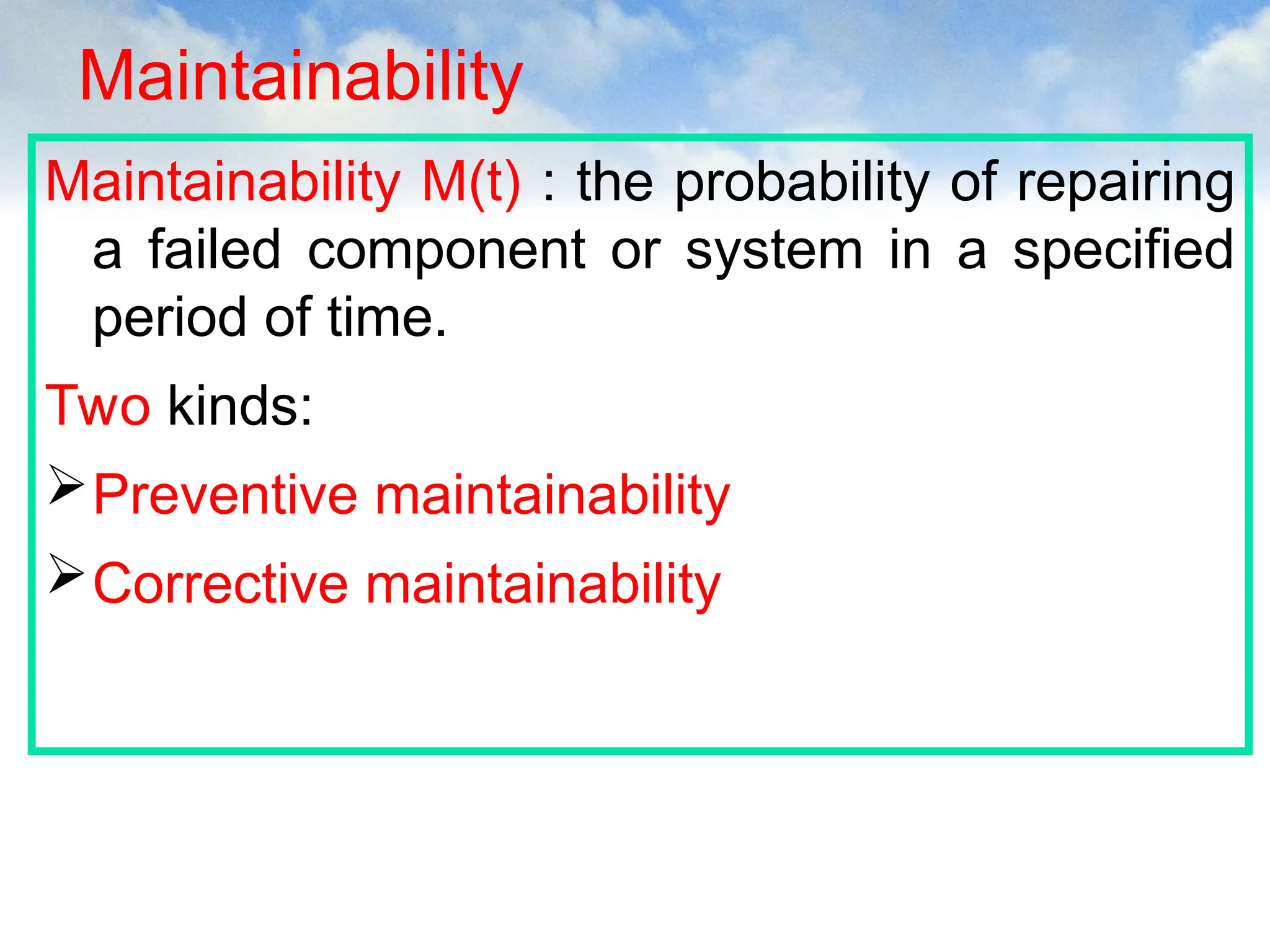
Maintainability
Maintainability M(t) : the probability of repairing
a failed component or system in a specified
period of time.
Two kinds:
Preventive maintainability
Corrective maintainability
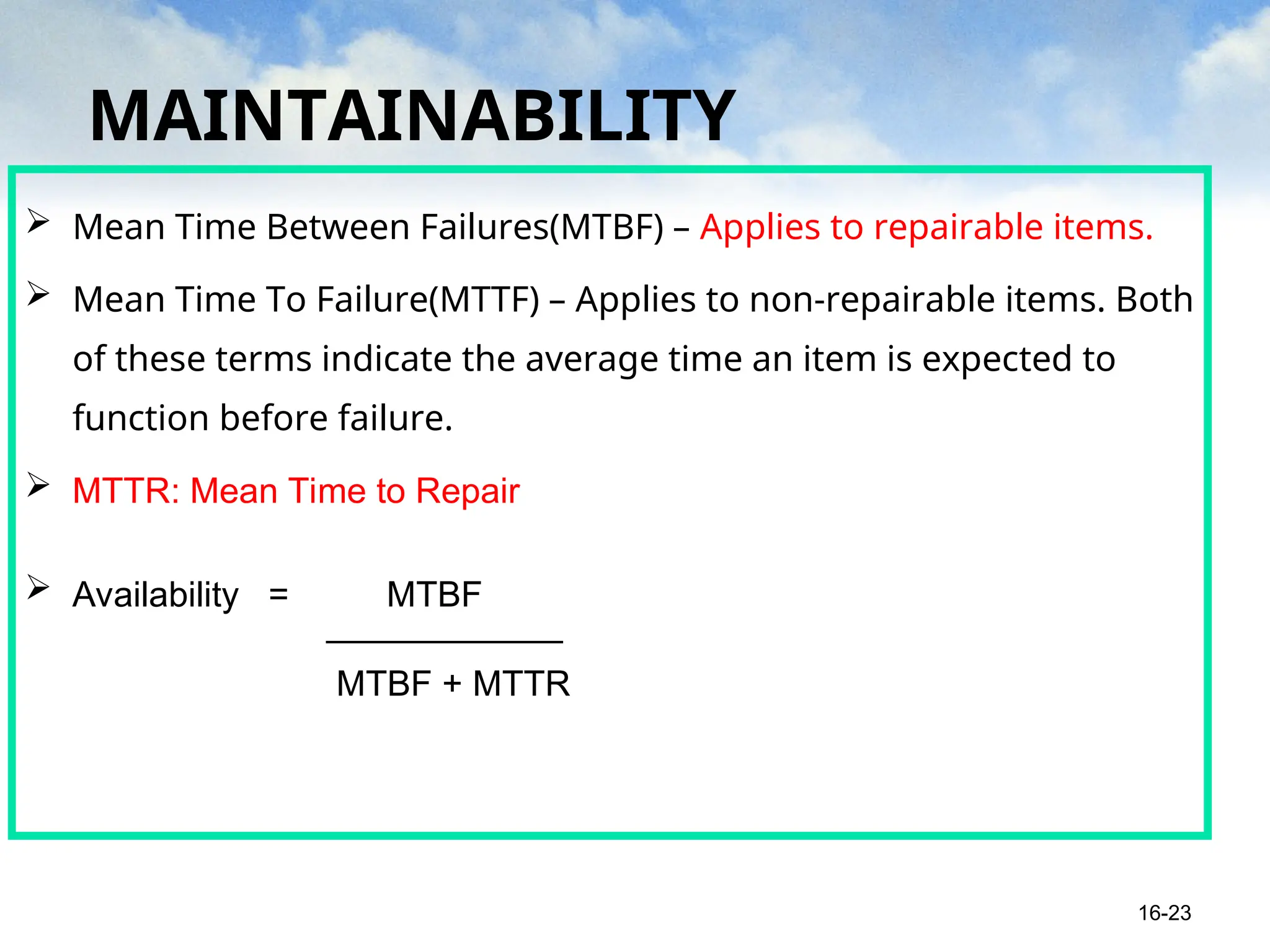
MAINTAINABILITY
 Mean Time Between Failures(MTBF) – Applies to repairable items.
 Mean Time To Failure(MTTF) – Applies to non-repairable items. Both
of these terms indicate the average time an item is expected to
function before failure.
 MTTR: Mean Time to Repair
 Availability = MTBF
____________
MTBF + MTTR
16-23
Cont.
16-24
Thank you!

QMC chapter five.ppt weave is durability

  • 1.
    Chapter - five Reliabilityand Maintainability
  • 2.
    Reliability – abilityto provide what was promised Assurance – knowledge and courtesy of employees and ability to convey trust Tangibles – physical facilities and appearance of personnel Empathy – degree of caring and individual attention Responsiveness – willingness to help customers and provide prompt service Cont.…. 16-2
  • 3.
    Key Dimensions ofQuality 16-3
  • 4.
    Maintenance and Reliability Maintenanceand Reliability  The objective of maintenance and reliability is to maintain the capability of the system while controlling costs Maintenance is all activities involved in keeping a system’s equipment in working order Reliability is the probability that a machine will function properly for a specified time.
  • 5.
    What is reliability? Reliability is the probability that a product, service, or part will perform as intended(without failure) for a specified period of time under normal conditions.  Failure – the termination of the ability of an item to perform its required function.  Failures may be sudden (non-predictable) or gradual (predictable).  They may also be partial or complete, 16-5
  • 6.
    Product Failure Rate(FR) Product Failure Rate (FR) Basic unit of measure for reliability Basic unit of measure for reliability FR(%) = x 100% FR(%) = x 100% Number of failures Number of failures Number of units tested Number of units tested FR(N) = FR(N) = Number of failures Number of unit-hours of operating time Mean time between failures Mean time between failures MTBF = MTBF = 1 1 FR(N) FR(N)
  • 7.
    Failure Rate Example FailureRate Example 20 air conditioning units designed for use in NASA 20 air conditioning units designed for use in NASA space shuttles operated for 1,000 hours One failed after 200 hours and shuttles operated for 1,000 hours One failed after 200 hours and one after 600 hours one after 600 hours FR(%) = ( FR(%) = (100%) = 10% %) = 10% 2 2 20 20 FR(N) = = .000106 failure/unit hr. 2 2 20,000 - 1,200 MTBF = = 9,434 hrs. 1 . .000106
  • 8.
    Cont.d  In thenineteenth and early twentieth-century:  designs were less severely constrained by the cost and schedule of delivery time pressures.  Components were individually fabricated and there was no mass production and standardization of parts.  Thus, in many cases, high levels of reliability were achieved as a result of over-design. 16-8
  • 9.
    Cont.  Nowadays, moderntechnology has developed capacity to design and manufacture equipment and systems of greater capital cost, sophistication, complexity, and capacity. • The consequences of low availability and high maintenance cost of such systems led to the desire for: high reliability, high maintainability, and low mean time to support (easily maintainable). 16-9
  • 10.
    Cont. • This canbe achieved by considering the above points in designing products to meet customer specifications.  As it is difficult to give guarantee for a product with 100 percent certainty to function properly, reliability can only be maximized. • Hence, for customer-oriented companies attaining a high reliability is an important part of quality and they should build this into their product design 16-10
  • 11.
    Cont. • Reliability isa probability, a likelihood, or a chance. • observed reliability is empirically defined as the ratio of items which perform their function for the stated period to the total number in the sample • For example, a product with a 90 percent reliability has a 90 percent chance of functioning as intended. Or, • the probability that the product will fail is 1 - .90 = .10, or 10 percent. This also means that 1 out of 10 products will not function as expected. 16-11
  • 12.
    Cont.  The reliabilityof a product is a direct function of the reliability of its component parts.  The probability that a garment will perform as intended is, therefore, a function of the reliabilities of its fabric, sewing thread, buttons, zip and other parts.  If all the parts in a product must work for the product to function, then the reliability of the system is computed as the product of the reliabilities of the individual components: 16-12
  • 13.
    Cont. Rs = (R1)(R2) (R3) . . . (Rn) where Rs = reliability of the product or system. R1... n = reliability of components 1 through n • As the reliability value of a component is most of the time less than one, the reliability of a system is lower than that of individual components. • This is because all the components in a series must function for the product to work. 16-13
  • 14.
    Cont. • If onlyone component doesn’t work, the entire product doesn’t work. • The more components a product has, the lower its reliability. • For example, a system with five components in series, each with a reliability of .90, has a reliability of only (.90) (.90)(.90)(.90)(.90) = 0.59. 16-14
  • 15.
    Cont. Rs = Reliabilityof 1st Component + (Reliability of 2nd Component * Probability of needing 2nd Component) Where: Probability of needing 2nd Component = probability of the 1st component failing 16-15
  • 16.
    Reliability can beincreased by:  Reducing Complexity: The fewer component parts and the fewer types of material involved, the greater is the likelihood of a reliable item. • Modern equipment, so often condemned for its unreliability, is frequently composed of thousands of component parts all of which interact within various tolerances  Duplication/replication: the use of additional, redundant, parts 16-16
  • 17.
    Cont. • But itadds capital cost, weight, Spares, Space, preventive maintenance and power consumption  Excess strength: Deliberate design to withstand stresses higher than are anticipated will reduce failure rates. • Again this also incurs additional costs 16-17
  • 18.
    Quality and reliability Quality: conformance to specification  Reliability: the probability of non-failure in a given period  Maintainability: the probability that a failed item will be restored to operational effectiveness within a given period of time when the repair action is performed in accordance with prescribed procedures.  This, in turn, can be paraphrased as ‘The probability of repair in a given time’. 16-18
  • 19.
    Cont.  Quality andreliability are interrelated: • A system cannot be reliable if it does not have high quality. Is it true always? Likewise, • a system cannot be of high quality if it is not reliable.  Their goal is the same – to achieve customer satisfaction • If a system is unreliable, it is unpredictable and if it is unpredictable, it is not of high quality. 16-19
  • 20.
    Factors affecting reliability customer's reliability requirements evolve over time and are not static – has a dynamic nature.  Reliability is influenced by the market environment partly as a result of the introduction of new products with new features by competitors and partly as a result of new legislatures  So reliability can be maximized by reducing complexity, duplication (spare production) and allowing excess strength in designing 16-20
  • 21.
    Reliability and Cost •There are three separate cost factors related to the reliability of an item throughout its life – Design & Development cost Production cost Maintenance & Repair cost 16-21
  • 22.
    Maintainability Maintainability M(t) :the probability of repairing a failed component or system in a specified period of time. Two kinds: Preventive maintainability Corrective maintainability
  • 23.
    MAINTAINABILITY  Mean TimeBetween Failures(MTBF) – Applies to repairable items.  Mean Time To Failure(MTTF) – Applies to non-repairable items. Both of these terms indicate the average time an item is expected to function before failure.  MTTR: Mean Time to Repair  Availability = MTBF ____________ MTBF + MTTR 16-23
  • 24.
  • 25.