What is reliability?
• Reliability is associated with unexpected
failures of products or services and
understanding why these failures occur is key
to improving reliability. The main reasons why
failures occur include:
• The product is not fit for purpose or more
specifically the design is inherently incapable.
• The item may be overstressed in some way.
• Failures can be caused by wear-out
• • Failures might be caused by variation.
• • Wrong specifications may cause failures.
• • Misuse of the item may cause failure.
• • Items are designed for a specific operating
environment and if they are then used outside
this environment then failure can occur.
Reliability is the probability that a product will perform its
intended function satisfactorily for a prescribed period of time
when it is used under the specified environmental conditions.
• Numerical Value
• Intended Function
• Intended Life of the Product
• Environmental Conditions
• Products as we know them have become
increasingly complicated over the years.
• Manufacturers are racing to add more
features and more components.
• The probability of product failure increases as
the number of features increases.
Manufacturers are increasingly aware of the
challenge of increasing the reliability of their
products to match the additional features.
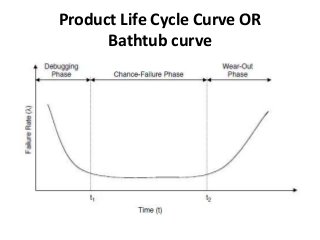
Product Life Cycle Curve OR
Bathtub curve
debugging phase
• The debugging phase, which is also called
infant-mortality phase, is characterized by a
time in the life of the product when there is a
drop in the failure rate as early failures are
identified and worked out, particularly during
prototype testing or pre-shipment testing.
During this phase, the curve is exponential.
Some of the early failures are due to any
number of factors including inadequate
materials, incorrect installation, or errors in
the manufacturing process
chance-failure phase
• The chance-failure phase occurs between time
t 1 and t 2, at a constant rate. Failure during
this phase occurs randomly, and may be due
to misapplication or misuse. The assumption
of a constant failure rate is valid for most
products; however, some products may have a
failure rate that increases with time.
wear-out phase
• The final phase of the cycle is the wear-out
phase, and is characterized by a rise in the
failure rate that occurs as the product ages
and wears out. Normal wear could result in
misalignment, loose fittings, and component
interference, and could lead to an increase in
the failure rate.
Causes of Product Unreliability
• At the Manufacturer’s Site
• Improper design of the product
• Inferior construction materials
• Faulty assembly
• Faulty manufacturing
• Inappropriate testing, leading to false results and wrong conclusions
• Damage during shipment
• Inadequate packaging, leading to damage during shipment
• At the Manufacturer’s Site
• Improper design of the product
• Inferior construction materials
• Faulty assembly
• Faulty manufacturing
• Inappropriate testing, leading to false results and wrong conclusions
• Damage during shipment
• Inadequate packaging, leading to damage during shipment
• At the Hands of the User
• Improper startups
• Product abuse
• Lack of maintenance
• Misapplication of
MEASURES OF RELIABILITY
• What failed?
• How did it fail?
And
• how many hours, cycles, actuations, or stresses
was it able to bear before failure?
• There are a number of tests for determining the
reliability of a product, including failure-
terminated, time-terminated, and sequential
tests.
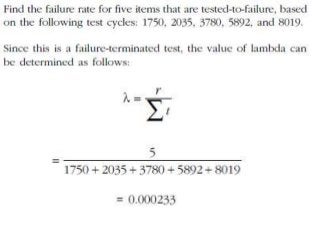
Failure-terminated tests
• Failure-terminated tests are ended when a
predetermined number of failures occur
within the sample being tested. The decision
to accept or reject the product hinges on the
number of products that have failed during
the test.
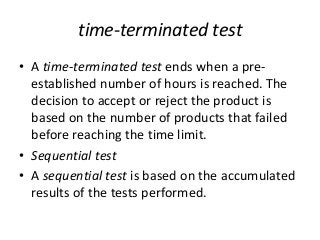
time-terminated test
• A time-terminated test ends when a pre-
established number of hours is reached. The
decision to accept or reject the product is
based on the number of products that failed
before reaching the time limit.
• Sequential test
• A sequential test is based on the accumulated
results of the tests performed.
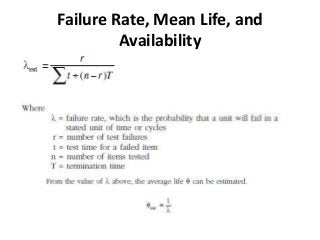
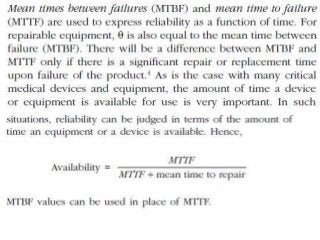
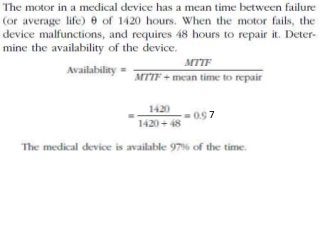
Failure Rate, Mean Life, and
Availability
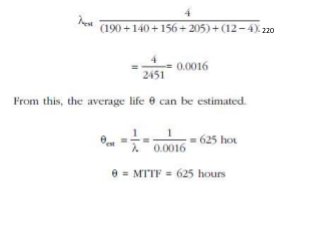
220
7
System reliability
• There are some who believe that the more features a
product has the better its quality
• as products become more complex (fitted with more
components and features), the chance that they will
develop problems increases
• The reliability of these systems is ultimately affected by the
• number of components in the systems. The reliability of the
entire system will also be affected by the manner in which
the components are arranged.
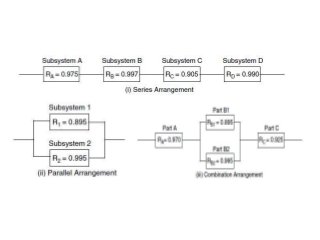
• Components are arranged in series, parallel, or a
combination.
• Figure illustrates the various arrangements.
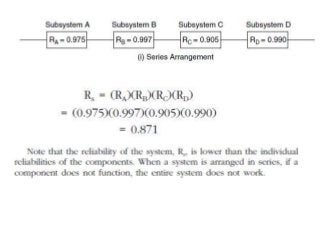
• Note that the “R” values are the probability
that the components will work.
• When components are arranged in series, the
reliability of the system is the product of the
reliability of the individual components.
• For the arrangement shown in Figure, the
reliability of the system, Rs,is computed as
follows:
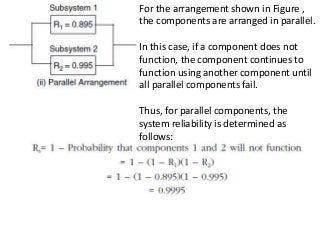
For the arrangement shown in Figure ,
the components are arranged in parallel.
In this case, if a component does not
function, the component continues to
function using another component until
all parallel components fail.
Thus, for parallel components, the
system reliability is determined as
follows:
Parallel connection
As the number of components in parallel increases, the
reliability of the system increases.
This is due to the fact it would take a failure of all of the
additional parallel components in order for the system to
fail.
Notice also that the reliability of the system is greater
than the reliability of the individual components.
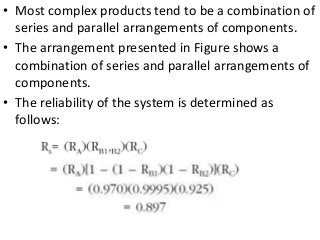
• Most complex products tend to be a combination of
series and parallel arrangements of components.
• The arrangement presented in Figure shows a
combination of series and parallel arrangements of
components.
• The reliability of the system is determined as
follows:
Reliability
Reliability
Reliability

Reliability

  • 2.
    What is reliability? •Reliability is associated with unexpected failures of products or services and understanding why these failures occur is key to improving reliability. The main reasons why failures occur include: • The product is not fit for purpose or more specifically the design is inherently incapable. • The item may be overstressed in some way.
  • 3.
    • Failures canbe caused by wear-out • • Failures might be caused by variation. • • Wrong specifications may cause failures. • • Misuse of the item may cause failure. • • Items are designed for a specific operating environment and if they are then used outside this environment then failure can occur.
  • 4.
    Reliability is theprobability that a product will perform its intended function satisfactorily for a prescribed period of time when it is used under the specified environmental conditions. • Numerical Value • Intended Function • Intended Life of the Product • Environmental Conditions
  • 5.
    • Products aswe know them have become increasingly complicated over the years. • Manufacturers are racing to add more features and more components. • The probability of product failure increases as the number of features increases. Manufacturers are increasingly aware of the challenge of increasing the reliability of their products to match the additional features.
  • 6.
    Product Life CycleCurve OR Bathtub curve
  • 7.
    debugging phase • Thedebugging phase, which is also called infant-mortality phase, is characterized by a time in the life of the product when there is a drop in the failure rate as early failures are identified and worked out, particularly during prototype testing or pre-shipment testing. During this phase, the curve is exponential. Some of the early failures are due to any number of factors including inadequate materials, incorrect installation, or errors in the manufacturing process
  • 8.
    chance-failure phase • Thechance-failure phase occurs between time t 1 and t 2, at a constant rate. Failure during this phase occurs randomly, and may be due to misapplication or misuse. The assumption of a constant failure rate is valid for most products; however, some products may have a failure rate that increases with time.
  • 9.
    wear-out phase • Thefinal phase of the cycle is the wear-out phase, and is characterized by a rise in the failure rate that occurs as the product ages and wears out. Normal wear could result in misalignment, loose fittings, and component interference, and could lead to an increase in the failure rate.
  • 10.
    Causes of ProductUnreliability • At the Manufacturer’s Site • Improper design of the product • Inferior construction materials • Faulty assembly • Faulty manufacturing • Inappropriate testing, leading to false results and wrong conclusions • Damage during shipment • Inadequate packaging, leading to damage during shipment
  • 11.
    • At theManufacturer’s Site • Improper design of the product • Inferior construction materials • Faulty assembly • Faulty manufacturing • Inappropriate testing, leading to false results and wrong conclusions • Damage during shipment • Inadequate packaging, leading to damage during shipment • At the Hands of the User • Improper startups • Product abuse • Lack of maintenance • Misapplication of
  • 12.
    MEASURES OF RELIABILITY •What failed? • How did it fail? And • how many hours, cycles, actuations, or stresses was it able to bear before failure? • There are a number of tests for determining the reliability of a product, including failure- terminated, time-terminated, and sequential tests.
  • 13.
    Failure-terminated tests • Failure-terminatedtests are ended when a predetermined number of failures occur within the sample being tested. The decision to accept or reject the product hinges on the number of products that have failed during the test.
  • 14.
    time-terminated test • Atime-terminated test ends when a pre- established number of hours is reached. The decision to accept or reject the product is based on the number of products that failed before reaching the time limit. • Sequential test • A sequential test is based on the accumulated results of the tests performed.
  • 15.
    Failure Rate, MeanLife, and Availability
  • 17.
  • 19.
  • 21.
    System reliability • Thereare some who believe that the more features a product has the better its quality • as products become more complex (fitted with more components and features), the chance that they will develop problems increases • The reliability of these systems is ultimately affected by the • number of components in the systems. The reliability of the entire system will also be affected by the manner in which the components are arranged. • Components are arranged in series, parallel, or a combination. • Figure illustrates the various arrangements.
  • 23.
    • Note thatthe “R” values are the probability that the components will work. • When components are arranged in series, the reliability of the system is the product of the reliability of the individual components. • For the arrangement shown in Figure, the reliability of the system, Rs,is computed as follows:
  • 25.
    For the arrangementshown in Figure , the components are arranged in parallel. In this case, if a component does not function, the component continues to function using another component until all parallel components fail. Thus, for parallel components, the system reliability is determined as follows:
  • 26.
    Parallel connection As thenumber of components in parallel increases, the reliability of the system increases. This is due to the fact it would take a failure of all of the additional parallel components in order for the system to fail. Notice also that the reliability of the system is greater than the reliability of the individual components.
  • 27.
    • Most complexproducts tend to be a combination of series and parallel arrangements of components. • The arrangement presented in Figure shows a combination of series and parallel arrangements of components. • The reliability of the system is determined as follows: