:Chintan H.Trivedi 
M.Tech Industrial 
1st Sem RCOEM.
o OC Curve? 
o Shape of OC curve 
o Types of OC curve 
o Specific Points On OC Curve 
o Probability Distributions used in OC Curve 
o OC Curve Uses 
o OC Curve Properties
o OC Curve was Developed along with SQC in 1930’s and 
40’s. 
o Graph used in quality control to determine the probability 
of accepting production lots. 
o Used in Discrimination of Sampling Plan Between Good 
And Bad Lots. 
o Measures Performance of Acceptance Sampling Plans.
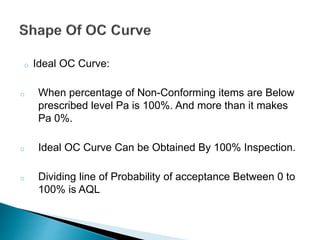
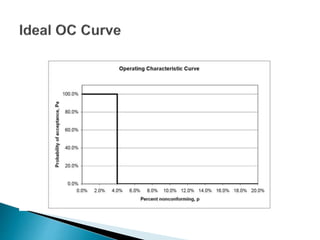
o Ideal OC Curve: 
o When percentage of Non-Conforming items are Below 
prescribed level Pa is 100%. And more than it makes 
Pa 0%. 
o Ideal OC Curve Can be Obtained By 100% Inspection. 
o Dividing line of Probability of acceptance Between 0 to 
100% is AQL
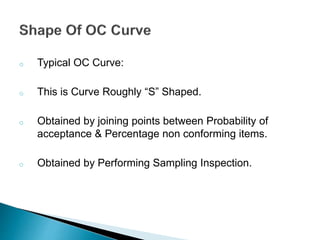
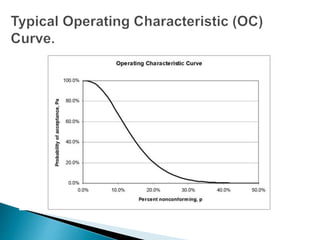
o Typical OC Curve: 
o This is Curve Roughly “S” Shaped. 
o Obtained by joining points between Probability of 
acceptance & Percentage non conforming items. 
o Obtained by Performing Sampling Inspection.
o Type A 
oGives the probability of acceptance for an individual lot 
coming from finite production 
oThis Curves are discontinuous. 
o Type B 
oGive the probability of acceptance for lots coming from 
a continuous process 
oThis Curves are correctly viewed as Continuous.
9 
o Assumes a finite lot. 
o Hypergeometric distribution is used for this type 
of curve. 
o Binomial or Poisson distribution often provides a 
good approximation. 
o View point of Type A curve is to evaluate 
consumer’s risk
o Assumes an infinite lot. 
o Binomial distribution is the correct one. 
o Poisson distribution often provides a good 
approximation. 
o View Point Type B OC curve is to evaluate 
producers risks.
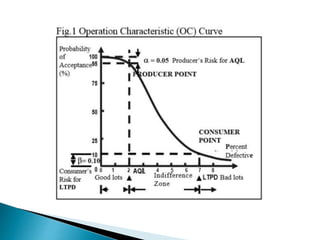
o Producer’s Risks (α): 
o Probability of Rejection of a conforming lot. 
o To Reduce Producers Risk Produce Product at a better 
Quality Level Than AQL. 
o Value of Producer’s Risks is Commonly 5%.
o Consumer’s Risks (β): 
o Risk associated with Consumer. 
o Probability of accepting a non-conforming lot. 
o Usually it is 10%.
o AQL(Acceptable Quality Level): 
o Maximum Percent of defectives that will make lot easily 
acceptable. 
o Fraction of Defectives accepted without any serious 
effect on quality and customer relations. 
o PA for an AQL lot should be high. 
o AQL is also Termed as Producer’s “safe point”.
o Rejectable Quality Level(RQL): 
o Quality Level Unacceptable to the Customer. 
o Definition Of Unsatisfactory Quality. 
o Characterised by low probability of acceptance. 
o PA of lot at RQL represents Consumer’s Risk.
o Y axis 
Gives the probability that the lot will be accepted (Pa). 
o X axis = p 
Percentage Defective. 
o Shows percentage-defectives along the horizontal ('X'), 
axis and probability of acceptance along the vertical ('Y') 
axis.
PA = The probability of acceptance 
p = Proportion defective 
N = Lot size 
n = Sample size 
c= Acceptance Number 
α = Producer’s Risk 
β= Consumer’s Risk
o Hyper geometric Distributions 
o Binomial Distributions 
o Poisson’s Distributions
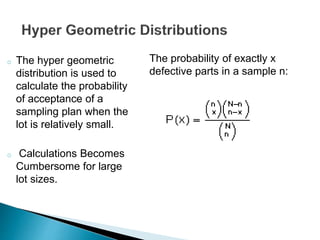
o The hyper geometric 
distribution is used to 
calculate the probability 
of acceptance of a 
sampling plan when the 
lot is relatively small. 
o Calculations Becomes 
Cumbersome for large 
lot sizes. 
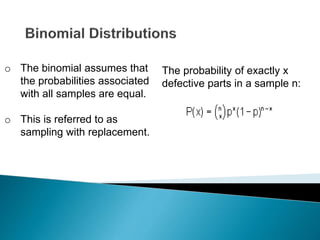
The probability of exactly x 
defective parts in a sample n:
o The binomial assumes that 
the probabilities associated 
with all samples are equal. 
o This is referred to as 
sampling with replacement. 
The probability of exactly x 
defective parts in a sample n:
Poisson Distributions 
o Used for sampling plans 
involving the number of 
defects or defects per unit 
rather than the number of 
defective parts. 
o When n is large and p is 
small, the Poisson 
distribution formula may be 
used. 
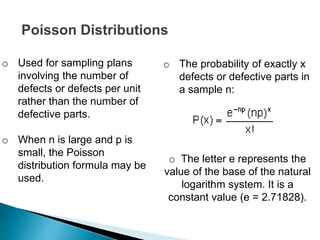
o The probability of exactly x 
defects or defective parts in 
a sample n: 
o The letter e represents the 
value of the base of the natural 
logarithm system. It is a 
constant value (e = 2.71828).
o Selection of sampling plans 
o Aids in selection of plans that are effective in reducing 
risk 
o keeps the high cost of inspection down
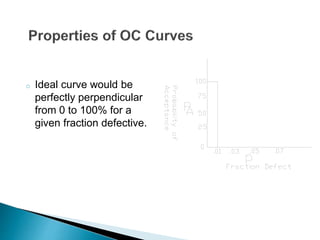
o Ideal curve would be 
perfectly perpendicular 
from 0 to 100% for a 
given fraction defective.
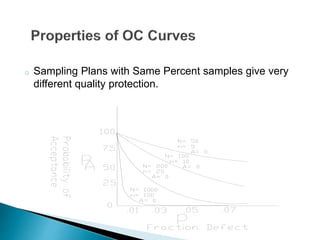
o Sampling Plans with Same Percent samples give very 
different quality protection.
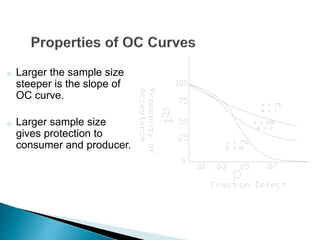
o Larger the sample size 
steeper is the slope of 
OC curve. 
o Larger sample size 
gives protection to 
consumer and producer.
Operating characteristics curve

Operating characteristics curve

  • 1.
    :Chintan H.Trivedi M.TechIndustrial 1st Sem RCOEM.
  • 2.
    o OC Curve? o Shape of OC curve o Types of OC curve o Specific Points On OC Curve o Probability Distributions used in OC Curve o OC Curve Uses o OC Curve Properties
  • 3.
    o OC Curvewas Developed along with SQC in 1930’s and 40’s. o Graph used in quality control to determine the probability of accepting production lots. o Used in Discrimination of Sampling Plan Between Good And Bad Lots. o Measures Performance of Acceptance Sampling Plans.
  • 4.
    o Ideal OCCurve: o When percentage of Non-Conforming items are Below prescribed level Pa is 100%. And more than it makes Pa 0%. o Ideal OC Curve Can be Obtained By 100% Inspection. o Dividing line of Probability of acceptance Between 0 to 100% is AQL
  • 5.
    o Typical OCCurve: o This is Curve Roughly “S” Shaped. o Obtained by joining points between Probability of acceptance & Percentage non conforming items. o Obtained by Performing Sampling Inspection.
  • 8.
    o Type A oGives the probability of acceptance for an individual lot coming from finite production oThis Curves are discontinuous. o Type B oGive the probability of acceptance for lots coming from a continuous process oThis Curves are correctly viewed as Continuous.
  • 9.
    9 o Assumesa finite lot. o Hypergeometric distribution is used for this type of curve. o Binomial or Poisson distribution often provides a good approximation. o View point of Type A curve is to evaluate consumer’s risk
  • 10.
    o Assumes aninfinite lot. o Binomial distribution is the correct one. o Poisson distribution often provides a good approximation. o View Point Type B OC curve is to evaluate producers risks.
  • 11.
    o Producer’s Risks(α): o Probability of Rejection of a conforming lot. o To Reduce Producers Risk Produce Product at a better Quality Level Than AQL. o Value of Producer’s Risks is Commonly 5%.
  • 12.
    o Consumer’s Risks(β): o Risk associated with Consumer. o Probability of accepting a non-conforming lot. o Usually it is 10%.
  • 13.
    o AQL(Acceptable QualityLevel): o Maximum Percent of defectives that will make lot easily acceptable. o Fraction of Defectives accepted without any serious effect on quality and customer relations. o PA for an AQL lot should be high. o AQL is also Termed as Producer’s “safe point”.
  • 14.
    o Rejectable QualityLevel(RQL): o Quality Level Unacceptable to the Customer. o Definition Of Unsatisfactory Quality. o Characterised by low probability of acceptance. o PA of lot at RQL represents Consumer’s Risk.
  • 16.
    o Y axis Gives the probability that the lot will be accepted (Pa). o X axis = p Percentage Defective. o Shows percentage-defectives along the horizontal ('X'), axis and probability of acceptance along the vertical ('Y') axis.
  • 17.
    PA = Theprobability of acceptance p = Proportion defective N = Lot size n = Sample size c= Acceptance Number α = Producer’s Risk β= Consumer’s Risk
  • 18.
    o Hyper geometricDistributions o Binomial Distributions o Poisson’s Distributions
  • 19.
    o The hypergeometric distribution is used to calculate the probability of acceptance of a sampling plan when the lot is relatively small. o Calculations Becomes Cumbersome for large lot sizes. The probability of exactly x defective parts in a sample n:
  • 20.
    o The binomialassumes that the probabilities associated with all samples are equal. o This is referred to as sampling with replacement. The probability of exactly x defective parts in a sample n:
  • 21.
    Poisson Distributions oUsed for sampling plans involving the number of defects or defects per unit rather than the number of defective parts. o When n is large and p is small, the Poisson distribution formula may be used. o The probability of exactly x defects or defective parts in a sample n: o The letter e represents the value of the base of the natural logarithm system. It is a constant value (e = 2.71828).
  • 22.
    o Selection ofsampling plans o Aids in selection of plans that are effective in reducing risk o keeps the high cost of inspection down
  • 23.
    o Ideal curvewould be perfectly perpendicular from 0 to 100% for a given fraction defective.
  • 24.
    o Sampling Planswith Same Percent samples give very different quality protection.
  • 25.
    o Larger thesample size steeper is the slope of OC curve. o Larger sample size gives protection to consumer and producer.