

HUMAN ELEMENT
FACTORS
AFFECTING
RELIABILITY AND
SAFETY
CHINTAN H.TRIVEDIM.Tech 2nd Sem
RCOEM
Key Points
 Introduction
 Unsafe Equipments And Unsafe Acts
 Case Study On:
1.Computer System Interruptions By Human
Errors
2.Utility Distributions Interruptions By Human
Errors
 Classification of Human Error
 Accident Injury Sequence Model
 Accident: Factors & its Prevention
Introduction
 Many system reliability predictive methods are based
solely on equipment failures, neglecting the human
component of man–machine systems (MMS).
 The reliability and safety of industrial and commercial
power systems and processes (i.e., MMS) are
dependent upon human characteristics and many
dependent and dynamic interactive factors .
 The consequences of human errors are very diverse
and can range from damage to equipment and
property, injury to personnel or fatalities, to disruption
of scheduled system operation, all of which represent
a significant cost to society.
Human Error
 A failure on the part of the human to perform a
prescribed act or task within specified limits of
accuracy, sequence, or time, which could
result in damage to equipment and property
and disruption of scheduled operations or
have no consequences at all.
Conti…
 “ most of the human errors occur because
humans are capable of doing so many
different things in many diverse ways.”
 Generally 20%–50% of all equipment failures
are due to human errors.
Unsafe equipment can cause
electrical accidents.
 1) Loose connections;
 2) Faulty installation;
 3) Improper grounding;
 4) Defective parts;
 5) Ground faults in equipment;
 6) Unguarded live parts.
These Conditions lead to plant interruptions and
disruption of processes and degrades
Reliability.
 According to many safety and health laws,
employers must provide a workplace where
workers will not be exposed to hazards, where
practicable.
 Workers must receive training, instruction,
supervision, and information so they are not
exposed to hazards.
Examples of unsafe acts
 1) Failure to de-energize, Lockout and Tag-Out
hazards during maintenance, repair, or
inspections;
 2) Use of defective and unsafe tools;
 3) Use of tools or equipment too close to
energized parts;
 4) Not draining off stored energy in capacitors;
 5) Using three-wire cord with a two-wire plug;
 6) Removing the wrong fuse.
CASE STUDIES ON THE
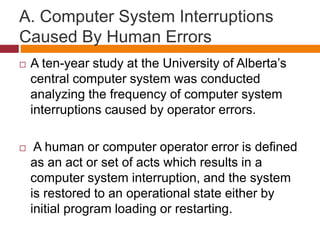
FREQUENCY OF HUMAN ERRORS
 A. Computer System Interruptions Caused By
Human Errors
 B. Utility Distribution Interruptions Caused By
Human Errors
A. Computer System Interruptions
Caused By Human Errors
 A ten-year study at the University of Alberta’s
central computer system was conducted
analyzing the frequency of computer system
interruptions caused by operator errors.
 A human or computer operator error is defined
as an act or set of acts which results in a
computer system interruption, and the system
is restored to an operational state either by
initial program loading or restarting.
 The computer system runs continuously 24
hours a day, except for maintenance periods
early in the mornings on the weekends to
minimize the impact of the scheduled
interruptions on the users.
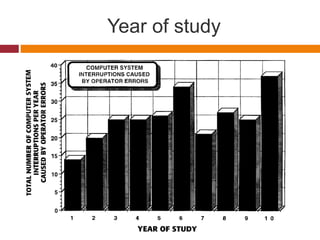
 The annual number of computer system
interruptions caused by operator errors is
shown in Fig (Next Slide).
Year of study
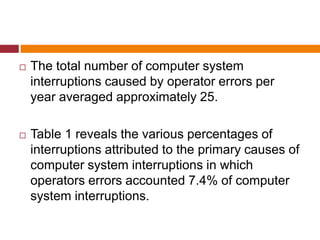
 The total number of computer system
interruptions caused by operator errors per
year averaged approximately 25.
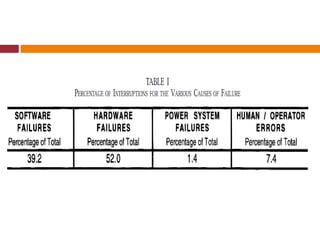
 Table 1 reveals the various percentages of
interruptions attributed to the primary causes of
computer system interruptions in which
operators errors accounted 7.4% of computer
system interruptions.
1.Day of the Week of Computer
System Interruptions:
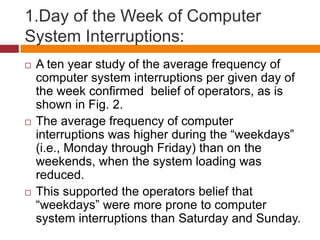
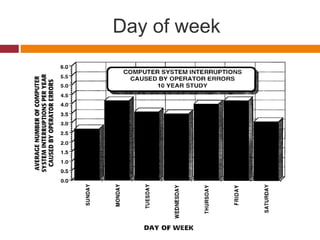
 A ten year study of the average frequency of
computer system interruptions per given day of
the week confirmed belief of operators, as is
shown in Fig. 2.
 The average frequency of computer
interruptions was higher during the “weekdays”
(i.e., Monday through Friday) than on the
weekends, when the system loading was
reduced.
 This supported the operators belief that
“weekdays” were more prone to computer
system interruptions than Saturday and Sunday.
Day of week
2.Time of the Day of Computer
System
Interruptions:
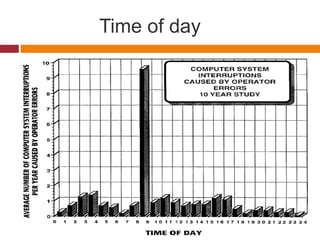
 Many users of the computer system claimed that
there appeared to be more interruptions in the
morning than during the remainder of the day.
 The loading on the system peaked between 8–9
a.m., and the load dropped off between 4–5 p.m.
and remained fairly steady for the remaining time
periods.
 It is clear that the sudden increase in computer
system loading and operator stress between 8–9
a.m. was directly correlated with a significant
increase in the frequency of operator errors
resulting in computer system interruptions.
Time of day
B. Utility Distribution Interruptions
Caused by Human Errors
 The electric utility distribution system customer
interruptions were recorded for the past 30 years
by the Canadian Electricity Association (CEA) in
Canada.
 It can be seen that the human element accounts
for approximately 1.7% of the total number of
distribution system interruptions.
 Other factors, such as scheduled outages,
lightning, and defective equipment were the
dominant causes of distribution system
interruptions.
Electric Utility Lost Time Due to
Injury Accidents:
 To measure the impact of injury accidents on
productivity in terms of hours in the workplace, the
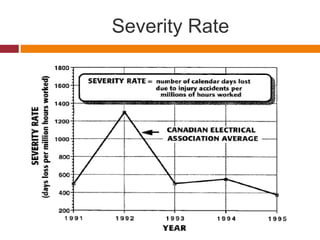
CEA uses an index called the severity rate.
 The severity rate equals the number of calendar
days lost due to injury accidents per millions of
hours worked. Typical rates are shown in Fig. 5
 The severity rate remains fairly constant for several
years, averaging about 500 days lost per million
hours worked.
Severity Rate
CLASSIFICATION OF HUMAN
ERRORS
 Human errors can occur at any stage in the life
of a system.
 It occurs from the original design
inadequacies, to installation deficiencies and
operating and maintenance human anomalies.
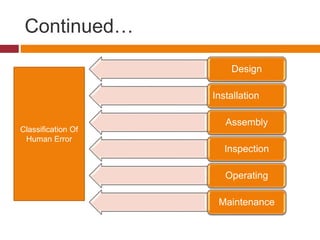
Continued…
Design
Installation
Assembly
Inspection
Operating
Maintenance
Classification Of
Human Error
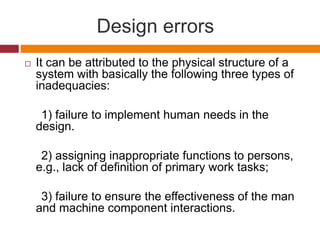
Design errors
 It can be attributed to the physical structure of a
system with basically the following three types of
inadequacies:
1) failure to implement human needs in the
design.
2) assigning inappropriate functions to persons,
e.g., lack of definition of primary work tasks;
3) failure to ensure the effectiveness of the man
and machine component interactions.
Installation
errors
 This are primarily due to the failure to install
equipment by humans according to instructions
or blueprints, assuming these drawings are
correct, and poor workmanship when operating
under severe time constraints.
 The inspection criteria of evaluation is
dependent upon the inspector’s knowledge of
the system and the relation between its
interacting parts.
 According to study an average inspection
effectiveness is close to 85%.
Inspection
errors
Assembly
errors
 This errors are the result of poor workmanship.
These errors are often discovered after the
installation process when they disrupt scheduled
system operations.
 Examples are:
1) use of incorrect component;
2) use of incorrect tools;
3) omitting a component;
4) improper connections;
5) improper handling of equipment.
 This error is subject to human operating errors.
Situations that lead to these errors are as
follows:
1) lack of proper procedures;
2) task complexity and overload conditions;
3) poor personnel selection and training;
4) operator carelessness and lack of interest;
5) poor environmental conditions.
Operation Errors
Maintenance
errors
 This errors are primarily due to the incorrect
repair/replacement/service activities of
equipment. Examples of maintenance errors are
the following:
1) incorrect calibration of instruments, e.g.,
relays, computer controls, and sensors;
2) failure to follow maintenance schedules and
procedures;
3) incorrect equipment cleaning procedures.
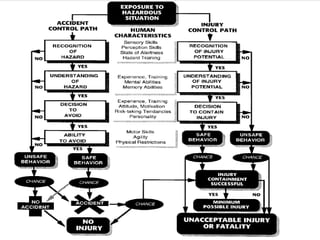
Accident-Injury Sequence
Model
 This Model provide a framework for identifying
the possible root cause of electrical accidents.
 This Model provide a basis for developing
accidents prevention and injury control
strategies to minimize
1. impact of disruption to system operation.
2. occurrences of injuries.
Accidents: factors and its
prevention
1) fatigue and sleeplessness—take breaks to
prevent fatigue;
2) anger, emotional upsets—take time to calm
down;
3) lack of skill—read instruction manuals, get
someone to help you;
4) faulty equipment—check equipment
regularly;
5) daydreaming, not concentrating—vary
routine to fight monotony;
6) hunger, letdown from low blood sugar—eat
7) extreme heat or cold—do inside jobs or
minimize exposure time to extreme temperatures;
8) alcohol, drugs—do not operate machines or do
dangerous jobs if you have been drinking or taking
or are on some form of drugs;
9) working too fast—do not operate machines if
you are tired, tense, or do not feel well;
10) panic in an emergency—learn first aid so you
know what to do.
11) taking chances and high risks—do not “show
off” or think that an accident cannot happen to you.
Reference
 Human Element Factors Affecting Reliability
and Safety, Don O. Koval and H. Landis Floyd,
IEEE Transactions on Industry Applications,
Vol. 34.
Thank You!

Human element factors affecting

  • 1.
  • 2.
    Key Points  Introduction Unsafe Equipments And Unsafe Acts  Case Study On: 1.Computer System Interruptions By Human Errors 2.Utility Distributions Interruptions By Human Errors  Classification of Human Error  Accident Injury Sequence Model  Accident: Factors & its Prevention
  • 3.
    Introduction  Many systemreliability predictive methods are based solely on equipment failures, neglecting the human component of man–machine systems (MMS).  The reliability and safety of industrial and commercial power systems and processes (i.e., MMS) are dependent upon human characteristics and many dependent and dynamic interactive factors .  The consequences of human errors are very diverse and can range from damage to equipment and property, injury to personnel or fatalities, to disruption of scheduled system operation, all of which represent a significant cost to society.
  • 4.
    Human Error  Afailure on the part of the human to perform a prescribed act or task within specified limits of accuracy, sequence, or time, which could result in damage to equipment and property and disruption of scheduled operations or have no consequences at all.
  • 5.
    Conti…  “ mostof the human errors occur because humans are capable of doing so many different things in many diverse ways.”  Generally 20%–50% of all equipment failures are due to human errors.
  • 6.
    Unsafe equipment cancause electrical accidents.  1) Loose connections;  2) Faulty installation;  3) Improper grounding;  4) Defective parts;  5) Ground faults in equipment;  6) Unguarded live parts. These Conditions lead to plant interruptions and disruption of processes and degrades Reliability.
  • 7.
     According tomany safety and health laws, employers must provide a workplace where workers will not be exposed to hazards, where practicable.  Workers must receive training, instruction, supervision, and information so they are not exposed to hazards.
  • 8.
    Examples of unsafeacts  1) Failure to de-energize, Lockout and Tag-Out hazards during maintenance, repair, or inspections;  2) Use of defective and unsafe tools;  3) Use of tools or equipment too close to energized parts;  4) Not draining off stored energy in capacitors;  5) Using three-wire cord with a two-wire plug;  6) Removing the wrong fuse.
  • 9.
    CASE STUDIES ONTHE FREQUENCY OF HUMAN ERRORS  A. Computer System Interruptions Caused By Human Errors  B. Utility Distribution Interruptions Caused By Human Errors
  • 10.
    A. Computer SystemInterruptions Caused By Human Errors  A ten-year study at the University of Alberta’s central computer system was conducted analyzing the frequency of computer system interruptions caused by operator errors.  A human or computer operator error is defined as an act or set of acts which results in a computer system interruption, and the system is restored to an operational state either by initial program loading or restarting.
  • 11.
     The computersystem runs continuously 24 hours a day, except for maintenance periods early in the mornings on the weekends to minimize the impact of the scheduled interruptions on the users.  The annual number of computer system interruptions caused by operator errors is shown in Fig (Next Slide).
  • 12.
  • 13.
     The totalnumber of computer system interruptions caused by operator errors per year averaged approximately 25.  Table 1 reveals the various percentages of interruptions attributed to the primary causes of computer system interruptions in which operators errors accounted 7.4% of computer system interruptions.
  • 15.
    1.Day of theWeek of Computer System Interruptions:  A ten year study of the average frequency of computer system interruptions per given day of the week confirmed belief of operators, as is shown in Fig. 2.  The average frequency of computer interruptions was higher during the “weekdays” (i.e., Monday through Friday) than on the weekends, when the system loading was reduced.  This supported the operators belief that “weekdays” were more prone to computer system interruptions than Saturday and Sunday.
  • 16.
  • 17.
    2.Time of theDay of Computer System Interruptions:  Many users of the computer system claimed that there appeared to be more interruptions in the morning than during the remainder of the day.  The loading on the system peaked between 8–9 a.m., and the load dropped off between 4–5 p.m. and remained fairly steady for the remaining time periods.  It is clear that the sudden increase in computer system loading and operator stress between 8–9 a.m. was directly correlated with a significant increase in the frequency of operator errors resulting in computer system interruptions.
  • 18.
  • 19.
    B. Utility DistributionInterruptions Caused by Human Errors  The electric utility distribution system customer interruptions were recorded for the past 30 years by the Canadian Electricity Association (CEA) in Canada.  It can be seen that the human element accounts for approximately 1.7% of the total number of distribution system interruptions.  Other factors, such as scheduled outages, lightning, and defective equipment were the dominant causes of distribution system interruptions.
  • 20.
    Electric Utility LostTime Due to Injury Accidents:  To measure the impact of injury accidents on productivity in terms of hours in the workplace, the CEA uses an index called the severity rate.  The severity rate equals the number of calendar days lost due to injury accidents per millions of hours worked. Typical rates are shown in Fig. 5  The severity rate remains fairly constant for several years, averaging about 500 days lost per million hours worked.
  • 21.
  • 22.
    CLASSIFICATION OF HUMAN ERRORS Human errors can occur at any stage in the life of a system.  It occurs from the original design inadequacies, to installation deficiencies and operating and maintenance human anomalies.
  • 23.
  • 24.
    Design errors  Itcan be attributed to the physical structure of a system with basically the following three types of inadequacies: 1) failure to implement human needs in the design. 2) assigning inappropriate functions to persons, e.g., lack of definition of primary work tasks; 3) failure to ensure the effectiveness of the man and machine component interactions.
  • 25.
    Installation errors  This areprimarily due to the failure to install equipment by humans according to instructions or blueprints, assuming these drawings are correct, and poor workmanship when operating under severe time constraints.  The inspection criteria of evaluation is dependent upon the inspector’s knowledge of the system and the relation between its interacting parts.  According to study an average inspection effectiveness is close to 85%. Inspection errors
  • 26.
    Assembly errors  This errorsare the result of poor workmanship. These errors are often discovered after the installation process when they disrupt scheduled system operations.  Examples are: 1) use of incorrect component; 2) use of incorrect tools; 3) omitting a component; 4) improper connections; 5) improper handling of equipment.
  • 27.
     This erroris subject to human operating errors. Situations that lead to these errors are as follows: 1) lack of proper procedures; 2) task complexity and overload conditions; 3) poor personnel selection and training; 4) operator carelessness and lack of interest; 5) poor environmental conditions. Operation Errors
  • 28.
    Maintenance errors  This errorsare primarily due to the incorrect repair/replacement/service activities of equipment. Examples of maintenance errors are the following: 1) incorrect calibration of instruments, e.g., relays, computer controls, and sensors; 2) failure to follow maintenance schedules and procedures; 3) incorrect equipment cleaning procedures.
  • 29.
    Accident-Injury Sequence Model  ThisModel provide a framework for identifying the possible root cause of electrical accidents.  This Model provide a basis for developing accidents prevention and injury control strategies to minimize 1. impact of disruption to system operation. 2. occurrences of injuries.
  • 31.
    Accidents: factors andits prevention 1) fatigue and sleeplessness—take breaks to prevent fatigue; 2) anger, emotional upsets—take time to calm down; 3) lack of skill—read instruction manuals, get someone to help you; 4) faulty equipment—check equipment regularly; 5) daydreaming, not concentrating—vary routine to fight monotony; 6) hunger, letdown from low blood sugar—eat
  • 32.
    7) extreme heator cold—do inside jobs or minimize exposure time to extreme temperatures; 8) alcohol, drugs—do not operate machines or do dangerous jobs if you have been drinking or taking or are on some form of drugs; 9) working too fast—do not operate machines if you are tired, tense, or do not feel well; 10) panic in an emergency—learn first aid so you know what to do. 11) taking chances and high risks—do not “show off” or think that an accident cannot happen to you.
  • 33.
    Reference  Human ElementFactors Affecting Reliability and Safety, Don O. Koval and H. Landis Floyd, IEEE Transactions on Industry Applications, Vol. 34.
  • 34.