4-1© 2007 Pearson Education
Chapter 4
Designing the Distribution
Network in a Supply Chain
Supply Chain Management
(3rd Edition)
© 2007 Pearson Education
Outline
The Role of Distribution in the Supply Chain
Factors Influencing Distribution Network Design
Design Options for a Distribution Network
E-Business and the Distribution Network
Distribution Networks in Practice
Summary of Learning Objectives
© 2007 Pearson Education
The Role of Distribution
in the Supply Chain
Distribution: the steps taken to move and store a
product from the supplier stage to the customer stage
in a supply chain
Distribution directly affects cost and the customer
experience and therefore drives profitability
Choice of distribution network can achieve supply
chain objectives from low cost to high responsiveness
Examples: Wal-Mart, Dell, Proctor & Gamble,
Grainger
© 2007 Pearson Education
Factors Influencing
Distribution Network Design
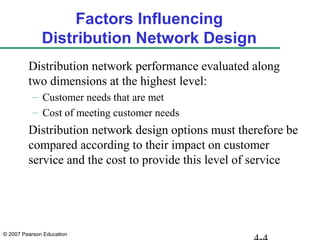
Distribution network performance evaluated along
two dimensions at the highest level:
– Customer needs that are met
– Cost of meeting customer needs
Distribution network design options must therefore be
compared according to their impact on customer
service and the cost to provide this level of service
© 2007 Pearson Education
Factors Influencing
Distribution Network Design
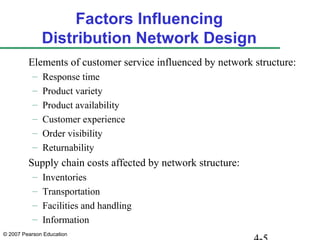
Elements of customer service influenced by network structure:
– Response time
– Product variety
– Product availability
– Customer experience
– Order visibility
– Returnability
Supply chain costs affected by network structure:
– Inventories
– Transportation
– Facilities and handling
– Information
© 2007 Pearson Education
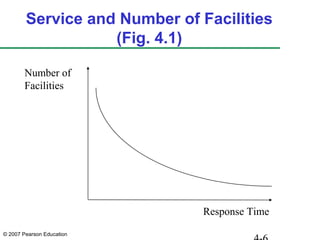
Service and Number of Facilities
(Fig. 4.1)
Number of
Facilities
Response Time
© 2007 Pearson Education
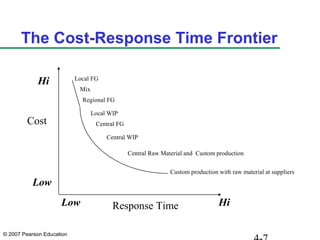
The Cost-Response Time Frontier
Local FG
Mix
Regional FG
Local WIP
Central FG
Central WIP
Central Raw Material and Custom production
Custom production with raw material at suppliers
Cost
Response Time HiLow
Low
Hi
© 2007 Pearson Education
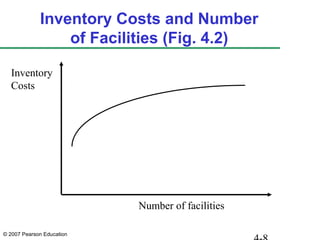
Inventory Costs and Number
of Facilities (Fig. 4.2)
Inventory
Costs
Number of facilities
© 2007 Pearson Education
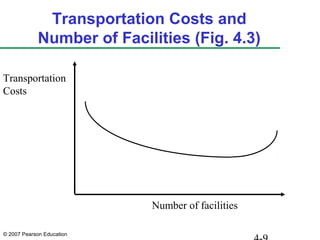
Transportation Costs and
Number of Facilities (Fig. 4.3)
Transportation
Costs
Number of facilities
© 2007 Pearson Education
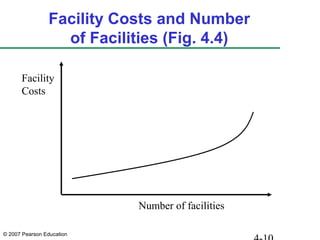
Facility Costs and Number
of Facilities (Fig. 4.4)
Facility
Costs
Number of facilities
© 2007 Pearson Education
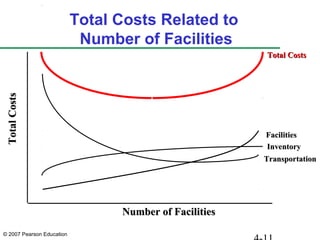
TransportationTransportation
Total Costs Related to
Number of Facilities
TotalCostsTotalCosts
Number of FacilitiesNumber of Facilities
InventoryInventory
FacilitiesFacilities
Total CostsTotal Costs
© 2007 Pearson Education
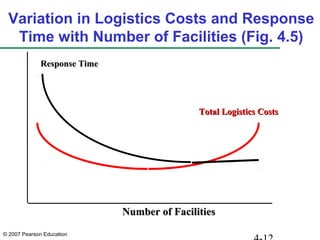
Response TimeResponse Time
Variation in Logistics Costs and Response
Time with Number of Facilities (Fig. 4.5)
Number of FacilitiesNumber of Facilities
Total Logistics CostsTotal Logistics Costs
© 2007 Pearson Education
Design Options for a
Distribution Network
Manufacturer Storage with Direct Shipping
Manufacturer Storage with Direct Shipping and In-
Transit Merge
Distributor Storage with Carrier Delivery
Distributor Storage with Last Mile Delivery
Manufacturer or Distributor Storage with Consumer
Pickup
Retail Storage with Consumer Pickup
Selecting a Distribution Network Design
© 2007 Pearson Education
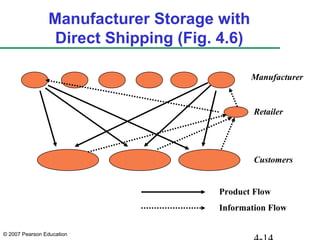
Manufacturer Storage with
Direct Shipping (Fig. 4.6)
Manufacturer
Retailer
Customers
Product Flow
Information Flow
© 2007 Pearson Education
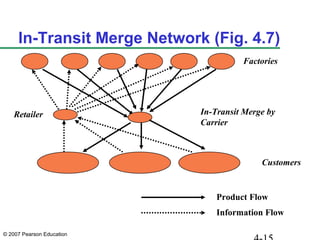
In-Transit Merge Network (Fig. 4.7)
Factories
Retailer
Product Flow
Information Flow
In-Transit Merge by
Carrier
Customers
© 2007 Pearson Education
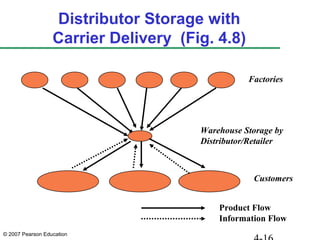
Distributor Storage with
Carrier Delivery (Fig. 4.8)
Factories
Customers
Product Flow
Information Flow
Warehouse Storage by
Distributor/Retailer
© 2007 Pearson Education
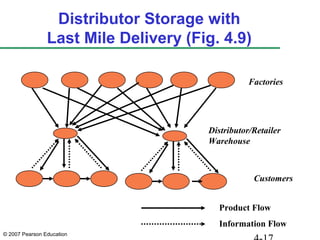
Distributor Storage with
Last Mile Delivery (Fig. 4.9)
Factories
Customers
Product Flow
Information Flow
Distributor/Retailer
Warehouse
© 2007 Pearson Education
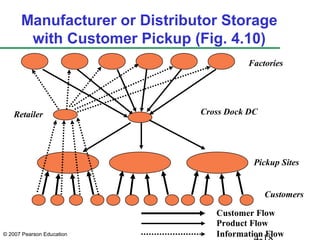
Manufacturer or Distributor Storage
with Customer Pickup (Fig. 4.10)
Factories
Retailer
Pickup Sites
Product Flow
Information Flow
Cross Dock DC
Customer Flow
Customers
© 2007 Pearson Education
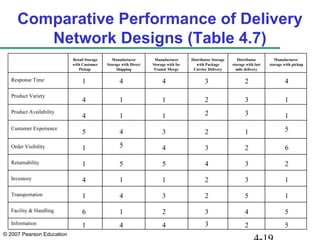
Comparative Performance of Delivery
Network Designs (Table 4.7)
Information
Facility & Handling
Transportation
Inventory
Returnability
Order Visibility
Customer Experience
Product Availability
Product Variety
Response Time
Manufacturer
storage with pickup
Distributor
storage with last
mile delivery
Distributor Storage
with Package
Carrier Delivery
Manufacturer
Storage with In-
Transit Merge
Manufacturer
Storage with Direct
Shipping
Retail Storage
with Customer
Pickup
1
1
1
1
1
1
1
1
1
1
1
1
1
1
1
1
1
2
2
2
2
2
2
2
2
2
2
3
3
3
3
3
3
3
3
3
3
4
4
4
4
4
4
4
4
4
4
4
4
4
5
5
5
5
55
5
6
6
5
© 2007 Pearson Education
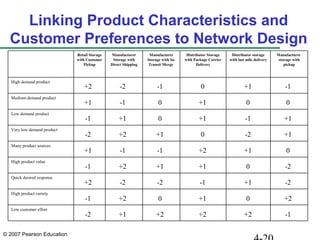
Linking Product Characteristics and
Customer Preferences to Network Design
Low customer effort
High product variety
Quick desired response
High product value
Many product sources
Very low demand product
Low demand product
Medium demand product
High demand product
Manufacturer
storage with
pickup
Distributor storage
with last mile delivery
Distributor Storage
with Package Carrier
Delivery
Manufacturer
Storage with In-
Transit Merge
Manufacturer
Storage with
Direct Shipping
Retail Storage
with Customer
Pickup
+2
+2
+2
+2
+2
+2
+2 +2 +2
+2
+1
+1
+1
+1
+1
+1
+1
+1
+1
+1
+1
+1
+1
+1
+1
0
0
0
0
0
0
0
0 0
0
-1
-1
-1
-1
-1 -1
-1
-1
-1
-1
-1
-2 -2
-2
-2
-2
-2 -2
-2
© 2007 Pearson Education
E-Business and the Distribution
Network
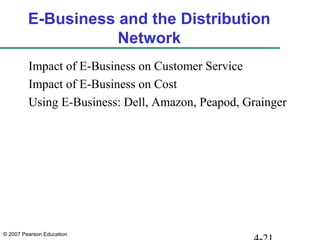
Impact of E-Business on Customer Service
Impact of E-Business on Cost
Using E-Business: Dell, Amazon, Peapod, Grainger
© 2007 Pearson Education
Distribution Networks in Practice
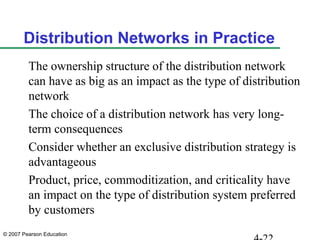
The ownership structure of the distribution network
can have as big as an impact as the type of distribution
network
The choice of a distribution network has very long-
term consequences
Consider whether an exclusive distribution strategy is
advantageous
Product, price, commoditization, and criticality have
an impact on the type of distribution system preferred
by customers
© 2007 Pearson Education
Summary of Learning Objectives
What are the key factors to be considered when
designing the distribution network?
What are the strengths and weaknesses of various
distribution options?
What roles do distributors play in the supply chain?

Supply chain management ch04 chopra

  • 1.
    4-1© 2007 PearsonEducation Chapter 4 Designing the Distribution Network in a Supply Chain Supply Chain Management (3rd Edition)
  • 2.
    © 2007 PearsonEducation Outline The Role of Distribution in the Supply Chain Factors Influencing Distribution Network Design Design Options for a Distribution Network E-Business and the Distribution Network Distribution Networks in Practice Summary of Learning Objectives
  • 3.
    © 2007 PearsonEducation The Role of Distribution in the Supply Chain Distribution: the steps taken to move and store a product from the supplier stage to the customer stage in a supply chain Distribution directly affects cost and the customer experience and therefore drives profitability Choice of distribution network can achieve supply chain objectives from low cost to high responsiveness Examples: Wal-Mart, Dell, Proctor & Gamble, Grainger
  • 4.
    © 2007 PearsonEducation Factors Influencing Distribution Network Design Distribution network performance evaluated along two dimensions at the highest level: – Customer needs that are met – Cost of meeting customer needs Distribution network design options must therefore be compared according to their impact on customer service and the cost to provide this level of service
  • 5.
    © 2007 PearsonEducation Factors Influencing Distribution Network Design Elements of customer service influenced by network structure: – Response time – Product variety – Product availability – Customer experience – Order visibility – Returnability Supply chain costs affected by network structure: – Inventories – Transportation – Facilities and handling – Information
  • 6.
    © 2007 PearsonEducation Service and Number of Facilities (Fig. 4.1) Number of Facilities Response Time
  • 7.
    © 2007 PearsonEducation The Cost-Response Time Frontier Local FG Mix Regional FG Local WIP Central FG Central WIP Central Raw Material and Custom production Custom production with raw material at suppliers Cost Response Time HiLow Low Hi
  • 8.
    © 2007 PearsonEducation Inventory Costs and Number of Facilities (Fig. 4.2) Inventory Costs Number of facilities
  • 9.
    © 2007 PearsonEducation Transportation Costs and Number of Facilities (Fig. 4.3) Transportation Costs Number of facilities
  • 10.
    © 2007 PearsonEducation Facility Costs and Number of Facilities (Fig. 4.4) Facility Costs Number of facilities
  • 11.
    © 2007 PearsonEducation TransportationTransportation Total Costs Related to Number of Facilities TotalCostsTotalCosts Number of FacilitiesNumber of Facilities InventoryInventory FacilitiesFacilities Total CostsTotal Costs
  • 12.
    © 2007 PearsonEducation Response TimeResponse Time Variation in Logistics Costs and Response Time with Number of Facilities (Fig. 4.5) Number of FacilitiesNumber of Facilities Total Logistics CostsTotal Logistics Costs
  • 13.
    © 2007 PearsonEducation Design Options for a Distribution Network Manufacturer Storage with Direct Shipping Manufacturer Storage with Direct Shipping and In- Transit Merge Distributor Storage with Carrier Delivery Distributor Storage with Last Mile Delivery Manufacturer or Distributor Storage with Consumer Pickup Retail Storage with Consumer Pickup Selecting a Distribution Network Design
  • 14.
    © 2007 PearsonEducation Manufacturer Storage with Direct Shipping (Fig. 4.6) Manufacturer Retailer Customers Product Flow Information Flow
  • 15.
    © 2007 PearsonEducation In-Transit Merge Network (Fig. 4.7) Factories Retailer Product Flow Information Flow In-Transit Merge by Carrier Customers
  • 16.
    © 2007 PearsonEducation Distributor Storage with Carrier Delivery (Fig. 4.8) Factories Customers Product Flow Information Flow Warehouse Storage by Distributor/Retailer
  • 17.
    © 2007 PearsonEducation Distributor Storage with Last Mile Delivery (Fig. 4.9) Factories Customers Product Flow Information Flow Distributor/Retailer Warehouse
  • 18.
    © 2007 PearsonEducation Manufacturer or Distributor Storage with Customer Pickup (Fig. 4.10) Factories Retailer Pickup Sites Product Flow Information Flow Cross Dock DC Customer Flow Customers
  • 19.
    © 2007 PearsonEducation Comparative Performance of Delivery Network Designs (Table 4.7) Information Facility & Handling Transportation Inventory Returnability Order Visibility Customer Experience Product Availability Product Variety Response Time Manufacturer storage with pickup Distributor storage with last mile delivery Distributor Storage with Package Carrier Delivery Manufacturer Storage with In- Transit Merge Manufacturer Storage with Direct Shipping Retail Storage with Customer Pickup 1 1 1 1 1 1 1 1 1 1 1 1 1 1 1 1 1 2 2 2 2 2 2 2 2 2 2 3 3 3 3 3 3 3 3 3 3 4 4 4 4 4 4 4 4 4 4 4 4 4 5 5 5 5 55 5 6 6 5
  • 20.
    © 2007 PearsonEducation Linking Product Characteristics and Customer Preferences to Network Design Low customer effort High product variety Quick desired response High product value Many product sources Very low demand product Low demand product Medium demand product High demand product Manufacturer storage with pickup Distributor storage with last mile delivery Distributor Storage with Package Carrier Delivery Manufacturer Storage with In- Transit Merge Manufacturer Storage with Direct Shipping Retail Storage with Customer Pickup +2 +2 +2 +2 +2 +2 +2 +2 +2 +2 +1 +1 +1 +1 +1 +1 +1 +1 +1 +1 +1 +1 +1 +1 +1 0 0 0 0 0 0 0 0 0 0 -1 -1 -1 -1 -1 -1 -1 -1 -1 -1 -1 -2 -2 -2 -2 -2 -2 -2 -2
  • 21.
    © 2007 PearsonEducation E-Business and the Distribution Network Impact of E-Business on Customer Service Impact of E-Business on Cost Using E-Business: Dell, Amazon, Peapod, Grainger
  • 22.
    © 2007 PearsonEducation Distribution Networks in Practice The ownership structure of the distribution network can have as big as an impact as the type of distribution network The choice of a distribution network has very long- term consequences Consider whether an exclusive distribution strategy is advantageous Product, price, commoditization, and criticality have an impact on the type of distribution system preferred by customers
  • 23.
    © 2007 PearsonEducation Summary of Learning Objectives What are the key factors to be considered when designing the distribution network? What are the strengths and weaknesses of various distribution options? What roles do distributors play in the supply chain?

Editor's Notes

  • #7 Notes: Increasing the number of facilities moves them closer to the end consumer. This reduces the response time. As Amazon has built warehouses, the average time from the warehouse to the end consumer has decreased. McMaster-Carr provides 1-2 day coverage of most of the U.S from 6 facilities. W.W. Grainger is able to increase coverage to same day delivery using about 370 facilities.
  • #8 Notes: As the customer is willing to tolerate longer lead times, the pull phase of the supply chain increases. The supply chain design must try and exploit this increase by centralizing assets to the extent possible. Local finished goods: Borders (Immediate response) Mix: W.W. Grainger (same day to next day response) Regional: McMaster Carr (next day response) Local WIP: PC assembler in India Central FG/WIP: Dell Central Raw Material and custom production: furniture manufacture (Amish in particular)
  • #9 Notes: Inventory costs increase, facility costs increase, and transportation costs decrease as we increase the number of facilities.
  • #10 Notes: Inventory costs increase, facility costs increase, and transportation costs decrease as we increase the number of facilities.
  • #11 Notes: Inventory costs increase, facility costs increase, and transportation costs decrease as we increase the number of facilities.
  • #12 Notes: Total costs decrease and then increase as we increase the number of facilities. The responsiveness improves as we increase the number of facilities. A supply chain should always operate above the lowest cost point. Operating beyond that point makes sense if the revenue generated from better responsiveness exceeds the cost of better responsiveness.
  • #13 Notes: Total costs decrease and then increase as we increase the number of facilities. The responsiveness improves as we increase the number of facilities. A supply chain should always operate above the lowest cost point. Operating beyond that point makes sense if the revenue generated from better responsiveness exceeds the cost of better responsiveness.
  • #20 Identify the best and worst network along various dimensions. Response time: (B) retail stores (W) Manufacturer storage with direct ship Product variety: (W) retail stores (B) Manufacturer storage with direct ship Product availability: (W) retail store (B) Manufacturer storage Inventory: (W) retail store (B) manufacturer storage Transportation: (B) retail store (W) last mile delivery Facility: (W) retail store (B) manufacturer storage Handling: (W) Distributor storage with last mile delivery (B) Information: Retail stores may be less complex; manufacturer storage with pickup may be very complex
  • #21 When designing the delivery network we should account for product and market characteristics. High demand products will have transportation cost play a significant role. Use network with good transportation cost (retail stores) Very low demand products will have inventory play a significant role. Use network with low inventory costs (direct shipping) Many product sources: transportation + information plays a role. Distributor storage with package carrier Few product sources but high customization: manufacturer storage with merge in transit High product variety: inventory cost will be significant. Use distributor storage Low customer effort: Distributor storage with package carrier delivery or last mile delivery depending upon desired response time