Chapter 2
Operations Strategy and
Competitiveness
Strategic Planning
 A process for getting from where the
company is today to where company
would like to be in the future.
 A process for getting from “here” to
“there.”
Strategic Planning Steps
 Preparing a mission statement
 Creating a vision
 Setting goals
 Formulating strategies
 Designing tactics
 Evaluating process and taking corrective
action
 Measuring results or outcomes
Strategic Planning Steps
 Mission
 What is our business? (Who we are?)
 Focus is on “today” (Here!)
 Vision
 What we hope to be.
 Focus is on “future” (There!)
Strategic Planning Steps
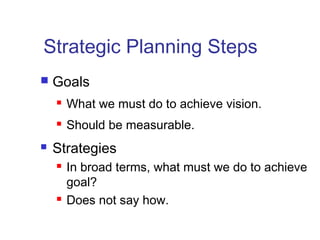
 Goals
 What we must do to achieve vision.
 Should be measurable.
 Strategies
 In broad terms, what must we do to achieve
goal?
 Does not say how.
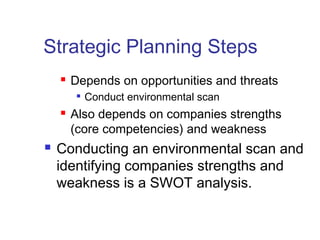
Strategic Planning Steps
 Depends on opportunities and threats

Conduct environmental scan
 Also depends on companies strengths
(core competencies) and weakness
 Conducting an environmental scan and
identifying companies strengths and
weakness is a SWOT analysis.
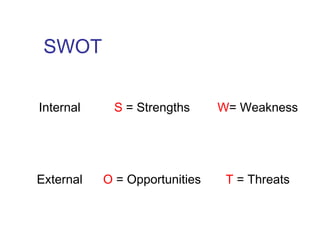
SWOT
Internal S = Strengths W= Weakness
External O = Opportunities T = Threats
Strategic Planning Steps
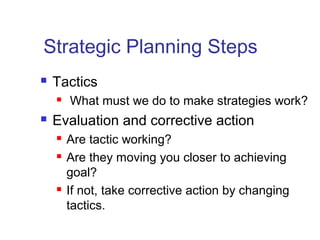
 Tactics
 What must we do to make strategies work?
 Evaluation and corrective action
 Are tactic working?
 Are they moving you closer to achieving
goal?
 If not, take corrective action by changing
tactics.
Strategic Planning Steps
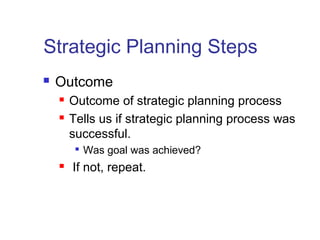
 Outcome
 Outcome of strategic planning process
 Tells us if strategic planning process was
successful.

Was goal was achieved?
 If not, repeat.
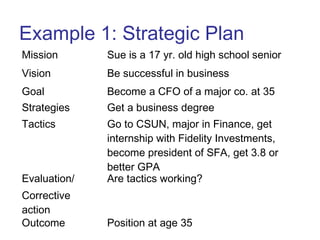
Example 1: Strategic Plan
Mission Sue is a 17 yr. old high school senior
Vision Be successful in business
Goal Become a CFO of a major co. at 35
Strategies Get a business degree
Tactics Go to CSUN, major in Finance, get
internship with Fidelity Investments,
become president of SFA, get 3.8 or
better GPA
Evaluation/
Corrective
action
Are tactics working?
Outcome Position at age 35
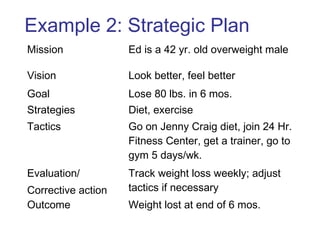
Example 2: Strategic Plan
Mission Ed is a 42 yr. old overweight male
Vision Look better, feel better
Goal Lose 80 lbs. in 6 mos.
Strategies Diet, exercise
Tactics Go on Jenny Craig diet, join 24 Hr.
Fitness Center, get a trainer, go to
gym 5 days/wk.
Evaluation/
Corrective action
Track weight loss weekly; adjust
tactics if necessary
Outcome Weight lost at end of 6 mos.
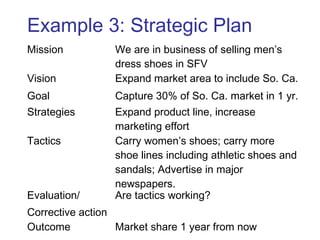
Example 3: Strategic Plan
Mission We are in business of selling men’s
dress shoes in SFV
Vision Expand market area to include So. Ca.
Goal Capture 30% of So. Ca. market in 1 yr.
Strategies Expand product line, increase
marketing effort
Tactics Carry women’s shoes; carry more
shoe lines including athletic shoes and
sandals; Advertise in major
newspapers.
Evaluation/
Corrective action
Are tactics working?
Outcome Market share 1 year from now
Starbuck’s Strategic Plan
 Mission statement
 'Establish Starbucks as the premier purveyor of
the finest coffee in the world while maintaining
our uncompromising principles while we grow.‘
 What’s wrong with Starbuck’s mission
statement?
Starbuck’s Strategic Plan
 Goal
 To establish Starbuck’s as the most
recognized and respected brand in the
world.
 What is requirement that goal should
meet?
 Does Starbuck’s goal meet it?
Starbuck’s Strategic Plan
 To achieve this goal, the Starbuck’s
plans to
 rapidly expand its retail operations,
 grow its specialty sales and other
operations, and
 selectively pursue opportunities to
leverage the Starbuck’s brand through the
introduction of new products and
 the development of new distribution
channels.
Starbuck’s Strategic Plan
 Are these steps strategies or tactics?
Answer
 They are Strategies - board statement
of what company will do to achieve
goals, but doesn’t say how.
 Tactics would tell us, for example, how
the company plans to expand retail
operations.
 For example, open more retail stores in
airports and malls.
FedEx’s Mission
FedEx provides access to a growing
global marketplace through a network of
supply chain, transportation, business and
related information services.
Lexus has revolutionized the luxury motoring
experience through its passionate commitment
to the finest products and the most satisfying
automobile ownership experience.
We vow to value the customer as an important
individual; to do things right the first time; and to
always exceed expectations.
We brought together these principles in the
Lexus Covenant, which inspires our dealers and
associates to treat customers as they would treat
guests and to go to any lengths to serve them
better.
Lexus’ Mission
More on Lexus
 “In order to make certain that a Lexus is
a Lexus no matter where it is built, the
entire workforce at Cambridge was
trained to follow the Passionate Pursuit
of Perfection that drives Lexus
associates worldwide.”
 Is there any connection between Lexus
and McDonald’s?
CSUN College of Business/Econ
Mission
 The College of Business and Economics at
California State University, Northridge is dedicated
to educating the leaders of tomorrow.
 By offering a challenging curriculum, smaller class
sizes, state-of-the-art facilities, and nationally
recognized programs, the College offers a truly
unique educational experience.
Developing an Operations
Strategy
 Operations Strategy is a plan for using
the operational capabilities of a
company to decide how it will compete.
 Will it compete on
 Price,
 Quality,
 Time,
 Flexibility?
 One, some or all?
Competing on Price?
 Offering product at a lower price relative
to competition
 Works if there are many competitors
offering same product or service.
 If you of a product with a high degree of
customization, does it make sense for
you to compete on price?
 Must also have lower ??? relative to
competitors.
Competing on Quality?
 Quality of product
 Quality of service
 Both
 Does competing on quality mean that a
company can’t compete on price
because it, if it offers better quality, it will
charge a higher price?
 Depends on how quality affects ???
 If it increases ????, yes.
 If it decreases ???, not necessarily.
Competing on Time?
 Time/speed one of most important
competition priorities
 Time related issues involve
 Rapid delivery:

Focused on shorter time between order
placement and delivery
 On-time delivery:

Deliver product exactly when needed every
time
Competing on Flexibility?
 Product flexibility:
 Easily switch production from one item to
another
 Easily customize product/service to meet
specific requirements of a customer
 Volume flexibility:
 Ability to ramp production up and down to
match market demands
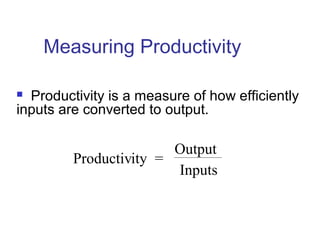
Measuring Productivity
Productivity =
Output
Inputs
 Productivity is a measure of how efficiently
inputs are converted to output.
Measuring Productivity
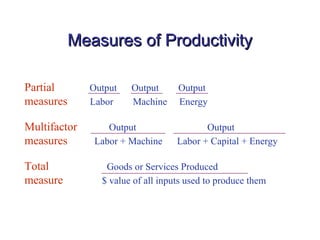
 Partial measures
 output/(single input)
 Multi-factor measures
 Uses some but not all inputs
 output/(multiple inputs)
 Total measure
 uses all inputs
 output/($ value of all inputs)
Measures of ProductivityMeasures of Productivity
Partial Output Output Output
measures Labor Machine Energy
Multifactor Output Output
measures Labor + Machine Labor + Capital + Energy
Total Goods or Services Produced
measure $ value of all inputs used to produce them
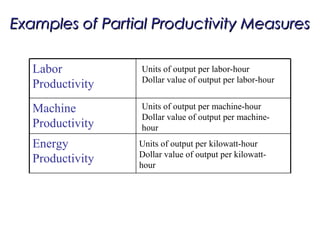
Units of output per kilowatt-hour
Dollar value of output per kilowatt-
hour
Energy
Productivity
Machine
Productivity
Labor
Productivity
Examples of Partial Productivity MeasuresExamples of Partial Productivity Measures
Units of output per labor-hour
Dollar value of output per labor-hour
Units of output per machine-hour
Dollar value of output per machine-
hour
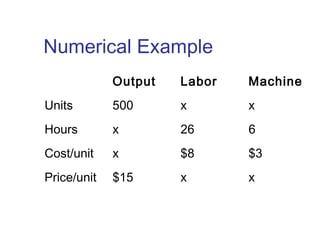
Numerical Example
Output Labor Machine
Units 500 x x
Hours x 26 6
Cost/unit x $8 $3
Price/unit $15 x x
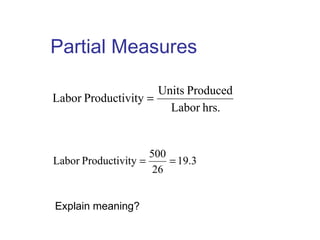
Partial Measures
hrs.Labor
ProducedUnits
tyProductiviLabor =
3.19
26
500
tyProductiviLabor ==
Explain meaning?
Partial Measures
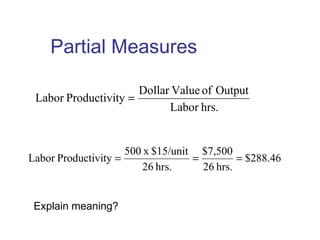
hrs.Labor
OutputofValueDollar
tyProductiviLabor =
46.288$
hrs.26
$7,500
hrs.26
$15/unitx500
tyProductiviLabor ===
Explain meaning?
Partial Measures
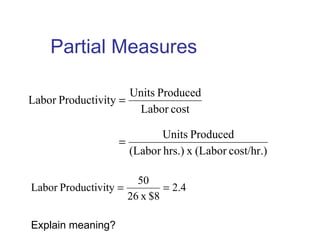
cost/hr.)(Laborxhrs.)(Labor
ProducedUnits
costLabor
ProducedUnits
tyProductiviLabor
=
=
4.2
$8x26
50
tyProductiviLabor ==
Explain meaning?
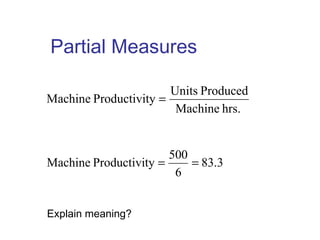
hrs.Machine
ProducedUnits
tyProductiviMachine =
Partial Measures
3.83
6
500
tyProductiviMachine ==
Explain meaning?
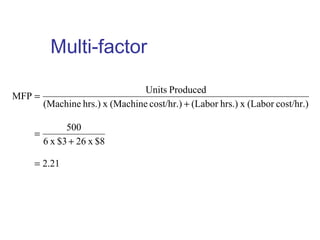
Multi-factor
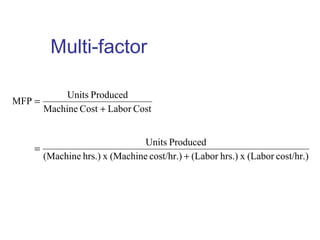
cost/hr.)(Laborxhrs.)(Laborcost/hr.)(Machinexhrs.)(Machine
ProducedUnits
CostLaborCostMachine
ProducedUnits
MFP
+
=
+
=
21.2
$8x26$3x6
500
cost/hr.)(Laborxhrs.)(Laborcost/hr.)(Machinexhrs.)(Machine
ProducedUnits
MFP
=
+
=
+
=
Multi-factor
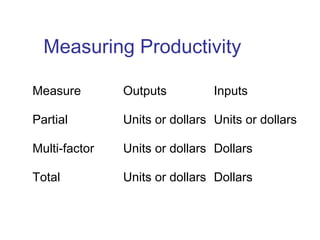
Measuring Productivity
Measure Outputs Inputs
Partial Units or dollars Units or dollars
Multi-factor Units or dollars Dollars
Total Units or dollars Dollars
Summary
 Output in units/Input in hrs. = Output
per input hour
 Output in $/Input in hrs. = X
Produced output worth $X per input hr.
 Output in units/Input in $ = Y
Produced Y units per $ spent on input
 Output in $/Input in $ = Z
Produced Z units per $ spent on input
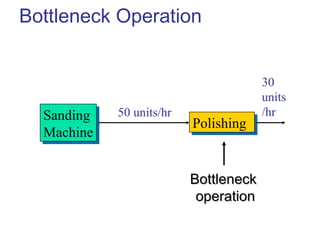
Bottleneck Operation
Sanding
Machine
Sanding
Machine PolishingPolishing
50 units/hr
30
units
/hr
BottleneckBottleneck
operationoperation
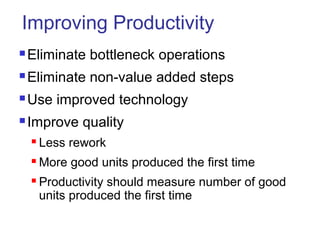
Improving Productivity
 Eliminate bottleneck operations
 Eliminate non-value added steps
 Use improved technology
 Improve quality
 Less rework
 More good units produced the first time
 Productivity should measure number of good
units produced the first time

operations strategy and competitiveness

  • 1.
    Chapter 2 Operations Strategyand Competitiveness
  • 2.
    Strategic Planning  Aprocess for getting from where the company is today to where company would like to be in the future.  A process for getting from “here” to “there.”
  • 3.
    Strategic Planning Steps Preparing a mission statement  Creating a vision  Setting goals  Formulating strategies  Designing tactics  Evaluating process and taking corrective action  Measuring results or outcomes
  • 4.
    Strategic Planning Steps Mission  What is our business? (Who we are?)  Focus is on “today” (Here!)  Vision  What we hope to be.  Focus is on “future” (There!)
  • 5.
    Strategic Planning Steps Goals  What we must do to achieve vision.  Should be measurable.  Strategies  In broad terms, what must we do to achieve goal?  Does not say how.
  • 6.
    Strategic Planning Steps Depends on opportunities and threats  Conduct environmental scan  Also depends on companies strengths (core competencies) and weakness  Conducting an environmental scan and identifying companies strengths and weakness is a SWOT analysis.
  • 7.
    SWOT Internal S =Strengths W= Weakness External O = Opportunities T = Threats
  • 8.
    Strategic Planning Steps Tactics  What must we do to make strategies work?  Evaluation and corrective action  Are tactic working?  Are they moving you closer to achieving goal?  If not, take corrective action by changing tactics.
  • 9.
    Strategic Planning Steps Outcome  Outcome of strategic planning process  Tells us if strategic planning process was successful.  Was goal was achieved?  If not, repeat.
  • 10.
    Example 1: StrategicPlan Mission Sue is a 17 yr. old high school senior Vision Be successful in business Goal Become a CFO of a major co. at 35 Strategies Get a business degree Tactics Go to CSUN, major in Finance, get internship with Fidelity Investments, become president of SFA, get 3.8 or better GPA Evaluation/ Corrective action Are tactics working? Outcome Position at age 35
  • 11.
    Example 2: StrategicPlan Mission Ed is a 42 yr. old overweight male Vision Look better, feel better Goal Lose 80 lbs. in 6 mos. Strategies Diet, exercise Tactics Go on Jenny Craig diet, join 24 Hr. Fitness Center, get a trainer, go to gym 5 days/wk. Evaluation/ Corrective action Track weight loss weekly; adjust tactics if necessary Outcome Weight lost at end of 6 mos.
  • 12.
    Example 3: StrategicPlan Mission We are in business of selling men’s dress shoes in SFV Vision Expand market area to include So. Ca. Goal Capture 30% of So. Ca. market in 1 yr. Strategies Expand product line, increase marketing effort Tactics Carry women’s shoes; carry more shoe lines including athletic shoes and sandals; Advertise in major newspapers. Evaluation/ Corrective action Are tactics working? Outcome Market share 1 year from now
  • 13.
    Starbuck’s Strategic Plan Mission statement  'Establish Starbucks as the premier purveyor of the finest coffee in the world while maintaining our uncompromising principles while we grow.‘  What’s wrong with Starbuck’s mission statement?
  • 14.
    Starbuck’s Strategic Plan Goal  To establish Starbuck’s as the most recognized and respected brand in the world.  What is requirement that goal should meet?  Does Starbuck’s goal meet it?
  • 15.
    Starbuck’s Strategic Plan To achieve this goal, the Starbuck’s plans to  rapidly expand its retail operations,  grow its specialty sales and other operations, and  selectively pursue opportunities to leverage the Starbuck’s brand through the introduction of new products and  the development of new distribution channels.
  • 16.
    Starbuck’s Strategic Plan Are these steps strategies or tactics?
  • 17.
    Answer  They areStrategies - board statement of what company will do to achieve goals, but doesn’t say how.  Tactics would tell us, for example, how the company plans to expand retail operations.  For example, open more retail stores in airports and malls.
  • 18.
    FedEx’s Mission FedEx providesaccess to a growing global marketplace through a network of supply chain, transportation, business and related information services.
  • 19.
    Lexus has revolutionizedthe luxury motoring experience through its passionate commitment to the finest products and the most satisfying automobile ownership experience. We vow to value the customer as an important individual; to do things right the first time; and to always exceed expectations. We brought together these principles in the Lexus Covenant, which inspires our dealers and associates to treat customers as they would treat guests and to go to any lengths to serve them better. Lexus’ Mission
  • 20.
    More on Lexus “In order to make certain that a Lexus is a Lexus no matter where it is built, the entire workforce at Cambridge was trained to follow the Passionate Pursuit of Perfection that drives Lexus associates worldwide.”  Is there any connection between Lexus and McDonald’s?
  • 21.
    CSUN College ofBusiness/Econ Mission  The College of Business and Economics at California State University, Northridge is dedicated to educating the leaders of tomorrow.  By offering a challenging curriculum, smaller class sizes, state-of-the-art facilities, and nationally recognized programs, the College offers a truly unique educational experience.
  • 22.
    Developing an Operations Strategy Operations Strategy is a plan for using the operational capabilities of a company to decide how it will compete.  Will it compete on  Price,  Quality,  Time,  Flexibility?  One, some or all?
  • 23.
    Competing on Price? Offering product at a lower price relative to competition  Works if there are many competitors offering same product or service.  If you of a product with a high degree of customization, does it make sense for you to compete on price?  Must also have lower ??? relative to competitors.
  • 24.
    Competing on Quality? Quality of product  Quality of service  Both  Does competing on quality mean that a company can’t compete on price because it, if it offers better quality, it will charge a higher price?  Depends on how quality affects ???  If it increases ????, yes.  If it decreases ???, not necessarily.
  • 25.
    Competing on Time? Time/speed one of most important competition priorities  Time related issues involve  Rapid delivery:  Focused on shorter time between order placement and delivery  On-time delivery:  Deliver product exactly when needed every time
  • 26.
    Competing on Flexibility? Product flexibility:  Easily switch production from one item to another  Easily customize product/service to meet specific requirements of a customer  Volume flexibility:  Ability to ramp production up and down to match market demands
  • 27.
    Measuring Productivity Productivity = Output Inputs Productivity is a measure of how efficiently inputs are converted to output.
  • 28.
    Measuring Productivity  Partialmeasures  output/(single input)  Multi-factor measures  Uses some but not all inputs  output/(multiple inputs)  Total measure  uses all inputs  output/($ value of all inputs)
  • 29.
    Measures of ProductivityMeasuresof Productivity Partial Output Output Output measures Labor Machine Energy Multifactor Output Output measures Labor + Machine Labor + Capital + Energy Total Goods or Services Produced measure $ value of all inputs used to produce them
  • 30.
    Units of outputper kilowatt-hour Dollar value of output per kilowatt- hour Energy Productivity Machine Productivity Labor Productivity Examples of Partial Productivity MeasuresExamples of Partial Productivity Measures Units of output per labor-hour Dollar value of output per labor-hour Units of output per machine-hour Dollar value of output per machine- hour
  • 31.
    Numerical Example Output LaborMachine Units 500 x x Hours x 26 6 Cost/unit x $8 $3 Price/unit $15 x x
  • 32.
  • 33.
  • 34.
  • 35.
  • 36.
  • 37.
  • 38.
    Measuring Productivity Measure OutputsInputs Partial Units or dollars Units or dollars Multi-factor Units or dollars Dollars Total Units or dollars Dollars
  • 39.
    Summary  Output inunits/Input in hrs. = Output per input hour  Output in $/Input in hrs. = X Produced output worth $X per input hr.  Output in units/Input in $ = Y Produced Y units per $ spent on input  Output in $/Input in $ = Z Produced Z units per $ spent on input
  • 40.
    Bottleneck Operation Sanding Machine Sanding Machine PolishingPolishing 50units/hr 30 units /hr BottleneckBottleneck operationoperation
  • 41.
    Improving Productivity  Eliminatebottleneck operations  Eliminate non-value added steps  Use improved technology  Improve quality  Less rework  More good units produced the first time  Productivity should measure number of good units produced the first time