Dr.K.Baranidharan
Present by…
TOTAL QUALITY
MANAGEMENT
TQM 2July 13, 2013
Joseph Moses Juran’s Trilogy
Presented by
Dr.K.Baranidharan
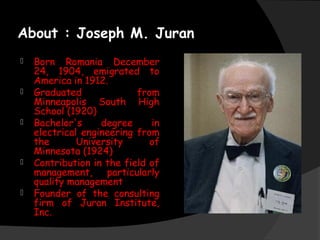
About : Joseph M. Juran
 Born Romania December
24, 1904, emigrated to
America in 1912.
 Graduated from
Minneapolis South High
School (1920)
 Bachelor's degree in
electrical engineering from
the University of
Minnesota (1924)
 Contribution in the field of
management, particularly
quality management
 Founder of the consulting
firm of Juran Institute,
Inc.
 1951 – published ‘quality control
hand book’
 Juran has authored 100’s papers
and 12 books
 Juran has been awarded 30
medals and fellowships world
wide.
JURAN CONTRIBUTION
 Juran’s Contributions Can Be Studied
Under The Following Six Topics.
 1. Internal customers
 2. Cost of Quality
 3. Quality Trilogy
 4. Juran’s 10 steps
 5. Breakthrough concept
1.INTERNAL CUSTOMER
 The customer was not just the
end customer and that each
person along the chain has an
internal customer.
 Each person along the chain,
from product designer to final
user, is a supplier and a
customer.
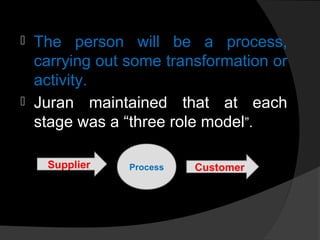
 The person will be a process,
carrying out some transformation or
activity.
 Juran maintained that at each
stage was a “three role model”.
Supplier Process Customer
2.COST OF QUALITY
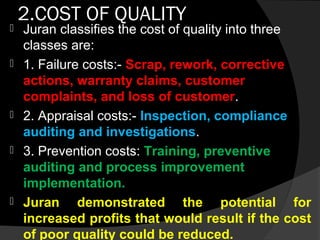
 Juran classifies the cost of quality into three
classes are:
 1. Failure costs:- Scrap, rework, corrective
actions, warranty claims, customer
complaints, and loss of customer.
 2. Appraisal costs:- Inspection, compliance
auditing and investigations.
 3. Prevention costs: Training, preventive
auditing and process improvement
implementation.
 Juran demonstrated the potential for
increased profits that would result if the cost
of poor quality could be reduced.
Introduction
 Quality
“Quality” means those features of products
which meet customer needs and thereby
provide customer satisfaction
“Quality” means freedom from deficiencies—
freedom from errors that require doing work
over again (rework) or that result in field
failures, customer dissatisfaction, customer
claims, and so on
In this sense, the meaning of quality is
oriented to costs, and higher quality usually
“costs less
J.M. Juran’s Trilogy
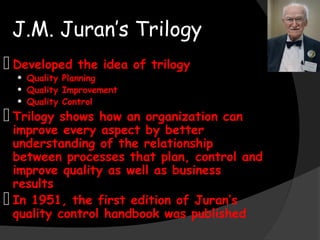
Developed the idea of trilogy
• Quality Planning
• Quality Improvement
• Quality Control
Trilogy shows how an organization can
improve every aspect by better
understanding of the relationship
between processes that plan, control and
improve quality as well as business
results
In 1951, the first edition of Juran’s
quality control handbook was published
How To Manage For Quality: The
Juran Trilogy
 To attain quality, it is well to begin by
establishing the “vision” for the
organization, along with policies and goals
 Managing for quality makes extensive use
of three such managerial processes:
Quality Planning
Quality Control
Quality Improvement
 These processes are now known as the
“Juran trilogy”
Quality Planning
 Establish quality goals
 Identify who the customers are
 Determine the needs of the customers
 Develop product features that respond to
customer’s needs
 Develop processes able to produce the
product features
 Establish process controls; transfer the plans
to the operating forces
Quality Control
 Evaluate actual performance
 Compare actual performance with quality
goals
 Act on the difference
 Choose units of measurement
 Choose control subjects (what to control)
 Interpret the difference (actual vs standard)
Quality Improvement
 Prove the need Establish the infrastructure
 Identify the improvement projects
 Establish project teams
 Provide the teams with resources, training,
and motivation to:
 Diagnose the causes Stimulate remedies
 Establish controls to hold the gains
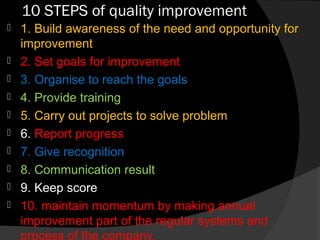
10 STEPS of quality improvement
 1. Build awareness of the need and opportunity for
improvement
 2. Set goals for improvement
 3. Organise to reach the goals
 4. Provide training
 5. Carry out projects to solve problem
 6. Report progress
 7. Give recognition
 8. Communication result
 9. Keep score
 10. maintain momentum by making annual
improvement part of the regular systems and
process of the company.
BREAKTHROUGH CONCEPT
 Like Deming cycle, juran’s
breakthrough concerns itself with
the product/service life cycle.
 In essence, this splits it up into two
areas :
 “journey from symptom to cause”
and “journey from cause to
remedy”.
Dr.K.Baranidharan
THANK YOU

TQM - JURAN CONTRIBUTION

  • 1.
  • 2.
  • 3.
    Joseph Moses Juran’sTrilogy Presented by Dr.K.Baranidharan
  • 5.
    About : JosephM. Juran  Born Romania December 24, 1904, emigrated to America in 1912.  Graduated from Minneapolis South High School (1920)  Bachelor's degree in electrical engineering from the University of Minnesota (1924)  Contribution in the field of management, particularly quality management  Founder of the consulting firm of Juran Institute, Inc.
  • 6.
     1951 –published ‘quality control hand book’  Juran has authored 100’s papers and 12 books  Juran has been awarded 30 medals and fellowships world wide.
  • 7.
    JURAN CONTRIBUTION  Juran’sContributions Can Be Studied Under The Following Six Topics.  1. Internal customers  2. Cost of Quality  3. Quality Trilogy  4. Juran’s 10 steps  5. Breakthrough concept
  • 8.
    1.INTERNAL CUSTOMER  Thecustomer was not just the end customer and that each person along the chain has an internal customer.  Each person along the chain, from product designer to final user, is a supplier and a customer.
  • 9.
     The personwill be a process, carrying out some transformation or activity.  Juran maintained that at each stage was a “three role model”. Supplier Process Customer
  • 10.
    2.COST OF QUALITY Juran classifies the cost of quality into three classes are:  1. Failure costs:- Scrap, rework, corrective actions, warranty claims, customer complaints, and loss of customer.  2. Appraisal costs:- Inspection, compliance auditing and investigations.  3. Prevention costs: Training, preventive auditing and process improvement implementation.  Juran demonstrated the potential for increased profits that would result if the cost of poor quality could be reduced.
  • 11.
    Introduction  Quality “Quality” meansthose features of products which meet customer needs and thereby provide customer satisfaction “Quality” means freedom from deficiencies— freedom from errors that require doing work over again (rework) or that result in field failures, customer dissatisfaction, customer claims, and so on In this sense, the meaning of quality is oriented to costs, and higher quality usually “costs less
  • 12.
    J.M. Juran’s Trilogy Developedthe idea of trilogy • Quality Planning • Quality Improvement • Quality Control Trilogy shows how an organization can improve every aspect by better understanding of the relationship between processes that plan, control and improve quality as well as business results In 1951, the first edition of Juran’s quality control handbook was published
  • 13.
    How To ManageFor Quality: The Juran Trilogy  To attain quality, it is well to begin by establishing the “vision” for the organization, along with policies and goals  Managing for quality makes extensive use of three such managerial processes: Quality Planning Quality Control Quality Improvement  These processes are now known as the “Juran trilogy”
  • 14.
    Quality Planning  Establishquality goals  Identify who the customers are  Determine the needs of the customers  Develop product features that respond to customer’s needs  Develop processes able to produce the product features  Establish process controls; transfer the plans to the operating forces
  • 15.
    Quality Control  Evaluateactual performance  Compare actual performance with quality goals  Act on the difference  Choose units of measurement  Choose control subjects (what to control)  Interpret the difference (actual vs standard)
  • 16.
    Quality Improvement  Provethe need Establish the infrastructure  Identify the improvement projects  Establish project teams  Provide the teams with resources, training, and motivation to:  Diagnose the causes Stimulate remedies  Establish controls to hold the gains
  • 17.
    10 STEPS ofquality improvement  1. Build awareness of the need and opportunity for improvement  2. Set goals for improvement  3. Organise to reach the goals  4. Provide training  5. Carry out projects to solve problem  6. Report progress  7. Give recognition  8. Communication result  9. Keep score  10. maintain momentum by making annual improvement part of the regular systems and process of the company.
  • 18.
    BREAKTHROUGH CONCEPT  LikeDeming cycle, juran’s breakthrough concerns itself with the product/service life cycle.  In essence, this splits it up into two areas :  “journey from symptom to cause” and “journey from cause to remedy”.
  • 19.