
Multivibrators
A multivibrator is an electronic circuit that switches
rapidly by means of positive feedback between two
or more states. There are three types of multivibrator
circuit depending on the circuit operation:
Astable; in which the circuit is not stable in either
state —it continually switches from one state to the
other. It does not require an input such as a clock
pulse.
Monostable, in which one of the states is stable, but the
other state is unstable (transient). A trigger causes the
circuit to enter the unstable state. After entering the
unstable state, the circuit will return to the stable state
after a set time. Such a circuit is useful for creating a
timing period of fixed duration in response to some
external event. This circuit is also known as a one shot.
Bistable, in which the circuit is stable in either state. The
circuit can be flipped from one state to the other by an
external event or trigger. The bistable multivibrator is
simply a latch (flip-flop); it is added to this classification
only for completeness.
A multivibrator consists of two main components —
two passive networks and a bistable circuit, connected
in a common feedback loop. The networks can be
both resistive-capacitive (in the case of an astable
circuit), a resistive-capacitive and a resistive
(monostable), and both resistive (bistable).
Multivibrators find applications in a variety of systems
where square waves or timed intervals are required.
Astable Multivibrator
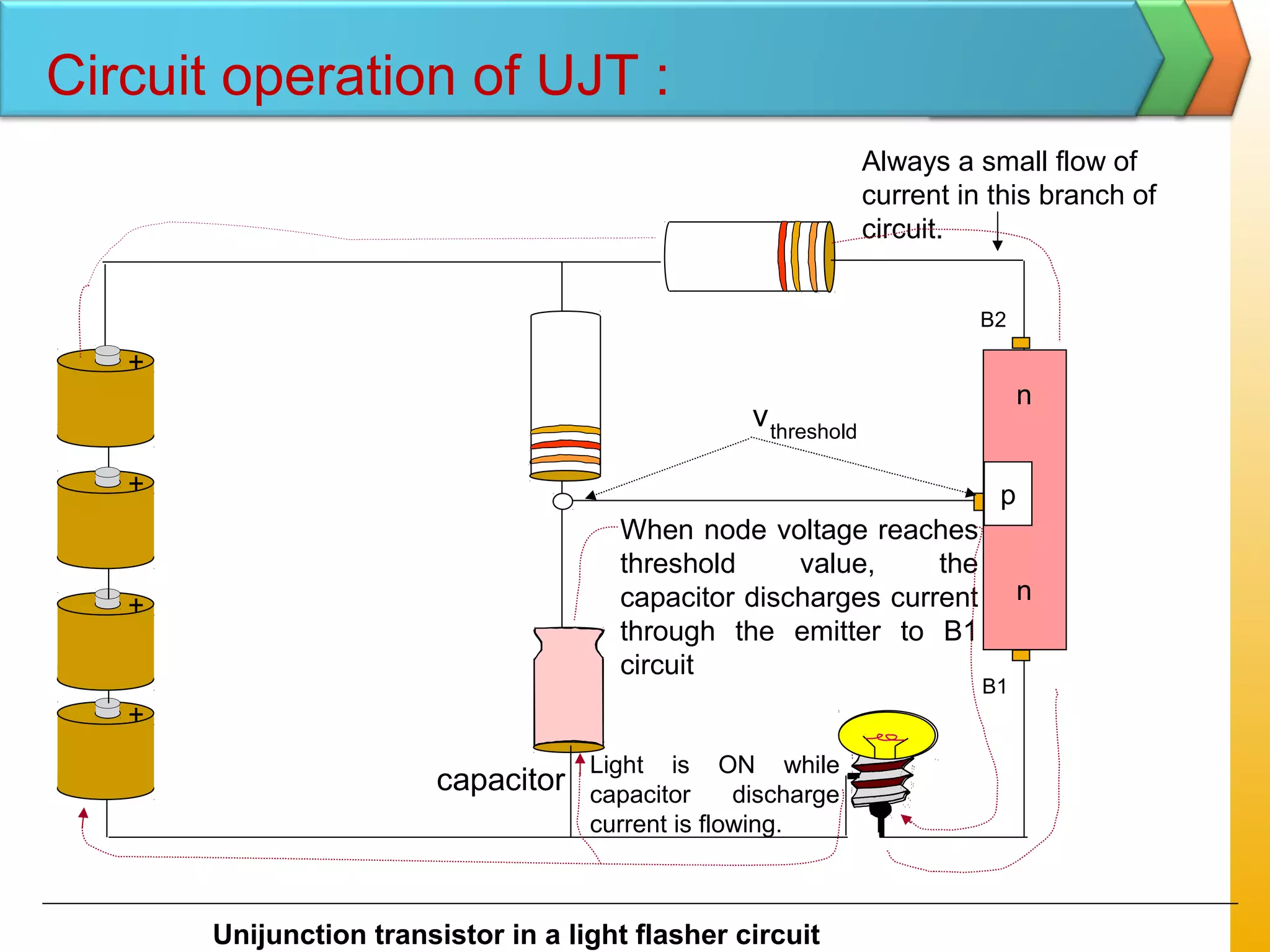
An astable multivibrator consists of two amplifying
stages connected in a positive feedback loop by two
capacitive-resistive coupling networks. The
amplifying elements may be junction or field-effect
transistors, vacuum tubes, operational amplifiers, or
other types of amplifier.
Regenerative switching circuits such as Astable
Multivibrators are the most commonly used type of
relaxation oscillator because not only are they are
simple, reliable and easy to construct, they also
produce a constant square wave output waveform.
The Astable Multivibrator has NO
stable output states as it changes
from one state to the other all the
time.
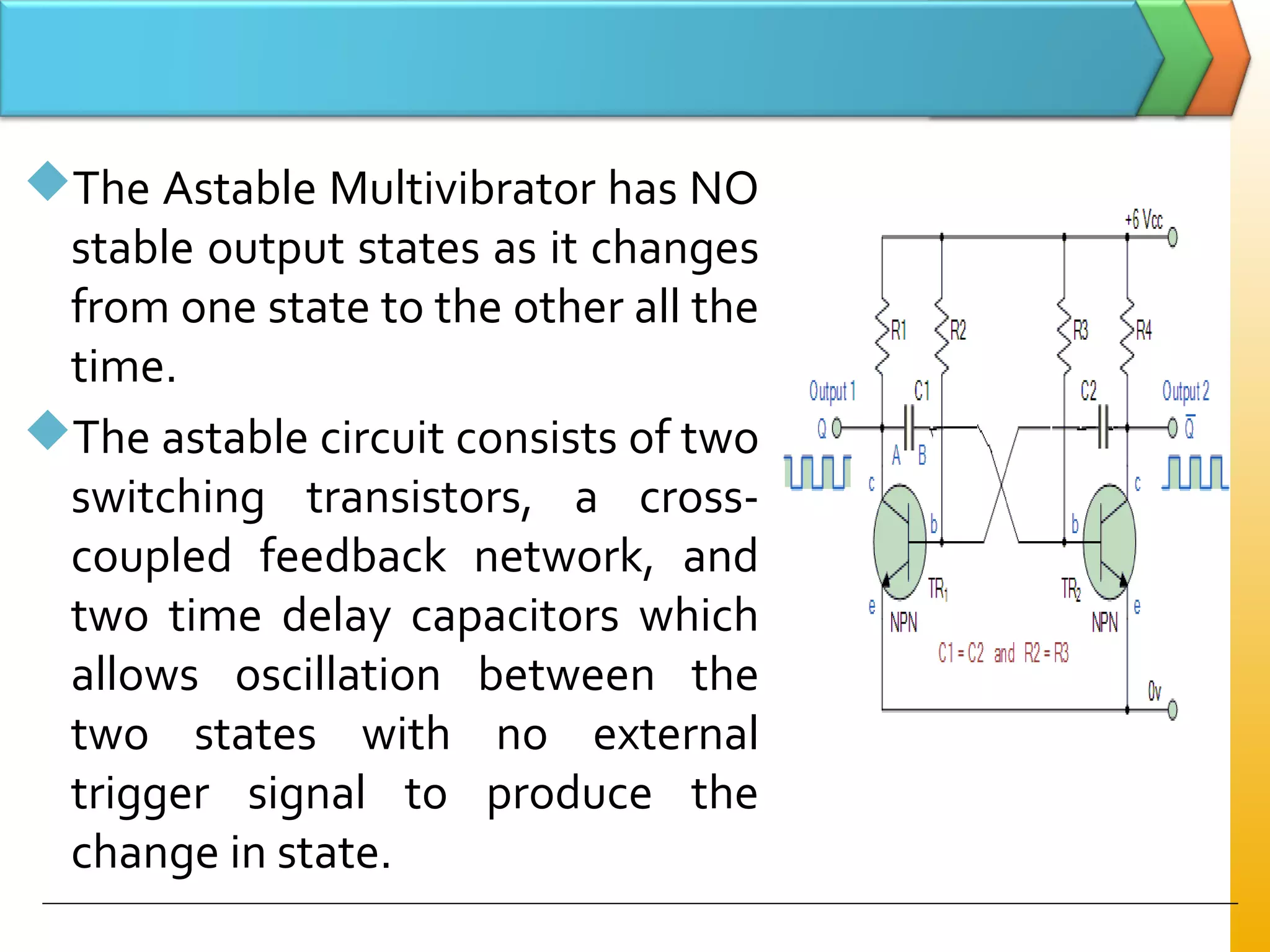
The astable circuit consists of two
switching transistors, a cross-
coupled feedback network, and
two time delay capacitors which
allows oscillation between the
two states with no external
trigger signal to produce the
change in state.
In Electronic Circuits, astable multivibrators are also
known as Free-running Multivibrator as they do not
require any additional inputs or external assistance to
oscillate.
Astable’s produce a continuous square wave from its
output or outputs, (two outputs no inputs) which can
then be used to flash lights or produce a sound in a
loudspeaker.
Time period of Astable multivibrator can be
controlled by changing the values of feedback
components such as coupling capacitors and
resistors.
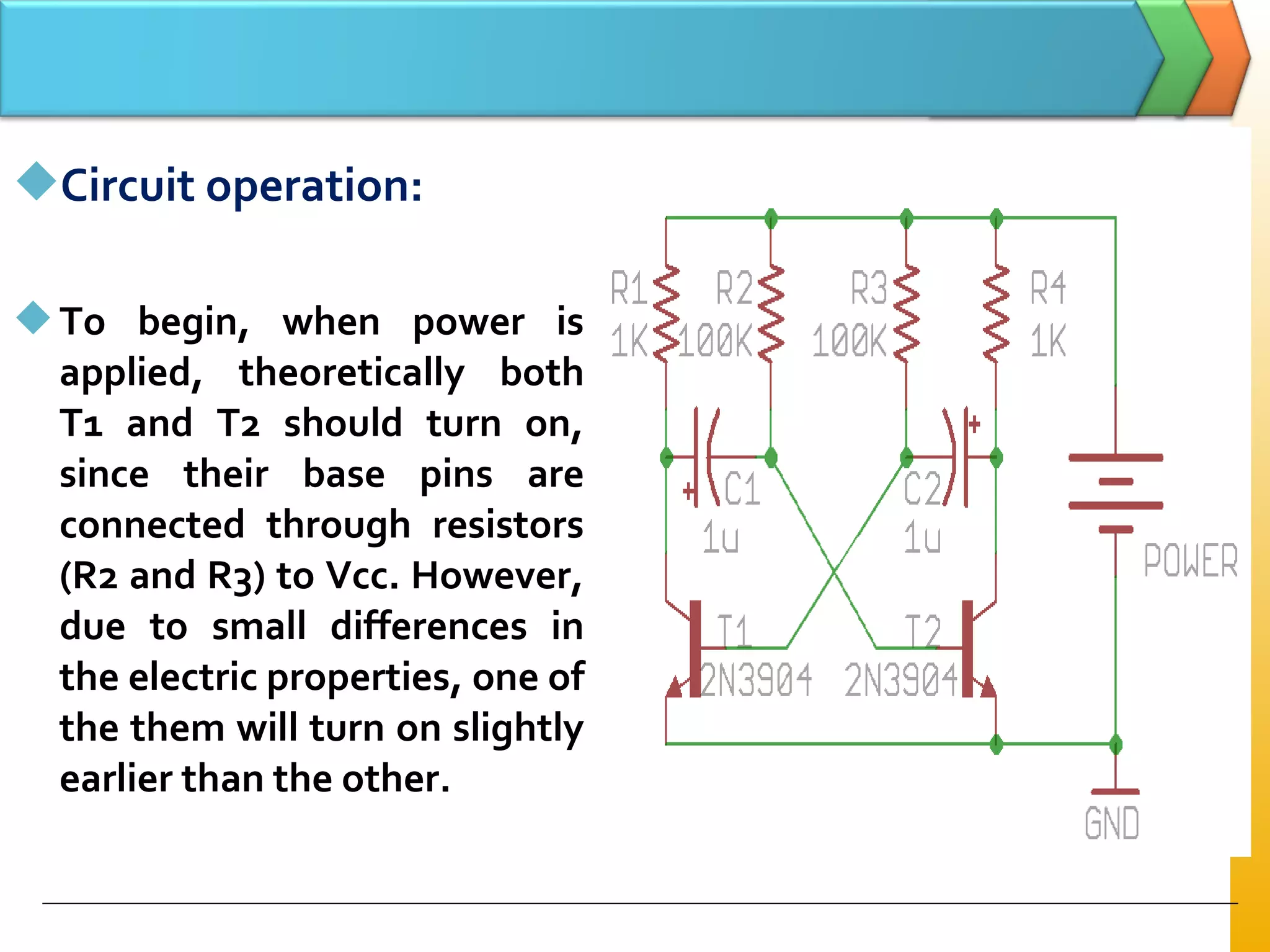
Circuit operation:
To begin, when power is
applied, theoretically both
T1 and T2 should turn on,
since their base pins are
connected through resistors
(R2 and R3) to Vcc. However,
due to small differences in
the electric properties, one of
the them will turn on slightly
earlier than the other.
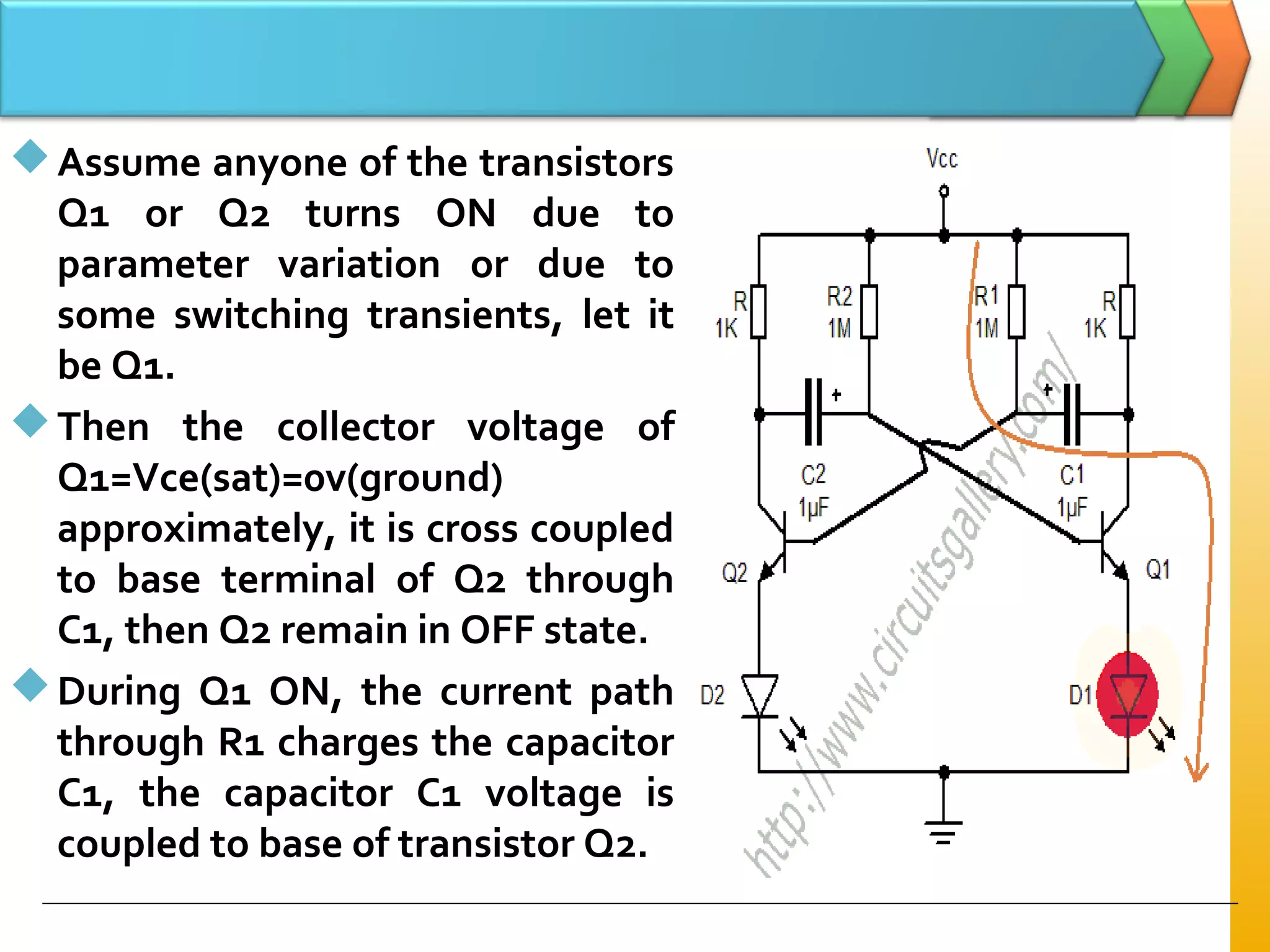
Assume anyone of the transistors
Q1 or Q2 turns ON due to
parameter variation or due to
some switching transients, let it
be Q1.
Then the collector voltage of
Q1=Vce(sat)=0v(ground)
approximately, it is cross coupled
to base terminal of Q2 through
C1, then Q2 remain in OFF state.
During Q1 ON, the current path
through R1 charges the capacitor
C1, the capacitor C1 voltage is
coupled to base of transistor Q2.
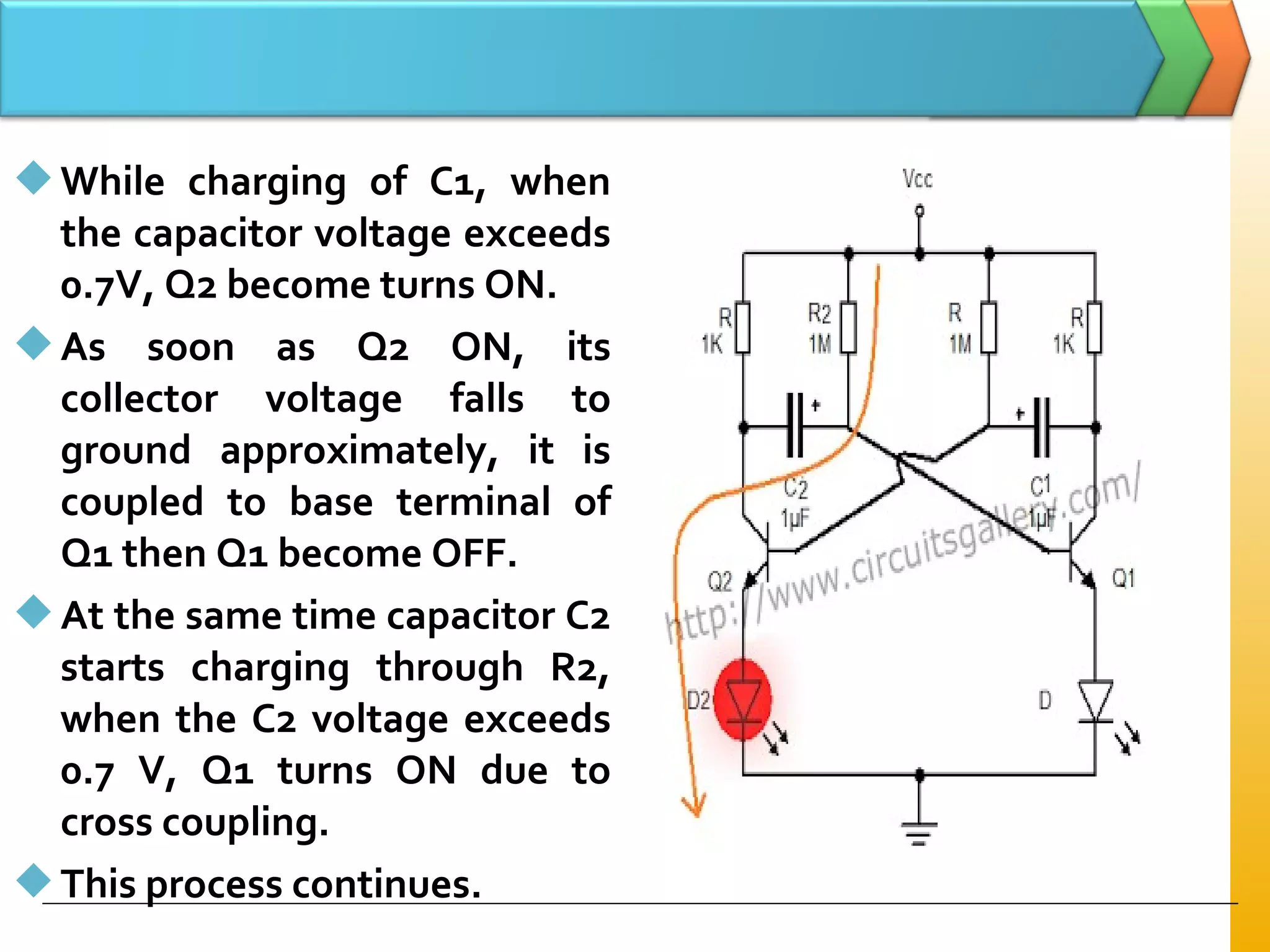
While charging of C1, when
the capacitor voltage exceeds
0.7V, Q2 become turns ON.
As soon as Q2 ON, its
collector voltage falls to
ground approximately, it is
coupled to base terminal of
Q1 then Q1 become OFF.
At the same time capacitor C2
starts charging through R2,
when the C2 voltage exceeds
0.7 V, Q1 turns ON due to
cross coupling.
This process continues.
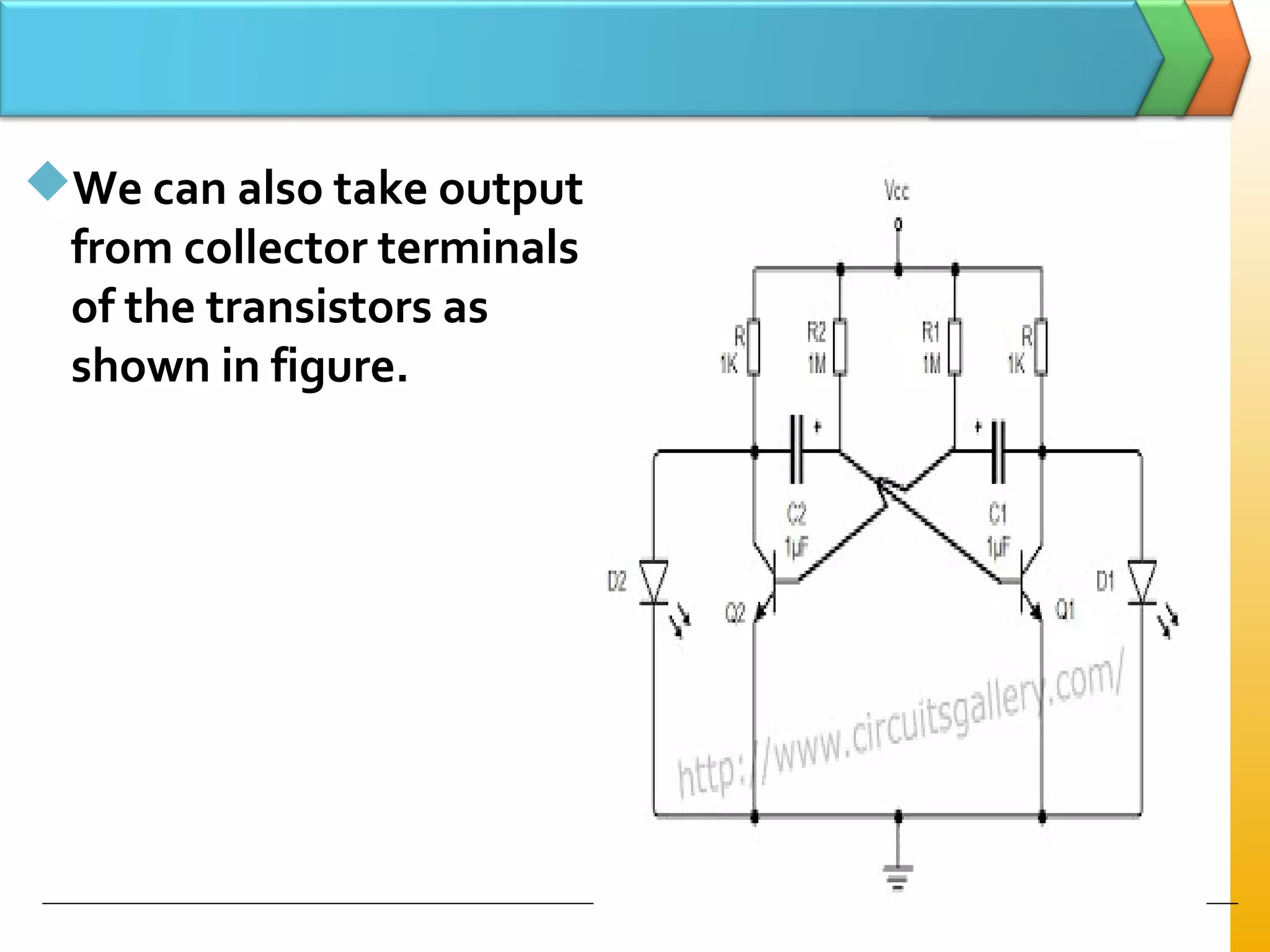
We can also take output
from collector terminals
of the transistors as
shown in figure.
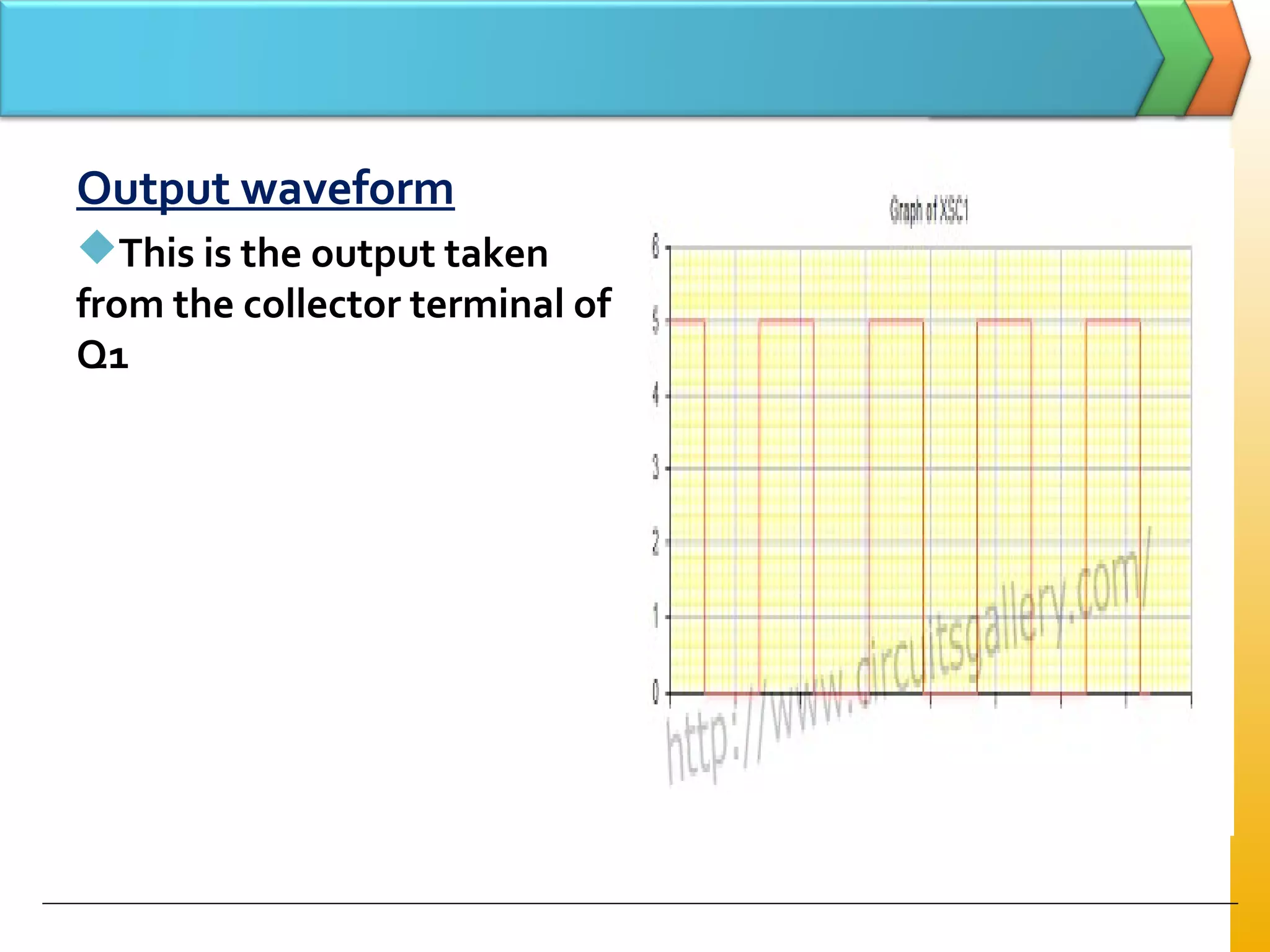
Output waveform
This is the output taken
from the collector terminal of
Q1
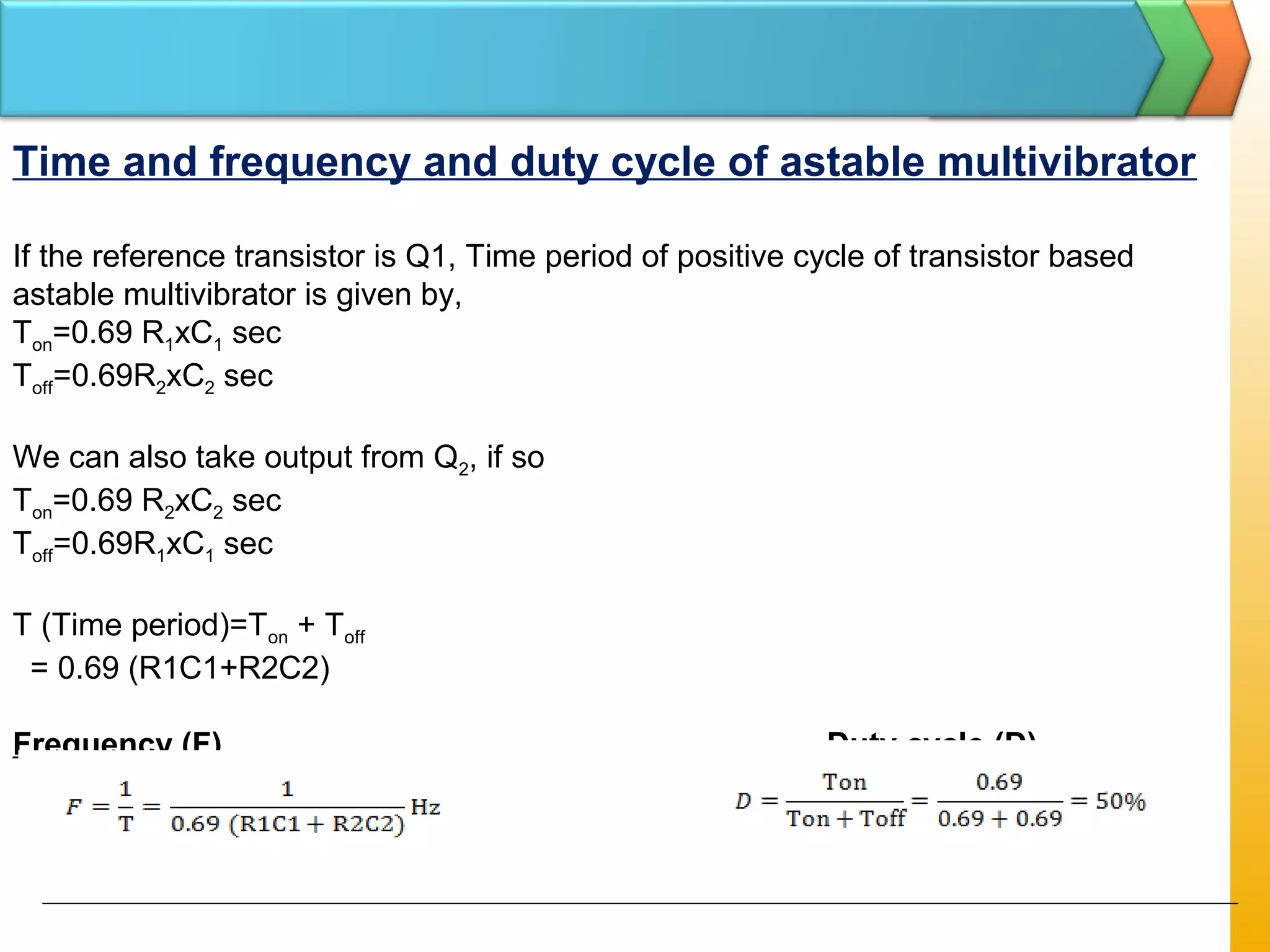
Time and frequency and duty cycle of astable multivibrator
If the reference transistor is Q1, Time period of positive cycle of transistor based
astable multivibrator is given by,
Ton=0.69 R1xC1 sec
Toff=0.69R2xC2 sec
We can also take output from Q2, if so
Ton=0.69 R2xC2 sec
Toff=0.69R1xC1 sec
T (Time period)=Ton + Toff
= 0.69 (R1C1+R2C2)
Frequency (F) Duty cycle (D)
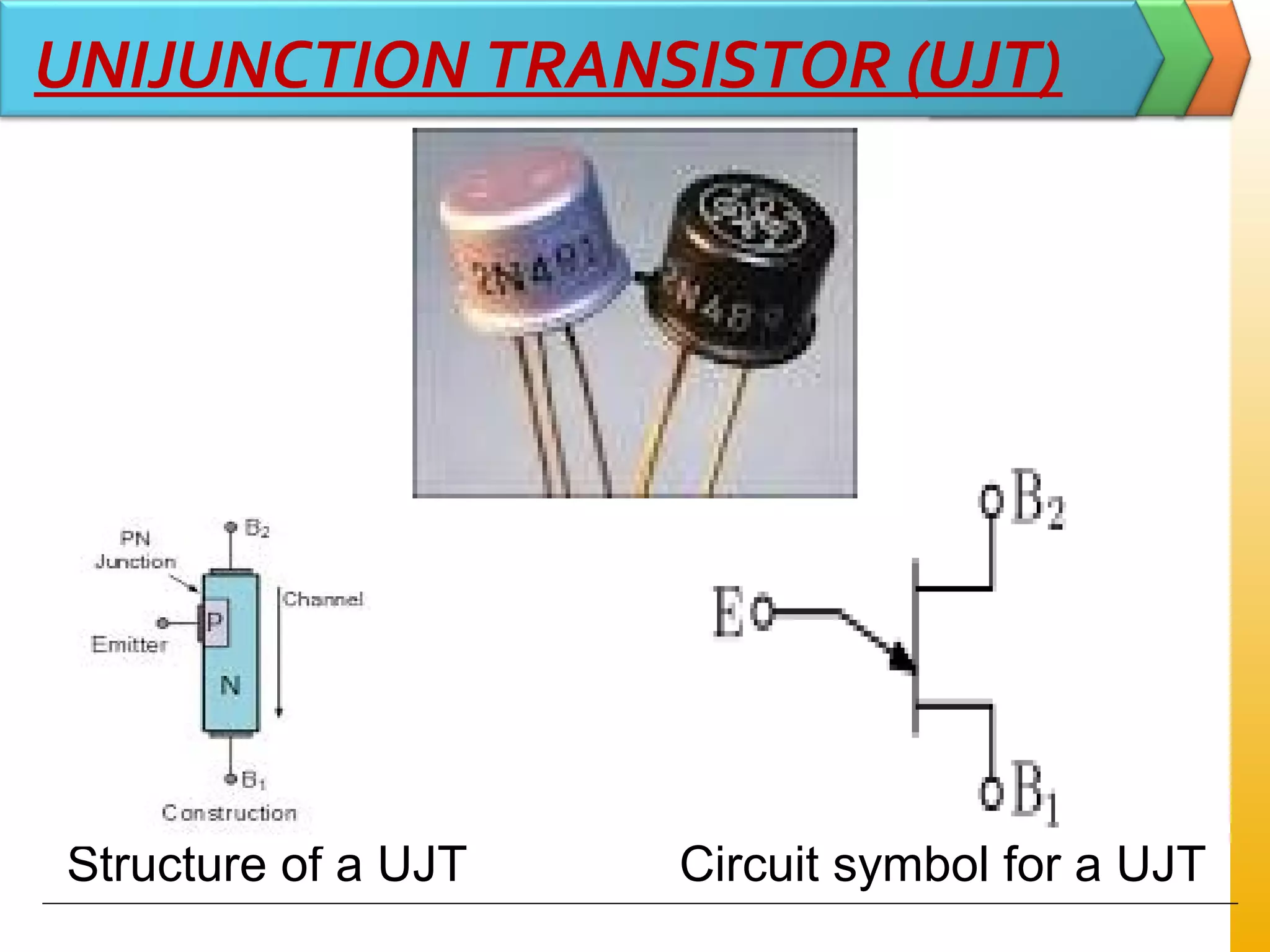
UNIJUNCTION TRANSISTOR (UJT)
Structure of a UJT Circuit symbol for a UJT
- A junction transistor (UJT) is a three-
lead electronic semiconductor device with only one junction that
acts exclusively as an electrically controlled switch.
-The UJT is not used as a linear amplifier. It is used in free-running
oscillators, synchronized or triggered oscillators, and pulse
generation circuits at low to moderate frequencies (hundreds of
kilohertz). It is widely used in the triggering circuits for silicon
controlled rectifiers.
-Its applications includes oscillators, pulse generators, saw-tooth
generators, triggering circuits, phase control, timing circuits, and
voltage- or current-regulated supplies.
The worth noting points about UJT:
1)The device has only one junction, so it is called the unijunction
device.
2)The device, because of one P-N junction, is quite similar to a diode
but it differs from an ordinary diode as it has three terminals.
3)The structure of a UJT is quite similar to that of an N-channel JFET.
The main difference is that the gate surface of the JFET is much larger
than emitter junction of UJT.
4)In a UJT the emitter is heavily doped while the N-region is lightly
doped, so the resistance between the base terminals is relatively
high, typically 4 to 10 kilo Ohm when the emitter is open.
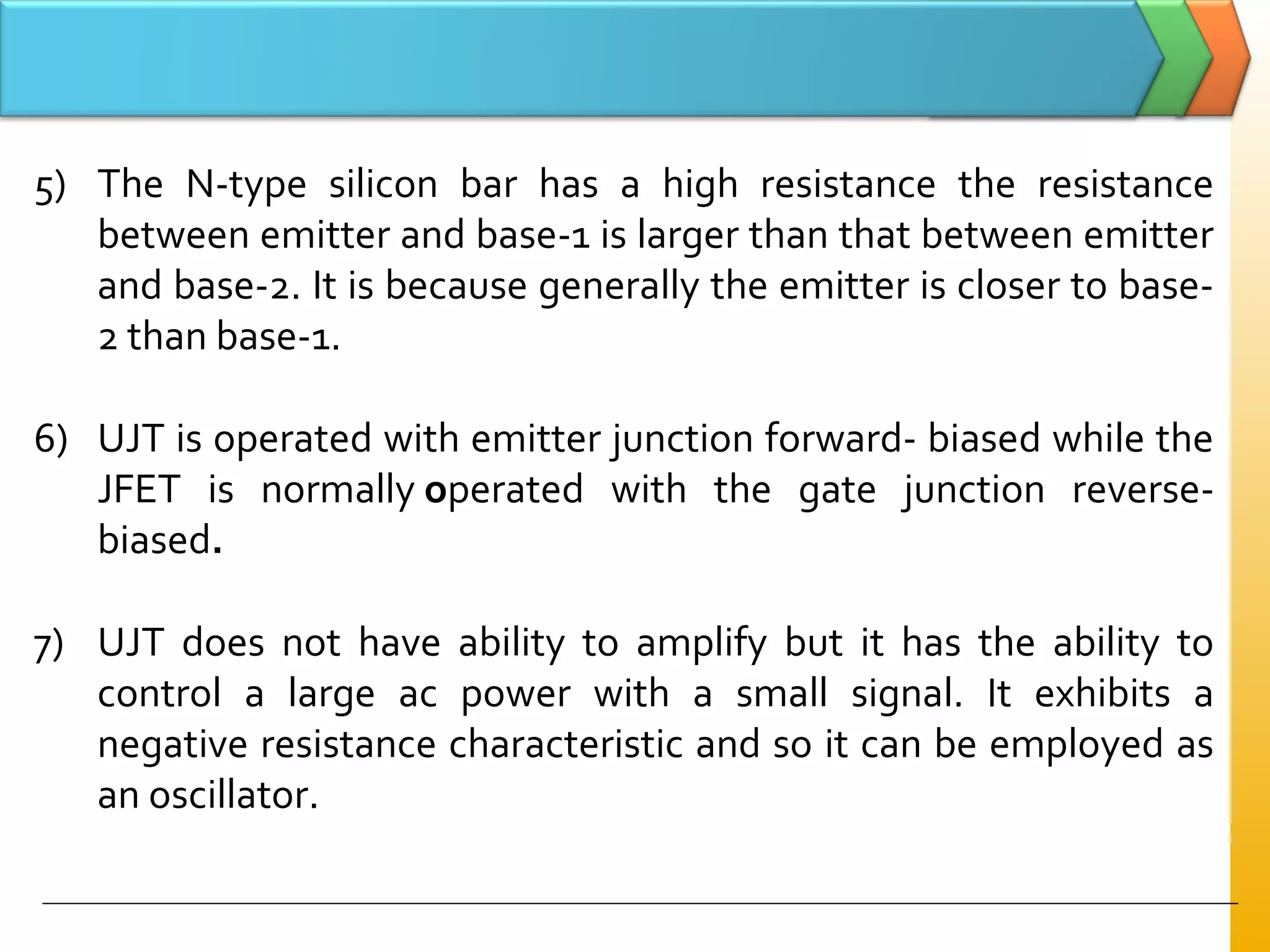
5) The N-type silicon bar has a high resistance the resistance
between emitter and base-1 is larger than that between emitter
and base-2. It is because generally the emitter is closer to base-
2 than base-1.
6) UJT is operated with emitter junction forward- biased while the
JFET is normally operated with the gate junction reverse-
biased.
7) UJT does not have ability to amplify but it has the ability to
control a large ac power with a small signal. It exhibits a
negative resistance characteristic and so it can be employed as
an oscillator.
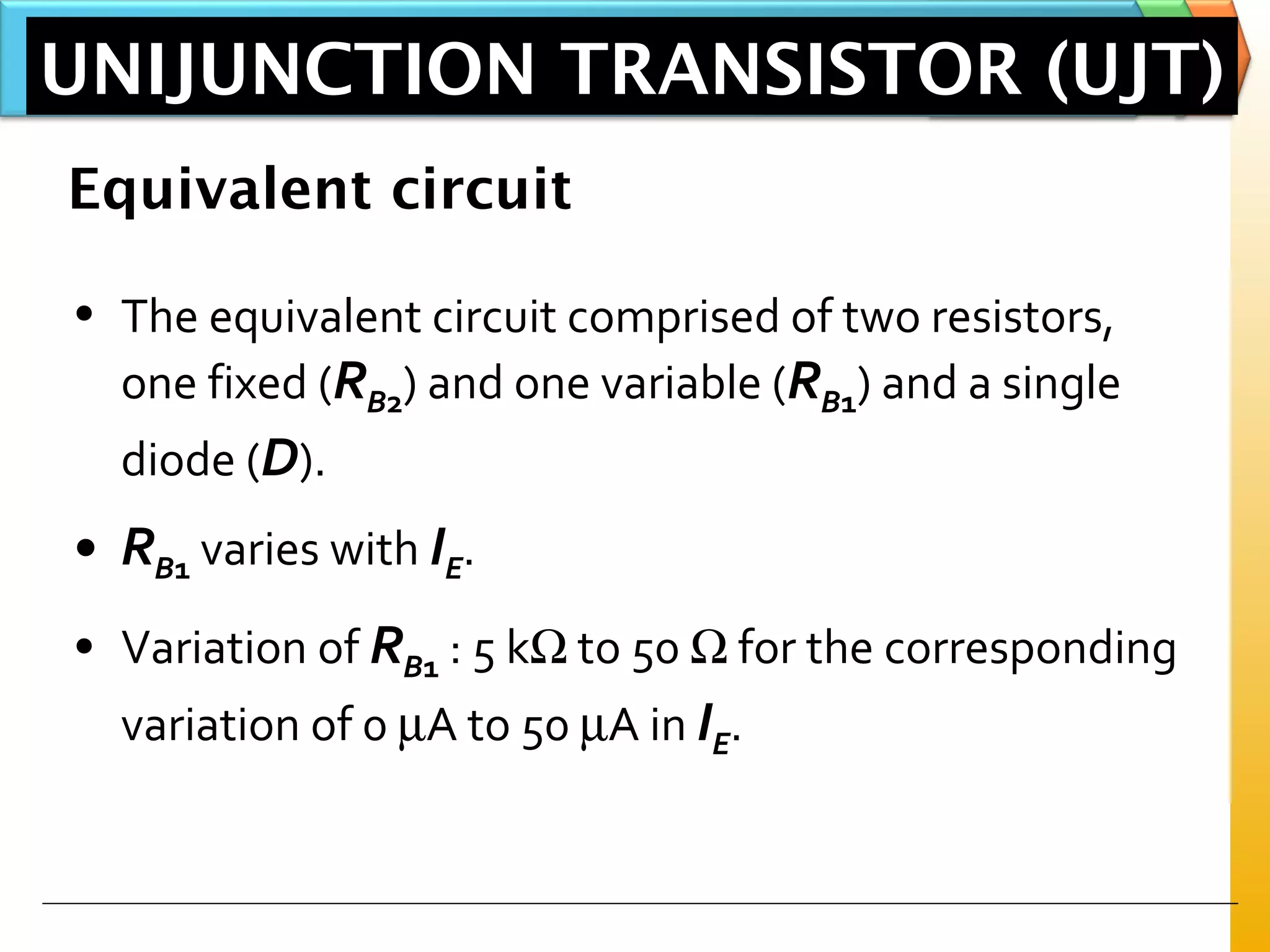
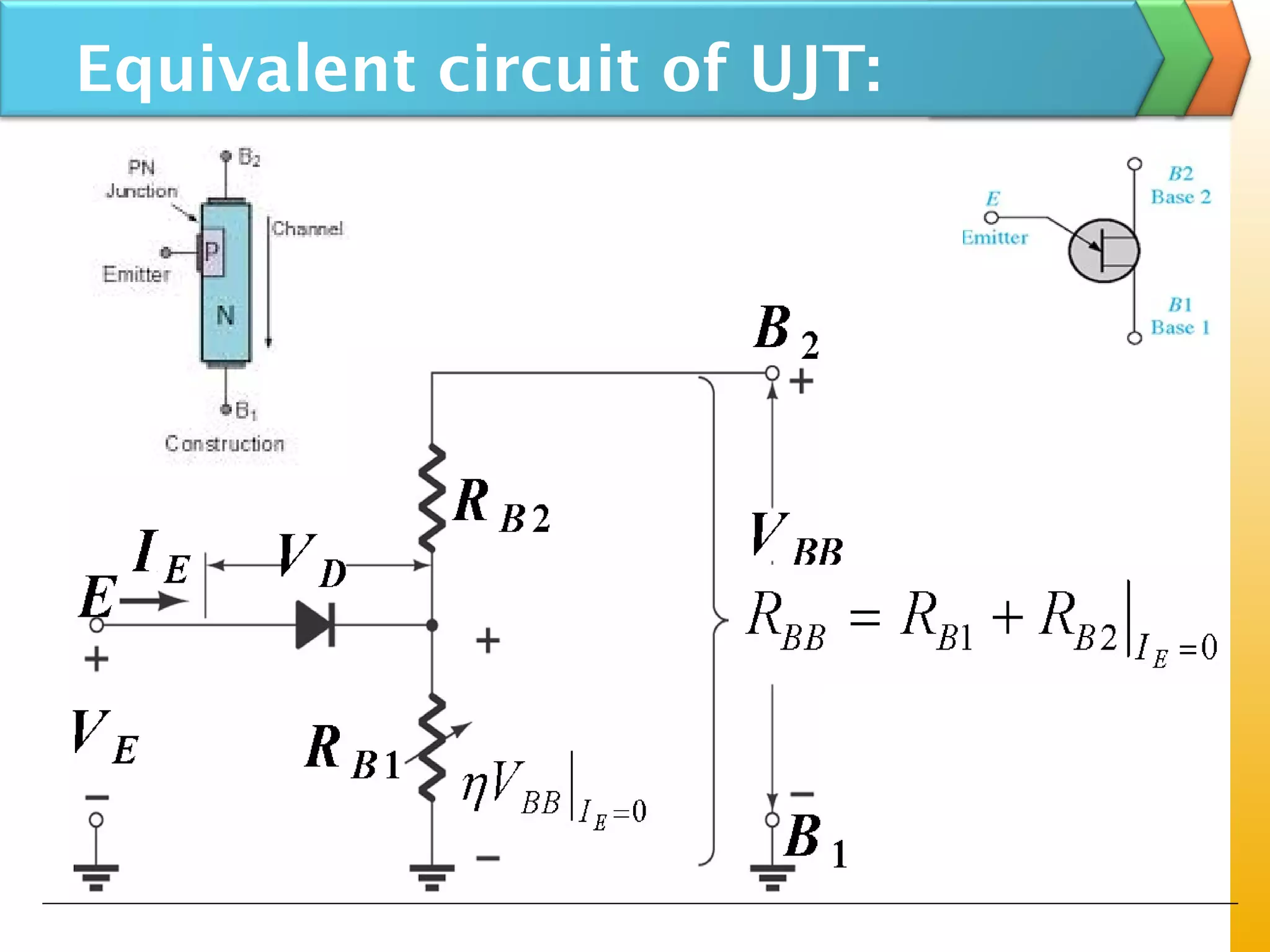
Equivalent circuit
• The equivalent circuit comprised of two resistors,
one fixed (RB2) and one variable (RB1) and a single
diode (D).
• RB1 varies with IE.
• Variation of RB1 : 5 kΩ to 50 Ω for the corresponding
variation of 0 µA to 50 µA in IE.
UNIJUNCTION TRANSISTOR (UJT)
Equivalent circuit of UJT:
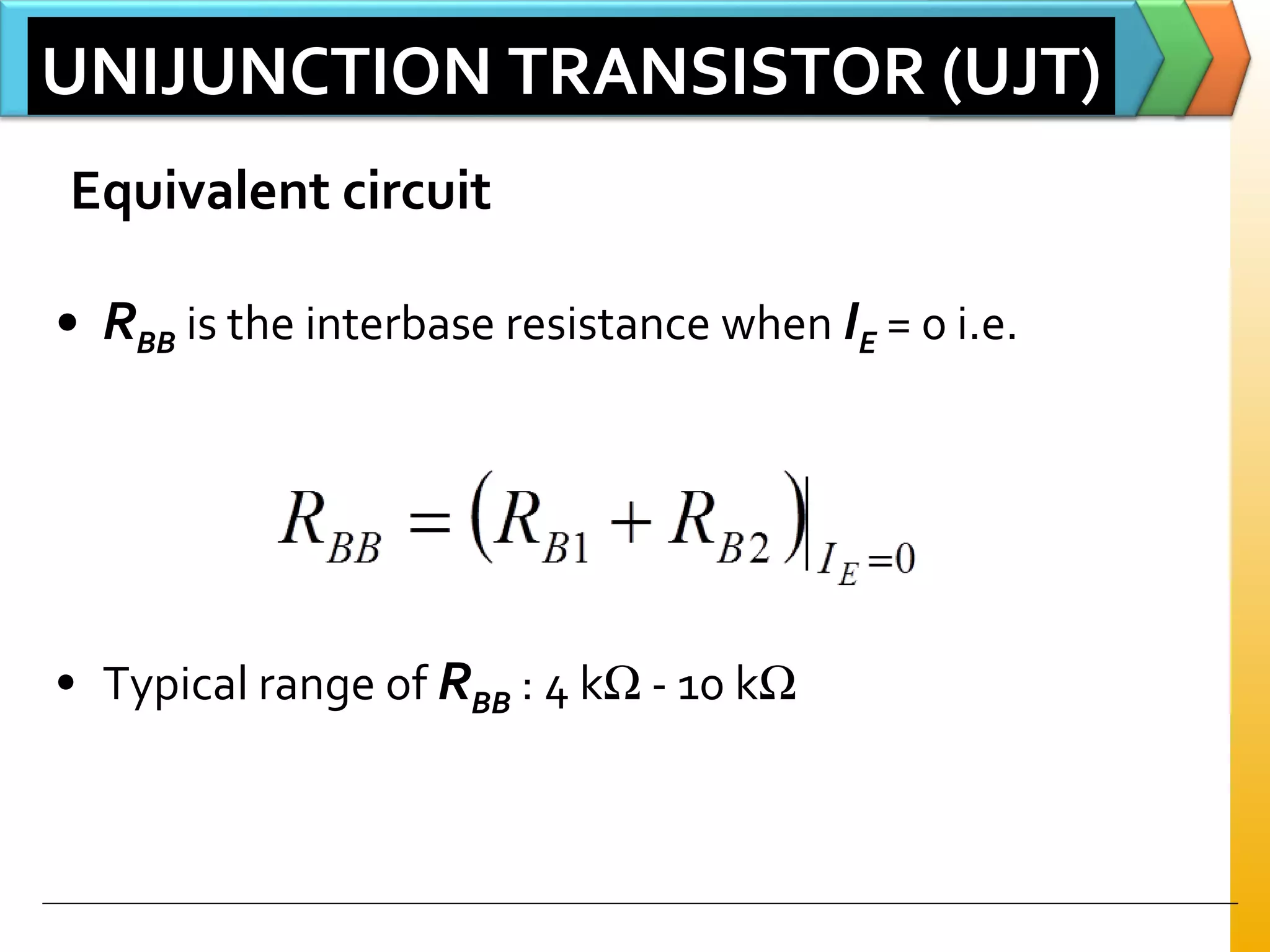
Equivalent circuit
• RBB is the interbase resistance when IE = 0 i.e.
• Typical range of RBB : 4 kΩ - 10 kΩ
UNIJUNCTION TRANSISTOR (UJT)
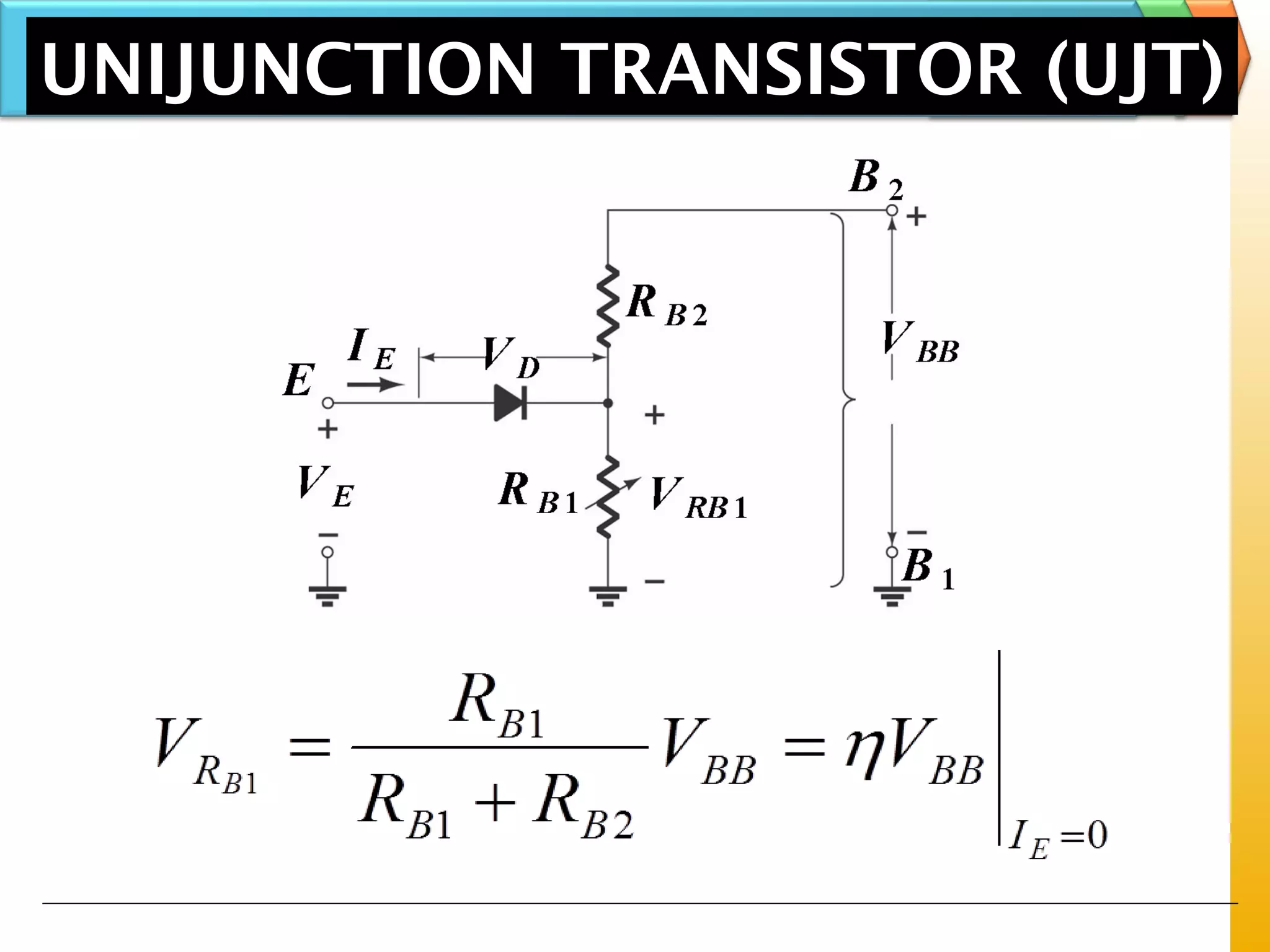
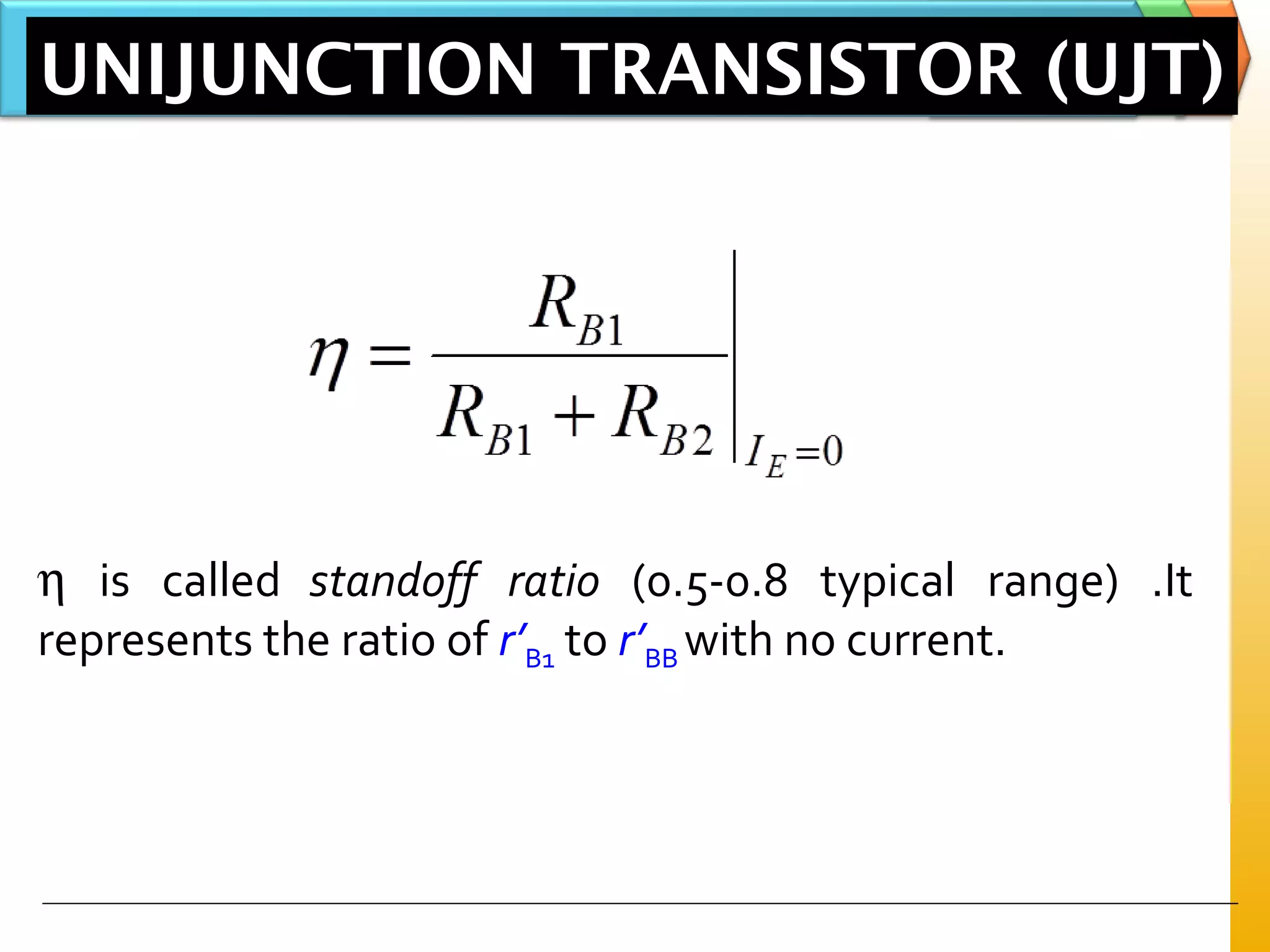
η is called standoff ratio (0.5-0.8 typical range) .It
represents the ratio of r’B1 to r’BB with no current.
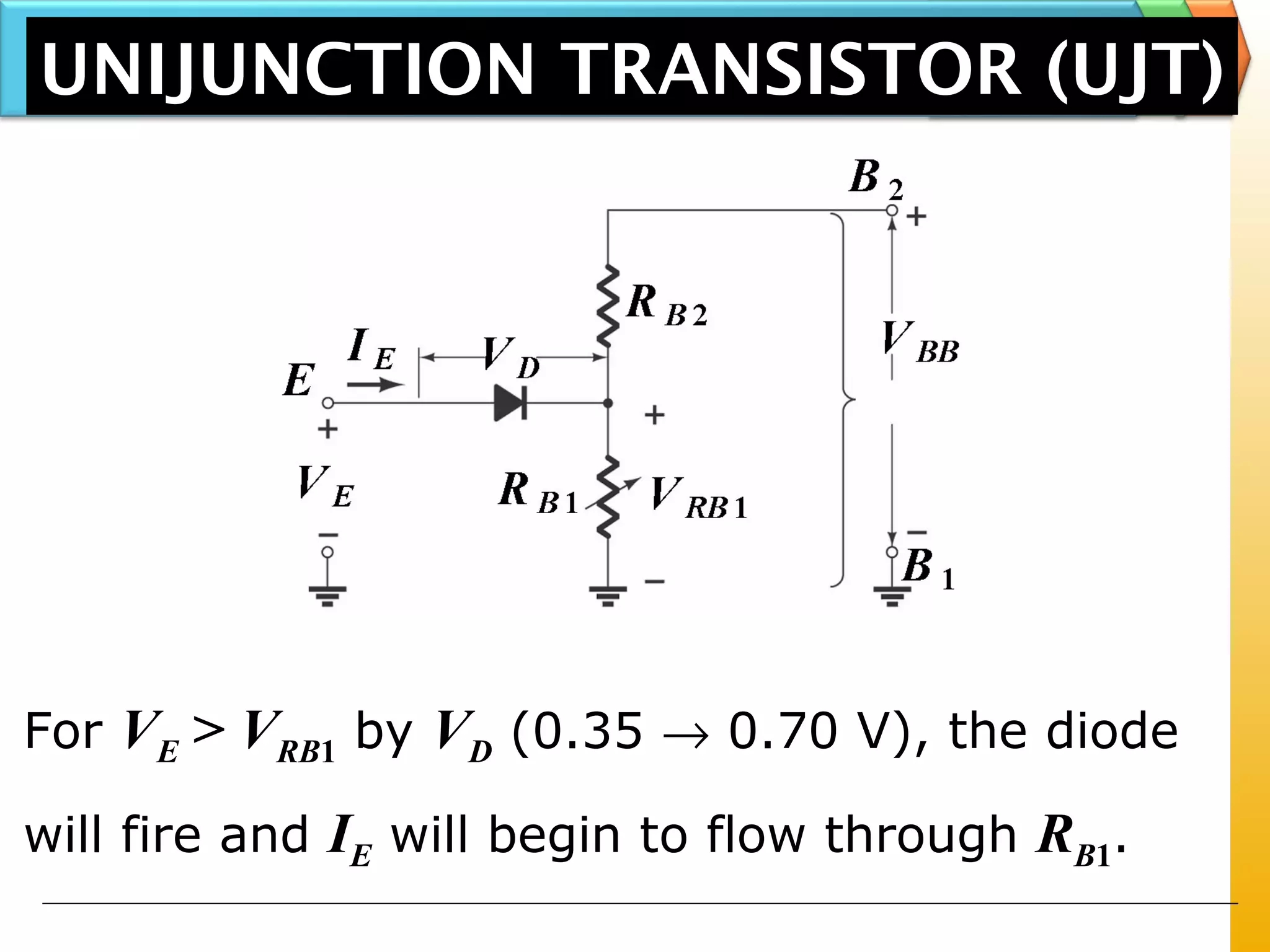
For VE > VRB1 by VD (0.35 → 0.70 V), the diode
will fire and IE will begin to flow through RB1.
UNIJUNCTION TRANSISTOR (UJT)
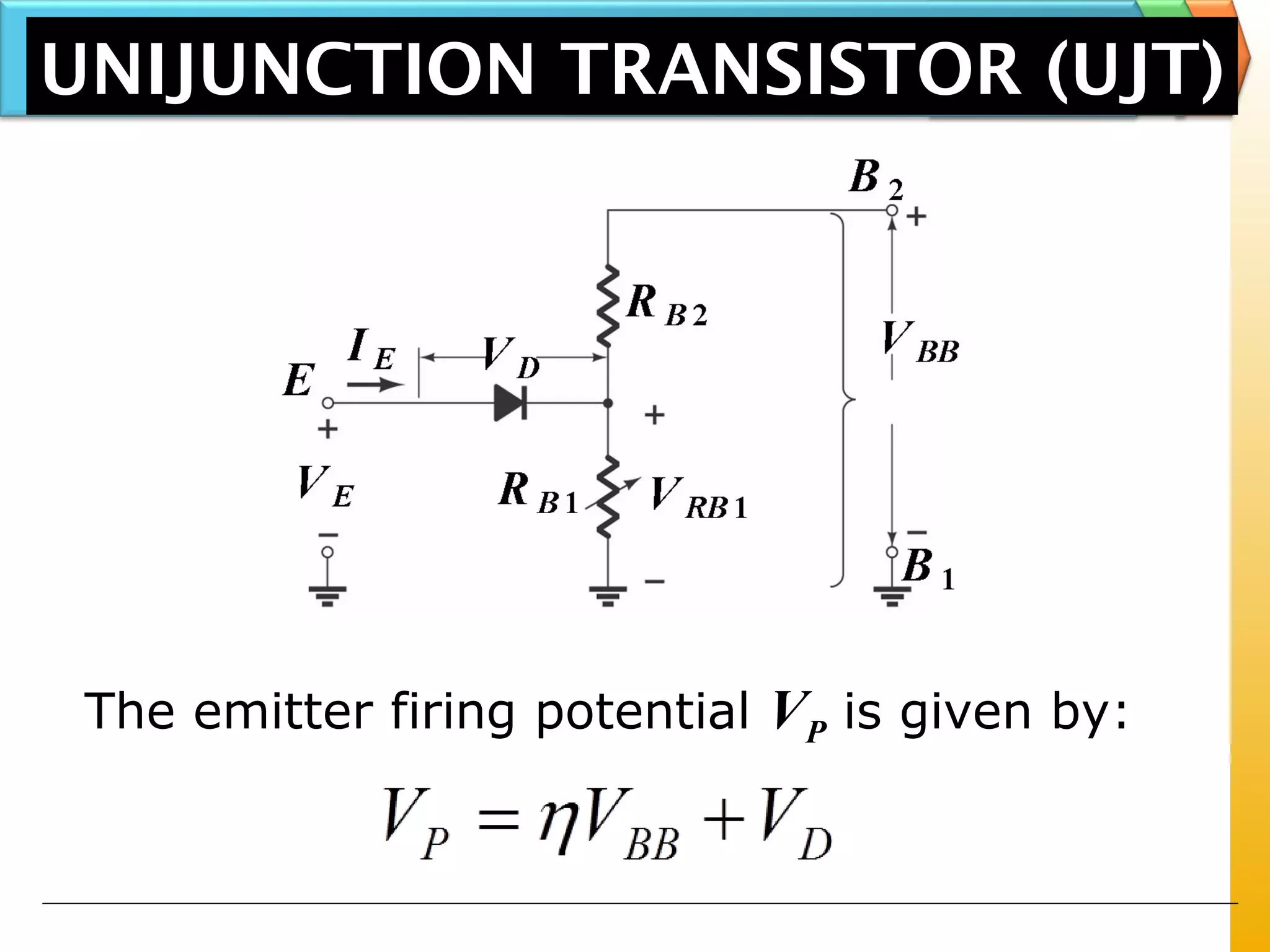
The emitter firing potential VP is given by:
UNIJUNCTION TRANSISTOR (UJT)
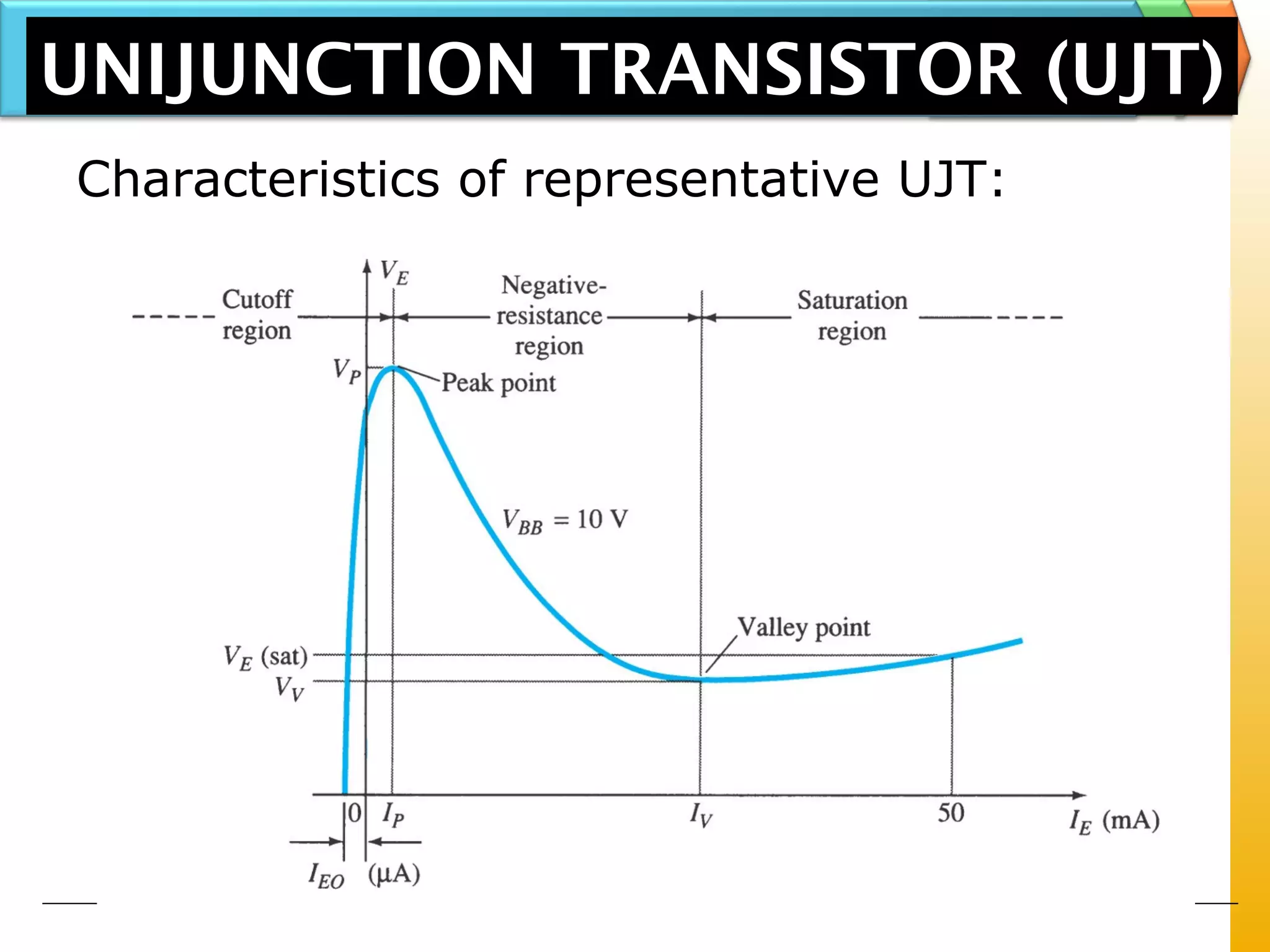
Characteristics of representative UJT:
UNIJUNCTION TRANSISTOR (UJT)
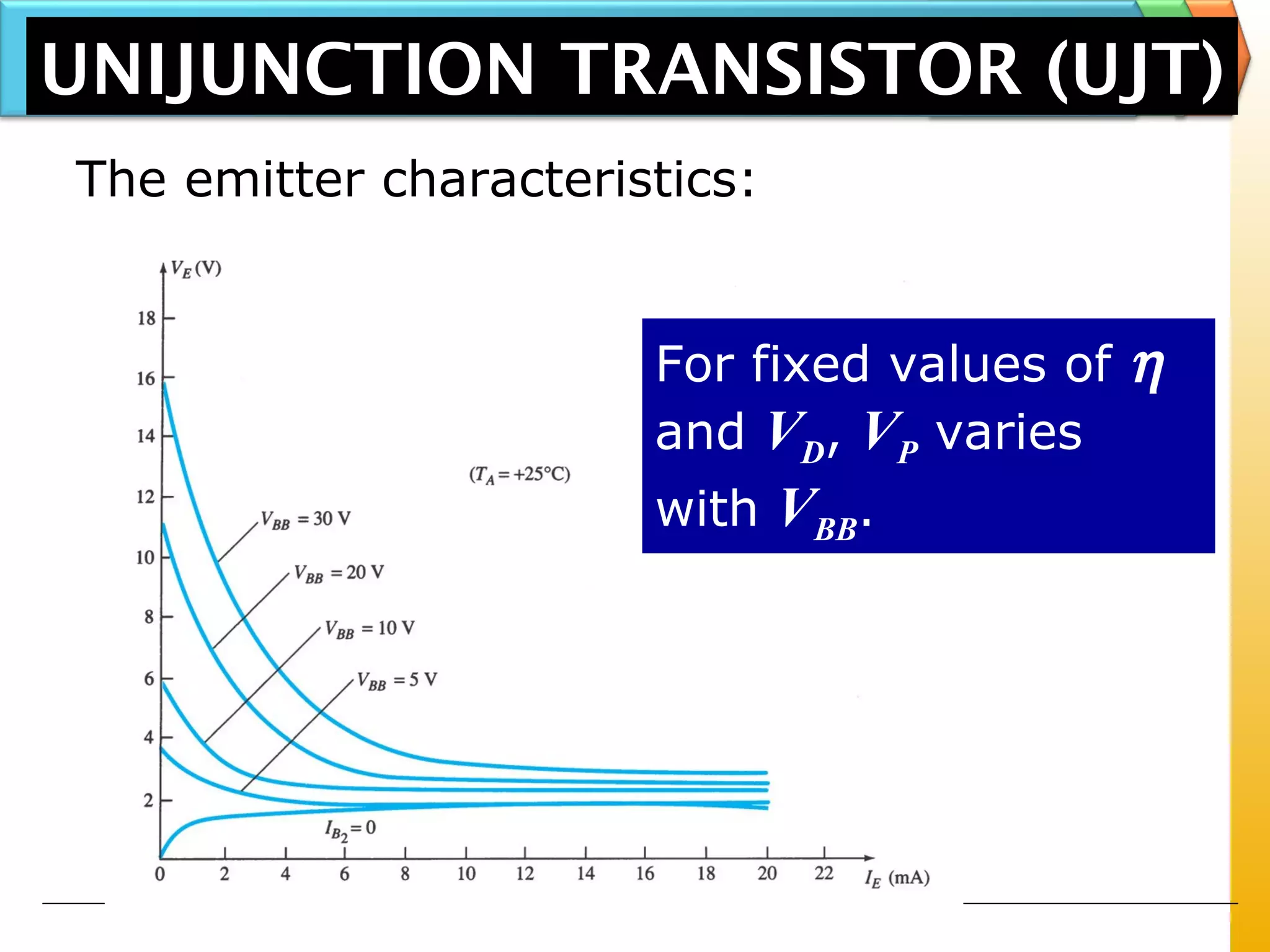
The emitter characteristics:
For fixed values of η
and VD, VP varies
with VBB.
UNIJUNCTION TRANSISTOR (UJT)
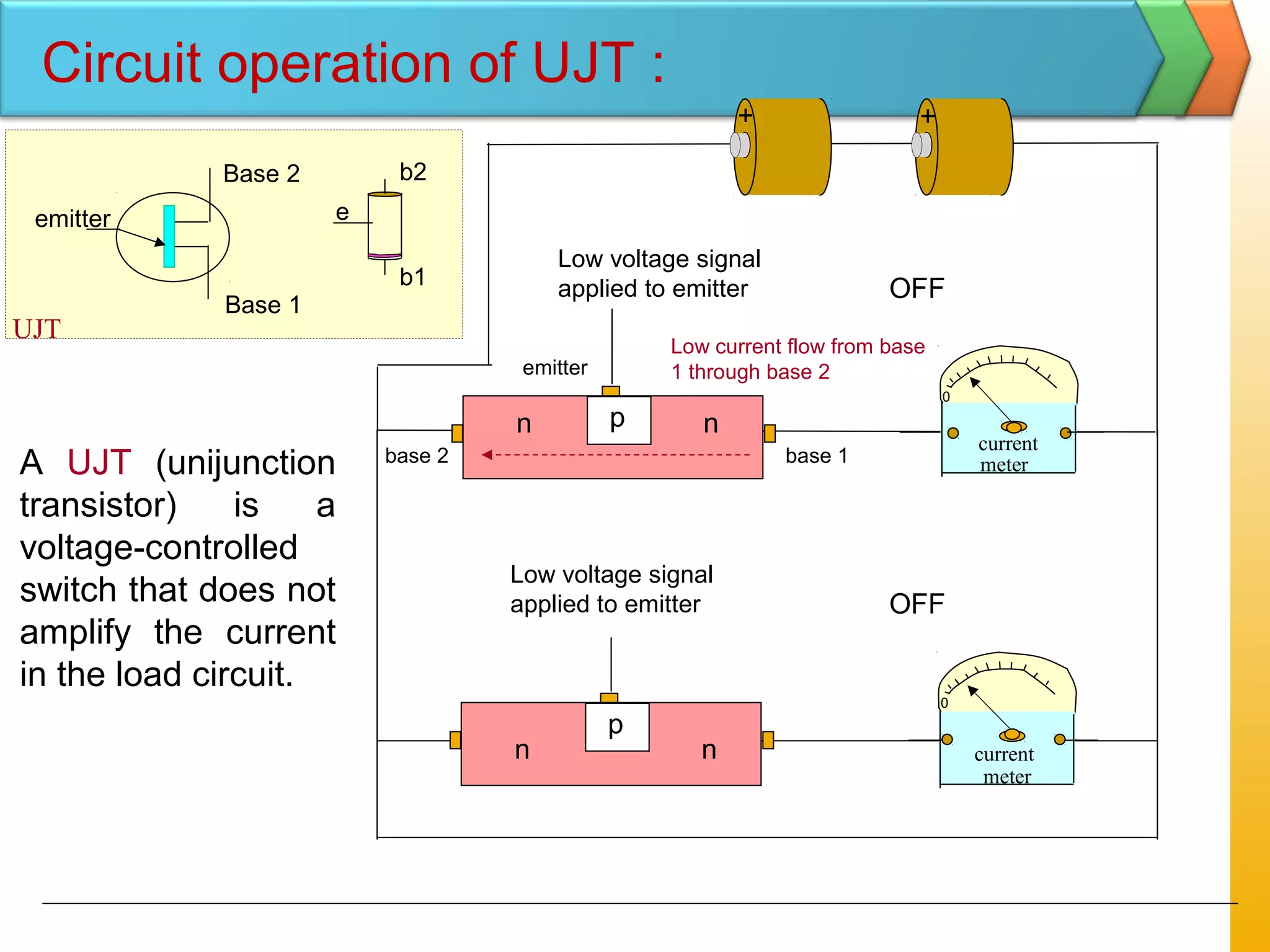
Low voltage signal
applied to emitter
A UJT (unijunction
transistor) is a
voltage-controlled
switch that does not
amplify the current
in the load circuit.
emitter
Base 1
Base 2
e
b2
b1
UJT
p
n n
0
Low current flow from base
1 through base 2emitter
pn n
current
meter
0
+
+
base 1base 2
Low voltage signal
applied to emitter
current
meter
OFF
OFF
Circuit operation of UJT :
Low voltage signal
applied to emitter
emitter
pn n
current
meter
0
+
+
emitter
Base 1
Base 2
e
b2
b1
UJT
p
n n
00
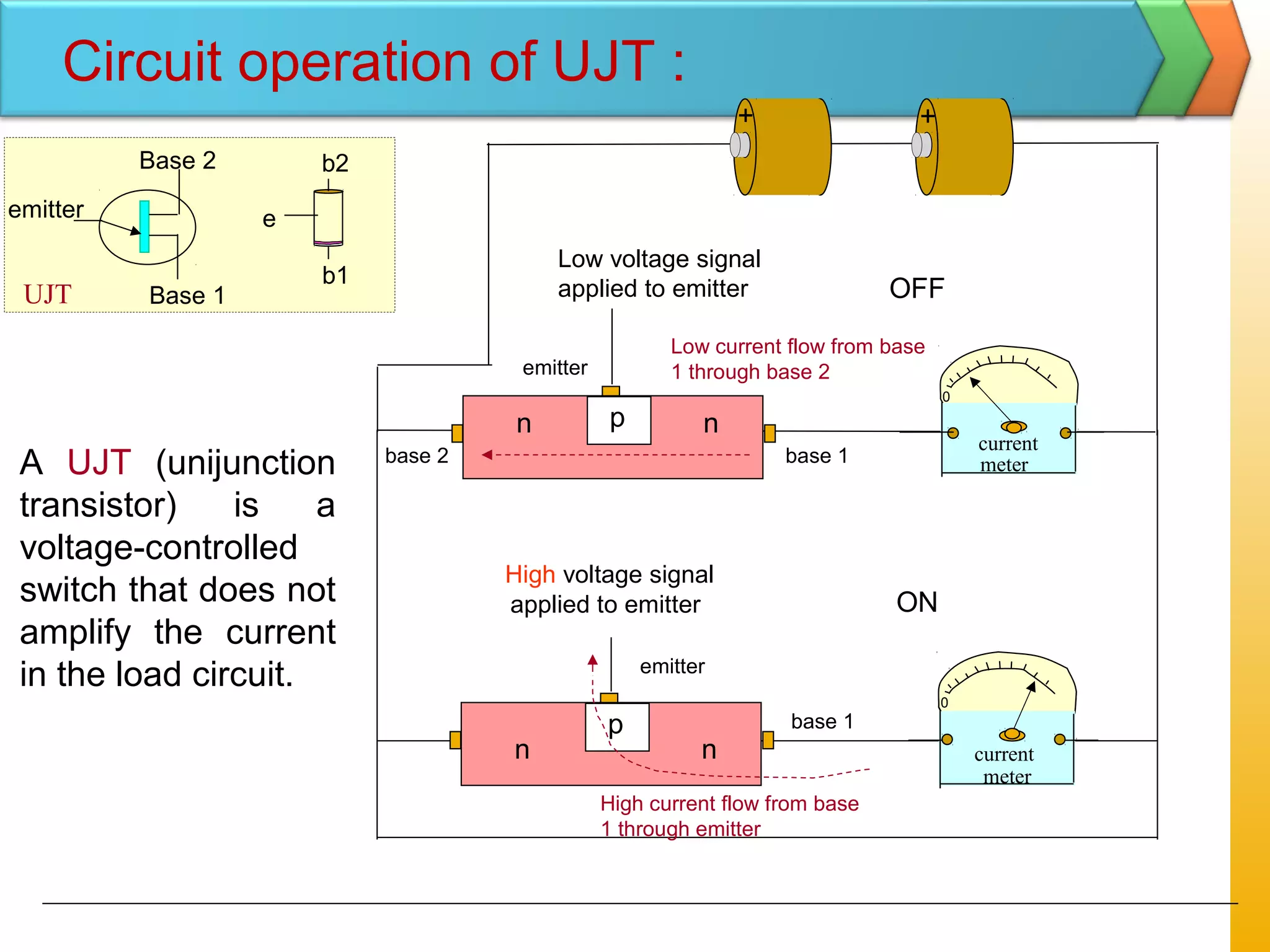
Low current flow from base
1 through base 2
base 1base 2
applied to emitter
High voltage signal
current
meter
OFF
ON
High current flow from base
1 through emitter
base 1
A UJT (unijunction
transistor) is a
voltage-controlled
switch that does not
amplify the current
in the load circuit. emitter
Circuit operation of UJT :
+
+
+
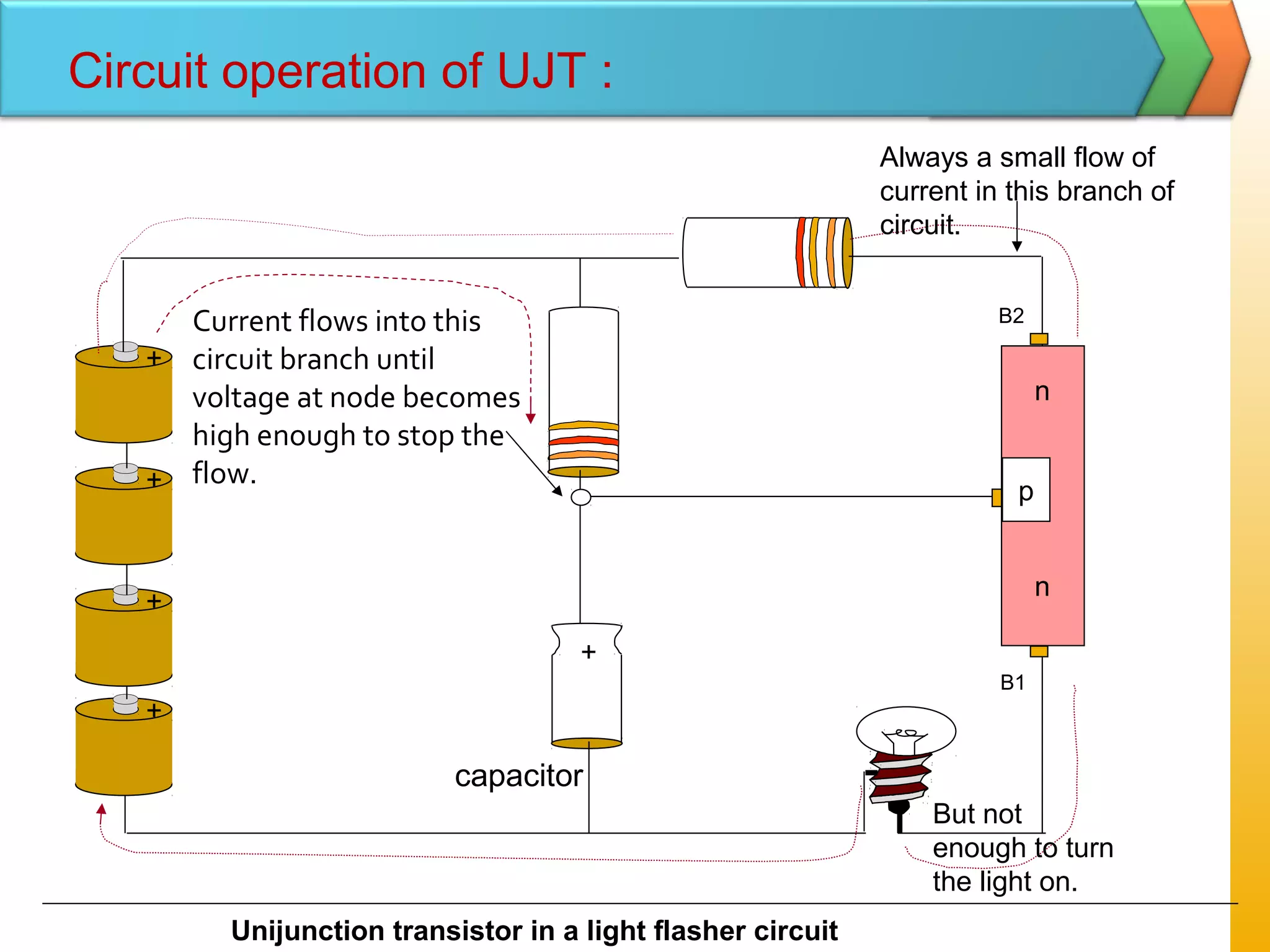
B2Current flows into this
circuit branch until
voltage at node becomes
high enough to stop the
flow.
p
n
n
B1
+
+
capacitor
Always a small flow of
current in this branch of
circuit.
But not
enough to turn
the light on.
Unijunction transistor in a light flasher circuit
Circuit operation of UJT :
Current flows into this circuit
branch until voltage at node
becomes high enough to stop
the flow.
+
+
B2
p
n
n
B1
+
capacitor
(This charging current
continues its flow into the
capacitor until the capacitor
becomes fully charged and
node reaches the threshold
voltage value.)
Always a small flow of
current in this branch of
circuit.
+
+
When node voltage reaches
threshold value, the
capacitor discharges current
through the emitter to B1
circuit
vthreshold
Light is ON while
capacitor discharge
current is flowing.
Unijunction transistor in a light flasher circuit
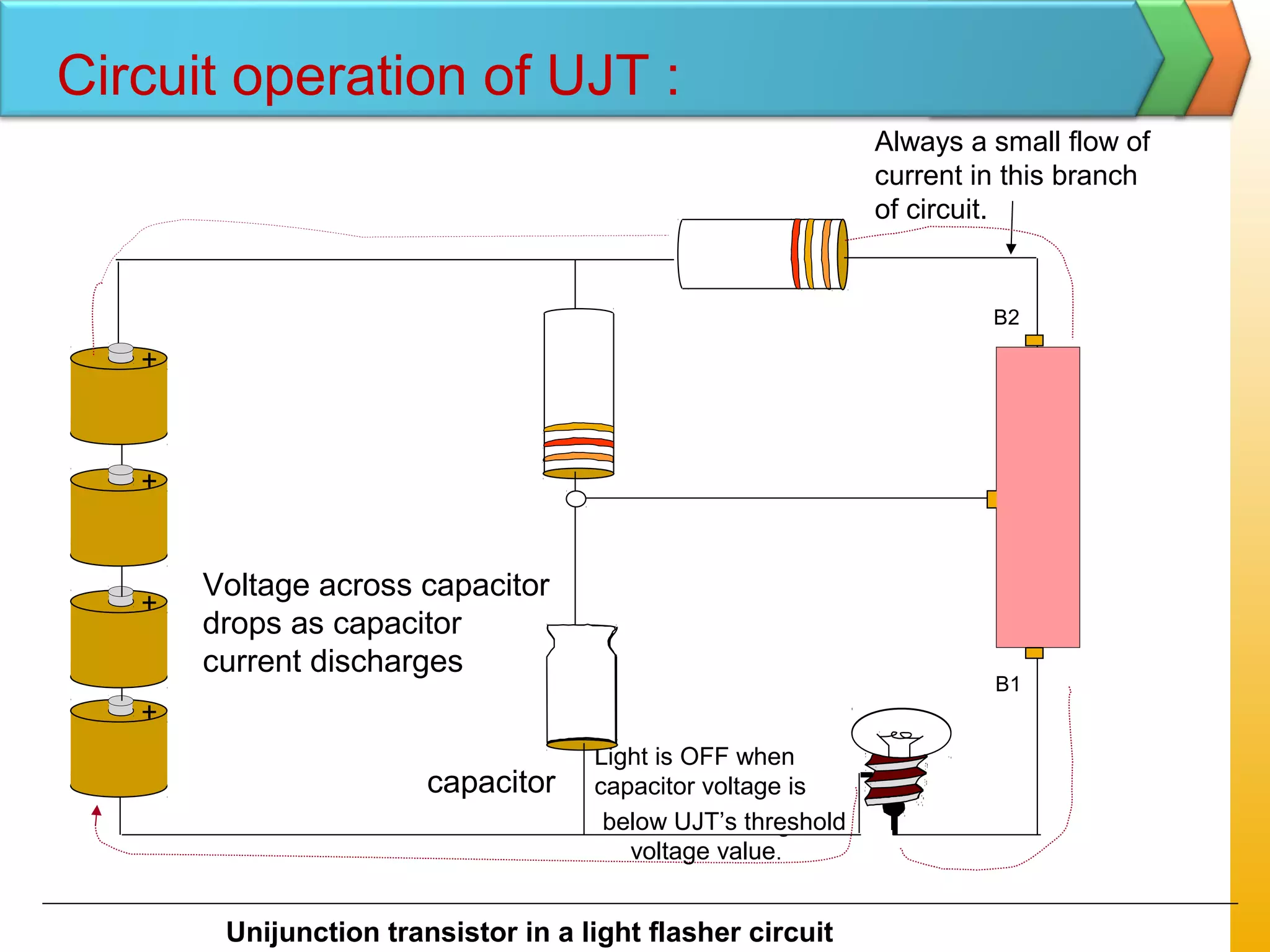
Circuit operation of UJT :
vthreshold
When node voltage reaches
threshold value, the capacitor
discharges current through the
emitter-B1 circuit
+
+
B2
Unijunction transistor in a light flasher circuit
capacitor
Always a small flow of
current in this branch
of circuit.
+
+
Voltage across capacitor
drops as capacitor
current discharges
Light is ON while
capacitor discharge
current is flowing.
Light is OFF when
capacitor voltage is
+
p
n
n
below UJT’s threshold
voltage value.
B1
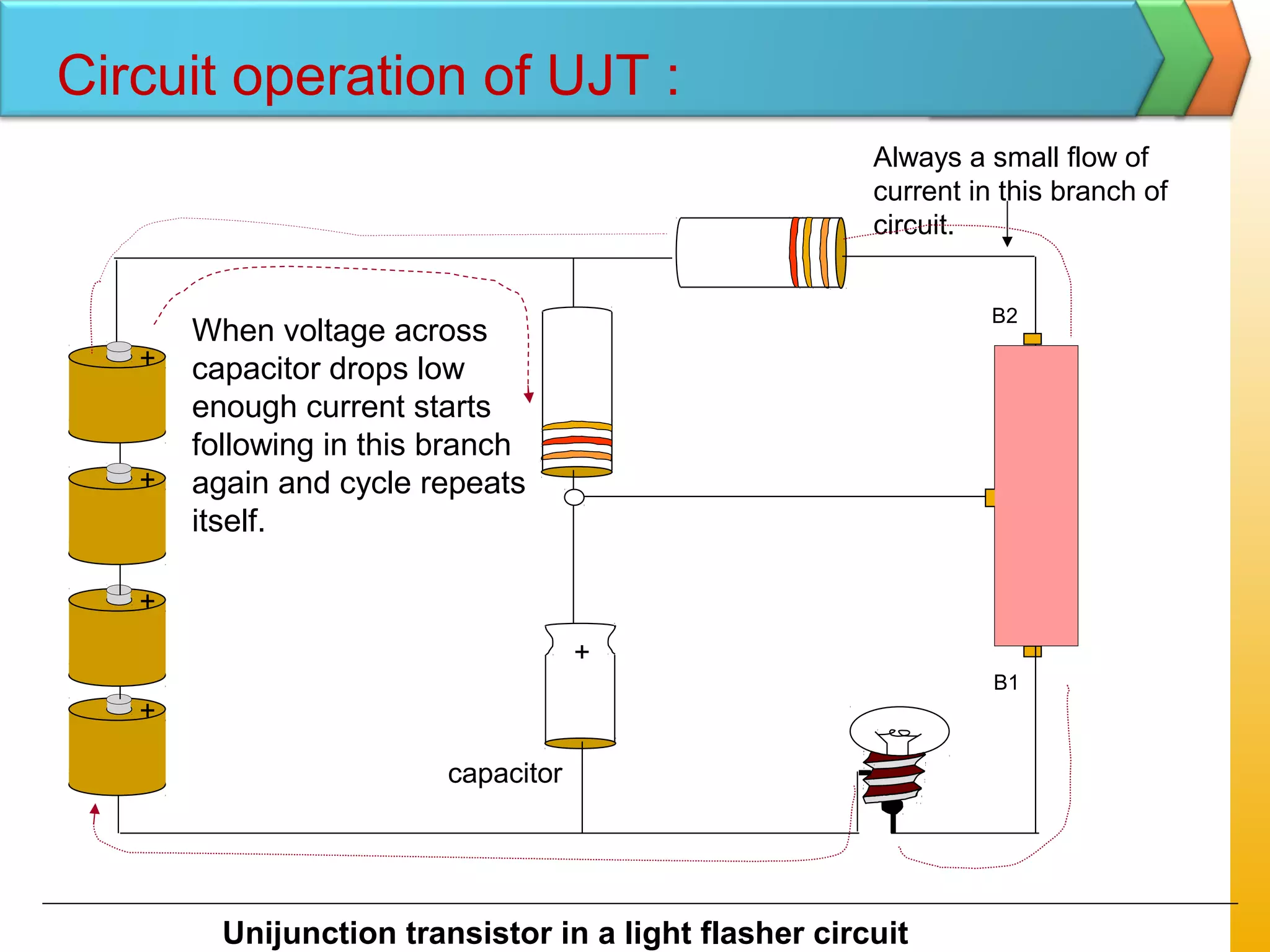
Circuit operation of UJT :
+
+
B2
Unijunction transistor in a light flasher circuit
B1
capacitor
Always a small flow of
current in this branch of
circuit.
+
+
Voltage across capacitor
drops as capacitor current
discharges
p
n
n
When voltage across
capacitor drops low
enough current starts
following in this branch
again and cycle repeats
itself.
+
Circuit operation of UJT :
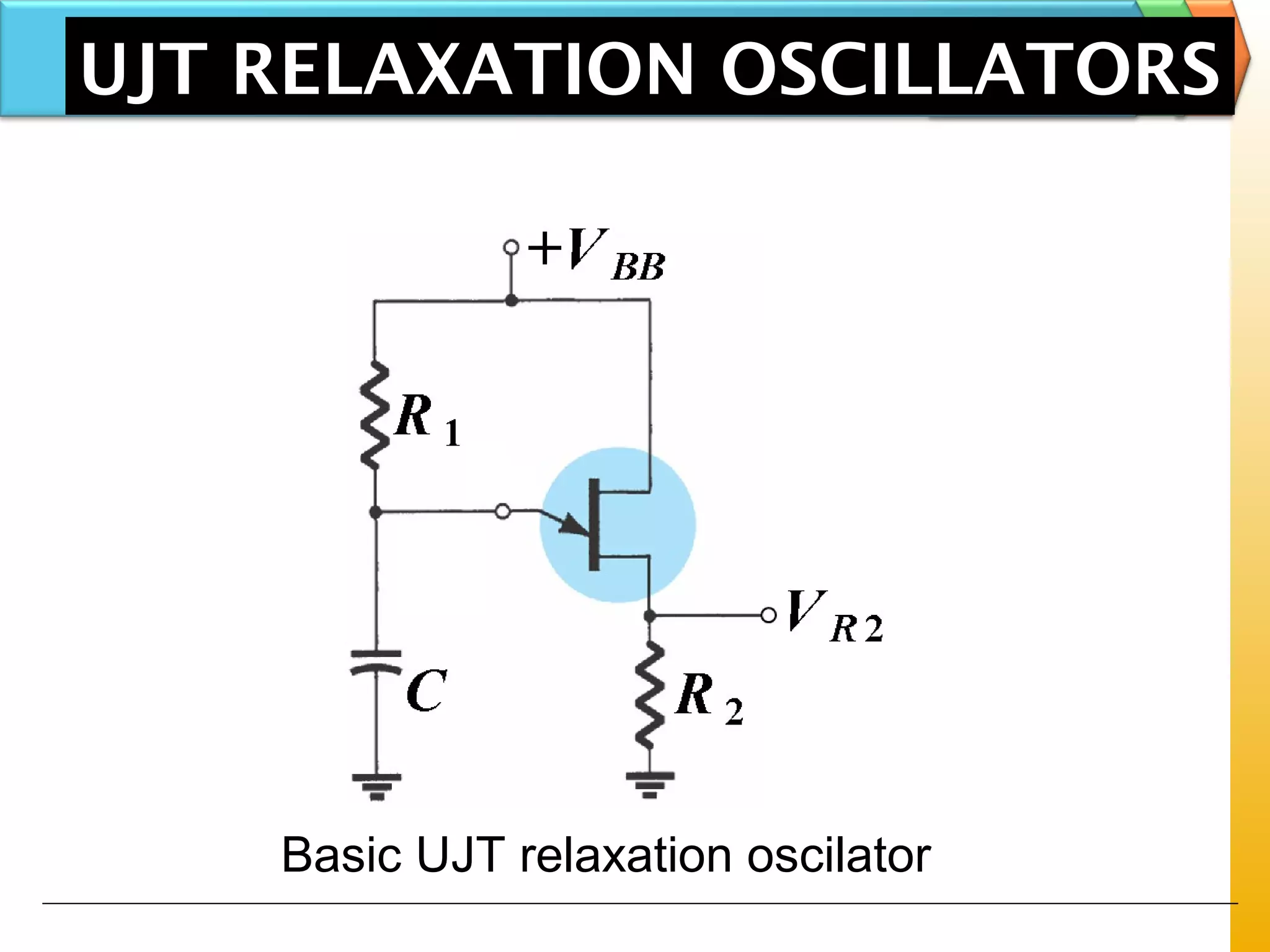
UJT RELAXATION OSCILLATORS
Basic UJT relaxation oscilator
UJT RELAXATION OSCILLATORS
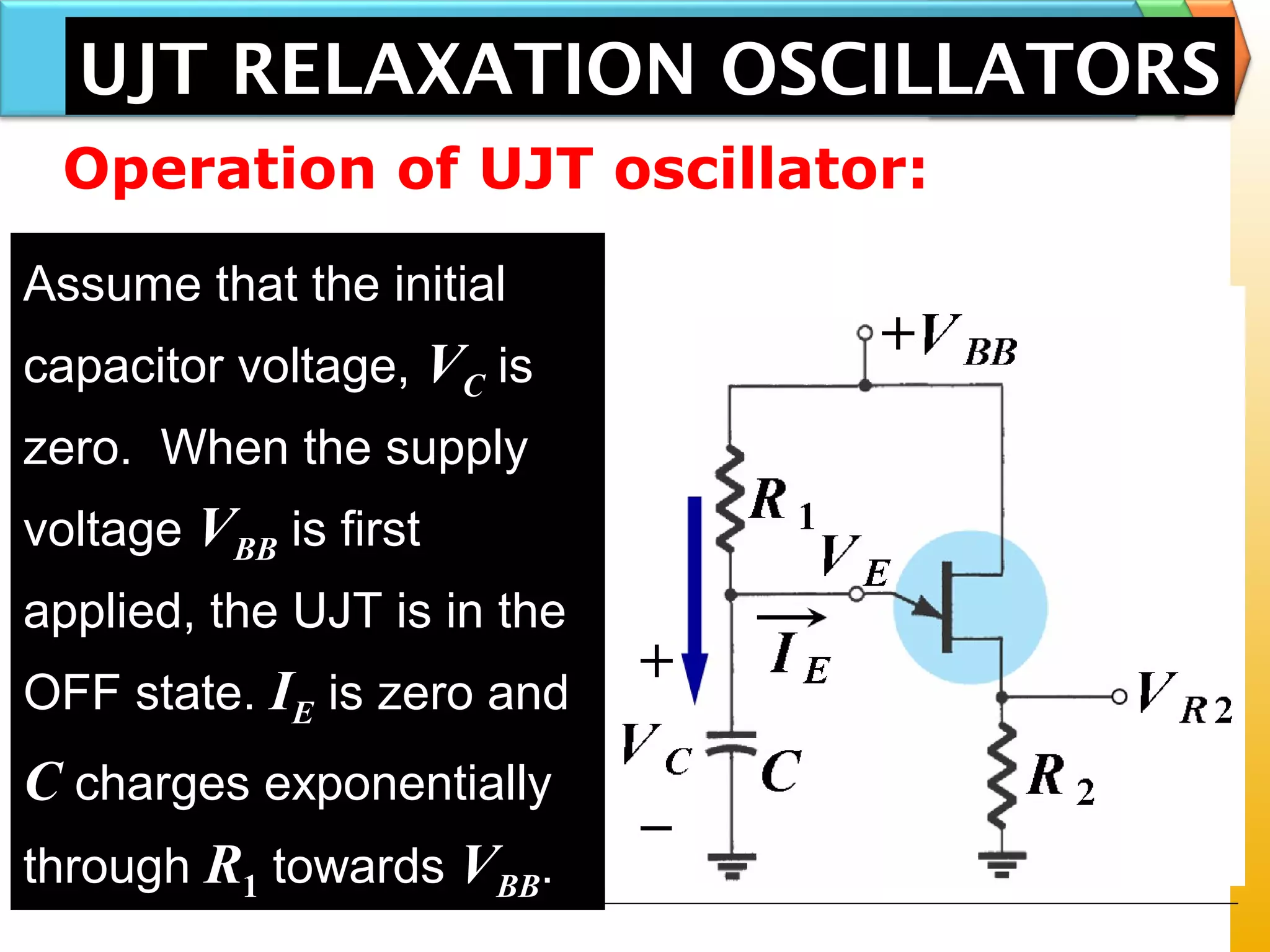
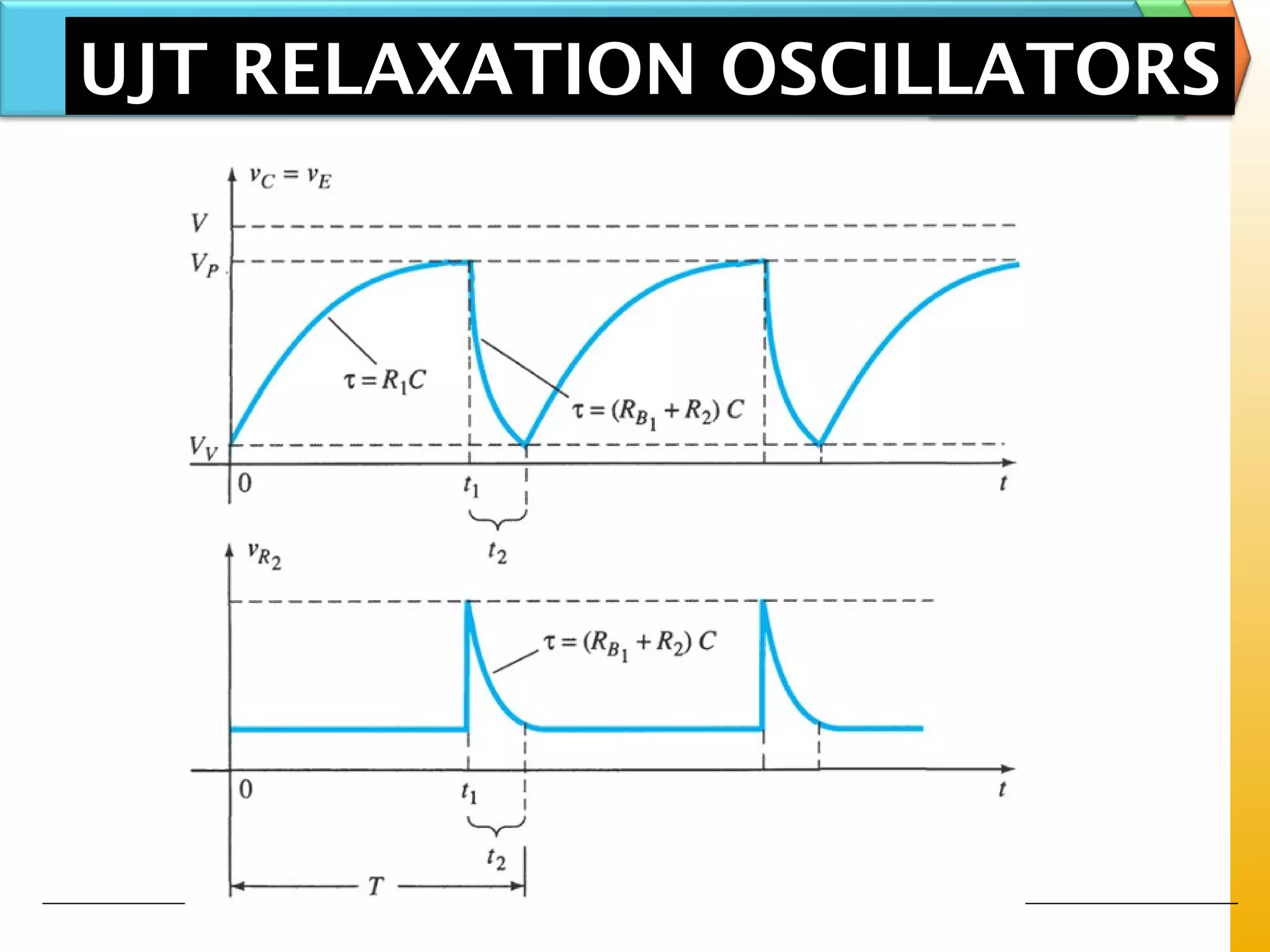
Assume that the initial
capacitor voltage, VC is
zero. When the supply
voltage VBB is first
applied, the UJT is in the
OFF state. IE is zero and
C charges exponentially
through R1 towards VBB.
Operation of UJT oscillator:
UJT RELAXATION OSCILLATORS
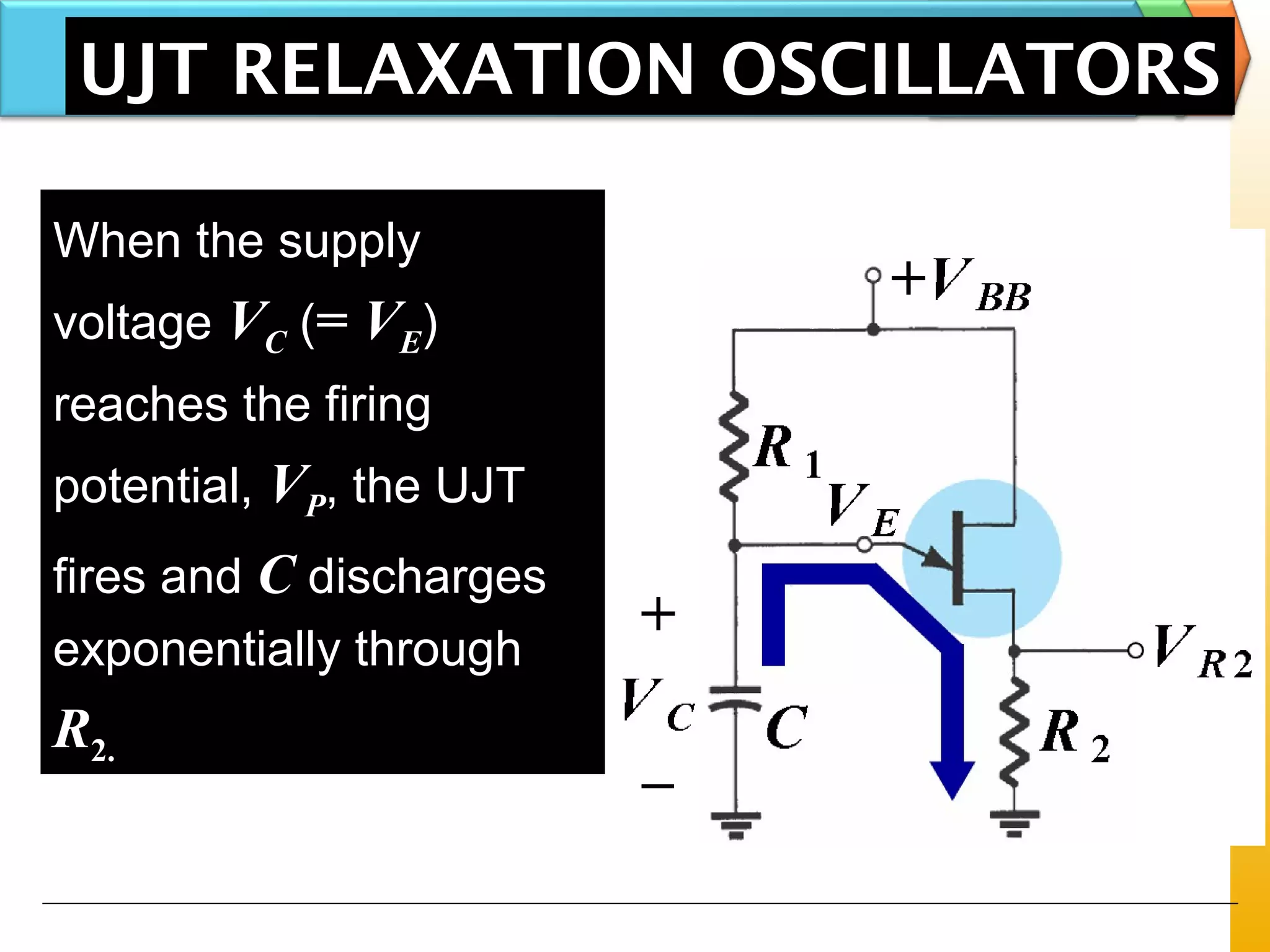
When the supply
voltage VC (= VE)
reaches the firing
potential, VP, the UJT
fires and C discharges
exponentially through
R2.
- when the emitter diode starts conducting, charge carriers
are injected into the RB region of the bar.
- Since the resistance of a semiconductor material depends
upon doping, the resistance of region RB decreases rapidly
due to additional charge carriers (holes).
- With this decrease in resistance, the voltage drop across
RB also decrease, cause the emitter diode to be more
heavily forward biased.
- This, in turn, results in larger forward current, and
consequently more charge carriers are injected causing still
further reduction in the resistance of the RB region.
- Thus the emitter current goes on increasing until it is limited
by the emitter power supply or some other mechanism like
capacitor charging/discharging at emitter circuit.
- Since VE decreases with the increase in emitter current, the
UJT is said to have negative resistance characteristic. It is
seen that the base-2 (B2) is used only for applying external
voltage VBB across it.
- When VE reaches the minimum potential (valley potential VV)
the UJT turns OFF, IE goes to zero and the capacitor is
recharged.
- This process repeats itself to produce the waveforms for vC
and vR2 as shown in the next slide;
UJT RELAXATION OSCILLATORS
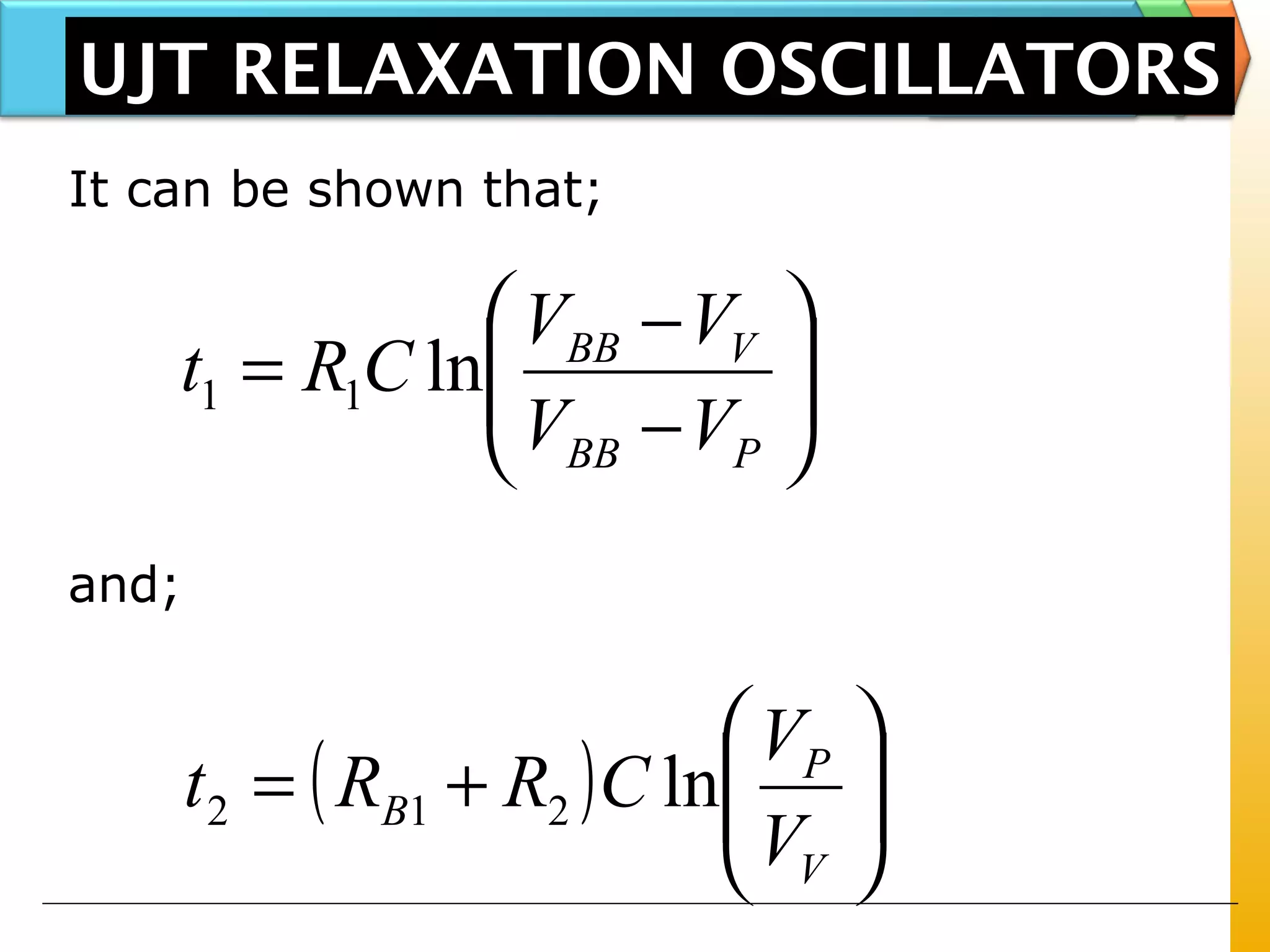
It can be shown that;






−
−
=
PBB
VBB
VV
VV
CRt ln11
and;
( ) 





+=
V
P
B
V
V
CRRt ln212
UJT RELAXATION OSCILLATORS
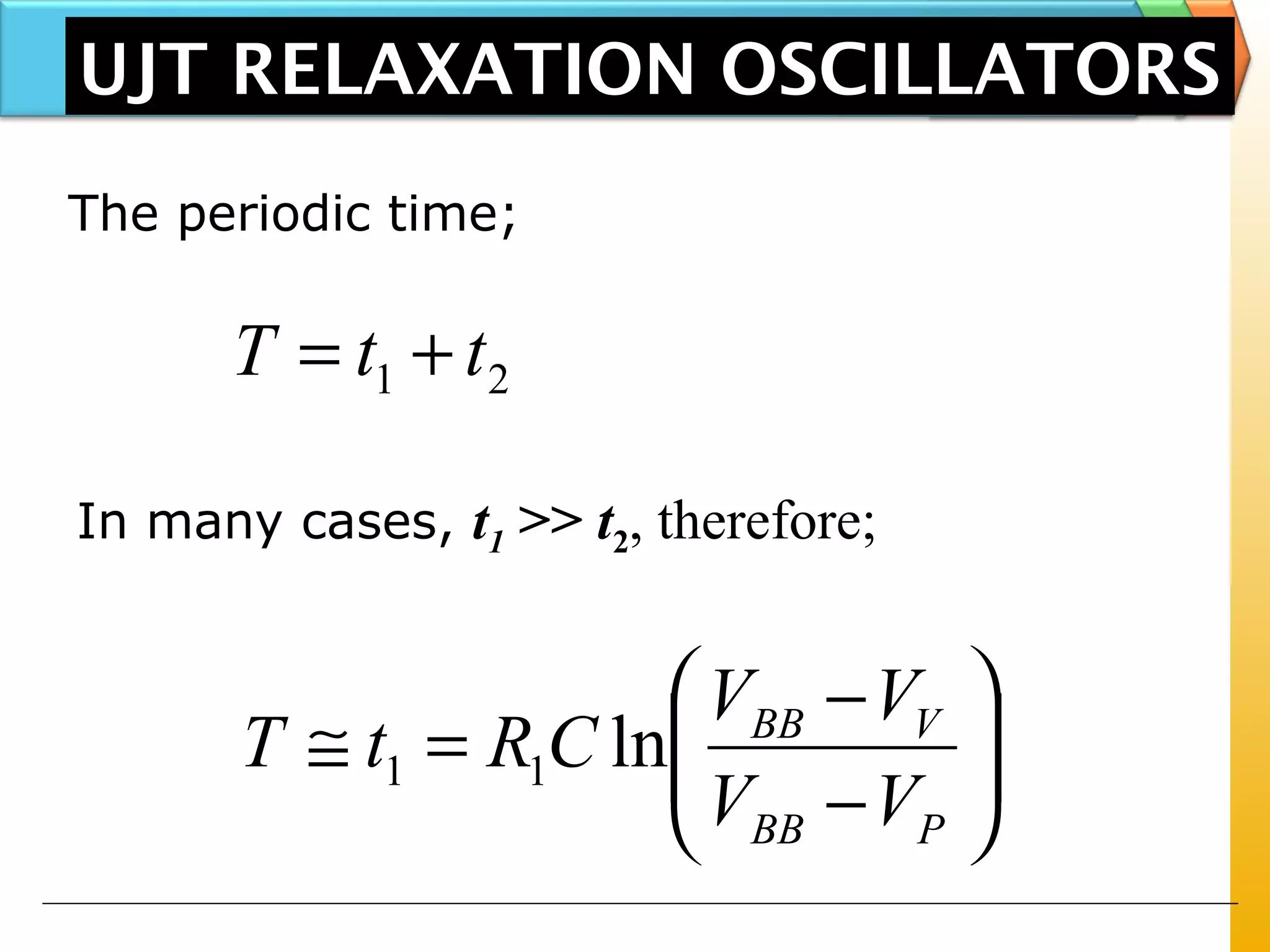
The periodic time;
21 ttT +=
In many cases, t1 >> t2, therefore;






−
−
=≅
PBB
VBB
VV
VV
CRtT ln11

Relaxation oscillators

  • 2.
    Multivibrators A multivibrator isan electronic circuit that switches rapidly by means of positive feedback between two or more states. There are three types of multivibrator circuit depending on the circuit operation: Astable; in which the circuit is not stable in either state —it continually switches from one state to the other. It does not require an input such as a clock pulse.
  • 3.
    Monostable, in whichone of the states is stable, but the other state is unstable (transient). A trigger causes the circuit to enter the unstable state. After entering the unstable state, the circuit will return to the stable state after a set time. Such a circuit is useful for creating a timing period of fixed duration in response to some external event. This circuit is also known as a one shot. Bistable, in which the circuit is stable in either state. The circuit can be flipped from one state to the other by an external event or trigger. The bistable multivibrator is simply a latch (flip-flop); it is added to this classification only for completeness.
  • 4.
    A multivibrator consistsof two main components — two passive networks and a bistable circuit, connected in a common feedback loop. The networks can be both resistive-capacitive (in the case of an astable circuit), a resistive-capacitive and a resistive (monostable), and both resistive (bistable). Multivibrators find applications in a variety of systems where square waves or timed intervals are required.
  • 5.
    Astable Multivibrator An astablemultivibrator consists of two amplifying stages connected in a positive feedback loop by two capacitive-resistive coupling networks. The amplifying elements may be junction or field-effect transistors, vacuum tubes, operational amplifiers, or other types of amplifier. Regenerative switching circuits such as Astable Multivibrators are the most commonly used type of relaxation oscillator because not only are they are simple, reliable and easy to construct, they also produce a constant square wave output waveform.
  • 6.
    The Astable Multivibratorhas NO stable output states as it changes from one state to the other all the time. The astable circuit consists of two switching transistors, a cross- coupled feedback network, and two time delay capacitors which allows oscillation between the two states with no external trigger signal to produce the change in state.
  • 7.
    In Electronic Circuits,astable multivibrators are also known as Free-running Multivibrator as they do not require any additional inputs or external assistance to oscillate. Astable’s produce a continuous square wave from its output or outputs, (two outputs no inputs) which can then be used to flash lights or produce a sound in a loudspeaker. Time period of Astable multivibrator can be controlled by changing the values of feedback components such as coupling capacitors and resistors.
  • 8.
    Circuit operation: To begin,when power is applied, theoretically both T1 and T2 should turn on, since their base pins are connected through resistors (R2 and R3) to Vcc. However, due to small differences in the electric properties, one of the them will turn on slightly earlier than the other.
  • 9.
    Assume anyone ofthe transistors Q1 or Q2 turns ON due to parameter variation or due to some switching transients, let it be Q1. Then the collector voltage of Q1=Vce(sat)=0v(ground) approximately, it is cross coupled to base terminal of Q2 through C1, then Q2 remain in OFF state. During Q1 ON, the current path through R1 charges the capacitor C1, the capacitor C1 voltage is coupled to base of transistor Q2.
  • 10.
    While charging ofC1, when the capacitor voltage exceeds 0.7V, Q2 become turns ON. As soon as Q2 ON, its collector voltage falls to ground approximately, it is coupled to base terminal of Q1 then Q1 become OFF. At the same time capacitor C2 starts charging through R2, when the C2 voltage exceeds 0.7 V, Q1 turns ON due to cross coupling. This process continues.
  • 11.
    We can alsotake output from collector terminals of the transistors as shown in figure.
  • 12.
    Output waveform This isthe output taken from the collector terminal of Q1
  • 13.
    Time and frequencyand duty cycle of astable multivibrator If the reference transistor is Q1, Time period of positive cycle of transistor based astable multivibrator is given by, Ton=0.69 R1xC1 sec Toff=0.69R2xC2 sec We can also take output from Q2, if so Ton=0.69 R2xC2 sec Toff=0.69R1xC1 sec T (Time period)=Ton + Toff = 0.69 (R1C1+R2C2) Frequency (F) Duty cycle (D)
  • 14.
    UNIJUNCTION TRANSISTOR (UJT) Structureof a UJT Circuit symbol for a UJT
  • 15.
    - A junctiontransistor (UJT) is a three- lead electronic semiconductor device with only one junction that acts exclusively as an electrically controlled switch. -The UJT is not used as a linear amplifier. It is used in free-running oscillators, synchronized or triggered oscillators, and pulse generation circuits at low to moderate frequencies (hundreds of kilohertz). It is widely used in the triggering circuits for silicon controlled rectifiers. -Its applications includes oscillators, pulse generators, saw-tooth generators, triggering circuits, phase control, timing circuits, and voltage- or current-regulated supplies.
  • 16.
    The worth notingpoints about UJT: 1)The device has only one junction, so it is called the unijunction device. 2)The device, because of one P-N junction, is quite similar to a diode but it differs from an ordinary diode as it has three terminals. 3)The structure of a UJT is quite similar to that of an N-channel JFET. The main difference is that the gate surface of the JFET is much larger than emitter junction of UJT. 4)In a UJT the emitter is heavily doped while the N-region is lightly doped, so the resistance between the base terminals is relatively high, typically 4 to 10 kilo Ohm when the emitter is open.
  • 17.
    5) The N-typesilicon bar has a high resistance the resistance between emitter and base-1 is larger than that between emitter and base-2. It is because generally the emitter is closer to base- 2 than base-1. 6) UJT is operated with emitter junction forward- biased while the JFET is normally operated with the gate junction reverse- biased. 7) UJT does not have ability to amplify but it has the ability to control a large ac power with a small signal. It exhibits a negative resistance characteristic and so it can be employed as an oscillator.
  • 18.
    Equivalent circuit • Theequivalent circuit comprised of two resistors, one fixed (RB2) and one variable (RB1) and a single diode (D). • RB1 varies with IE. • Variation of RB1 : 5 kΩ to 50 Ω for the corresponding variation of 0 µA to 50 µA in IE. UNIJUNCTION TRANSISTOR (UJT)
  • 19.
  • 20.
    Equivalent circuit • RBBis the interbase resistance when IE = 0 i.e. • Typical range of RBB : 4 kΩ - 10 kΩ UNIJUNCTION TRANSISTOR (UJT)
  • 21.
  • 22.
    UNIJUNCTION TRANSISTOR (UJT) ηis called standoff ratio (0.5-0.8 typical range) .It represents the ratio of r’B1 to r’BB with no current.
  • 23.
    For VE >VRB1 by VD (0.35 → 0.70 V), the diode will fire and IE will begin to flow through RB1. UNIJUNCTION TRANSISTOR (UJT)
  • 24.
    The emitter firingpotential VP is given by: UNIJUNCTION TRANSISTOR (UJT)
  • 25.
    Characteristics of representativeUJT: UNIJUNCTION TRANSISTOR (UJT)
  • 26.
    The emitter characteristics: Forfixed values of η and VD, VP varies with VBB. UNIJUNCTION TRANSISTOR (UJT)
  • 27.
    Low voltage signal appliedto emitter A UJT (unijunction transistor) is a voltage-controlled switch that does not amplify the current in the load circuit. emitter Base 1 Base 2 e b2 b1 UJT p n n 0 Low current flow from base 1 through base 2emitter pn n current meter 0 + + base 1base 2 Low voltage signal applied to emitter current meter OFF OFF Circuit operation of UJT :
  • 28.
    Low voltage signal appliedto emitter emitter pn n current meter 0 + + emitter Base 1 Base 2 e b2 b1 UJT p n n 00 Low current flow from base 1 through base 2 base 1base 2 applied to emitter High voltage signal current meter OFF ON High current flow from base 1 through emitter base 1 A UJT (unijunction transistor) is a voltage-controlled switch that does not amplify the current in the load circuit. emitter Circuit operation of UJT :
  • 29.
    + + + B2Current flows intothis circuit branch until voltage at node becomes high enough to stop the flow. p n n B1 + + capacitor Always a small flow of current in this branch of circuit. But not enough to turn the light on. Unijunction transistor in a light flasher circuit Circuit operation of UJT :
  • 30.
    Current flows intothis circuit branch until voltage at node becomes high enough to stop the flow. + + B2 p n n B1 + capacitor (This charging current continues its flow into the capacitor until the capacitor becomes fully charged and node reaches the threshold voltage value.) Always a small flow of current in this branch of circuit. + + When node voltage reaches threshold value, the capacitor discharges current through the emitter to B1 circuit vthreshold Light is ON while capacitor discharge current is flowing. Unijunction transistor in a light flasher circuit Circuit operation of UJT :
  • 31.
    vthreshold When node voltagereaches threshold value, the capacitor discharges current through the emitter-B1 circuit + + B2 Unijunction transistor in a light flasher circuit capacitor Always a small flow of current in this branch of circuit. + + Voltage across capacitor drops as capacitor current discharges Light is ON while capacitor discharge current is flowing. Light is OFF when capacitor voltage is + p n n below UJT’s threshold voltage value. B1 Circuit operation of UJT :
  • 32.
    + + B2 Unijunction transistor ina light flasher circuit B1 capacitor Always a small flow of current in this branch of circuit. + + Voltage across capacitor drops as capacitor current discharges p n n When voltage across capacitor drops low enough current starts following in this branch again and cycle repeats itself. + Circuit operation of UJT :
  • 33.
    UJT RELAXATION OSCILLATORS BasicUJT relaxation oscilator
  • 34.
    UJT RELAXATION OSCILLATORS Assumethat the initial capacitor voltage, VC is zero. When the supply voltage VBB is first applied, the UJT is in the OFF state. IE is zero and C charges exponentially through R1 towards VBB. Operation of UJT oscillator:
  • 35.
    UJT RELAXATION OSCILLATORS Whenthe supply voltage VC (= VE) reaches the firing potential, VP, the UJT fires and C discharges exponentially through R2.
  • 36.
    - when theemitter diode starts conducting, charge carriers are injected into the RB region of the bar. - Since the resistance of a semiconductor material depends upon doping, the resistance of region RB decreases rapidly due to additional charge carriers (holes). - With this decrease in resistance, the voltage drop across RB also decrease, cause the emitter diode to be more heavily forward biased. - This, in turn, results in larger forward current, and consequently more charge carriers are injected causing still further reduction in the resistance of the RB region.
  • 37.
    - Thus theemitter current goes on increasing until it is limited by the emitter power supply or some other mechanism like capacitor charging/discharging at emitter circuit. - Since VE decreases with the increase in emitter current, the UJT is said to have negative resistance characteristic. It is seen that the base-2 (B2) is used only for applying external voltage VBB across it. - When VE reaches the minimum potential (valley potential VV) the UJT turns OFF, IE goes to zero and the capacitor is recharged. - This process repeats itself to produce the waveforms for vC and vR2 as shown in the next slide;
  • 38.
  • 39.
    UJT RELAXATION OSCILLATORS Itcan be shown that;       − − = PBB VBB VV VV CRt ln11 and; ( )       += V P B V V CRRt ln212
  • 40.
    UJT RELAXATION OSCILLATORS Theperiodic time; 21 ttT += In many cases, t1 >> t2, therefore;       − − =≅ PBB VBB VV VV CRtT ln11