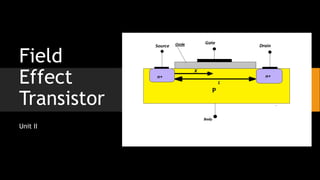

Field
Effect
Transistor
Unit II
FET
• The field-effect transistor (FET) is a type of transistor that uses an
electric field to control the flow of current in a semiconductor.
• FETs are devices with three terminals:
• source
• gate and
• Drain
• The Field Effect Transistor, FET, is a three terminal active device
that uses an electric field to control the current flow and it has a
high input impedance which is useful in many circuits.
Types
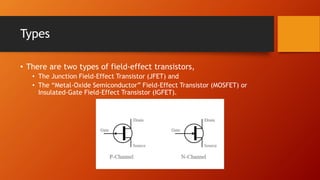
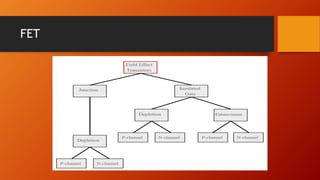
• There are two types of field-effect transistors,
• The Junction Field-Effect Transistor (JFET) and
• The “Metal-Oxide Semiconductor” Field-Effect Transistor (MOSFET) or
Insulated-Gate Field-Effect Transistor (IGFET).
FET
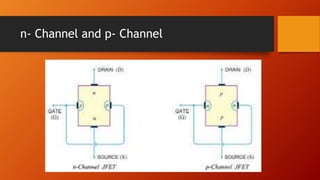
n- Channel and p- Channel
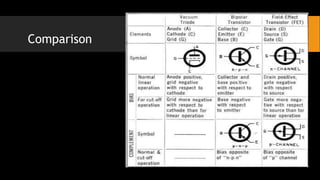
Comparison
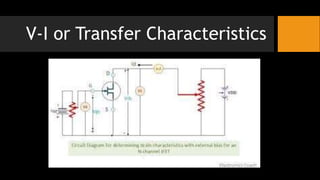
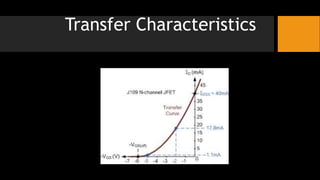
V-I or Transfer Characteristics
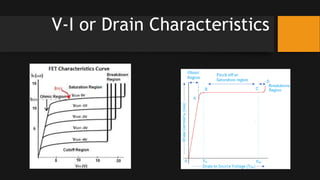
V-I or Drain Characteristics
Transfer Characteristics
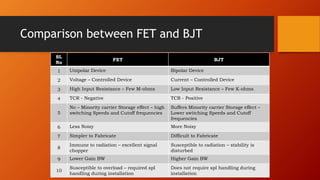
Comparison between FET and BJT
SL
No
FET BJT
1 Unipolar Device Bipolar Device
2 Voltage – Controlled Device Current – Controlled Device
3 High Input Resistance – Few M-ohms Low Input Resistance – Few K-ohms
4 TCR - Negative TCR - Positive
5
No – Minority carrier Storage effect – high
switching Speeds and Cutoff frequencies
Suffers Minority carrier Storage effect –
Lower switching Speeds and Cutoff
frequencies
6 Less Noisy More Noisy
7 Simpler to Fabricate Difficult to Fabricate
8
Immune to radiation – excellent signal
chopper
Susceptible to radiation – stability is
disturbed
9 Lower Gain BW Higher Gain BW
10
Susceptible to overload – required spl
handling during installation
Does not require spl handling during
installation
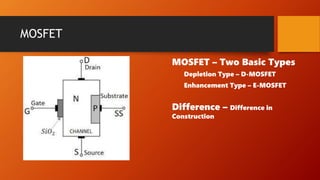
MOSFET
MOSFET – Two Basic Types
Depletion Type – D-MOSFET
Enhancement Type – E-MOSFET
Difference – Difference in
Construction
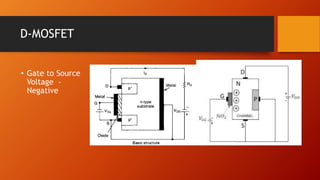
D-MOSFET
• Gate to Source
Voltage -
Negative
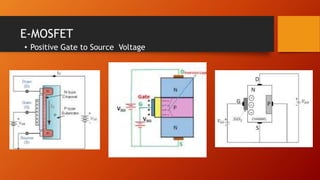
E-MOSFET
• Positive Gate to Source Voltage
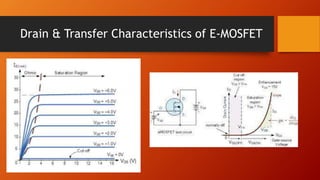
Drain & Transfer Characteristics of E-MOSFET
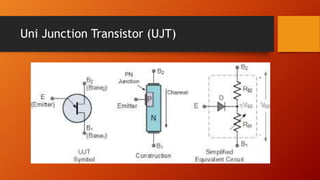
Uni Junction Transistor (UJT)
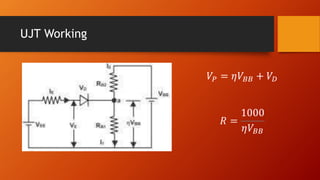
UJT Working
𝑉𝑃 = 𝜂𝑉𝐵𝐵 + 𝑉𝐷
𝑅 =
1000
𝜂𝑉𝐵𝐵
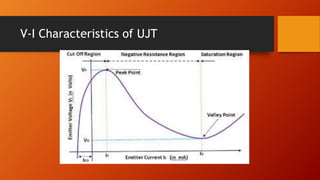
V-I Characteristics of UJT
Applications of UJT
• Trigger Device for SCR’s and TRIACs
• Non-Sinusoidal Oscillators
• Saw-Tooth generators
• Timing circuits
Relaxation Oscillator
• An oscillator is a device that produces a waveform by its own,
without any input. Though some dc voltage is applied for the
device to work, it will not produce any waveform as input.
• The UJT relaxation oscillator is called so because the timing
interval is set up by the charging of a capacitor and the timing
interval is ceased by the rapid discharge of the same capacitor.
• In electronics a relaxation oscillator is a nonlinear electronic
oscillator circuit that produces a nonsinusoidal repetitive output
signal, such as a triangle wave or square wave.
• This waveform depends generally upon the charging and
discharging time constants of a capacitor in the circuit.
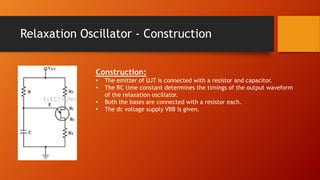
Relaxation Oscillator - Construction
Construction:
• The emitter of UJT is connected with a resistor and capacitor.
• The RC time constant determines the timings of the output waveform
of the relaxation oscillator.
• Both the bases are connected with a resistor each.
• The dc voltage supply VBB is given.
Relaxation Oscillator - Working
Working:
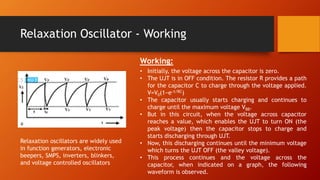
• Initially, the voltage across the capacitor is zero.
• The UJT is in OFF condition. The resistor R provides a path
for the capacitor C to charge through the voltage applied.
V=V0(1−e−t/RC)
• The capacitor usually starts charging and continues to
charge until the maximum voltage VBB.
• But in this circuit, when the voltage across capacitor
reaches a value, which enables the UJT to turn ON (the
peak voltage) then the capacitor stops to charge and
starts discharging through UJT.
• Now, this discharging continues until the minimum voltage
which turns the UJT OFF (the valley voltage).
• This process continues and the voltage across the
capacitor, when indicated on a graph, the following
waveform is observed.
Relaxation oscillators are widely used
in function generators, electronic
beepers, SMPS, inverters, blinkers,
and voltage controlled oscillators

Transistors - JFET, MOSFET, UJT & 555 Timer

  • 1.
  • 2.
    FET • The field-effecttransistor (FET) is a type of transistor that uses an electric field to control the flow of current in a semiconductor. • FETs are devices with three terminals: • source • gate and • Drain • The Field Effect Transistor, FET, is a three terminal active device that uses an electric field to control the current flow and it has a high input impedance which is useful in many circuits.
  • 3.
    Types • There aretwo types of field-effect transistors, • The Junction Field-Effect Transistor (JFET) and • The “Metal-Oxide Semiconductor” Field-Effect Transistor (MOSFET) or Insulated-Gate Field-Effect Transistor (IGFET).
  • 4.
  • 5.
    n- Channel andp- Channel
  • 6.
  • 7.
    V-I or TransferCharacteristics
  • 8.
    V-I or DrainCharacteristics
  • 9.
  • 10.
    Comparison between FETand BJT SL No FET BJT 1 Unipolar Device Bipolar Device 2 Voltage – Controlled Device Current – Controlled Device 3 High Input Resistance – Few M-ohms Low Input Resistance – Few K-ohms 4 TCR - Negative TCR - Positive 5 No – Minority carrier Storage effect – high switching Speeds and Cutoff frequencies Suffers Minority carrier Storage effect – Lower switching Speeds and Cutoff frequencies 6 Less Noisy More Noisy 7 Simpler to Fabricate Difficult to Fabricate 8 Immune to radiation – excellent signal chopper Susceptible to radiation – stability is disturbed 9 Lower Gain BW Higher Gain BW 10 Susceptible to overload – required spl handling during installation Does not require spl handling during installation
  • 11.
    MOSFET MOSFET – TwoBasic Types Depletion Type – D-MOSFET Enhancement Type – E-MOSFET Difference – Difference in Construction
  • 12.
    D-MOSFET • Gate toSource Voltage - Negative
  • 13.
    E-MOSFET • Positive Gateto Source Voltage
  • 14.
    Drain & TransferCharacteristics of E-MOSFET
  • 15.
  • 16.
    UJT Working 𝑉𝑃 =𝜂𝑉𝐵𝐵 + 𝑉𝐷 𝑅 = 1000 𝜂𝑉𝐵𝐵
  • 17.
  • 18.
    Applications of UJT •Trigger Device for SCR’s and TRIACs • Non-Sinusoidal Oscillators • Saw-Tooth generators • Timing circuits
  • 19.
    Relaxation Oscillator • Anoscillator is a device that produces a waveform by its own, without any input. Though some dc voltage is applied for the device to work, it will not produce any waveform as input. • The UJT relaxation oscillator is called so because the timing interval is set up by the charging of a capacitor and the timing interval is ceased by the rapid discharge of the same capacitor. • In electronics a relaxation oscillator is a nonlinear electronic oscillator circuit that produces a nonsinusoidal repetitive output signal, such as a triangle wave or square wave.
  • 20.
    • This waveformdepends generally upon the charging and discharging time constants of a capacitor in the circuit.
  • 21.
    Relaxation Oscillator -Construction Construction: • The emitter of UJT is connected with a resistor and capacitor. • The RC time constant determines the timings of the output waveform of the relaxation oscillator. • Both the bases are connected with a resistor each. • The dc voltage supply VBB is given.
  • 22.
    Relaxation Oscillator -Working Working: • Initially, the voltage across the capacitor is zero. • The UJT is in OFF condition. The resistor R provides a path for the capacitor C to charge through the voltage applied. V=V0(1−e−t/RC) • The capacitor usually starts charging and continues to charge until the maximum voltage VBB. • But in this circuit, when the voltage across capacitor reaches a value, which enables the UJT to turn ON (the peak voltage) then the capacitor stops to charge and starts discharging through UJT. • Now, this discharging continues until the minimum voltage which turns the UJT OFF (the valley voltage). • This process continues and the voltage across the capacitor, when indicated on a graph, the following waveform is observed. Relaxation oscillators are widely used in function generators, electronic beepers, SMPS, inverters, blinkers, and voltage controlled oscillators