RELATIONAL DIALECTICS Of  Baxter and Montgomery
Basic Approach Intimate relationships organized around the dynamic interplay of opposing tendencies Interpersonal relationships are indeterminate processes of ongoing flux Relational dialectics highlights the tensions in close personal ties
Contradictions Contradiction is the dynamic interplay between unified oppositions Tensions between intimacy and independence Bonding occurs through interdependence and dependence, yet people need personal space There is  no ultimate resolution Dialectical tension provides opportunity for dialogue
Dialectic internal to the relationship Closeness ,  certainty ,  openness  need to be balanced against  autonomy ,  novelty ,  privacy Tension between connectedness (closeness) and separateness (autonomy) is common to all relationships; if one axis wins, the relationship loses
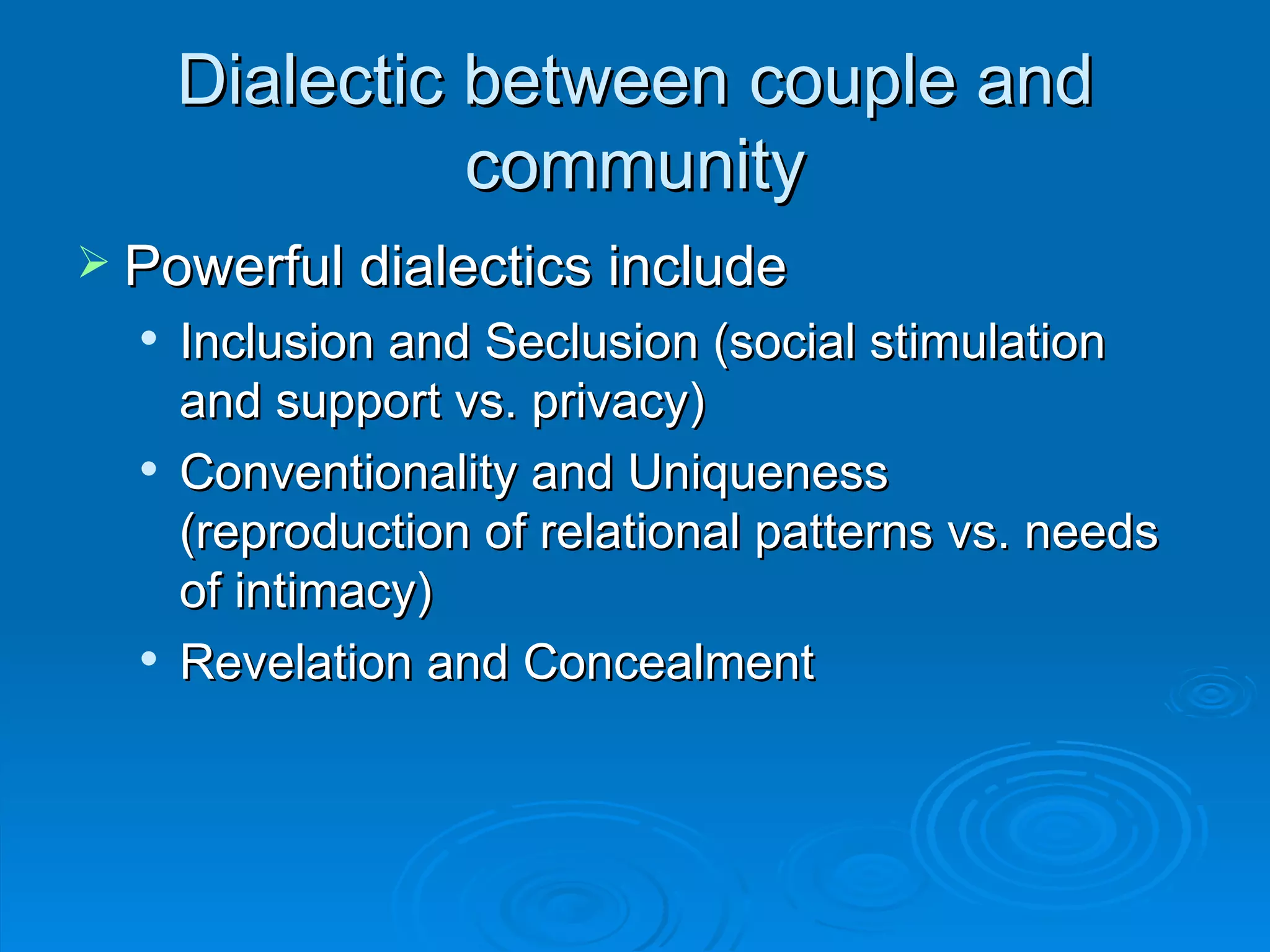
Dialectic between couple and community Powerful dialectics include Inclusion and Seclusion (social stimulation and support vs. privacy) Conventionality and Uniqueness (reproduction of relational patterns vs. needs of intimacy) Revelation and Concealment
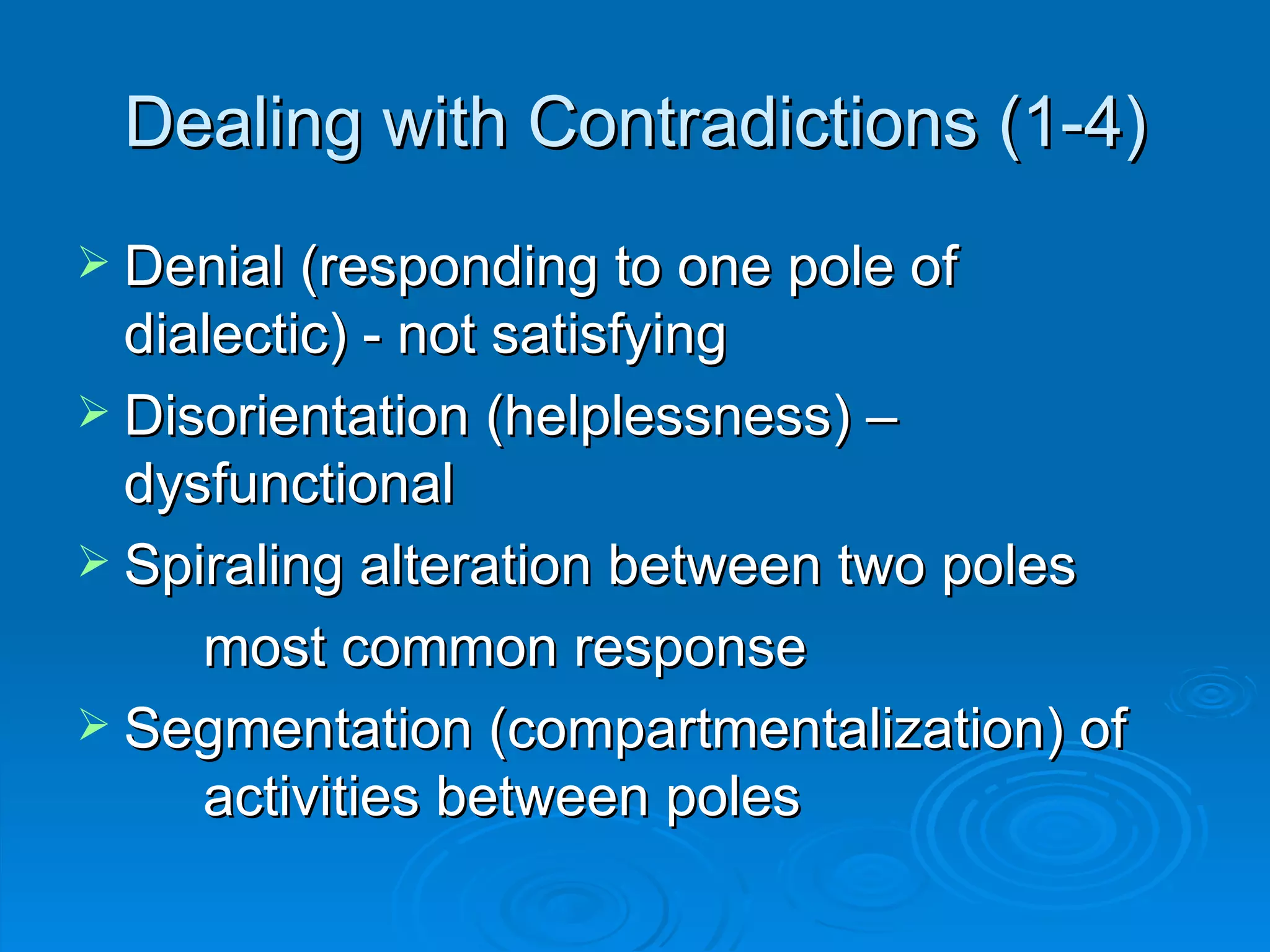
Dealing with Contradictions (1-4) Denial (responding to one pole of dialectic) - not satisfying Disorientation (helplessness) – dysfunctional Spiraling alteration between two poles most common response Segmentation (compartmentalization) of  activities between poles
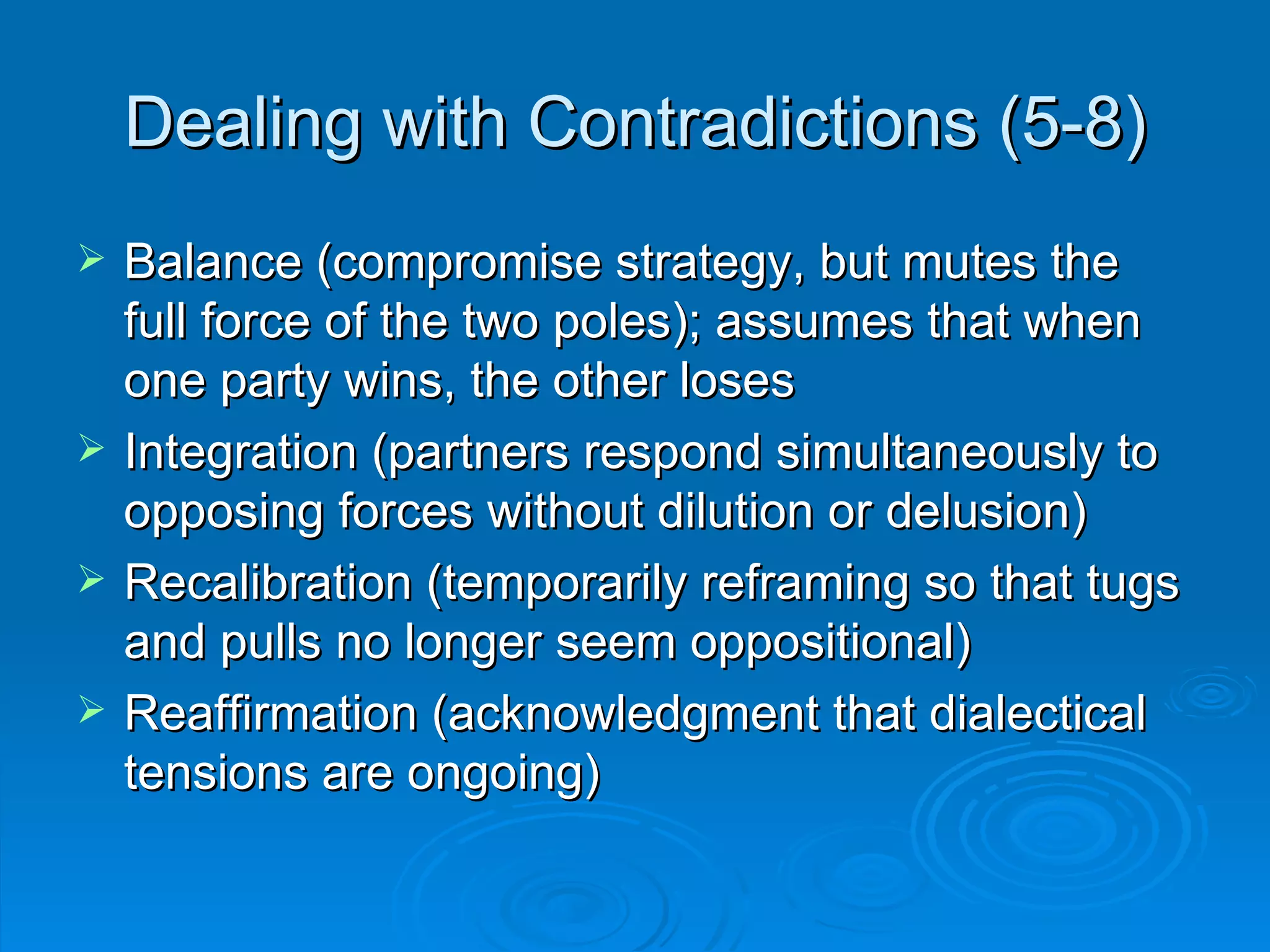
Dealing with Contradictions (5-8) Balance (compromise strategy, but mutes the full force of the two poles); assumes that when one party wins, the other loses Integration (partners respond simultaneously to opposing forces without dilution or delusion) Recalibration (temporarily reframing so that tugs and pulls no longer seem oppositional) Reaffirmation (acknowledgment that dialectical tensions are ongoing)
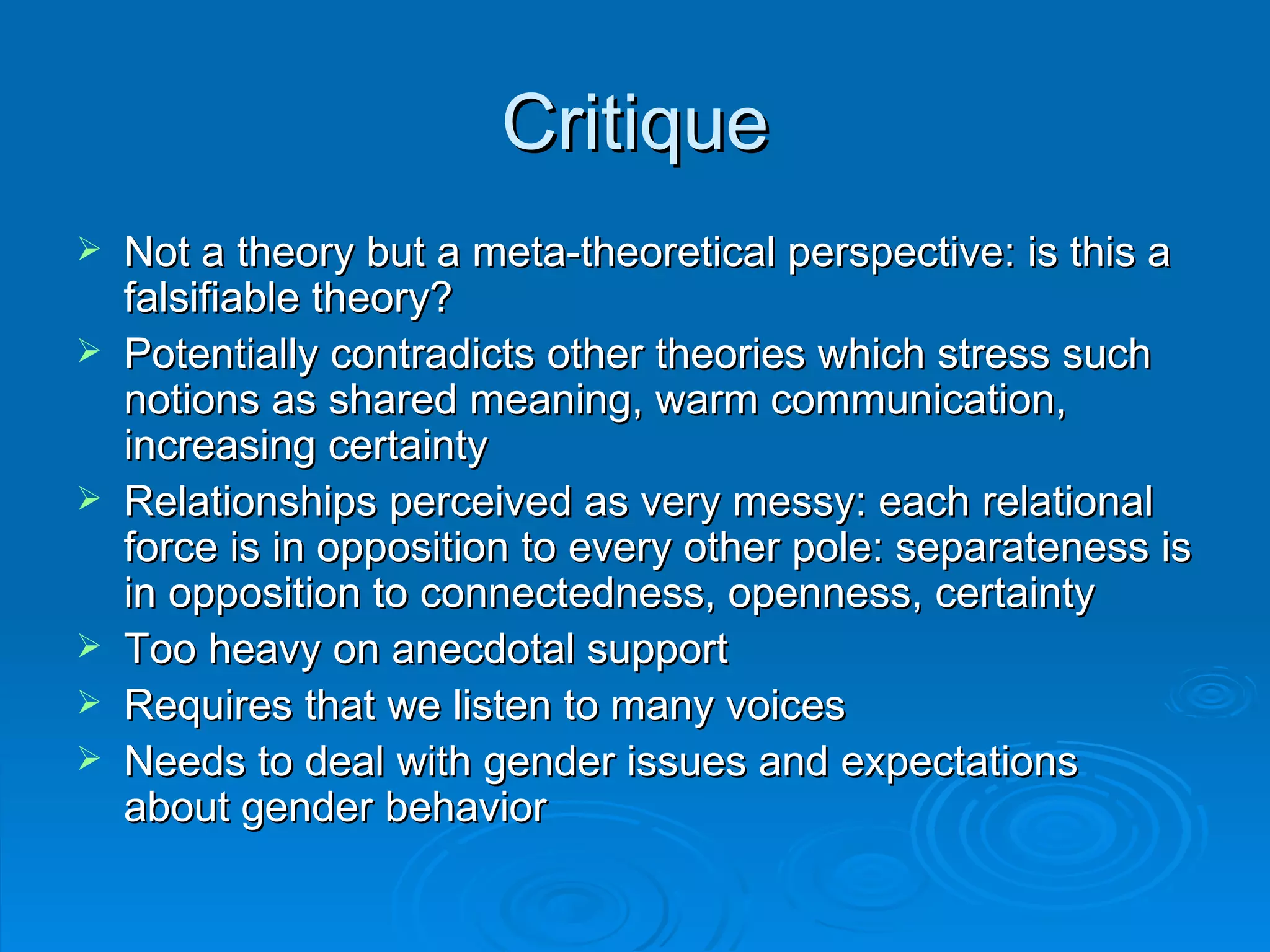
Critique Not a theory but a meta-theoretical perspective: is this a falsifiable theory? Potentially contradicts other theories which stress such notions as shared meaning, warm communication, increasing certainty Relationships perceived as very messy: each relational force is in opposition to every other pole: separateness is in opposition to connectedness, openness, certainty Too heavy on anecdotal support Requires that we listen to many voices Needs to deal with gender issues and expectations about gender behavior

Relational Dialectics

  • 1.
    RELATIONAL DIALECTICS Of Baxter and Montgomery
  • 2.
    Basic Approach Intimaterelationships organized around the dynamic interplay of opposing tendencies Interpersonal relationships are indeterminate processes of ongoing flux Relational dialectics highlights the tensions in close personal ties
  • 3.
    Contradictions Contradiction isthe dynamic interplay between unified oppositions Tensions between intimacy and independence Bonding occurs through interdependence and dependence, yet people need personal space There is no ultimate resolution Dialectical tension provides opportunity for dialogue
  • 4.
    Dialectic internal tothe relationship Closeness , certainty , openness need to be balanced against autonomy , novelty , privacy Tension between connectedness (closeness) and separateness (autonomy) is common to all relationships; if one axis wins, the relationship loses
  • 5.
    Dialectic between coupleand community Powerful dialectics include Inclusion and Seclusion (social stimulation and support vs. privacy) Conventionality and Uniqueness (reproduction of relational patterns vs. needs of intimacy) Revelation and Concealment
  • 6.
    Dealing with Contradictions(1-4) Denial (responding to one pole of dialectic) - not satisfying Disorientation (helplessness) – dysfunctional Spiraling alteration between two poles most common response Segmentation (compartmentalization) of activities between poles
  • 7.
    Dealing with Contradictions(5-8) Balance (compromise strategy, but mutes the full force of the two poles); assumes that when one party wins, the other loses Integration (partners respond simultaneously to opposing forces without dilution or delusion) Recalibration (temporarily reframing so that tugs and pulls no longer seem oppositional) Reaffirmation (acknowledgment that dialectical tensions are ongoing)
  • 8.
    Critique Not atheory but a meta-theoretical perspective: is this a falsifiable theory? Potentially contradicts other theories which stress such notions as shared meaning, warm communication, increasing certainty Relationships perceived as very messy: each relational force is in opposition to every other pole: separateness is in opposition to connectedness, openness, certainty Too heavy on anecdotal support Requires that we listen to many voices Needs to deal with gender issues and expectations about gender behavior