Introduction to Communication Theory
Turner and West

 Uncertainty Reduction Theory (URT) is also known
as Initial Interaction Theory.
 Uncertainty Reduction Theory was originated by
Charles Berger and Richard Calabrese in 1975.
 Their goal was to explain how communication is
used to reduce uncertainties between strangers
engaging in their first conversation together.
Origin

Predictions
Explanation
Sub Processes

Cognitive uncertainty
Beliefs and attitudes
Behavioral uncertainty
Behavior based upon situation
Self-Disclosure
Two types of uncertainty in
initial encounters

Proactive uncertainty
reduction
Retroactive uncertainty
reduction
Two Processes

 Verbal output
 Non Verbal warmth
 Information seeking
 Self-Disclosure
 Reciprocity of disclosure
 Similarity
 Liking
Uncertainty is related to 7
concepts

 People experience uncertainty in interpersonal settings.
 Uncertainty is an aversive state, generating cognitive
stress.
 When strangers meet, their primary concern is to reduce
uncertainty or to increase predictability.
 Interpersonal communication is a developmental process
that occurs through stages.
 Interpersonal communication is the primary means of
uncertainty reduction.
 The quantity of info shared changes through time.
 It is possible to predict behavior in a law like way.
7 assumptions

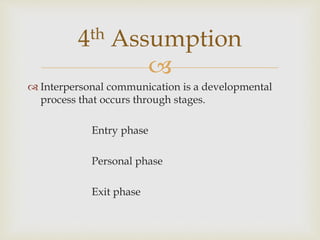
 Interpersonal communication is a developmental
process that occurs through stages.
Entry phase
Personal phase
Exit phase
4th Assumption

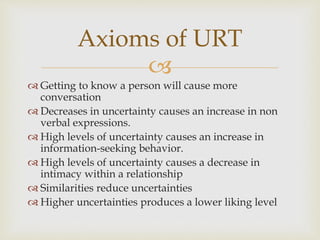
 Getting to know a person will cause more
conversation
 Decreases in uncertainty causes an increase in non
verbal expressions.
 High levels of uncertainty causes an increase in
information-seeking behavior.
 High levels of uncertainty causes a decrease in
intimacy within a relationship
 Similarities reduce uncertainties
 Higher uncertainties produces a lower liking level
Axioms of URT

 Uncertainty is negatively related to interaction with
social networks.
 There is an inverse, or negative, relationship between
uncertainty and communication satisfaction.
Additional Axioms of URT

 The first condition occurs when the other person has
the potential to reward or punish.
 The second condition occurs when the other person
behaves contrary to expectations.
 The last condition occurs when a person expects
future interactions with another.
Antecedent Conditions

Passive
Active
Interactive
Strategies

 Uncertainty in developed relationships may be
different than it is in initial encounters.
 There may be a tension between reducing and
increasing uncertainty in developed relationships.
 The excitement of uncertainty becomes desirable as
people begin to feel certain about their relationships
and their partners.
 Relational uncertainty
Relationships

 URT places communication in a central position
because it has provoked a large amount of
commentary and research.
 It has made a very important contribution to the
field of communication even though it has generated
controversy and theoretical disputes.
Conclusion

Uncertainty Reduction

  • 1.
    Introduction to CommunicationTheory Turner and West
  • 2.
      Uncertainty ReductionTheory (URT) is also known as Initial Interaction Theory.  Uncertainty Reduction Theory was originated by Charles Berger and Richard Calabrese in 1975.  Their goal was to explain how communication is used to reduce uncertainties between strangers engaging in their first conversation together. Origin
  • 3.
  • 4.
     Cognitive uncertainty Beliefs andattitudes Behavioral uncertainty Behavior based upon situation Self-Disclosure Two types of uncertainty in initial encounters
  • 5.
  • 6.
      Verbal output Non Verbal warmth  Information seeking  Self-Disclosure  Reciprocity of disclosure  Similarity  Liking Uncertainty is related to 7 concepts
  • 7.
      People experienceuncertainty in interpersonal settings.  Uncertainty is an aversive state, generating cognitive stress.  When strangers meet, their primary concern is to reduce uncertainty or to increase predictability.  Interpersonal communication is a developmental process that occurs through stages.  Interpersonal communication is the primary means of uncertainty reduction.  The quantity of info shared changes through time.  It is possible to predict behavior in a law like way. 7 assumptions
  • 8.
      Interpersonal communicationis a developmental process that occurs through stages. Entry phase Personal phase Exit phase 4th Assumption
  • 9.
      Getting toknow a person will cause more conversation  Decreases in uncertainty causes an increase in non verbal expressions.  High levels of uncertainty causes an increase in information-seeking behavior.  High levels of uncertainty causes a decrease in intimacy within a relationship  Similarities reduce uncertainties  Higher uncertainties produces a lower liking level Axioms of URT
  • 10.
      Uncertainty isnegatively related to interaction with social networks.  There is an inverse, or negative, relationship between uncertainty and communication satisfaction. Additional Axioms of URT
  • 11.
      The firstcondition occurs when the other person has the potential to reward or punish.  The second condition occurs when the other person behaves contrary to expectations.  The last condition occurs when a person expects future interactions with another. Antecedent Conditions
  • 12.
  • 13.
      Uncertainty indeveloped relationships may be different than it is in initial encounters.  There may be a tension between reducing and increasing uncertainty in developed relationships.  The excitement of uncertainty becomes desirable as people begin to feel certain about their relationships and their partners.  Relational uncertainty Relationships
  • 14.
      URT placescommunication in a central position because it has provoked a large amount of commentary and research.  It has made a very important contribution to the field of communication even though it has generated controversy and theoretical disputes. Conclusion