Seven Different Traditions in the Field of Communication Theory
Socio-Psychological Tradition Emphasizes scientific perspective Associated with Carl Hovland and the Yale team Concentrated on the source and the content of persuasive messages, and the audience characteristics Source credibility rests on expertness and character; expertness had the bigger effect on credibility, but did not last. The “sleeper effect” : the impact of credibility does not last.
Cybernetic Tradition Wiener coined the term, in the field of artificial intelligence Introduced the concept of feedback Claude Shannon established the idea of communication as information processing Goal was to maximize line capacity with minimum distortion Reduce uncertainty through redundancy; more redundancy=reduced capacity.
Rhetorical Tradition Speech distinguishes humans Confidence in efficacy of public address Setting: one speaker addressing large audience with intention to persuade Oratorical training for leader’s education Power and beauty of language moves people emotionally and stir them to action Rhetoric as male province
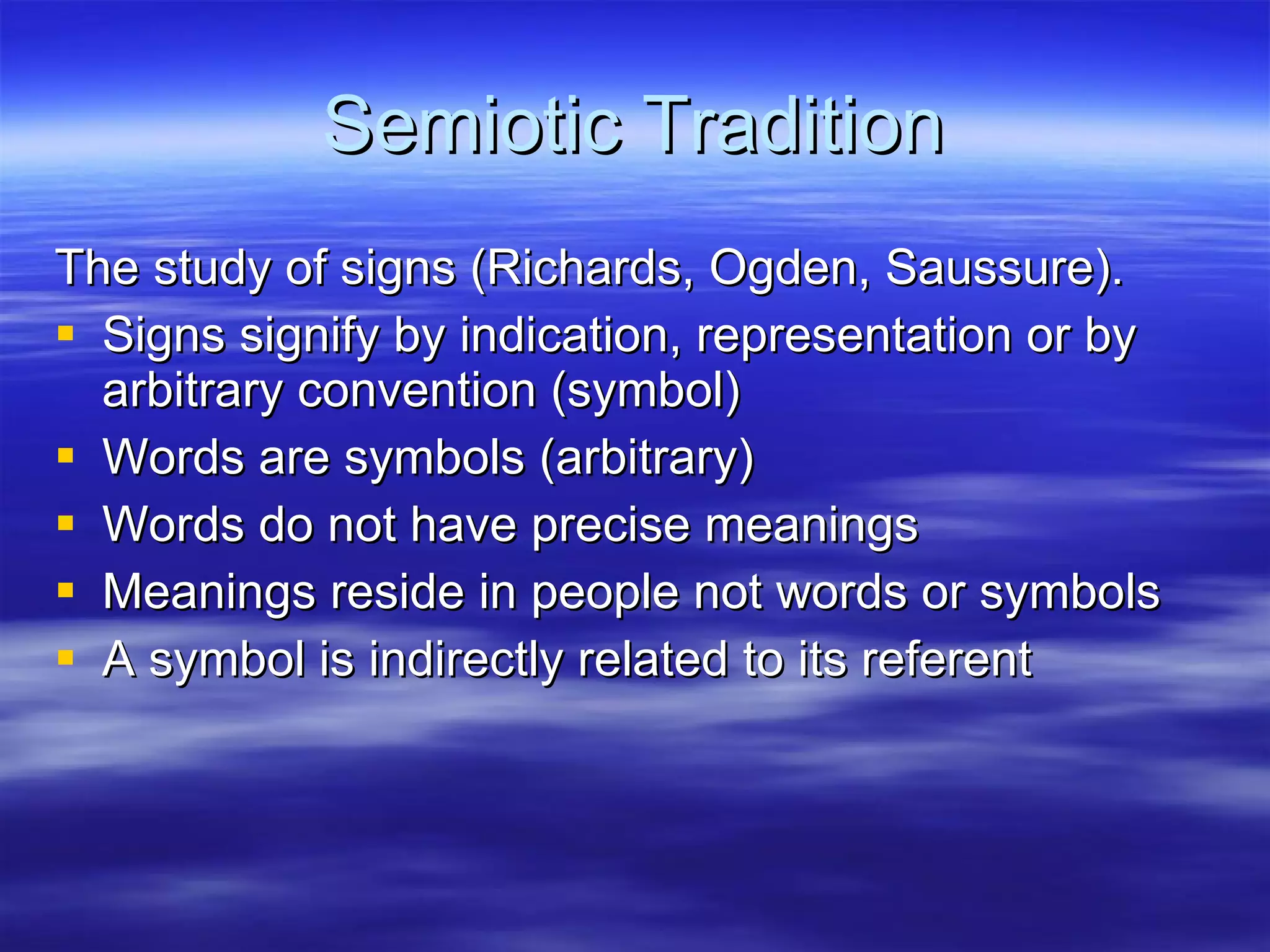
Semiotic Tradition The study of signs (Richards, Ogden, Saussure).  Signs signify by indication, representation or by arbitrary convention (symbol) Words are symbols (arbitrary) Words do not have precise meanings Meanings reside in people not words or symbols A symbol is indirectly related to its referent
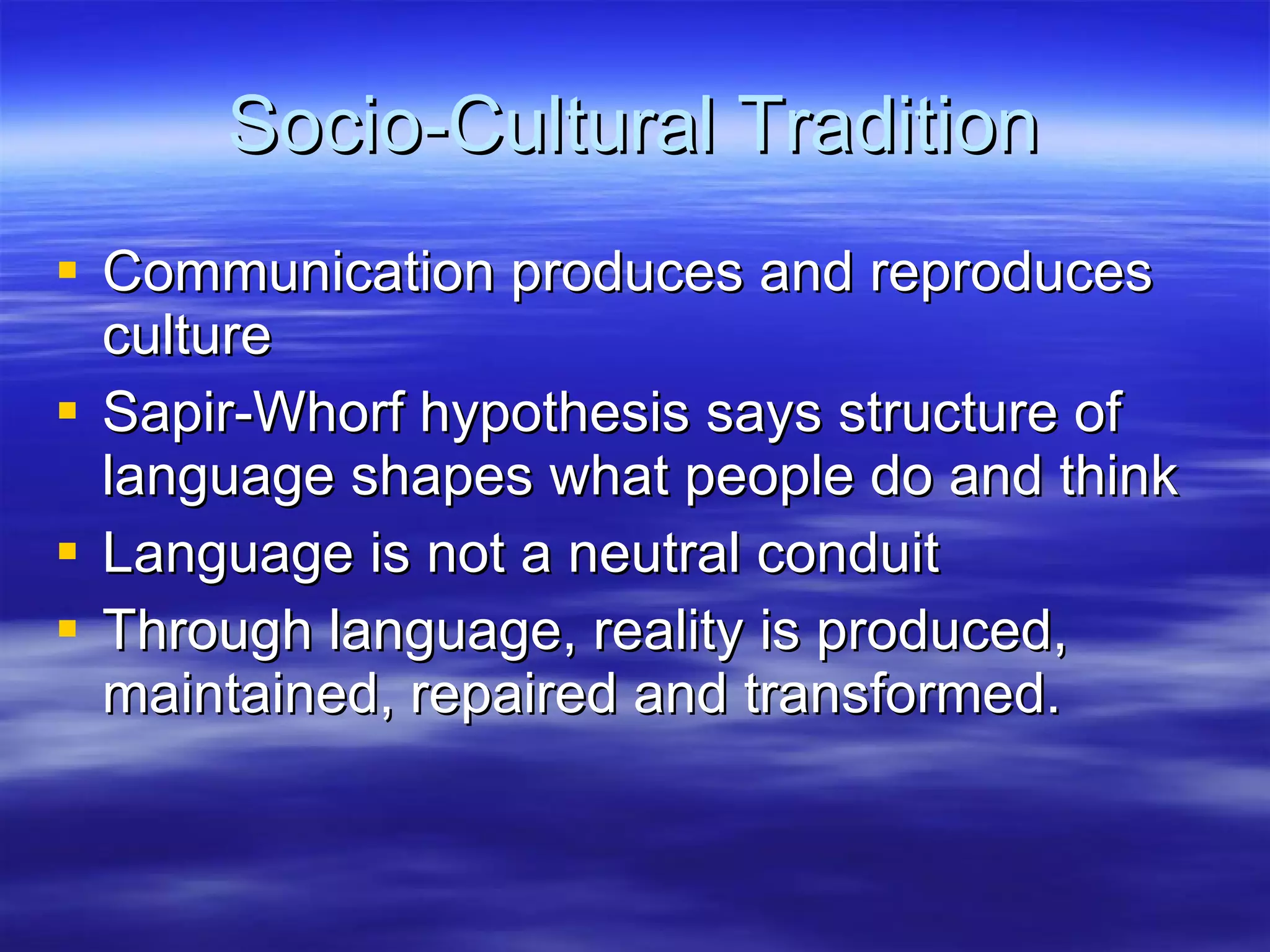
Socio-Cultural Tradition Communication produces and reproduces culture Sapir-Whorf hypothesis says structure of language shapes what people do and think Language is not a neutral conduit Through language, reality is produced, maintained, repaired and transformed.
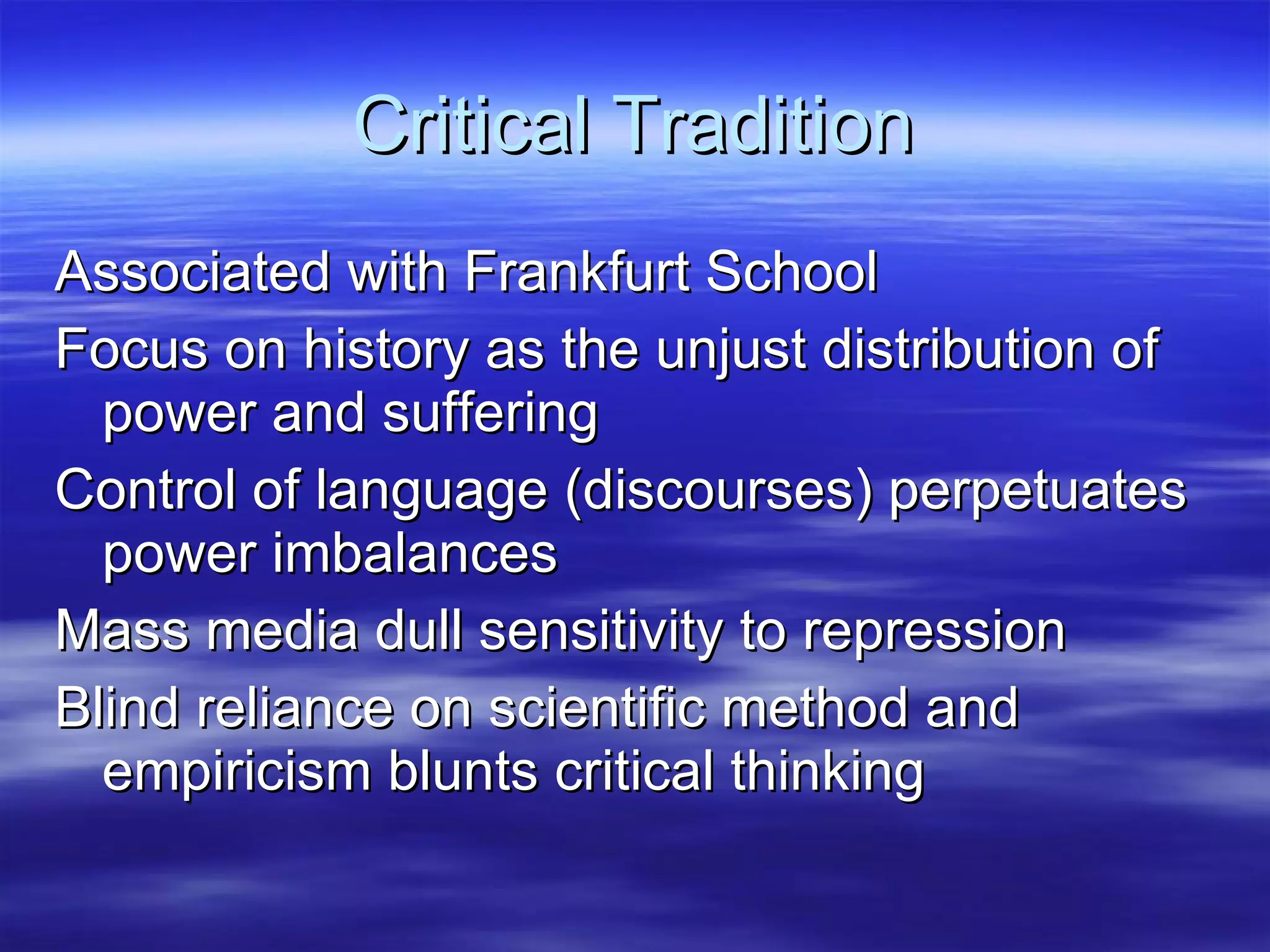
Critical Tradition Associated with Frankfurt School Focus on history as the unjust distribution of power and suffering Control of language (discourses) perpetuates power imbalances Mass media dull sensitivity to repression Blind reliance on scientific method and empiricism blunts critical thinking
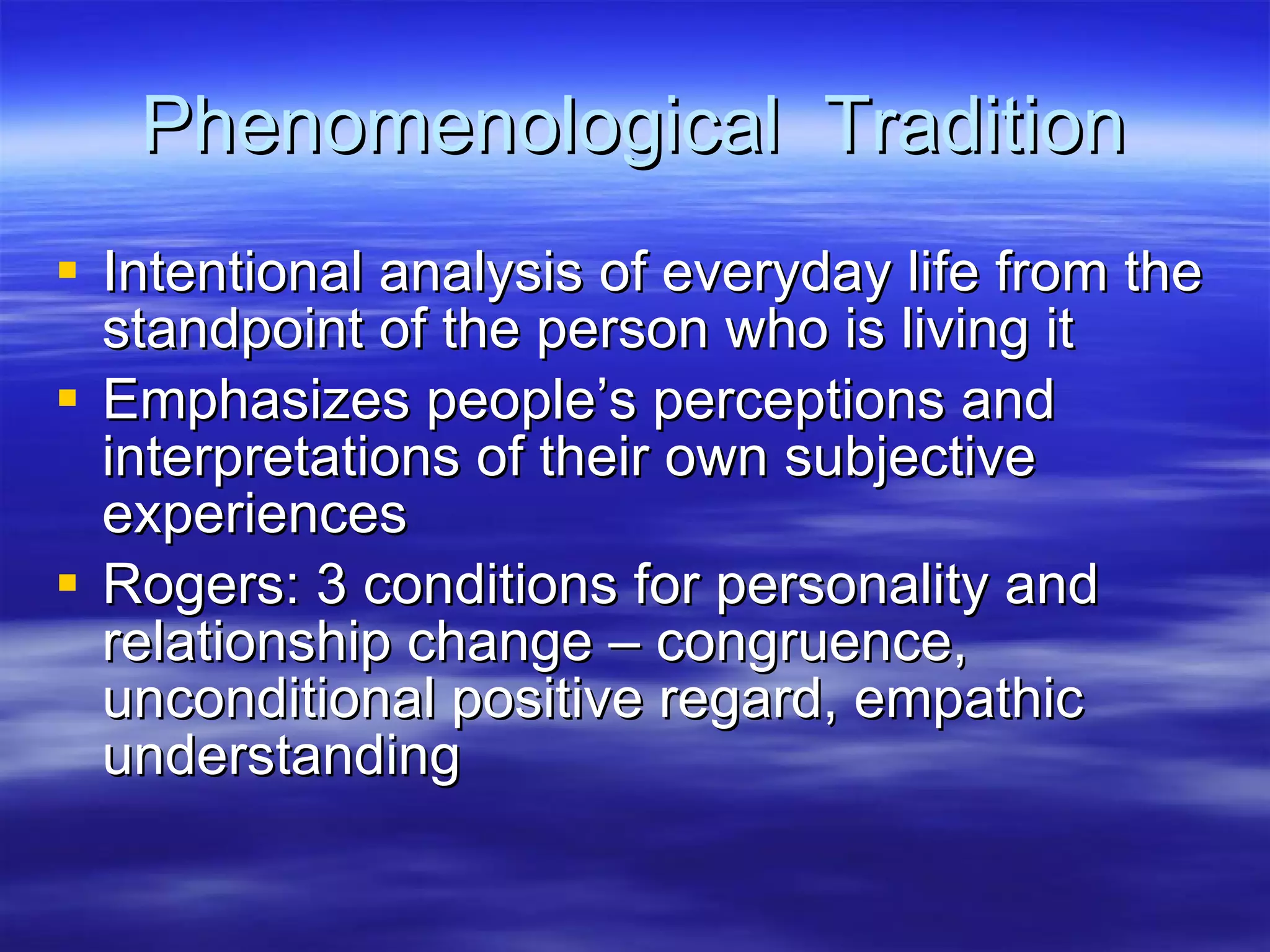
Phenomenological  Tradition Intentional analysis of everyday life from the standpoint of the person who is living it Emphasizes people’s perceptions and interpretations of their own subjective experiences Rogers: 3 conditions for personality and relationship change – congruence, unconditional positive regard, empathic understanding
Ethical Tradition NCA Credo for Communication Ethics: Truthfulness, accuracy, honesty, reason Accepts responsibility for short-term and long-term consequences of communication Strives to understand and respect other communicators before evaluating and responding to their messages.

Seven Different Traditions In The Field Of Communication

  • 1.
    Seven Different Traditionsin the Field of Communication Theory
  • 2.
    Socio-Psychological Tradition Emphasizesscientific perspective Associated with Carl Hovland and the Yale team Concentrated on the source and the content of persuasive messages, and the audience characteristics Source credibility rests on expertness and character; expertness had the bigger effect on credibility, but did not last. The “sleeper effect” : the impact of credibility does not last.
  • 3.
    Cybernetic Tradition Wienercoined the term, in the field of artificial intelligence Introduced the concept of feedback Claude Shannon established the idea of communication as information processing Goal was to maximize line capacity with minimum distortion Reduce uncertainty through redundancy; more redundancy=reduced capacity.
  • 4.
    Rhetorical Tradition Speechdistinguishes humans Confidence in efficacy of public address Setting: one speaker addressing large audience with intention to persuade Oratorical training for leader’s education Power and beauty of language moves people emotionally and stir them to action Rhetoric as male province
  • 5.
    Semiotic Tradition Thestudy of signs (Richards, Ogden, Saussure). Signs signify by indication, representation or by arbitrary convention (symbol) Words are symbols (arbitrary) Words do not have precise meanings Meanings reside in people not words or symbols A symbol is indirectly related to its referent
  • 6.
    Socio-Cultural Tradition Communicationproduces and reproduces culture Sapir-Whorf hypothesis says structure of language shapes what people do and think Language is not a neutral conduit Through language, reality is produced, maintained, repaired and transformed.
  • 7.
    Critical Tradition Associatedwith Frankfurt School Focus on history as the unjust distribution of power and suffering Control of language (discourses) perpetuates power imbalances Mass media dull sensitivity to repression Blind reliance on scientific method and empiricism blunts critical thinking
  • 8.
    Phenomenological TraditionIntentional analysis of everyday life from the standpoint of the person who is living it Emphasizes people’s perceptions and interpretations of their own subjective experiences Rogers: 3 conditions for personality and relationship change – congruence, unconditional positive regard, empathic understanding
  • 9.
    Ethical Tradition NCACredo for Communication Ethics: Truthfulness, accuracy, honesty, reason Accepts responsibility for short-term and long-term consequences of communication Strives to understand and respect other communicators before evaluating and responding to their messages.