Technological Determinism Of Marshall McLuhan
Basic Ideas New electronic media radically affect how we think, feel, and act The world will never be the same Electronic age supersedes tribal, literate (phonetic alphabet), and print ages Inventions in technology cause cultural change Changes in modes of communication shape human existence Media are extensions of human faculties: media are tools that amplify or intensify a bodily organ, sense, or function.
The Medium is the Message The medium changes people more than the sum of all the messages that the medium conveys : the medium is also the mass-age
Tribal Age Senses of hearing , touch, taste and smell developed beyond ability to visualize: this is an oral culture Spoken word is emotionally laden – it draws people into tribal mesh
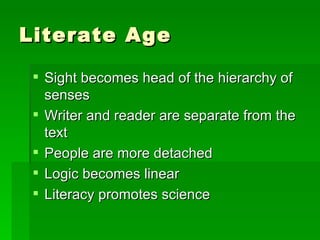
Literate Age Sight becomes head of the hierarchy of senses Writer and reader are separate from the text People are more detached Logic becomes linear Literacy promotes science
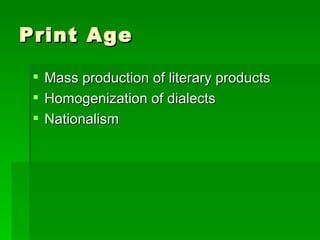
Print Age Mass production of literary products Homogenization of dialects Nationalism
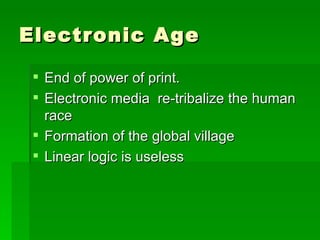
Electronic Age End of power of print.  Electronic media  re-tribalize the human race Formation of the global village Linear logic is useless
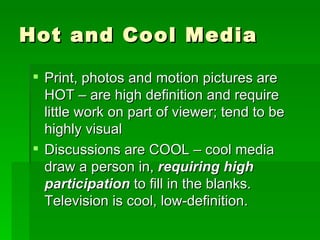
Hot and Cool Media Print, photos and motion pictures are HOT – are high definition and require little work on part of viewer; tend to be highly visual Discussions are COOL – cool media draw a person in,  requiring high participation  to fill in the blanks.  Television is cool, low-definition.
Media-Induced Changes Politics Education Sex and drugs
Critique Postman – new digital age, a new age, in which culture is totally used by tools and in which our thought world is dominated by technopoly Mediated world takes us from truth claims to aesthetic appeals Have we become  tools of our tools Like many single-factor theories, McLuhan’s thesis is provocative but very disputable Relate to Post-Modernism of Baudrillard and Derrida and others.

Technological Determinism

  • 1.
  • 2.
    Basic Ideas Newelectronic media radically affect how we think, feel, and act The world will never be the same Electronic age supersedes tribal, literate (phonetic alphabet), and print ages Inventions in technology cause cultural change Changes in modes of communication shape human existence Media are extensions of human faculties: media are tools that amplify or intensify a bodily organ, sense, or function.
  • 3.
    The Medium isthe Message The medium changes people more than the sum of all the messages that the medium conveys : the medium is also the mass-age
  • 4.
    Tribal Age Sensesof hearing , touch, taste and smell developed beyond ability to visualize: this is an oral culture Spoken word is emotionally laden – it draws people into tribal mesh
  • 5.
    Literate Age Sightbecomes head of the hierarchy of senses Writer and reader are separate from the text People are more detached Logic becomes linear Literacy promotes science
  • 6.
    Print Age Massproduction of literary products Homogenization of dialects Nationalism
  • 7.
    Electronic Age Endof power of print. Electronic media re-tribalize the human race Formation of the global village Linear logic is useless
  • 8.
    Hot and CoolMedia Print, photos and motion pictures are HOT – are high definition and require little work on part of viewer; tend to be highly visual Discussions are COOL – cool media draw a person in, requiring high participation to fill in the blanks. Television is cool, low-definition.
  • 9.
    Media-Induced Changes PoliticsEducation Sex and drugs
  • 10.
    Critique Postman –new digital age, a new age, in which culture is totally used by tools and in which our thought world is dominated by technopoly Mediated world takes us from truth claims to aesthetic appeals Have we become tools of our tools Like many single-factor theories, McLuhan’s thesis is provocative but very disputable Relate to Post-Modernism of Baudrillard and Derrida and others.