




Marxism (Part One) Dr. Christopher S. Rice
 
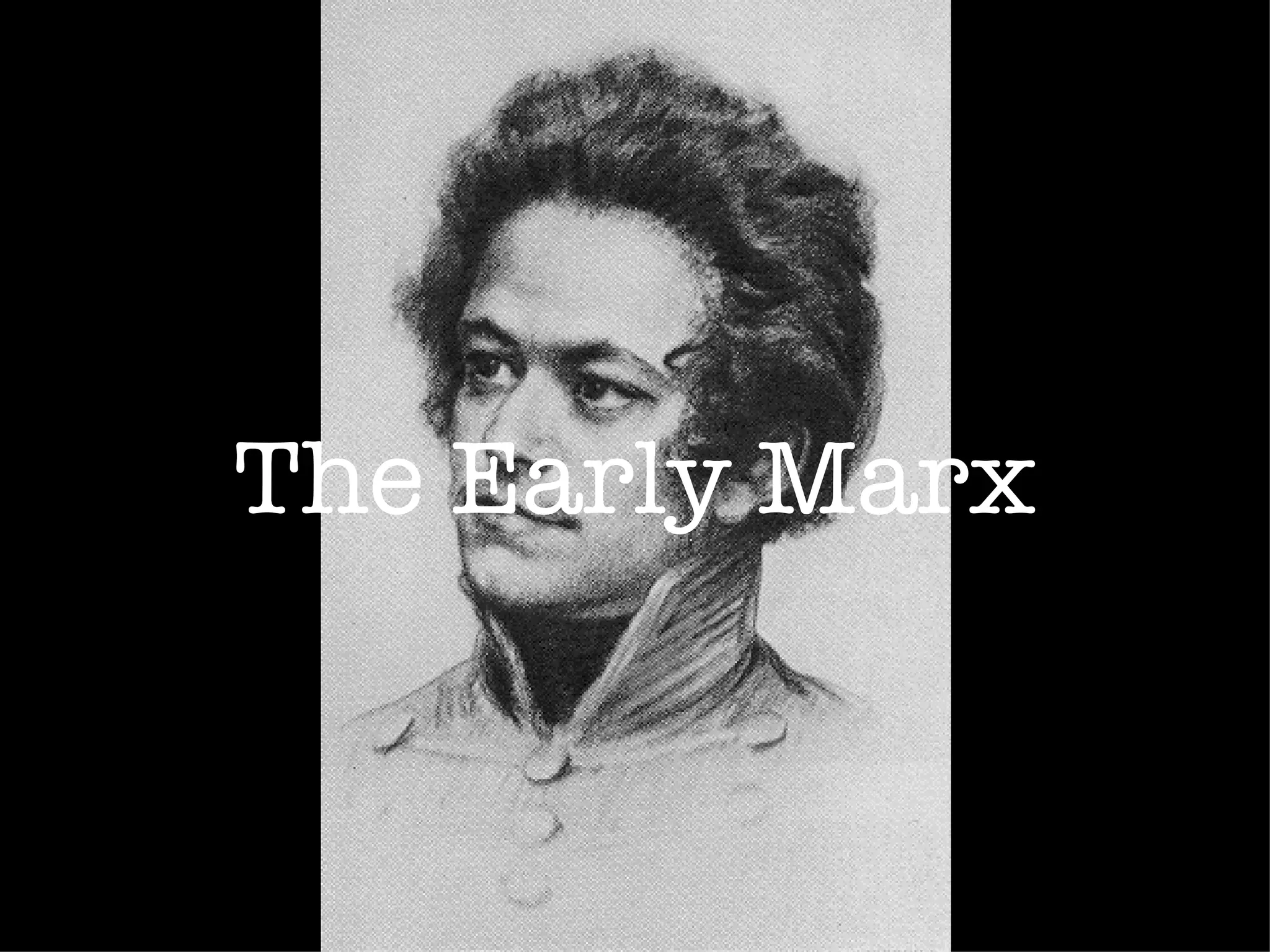
The Early Marx
Marx Becomes A Philosopher
2 effects of his career in Journalism
He came to appreciate the central social and political importance of economics
He ceased to be a  liberal  and became a  radical
 
The Economic and Philosophical Manuscripts of 1844
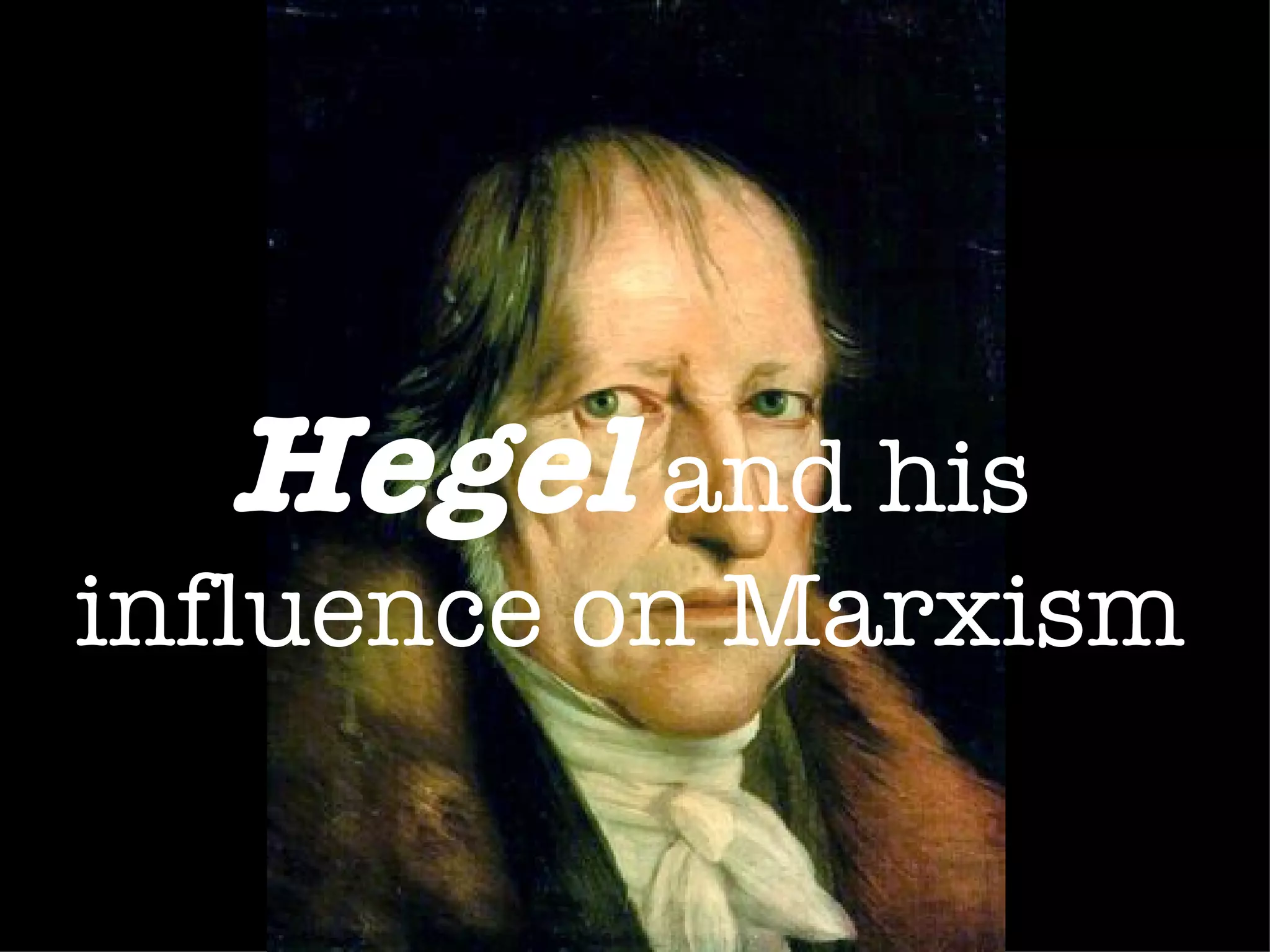
Hegel  and his influence on Marxism
Hegel’s Philosophy of History
Geist
Alienation ( entfremdung )
Dialectic the process whereby opposite views or forces come into conflict, which eventually leads to the overcoming or reconciliation of the opposition in a new and presumably higher form
The Master-Slave Dialectic The master becomes master by physically conquering another, whom he then enslaves. Seeing oneself through the eyes of the Other. The master and slave are engaged in a symbiotic relationship. The master and slave are engaged in a conflictual relationship. The true relationship revealed through resistance. A Happy Conclusion…
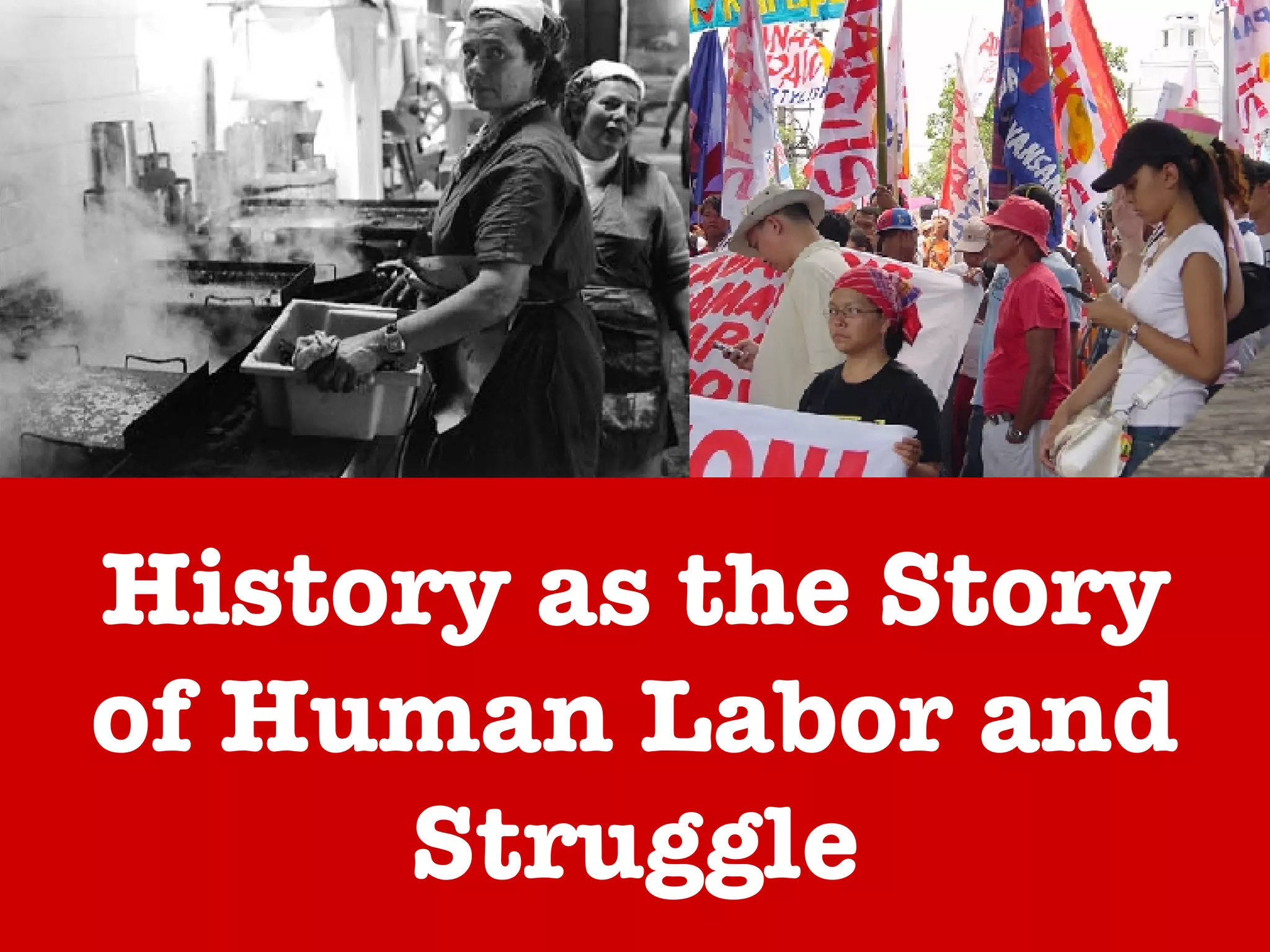
History as the Story of Human Labor and Struggle
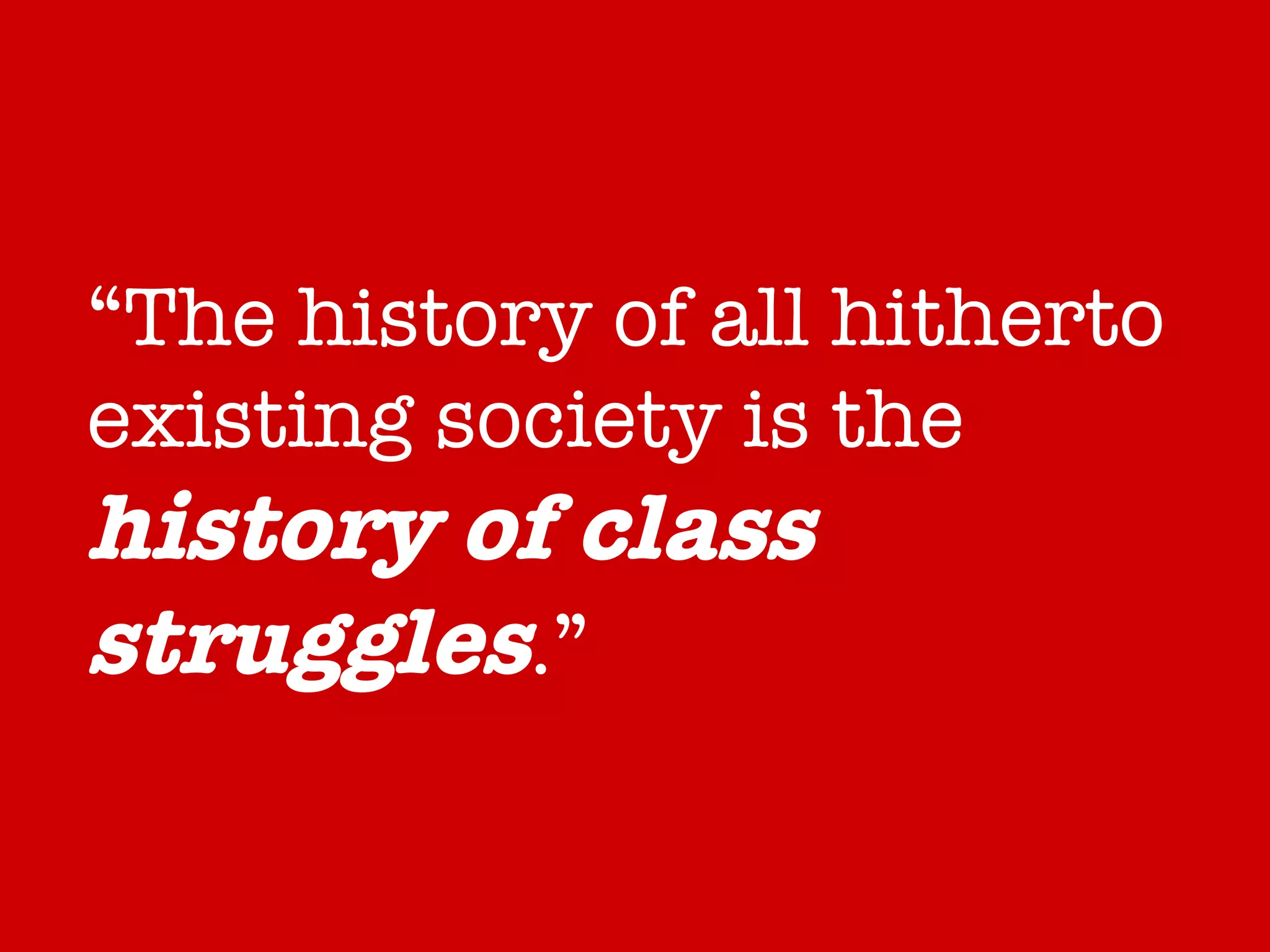
“ The history of all hitherto existing society is the  history of class struggles .”
Materialist vs. Idealist
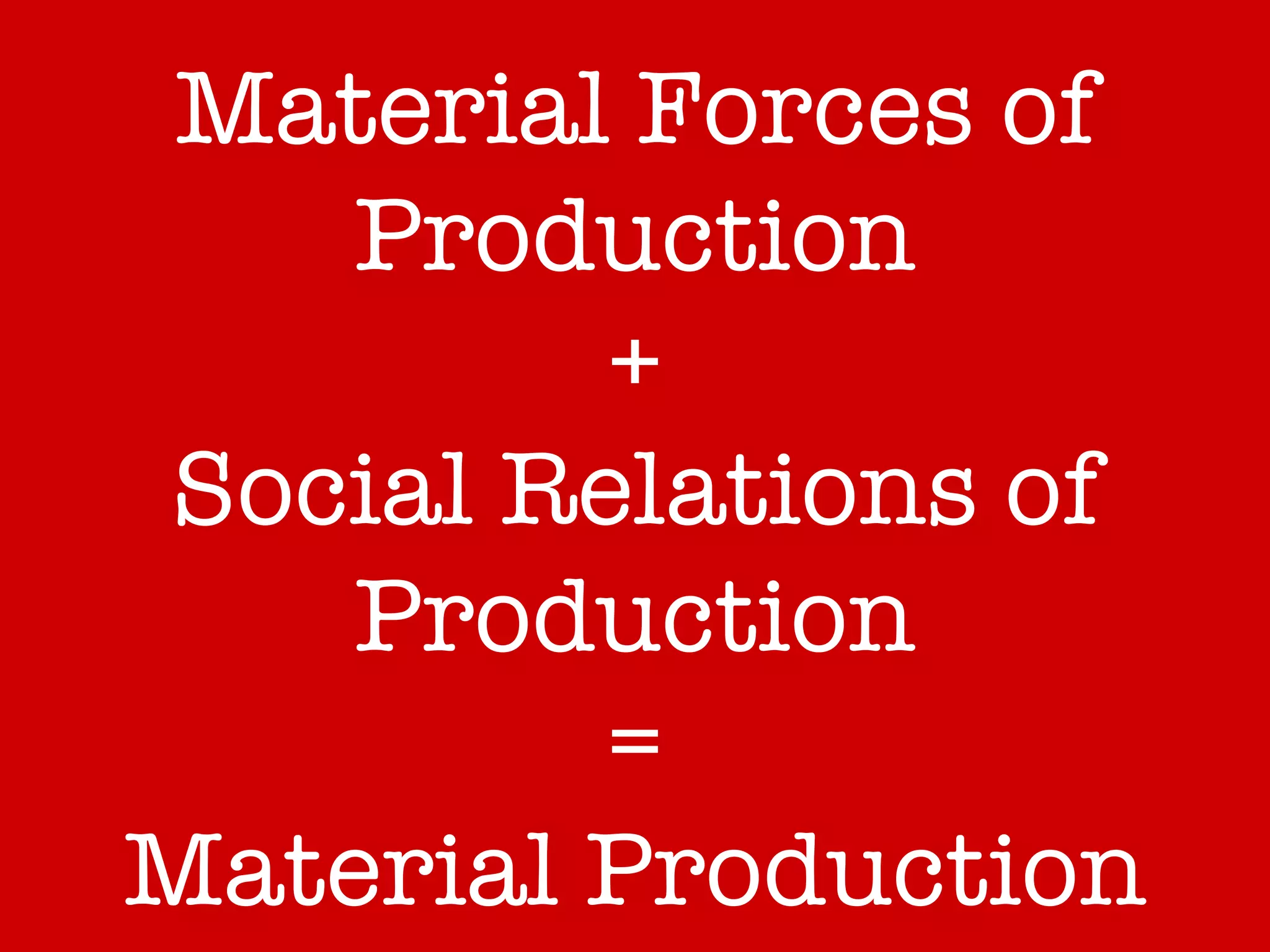
Material Forces of Production + Social Relations of Production = Material Production
Material Forces of Production
Social Relations of Production
The Dialectic of Class
Class determined by relation to the forces of production
Dominating Class has 2 important advantages: Monopoly on the power, agents of coercion Control of the Mental Means of Production
False Consciousness
Base & Superstructure
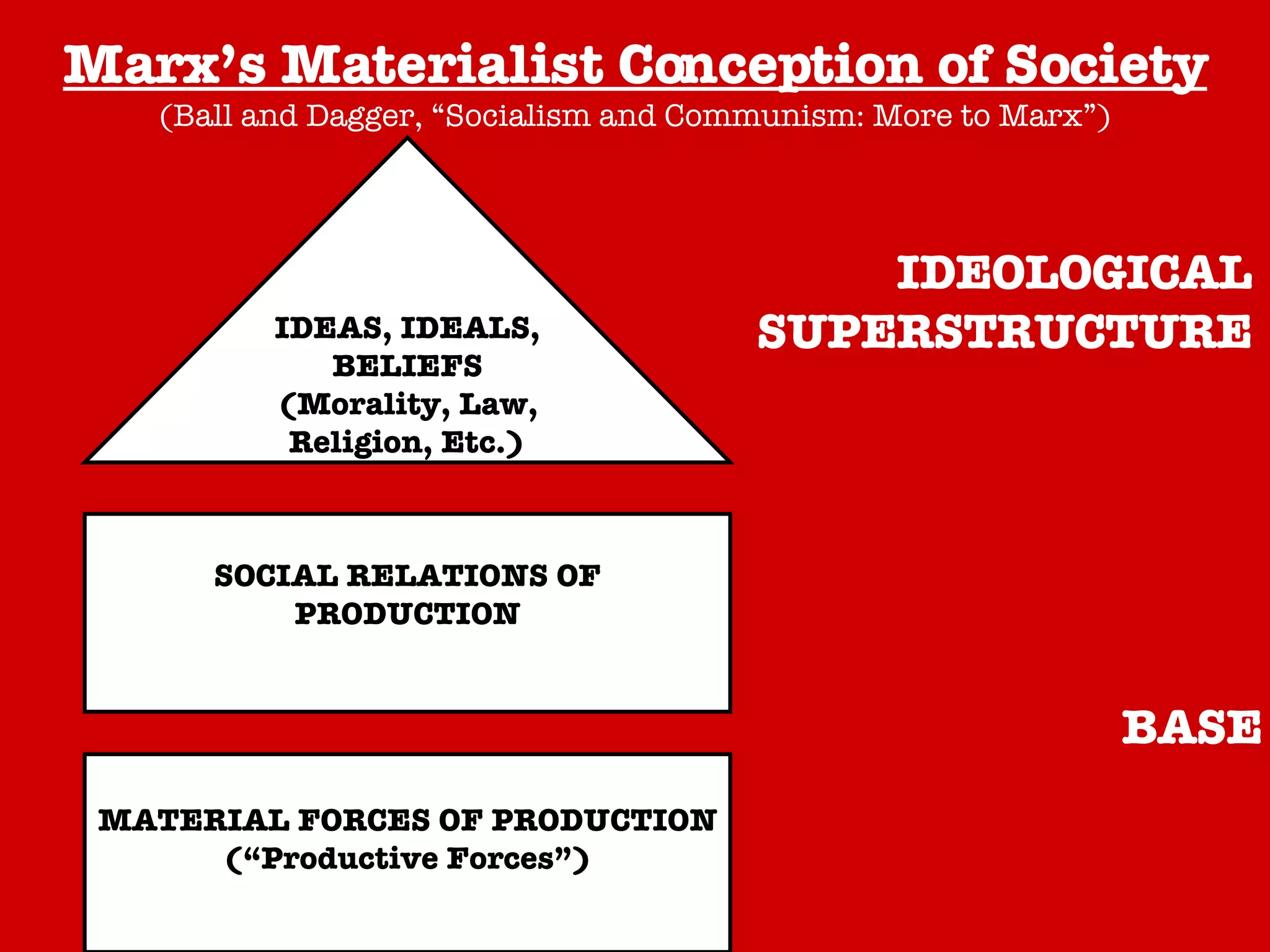
Marx’s Materialist Conception of Society (Ball and Dagger, “Socialism and Communism: More to Marx”) IDEOLOGICAL SUPERSTRUCTURE BASE IDEAS, IDEALS, BELIEFS (Morality, Law, Religion, Etc.) SOCIAL RELATIONS OF PRODUCTION MATERIAL FORCES OF PRODUCTION (“Productive Forces”)
“ Religion is the opiate of the masses”
Possessive Individualism
Marx’s Critique of Capitalism
“ The bourgeoisie, historically, has played a most revolutionary part.”
Capitalism’s 3 important progressive functions
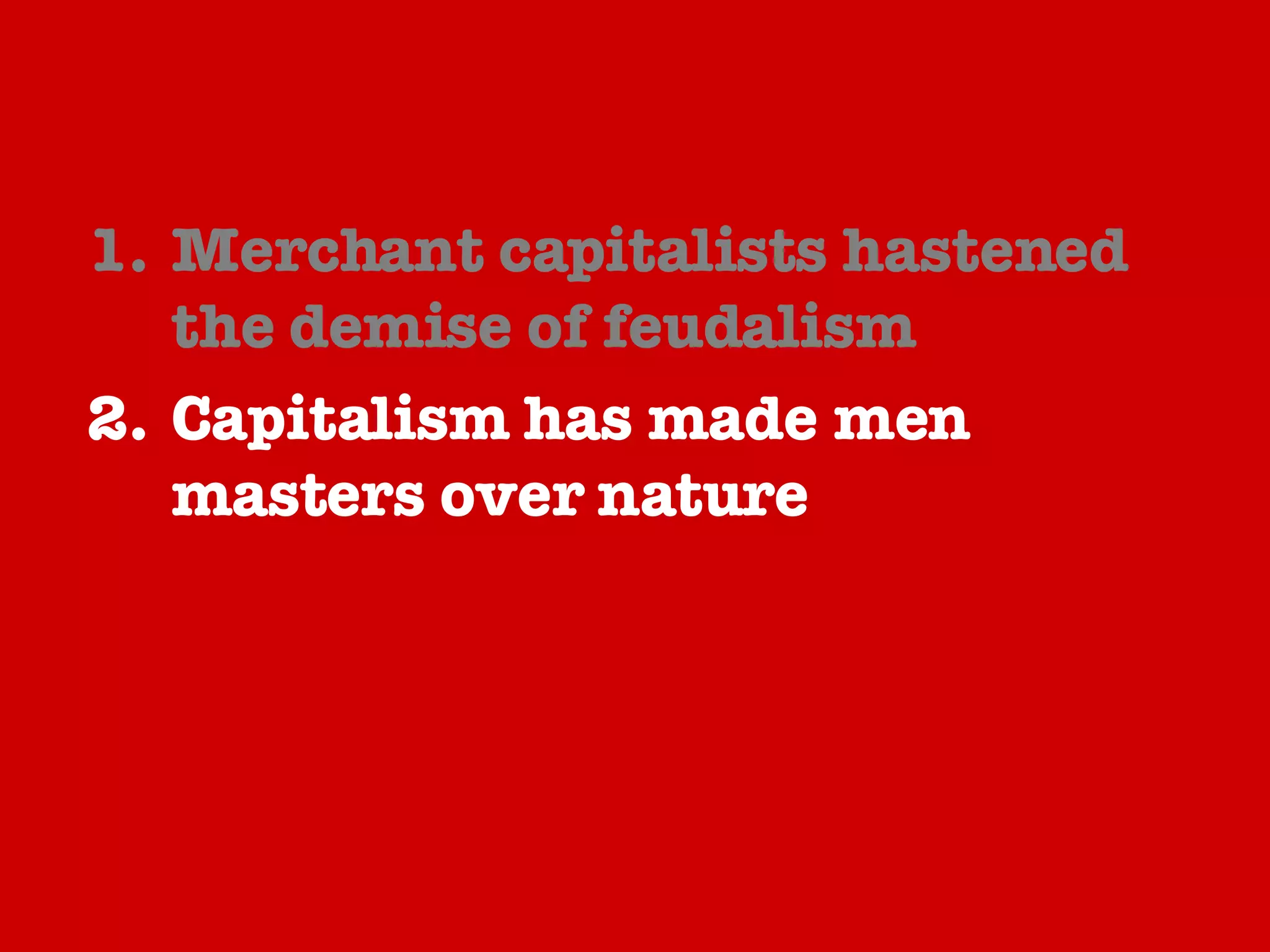
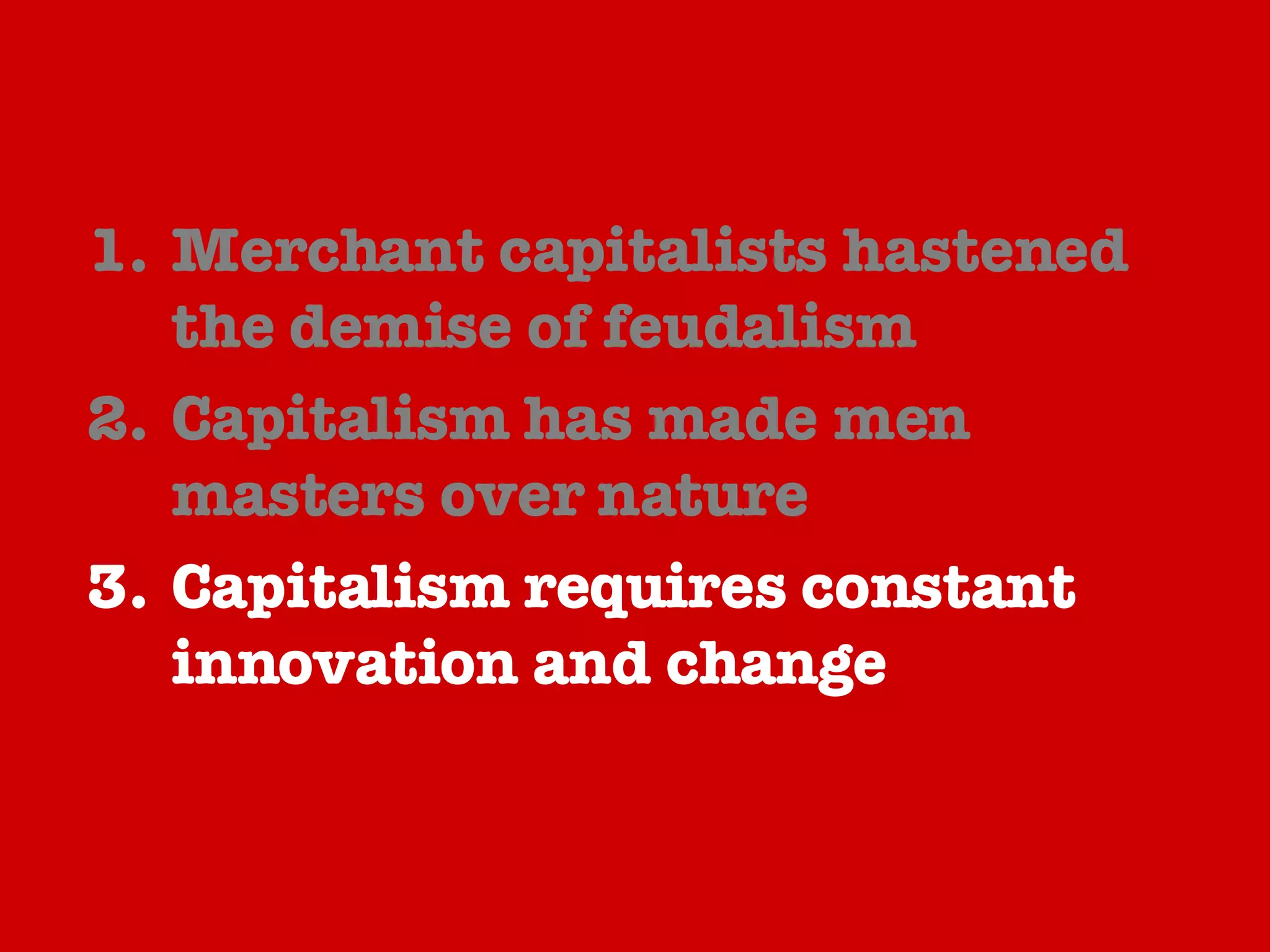
Merchant capitalists hastened the demise of feudalism Capitalism has made men masters over nature Capitalism requires constant innovation and change
So why should Capitalism be replaced???
3   Reasons
Capitalism is   Outmoded
Capitalism creates   Alienation
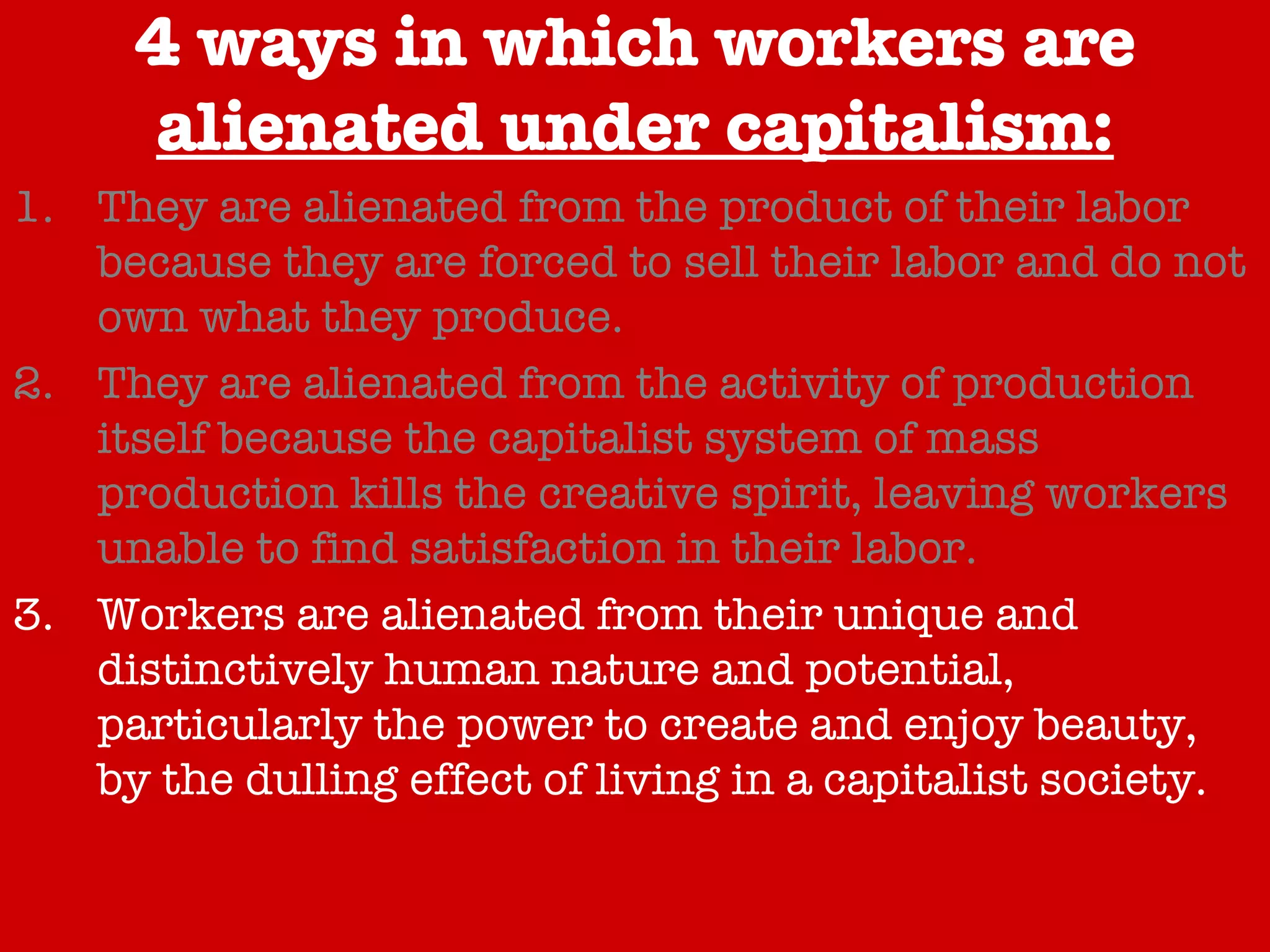
4 ways in which workers are  alienated under capitalism: They are alienated from the product of their labor because they are forced to sell their labor and do not own what they produce. They are alienated from the activity of production itself because the capitalist system of mass production kills the creative spirit, leaving workers unable to find satisfaction in their labor. Workers are alienated from their unique and distinctively human nature and potential, particularly the power to create and enjoy beauty, by the dulling effect of living in a capitalist society. Capitalism alienates workers from each other because it forces them to compete of jobs and wages.
Capitalism is Self-subverting
Why capitalism is DOOOOOOOMED!
Capitalism contains within itself the seeds of its own destruction
Capitalism has created its own “grave-diggers” by creating a class with interests diametrically opposed to its own, brought them together & taught them how to cooperate
Thus, they become a unified class, which has common interests and a common enemy, the bourgeoisie
The proletariat then comes to realize that it is a class with nothing to lose but everything to gain by revolting against and overthrowing the bourgeoisie
Bourgeois-Proletariat Dialectic The Worker is enslaved by the Capitalist, though at first, he or she does not know it The Worker wakes from a “False Consciousness” The Dialectic turns… Establishing the classless society
 
Bourgeois-Proletariat Dialectic The Worker is enslaved by the Capitalist, though at first, he or she does not know it The Worker wakes from a “False Consciousness” The Dialectic turns… Establishing the classless society
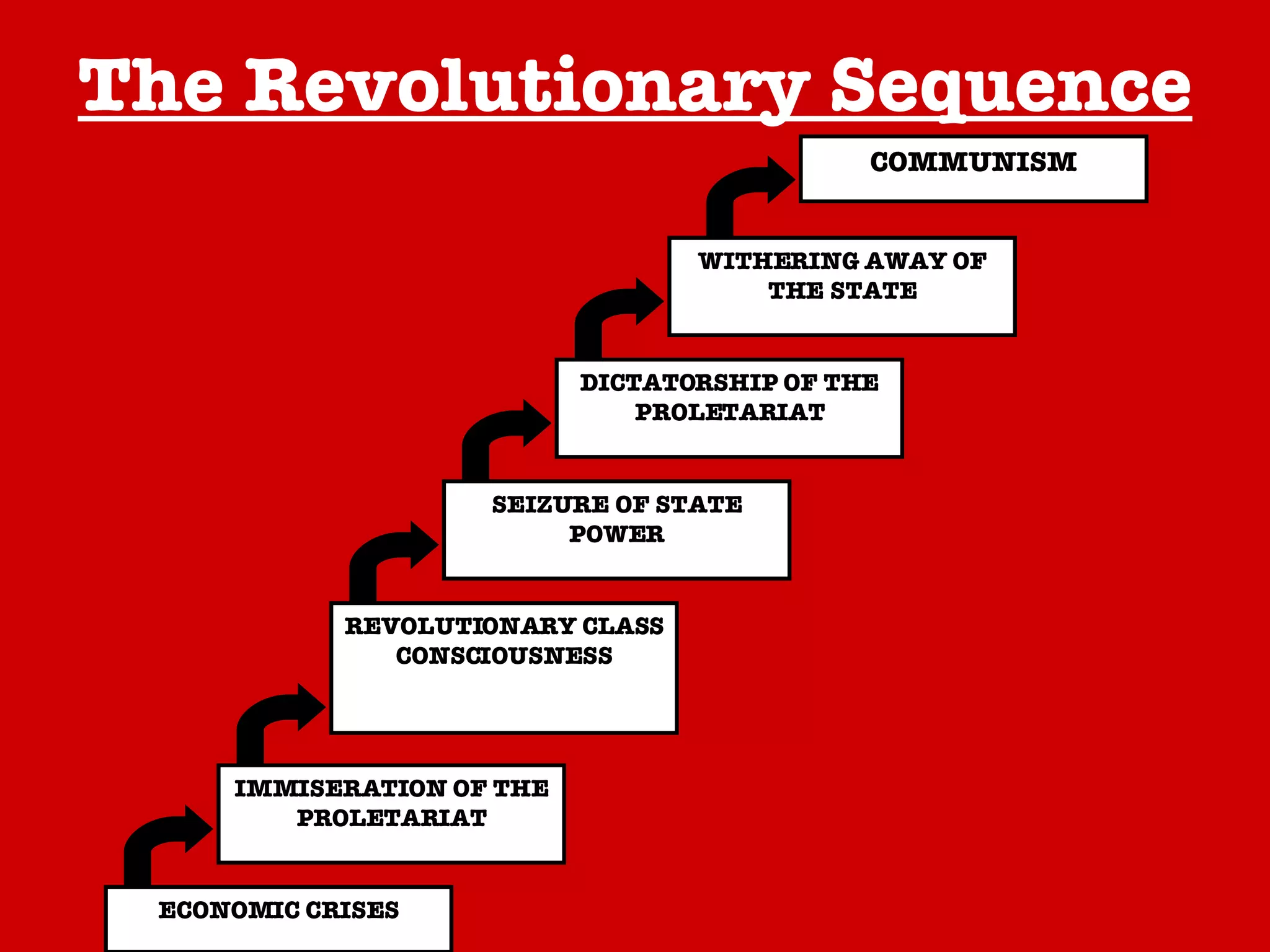
The Revolutionary Sequence COMMUNISM WITHERING AWAY OF THE STATE DICTATORSHIP OF THE PROLETARIAT SEIZURE OF STATE POWER REVOLUTIONARY CLASS CONSCIOUSNESS IMMISERATION OF THE PROLETARIAT ECONOMIC CRISES
The Marxist View of Freedom (Ball and Dagger, “Socialism and Communism: More to Marx”) OBSTACLE: Class divisions, economic inequalities, unequal life chances, “False Consciousness" AGENT: Common/ Working People; The proletariat GOAL: Fulfillment of human potential and needs

Marxism (Part 1)

  • 1.
    Marxism (Part One)Dr. Christopher S. Rice
  • 2.
  • 3.
  • 4.
    Marx Becomes APhilosopher
  • 5.
    2 effects ofhis career in Journalism
  • 6.
    He came toappreciate the central social and political importance of economics
  • 7.
    He ceased tobe a liberal and became a radical
  • 8.
  • 9.
    The Economic andPhilosophical Manuscripts of 1844
  • 10.
    Hegel andhis influence on Marxism
  • 11.
  • 12.
  • 13.
  • 14.
    Dialectic the processwhereby opposite views or forces come into conflict, which eventually leads to the overcoming or reconciliation of the opposition in a new and presumably higher form
  • 15.
    The Master-Slave DialecticThe master becomes master by physically conquering another, whom he then enslaves. Seeing oneself through the eyes of the Other. The master and slave are engaged in a symbiotic relationship. The master and slave are engaged in a conflictual relationship. The true relationship revealed through resistance. A Happy Conclusion…
  • 16.
    The Master-Slave DialecticThe master becomes master by physically conquering another, whom he then enslaves. Seeing oneself through the eyes of the Other. The master and slave are engaged in a symbiotic relationship. The master and slave are engaged in a conflictual relationship. The true relationship revealed through resistance. A Happy Conclusion…
  • 17.
    The Master-Slave DialecticThe master becomes master by physically conquering another, whom he then enslaves. Seeing oneself through the eyes of the Other. The master and slave are engaged in a symbiotic relationship. The master and slave are engaged in a conflictual relationship. The true relationship revealed through resistance. A Happy Conclusion…
  • 18.
    The Master-Slave DialecticThe master becomes master by physically conquering another, whom he then enslaves. Seeing oneself through the eyes of the Other. The master and slave are engaged in a symbiotic relationship. The master and slave are engaged in a conflictual relationship. The true relationship revealed through resistance. A Happy Conclusion…
  • 19.
    The Master-Slave DialecticThe master becomes master by physically conquering another, whom he then enslaves. Seeing oneself through the eyes of the Other. The master and slave are engaged in a symbiotic relationship. The master and slave are engaged in a conflictual relationship. The true relationship revealed through resistance. A Happy Conclusion…
  • 20.
    The Master-Slave DialecticThe master becomes master by physically conquering another, whom he then enslaves. Seeing oneself through the eyes of the Other. The master and slave are engaged in a symbiotic relationship. The master and slave are engaged in a conflictual relationship. The true relationship revealed through resistance. A Happy Conclusion…
  • 21.
    History as theStory of Human Labor and Struggle
  • 22.
    “ The historyof all hitherto existing society is the history of class struggles .”
  • 23.
  • 24.
    Material Forces ofProduction + Social Relations of Production = Material Production
  • 25.
  • 26.
  • 27.
  • 28.
    Class determined byrelation to the forces of production
  • 29.
    Dominating Class has2 important advantages: Monopoly on the power, agents of coercion Control of the Mental Means of Production
  • 30.
    Dominating Class has2 important advantages: Monopoly on the power, agents of coercion Control of the Mental Means of Production
  • 31.
  • 32.
  • 33.
    Marx’s Materialist Conceptionof Society (Ball and Dagger, “Socialism and Communism: More to Marx”) IDEOLOGICAL SUPERSTRUCTURE BASE IDEAS, IDEALS, BELIEFS (Morality, Law, Religion, Etc.) SOCIAL RELATIONS OF PRODUCTION MATERIAL FORCES OF PRODUCTION (“Productive Forces”)
  • 34.
    “ Religion isthe opiate of the masses”
  • 35.
  • 36.
  • 37.
    “ The bourgeoisie,historically, has played a most revolutionary part.”
  • 38.
    Capitalism’s 3 importantprogressive functions
  • 39.
    Merchant capitalists hastenedthe demise of feudalism Capitalism has made men masters over nature Capitalism requires constant innovation and change
  • 40.
    Merchant capitalists hastenedthe demise of feudalism Capitalism has made men masters over nature Capitalism requires constant innovation and change
  • 41.
    Merchant capitalists hastenedthe demise of feudalism Capitalism has made men masters over nature Capitalism requires constant innovation and change
  • 42.
    So why shouldCapitalism be replaced???
  • 43.
    3 Reasons
  • 44.
  • 45.
  • 46.
    4 ways inwhich workers are alienated under capitalism: They are alienated from the product of their labor because they are forced to sell their labor and do not own what they produce. They are alienated from the activity of production itself because the capitalist system of mass production kills the creative spirit, leaving workers unable to find satisfaction in their labor. Workers are alienated from their unique and distinctively human nature and potential, particularly the power to create and enjoy beauty, by the dulling effect of living in a capitalist society. Capitalism alienates workers from each other because it forces them to compete of jobs and wages.
  • 47.
    4 ways inwhich workers are alienated under capitalism: They are alienated from the product of their labor because they are forced to sell their labor and do not own what they produce. They are alienated from the activity of production itself because the capitalist system of mass production kills the creative spirit, leaving workers unable to find satisfaction in their labor. Workers are alienated from their unique and distinctively human nature and potential, particularly the power to create and enjoy beauty, by the dulling effect of living in a capitalist society. Capitalism alienates workers from each other because it forces them to compete of jobs and wages.
  • 48.
    4 ways inwhich workers are alienated under capitalism: They are alienated from the product of their labor because they are forced to sell their labor and do not own what they produce. They are alienated from the activity of production itself because the capitalist system of mass production kills the creative spirit, leaving workers unable to find satisfaction in their labor. Workers are alienated from their unique and distinctively human nature and potential, particularly the power to create and enjoy beauty, by the dulling effect of living in a capitalist society. Capitalism alienates workers from each other because it forces them to compete of jobs and wages.
  • 49.
    4 ways inwhich workers are alienated under capitalism: They are alienated from the product of their labor because they are forced to sell their labor and do not own what they produce. They are alienated from the activity of production itself because the capitalist system of mass production kills the creative spirit, leaving workers unable to find satisfaction in their labor. Workers are alienated from their unique and distinctively human nature and potential, particularly the power to create and enjoy beauty, by the dulling effect of living in a capitalist society. Capitalism alienates workers from each other because it forces them to compete of jobs and wages.
  • 50.
  • 51.
    Why capitalism isDOOOOOOOMED!
  • 52.
    Capitalism contains withinitself the seeds of its own destruction
  • 53.
    Capitalism has createdits own “grave-diggers” by creating a class with interests diametrically opposed to its own, brought them together & taught them how to cooperate
  • 54.
    Thus, they becomea unified class, which has common interests and a common enemy, the bourgeoisie
  • 55.
    The proletariat thencomes to realize that it is a class with nothing to lose but everything to gain by revolting against and overthrowing the bourgeoisie
  • 56.
    Bourgeois-Proletariat Dialectic TheWorker is enslaved by the Capitalist, though at first, he or she does not know it The Worker wakes from a “False Consciousness” The Dialectic turns… Establishing the classless society
  • 57.
  • 58.
    Bourgeois-Proletariat Dialectic TheWorker is enslaved by the Capitalist, though at first, he or she does not know it The Worker wakes from a “False Consciousness” The Dialectic turns… Establishing the classless society
  • 59.
    Bourgeois-Proletariat Dialectic TheWorker is enslaved by the Capitalist, though at first, he or she does not know it The Worker wakes from a “False Consciousness” The Dialectic turns… Establishing the classless society
  • 60.
    Bourgeois-Proletariat Dialectic TheWorker is enslaved by the Capitalist, though at first, he or she does not know it The Worker wakes from a “False Consciousness” The Dialectic turns… Establishing the classless society
  • 61.
    The Revolutionary SequenceCOMMUNISM WITHERING AWAY OF THE STATE DICTATORSHIP OF THE PROLETARIAT SEIZURE OF STATE POWER REVOLUTIONARY CLASS CONSCIOUSNESS IMMISERATION OF THE PROLETARIAT ECONOMIC CRISES
  • 62.
    The Marxist Viewof Freedom (Ball and Dagger, “Socialism and Communism: More to Marx”) OBSTACLE: Class divisions, economic inequalities, unequal life chances, “False Consciousness" AGENT: Common/ Working People; The proletariat GOAL: Fulfillment of human potential and needs