Design of Concrete Structure II
Sessional
(CE-3103)
A Presentation
on
Reinforced Slab Bridge Design(ASD)
Prepared by-
Shekh Muhsen Uddin Ahmed
3 𝑟𝑑 𝑌𝑒𝑎𝑟 1 𝑠𝑡 𝑆𝑒𝑚𝑒𝑠𝑡𝑒𝑟
Department of Civil Engineering
Submitted to-
Md. Rezaul Karim, Ph.D.
Associate Professor
&
Sukanta Kumar Shill
Assistant Professor
Dhaka University of Engineering & Technology
Contents
Introduction to Bridge Structures
Types of Reinforced Concrete Bridge
Loads that Concerned with Slab Bridges
Components of Slab Bridge
Design Steps for Slab and Edge Beam
A Short Introduction to Bridge Structures
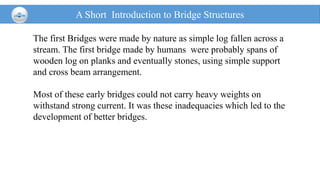
The first Bridges were made by nature as simple log fallen across a
stream. The first bridge made by humans were probably spans of
wooden log on planks and eventually stones, using simple support
and cross beam arrangement.
Most of these early bridges could not carry heavy weights on
withstand strong current. It was these inadequacies which led to the
development of better bridges.
Types of Reinforced Concrete Bridge
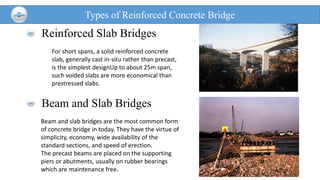
Reinforced Slab Bridges
Beam and Slab Bridges
For short spans, a solid reinforced concrete
slab, generally cast in-situ rather than precast,
is the simplest designUp to about 25m span,
such voided slabs are more economical than
prestressed slabs.
Beam and slab bridges are the most common form
of concrete bridge in today. They have the virtue of
simplicity, economy, wide availability of the
standard sections, and speed of erection.
The precast beams are placed on the supporting
piers or abutments, usually on rubber bearings
which are maintenance free.
Types of Reinforced Concrete Bridge
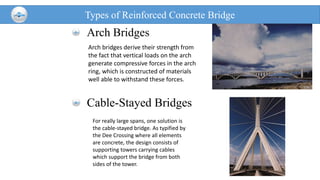
Arch Bridges
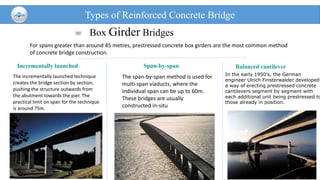
Cable-Stayed Bridges
Arch bridges derive their strength from
the fact that vertical loads on the arch
generate compressive forces in the arch
ring, which is constructed of materials
well able to withstand these forces.
For really large spans, one solution is
the cable-stayed bridge. As typified by
the Dee Crossing where all elements
are concrete, the design consists of
supporting towers carrying cables
which support the bridge from both
sides of the tower.
Box Girder Bridges
Types of Reinforced Concrete Bridge
For spans greater than around 45 metres, prestressed concrete box girders are the most common method
of concrete bridge construction.
Incrementally launched
The incrementally launched technique
creates the bridge section by section,
pushing the structure outwards from
the abutment towards the pier. The
practical limit on span for the technique
is around 75m.
Span-by-span
The span-by-span method is used for
multi-span viaducts, where the
individual span can be up to 60m.
These bridges are usually
constructed in-situ
Balanced cantilever
In the early 1950's, the German
engineer Ulrich Finsterwalder developed
a way of erecting prestressed concrete
cantilevers segment by segment with
each additional unit being prestressed to
those already in position.
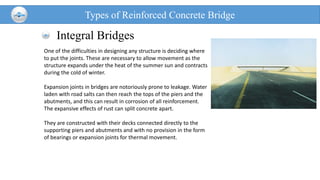
Integral Bridges
Types of Reinforced Concrete Bridge
One of the difficulties in designing any structure is deciding where
to put the joints. These are necessary to allow movement as the
structure expands under the heat of the summer sun and contracts
during the cold of winter.
Expansion joints in bridges are notoriously prone to leakage. Water
laden with road salts can then reach the tops of the piers and the
abutments, and this can result in corrosion of all reinforcement.
The expansive effects of rust can split concrete apart.
They are constructed with their decks connected directly to the
supporting piers and abutments and with no provision in the form
of bearings or expansion joints for thermal movement.
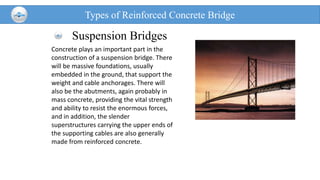
Suspension Bridges
Types of Reinforced Concrete Bridge
Concrete plays an important part in the
construction of a suspension bridge. There
will be massive foundations, usually
embedded in the ground, that support the
weight and cable anchorages. There will
also be the abutments, again probably in
mass concrete, providing the vital strength
and ability to resist the enormous forces,
and in addition, the slender
superstructures carrying the upper ends of
the supporting cables are also generally
made from reinforced concrete.
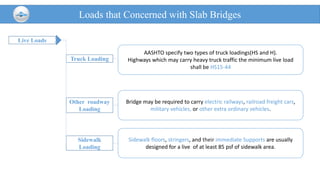
Live Loads
Loads that Concerned with Slab Bridges
Truck Loading
Other roadway
Loading
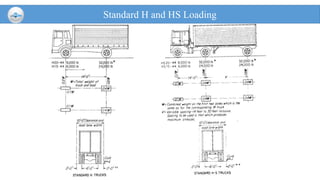
AASHTO specify two types of truck loadings(HS and H).
Highways which may carry heavy truck traffic the minimum live load
shall be HS15-44
Bridge may be required to carry electric railways, railroad freight cars,
military vehicles, or other extra ordinary vehicles.
Sidewalk
Loading
Sidewalk floors, stringers, and their immediate Supports are usually
designed for a live of at least 85 psf of sidewalk area.
Standard H and HS Loading
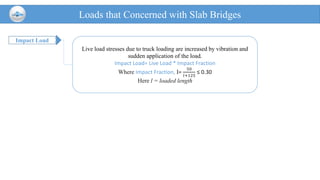
Impact Load
Loads that Concerned with Slab Bridges
Live load stresses due to truck loading are increased by vibration and
sudden application of the load.
Impact Load= Live Load * Impact Fraction
Where Impact Fraction, I=
50
𝑙+125
≤ 0.30
Here l = loaded length
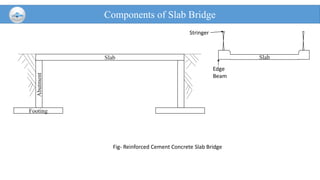
Components of Slab Bridge
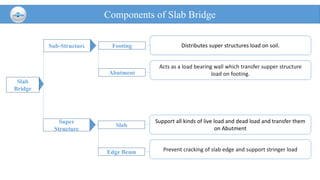
Sub-Structure Footing Distributes super structures load on soil.
Abutment
Acts as a load bearing wall which transfer supper structure
load on footing.
Super
Structure
Slab
Support all kinds of live load and dead load and transfer them
on Abutment
Edge Beam Prevent cracking of slab edge and support stringer load
Slab
Bridge
Components of Slab Bridge
Slab
Footing
Abutment
Slab
Edge
Beam
Fig- Reinforced Cement Concrete Slab Bridge
Stringer
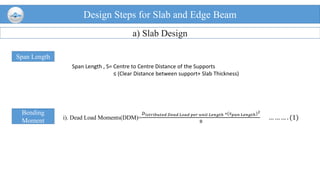
Design Steps for Slab and Edge Beam
a) Slab Design
Span Length
Span Length , S= Centre to Centre Distance of the Supports
≤ (Clear Distance between support+ Slab Thickness)
Bending
Moment i). Dead Load Moments(DDM)=
𝐷 𝑖𝑠𝑡𝑟𝑖𝑏𝑢𝑡𝑒𝑑 𝐷𝑒𝑎𝑑 𝐿𝑜𝑎𝑑 𝑝𝑒𝑟 𝑢𝑛𝑖𝑡 𝐿𝑒𝑛𝑔𝑡ℎ ∗(𝑠 𝑝𝑎𝑛 𝐿𝑒𝑛𝑔𝑡ℎ)2
8
… … … . (1)
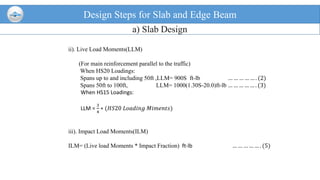
ii). Live Load Moments(LLM)
(For main reinforcement parallel to the traffic)
When HS20 Loadings:
Spans up to and including 50ft ,LLM= 900S ft-lb … … … … … . (2)
Spans 50ft to 100ft, LLM= 1000(1.30S-20.0)ft-lb … … … … … . (3)
When HS15 Loadings:
LLM =
3
4
∗ (𝐻𝑆20 𝐿𝑜𝑎𝑑𝑖𝑛𝑔 𝑀𝑖𝑚𝑒𝑛𝑡𝑠)
iii). Impact Load Moments(ILM)
ILM= (Live load Moments * Impact Fraction) ft-lb … … … … … . (5)
Design Steps for Slab and Edge Beam
a) Slab Design
Design Steps for Slab and Edge Beam
a) Slab Design
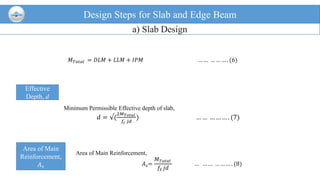
𝑀 𝑇𝑜𝑡𝑎𝑙 = 𝐷𝐿𝑀 + 𝐿𝐿𝑀 + 𝐼𝑃𝑀 … … … … … . (6)
Effective
Depth, d
Minimum Permissible Effective depth of slab,
𝑑 = √(
2𝑀 𝑇𝑜𝑡𝑎𝑙
𝑓𝑐 𝑗𝑑
) … … … … … . (7)
Area of Main
Reinforcement,
𝐴 𝑠
Area of Main Reinforcement,
𝐴 𝑠=
𝑀 𝑇𝑜𝑡𝑎𝑙
𝑓𝑆 𝑗𝑑
… … … … … … . (8)
Design Step for Slab and Edge Beam
a) Slab Design
Area of
Distributed
Reinforcement,
𝐴 𝑠′
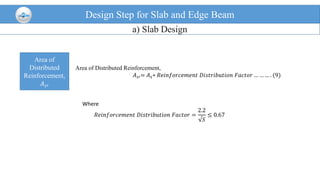
Area of Distributed Reinforcement,
𝐴 𝑠′= 𝐴 𝑠∗ 𝑅𝑒𝑖𝑛𝑓𝑜𝑟𝑐𝑒𝑚𝑒𝑛𝑡 𝐷𝑖𝑠𝑡𝑟𝑖𝑏𝑢𝑡𝑖𝑜𝑛 𝐹𝑎𝑐𝑡𝑜𝑟 … … … . (9)
Where
𝑅𝑒𝑖𝑛𝑓𝑜𝑟𝑐𝑒𝑚𝑒𝑛𝑡 𝐷𝑖𝑠𝑡𝑟𝑖𝑏𝑢𝑡𝑖𝑜𝑛 𝐹𝑎𝑐𝑡𝑜𝑟 =
2.2
√𝑆
≤ 0.67
Design Steps for Slab and Edge Beam
b) Edge Beam Design
Bending
Moment
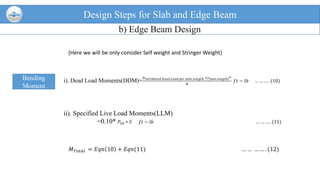
i). Dead Load Moments(DDM)=
𝐷 𝑖𝑠𝑡𝑟𝑖𝑏𝑢𝑡𝑒𝑑 𝐷𝑒𝑎𝑑 𝐿𝑜𝑎𝑑 𝑝𝑒𝑟 𝑢𝑛𝑖𝑡 𝐿𝑒𝑛𝑔𝑡ℎ ∗(𝑠 𝑝𝑎𝑛 𝐿𝑒𝑛𝑔𝑡ℎ)2
8
𝑓𝑡 − 𝑙𝑏 … … … . (10)
ii). Specified Live Load Moments(LLM)
=0.10* 𝑃20 ∗ 𝑆 𝑓𝑡 − 𝑙𝑏 … … … . (11)
(Here we will be only consider Self weight and Stringer Weight)
𝑀 𝑇𝑜𝑡𝑎𝑙 = 𝐸𝑞𝑛 10 + 𝐸𝑞𝑛(11) … … … … . (12)
Design Step for Slab and Edge Beam
b) Edge Beam Design
Area of Tensile
Reinforcement,
𝐴 𝑠
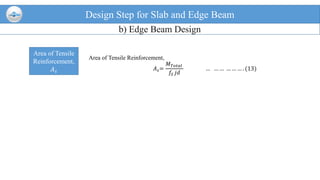
Area of Tensile Reinforcement,
𝐴 𝑠=
𝑀 𝑇𝑜𝑡𝑎𝑙
𝑓𝑆 𝑗𝑑
… … … … … … . (13)
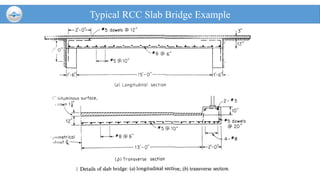
Typical RCC Slab Bridge Example
Reference
1. Auther H. Nilson,"𝐷𝑒𝑠𝑖𝑔𝑛 𝑜𝑓 𝐶𝑜𝑛𝑐𝑟𝑒𝑡𝑒 𝑆𝑡𝑟𝑢𝑐𝑡𝑢𝑟𝑒, 11 𝑡ℎ
𝑒𝑑. , ′′𝑀𝑐𝐺𝑟𝑎𝑤 − 𝐻𝑖𝑙𝑙, 1986.
2. http://www.cbdg.org.uk/intro3.asp
Thanks
To
Everyone

Reinforced slab bridge design(AASHTO allowable stress design method)

  • 1.
    Design of ConcreteStructure II Sessional (CE-3103) A Presentation on Reinforced Slab Bridge Design(ASD) Prepared by- Shekh Muhsen Uddin Ahmed 3 𝑟𝑑 𝑌𝑒𝑎𝑟 1 𝑠𝑡 𝑆𝑒𝑚𝑒𝑠𝑡𝑒𝑟 Department of Civil Engineering Submitted to- Md. Rezaul Karim, Ph.D. Associate Professor & Sukanta Kumar Shill Assistant Professor Dhaka University of Engineering & Technology
  • 2.
    Contents Introduction to BridgeStructures Types of Reinforced Concrete Bridge Loads that Concerned with Slab Bridges Components of Slab Bridge Design Steps for Slab and Edge Beam
  • 3.
    A Short Introductionto Bridge Structures The first Bridges were made by nature as simple log fallen across a stream. The first bridge made by humans were probably spans of wooden log on planks and eventually stones, using simple support and cross beam arrangement. Most of these early bridges could not carry heavy weights on withstand strong current. It was these inadequacies which led to the development of better bridges.
  • 4.
    Types of ReinforcedConcrete Bridge Reinforced Slab Bridges Beam and Slab Bridges For short spans, a solid reinforced concrete slab, generally cast in-situ rather than precast, is the simplest designUp to about 25m span, such voided slabs are more economical than prestressed slabs. Beam and slab bridges are the most common form of concrete bridge in today. They have the virtue of simplicity, economy, wide availability of the standard sections, and speed of erection. The precast beams are placed on the supporting piers or abutments, usually on rubber bearings which are maintenance free.
  • 5.
    Types of ReinforcedConcrete Bridge Arch Bridges Cable-Stayed Bridges Arch bridges derive their strength from the fact that vertical loads on the arch generate compressive forces in the arch ring, which is constructed of materials well able to withstand these forces. For really large spans, one solution is the cable-stayed bridge. As typified by the Dee Crossing where all elements are concrete, the design consists of supporting towers carrying cables which support the bridge from both sides of the tower.
  • 6.
    Box Girder Bridges Typesof Reinforced Concrete Bridge For spans greater than around 45 metres, prestressed concrete box girders are the most common method of concrete bridge construction. Incrementally launched The incrementally launched technique creates the bridge section by section, pushing the structure outwards from the abutment towards the pier. The practical limit on span for the technique is around 75m. Span-by-span The span-by-span method is used for multi-span viaducts, where the individual span can be up to 60m. These bridges are usually constructed in-situ Balanced cantilever In the early 1950's, the German engineer Ulrich Finsterwalder developed a way of erecting prestressed concrete cantilevers segment by segment with each additional unit being prestressed to those already in position.
  • 7.
    Integral Bridges Types ofReinforced Concrete Bridge One of the difficulties in designing any structure is deciding where to put the joints. These are necessary to allow movement as the structure expands under the heat of the summer sun and contracts during the cold of winter. Expansion joints in bridges are notoriously prone to leakage. Water laden with road salts can then reach the tops of the piers and the abutments, and this can result in corrosion of all reinforcement. The expansive effects of rust can split concrete apart. They are constructed with their decks connected directly to the supporting piers and abutments and with no provision in the form of bearings or expansion joints for thermal movement.
  • 8.
    Suspension Bridges Types ofReinforced Concrete Bridge Concrete plays an important part in the construction of a suspension bridge. There will be massive foundations, usually embedded in the ground, that support the weight and cable anchorages. There will also be the abutments, again probably in mass concrete, providing the vital strength and ability to resist the enormous forces, and in addition, the slender superstructures carrying the upper ends of the supporting cables are also generally made from reinforced concrete.
  • 9.
    Live Loads Loads thatConcerned with Slab Bridges Truck Loading Other roadway Loading AASHTO specify two types of truck loadings(HS and H). Highways which may carry heavy truck traffic the minimum live load shall be HS15-44 Bridge may be required to carry electric railways, railroad freight cars, military vehicles, or other extra ordinary vehicles. Sidewalk Loading Sidewalk floors, stringers, and their immediate Supports are usually designed for a live of at least 85 psf of sidewalk area.
  • 10.
    Standard H andHS Loading
  • 11.
    Impact Load Loads thatConcerned with Slab Bridges Live load stresses due to truck loading are increased by vibration and sudden application of the load. Impact Load= Live Load * Impact Fraction Where Impact Fraction, I= 50 𝑙+125 ≤ 0.30 Here l = loaded length
  • 12.
    Components of SlabBridge Sub-Structure Footing Distributes super structures load on soil. Abutment Acts as a load bearing wall which transfer supper structure load on footing. Super Structure Slab Support all kinds of live load and dead load and transfer them on Abutment Edge Beam Prevent cracking of slab edge and support stringer load Slab Bridge
  • 13.
    Components of SlabBridge Slab Footing Abutment Slab Edge Beam Fig- Reinforced Cement Concrete Slab Bridge Stringer
  • 14.
    Design Steps forSlab and Edge Beam a) Slab Design Span Length Span Length , S= Centre to Centre Distance of the Supports ≤ (Clear Distance between support+ Slab Thickness) Bending Moment i). Dead Load Moments(DDM)= 𝐷 𝑖𝑠𝑡𝑟𝑖𝑏𝑢𝑡𝑒𝑑 𝐷𝑒𝑎𝑑 𝐿𝑜𝑎𝑑 𝑝𝑒𝑟 𝑢𝑛𝑖𝑡 𝐿𝑒𝑛𝑔𝑡ℎ ∗(𝑠 𝑝𝑎𝑛 𝐿𝑒𝑛𝑔𝑡ℎ)2 8 … … … . (1)
  • 15.
    ii). Live LoadMoments(LLM) (For main reinforcement parallel to the traffic) When HS20 Loadings: Spans up to and including 50ft ,LLM= 900S ft-lb … … … … … . (2) Spans 50ft to 100ft, LLM= 1000(1.30S-20.0)ft-lb … … … … … . (3) When HS15 Loadings: LLM = 3 4 ∗ (𝐻𝑆20 𝐿𝑜𝑎𝑑𝑖𝑛𝑔 𝑀𝑖𝑚𝑒𝑛𝑡𝑠) iii). Impact Load Moments(ILM) ILM= (Live load Moments * Impact Fraction) ft-lb … … … … … . (5) Design Steps for Slab and Edge Beam a) Slab Design
  • 16.
    Design Steps forSlab and Edge Beam a) Slab Design 𝑀 𝑇𝑜𝑡𝑎𝑙 = 𝐷𝐿𝑀 + 𝐿𝐿𝑀 + 𝐼𝑃𝑀 … … … … … . (6) Effective Depth, d Minimum Permissible Effective depth of slab, 𝑑 = √( 2𝑀 𝑇𝑜𝑡𝑎𝑙 𝑓𝑐 𝑗𝑑 ) … … … … … . (7) Area of Main Reinforcement, 𝐴 𝑠 Area of Main Reinforcement, 𝐴 𝑠= 𝑀 𝑇𝑜𝑡𝑎𝑙 𝑓𝑆 𝑗𝑑 … … … … … … . (8)
  • 17.
    Design Step forSlab and Edge Beam a) Slab Design Area of Distributed Reinforcement, 𝐴 𝑠′ Area of Distributed Reinforcement, 𝐴 𝑠′= 𝐴 𝑠∗ 𝑅𝑒𝑖𝑛𝑓𝑜𝑟𝑐𝑒𝑚𝑒𝑛𝑡 𝐷𝑖𝑠𝑡𝑟𝑖𝑏𝑢𝑡𝑖𝑜𝑛 𝐹𝑎𝑐𝑡𝑜𝑟 … … … . (9) Where 𝑅𝑒𝑖𝑛𝑓𝑜𝑟𝑐𝑒𝑚𝑒𝑛𝑡 𝐷𝑖𝑠𝑡𝑟𝑖𝑏𝑢𝑡𝑖𝑜𝑛 𝐹𝑎𝑐𝑡𝑜𝑟 = 2.2 √𝑆 ≤ 0.67
  • 18.
    Design Steps forSlab and Edge Beam b) Edge Beam Design Bending Moment i). Dead Load Moments(DDM)= 𝐷 𝑖𝑠𝑡𝑟𝑖𝑏𝑢𝑡𝑒𝑑 𝐷𝑒𝑎𝑑 𝐿𝑜𝑎𝑑 𝑝𝑒𝑟 𝑢𝑛𝑖𝑡 𝐿𝑒𝑛𝑔𝑡ℎ ∗(𝑠 𝑝𝑎𝑛 𝐿𝑒𝑛𝑔𝑡ℎ)2 8 𝑓𝑡 − 𝑙𝑏 … … … . (10) ii). Specified Live Load Moments(LLM) =0.10* 𝑃20 ∗ 𝑆 𝑓𝑡 − 𝑙𝑏 … … … . (11) (Here we will be only consider Self weight and Stringer Weight) 𝑀 𝑇𝑜𝑡𝑎𝑙 = 𝐸𝑞𝑛 10 + 𝐸𝑞𝑛(11) … … … … . (12)
  • 19.
    Design Step forSlab and Edge Beam b) Edge Beam Design Area of Tensile Reinforcement, 𝐴 𝑠 Area of Tensile Reinforcement, 𝐴 𝑠= 𝑀 𝑇𝑜𝑡𝑎𝑙 𝑓𝑆 𝑗𝑑 … … … … … … . (13)
  • 20.
    Typical RCC SlabBridge Example
  • 21.
    Reference 1. Auther H.Nilson,"𝐷𝑒𝑠𝑖𝑔𝑛 𝑜𝑓 𝐶𝑜𝑛𝑐𝑟𝑒𝑡𝑒 𝑆𝑡𝑟𝑢𝑐𝑡𝑢𝑟𝑒, 11 𝑡ℎ 𝑒𝑑. , ′′𝑀𝑐𝐺𝑟𝑎𝑤 − 𝐻𝑖𝑙𝑙, 1986. 2. http://www.cbdg.org.uk/intro3.asp
  • 22.