Tri-Service Infrastructure Systems
Conference & Exhibition
August 2 –4, 2005
Design of Buildings to
Resist Progressive Collapse
UFC 4-023-03
Bernie Deneke, PE
Antiterrorism Force Protection Criteria Program Manager
Structural Engineer
Naval Facilities Engineering Command, Atlantic
Phone: 757.322.4233
Email: bernard.deneke@navy.mil
Acknowledgements
Security Engineering
Working Group (SEWG)
(Department of Defense)
Tri- Services
(Army, Navy & Marine Corp, Air Force)
Primary Authors:
David Stevens, ARA
Kirk Marchand, Walter P. Moore
Brian Crowder, NAVFAC
“Critiques and Trouble Makers”
Bernie Deneke, NAVFAC
Ed Conrath, USACE PDC
Tim Campbell, USACE PDC
Overview
Motivated in part by recent terrorist attacks, the
Department of Defense now requires explicit
consideration of Progressive Collapse (PC) in
the design of new buildings and retrofit of
existing buildings.
Previously, there were no US design codes that
provided PC design procedures that met DoD’s
needs.
Overview
The Security Engineering Working Group,
through the Naval Facilities Command
(NAVFAC), contracted with ARA to develop
Unified Facilities Criteria 4-023-03 “Design of
Buildings to Resist Progressive Collapse.”
The UFC has been approved by the three
services (Navy, Army, and Air Force) and will
be officially signed in the near future.
Background
Definition of Progressive Collapse:
The commentary in the American Society of Civil
Engineers (ASCE) Standard 7-02 “Minimum
Design Loads for Buildings and Other Structures”
describes progressive collapse as
“the spread of an initial local failure from element to
element, eventually resulting in the collapse of an
entire structure or a disproportionately large part of
it.”
Background
In the United States and other Western nations,
progressive collapse is a relatively rare event; to
occur, it requires:
an abnormal loading to initiate the damage
AND
a structure that lacks adequate continuity, ductility,
and redundancy.
However, significant casualties can result when
progressive collapse occurs.
Background
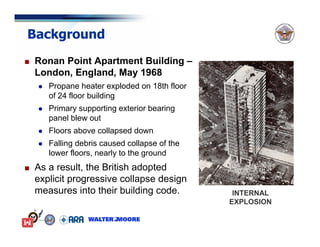
Ronan Point Apartment Building –
London, England, May 1968
Propane heater exploded on 18th floor
of 24 floor building
Primary supporting exterior bearing
panel blew out
Floors above collapsed down
Falling debris caused collapse of the
lower floors, nearly to the ground
As a result, the British adopted
explicit progressive collapse design
measures into their building code. INTERNAL
EXPLOSION
Background
TERRORIST
ATTACK
A.P. Murrah Federal Building – Oklahoma City, Oklahoma
Background
1983
1996
1998
1995
Existing Approaches
America:
ASCE and material specific codes (ACI, AISC,
TMS, etc) do not provide explicit and enforceable
requirements for progressive collapse.
UK
Explicit requirements in RC, steel, and masonry
codes.
Overall approach is composed of three methods:
Tie Forces (Indirect Design)
Alternate Path (Direct Design)
Specific Local Resistance (Direct Design)
Existing Approaches
Proposed British Standards
A risk/consequence approach will be used for
progressive collapse requirements, to choose
structures that require PC design.
GSA Guidelines
Developed by ARA, Vicksburg, for GSA.
Alternate Path Method is used exclusively.
Progressive Collapse Design Approach
UFC 4-023-03, “Design of Buildings to Resist
Progressive Collapse”
Provides the design guidance necessary to reduce
the potential of progressive collapse for new and
existing DoD facilities that experience localized
structural damage through manmade or natural
events.
Progressive Collapse Design Approach
Applicability
Applies to all DoD services and to all DoD inhabited
buildings of three or more stories.
Applies to new construction, major renovations,
and leased buildings and will be utilized in
accordance with the applicability requirements of
UFC 4-010-01 or as directed by Service Guidance.
Progressive Collapse Design Approach
Five materials are considered:
1. Reinforced Concrete
2. Structural Steel
3. Masonry
4. Light Frame Wood
5. Cold-Formed Steel
Progressive Collapse Design Approach
Design approach employs two main mechanisms:
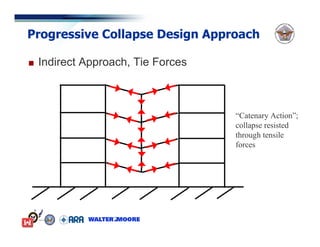
Catenary (Tie Forces, Indirect Design)
Flexural (Alternate Path, Direct Design)
Progressive Collapse Design Approach
Indirect Approach, Tie Forces
“Catenary Action”;
collapse resisted
through tensile
forces
Progressive Collapse Design Approach
Direct Approach, Alternate Path
“Flexural Action”;
collapse resisted
through
bending/membrane
response
Progressive Collapse Design Approach
The PC UFC is threat-independent and is NOT
intended to address the hardening of a
building that is exposed to a specific explosive
threat.
Level of required PC design depends upon
required level of protection, which is determined
by the Project Planning Team.
Progressive Collapse Design Approach
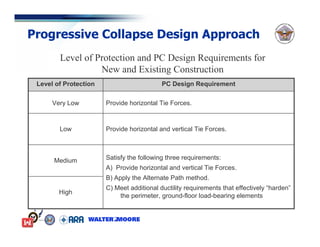
High
Satisfy the following three requirements:
A) Provide horizontal and vertical Tie Forces.
B) Apply the Alternate Path method.
C) Meet additional ductility requirements that effectively “harden”
the perimeter, ground-floor load-bearing elements
Medium
Provide horizontal and vertical Tie Forces.
Low
Provide horizontal Tie Forces.
Very Low
PC Design Requirement
Level of Protection
Level of Protection and PC Design Requirements for
New and Existing Construction
Progressive Collapse Design Approach
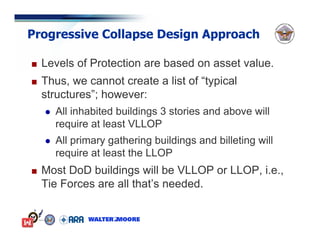
Levels of Protection are based on asset value.
Thus, we cannot create a list of “typical
structures”; however:
All inhabited buildings 3 stories and above will
require at least VLLOP
All primary gathering buildings and billeting will
require at least the LLOP
Most DoD buildings will be VLLOP or LLOP, i.e.,
Tie Forces are all that’s needed.
Progressive Collapse Design Approach
LRFD approach is used for both Tie Forces and
Alternate Path requirements
Consistent with existing material design codes.
May allow easier transition to the civilian world.
Makes use of the ASCE 7-02, Section C2.5, Load
Combinations for Extraordinary Events:
(0.9 or 1.2) D + (0.5 L or 0.2 S) + 0.2 W
Progressive Collapse Design Approach
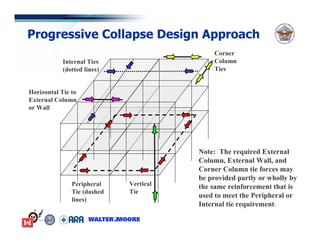
Corner
Column
Ties
Horizontal Tie to
External Column
or Wall
Vertical
Tie
Internal Ties
(dotted lines)
Peripheral
Tie (dashed
lines)
Note: The required External
Column, External Wall, and
Corner Column tie forces may
be provided partly or wholly by
the same reinforcement that is
used to meet the Peripheral or
Internal tie requirement.
Progressive Collapse Design Approach
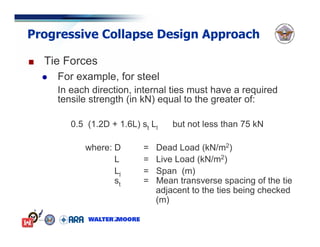
Tie Forces
For example, for steel
In each direction, internal ties must have a required
tensile strength (in kN) equal to the greater of:
0.5 (1.2D + 1.6L) st Ll but not less than 75 kN
where: D = Dead Load (kN/m2)
L = Live Load (kN/m2)
Ll = Span (m)
st = Mean transverse spacing of the tie
adjacent to the ties being checked
(m)
Progressive Collapse Design Approach
Alternate Path
Structure must be able to bridge over a removed
element.
Not intended to replicate an event, but to ensure a
consistent level of resistance.
Applied in 2 situations:
1. An element cannot provide adequate vertical tie
force—bridging must be shown.
2. For MLOP and HLOP.
Progressive Collapse Design Approach
Alternate Path, cont’d
For Alternate Path in MLOP and
HLOP structures, these locations of
column/wall removal are required:
Center of short side
Center of long side
Corner
Significant changes in structural
system
Columns/walls are removed, one at a
time, from EACH floor (i.e., with 8
floors, at least 24 Alternate Path
analyses are required).
Column
Removal
Locations
Column removal
at every floor!
Progressive Collapse Design Approach
Alternate Path, cont’d
Damage Limits
Exterior column or wall removal:
Local damaged area of the floor area directly above and
directly below the removed element must be less than 70
m2 (750 ft2) or 15% of the floor area, whichever is smaller.
The damage must not extend beyond the bays associated
with the removed wall or column.
Interior column or wall removal:
Similar, but 140 m2 (1500 ft2) or 15% of the floor area,
whichever is smaller.
Progressive Collapse Design Approach
Common Design Requirements For All
Construction Types
Increased Effective Column and Wall Height
Upward Loads on Floors and Slabs
Progressive Collapse Design Approach
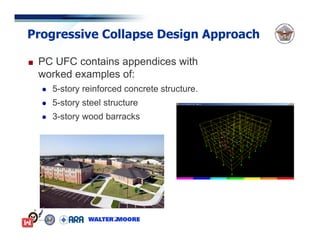
PC UFC contains appendices with
worked examples of:
5-story reinforced concrete structure.
5-story steel structure
3-story wood barracks
Summary
The DOD UFC 4-023-03 bases the level of
required progressive collapse design on the
facility’s required level of protection.
Overall approach is similar to British requirements.
Most DOD structures will be rated at Very Low or
Low Level of Protection and only Tie Forces will
be required; this should not be an odious demand.
The UFC is a living document and can/will be
modified in the future as engineers, designers,
and facility owners provide feedback on the cost
and impact on their structures.
Questions
Bernie Deneke, PE
Antiterrorism Force Protection Criteria Program Manager
Structural Engineer
Naval Facilities Engineering Command, Atlantic
Phone: 757.322.4233
Email: bernard.deneke@navy.mil

Progressive collapse

  • 1.
    Tri-Service Infrastructure Systems Conference& Exhibition August 2 –4, 2005 Design of Buildings to Resist Progressive Collapse UFC 4-023-03 Bernie Deneke, PE Antiterrorism Force Protection Criteria Program Manager Structural Engineer Naval Facilities Engineering Command, Atlantic Phone: 757.322.4233 Email: bernard.deneke@navy.mil
  • 2.
    Acknowledgements Security Engineering Working Group(SEWG) (Department of Defense) Tri- Services (Army, Navy & Marine Corp, Air Force) Primary Authors: David Stevens, ARA Kirk Marchand, Walter P. Moore Brian Crowder, NAVFAC “Critiques and Trouble Makers” Bernie Deneke, NAVFAC Ed Conrath, USACE PDC Tim Campbell, USACE PDC
  • 3.
    Overview Motivated in partby recent terrorist attacks, the Department of Defense now requires explicit consideration of Progressive Collapse (PC) in the design of new buildings and retrofit of existing buildings. Previously, there were no US design codes that provided PC design procedures that met DoD’s needs.
  • 4.
    Overview The Security EngineeringWorking Group, through the Naval Facilities Command (NAVFAC), contracted with ARA to develop Unified Facilities Criteria 4-023-03 “Design of Buildings to Resist Progressive Collapse.” The UFC has been approved by the three services (Navy, Army, and Air Force) and will be officially signed in the near future.
  • 5.
    Background Definition of ProgressiveCollapse: The commentary in the American Society of Civil Engineers (ASCE) Standard 7-02 “Minimum Design Loads for Buildings and Other Structures” describes progressive collapse as “the spread of an initial local failure from element to element, eventually resulting in the collapse of an entire structure or a disproportionately large part of it.”
  • 6.
    Background In the UnitedStates and other Western nations, progressive collapse is a relatively rare event; to occur, it requires: an abnormal loading to initiate the damage AND a structure that lacks adequate continuity, ductility, and redundancy. However, significant casualties can result when progressive collapse occurs.
  • 7.
    Background Ronan Point ApartmentBuilding – London, England, May 1968 Propane heater exploded on 18th floor of 24 floor building Primary supporting exterior bearing panel blew out Floors above collapsed down Falling debris caused collapse of the lower floors, nearly to the ground As a result, the British adopted explicit progressive collapse design measures into their building code. INTERNAL EXPLOSION
  • 8.
    Background TERRORIST ATTACK A.P. Murrah FederalBuilding – Oklahoma City, Oklahoma
  • 9.
  • 10.
    Existing Approaches America: ASCE andmaterial specific codes (ACI, AISC, TMS, etc) do not provide explicit and enforceable requirements for progressive collapse. UK Explicit requirements in RC, steel, and masonry codes. Overall approach is composed of three methods: Tie Forces (Indirect Design) Alternate Path (Direct Design) Specific Local Resistance (Direct Design)
  • 11.
    Existing Approaches Proposed BritishStandards A risk/consequence approach will be used for progressive collapse requirements, to choose structures that require PC design. GSA Guidelines Developed by ARA, Vicksburg, for GSA. Alternate Path Method is used exclusively.
  • 12.
    Progressive Collapse DesignApproach UFC 4-023-03, “Design of Buildings to Resist Progressive Collapse” Provides the design guidance necessary to reduce the potential of progressive collapse for new and existing DoD facilities that experience localized structural damage through manmade or natural events.
  • 13.
    Progressive Collapse DesignApproach Applicability Applies to all DoD services and to all DoD inhabited buildings of three or more stories. Applies to new construction, major renovations, and leased buildings and will be utilized in accordance with the applicability requirements of UFC 4-010-01 or as directed by Service Guidance.
  • 14.
    Progressive Collapse DesignApproach Five materials are considered: 1. Reinforced Concrete 2. Structural Steel 3. Masonry 4. Light Frame Wood 5. Cold-Formed Steel
  • 15.
    Progressive Collapse DesignApproach Design approach employs two main mechanisms: Catenary (Tie Forces, Indirect Design) Flexural (Alternate Path, Direct Design)
  • 16.
    Progressive Collapse DesignApproach Indirect Approach, Tie Forces “Catenary Action”; collapse resisted through tensile forces
  • 17.
    Progressive Collapse DesignApproach Direct Approach, Alternate Path “Flexural Action”; collapse resisted through bending/membrane response
  • 18.
    Progressive Collapse DesignApproach The PC UFC is threat-independent and is NOT intended to address the hardening of a building that is exposed to a specific explosive threat. Level of required PC design depends upon required level of protection, which is determined by the Project Planning Team.
  • 19.
    Progressive Collapse DesignApproach High Satisfy the following three requirements: A) Provide horizontal and vertical Tie Forces. B) Apply the Alternate Path method. C) Meet additional ductility requirements that effectively “harden” the perimeter, ground-floor load-bearing elements Medium Provide horizontal and vertical Tie Forces. Low Provide horizontal Tie Forces. Very Low PC Design Requirement Level of Protection Level of Protection and PC Design Requirements for New and Existing Construction
  • 20.
    Progressive Collapse DesignApproach Levels of Protection are based on asset value. Thus, we cannot create a list of “typical structures”; however: All inhabited buildings 3 stories and above will require at least VLLOP All primary gathering buildings and billeting will require at least the LLOP Most DoD buildings will be VLLOP or LLOP, i.e., Tie Forces are all that’s needed.
  • 21.
    Progressive Collapse DesignApproach LRFD approach is used for both Tie Forces and Alternate Path requirements Consistent with existing material design codes. May allow easier transition to the civilian world. Makes use of the ASCE 7-02, Section C2.5, Load Combinations for Extraordinary Events: (0.9 or 1.2) D + (0.5 L or 0.2 S) + 0.2 W
  • 22.
    Progressive Collapse DesignApproach Corner Column Ties Horizontal Tie to External Column or Wall Vertical Tie Internal Ties (dotted lines) Peripheral Tie (dashed lines) Note: The required External Column, External Wall, and Corner Column tie forces may be provided partly or wholly by the same reinforcement that is used to meet the Peripheral or Internal tie requirement.
  • 23.
    Progressive Collapse DesignApproach Tie Forces For example, for steel In each direction, internal ties must have a required tensile strength (in kN) equal to the greater of: 0.5 (1.2D + 1.6L) st Ll but not less than 75 kN where: D = Dead Load (kN/m2) L = Live Load (kN/m2) Ll = Span (m) st = Mean transverse spacing of the tie adjacent to the ties being checked (m)
  • 24.
    Progressive Collapse DesignApproach Alternate Path Structure must be able to bridge over a removed element. Not intended to replicate an event, but to ensure a consistent level of resistance. Applied in 2 situations: 1. An element cannot provide adequate vertical tie force—bridging must be shown. 2. For MLOP and HLOP.
  • 25.
    Progressive Collapse DesignApproach Alternate Path, cont’d For Alternate Path in MLOP and HLOP structures, these locations of column/wall removal are required: Center of short side Center of long side Corner Significant changes in structural system Columns/walls are removed, one at a time, from EACH floor (i.e., with 8 floors, at least 24 Alternate Path analyses are required). Column Removal Locations Column removal at every floor!
  • 26.
    Progressive Collapse DesignApproach Alternate Path, cont’d Damage Limits Exterior column or wall removal: Local damaged area of the floor area directly above and directly below the removed element must be less than 70 m2 (750 ft2) or 15% of the floor area, whichever is smaller. The damage must not extend beyond the bays associated with the removed wall or column. Interior column or wall removal: Similar, but 140 m2 (1500 ft2) or 15% of the floor area, whichever is smaller.
  • 27.
    Progressive Collapse DesignApproach Common Design Requirements For All Construction Types Increased Effective Column and Wall Height Upward Loads on Floors and Slabs
  • 28.
    Progressive Collapse DesignApproach PC UFC contains appendices with worked examples of: 5-story reinforced concrete structure. 5-story steel structure 3-story wood barracks
  • 29.
    Summary The DOD UFC4-023-03 bases the level of required progressive collapse design on the facility’s required level of protection. Overall approach is similar to British requirements. Most DOD structures will be rated at Very Low or Low Level of Protection and only Tie Forces will be required; this should not be an odious demand. The UFC is a living document and can/will be modified in the future as engineers, designers, and facility owners provide feedback on the cost and impact on their structures.
  • 30.
    Questions Bernie Deneke, PE AntiterrorismForce Protection Criteria Program Manager Structural Engineer Naval Facilities Engineering Command, Atlantic Phone: 757.322.4233 Email: bernard.deneke@navy.mil