1
Approximate Lateral Load Analysis by Portal Method
Portal Frame
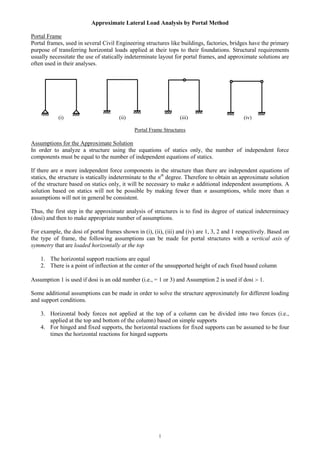
Portal frames, used in several Civil Engineering structures like buildings, factories, bridges have the primary
purpose of transferring horizontal loads applied at their tops to their foundations. Structural requirements
usually necessitate the use of statically indeterminate layout for portal frames, and approximate solutions are
often used in their analyses.
(i) (ii) (iii) (iv)
Portal Frame Structures
Assumptions for the Approximate Solution
In order to analyze a structure using the equations of statics only, the number of independent force
components must be equal to the number of independent equations of statics.
If there are n more independent force components in the structure than there are independent equations of
statics, the structure is statically indeterminate to the nth
degree. Therefore to obtain an approximate solution
of the structure based on statics only, it will be necessary to make n additional independent assumptions. A
solution based on statics will not be possible by making fewer than n assumptions, while more than n
assumptions will not in general be consistent.
Thus, the first step in the approximate analysis of structures is to find its degree of statical indeterminacy
(dosi) and then to make appropriate number of assumptions.
For example, the dosi of portal frames shown in (i), (ii), (iii) and (iv) are 1, 3, 2 and 1 respectively. Based on
the type of frame, the following assumptions can be made for portal structures with a vertical axis of
symmetry that are loaded horizontally at the top
1. The horizontal support reactions are equal
2. There is a point of inflection at the center of the unsupported height of each fixed based column
Assumption 1 is used if dosi is an odd number (i.e., = 1 or 3) and Assumption 2 is used if dosi 1.
Some additional assumptions can be made in order to solve the structure approximately for different loading
and support conditions.
3. Horizontal body forces not applied at the top of a column can be divided into two forces (i.e.,
applied at the top and bottom of the column) based on simple supports
4. For hinged and fixed supports, the horizontal reactions for fixed supports can be assumed to be four
times the horizontal reactions for hinged supports
2
Example
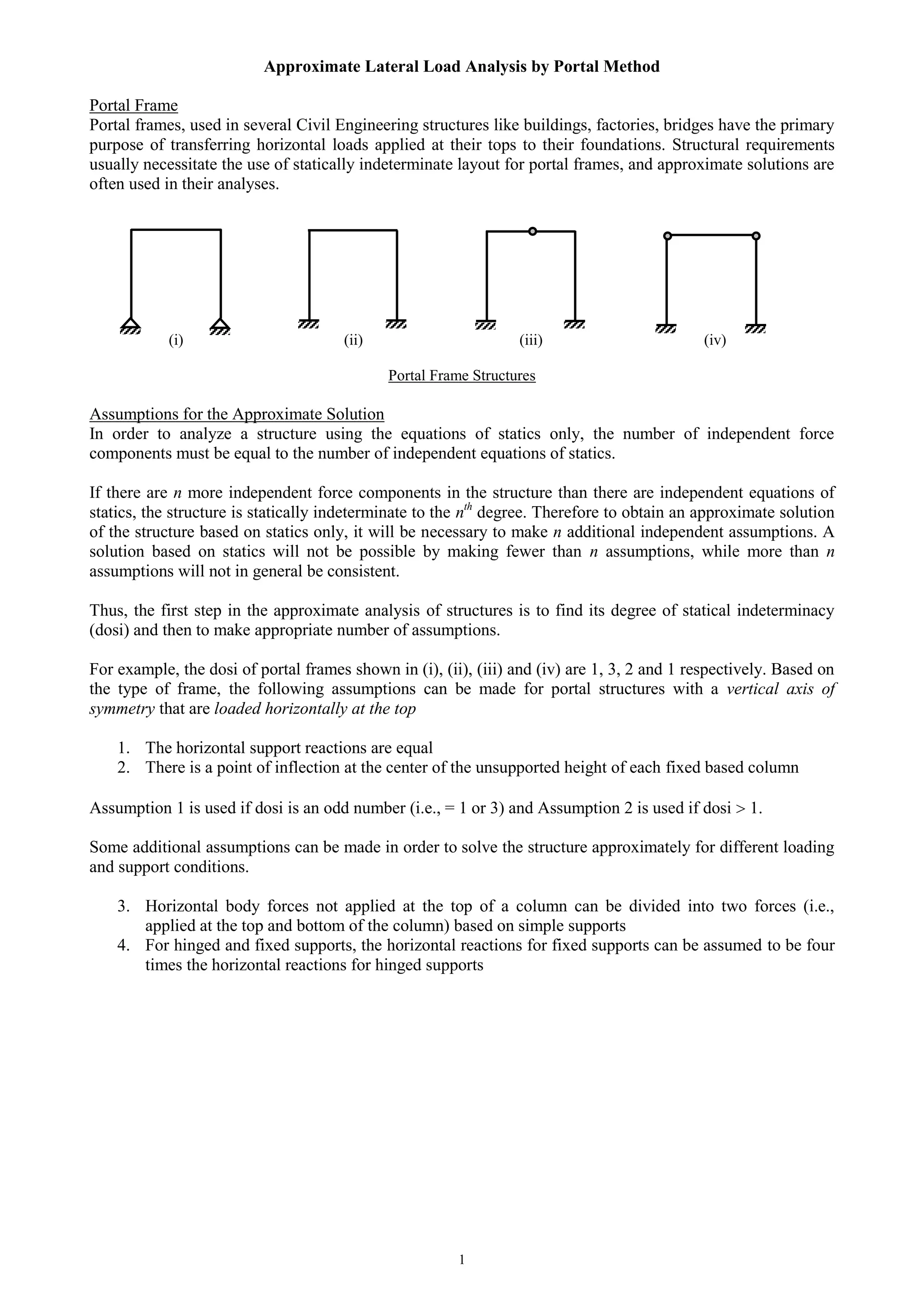
Draw the axial force, shear force and bending moment diagrams of the frames loaded as shown below.
(i) (ii)
Solution
(i) For this frame, dosi = 3 3 + 4 3 4 = 1; i.e., Assumption 1 HA = HD = 10/2 = 5 k
MA = 0 10 10 VD 15 = 0 VD = 6.67 k
Fy = 0 VA + VD = 0 VA = 6.67 k
Reactions AFD (k) SFD (k) BMD (k-ft)
(ii) dosi = 3 3 + 6 3 4 = 3
Assumption 1 HA = HD = 10/2 = 5 k, Assumption 2 BME = BMF = 0
BMF = 0 HA 5 + MA = 0 MA = 25 k-ft; Similarly BME = 0 MD = 25 k-ft
MA = 0 25 25 + 10 10 VD 15 = 0 VD = 3.33 k
Fy = 0 VA + VD = 0 VA = 3.33 k
Reactions AFD (k) SFD (k) BMD (k-ft)
5
25 k-ft
6.67 k6.67 k
5 k5 k
EF
D
CB
A
10 k
15
5
10 k
6.67 6.67 5 5
6.67
50 50
3.33 k3.33 k
5 k5 k
10 k
3.33
3.33
5
5 5
3.33
25 25
25 k-ft
2525
D
CB
A
10 k
15
10
3
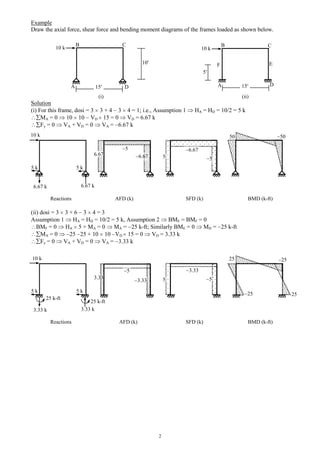
(iii)
dosi = 3 4 + 6 3 5 1 = 2; Assumption 1 and 2 BME = BMF = 0
BME = 0 (bottom) HA 5 + MA = 0 MA = 5HA; Similarly BMF = 0 MD = 5HD
Also BME = 0 (free body of EBCF) 10 5 VD 15 = 0 VD = 3.33 k
Fy = 0 VA + VD = 0 VA = VD = 3.33 k
BMG = 0 (between E and G) VA 7.5 HA 5 = 0 HA = 5 k MA = 5HA = 25 k-ft
Fx = 0 (entire structure) HA + HD + 10 = 0 5 + HD + 10 = 0 HD = 5 k MD = 5HD = 25 k-ft
Reactions AFD (k) SFD (k) BMD (k-ft)
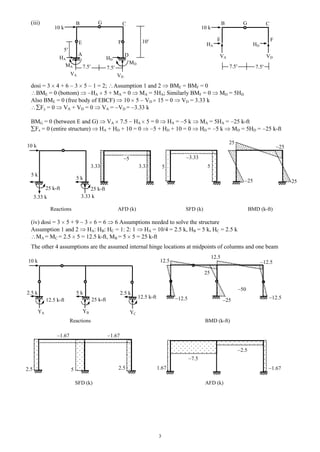
(iv) dosi = 3 5 + 9 3 6 = 6 6 Assumptions needed to solve the structure
Assumption 1 and 2 HA: HB: HC = 1: 2: 1 HA = 10/4 = 2.5 k, HB = 5 k, HC = 2.5 k
MA = MC = 2.5 5 = 12.5 k-ft, MB = 5 5 = 25 k-ft
The other 4 assumptions are the assumed internal hinge locations at midpoints of columns and one beam
Reactions BMD (k-ft)
SFD (k) AFD (k)
10 k
10 k
25 k-ft
MD
VD
HD
G
12.5 k-ft
CB
D
CB
A
10 k10 k
7.5
10 FE
YBYA
5 k2.5 k
25 k-ft
7.5 7.5
FE
5
MA
VA
HA
25 k-ft
3.33 k3.33 k
5 k
5 k
3.33 3.33
5
5 5
3.33
25
25
2525
50
VA
HA
VD
HD
7.5
G
2.5 k
12.5 k-ft
YC
12.5 25 12.5
12.5
12.5
12.5
25
5 2.52.5
1.67 1.67
1.67 1.67
7.5
2.5
4
Analysis of Multi-storied Structures by Portal Method
Approximate methods of analyzing multi-storied structures are important because such structures are
statically highly indeterminate. The number of assumptions that must be made to permit an analysis by
statics alone is equal to the degree of statical indeterminacy of the structure.
Assumptions
The assumptions used in the approximate analysis of portal frames can be extended for the lateral load
analysis of multi-storied structures. The Portal Method thus formulated is based on three assumptions
1. The shear force in an interior column is twice the shear force in an exterior column.
2. There is a point of inflection at the center of each column.
3. There is a point of inflection at the center of each beam.
Assumption 1 is based on assuming the interior columns to be formed by columns of two adjacent bays or
portals. Assumption 2 and 3 are based on observing the deflected shape of the structure.
Example
Use the Portal Method to draw the axial force, shear force and bending moment diagrams of the three-storied
frame structure loaded as shown below.
E
A
404040
151515
33
15 10 15
18k
12k
6k
122@10=20
Beam BMD (k-ft) Beam SFD (k) Column AFD (k)
616161
-3-2 -2
-8
-5.33 -5.33
-2
-3.67
12
-7.75
3.67
-1
7.7515.5
-7.33
-12.2-8.13 -8.13
12
10
6
12
10
6
6 6
55
Column shear forces are at the ratio of 1:2:2:1.
Shear force in (V) columns IM, JN, KO, LP are
[18 1/(1 + 2 + 2 + 1) =] 3k
, [18 2/(1 + 2 + 2 + 1) =] 6k
,
6k
, 3k
respectively. Similarly,
VEI = 30 1/(6) = 5k
, VFJ = 10k
, VGK = 10k
, VHL = 5k
; and
VAE = 36 1/(6) = 6k
, VBF = 12k
, VCG = 12k
, VDH = 6k
Bending moments are
MIM = 3 10/2 = 15k
, MJN = 30k
, MKO = 30k
, MLP = 15k
MEI = 5 10/2 = 25k
, MFJ = 50k
, MGK = 50k
, MHL = 25k
MAE = 6 10/2 = 30k
, MFJ = 60k
, MGK = 60k
, MHL = 30k
M
I
F
B
N
J
G
C
O
K
H
P
L
D
The rest of the calculations follow from the free-body diagrams
72
50
30
25
15
36
25
15
3672
50
30
Column SFD (k) Column BMD (k-ft) Beam AFD (k)
-15 -9 -3
-10
-6 -2
-5 -3 -1
-15.5
7.33
5
Problems on Lateral Load Analysis by Portal Method
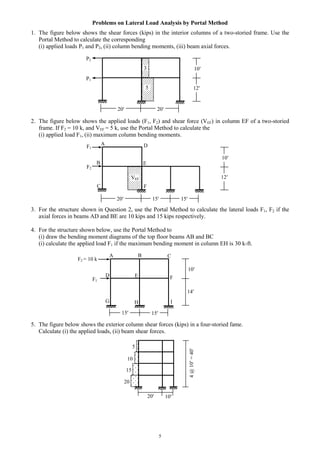
1. The figure below shows the shear forces (kips) in the interior columns of a two-storied frame. Use the
Portal Method to calculate the corresponding
(i) applied loads P1 and P2, (ii) column bending moments, (iii) beam axial forces.
2. The figure below shows the applied loads (F1, F2) and shear force (VEF) in column EF of a two-storied
frame. If F2 = 10 k, and VEF = 5 k, use the Portal Method to calculate the
(i) applied load F1, (ii) maximum column bending moments.
3. For the structure shown in Question 2, use the Portal Method to calculate the lateral loads F1, F2 if the
axial forces in beams AD and BE are 10 kips and 15 kips respectively.
4. For the structure shown below, use the Portal Method to
(i) draw the bending moment diagrams of the top floor beams AB and BC
(i) calculate the applied load F1 if the maximum bending moment in column EH is 30 k-ft.
5. The figure below shows the exterior column shear forces (kips) in a four-storied fame.
Calculate (i) the applied loads, (ii) beam shear forces.
5
3
20 20
12
10
P2
P1
F
D
E
VEF 12
10
F1
F2
20 15 15
A
C
B
IG H
FD
CB
F1
F2 = 10 k
10
14
15 15
E
A
4@10=40
20
15
10
5
20 10
6
Analysis of Multi-storied Structures by Cantilever Method
Although the results using the Portal Method are reasonable in most cases, the method suffers due to the
lack of consideration given to the variation of structural response due to the difference between sectional
properties of various members. The Cantilever Method attempts to rectify this limitation by considering the
cross-sectional areas of columns in distributing the axial forces in various columns of a story.
Assumptions
The Cantilever Method is based on three assumptions
1. The axial force in each column of a storey is proportional to its horizontal distance from the
centroidal axis of all the columns of the storey.
2. There is a point of inflection at the center of each column.
3. There is a point of inflection at the center of each beam.
Assumption 1 is based on assuming that the axial stresses can be obtained by a method analogous to that
used for determining the distribution of normal stresses on a transverse section of a cantilever beam.
Assumption 2 and 3 are based on observing the deflected shape of the structure.
Example
Use the Cantilever Method to draw the axial force, shear force and bending moment diagrams of the three -
storied frame structure loaded as shown below.
E
A
15 5 5 15
18k
12k
6k
122@10=20
42.435.342.4
15.913.215.9
Beam BMD (k-ft)
64.653.864.6
The dotted line is the column centerline (at all floors)
Column axial forces are at the ratio of 20: 5: 5: 20.
Axial force in (P) columns IM, JN, KO, LP are
[18 5 20/{202
+ 52
+ ( 5)2
+ ( 20)2
} = ] 2.12k
, [18 5
5/(202
+ 52
+ ( 5)2
+ ( 20)2
} = ] 0.53k
, 0.53k
, 2.12k
respectively.
Similarly, PEI = 330 20/(850) = 7.76k
, PFJ = 1.94k
, PGK =
1.94k
, PHL = 7.76k
; and
PAE = 696 20/(850) = 16.38k
, PBF = 4.09k
, PCG = 4.09k
,
PDH = 16.38k
M
I
F
B
N
J
G
C
O
K
H
P
L
D
The rest of the calculations follow from the free-body diagrams
Beam AFD (k)
-14.82 -8.98 -3.04
-9.88
-6.00 -2.12
-4.95 -3.00 -1.05
Beam SFD (k)
-2.65-2.12 -2.12
-7.06-5.65 -5.64
-10.76-8.61 -8.61
-7.76
-2.12
-1.94
-0.532.12
1.94
0.53
7.76
Column AFD (k)
16.38 -16.38
Column BMD (k-ft)
69.9
1
48.5
29.1
26.5
15.9
38.1
26.5
15.9
38.169.9
48.5
29.1
4.09 -4.09
3.18
Column SFD (k)
5.825.82 3.18
11.65
9.70
11.65
9.70
6.35 6.35
5.305.30
7
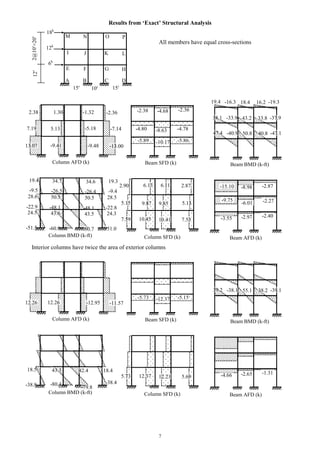
Results from ‘Exact’ Structural Analysis
E
A
15 10 15
18k
12k
6k
122@10=20
Beam BMD (k-ft)
M
I
F
B
N
J
G
C
O
K
H
P
L
D
All members have equal cross-sections
Beam AFD (k)
-15.10 -8.98 -2.87
-9.75
-6.01 -2.27
-3.55 -2.97 -2.40
Beam SFD (k)
-4.68-2.38 -2.36
-8.63-4.80 -4.78
-10.17-5.89 -5.86
-7.14
-2.36
-5.18
-1.322.38
5.13
1.30
7.19
Column AFD (k)
13.07 -13.00
Column BMD (k-ft)
-9.48
2.90
Column SFD (k)
6.116.13 2.87
10.41
9.85
10.45
9.87
7.59 7.53
5.135.15
-9.41
-16.3 16.218.419.4 -19.3
-33.9 33.843.238.1 -37.9
-40.9 40.850.847.4 -47.1
28.6
19.4
24.5
-51.5
-9.5
-22.9
50.5
34.7
43.6
-60.9
-26.5
-48.1
50.5
34.6
43.5
-60.7
-26.4
-48.1
28.5
19.3
24.3
-51.0
-9.4
-22.8
Beam BMD (k-ft)
Beam AFD (k)
-4.66 -2.65 -1.31
Beam SFD (k)
-12.37-5.73 -5.15
Column AFD (k)
12.26
Column BMD (k-ft)
-12.95
Column SFD (k)
12.2112.375.73 5.69
12.26
-38.1 38.255.139.2 -39.1
18.5
-38.8
43.3
-80.4
42.4
-79.8
18.4
-38.4
Interior columns have twice the area of exterior columns
-11.57
8
Problems on Lateral Load Analysis by Cantilever Method
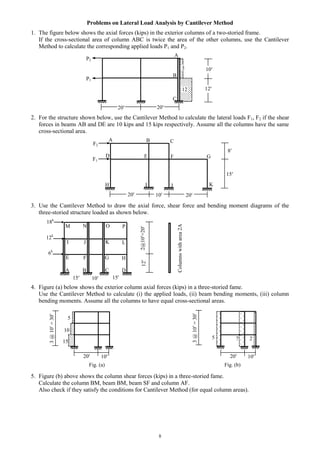
1. The figure below shows the axial forces (kips) in the exterior columns of a two-storied frame.
If the cross-sectional area of column ABC is twice the area of the other columns, use the Cantilever
Method to calculate the corresponding applied loads P1 and P2.
2. For the structure shown below, use the Cantilever Method to calculate the lateral loads F1, F2 if the shear
forces in beams AB and DE are 10 kips and 15 kips respectively. Assume all the columns have the same
cross-sectional area.
3. Use the Cantilever Method to draw the axial force, shear force and bending moment diagrams of the
three-storied structure loaded as shown below.
4. Figure (a) below shows the exterior column axial forces (kips) in a three-storied fame.
Use the Cantilever Method to calculate (i) the applied loads, (ii) beam bending moments, (iii) column
bending moments. Assume all the columns to have equal cross-sectional areas.
Fig. (a) Fig. (b)
5. Figure (b) above shows the column shear forces (kips) in a three-storied fame.
Calculate the column BM, beam BM, beam SF and column AF.
Also check if they satisfy the conditions for Cantilever Method (for equal column areas).
7
15
10
5
20 10
3@10=30
20 10
3@10=30
5
E
A
15 10 15
18k
12k
6k
122@10=20
M
I
F
B
N
J
G
C
O
K
H
P
L
D
Columnswitharea2A
2
C
B
A
12
3
12
10
P2
P1
20 20
JH I K
FD
C
8
15
20 10
E
20
GF1
F2
A B
9
Approximate Vertical Load Analysis
Approximation based on the Location of Hinges
If a beam AB is subjected to a uniformly distributed vertical load of w per unit length [Fig. (a)], both the
joints A and B will rotate as shown in Fig. (b), because although the joints A and B are partly restrained
against rotation, the restraint is not complete. Had the joints A and B been completely fixed against rotation
[Fig. (c)] the points of inflection would be located at a distance 0.21L from each end. If, on the other hand,
the joints A and B are hinged [Fig. (d)], the points of zero moment would be at the end of the beam. For the
actual case of partial fixity, the points of inflection can be assumed to be somewhere between 0.21 L and 0
from the end of the beam. For approximate analysis, they are often assumed to be located at one-tenth (0.1
L) of the span length from each end joint.
(a) (b) (c) (d)
Depending on the support conditions (i.e., hinge ended, fixed ended or continuous), a beam in general can be
statically indeterminate up to a degree of three. Therefore, to make it statically determinate, the following
three assumptions are often made in the vertical load analysis of a beam
1. The axial force in the beam is zero
2. Points of inflection occur at the distance 0.1 L measured along the span from the left and right support.
Bending Moment and Shear Force from Approximate Analysis
Based on the approximations mentioned (i.e., points of inflection at a distance 0.1 L from the ends), the
maximum positive bending moment in the beam is calculated to be
M(+) = w(0.8L)2
/8 = 0.08 wL2
, at the midspan of the beam
The maximum negative bending moment is
M( ) = wL2
/8 0.08 wL2
= 0.045 wL2
, at the joints A and B of the beam
The shear forces are maximum (positive or negative) at the joints A and B and are calculated to be
VA = wL/2, and VB = wL/2
Moment and Shear Values using ACI Coefficients
Maximum allowable LL/DL = 3, maximum allowable adjacent span difference = 20%
1. Positive Moments
(i) For End Spans
(a) If discontinuous end is unrestrained, M(+) = wL2
/11
(b) If discontinuous end is restrained, M(+) = wL2
/14
(ii) For Interior Spans, M(+) = wL2
/16
2. Negative Moments
(i) At the exterior face of first interior supports
(a) Two spans, M( ) = wL2
/9
(b) More than two spans, M( ) = wL2
/10
(ii) At the other faces of interior supports, M( ) = wL2
/11
(iii) For spans not exceeding 10 , of where columns are much stiffer than beams, M( ) = wL2
/12
(iv) At the interior faces of exterior supports
(a) If the support is a beam, M( ) = wL2
/24
(b) If the support is a column, M( ) = wL2
/16
3. Shear Forces
(i) In end members at first interior support, V = 1.15wL/2
(ii) At all other supports, V = wL/2
[where L = clear span for M(+) and V, and average of two adjacent clear spans for M( )]
0.21L0.21L
DCDC
BABABA
BA
L
k2Lk1L
10
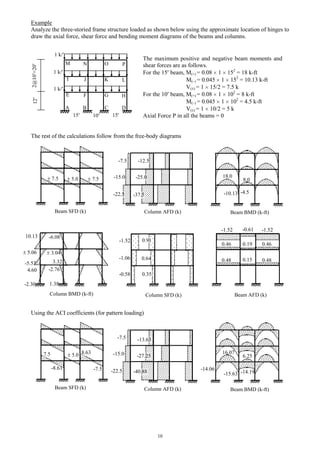
Example
Analyze the three-storied frame structure loaded as shown below using the approximate location of hinges to
draw the axial force, shear force and bending moment diagrams of the beams and columns.
1 k/
1 k/
1 k/
E
A
15 10 15
122@10=20
Beam BMD (k-ft)
The maximum positive and negative beam moments and
shear forces are as follows.
For the 15 beam, M(+) = 0.08 1 152
= 18 k-ft
M( ) = 0.045 1 152
= 10.13 k-ft
V( ) = 1 15/2 = 7.5 k
For the 10 beam, M(+) = 0.08 1 102
= 8 k-ft
M( ) = 0.045 1 102
= 4.5 k-ft
V( ) = 1 10/2 = 5 k
Axial Force P in all the beams = 0
M
I
F
B
N
J
G
C
O
K
H
P
L
D
The rest of the calculations follow from the free-body diagrams
Beam SFD (k) Column AFD (k)
Column BMD (k-ft) Column SFD (k)
-1.52
-0.58
-1.06
7.55.07.5
-4.5-10.13
18.0
8.0
-7.5
-15.0
-12.5
-25.0
-37.5
-5.53
5.06
10.13
4.60
-2.30
3.32
3.04
-6.08
-2.76
1.38
0.91
11
0.35
0.64
Beam AFD (k)
-1.52 -0.61 -1.52
0.46 0.19 0.46
0.48 0.15 0.48
Beam BMD (k-ft)
Using the ACI coefficients (for pattern loading)
Beam SFD (k) Column AFD (k)
-7.5
5.0
-14.19-15.63
16.07
6.25
-7.5
-15.0
-13.63
-27.25
-40.88
7.5
-8.63
8.63
-22.5
-22.5 -14.06
11
Approximate Analysis of Bridge Portal and Mill Bent
Bridge Portals and Mill Bents
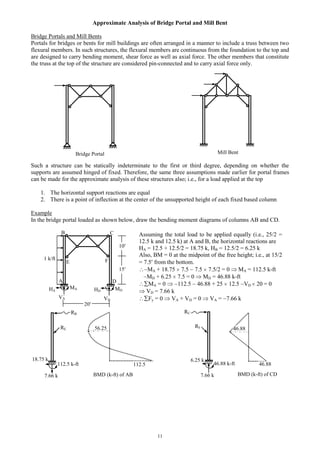
Portals for bridges or bents for mill buildings are often arranged in a manner to include a truss between two
flexural members. In such structures, the flexural members are continuous from the foundation to the top and
are designed to carry bending moment, shear force as well as axial force. The other members that constitute
the truss at the top of the structure are considered pin-connected and to carry axial force only.
Such a structure can be statically indeterminate to the first or third degree, depending on whether the
supports are assumed hinged of fixed. Therefore, the same three assumptions made earlier for portal frames
can be made for the approximate analysis of these structures also; i.e., for a load applied at the top
1. The horizontal support reactions are equal
2. There is a point of inflection at the center of the unsupported height of each fixed based column
Example
In the bridge portal loaded as shown below, draw the bending moment diagrams of columns AB and CD.
FE
D
C
A
B
Bridge Portal Mill Bent
1 k/ft
Assuming the total load to be applied equally (i.e., 25/2 =
12.5 k and 12.5 k) at A and B, the horizontal reactions are
HA = 12.5 + 12.5/2 = 18.75 k, HB = 12.5/2 = 6.25 k
Also, BM = 0 at the midpoint of the free height; i.e., at 15/2
= 7.5 from the bottom.
MA + 18.75 7.5 7.5 7.5/2 = 0 MA = 112.5 k-ft
MD + 6.25 7.5 = 0 MD = 46.88 k-ft
MA = 0 112.5 46.88 + 25 12.5 VD 20 = 0
VD = 7.66 k
Fy = 0 VA + VD = 0 VA = 7.66 k
15
10
HA
VA
MA HD
VD
MD
20
112.5 k-ft
7.66 k
18.75 k
46.88 k-ft
7.66 k
6.25 k
RB RC
RE
RF
112.5
56.25
46.88
46.88
BMD (k-ft) of AB BMD (k-ft) of CD
12
Approximate Analysis of Statically Indeterminate Trusses
Two approximate methods are commonly used for the analysis of statically indeterminate trusses. The
methods are based on two basic assumptions
Method 1: Diagonal members take equal share of the sectional shear force
Method 2: Diagonal members can take tension only (i.e., they cannot take any compression)
Example
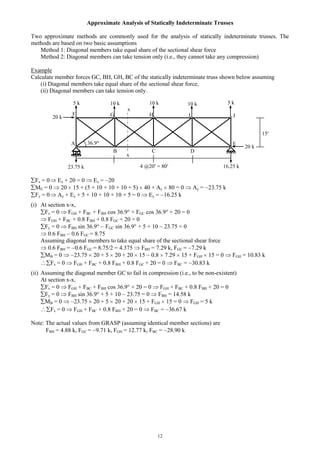
Calculate member forces GC, BH, GH, BC of the statically indeterminate truss shown below assuming
(i) Diagonal members take equal share of the sectional shear force,
(ii) Diagonal members can take tension only.
Fx = 0 Ex + 20 = 0 Ex = 20
ME = 0 20 15 + (5 + 10 + 10 + 10 + 5) 40 + Ay 80 = 0 Ay = 23.75 k
Fy = 0 Ay + Ey + 5 + 10 + 10 + 10 + 5 = 0 Ey = 16.25 k
(i) At section x-x,
Fx = 0 FGH + FBC + FBH cos 36.9 + FGC cos 36.9 + 20 = 0
FGH + FBC + 0.8 FBH + 0.8 FGC + 20 = 0
Fy = 0 FBH sin 36.9 FGC sin 36.9 + 5 + 10 23.75 = 0
0.6 FBH 0.6 FGC = 8.75
Assuming diagonal members to take equal share of the sectional shear force
0.6 FBH = 0.6 FGC = 8.75/2 = 4.375 FBH = 7.29 k, FGC = 7.29 k
MB = 0 23.75 20 + 5 20 + 20 15 0.8 7.29 15 + FGH 15 = 0 FGH = 10.83 k
Fx = 0 FGH + FBC + 0.8 FBH + 0.8 FGC + 20 = 0 FBC = 30.83 k
(ii) Assuming the diagonal member GC to fail in compression (i.e., to be non-existent)
At section x-x,
Fx = 0 FGH + FBC + FBH cos 36.9 + 20 = 0 FGH + FBC + 0.8 FBH + 20 = 0
Fy = 0 FBH sin 36.9 + 5 + 10 23.75 = 0 FBH = 14.58 k
MB = 0 23.75 20 + 5 20 + 20 15 + FGH 15 = 0 FGH = 5 k
Fx = 0 FGH + FBC + 0.8 FBH + 20 = 0 FBC = 36.67 k
Note: The actual values from GRASP (assuming identical member sections) are
FBH = 4.88 k, FGC = 9.71 k, FGH = 12.77 k, FBC = 28.90 k
x
x
JIHGF
E
DCB
A
20 k
5 k 10 k 10 k 10 k 5 k
4 @20 = 80 16.25 k
20 k
15
23.75 k
36.9
13
Problems on Approximate Analysis of Bridge Portal, Mill Bent and Truss
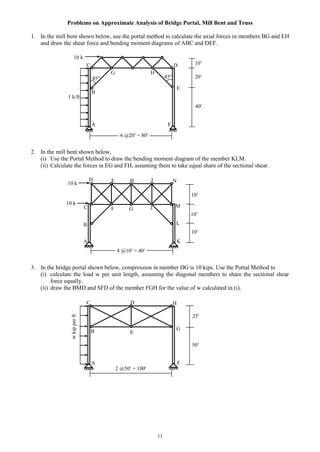
1. In the mill bent shown below, use the portal method to calculate the axial forces in members BG and EH
and draw the shear force and bending moment diagrams of ABC and DEF.
2. In the mill bent shown below,
(i) Use the Portal Method to draw the bending moment diagram of the member KLM.
(ii) Calculate the forces in EG and FH, assuming them to take equal share of the sectional shear.
3. In the bridge portal shown below, compression in member DG is 10 kips. Use the Portal Method to
(i) calculate the load w per unit length, assuming the diagonal members to share the sectional shear
force equally.
(ii) draw the BMD and SFD of the member FGH for the value of w calculated in (i).
B L
I
JF
H
GC
E N
M
K
D
A
10 k
10
10
10
10 k
wkipperft
B
H
G
F
C
A
2 @50 = 100
50
25
D
E
45
HG
45
1 k/ft
D
E
F
C
B
A
10 k
4 @20 = 80
40
20
10
4 @10 = 40
14
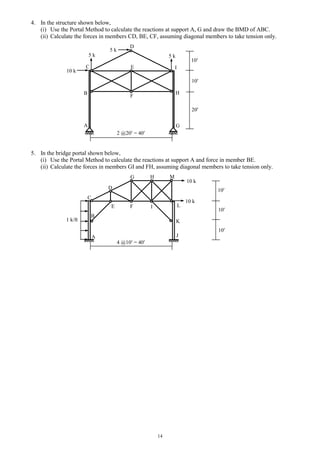
4. In the structure shown below,
(i) Use the Portal Method to calculate the reactions at support A, G and draw the BMD of ABC.
(ii) Calculate the forces in members CD, BE, CF, assuming diagonal members to take tension only.
5. In the bridge portal shown below,
(i) Use the Portal Method to calculate the reactions at support A and force in member BE.
(ii) Calculate the forces in members GI and FH, assuming diagonal members to take tension only.
B
D
I
H
G
C
A
10 k
2 @20 = 40
20
10
5 k
10
E
5 k 5 k
F
K
I
H
F
G
10 k
10 k
B
1 k/ft
E
C
D
M
L
JA
4 @10 = 40
10
10
10
15
Deflection Calculation by the Method of Virtual Work
Method of Virtual Work
Another way of representing the equilibrium equations is by energy methods, which is based on the law of
conservation of energy. According to the principle of virtual work, if a system in equilibrium is subjected to
virtual displacements, the virtual work done by the external forces ( WE) is equal to the virtual work done
by the internal forces ( WI)
WE = WI …...…………………(1)
where the symbol is used to indicate ‘virtual’. This term is used to indicate hypothetical increments of
displacements and works that are assumed to happen in order to formulate the problem.
while the virtual work done by the virtual internal force (u) on B is = u. dL …...…………………(3)
The total internal virtual work done is WI = u. dL …...…………………(4)
where the symbol indicates the summation over the lengths of all the elements within the body.
In this formulation, the terms in italic indicate virtual loads or internal forces.
The principle of virtual work [Eq. (1)] 1. = u. dL = u. dL …...…………………(5)
It is to be noted here that the term above can indicate the deflection or rotation of the body, depending on
which the virtual load (1) can be a unit force or a unit moment applied in the direction of .
Deflection of Truss due to External Loads
The above principle can be applied to calculate the deflection of a truss due to axial deformation of its
members. This axial deformation can be caused be caused by external loads on the truss, temperature change
or misfit of member length. The axial deformation due to external loads is caused by the internal forces
within the truss members, the resulting extension of a truss member being
dL = N0L/EA …...…………………(6)
where N0, L, E and A stand for the axial force (due to external loads), length, modulus of elasticity and
cross-sectional area of a truss member. The internal force u due to the unit virtual load is often expressed by
N1, from which the equation for truss deflection [Eq. (5)] becomes = N1. N0L/EA ……….……(7)
Example
Calculate the vertical deflection of the point B of the truss ABCDEF due to the external loads applied
[Given: EA/L = 500 kip/ft, for all the truss members].
Using member forces N0 and N1 from the above analyses, = N0 N1 L/EA ……….……(7)
Ignoring zero force members,
B,v = {(7.07) (0.707) + (−7.07) (0.707) + (−5) (−0.5) + (−5) (−0.5)}/500 = 0.01 ft
Consider the body loaded as shown in Fig. 1. Under the given
loading conditions, the point A deflects an amount in the direction
shown in the Figure. Moreover the same load causes the element B
within the body to extend an amount dL in the direction shown.
If a virtual unit load (i.e., a load of magnitude 1), when applied in
the direction of , causes a virtual internal force u in the element B
in the direction of dL, the virtual work done by the external forces
WE = 1. …...…………………(2)
Fig. 1
A
B
dL
u
1
A B C
F E D
A B C
F E D
A B
C
F E D
3 @ 20 = 60
20
10 k
0
0
1010
-14.147.07 -7.07
-5 -5
N0 (k) N1
10 k
1
-10.707 0.707
-0.5 -0.5
0 0
0
0
16
Deflection of Truss due to Temperature Change and Misfit
In addition to external loads, a truss joint may deflect due to change in member lengths (i.e., become longer
or shorter than its original length) caused by change in temperature or geometrical misfit of any truss
member (being longer or shorter than its specified length).
In Eq. (5); i.e., = u. dL …...…………………(5)
the tem dL (elongation of a truss member) can also be due to temperature change or fabrication defect of any
truss member.
The change in length due to increase in the temperature T is = T L …...…………………(8)
where = Coefficient of thermal expansion; i.e., change of length of a member of unit length due to unit
change of temperature, T = Change of temperature of a member of length L.
Adding to it a geometric misfit (due to fabrication defect) of L, the total elongation of a truss member
dL = N0L/EA + T L + L …...…………………(9)
from which the equation for truss deflection [Eq. (5)] becomes
= N1 dL = N1 (N0L/EA + T L + L) …...…………………(10)
Example
Calculate the vertical deflection of joint B of the truss ABCDEF shown below due to
(i) temperature rise of 30 F in the bottom cord members AB and BC,
(ii) fabrication defects resulting in vertical members BF and CE to be made 0.25 shorter than specified
[Given: Coefficient of thermal expansion = 5.5 10-6
/ F, for all the truss members].
(i) For members AB and BC, = 5.5 10-6
/ F, T = 30 F, L = 20 ft = 240 in
dL = T L = (5.5 10-6
) (30) (240) = 0.0396 in
Ignoring zero force members, B,v = (0.0396) (-0.5) + (0.0396) (-0.5) = 0.0396 in
(ii) For members BF and CE, dL = 0.25 in
Ignoring zero force members, B,v = ( 0.25) (-1) + ( 0.25) (0) = 0.25 in
Support Settlement
Settlement of supports due to consolidation or instability of the subsoil/foundation is a major reason of
deflection of structures. There is a fundamental difference between the effect of support settlement on
statically determinate and indeterminate structures. While it causes deflection due to geometrical changes
only in statically determinate structures, it induces internal stresses in statically indeterminate structures
(which may even be more significant than the forces due to external loads).
The effect of support settlement on statically indeterminate structures is dealt separately but the following
figure shows the deflected shape of the truss ABCDEF shown above due to settlement of support C.
A
B
C
F E D
3 @ 20 = 60
20 -0.25
-0.25
0.0396
dL (in) N1
1
-10.707 0.707
-0.5 -0.5
0 0
0
0
0.0396
17
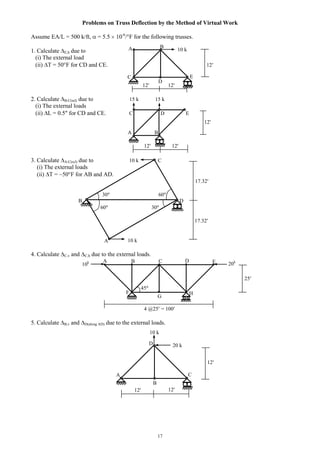
Problems on Truss Deflection by the Method of Virtual Work
Assume EA/L = 500 k/ft, = 5.5 10-6
/ F for the following trusses.
1. Calculate E,h due to
(i) The external load
(ii) T = 50 F for CD and CE. 12
12 12
2. Calculate B-C(rel) due to 15 k 15 k
(i) The external loads
(ii) L = 0.5 for CD and CE. C D E
A B
12 12
3. Calculate A-C(rel) due to 10 k C
(i) The external loads
(ii) T = 50 F for AB and AD.
17.32
30 60
B D
60 30
17.32
10 k
4. Calculate C,v and C,h due to the external loads.
5. Calculate B,v and D(along AD) due to the external loads.
20 k
10 k
A
A
B
C
D
A B
C
D
E
10 k
A
G
F
EDC
H
25
10k
4 @25 = 100
45
20kB
12
1212
12
18
Deflection due to Flexural Deformations
Flexural deformation is the main source of deflection in many civil engineering structures, like beams, slabs
and frames; i.e., those designed primarily against bending moment. It is often much more significant than
other causes of deflection like axial, shear and torsional deformation. From Eq. (5) of the previous section,
the principle of virtual work = u. dL …………………(5)
where the term above can indicate the deflection or rotation of the body, u is the virtual internal force in
an element within the body, which deforms by an amount dL in the direction of u.
Deflection of Beam/Frame due to External Loads
For flexural deformation, u is be the virtual internal moment m1 in the element while dL is the rotation d
caused by external forces; i.e., dL = d = curvature ds = (m0/EI) ds.
= m1 m0/EI ds …………………(11)
where m0 is the bending moment caused by external forces and EI is called the flexural rigidity of the
member. Here, the integration sign is used instead of summation because the bending moments vary
within the length of each member (unlike the trusses, where axial forces do not vary within the members).
Integration Table
In order to facilitate the integration shown in Eq. (11), the following table is used between functions f1 and
f2, both of which can be uniform or vary linearly or parabolically along the length (L) of a member.
Integration of Product of Functions (I = f1 f2 dS)
f2 f1 A
L
B
L
A
L
A B
L
A C B
L
a
L
AaL BaL/2 AaL/2 (A+B)aL/2 [A+4C+B]aL/6
b
L
AbL/2 BbL/3 AbL/6 [A+2B]bL/6 [2C+B]bL/6
a
L
AaL/2 BaL/6 AaL/3 [2A+B]aL/6 [A+2C]aL/6
a b
L
A(a+b)L/2 B(a+2b)L/6 A(2a+b)L/6 [A(2a+b)+B(a+2b)]L/6
[Aa+Bb+
2C(a+b)]L/6
Example: Calculate the tip rotation and deflection of the beam shown below [Given: EI = const].
m1
m0
B
P0L
A
P0
L
L
1
m1
Using the m0 diagram along with m1 for unit anticlockwise
moment at A
A = ( 1) ( P0L/EI) L/2 = P0L2
/2EI
Using the m0 diagram and m1 for unit upward load at A
vA = (L) ( P0L/EI) L/3 = P0L3
/3EI
19
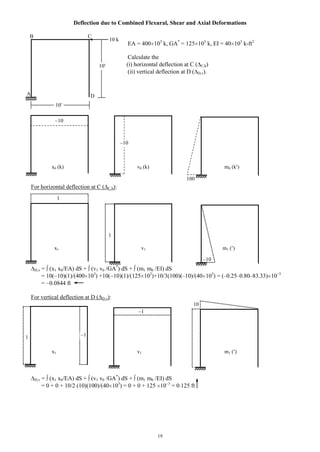
Deflection due to Combined Flexural, Shear and Axial Deformations
EA = 400 103
k, GA*
= 125 103
k, EI = 40 103
k-ft2
Calculate the
(i) horizontal deflection at C ( C,h)
(ii) vertical deflection at D ( D,v).
x0 (k) v0 (k) m0 (k )
For horizontal deflection at C ( C,h):
x1 v1 m1 ( )
D,v = (x1 x0/EA) dS + (v1 v0 /GA*
) dS + (m1 m0 /EI) dS
= 10( 10)(1)/(400 103
) +10( 10)(1)/(125 103
)+10/3(100)(–10)/(40 103
) = (–0.25–0.80–83.33) 10 3
= 0.0844 ft
For vertical deflection at D ( D,v):
x1 v1 m1 ( )
D,v = (x1 x0/EA) dS + (v1 v0 /GA*
) dS + (m1 m0 /EI) dS
= 0 + 0 + 10/2 (10)(100)/(40 103
) = 0 + 0 + 125 10 3
= 0.125 ft
1
1
1
–1
CB
DA
10 k
10
10
–1
10
–10
–10
100
–10
20
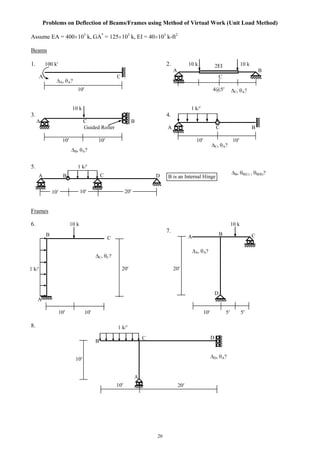
Problems on Deflection of Beams/Frames using Method of Virtual Work (Unit Load Method)
Assume EA = 400 103
k, GA*
= 125 103
k, EI = 40 103
k-ft2
Beams
1. 100 k 2. 10 k 10 k
A B
A C C
10 4@5
10 k 1 k/
3. 4.
A C B
Guided Roller A C B
10 10 10 10
5.
Frames
6. 10 k 10 k
7.
20 20
D
A
10 10 10 5 5
8.
1 k/
CB
AB
A, A?
C, A?
B, A?
C, A?
C, C?
A, A?
C
2EI
DBA
1 k/
B is an Internal HingeC
10 2010
B, B(L) , B(R)?
1 k/
10
A
C D
B
10 20
D, A?
21
Analysis of Statically Indeterminate Structures by Flexibility Method
The
22
Flexibility Method for 2-degree Indeterminate Trusses
D C 10 k
EA/L = constant = 1000 k/ft
(Note: EA constant)
dosi = 1 6 + 4 – 2 4 = 2
10 The horizontal reaction HB and member force FBD
are taken as the two redundants.
A B
10
10 k
1,0 = {N1 N0 /(EA/L)} = {0 0 + 0 0 + 0 14.14 + 0 (–10) + 1 0}/1000 = 0 ft
2,0 = {N2 N0 /(EA/L)} = {14.14 1 + (–10) (–0.707)}/1000 = 21.21 10-3
ft
1,1 = {N1 N1 /(EA/L)} = {02
+ 02
+ 02
+ 02
+ 12
}/1000 = 1 10-3
ft/k
1,2 = 2,1 = {N1 N2 /(EA/L)} = {1 (–0.707)}/1000 = –0.707 10-3
ft/k
2,2 = {N2 N2 /(EA/L)} = {4 (–0.707)2
+ 2 12
}/1000 = 4 10-3
ft/k
(1 10-3
) HB + (–0.707 10-3
) FBD = 0
(–0.707 10-3
) HB + (4 10-3
) FBD = –21.21 10-3
HB = – 4.29 k, and FBD = – 6.06 k
N = N0 + N1 HB + N2 FBD
FAB = 0 +1 (– 4.29) + (–0.707) (–6.06) = 0, FBC = –10 + 0 + (–0.707) (–6.06) = –5.71 k
FCD = 0 +0 + (–0.707) (–6.06) = 4.29, FDA = 0 +0 + (–0.707) (–6.06) = 4.29 k
FAC = 14.14 + 0 +(1) (–6.06) = 8.08 k, FBD = – 6.06 k
(0)
(0)
(0)
(14.14) ( 10) (0)
(0)
(0) (0)
(1)
(1)
( 0.707)
(1)
( 0.707)
( 0.707)
( 0.707)
Case 0 (HB = 0, FBD = 0)
[Forces N0 (k)]
Case 1 (HB = 1)
[Forces N1]
Case 2 (FBD = 1)
[Forces N2]
23
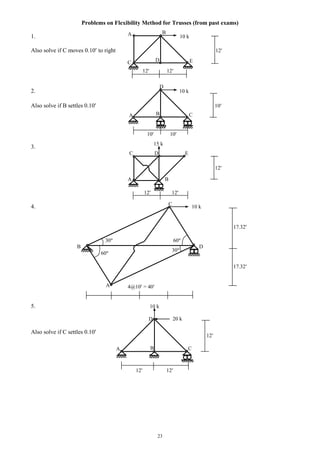
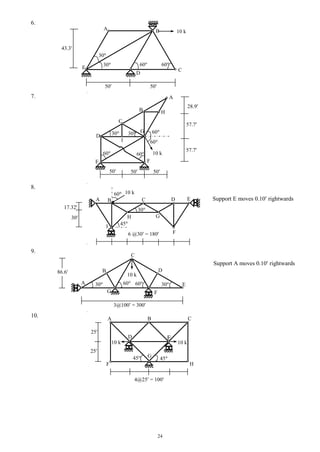
Problems on Flexibility Method for Trusses (from past exams)
1. 10 k
Also solve if C moves 0.10 to right 12
12 12
2. 10 k
Also solve if B settles 0.10 10
10 10
3.
C D E
A B
12 12
4. 10 k
17.32
30 60
B D
60
17.32
4@10 = 40
5. 10 k
20 k
Also solve if C settles 0.10
12 12
15 k
C
30
A
A B C
D
A B
C D E
A B C
D
12
12
24
6.
7.
28.9
8.
9.
10.
45
30
10 k
A B C D E
I
H G
F6 @30 = 180
30
17.32
60
10 k
A
B
C
D
E
FG
30 60 3060
86.6
3@100 = 300
57.7
60
60
E
A
30
10 k
B
C
D
50 50
F
60
G
H
30
50
57.7
60I
6060
B
C
D
E
A
30
30
10 k
50 50
43.3
Support E moves 0.10 rightwards
Support A moves 0.10 rightwards
4545
10 k
A B C
F
D E
H
G
4@25 = 100
10 k
25
25
25
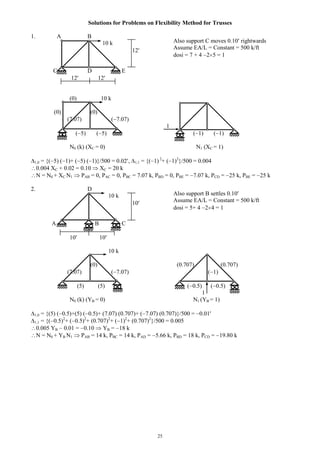
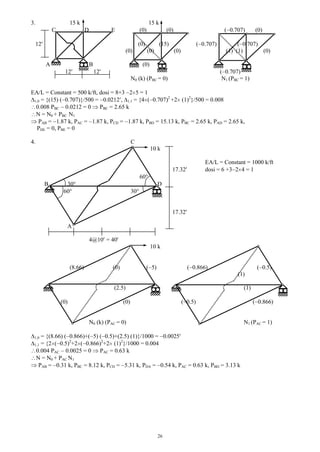
Solutions for Problems on Flexibility Method for Trusses
1. A B
10 k
12
C D E
12 12
(0) 10 k
(0) (0)
(7.07) ( 7.07)
1
( 5) ( 5) ( 1) ( 1)
N0 (k) (XC = 0) N1 (XC = 1)
1,0 = {( 5) ( 1)+ ( 5) ( 1)}/500 = 0.02 , 1,1 = {( 1) 2
+ ( 1)2
}/500 = 0.004
0.004 XC + 0.02 = 0.10 XC = 20 k
N = N0 + XC N1 PAB = 0, PAC = 0, PBC = 7.07 k, PBD = 0, PBE = 7.07 k, PCD = 25 k, PBE = 25 k
2. D
10 k
10
A B C
10 10
10 k
(0) (0.707) (0.707)
(7.07) ( 7.07) ( 1)
(5) (5) ( 0.5) ( 0.5)
1
N0 (k) (YB = 0) N1 (YB = 1)
1,0 = {(5) ( 0.5)+(5) ( 0.5)+ (7.07) (0.707)+ ( 7.07) (0.707)}/500 = 0.01
1,1 = {( 0.5)2
+ ( 0.5)2
+ (0.707)2
+ ( 1)2
+ (0.707)2
}/500 = 0.005
0.005 YB 0.01 = 0.10 YB = 18 k
N = N0 + YB N1 PAB = 14 k, PBC = 14 k, PAD = 5.66 k, PBD = 18 k, PCD = 19.80 k
Also support C moves 0.10 rightwards
Assume EA/L = Constant = 500 k/ft
dosi = 7 + 4 2 5 = 1
Also support B settles 0.10
Assume EA/L = Constant = 500 k/ft
dosi = 5+ 4 2 4 = 1
26
3. 15 k 15 k
C D E (0) (0) ( 0.707) (0)
12 (0) (15) ( 0.707) ( 0.707)
(0) (0) (0) (1) (1) (0)
A B (0)
12 12 ( 0.707)
N0 (k) (PBC = 0) N1 (PBC = 1)
EA/L = Constant = 500 k/ft, dosi = 8+3 2 5 = 1
1,0 = {(15) ( 0.707)}/500 = 0.0212 , 1,1 = {4 ( 0.707)2
+2 (1)2
}/500 = 0.008
0.008 PBC 0.0212 = 0 PBC = 2.65 k
N = N0 + PBC N1
PAB = 1.87 k, PAC = 1.87 k, PCD = 1.87 k, PBD = 15.13 k, PBC = 2.65 k, PAD = 2.65 k,
PDE = 0, PBE = 0
4. C
10 k
EA/L = Constant = 1000 k/ft
17.32 dosi = 6 +3 2 4 = 1
60
B 30 D
60 30
17.32
4@10 = 40
10 k
(8.66) (0) ( 5) ( 0.866) ( 0.5)
(1)
(2.5) (1)
(0) (0) ( 0.5) ( 0.866)
N0 (k) (PAC = 0) N1 (PAC = 1)
1,0 = {(8.66) ( 0.866)+( 5) ( 0.5)+(2.5) (1)}/1000 = 0.0025
1,1 = {2 ( 0.5)2
+2 ( 0.866)2
+2 (1)2
}/1000 = 0.004
0.004 PAC 0.0025 = 0 PAC = 0.63 k
N = N0 + PAC N1
PAB = 0.31 k, PBC = 8.12 k, PCD = 5.31 k, PDA = 0.54 k, PAC = 0.63 k, PBD = 3.13 k
A
27
5. 10 k
D
20 k
10
A B C
10 10
10 k
20 k
( 28.28) (30) (0) (0) (0) (0) ( 1.41) ( 1.41)
(2)
(0) (0) (1) (0) (1) (1)
N0 (k) N1 (XB = 1) N2 (YC = 1)
1,0 = 0, 2,0 = {( 28.28) ( 1.41) + (30) (2)}/500 = 0.20
1,1 = (1)2
/500 = 0.002, 1,2 = 2,1 = (1) (1)/500 = 0.002, 2,2 = {2 ( 1.41)2
+ (2)2
+2 (1)2
}/500 = 0.02
0.002 XB + 0.002 YC + 0 = 0
0.002 XB + 0.02 YC + 0.20 = 0.10
XB = 16.67 k, YC = 16.67 k
N = N0 + XB N1 + YC N2
PAB = 0, PBC = 16.67 k, PAD = 4.71 k, PBD = 3.33 k, PCD = 23.57 k
Also support C settles 0.10
Assume EA/L = Constant = 500 k/ft
dosi = 5+5 2 4 = 2
1
1
28
Flexibility Method for 1-degree Indeterminate Beams
Example 1
EI = constant
A B C dosi = 3 1 + 4 – 3 2 = 1
Take RA as the redundant
L/2 L/2 1,0 + RA 1,1 = A = 0 …………..…(i)
1,0 = (L/2)/6 [2L + L/2] (–PL/2)/EI = – 5PL3
/48EI
1,1 = m1 m1 dS/EI
= L/3 (L) (L)/EI = L3
/3EI
m1
(i) – 5PL 3
/48EI + L3
/3EI = 0 RA = 5P/16
M = m0 + RA m1 = m0 + (5P/16) m1
M MA = 0, MB = 5PL/32, MC = –PL/2 + 5PL/16 = –3PL/16
Example 2
EI = constant
A B C dosi = 3 2 + 4 – 3 3 = 1
Take RB as the redundant
10 10 1,0 + RB 1,1 = B = 0 …………..…(i)
1,0 = 2 [2 37.5 + 50] (–5 10/6)/EI = –2083.33/EI
1,1 = m1 m1 dS/EI
m1 ( ) = 2 10/3 (–5) (–5)/EI = 166.67/EI
– 5 (i) –2083.33/EI + 166.67 RB/EI = 0
RB = 12.5 k
M = m0 + RB m1 = m0 + 12.5 m1
M (k ) MA = 0, MB = 50 – 62.5 = – 12.5 k , MC = 0
– 12.5
6.256.25
1 k/ft
m0 (k )
37.5
50
P
m0
PL/2
100
L
L/2
3PL/16
5PL/32
29
Flexibility Method for 2-degree Indeterminate Beams
Example 3
10 k 10 k
A B C D E
dosi = 3 2 + 5 – 3 3 = 2
EI = 1 EI = 1 1,0 + RA 1,1 + RC 1,2 = A = 0 ……(i)
5 5 5 5 2,0 + RA 2,1 + RC 2,2 = C = 0 ……(ii)
m0 (k ) 1,0 = m1 m0 dS/EI
0 0 = {10/6 (–100) (30+5)
–50 –100 + 5/6[(–100)(30+20) + (–200)(40+15)]}/EI
–200 = –19166.67/EI
15 20 2,0 = m2 m0 dS/EI
5 = {5/6 (5) (–200–50)
m1 ( ) + 5/6 [(5)(–200–200)+(10)(–400–100)]}/EI = – 6875/EI
1,1 = m1 m1 dS/EI = 20/3 (20) (20)/EI
= 2666.67/EI
5 10 1,2 = 2,1 = m1 m2 dS/EI
m2 ( ) = {5/6(5)(30+10)
+5/6 [(5)(30+20)+(10)(40+15)]}/EI
= 833.33/EI
2,2 = m2 m2dS/EI = 10/3 (10) (10)/EI
= 333.33/EI
Avoiding the factors EI
(i) 2666.67 RA + 833.33 RC = 19166.67
(ii) 833.33 RA + 333.33 RC = 6875
RA = [19166.67 333.33 – 833.33 6875]/[2666.67 333.33 – 833.332
] = 3.39 k
and RC = [2666.67 6875 – 833.33 19166.67]/[2666.67 333.33 – 833.332
] = 12.14 k
M = m0 + RA m1 + RC m2 = m0 + 3.39 m1 + 12.14 m2
MA = 0, MB = 0 + 3.39 5+ 0 12.14 = 16.95 k , MC = –50 + 3.39 10 +0 12.14 = –16.10 k ,
MD = –100 + 3.39 15 + 5 12.14 = 11.55 k , ME = –200 + 3.39 20 + 10 12.14 = –10.80 k
16.95
11.55
M (k )
10
–16.10
–10.80
30
Analysis for Support Settlement
Example 4
Support B settles 0.10
A B C EI = 40 103
k-ft2
dosi = 3 2 + 4 – 3 3 = 1
1,0 + RB 1,1 = B = –0.10 ……(i)
10 10 1,0 = 0
m1 ( ) 1,1 = m1 m1 dS/EI
= 2 10/3 (–5) (–5)/EI = 166.67/40 103
–5 (i) 166.67 RB/40 103
+ 0 = –0.10
RB = – 4000/166.67 = –24 k
120
M = m0 + RB m1 = –24 m1 [in k ]
M (k )
Example 5
Support C settles 0.10
EI = 40 103
k-ft2
A B C D E dosi = 2
1,0 + RA 1,1 + RC 1,2 = A = 0.…..….(i)
10 10 2,0 + RA 2,1 + RC 2,2 = C = –0.10.…(ii)
1,0 = 0, 2,0 = 0
1,1 = m1 m1 dS/EI = 2666.67/EI, 1,2 = 2,1 = 833.33/EI, 2,2 = 333.33/EI
(i) (2666.67/EI) RA + (833.33/EI) RC = 0
(ii) (833.33/EI) RA + (333.33/EI) RC = –0.10
RA = 17.14 k, and RC = –54.86 k
M = m0 + RA m1 + RC m2 = 17.14 m1 – 54.86 m2 [in k ]
MA = 0, MB = 17.14 5 – 0 54.86 = 85.70, MC = 17.14 10 – 0 54.86 = 171.40,
MD = 17.14 15 – 5 54.86 = –17.20, ME = 17.14 20 – 10 54.86 = – 205.80
171.40
M (k )
–205.80
31
Combined Flexural, Shear and Axial Deformations
B C
EA = 400 103
k, GA*
= 125 103
k
EI = 40 103
k-ft2
dosi = 3 3 + 4 – 3 4 = 1
10
The vertical reaction at D (VD) is taken
as the redundant.
A D
10
–10
–10
100
x0 (k) v0 (k) m0 (k )
10
–1
–1
x1 v1 m1 ( )
1,0 = (x1 x0/EA) dS + (v1 v0 /GA*
) dS + (m1 m0 /EI) dS
= 0 + 0 + 10/2 (100)(10)/(40 103
) = 0.125 ft
1,1 = (x1 x1/EA) dS + (v1 v1 /GA*
) dS + (m1 m1 /EI) dS
= 2 10 (1 1)/(400 103
)+10 (1 1)/(125 103
)+[10 (10 10)+10 (10 10)/3]/(40 103
)
= 0.05 10–3
+ 0.08 10–3
+33.33 10–3
= 33.46 10–3
VD = –0.125/33.46 10–3
= –3.74 k
1
10 k
32
Problems on Flexibility Method (Beams/Frames)
Assume EA = 400 103
k, GA*
= 125 103
k, EI = 40 103
k-ft2
Beams
1. 100 k 2. 10 k 10 k
10 4@5
1 k/
3. 10 k 4.
Guided Rollers
10 10 10 10
1 k/
5. 10 k 6.
5 5 10 10 10 10
7. 10 k 10 k 8. Support settles 0.10
5 5 10 5 5 3@10
Frames
10 k 10 k
9. 10.
1 k/
20 20
10 10 10 5 5
33
Solution of Problems on Flexibility Method (Beams/Frames)
1. dosi = 3 + 4 – 6 = 1; i.e., assume RA as the redundant
1,0 = (m0 m1/EI) dS = 10/2 (–100) (10)/(40 103
) = –0.125 ft
1,1 = (m1 m1/EI) dS = 10/3 (10 10)/(40 103
) = 8.33 10–3
ft/k
RA = 0.125/(8.33 10–3
) = 15 k
2. dosi = 6 + 4 – 9 = 1; i.e., assume RB as the redundant
1,0 = (m0 m1/EI) dS = 2 {5/3 (50) (–2.5) +5/2 (50) (–2.5 –5)}/(40 103
) = –0.0573 ft
1,1 = (m1 m1/EI) dS = 2 {10/3 (–5) (–5)}/(40 103
) = 4.17 10–3
ft/k
RB = 0.0573/(4.17 10–3
) = 13.75 k
3. dosi = 3 + 4 – 6 = 1; i.e., assume MA as the redundant
1,0 = (m0 m1/EI) dS = {10/2 (100) (–1) +10 (100) (–1)}/(40 103
) = –0.0375 ft
1,1 = (m1 m1/EI) dS = 20 (–1) (–1)/(40 103
) = 0.5 10–3
ft/k
MA = 0.0375/(0.5 10–3
) = 75 k-ft
4. dosi = 6 + 4 – 9 = 1; i.e., assume RB as the redundant
1,0 = (m0 m1/EI) dS = 2 {10/6 (2 37.5 + 50) (–5)}/(40 103
) = –0.0521 ft
1,1 = 4.17 10–3
ft/k (as in Problem 2)
RB = 0.0521/(4.17 10–3
) = 12.5 k
–5
25
1
m1 ( )m0 (k )
6.25
37.5
50
–100
–100 RA = 1
10
m0 (k ) m1 ( )
50
M (k )
RB = 1
6.25
–12.5
M (k )
5050
RB = 1
–5
m1 ( )
15.63
–18.75
M (k )
MA = 1
m1 ( )
–75
M (k )
100
m0 (k )
m0 (k )
34
5. dosi = 9 + 5 – 12 – 1 = 1; i.e., assume RC as the redundant
1,0 = (m0 m1/EI) dS = 10/6 (–50–2 100) (10)/(40 103
) = –0.1042 ft
1,1 = (m1 m1/EI) dS = 10/3 (10) (10)/(40 103
) = 8.33 10–3
ft/k
RB = 0.1042/(8.33 10–3
) = 12.5 k
6. dosi = 6 + 5 – 9 = 2; i.e., assume RB and MC as the redundants
1,0 = –0.0521 ft, 1,1 = 4.17 10–3
ft/k (as in Problem 4)
2,0 = (m0 m2/EI) dS = 20/6 (2 50+0) (1)/(40 103
) = 8.33 10–3
rad
1,2 = 2,1 = (m1 m2/EI) dS = {10/3 (–5)(0.5) +10/6 (–5)(1+2 0.5)}/(40 103
) = –0.625 10-3
rad/k
2,2 = (m2 m2/EI) dS = 20/3 (1)(1)/(40 103
) = 0.167 10-3
rad/k-ft
4.17 RB – 0.625 MC = 52.1; and –0.625 RB + 0.167 MC = –8.33
RB = 11.43 k, MC = –7.14 k-ft
7. dosi = 6 + 5 – 9 = 2; i.e., assume RB and RC as the redundants
1,0 = (m0 m1/EI) dS
= {5/3(50)(3.33)+5/2(50)(3.33+6.67)+15/2(50)(6.67+1.67)+5/3(50)(1.67)}/(40 103
)= 119.8 10–3
ft
1,1 = (m1 m1/EI) dS = {10/3 ( 6.67) ( 6.67) + 20/3 ( 6.67) ( 6.67)}/(40 103
) = 11.11 10–3
ft/k
1,2 = 2,1 = (m1 m2/EI) dS = [10/3( 6.67)( 3.33) + 10/6{( 6.67)( 2 3.33 6.67)
+( 3.33)( 2 6.67 3.33)}+10/3( 6.67)( 3.33)]/(40 103
) = 9.72 10–3
ft/k
2,0 = 1,0 = 119.8 10–3
ft, 2,2 = 1,1 = 11.11 10–3
ft/k
RB = RC = 5.75 k (i.e., upward)
–7.14
7.5
21.25
0.5 1
100
10
m0 (k )
37.5
50
m1 ( )
RB = 1
–5
1.347.14
–10.71
M (k )
RC = 1
m1 ( )
25
–50
M (k )
25
m0 (k )
50
25
m2
MC = 1
M (k )
6.67m0 (k )
50
6.67
50
RB = 1
m1 ( )
RC = 1
m2 ( )
35
8. dosi = 6 + 5 – 9 = 2; i.e., assume RB and RC as the redundants
m0 is zero here, but m1 and m2 are same as in Problem 7.
1,0 = (m0 m1/EI) dS = 0, 2,0 = (m0 m2/EI) dS = 0
1,1 = 11.11 10–3
ft/k, 1,2 = 2,1 = 9.72 10–3
ft/k, 2,2 = 1,1 = 11.11 10–3
ft/k
11.11 10–3
RB + 9.72 10–3
RC = 0.10
9.72 10–3
RB + 11.11 10–3
RC = 0 RB = 38.4 k (i.e., downward), RC = 33.6 k (i.e., upward)
9. dosi = 6 + 4 – 9 = 1; i.e., assume RC as the redundant
1,0 = (x0 x1/EA) dS + (v0 v1/GA*
) dS + (m0 m1/EI) dS
= 20( 10)(1)/(400 103
) + 10(10)( 1)/(125 103
)
{10/6(100)(2 20+10)+20/6(100+4 150+300)(20)}/(40 103
) = ( 0.5 0.8 1875) 10-3
= 1.876 ft
1,1 = (x1 x1/EA)dS + (v1 v1/GA*
)dS + (m1 m1/EI)dS = 20(1)(1)/(400 103
) + 20( 1)( 1)/(125 103
) +
{20/3 (20) (20) + 20 (20) (20)}/(40 103
) = (0.05 + 0.16 + 266.67) 10-3
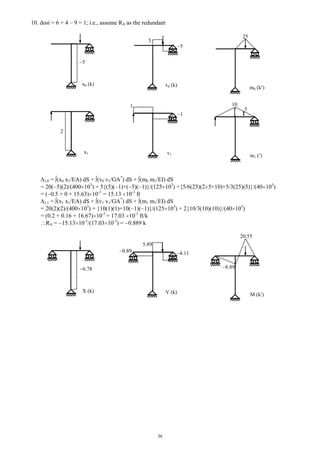
= 0.2669 ft/k
RB = 1.876/(0.2669) = 7.03 k
2.97
20
7.03
2.97
1
1
x1
144
96
M (k )
20
m1 ( )
150
300
100
m0 (k )
9.37
70.31
40.63
159.37
M (k )
10 x0 (k) 20 v0 (k)
v1
10
X (k) V (k)
36
10. dosi = 6 + 4 – 9 = 1; i.e., assume RA as the redundant
1,0 = (x0 x1/EA) dS + (v0 v1/GA*
) dS + (m0 m1/EI) dS
= 20( 5)(2)/(400 103
) + 5{(5)( 1)+( 5)( 1)}/(125 103
) +{5/6(25)(2 5+10)+5/3(25)(5)}/(40 103
)
= ( 0.5 + 0 + 15.63) 10-3
= 15.13 10-3
ft
1,1 = (x1 x1/EA) dS + (v1 v1/GA*
) dS + (m1 m1/EI) dS
= 20(2)(2)/(400 103
) + {10(1)(1)+10( 1)( 1)}/(125 103
) + 2{10/3(10)(10)}/(40 103
)
= (0.2 + 0.16 + 16.67) 10-3
= 17.03 10-3
ft/k
RA = 15.13 10-3
/(17.03 10-3
) = 0.889 k
5
x0 (k) v0 (k)
5
m0 (k )
5
25
2
x1 v1
1
m1 ( )
1 10
5
6.78
X (k) V (k)
4.11
M (k )
5.89
20.55
0.89
8.89
37
The Moment Distribution Method
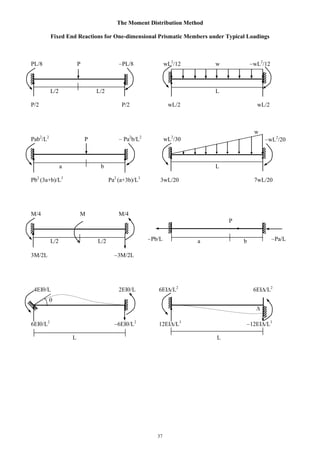
Fixed End Reactions for One-dimensional Prismatic Members under Typical Loadings
PL/8 P PL/8 wL2
/12 w wL2
/12
L/2 L/2 L
P/2 P/2 wL/2 wL/2
w
Pab2
/L2
P Pa2
b/L2
wL2
/30
a b L
Pb2
(3a+b)/L3
Pa2
(a+3b)/L3
3wL/20 7wL/20
M/4 M M/4
P
L/2 L/2 a b
3M/2L 3M/2L
4EI /L 2EI /L 6EI /L2
6EI /L2
6EI /L2
6EI /L2
12EI /L3
12EI /L3
L L
wL2
/20
Pa/LPb/L
38
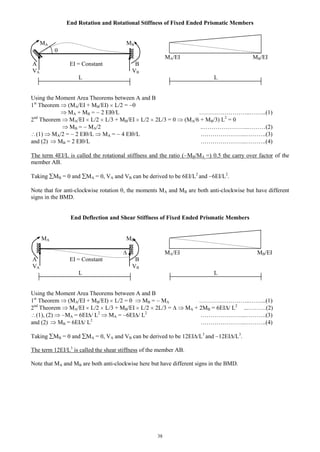
End Rotation and Rotational Stiffness of Fixed Ended Prismatic Members
MA MB
MA/EI MB/EI
A EI = Constant B
VA VB
L L
Using the Moment Area Theorems between A and B
1st
Theorem (MA/EI + MB/EI) L/2 =
MA + MB = 2 EI /L ……………………..……...(1)
2nd
Theorem MA/EI L/2 L/3 + MB/EI L/2 2L/3 = 0 (MA/6 + MB/3) L2
= 0
MB = MA/2 ..…………………..………(2)
(1) MA/2 = 2 EI /L MA = 4 EI /L …………………..………..(3)
and (2) MB = 2 EI /L …………………..………..(4)
The term 4EI/L is called the rotational stiffness and the ratio ( MB/MA =) 0.5 the carry over factor of the
member AB.
Taking MB = 0 and MA = 0, VA and VB can be derived to be 6EI/L2
and 6EI/L2
.
Note that for anti-clockwise rotation , the moments MA and MB are both anti-clockwise but have different
signs in the BMD.
End Deflection and Shear Stiffness of Fixed Ended Prismatic Members
MA MB
MA/EI MB/EI
A EI = Constant B
VA VB
L L
Using the Moment Area Theorems between A and B
1st
Theorem (MA/EI + MB/EI) L/2 = 0 MB = MA ……………………..……...(1)
2nd
Theorem MA/EI L/2 L/3 + MB/EI L/2 2L/3 = MA + 2MB = 6EI / L2
...………(2)
(1), (2) MA = 6EI / L2
MA = 6EI / L2
…………………..………..(3)
and (2) MB = 6EI / L2
…………………..………..(4)
Taking MB = 0 and MA = 0, VA and VB can be derived to be 12EI /L3
and 12EI /L3
.
The term 12EI/L3
is called the shear stiffness of the member AB.
Note that MA and MB are both anti-clockwise here but have different signs in the BMD.
39
Rotation of a Joint and Moment Distribution Factors (MDF)
B
A KOB
KOA MO
O KOC C
KOE
E
KOD
D
Flexural members OA, OB, OC…...are joined at joint O and have rotational stiffnesses of KOA, KOB,
KOC…….respectively; i.e., for unit rotation of the joint O they require moments KOA, KOB, KOC…….
respectively to be applied at O.
If a moment MO applied at joint O causes it to rotate by an angle , the following moments are needed to
rotate members OA, OB, OC…...
MOA = KOA ………..(1)
MOB = KOB ………..(2)
MOC = KOC ………..(3)
………………………
Adding (1), (2), (3)…. MOA + MOB + MOC + …….= KOA + KOB + KOC +…… ………..(4)
Since MO = MOA + MOB + MOC + ……….
MO = (KOA + KOB + KOC +……) = KO [KO = KOA + KOB + KOC +……]
= MO/(KO) ………..(5)
(1) MOA = [KOA/KO] MO ………..(6)
(2) MOB = [KOB/KO] MO ………..(7)
(3) MOC = [KOC/KO] MO ………..(8)
………………………
The factors [KOA/KO], [KOB/KO], [KOC/KO]………..are the moment distribution factors (MDF) of members
OA, OB, OC……..respectively. Therefore the distributed moments in members are proportional to their
respective MDFs.
Example
10 k
0.60 12.5 12.5 3.75 7.5 16.25
0.40 5.0 5.0
15
EI = Constant
2.5
5 5
[Load and MDF] [FEM] [Dist M] [Total end M]
5.0
2.5
40
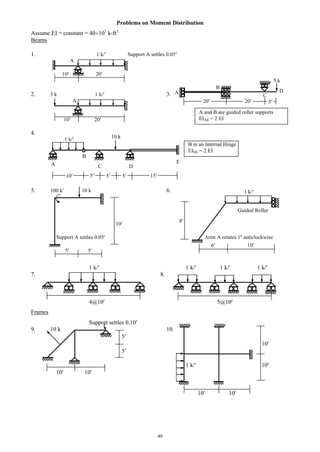
Problems on Moment Distribution
Assume EI = constant = 40 103
k-ft2
Beams
1. 1 k/ Support A settles 0.05
A
10 20
2. 5 k 1 k/ 3.
A
10 20
4.
5. 100 k 10 k 6.
Guided Roller
10
Support A settles 0.05 Joint A rotates 1º anticlockwise
5 5
1 k/ 1 k/ 1 k/ 1 k/
7. 8.
4@10 5@10
Frames
Support settles 0.10
9. 10 k 10.
5
10
5
1 k/ 10
10 10
10 10
D
C
B
A
A and B are guided roller supports
EIAB = 2 EI
20 5
5 k
20
8
6 10
1 k/
B
A
B in an Internal Hinge
EIDE = 2 EI
C
10 k
5 15
D
1 k/
10 5 5
E
41
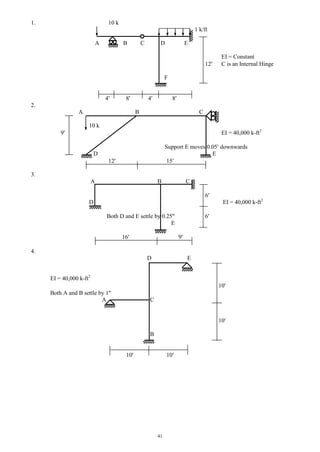
1. 10 k
1 k/ft
A B C D E
EI = Constant
12 C is an Internal Hinge
F
4 8 4 8
2.
A B C
10 k
9 EI = 40,000 k-ft2
Support E moves 0.05 downwards
D E
12 15
3.
A B C
6
D EI = 40,000 k-ft2
Both D and E settle by 0.25 6
E
16 9
4.
D E
EI = 40,000 k-ft2
10
Both A and B settle by 1
A C
10
B
10 10
42
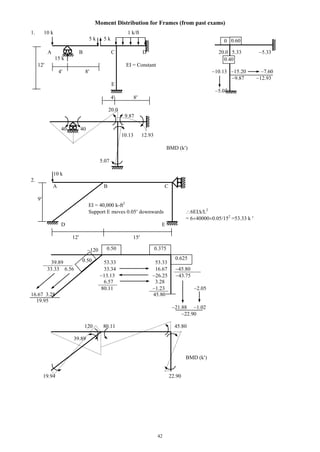
Moment Distribution for Frames (from past exams)
1. 10 k 1 k/ft
5 k 5 k
A B C D 20.0 5.33 5.33
15 k
12 EI = Constant
4 8 10.13 15.20 7.60
9.87 12.93
E
5.07
4 8
20.0
9.87
40 40
10.13 12.93
BMD (k )
5.07
10 k
2.
A B C
9
EI = 40,000 k-ft2
Support E moves 0.05 downwards 6EI /L2
= 6 40000 0.05/152
=53.33 k
D E
12 15
120
39.89 53.33 53.33
33.33 6.56 33.34 16.67 45.80
13.13 26.25 43.75
6.57 3.28
80.11 1.23 2.05
16.67 3.28 45.80
19.95
21.88 1.02
22.90
120 80.11 45.80
39.89
BMD (k )
19.94 22.90
0 0.60
0.50
0.50
0.375
0.625
0.40
43
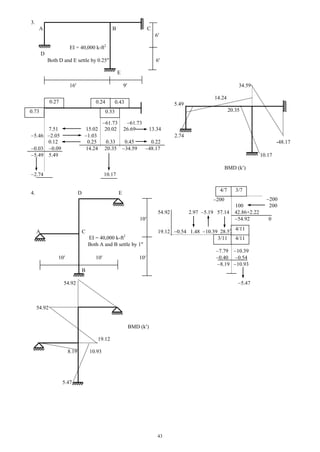
3.
A B C
6
EI = 40,000 k-ft2
D
Both D and E settle by 0.25 6
E
16 9 34.59
14.24
5.49
20.35
61.73 61.73
7.51 15.02 20.02 26.69 13.34
5.46 2.05 1.03 2.74
0.12 0.25 0.33 0.45 0.22
0.03 0.09 14.24 20.35 34.59 48.17
5.49 5.49 10.17
BMD (k )
2.74 10.17
4. D E
200
100
54.92 2.97 5.19 57.14 42.86+2.22
10 54.92 0
A C 19.12 0.54 1.48 10.39 28.57
EI = 40,000 k-ft2
Both A and B settle by 1
7.79 10.39
10 10 10 0.40 0.54
8.19 10.93
B
54.92 5.47
54.92
BMD (k )
19.12
8.19 10.93
5.47
0.33
0.430.240.27
0.73
-48.17
3/74/7
3/11 4/11
4/11
200
200
44
Qualitative Influence Lines and Maximum Forces
1. For the beam shown below, draw the influence lines of RA, RB, VB
(L)
, VB
(R)
, MA, MB.
A B C
10 5
RA RB
VB
(L)
VB
(R)
MA MB
2. For the beam shown below, DL = 1 k/ , moving LL = 0.5 k/ (UDL), 5 k (concentrated).
Calculate the maximum values of RA, RB, ME, MB and MF [Each span is 10 long].
A B C D A B C D
E F G (RA) E F G (RB)
A B C D A B C D
E F G (ME) E F G (MB)
1.5 k/ 5 k
1 k/ 1 k/
(MF) Load arrangement for MF(max)
Final end moments 0 16.25 16.25
MF(max) = 16.25 + 1.5 102
/8 + 5 10/4 = 15 k
45
3. For the beam shown below, draw the qualitative influence lines for
(i) Bending moments MC, MD, ME, MF
(ii) Support reactions RB, RD, RE, RF
(iii) Shear forces VB
(R)
, VD
(L)
, VD
(R)
, VE
(L)
, VE
(R)
,VF
If the beam is subjected to a uniformly distributed DL = 1.5 k/ft and moving LL = 0.5 k/ft (uniformly
distributed) and 5 k (concentrated), calculate the maximum values of
(i) positive MC, (ii) positive RD and (iii) positive VE
(R)
[Given: EI = constant].
A B C D E F
5 5 5 10 10
IL of MC IL of RD IL of VE
(R)
IL of MD IL of RF IL of VD
(L)
(i) Maximum positive value of MC: (ii) Maximum positive value of RD:
5 k 5 k
1.5 k/ 2 k/ 1.5 k/ 2 k/ UDL 1.5 k/ 2 k/ 2 k/ 1.5 k/
0 1 3/7 4/7 0.5 0.5 DF 0 1 3/7 4/7 0.5 0.5
18.75 22.92 22.92 12.5 12.5 16.67 16.67 FEM
( 4.17) (2.08) (2.08) (2.08)
2.08
(5.36) (7.14) 3.57 ( 0.89) ( 1.19) 0.60
1.93 ( 3.87) ( 3.87) 1.93
(0.83) (1.10) 0.55 ( 0.06) ( 0.09)
0.14 ( 0.27) ( 0.28) 0.14
(0.06) (0.08)
18.75 18.75 18.75 18.75 12.52 12.52 18.74 VD
(L)
= 2 10/2+(18.75 16.58)/10= 9.78 k
VD
(R)
= 2 10/2+(16.58 14.88)/10 = 10.17 k
Maximum value of MC Maximum RD = VD
(R)
VD
(L)
+5 =24.95 k
= 18.75 + 2 102
/8 + 5 10/4 = 18.75 k
18.75 16.67 16.67 16.67 16.66 12.5 12.5
1.04 1.04 1.04
0.15 (0.30) (0.30) 0.15
18.75 18.75 16.58 16.58 14.88 14.88 11.31
46
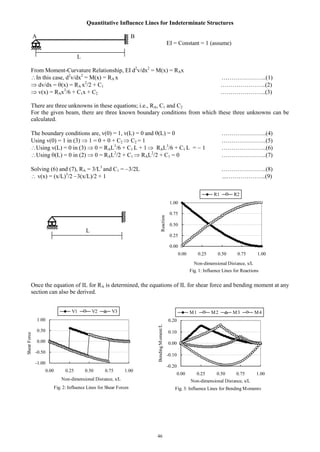
Quantitative Influence Lines for Indeterminate Structures
A B
EI = Constant = 1 (assume)
L
From Moment-Curvature Relationship, EI d2
v/dx2
= M(x) = RAx
In this case, d2
v/dx2
= M(x) = RA x …………………..(1)
dv/dx = (x) = RA x2
/2 + C1 …………………..(2)
v(x) = RAx3
/6 + C1x + C2 …………………..(3)
There are three unknowns in these equations; i.e., RA, C1 and C2
For the given beam, there are three known boundary conditions from which these three unknowns can be
calculated.
The boundary conditions are, v(0) = 1, v(L) = 0 and (L) = 0 …………………..(4)
Using v(0) = 1 in (3) 1 = 0 + 0 + C2 C2 = 1 …………………..(5)
Using v(L) = 0 in (3) 0 = RAL3
/6 + C1 L + 1 RAL3
/6 + C1 L = 1 …………………..(6)
Using (L) = 0 in (2) 0 = RAL2
/2 + C1 RAL2
/2 + C1 = 0 …………………..(7)
Solving (6) and (7), RA = 3/L3
and C1 = 3/2L …………………..(8)
v(x) = (x/L)3
/2 3(x/L)/2 + 1 ...………………..(9)
L
Once the equation of IL for RA is determined, the equations of IL for shear force and bending moment at any
section can also be derived.
Fig. 1: Influence Lines for Reactions
0.00
0.25
0.50
0.75
1.00
0.00 0.25 0.50 0.75 1.00
Non-dimensional Distance, x/L
Reaction
R1 R2
Fig. 2: Influence Lines for Shear Forces
-1.00
-0.50
0.00
0.50
1.00
0.00 0.25 0.50 0.75 1.00
Non-dimensional Distance, x/L
ShearForce
V1 V2 V3
Fig. 3: Influence Lines for Bending Moments
-0.20
-0.10
0.00
0.10
0.20
0.00 0.25 0.50 0.75 1.00
Non-dimensional Distance, x/L
BendingMoment/L
M1 M2 M3 M4
47
Short Questions and Explanations
Flexibility Method for 2D Trusses vs. 2D Frames
1. Unknowns: Forces only vs. Forces + Moments
2. No. of Unknowns: dosi = m + r 2j vs. dosi = 3m + r 3j
3. Member Properties: E, A vs. E, G, A, A , I
4. Deformations considered: Axial vs. Axial, Shear, Flexural
5. Forces Calculated: Member Axial Forces vs. Member Axial, Shear Forces, BM’s
6. Structural Displacements: Deflections vs. Deflections + Rotations
Also learn
- Lateral Load Analysis by Portal vs. Cantilever Method
- Vertical Load Analysis by ACI Coefficients vs. Approximate Hinge locations
- Difference between approximate Methods for Truss Analysis
- Flexibility Method vs. Moment Distribution Method
Briefly explain why
- it is often useful to perform approximate analysis of statically indeterminate structures
- dosi of 3D truss = m + r 3j and dosi of 3D frame = 6m + r 6j h
- axial deformations are sometimes neglected for structural analysis of beams/frames but not trusses
- support settlement is to be considered/avoided in designing statically indeterminate structures
- unit load method is often used in the structural analysis by Flexibility Method
- a guided roller can be used in modeling one-half of a symmetric structure
- the terms moment distribution factor and carry over factor in the Moment Distribution Method
- the influence lines of statically determinate structures are straight while the influence lines of
statically indeterminate structures are curved
Comment on
- two basic characteristics of the Flexibility Matrix of a structure
- the main advantage and limitation of the Moment Distribution Method
- advantage of using modified stiffness in the Moment Distribution Method
- the applicability of ‘qualitative’ and ‘quantitative’ influence lines
48
Non-coplanar Forces and Analysis of Space Truss
Non-coplanar Force
A vector in space may be defined or located by any three mutually perpendicular reference axes Ox, Oy and
Oz (Fig. 1). This vector may be resolved into three components parallel to the three reference axes.
Space Truss
Although simplified two-dimensional structural models are quite common, all civil engineering structures
are actually three-dimensional. Among them, electric towers, offshore rigs, rooftops of large open spaces
like industries or auditoriums are common examples of three-dimensional or space truss. The members of a
space truss are non-coplanar and therefore their axial forces can be modeled as non-coplanar forces.
Since there is only one force per member and three equilibrium equations per joint of a space truss, the
degree of statical indeterminacy (dosi) of such a structure is given by
dosi = m + r 3j ……………………………(viii)
The three equilibrium equations per joint of a space truss are related to forces in the three perpendicular axes
x, y and z
Fx = 0, Fy = 0 and Fz = 0 ……..………………………(ix)
However the other three equilibrium equations related to moments; i.e.,
Mx = 0, My = 0 and Mz = 0 ……..………………….……(x)
may also be needed to calculate the support reactions of the truss. Here, it is pertinent to mention that the
moment of a force about an axis is zero if the force is parallel to the axis (when it does not produce any
rotational tendency about that axis) or intersects it (when the perpendicular distance from the axis is zero).
If the force OC (of magnitude F) makes angles , and
with the three reference axes Ox, Oy and Oz, then the
components of the force along these axes are given by
Fx = F cos …….……….……….………(i)
Fy = F cos …...……….…………..…….(ii)
Fz = F cos …….……..…………..……(iii)
[(i)2
+ (ii)2
+ (iii)2
] F = [Fx
2
+ Fy
2
+ Fz
2
] ….…...….(iv)
(i) cos = Fx/ [Fx
2
+ Fy
2
+ Fz
2
] …….…….……(v)
(ii) cos = Fy/ [Fx
2
+ Fy
2
+ Fz
2
] ……….…..…...(vi)
(iii) cos = Fz/ [Fx
2
+ Fy
2
+ Fz
2
] ……….…..….(vii)
The values of cos , cos and cos given by Eqs. (v), (vi)
and (vii) are called the direction cosines of the vector F.
C
z
xO
y
Fig. 1: Non-coplanar Force and Components
49
Example: Calculate the support reactions and member forces of the truss shown below.
MCD = 0 YA 20 10 20 = 0 YA = 10 k ….…………(1)
MBC = 0 YA 30 + YD 30 + 20 25 = 0 YD = 26.67 k …………….(2)
My(D) = 0 20 10 + ZC 30 = 0 ZC = 6.67 k ………….…(3)
Fy = 0 YA + YC + YD 10 = 0 YC = 26.67 k …...………..(4)
Fx = 0 XD + XC + 20 = 0 …………….(5)
Fz = 0 ZD + ZC = 0
ZD = ZC = 6.67 k [using (3)] ……………..(6)
Equilibrium of Joint A (unknowns FAB, FAD and FAE):
Fx = 0 FAB + 0.49 FAE = 0 …………..…(7)
Fy = 0 0.81 FAE + 10 = 0 FAE = 12.33 k …..………....(8)
FAB = 0.49 FAE = 6.00 k [using (7)] …..………....(9)
Fz = 0 FAD 0.32 FAE = 0 FAD = 4.00 k [using (8)] …....………(10)
Equilibrium of Joint B (unknowns FBC, FBD and FBE):
Fx = 0 FBA 0.83 FBD 0.49 FBE = 0 ……………(11)
Fy = 0 0.81 FBE 10 = 0 FBE = 12.33 k …...……….(12)
FBD = ( FBA 0.49 FBE)/0.83 = 14.42 k [using (11)] …...……….(13)
Fz = 0 FBC 0.56 FBD 0.32 FBE = 0 FBC = 4.00 k [using (12), (13)] ….…..….…(14)
Equilibrium of Joint C (unknowns XC and FCE):
Fx = 0 XC 0.49 FCE = 0 …………….(15)
Fy = 0 26.67 + 0.81 FCE = 0 FCE = 32.88 k ………….…(16)
XC = 0.49 FCE = 16 k [using (16)] …...……..…(17)
Fz = 0 6.67 + 0.32 FCE + FCB = 0 FCB = 4.00 k [verified]
Equilibrium of Joint D (unknowns XD and FDE):
Fx = 0 XD + 0.49 FDE + 0.83 FDB = 0 ……………...(18)
Fy = 0 26.67 + 0.81 FDE = 0 FDE = 32.88 k …..………….(19)
XD = 4.00 [using (13), (19)] ……...………(20)
XC = 20 XD = 16.00 [using (5)] …...…………(21)
Fz = 0 6.67 + 0.32 FDE + FDA + 0.56 FDB = 0 6.67 + 10.67 + 4.00 8.00 = 0
0 = 0 [verified]
z
y
10 k
20 kE
CD
B
A
25
10
Ignoring the zero force member CD
dosi = m + r 3j = 8 + 7 3 5 = 0
The structure is statically determinate.
Member Lx Ly Lz Cx Cy Cz
AB 30 0 0 1.00 0.00 0.00
BC 0 0 20 0.00 0.00 1.00
BD 30 0 20 0.83 0.00 0.56
AD 0 0 20 0.00 0.00 1.00
AE 15 25 10 0.49 0.81 0.32
BE 15 25 10 0.49 0.81 0.32
CE 15 25 10 0.49 0.81 0.32
DE 15 25 10 0.49 0.81 0.32
10
15 15
x
50
Problems on the Analysis of Space Trusses
1. Calculate the member forces of the space truss loaded as shown below.
2. Calculate the horizontal (along x axis) deflection of joint E and vertical (along y axis) deflection of joint
B of the space truss analyzed in class [Given: EA/L = constant = 500 k/ft].
3. Calculate the support reactions and member forces of the space truss loaded as shown below. Also
calculate the vertical (along y axis) deflection of the joint d [Given: EA/L = constant = 500 k/ft].
4. Calculate the support reactions, member forces and also the horizontal (along x axis) deflection of the
joint a of the space truss loaded as shown below [Given: EA/L = constant = 500 k/ft].
x
d
a
b
c, d
a
y
x
c
b
a
d
Xb
ZcZa
10 k
Ya Yb Yc
10 10
20
5
5
z
x
c, db, e
a
10 k
Yb, Ye Yc, Yd
5 15
20
5
10
y
x
z
x
10 k
y
20 20
20
Hinge Support
b
c
20 40
x
z
a 10 k
d
c
e
b
Xb
Xd
Zb
51
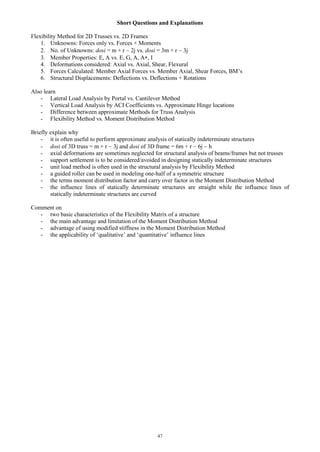
Deflection of Grids due to Combined Flexural and Torsional Deformations
Grids are 2-dimensional (coplanar) structures with one deflection and two rotations at each node.
If the structure is in the x-z plane, the deflection is out-of-plane (along the y axis) while the rotations are
about two in-plane axes (x and z axis). Grids are loaded perpendicular to the structural plane and have three
forces per member; i.e., shear force, bending moment and torsion.
Example
EI = 40 103
k-ft2
GJ = 30 103
k-ft2
Top View Isometric View
150
50
50 50
10
5
5
1
A,v = (m1 m0/EI) dS + (t1 t0/GJ) dS
= {[5 5 (–50)/3] + 5 [5 (–250)+10 (–350)]/6}/(40 103
) +{10 (–5) (–50)}/(30 103
)
= –109.38 10–3
+ 83.33 10–3
= –26.05 10–3
ft
10
5
5
1
C,v = {[5 5 (–50)/3]+[5 5 (–50)/3]+5 [5 (–250)+10 (–350)]/6}/(40 103
) + {10 (5) (–50)}/(30 103
)
= –120.80 10–3
– 83.33 10–3
= –204.13 10–3
ft
5
EE
Calculate A,v and C,v if
10 k
10 k
A
D
10 k
10 k
D
A B CB C
5
5
55
5
Calculation of A,v
Calculation of C,v
m1 ( ) t1 ( )
m1 ( ) t1 ( )
m0 (k ) t0 (k )
52
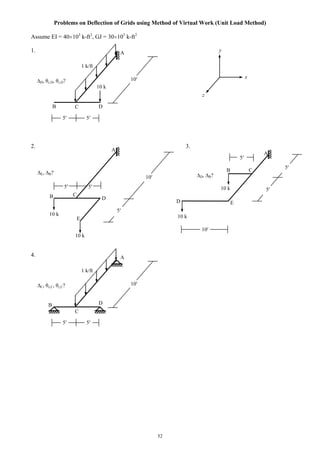
Problems on Deflection of Grids using Method of Virtual Work (Unit Load Method)
Assume EI = 40 103
k-ft2
, GJ = 30 103
k-ft2
1.
2. 3.
4.
10 k
1 k/ft
A
B C D
D, θx,D, θz,D?
x
y
z
55
10
10 k
A
B C
D
E, B?
5
10
5
E
10 k
5
A
E
5
10 k
10
D
5
10 k
CB
D, B?
5
1 k/ft
A
B
C
D
C, θx,C, θz,C?
55
10
53
Deflection of Grids using Method of Virtual Work
1.
D = [(−50)(5)5/3 + {2(−62.5) + (−150)}(10)(10)/6]/(40 103
) + [(−50)(5)10]/(30 103
)
= −0.125 −0.0833 = −0.2083 ft
2.
E = [(−50)(5)5/3 + (−50)(5)5/3 + {(−50) (25) + (−250) (35)}(10)/6]/(40 103
) + [(50)(−5)5]/(30 103
)
= −0.4375 −0.0417 = −0.4792 ft
10
50
150
62.5
m0 (k-ft)
50
t0 (k-ft) m1 (ft) t1 (ft)
55
A
B C D
For D
50
250
m0 (k-ft)
50
t0 (k-ft) m1 (ft) t1 (ft)
5
A
B C
D
For E
E
50
5
15
5
5
54
3.
D = [(−100)(10)10/3 + (−50)(5)5/3 + {(−50) (20) + (−150) (25)}(5)/6]/(40 103
) +
[(100 + 150)(−10)5]/(30 103
)
= −0.1927 −0.4167 = −0.6094 ft
4.
D = [(12.5)(−2.5) 5/3 2]/(40 103
)
= −26.04 10-3
ft
A
B
C
D
10
100
150
50
m0 (k-ft)
100
t0 (k-ft) m1 (ft) t1 (ft)
10
10
A
B
C
For D
D
E
150
m0 (k-ft) t0 (k-ft) m1 (ft) t1 (ft)
For C
12.5
12.5
−2.5
5
55
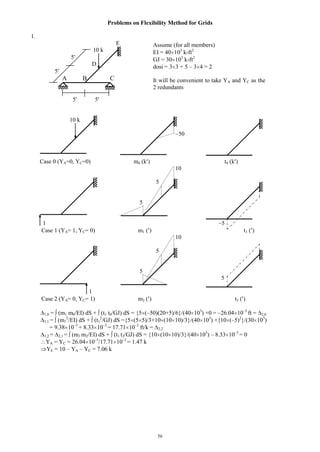
Flexibility Method for Grids (Combined Flexural and Torsional Deformations)
Grids are 2-dimensional (coplanar) structures with one deflection and two rotations at each node.
If the structure is in the x-z plane, the deflection is out-of-plane (along the y axis) while the rotations are
about two in-plane axes (x and z axis).
Grids are loaded perpendicular to the structural plane and have three forces per member; i.e., shear force,
bending moment and torsion.
Example
E
E
5 EI = 40 103
k-ft2
10 k
GJ = 30 103
k-ft2
dosi = 3 3 + 4 – 3 4 = 1 D
5 10 k
A B C A B C
5 5
Top View Isometric View
10 k
150
10 k 50
1,0
50 50
Case 0 m0 (k ) t0 (k )
10
5
1,1
5
1 5
Case 1 m1 ( ) t1 ( )
1,0 = (m1 m0/EI) dS + (t1 t0/GJ) dS
= {[5 5 (–50)/3] + 5 [5 (–250)+10 (–350)]/6}/(40 103
) +{10 (–5) (–50)}/(30 103
)
= –109.38 10–3
+ 83.33 10–3
= –26.05 10–3
ft
1,1 = (m1 m1/EI) dS + (t1 t1/GJ) dS
={5 (5 5)/3+10 (10 10)/3}/(40 103
) +{10 (–5) (–5)}/(30 103
)
= 9.38 10–3
+ 8.33 10–3
= 17.71 10–3
ft/k
VA = 26.05 10–3
/17.71 10–3
= 1.47 k
D
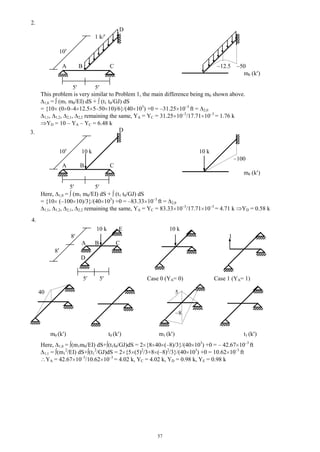
56
Problems on Flexibility Method for Grids
1.
E
10 k
5
D
5
A B C
5 5
10 k
50
Case 0 (YA=0, YC=0) m0 (k ) t0 (k )
10
5
5
1 5
Case 1 (YA= 1, YC= 0) m1 ( ) t1 ( )
10
5
5
5
1
Case 2 (YA= 0, YC= 1) m2 ( ) t2 ( )
1,0 = (m1 m0/EI) dS + (t1 t0/GJ) dS = {5 (–50)(20+5)/6}/(40 103
) +0 = –26.04 10–3
ft = 2,0
1,1 = (m1
2
/EI) dS + (t1
2
/GJ) dS ={5 (5 5)/3+10 (10 10)/3}/(40 103
) +{10 (–5)2
}/(30 103
)
= 9.38 10–3
+ 8.33 10–3
= 17.71 10–3
ft/k = 2,2
1,2 = 2,1 = (m1 m2/EI) dS + (t1 t2/GJ) dS = {10 (10 10)/3}/(40 103
) – 8.33 10–3
= 0
YA = YC = 26.04 10–3
/17.71 10–3
= 1.47 k
YE = 10 – YA – YC = 7.06 k
Assume (for all members)
EI = 40 103
k-ft2
GJ = 30 103
k-ft2
dosi = 3 3 + 5 – 3 4 = 2
It will be convenient to take YA and YC as the
2 redundants
57
2.
D
1 k/
10
A B C 12.5 50
m0 (k )
5 5
This problem is very similar to Problem 1, the main difference being m0 shown above.
1,0 = (m1 m0/EI) dS + (t1 t0/GJ) dS
= {10 (0 0–4 12.5 5–50 10)/6}/(40 103
) +0 = –31.25 10–3
ft = 2,0
1,1, 1,2, 2,1, 2,2 remaining the same, YA = YC = 31.25 10–3
/17.71 10–3
= 1.76 k
YD = 10 – YA – YC = 6.48 k
D
10 10 k 10 k
100
A B C
m0 (k )
5 5
Here, 1,0 = (m1 m0/EI) dS + (t1 t0/GJ) dS
= {10 (–100 10)/3}/(40 103
) +0 = –83.33 10–3
ft = 2,0
1,1, 1,2, 2,1, 2,2 remaining the same, YA = YC = 83.33 10–3
/17.71 10–3
= 4.71 k YD = 0.58 k
10 k E 10 k
8 1
A B C
8
D
5 5 Case 0 (YA= 0) Case 1 (YA= 1)
40 5
8
m0 (k ) t0 (k ) m1 (k ) t1 (k )
Here, 1,0 = (m1m0/EI) dS+ (t1t0/GJ)dS = 2 {8 40 (–8)/3}/(40 103
) +0 = – 42.67 10–3
ft
1,1 = (m1
2
/EI) dS+ (t1
2
/GJ)dS = 2 {5 (5)2
/3+8 (–8)2
/3}/(40 103
) +0 = 10.62 10–3
ft
YA = 42.67 10–3
/10.62 10–3
= 4.02 k, YC = 4.02 k, YD = 0.98 k, YE = 0.98 k
3.
4.

Structural engineering ii

  • 1.
    1 Approximate Lateral LoadAnalysis by Portal Method Portal Frame Portal frames, used in several Civil Engineering structures like buildings, factories, bridges have the primary purpose of transferring horizontal loads applied at their tops to their foundations. Structural requirements usually necessitate the use of statically indeterminate layout for portal frames, and approximate solutions are often used in their analyses. (i) (ii) (iii) (iv) Portal Frame Structures Assumptions for the Approximate Solution In order to analyze a structure using the equations of statics only, the number of independent force components must be equal to the number of independent equations of statics. If there are n more independent force components in the structure than there are independent equations of statics, the structure is statically indeterminate to the nth degree. Therefore to obtain an approximate solution of the structure based on statics only, it will be necessary to make n additional independent assumptions. A solution based on statics will not be possible by making fewer than n assumptions, while more than n assumptions will not in general be consistent. Thus, the first step in the approximate analysis of structures is to find its degree of statical indeterminacy (dosi) and then to make appropriate number of assumptions. For example, the dosi of portal frames shown in (i), (ii), (iii) and (iv) are 1, 3, 2 and 1 respectively. Based on the type of frame, the following assumptions can be made for portal structures with a vertical axis of symmetry that are loaded horizontally at the top 1. The horizontal support reactions are equal 2. There is a point of inflection at the center of the unsupported height of each fixed based column Assumption 1 is used if dosi is an odd number (i.e., = 1 or 3) and Assumption 2 is used if dosi 1. Some additional assumptions can be made in order to solve the structure approximately for different loading and support conditions. 3. Horizontal body forces not applied at the top of a column can be divided into two forces (i.e., applied at the top and bottom of the column) based on simple supports 4. For hinged and fixed supports, the horizontal reactions for fixed supports can be assumed to be four times the horizontal reactions for hinged supports
  • 2.
    2 Example Draw the axialforce, shear force and bending moment diagrams of the frames loaded as shown below. (i) (ii) Solution (i) For this frame, dosi = 3 3 + 4 3 4 = 1; i.e., Assumption 1 HA = HD = 10/2 = 5 k MA = 0 10 10 VD 15 = 0 VD = 6.67 k Fy = 0 VA + VD = 0 VA = 6.67 k Reactions AFD (k) SFD (k) BMD (k-ft) (ii) dosi = 3 3 + 6 3 4 = 3 Assumption 1 HA = HD = 10/2 = 5 k, Assumption 2 BME = BMF = 0 BMF = 0 HA 5 + MA = 0 MA = 25 k-ft; Similarly BME = 0 MD = 25 k-ft MA = 0 25 25 + 10 10 VD 15 = 0 VD = 3.33 k Fy = 0 VA + VD = 0 VA = 3.33 k Reactions AFD (k) SFD (k) BMD (k-ft) 5 25 k-ft 6.67 k6.67 k 5 k5 k EF D CB A 10 k 15 5 10 k 6.67 6.67 5 5 6.67 50 50 3.33 k3.33 k 5 k5 k 10 k 3.33 3.33 5 5 5 3.33 25 25 25 k-ft 2525 D CB A 10 k 15 10
  • 3.
    3 (iii) dosi = 34 + 6 3 5 1 = 2; Assumption 1 and 2 BME = BMF = 0 BME = 0 (bottom) HA 5 + MA = 0 MA = 5HA; Similarly BMF = 0 MD = 5HD Also BME = 0 (free body of EBCF) 10 5 VD 15 = 0 VD = 3.33 k Fy = 0 VA + VD = 0 VA = VD = 3.33 k BMG = 0 (between E and G) VA 7.5 HA 5 = 0 HA = 5 k MA = 5HA = 25 k-ft Fx = 0 (entire structure) HA + HD + 10 = 0 5 + HD + 10 = 0 HD = 5 k MD = 5HD = 25 k-ft Reactions AFD (k) SFD (k) BMD (k-ft) (iv) dosi = 3 5 + 9 3 6 = 6 6 Assumptions needed to solve the structure Assumption 1 and 2 HA: HB: HC = 1: 2: 1 HA = 10/4 = 2.5 k, HB = 5 k, HC = 2.5 k MA = MC = 2.5 5 = 12.5 k-ft, MB = 5 5 = 25 k-ft The other 4 assumptions are the assumed internal hinge locations at midpoints of columns and one beam Reactions BMD (k-ft) SFD (k) AFD (k) 10 k 10 k 25 k-ft MD VD HD G 12.5 k-ft CB D CB A 10 k10 k 7.5 10 FE YBYA 5 k2.5 k 25 k-ft 7.5 7.5 FE 5 MA VA HA 25 k-ft 3.33 k3.33 k 5 k 5 k 3.33 3.33 5 5 5 3.33 25 25 2525 50 VA HA VD HD 7.5 G 2.5 k 12.5 k-ft YC 12.5 25 12.5 12.5 12.5 12.5 25 5 2.52.5 1.67 1.67 1.67 1.67 7.5 2.5
  • 4.
    4 Analysis of Multi-storiedStructures by Portal Method Approximate methods of analyzing multi-storied structures are important because such structures are statically highly indeterminate. The number of assumptions that must be made to permit an analysis by statics alone is equal to the degree of statical indeterminacy of the structure. Assumptions The assumptions used in the approximate analysis of portal frames can be extended for the lateral load analysis of multi-storied structures. The Portal Method thus formulated is based on three assumptions 1. The shear force in an interior column is twice the shear force in an exterior column. 2. There is a point of inflection at the center of each column. 3. There is a point of inflection at the center of each beam. Assumption 1 is based on assuming the interior columns to be formed by columns of two adjacent bays or portals. Assumption 2 and 3 are based on observing the deflected shape of the structure. Example Use the Portal Method to draw the axial force, shear force and bending moment diagrams of the three-storied frame structure loaded as shown below. E A 404040 151515 33 15 10 15 18k 12k 6k 122@10=20 Beam BMD (k-ft) Beam SFD (k) Column AFD (k) 616161 -3-2 -2 -8 -5.33 -5.33 -2 -3.67 12 -7.75 3.67 -1 7.7515.5 -7.33 -12.2-8.13 -8.13 12 10 6 12 10 6 6 6 55 Column shear forces are at the ratio of 1:2:2:1. Shear force in (V) columns IM, JN, KO, LP are [18 1/(1 + 2 + 2 + 1) =] 3k , [18 2/(1 + 2 + 2 + 1) =] 6k , 6k , 3k respectively. Similarly, VEI = 30 1/(6) = 5k , VFJ = 10k , VGK = 10k , VHL = 5k ; and VAE = 36 1/(6) = 6k , VBF = 12k , VCG = 12k , VDH = 6k Bending moments are MIM = 3 10/2 = 15k , MJN = 30k , MKO = 30k , MLP = 15k MEI = 5 10/2 = 25k , MFJ = 50k , MGK = 50k , MHL = 25k MAE = 6 10/2 = 30k , MFJ = 60k , MGK = 60k , MHL = 30k M I F B N J G C O K H P L D The rest of the calculations follow from the free-body diagrams 72 50 30 25 15 36 25 15 3672 50 30 Column SFD (k) Column BMD (k-ft) Beam AFD (k) -15 -9 -3 -10 -6 -2 -5 -3 -1 -15.5 7.33
  • 5.
    5 Problems on LateralLoad Analysis by Portal Method 1. The figure below shows the shear forces (kips) in the interior columns of a two-storied frame. Use the Portal Method to calculate the corresponding (i) applied loads P1 and P2, (ii) column bending moments, (iii) beam axial forces. 2. The figure below shows the applied loads (F1, F2) and shear force (VEF) in column EF of a two-storied frame. If F2 = 10 k, and VEF = 5 k, use the Portal Method to calculate the (i) applied load F1, (ii) maximum column bending moments. 3. For the structure shown in Question 2, use the Portal Method to calculate the lateral loads F1, F2 if the axial forces in beams AD and BE are 10 kips and 15 kips respectively. 4. For the structure shown below, use the Portal Method to (i) draw the bending moment diagrams of the top floor beams AB and BC (i) calculate the applied load F1 if the maximum bending moment in column EH is 30 k-ft. 5. The figure below shows the exterior column shear forces (kips) in a four-storied fame. Calculate (i) the applied loads, (ii) beam shear forces. 5 3 20 20 12 10 P2 P1 F D E VEF 12 10 F1 F2 20 15 15 A C B IG H FD CB F1 F2 = 10 k 10 14 15 15 E A 4@10=40 20 15 10 5 20 10
  • 6.
    6 Analysis of Multi-storiedStructures by Cantilever Method Although the results using the Portal Method are reasonable in most cases, the method suffers due to the lack of consideration given to the variation of structural response due to the difference between sectional properties of various members. The Cantilever Method attempts to rectify this limitation by considering the cross-sectional areas of columns in distributing the axial forces in various columns of a story. Assumptions The Cantilever Method is based on three assumptions 1. The axial force in each column of a storey is proportional to its horizontal distance from the centroidal axis of all the columns of the storey. 2. There is a point of inflection at the center of each column. 3. There is a point of inflection at the center of each beam. Assumption 1 is based on assuming that the axial stresses can be obtained by a method analogous to that used for determining the distribution of normal stresses on a transverse section of a cantilever beam. Assumption 2 and 3 are based on observing the deflected shape of the structure. Example Use the Cantilever Method to draw the axial force, shear force and bending moment diagrams of the three - storied frame structure loaded as shown below. E A 15 5 5 15 18k 12k 6k 122@10=20 42.435.342.4 15.913.215.9 Beam BMD (k-ft) 64.653.864.6 The dotted line is the column centerline (at all floors) Column axial forces are at the ratio of 20: 5: 5: 20. Axial force in (P) columns IM, JN, KO, LP are [18 5 20/{202 + 52 + ( 5)2 + ( 20)2 } = ] 2.12k , [18 5 5/(202 + 52 + ( 5)2 + ( 20)2 } = ] 0.53k , 0.53k , 2.12k respectively. Similarly, PEI = 330 20/(850) = 7.76k , PFJ = 1.94k , PGK = 1.94k , PHL = 7.76k ; and PAE = 696 20/(850) = 16.38k , PBF = 4.09k , PCG = 4.09k , PDH = 16.38k M I F B N J G C O K H P L D The rest of the calculations follow from the free-body diagrams Beam AFD (k) -14.82 -8.98 -3.04 -9.88 -6.00 -2.12 -4.95 -3.00 -1.05 Beam SFD (k) -2.65-2.12 -2.12 -7.06-5.65 -5.64 -10.76-8.61 -8.61 -7.76 -2.12 -1.94 -0.532.12 1.94 0.53 7.76 Column AFD (k) 16.38 -16.38 Column BMD (k-ft) 69.9 1 48.5 29.1 26.5 15.9 38.1 26.5 15.9 38.169.9 48.5 29.1 4.09 -4.09 3.18 Column SFD (k) 5.825.82 3.18 11.65 9.70 11.65 9.70 6.35 6.35 5.305.30
  • 7.
    7 Results from ‘Exact’Structural Analysis E A 15 10 15 18k 12k 6k 122@10=20 Beam BMD (k-ft) M I F B N J G C O K H P L D All members have equal cross-sections Beam AFD (k) -15.10 -8.98 -2.87 -9.75 -6.01 -2.27 -3.55 -2.97 -2.40 Beam SFD (k) -4.68-2.38 -2.36 -8.63-4.80 -4.78 -10.17-5.89 -5.86 -7.14 -2.36 -5.18 -1.322.38 5.13 1.30 7.19 Column AFD (k) 13.07 -13.00 Column BMD (k-ft) -9.48 2.90 Column SFD (k) 6.116.13 2.87 10.41 9.85 10.45 9.87 7.59 7.53 5.135.15 -9.41 -16.3 16.218.419.4 -19.3 -33.9 33.843.238.1 -37.9 -40.9 40.850.847.4 -47.1 28.6 19.4 24.5 -51.5 -9.5 -22.9 50.5 34.7 43.6 -60.9 -26.5 -48.1 50.5 34.6 43.5 -60.7 -26.4 -48.1 28.5 19.3 24.3 -51.0 -9.4 -22.8 Beam BMD (k-ft) Beam AFD (k) -4.66 -2.65 -1.31 Beam SFD (k) -12.37-5.73 -5.15 Column AFD (k) 12.26 Column BMD (k-ft) -12.95 Column SFD (k) 12.2112.375.73 5.69 12.26 -38.1 38.255.139.2 -39.1 18.5 -38.8 43.3 -80.4 42.4 -79.8 18.4 -38.4 Interior columns have twice the area of exterior columns -11.57
  • 8.
    8 Problems on LateralLoad Analysis by Cantilever Method 1. The figure below shows the axial forces (kips) in the exterior columns of a two-storied frame. If the cross-sectional area of column ABC is twice the area of the other columns, use the Cantilever Method to calculate the corresponding applied loads P1 and P2. 2. For the structure shown below, use the Cantilever Method to calculate the lateral loads F1, F2 if the shear forces in beams AB and DE are 10 kips and 15 kips respectively. Assume all the columns have the same cross-sectional area. 3. Use the Cantilever Method to draw the axial force, shear force and bending moment diagrams of the three-storied structure loaded as shown below. 4. Figure (a) below shows the exterior column axial forces (kips) in a three-storied fame. Use the Cantilever Method to calculate (i) the applied loads, (ii) beam bending moments, (iii) column bending moments. Assume all the columns to have equal cross-sectional areas. Fig. (a) Fig. (b) 5. Figure (b) above shows the column shear forces (kips) in a three-storied fame. Calculate the column BM, beam BM, beam SF and column AF. Also check if they satisfy the conditions for Cantilever Method (for equal column areas). 7 15 10 5 20 10 3@10=30 20 10 3@10=30 5 E A 15 10 15 18k 12k 6k 122@10=20 M I F B N J G C O K H P L D Columnswitharea2A 2 C B A 12 3 12 10 P2 P1 20 20 JH I K FD C 8 15 20 10 E 20 GF1 F2 A B
  • 9.
    9 Approximate Vertical LoadAnalysis Approximation based on the Location of Hinges If a beam AB is subjected to a uniformly distributed vertical load of w per unit length [Fig. (a)], both the joints A and B will rotate as shown in Fig. (b), because although the joints A and B are partly restrained against rotation, the restraint is not complete. Had the joints A and B been completely fixed against rotation [Fig. (c)] the points of inflection would be located at a distance 0.21L from each end. If, on the other hand, the joints A and B are hinged [Fig. (d)], the points of zero moment would be at the end of the beam. For the actual case of partial fixity, the points of inflection can be assumed to be somewhere between 0.21 L and 0 from the end of the beam. For approximate analysis, they are often assumed to be located at one-tenth (0.1 L) of the span length from each end joint. (a) (b) (c) (d) Depending on the support conditions (i.e., hinge ended, fixed ended or continuous), a beam in general can be statically indeterminate up to a degree of three. Therefore, to make it statically determinate, the following three assumptions are often made in the vertical load analysis of a beam 1. The axial force in the beam is zero 2. Points of inflection occur at the distance 0.1 L measured along the span from the left and right support. Bending Moment and Shear Force from Approximate Analysis Based on the approximations mentioned (i.e., points of inflection at a distance 0.1 L from the ends), the maximum positive bending moment in the beam is calculated to be M(+) = w(0.8L)2 /8 = 0.08 wL2 , at the midspan of the beam The maximum negative bending moment is M( ) = wL2 /8 0.08 wL2 = 0.045 wL2 , at the joints A and B of the beam The shear forces are maximum (positive or negative) at the joints A and B and are calculated to be VA = wL/2, and VB = wL/2 Moment and Shear Values using ACI Coefficients Maximum allowable LL/DL = 3, maximum allowable adjacent span difference = 20% 1. Positive Moments (i) For End Spans (a) If discontinuous end is unrestrained, M(+) = wL2 /11 (b) If discontinuous end is restrained, M(+) = wL2 /14 (ii) For Interior Spans, M(+) = wL2 /16 2. Negative Moments (i) At the exterior face of first interior supports (a) Two spans, M( ) = wL2 /9 (b) More than two spans, M( ) = wL2 /10 (ii) At the other faces of interior supports, M( ) = wL2 /11 (iii) For spans not exceeding 10 , of where columns are much stiffer than beams, M( ) = wL2 /12 (iv) At the interior faces of exterior supports (a) If the support is a beam, M( ) = wL2 /24 (b) If the support is a column, M( ) = wL2 /16 3. Shear Forces (i) In end members at first interior support, V = 1.15wL/2 (ii) At all other supports, V = wL/2 [where L = clear span for M(+) and V, and average of two adjacent clear spans for M( )] 0.21L0.21L DCDC BABABA BA L k2Lk1L
  • 10.
    10 Example Analyze the three-storiedframe structure loaded as shown below using the approximate location of hinges to draw the axial force, shear force and bending moment diagrams of the beams and columns. 1 k/ 1 k/ 1 k/ E A 15 10 15 122@10=20 Beam BMD (k-ft) The maximum positive and negative beam moments and shear forces are as follows. For the 15 beam, M(+) = 0.08 1 152 = 18 k-ft M( ) = 0.045 1 152 = 10.13 k-ft V( ) = 1 15/2 = 7.5 k For the 10 beam, M(+) = 0.08 1 102 = 8 k-ft M( ) = 0.045 1 102 = 4.5 k-ft V( ) = 1 10/2 = 5 k Axial Force P in all the beams = 0 M I F B N J G C O K H P L D The rest of the calculations follow from the free-body diagrams Beam SFD (k) Column AFD (k) Column BMD (k-ft) Column SFD (k) -1.52 -0.58 -1.06 7.55.07.5 -4.5-10.13 18.0 8.0 -7.5 -15.0 -12.5 -25.0 -37.5 -5.53 5.06 10.13 4.60 -2.30 3.32 3.04 -6.08 -2.76 1.38 0.91 11 0.35 0.64 Beam AFD (k) -1.52 -0.61 -1.52 0.46 0.19 0.46 0.48 0.15 0.48 Beam BMD (k-ft) Using the ACI coefficients (for pattern loading) Beam SFD (k) Column AFD (k) -7.5 5.0 -14.19-15.63 16.07 6.25 -7.5 -15.0 -13.63 -27.25 -40.88 7.5 -8.63 8.63 -22.5 -22.5 -14.06
  • 11.
    11 Approximate Analysis ofBridge Portal and Mill Bent Bridge Portals and Mill Bents Portals for bridges or bents for mill buildings are often arranged in a manner to include a truss between two flexural members. In such structures, the flexural members are continuous from the foundation to the top and are designed to carry bending moment, shear force as well as axial force. The other members that constitute the truss at the top of the structure are considered pin-connected and to carry axial force only. Such a structure can be statically indeterminate to the first or third degree, depending on whether the supports are assumed hinged of fixed. Therefore, the same three assumptions made earlier for portal frames can be made for the approximate analysis of these structures also; i.e., for a load applied at the top 1. The horizontal support reactions are equal 2. There is a point of inflection at the center of the unsupported height of each fixed based column Example In the bridge portal loaded as shown below, draw the bending moment diagrams of columns AB and CD. FE D C A B Bridge Portal Mill Bent 1 k/ft Assuming the total load to be applied equally (i.e., 25/2 = 12.5 k and 12.5 k) at A and B, the horizontal reactions are HA = 12.5 + 12.5/2 = 18.75 k, HB = 12.5/2 = 6.25 k Also, BM = 0 at the midpoint of the free height; i.e., at 15/2 = 7.5 from the bottom. MA + 18.75 7.5 7.5 7.5/2 = 0 MA = 112.5 k-ft MD + 6.25 7.5 = 0 MD = 46.88 k-ft MA = 0 112.5 46.88 + 25 12.5 VD 20 = 0 VD = 7.66 k Fy = 0 VA + VD = 0 VA = 7.66 k 15 10 HA VA MA HD VD MD 20 112.5 k-ft 7.66 k 18.75 k 46.88 k-ft 7.66 k 6.25 k RB RC RE RF 112.5 56.25 46.88 46.88 BMD (k-ft) of AB BMD (k-ft) of CD
  • 12.
    12 Approximate Analysis ofStatically Indeterminate Trusses Two approximate methods are commonly used for the analysis of statically indeterminate trusses. The methods are based on two basic assumptions Method 1: Diagonal members take equal share of the sectional shear force Method 2: Diagonal members can take tension only (i.e., they cannot take any compression) Example Calculate member forces GC, BH, GH, BC of the statically indeterminate truss shown below assuming (i) Diagonal members take equal share of the sectional shear force, (ii) Diagonal members can take tension only. Fx = 0 Ex + 20 = 0 Ex = 20 ME = 0 20 15 + (5 + 10 + 10 + 10 + 5) 40 + Ay 80 = 0 Ay = 23.75 k Fy = 0 Ay + Ey + 5 + 10 + 10 + 10 + 5 = 0 Ey = 16.25 k (i) At section x-x, Fx = 0 FGH + FBC + FBH cos 36.9 + FGC cos 36.9 + 20 = 0 FGH + FBC + 0.8 FBH + 0.8 FGC + 20 = 0 Fy = 0 FBH sin 36.9 FGC sin 36.9 + 5 + 10 23.75 = 0 0.6 FBH 0.6 FGC = 8.75 Assuming diagonal members to take equal share of the sectional shear force 0.6 FBH = 0.6 FGC = 8.75/2 = 4.375 FBH = 7.29 k, FGC = 7.29 k MB = 0 23.75 20 + 5 20 + 20 15 0.8 7.29 15 + FGH 15 = 0 FGH = 10.83 k Fx = 0 FGH + FBC + 0.8 FBH + 0.8 FGC + 20 = 0 FBC = 30.83 k (ii) Assuming the diagonal member GC to fail in compression (i.e., to be non-existent) At section x-x, Fx = 0 FGH + FBC + FBH cos 36.9 + 20 = 0 FGH + FBC + 0.8 FBH + 20 = 0 Fy = 0 FBH sin 36.9 + 5 + 10 23.75 = 0 FBH = 14.58 k MB = 0 23.75 20 + 5 20 + 20 15 + FGH 15 = 0 FGH = 5 k Fx = 0 FGH + FBC + 0.8 FBH + 20 = 0 FBC = 36.67 k Note: The actual values from GRASP (assuming identical member sections) are FBH = 4.88 k, FGC = 9.71 k, FGH = 12.77 k, FBC = 28.90 k x x JIHGF E DCB A 20 k 5 k 10 k 10 k 10 k 5 k 4 @20 = 80 16.25 k 20 k 15 23.75 k 36.9
  • 13.
    13 Problems on ApproximateAnalysis of Bridge Portal, Mill Bent and Truss 1. In the mill bent shown below, use the portal method to calculate the axial forces in members BG and EH and draw the shear force and bending moment diagrams of ABC and DEF. 2. In the mill bent shown below, (i) Use the Portal Method to draw the bending moment diagram of the member KLM. (ii) Calculate the forces in EG and FH, assuming them to take equal share of the sectional shear. 3. In the bridge portal shown below, compression in member DG is 10 kips. Use the Portal Method to (i) calculate the load w per unit length, assuming the diagonal members to share the sectional shear force equally. (ii) draw the BMD and SFD of the member FGH for the value of w calculated in (i). B L I JF H GC E N M K D A 10 k 10 10 10 10 k wkipperft B H G F C A 2 @50 = 100 50 25 D E 45 HG 45 1 k/ft D E F C B A 10 k 4 @20 = 80 40 20 10 4 @10 = 40
  • 14.
    14 4. In thestructure shown below, (i) Use the Portal Method to calculate the reactions at support A, G and draw the BMD of ABC. (ii) Calculate the forces in members CD, BE, CF, assuming diagonal members to take tension only. 5. In the bridge portal shown below, (i) Use the Portal Method to calculate the reactions at support A and force in member BE. (ii) Calculate the forces in members GI and FH, assuming diagonal members to take tension only. B D I H G C A 10 k 2 @20 = 40 20 10 5 k 10 E 5 k 5 k F K I H F G 10 k 10 k B 1 k/ft E C D M L JA 4 @10 = 40 10 10 10
  • 15.
    15 Deflection Calculation bythe Method of Virtual Work Method of Virtual Work Another way of representing the equilibrium equations is by energy methods, which is based on the law of conservation of energy. According to the principle of virtual work, if a system in equilibrium is subjected to virtual displacements, the virtual work done by the external forces ( WE) is equal to the virtual work done by the internal forces ( WI) WE = WI …...…………………(1) where the symbol is used to indicate ‘virtual’. This term is used to indicate hypothetical increments of displacements and works that are assumed to happen in order to formulate the problem. while the virtual work done by the virtual internal force (u) on B is = u. dL …...…………………(3) The total internal virtual work done is WI = u. dL …...…………………(4) where the symbol indicates the summation over the lengths of all the elements within the body. In this formulation, the terms in italic indicate virtual loads or internal forces. The principle of virtual work [Eq. (1)] 1. = u. dL = u. dL …...…………………(5) It is to be noted here that the term above can indicate the deflection or rotation of the body, depending on which the virtual load (1) can be a unit force or a unit moment applied in the direction of . Deflection of Truss due to External Loads The above principle can be applied to calculate the deflection of a truss due to axial deformation of its members. This axial deformation can be caused be caused by external loads on the truss, temperature change or misfit of member length. The axial deformation due to external loads is caused by the internal forces within the truss members, the resulting extension of a truss member being dL = N0L/EA …...…………………(6) where N0, L, E and A stand for the axial force (due to external loads), length, modulus of elasticity and cross-sectional area of a truss member. The internal force u due to the unit virtual load is often expressed by N1, from which the equation for truss deflection [Eq. (5)] becomes = N1. N0L/EA ……….……(7) Example Calculate the vertical deflection of the point B of the truss ABCDEF due to the external loads applied [Given: EA/L = 500 kip/ft, for all the truss members]. Using member forces N0 and N1 from the above analyses, = N0 N1 L/EA ……….……(7) Ignoring zero force members, B,v = {(7.07) (0.707) + (−7.07) (0.707) + (−5) (−0.5) + (−5) (−0.5)}/500 = 0.01 ft Consider the body loaded as shown in Fig. 1. Under the given loading conditions, the point A deflects an amount in the direction shown in the Figure. Moreover the same load causes the element B within the body to extend an amount dL in the direction shown. If a virtual unit load (i.e., a load of magnitude 1), when applied in the direction of , causes a virtual internal force u in the element B in the direction of dL, the virtual work done by the external forces WE = 1. …...…………………(2) Fig. 1 A B dL u 1 A B C F E D A B C F E D A B C F E D 3 @ 20 = 60 20 10 k 0 0 1010 -14.147.07 -7.07 -5 -5 N0 (k) N1 10 k 1 -10.707 0.707 -0.5 -0.5 0 0 0 0
  • 16.
    16 Deflection of Trussdue to Temperature Change and Misfit In addition to external loads, a truss joint may deflect due to change in member lengths (i.e., become longer or shorter than its original length) caused by change in temperature or geometrical misfit of any truss member (being longer or shorter than its specified length). In Eq. (5); i.e., = u. dL …...…………………(5) the tem dL (elongation of a truss member) can also be due to temperature change or fabrication defect of any truss member. The change in length due to increase in the temperature T is = T L …...…………………(8) where = Coefficient of thermal expansion; i.e., change of length of a member of unit length due to unit change of temperature, T = Change of temperature of a member of length L. Adding to it a geometric misfit (due to fabrication defect) of L, the total elongation of a truss member dL = N0L/EA + T L + L …...…………………(9) from which the equation for truss deflection [Eq. (5)] becomes = N1 dL = N1 (N0L/EA + T L + L) …...…………………(10) Example Calculate the vertical deflection of joint B of the truss ABCDEF shown below due to (i) temperature rise of 30 F in the bottom cord members AB and BC, (ii) fabrication defects resulting in vertical members BF and CE to be made 0.25 shorter than specified [Given: Coefficient of thermal expansion = 5.5 10-6 / F, for all the truss members]. (i) For members AB and BC, = 5.5 10-6 / F, T = 30 F, L = 20 ft = 240 in dL = T L = (5.5 10-6 ) (30) (240) = 0.0396 in Ignoring zero force members, B,v = (0.0396) (-0.5) + (0.0396) (-0.5) = 0.0396 in (ii) For members BF and CE, dL = 0.25 in Ignoring zero force members, B,v = ( 0.25) (-1) + ( 0.25) (0) = 0.25 in Support Settlement Settlement of supports due to consolidation or instability of the subsoil/foundation is a major reason of deflection of structures. There is a fundamental difference between the effect of support settlement on statically determinate and indeterminate structures. While it causes deflection due to geometrical changes only in statically determinate structures, it induces internal stresses in statically indeterminate structures (which may even be more significant than the forces due to external loads). The effect of support settlement on statically indeterminate structures is dealt separately but the following figure shows the deflected shape of the truss ABCDEF shown above due to settlement of support C. A B C F E D 3 @ 20 = 60 20 -0.25 -0.25 0.0396 dL (in) N1 1 -10.707 0.707 -0.5 -0.5 0 0 0 0 0.0396
  • 17.
    17 Problems on TrussDeflection by the Method of Virtual Work Assume EA/L = 500 k/ft, = 5.5 10-6 / F for the following trusses. 1. Calculate E,h due to (i) The external load (ii) T = 50 F for CD and CE. 12 12 12 2. Calculate B-C(rel) due to 15 k 15 k (i) The external loads (ii) L = 0.5 for CD and CE. C D E A B 12 12 3. Calculate A-C(rel) due to 10 k C (i) The external loads (ii) T = 50 F for AB and AD. 17.32 30 60 B D 60 30 17.32 10 k 4. Calculate C,v and C,h due to the external loads. 5. Calculate B,v and D(along AD) due to the external loads. 20 k 10 k A A B C D A B C D E 10 k A G F EDC H 25 10k 4 @25 = 100 45 20kB 12 1212 12
  • 18.
    18 Deflection due toFlexural Deformations Flexural deformation is the main source of deflection in many civil engineering structures, like beams, slabs and frames; i.e., those designed primarily against bending moment. It is often much more significant than other causes of deflection like axial, shear and torsional deformation. From Eq. (5) of the previous section, the principle of virtual work = u. dL …………………(5) where the term above can indicate the deflection or rotation of the body, u is the virtual internal force in an element within the body, which deforms by an amount dL in the direction of u. Deflection of Beam/Frame due to External Loads For flexural deformation, u is be the virtual internal moment m1 in the element while dL is the rotation d caused by external forces; i.e., dL = d = curvature ds = (m0/EI) ds. = m1 m0/EI ds …………………(11) where m0 is the bending moment caused by external forces and EI is called the flexural rigidity of the member. Here, the integration sign is used instead of summation because the bending moments vary within the length of each member (unlike the trusses, where axial forces do not vary within the members). Integration Table In order to facilitate the integration shown in Eq. (11), the following table is used between functions f1 and f2, both of which can be uniform or vary linearly or parabolically along the length (L) of a member. Integration of Product of Functions (I = f1 f2 dS) f2 f1 A L B L A L A B L A C B L a L AaL BaL/2 AaL/2 (A+B)aL/2 [A+4C+B]aL/6 b L AbL/2 BbL/3 AbL/6 [A+2B]bL/6 [2C+B]bL/6 a L AaL/2 BaL/6 AaL/3 [2A+B]aL/6 [A+2C]aL/6 a b L A(a+b)L/2 B(a+2b)L/6 A(2a+b)L/6 [A(2a+b)+B(a+2b)]L/6 [Aa+Bb+ 2C(a+b)]L/6 Example: Calculate the tip rotation and deflection of the beam shown below [Given: EI = const]. m1 m0 B P0L A P0 L L 1 m1 Using the m0 diagram along with m1 for unit anticlockwise moment at A A = ( 1) ( P0L/EI) L/2 = P0L2 /2EI Using the m0 diagram and m1 for unit upward load at A vA = (L) ( P0L/EI) L/3 = P0L3 /3EI
  • 19.
    19 Deflection due toCombined Flexural, Shear and Axial Deformations EA = 400 103 k, GA* = 125 103 k, EI = 40 103 k-ft2 Calculate the (i) horizontal deflection at C ( C,h) (ii) vertical deflection at D ( D,v). x0 (k) v0 (k) m0 (k ) For horizontal deflection at C ( C,h): x1 v1 m1 ( ) D,v = (x1 x0/EA) dS + (v1 v0 /GA* ) dS + (m1 m0 /EI) dS = 10( 10)(1)/(400 103 ) +10( 10)(1)/(125 103 )+10/3(100)(–10)/(40 103 ) = (–0.25–0.80–83.33) 10 3 = 0.0844 ft For vertical deflection at D ( D,v): x1 v1 m1 ( ) D,v = (x1 x0/EA) dS + (v1 v0 /GA* ) dS + (m1 m0 /EI) dS = 0 + 0 + 10/2 (10)(100)/(40 103 ) = 0 + 0 + 125 10 3 = 0.125 ft 1 1 1 –1 CB DA 10 k 10 10 –1 10 –10 –10 100 –10
  • 20.
    20 Problems on Deflectionof Beams/Frames using Method of Virtual Work (Unit Load Method) Assume EA = 400 103 k, GA* = 125 103 k, EI = 40 103 k-ft2 Beams 1. 100 k 2. 10 k 10 k A B A C C 10 4@5 10 k 1 k/ 3. 4. A C B Guided Roller A C B 10 10 10 10 5. Frames 6. 10 k 10 k 7. 20 20 D A 10 10 10 5 5 8. 1 k/ CB AB A, A? C, A? B, A? C, A? C, C? A, A? C 2EI DBA 1 k/ B is an Internal HingeC 10 2010 B, B(L) , B(R)? 1 k/ 10 A C D B 10 20 D, A?
  • 21.
    21 Analysis of StaticallyIndeterminate Structures by Flexibility Method The
  • 22.
    22 Flexibility Method for2-degree Indeterminate Trusses D C 10 k EA/L = constant = 1000 k/ft (Note: EA constant) dosi = 1 6 + 4 – 2 4 = 2 10 The horizontal reaction HB and member force FBD are taken as the two redundants. A B 10 10 k 1,0 = {N1 N0 /(EA/L)} = {0 0 + 0 0 + 0 14.14 + 0 (–10) + 1 0}/1000 = 0 ft 2,0 = {N2 N0 /(EA/L)} = {14.14 1 + (–10) (–0.707)}/1000 = 21.21 10-3 ft 1,1 = {N1 N1 /(EA/L)} = {02 + 02 + 02 + 02 + 12 }/1000 = 1 10-3 ft/k 1,2 = 2,1 = {N1 N2 /(EA/L)} = {1 (–0.707)}/1000 = –0.707 10-3 ft/k 2,2 = {N2 N2 /(EA/L)} = {4 (–0.707)2 + 2 12 }/1000 = 4 10-3 ft/k (1 10-3 ) HB + (–0.707 10-3 ) FBD = 0 (–0.707 10-3 ) HB + (4 10-3 ) FBD = –21.21 10-3 HB = – 4.29 k, and FBD = – 6.06 k N = N0 + N1 HB + N2 FBD FAB = 0 +1 (– 4.29) + (–0.707) (–6.06) = 0, FBC = –10 + 0 + (–0.707) (–6.06) = –5.71 k FCD = 0 +0 + (–0.707) (–6.06) = 4.29, FDA = 0 +0 + (–0.707) (–6.06) = 4.29 k FAC = 14.14 + 0 +(1) (–6.06) = 8.08 k, FBD = – 6.06 k (0) (0) (0) (14.14) ( 10) (0) (0) (0) (0) (1) (1) ( 0.707) (1) ( 0.707) ( 0.707) ( 0.707) Case 0 (HB = 0, FBD = 0) [Forces N0 (k)] Case 1 (HB = 1) [Forces N1] Case 2 (FBD = 1) [Forces N2]
  • 23.
    23 Problems on FlexibilityMethod for Trusses (from past exams) 1. 10 k Also solve if C moves 0.10 to right 12 12 12 2. 10 k Also solve if B settles 0.10 10 10 10 3. C D E A B 12 12 4. 10 k 17.32 30 60 B D 60 17.32 4@10 = 40 5. 10 k 20 k Also solve if C settles 0.10 12 12 15 k C 30 A A B C D A B C D E A B C D 12 12
  • 24.
    24 6. 7. 28.9 8. 9. 10. 45 30 10 k A BC D E I H G F6 @30 = 180 30 17.32 60 10 k A B C D E FG 30 60 3060 86.6 3@100 = 300 57.7 60 60 E A 30 10 k B C D 50 50 F 60 G H 30 50 57.7 60I 6060 B C D E A 30 30 10 k 50 50 43.3 Support E moves 0.10 rightwards Support A moves 0.10 rightwards 4545 10 k A B C F D E H G 4@25 = 100 10 k 25 25
  • 25.
    25 Solutions for Problemson Flexibility Method for Trusses 1. A B 10 k 12 C D E 12 12 (0) 10 k (0) (0) (7.07) ( 7.07) 1 ( 5) ( 5) ( 1) ( 1) N0 (k) (XC = 0) N1 (XC = 1) 1,0 = {( 5) ( 1)+ ( 5) ( 1)}/500 = 0.02 , 1,1 = {( 1) 2 + ( 1)2 }/500 = 0.004 0.004 XC + 0.02 = 0.10 XC = 20 k N = N0 + XC N1 PAB = 0, PAC = 0, PBC = 7.07 k, PBD = 0, PBE = 7.07 k, PCD = 25 k, PBE = 25 k 2. D 10 k 10 A B C 10 10 10 k (0) (0.707) (0.707) (7.07) ( 7.07) ( 1) (5) (5) ( 0.5) ( 0.5) 1 N0 (k) (YB = 0) N1 (YB = 1) 1,0 = {(5) ( 0.5)+(5) ( 0.5)+ (7.07) (0.707)+ ( 7.07) (0.707)}/500 = 0.01 1,1 = {( 0.5)2 + ( 0.5)2 + (0.707)2 + ( 1)2 + (0.707)2 }/500 = 0.005 0.005 YB 0.01 = 0.10 YB = 18 k N = N0 + YB N1 PAB = 14 k, PBC = 14 k, PAD = 5.66 k, PBD = 18 k, PCD = 19.80 k Also support C moves 0.10 rightwards Assume EA/L = Constant = 500 k/ft dosi = 7 + 4 2 5 = 1 Also support B settles 0.10 Assume EA/L = Constant = 500 k/ft dosi = 5+ 4 2 4 = 1
  • 26.
    26 3. 15 k15 k C D E (0) (0) ( 0.707) (0) 12 (0) (15) ( 0.707) ( 0.707) (0) (0) (0) (1) (1) (0) A B (0) 12 12 ( 0.707) N0 (k) (PBC = 0) N1 (PBC = 1) EA/L = Constant = 500 k/ft, dosi = 8+3 2 5 = 1 1,0 = {(15) ( 0.707)}/500 = 0.0212 , 1,1 = {4 ( 0.707)2 +2 (1)2 }/500 = 0.008 0.008 PBC 0.0212 = 0 PBC = 2.65 k N = N0 + PBC N1 PAB = 1.87 k, PAC = 1.87 k, PCD = 1.87 k, PBD = 15.13 k, PBC = 2.65 k, PAD = 2.65 k, PDE = 0, PBE = 0 4. C 10 k EA/L = Constant = 1000 k/ft 17.32 dosi = 6 +3 2 4 = 1 60 B 30 D 60 30 17.32 4@10 = 40 10 k (8.66) (0) ( 5) ( 0.866) ( 0.5) (1) (2.5) (1) (0) (0) ( 0.5) ( 0.866) N0 (k) (PAC = 0) N1 (PAC = 1) 1,0 = {(8.66) ( 0.866)+( 5) ( 0.5)+(2.5) (1)}/1000 = 0.0025 1,1 = {2 ( 0.5)2 +2 ( 0.866)2 +2 (1)2 }/1000 = 0.004 0.004 PAC 0.0025 = 0 PAC = 0.63 k N = N0 + PAC N1 PAB = 0.31 k, PBC = 8.12 k, PCD = 5.31 k, PDA = 0.54 k, PAC = 0.63 k, PBD = 3.13 k A
  • 27.
    27 5. 10 k D 20k 10 A B C 10 10 10 k 20 k ( 28.28) (30) (0) (0) (0) (0) ( 1.41) ( 1.41) (2) (0) (0) (1) (0) (1) (1) N0 (k) N1 (XB = 1) N2 (YC = 1) 1,0 = 0, 2,0 = {( 28.28) ( 1.41) + (30) (2)}/500 = 0.20 1,1 = (1)2 /500 = 0.002, 1,2 = 2,1 = (1) (1)/500 = 0.002, 2,2 = {2 ( 1.41)2 + (2)2 +2 (1)2 }/500 = 0.02 0.002 XB + 0.002 YC + 0 = 0 0.002 XB + 0.02 YC + 0.20 = 0.10 XB = 16.67 k, YC = 16.67 k N = N0 + XB N1 + YC N2 PAB = 0, PBC = 16.67 k, PAD = 4.71 k, PBD = 3.33 k, PCD = 23.57 k Also support C settles 0.10 Assume EA/L = Constant = 500 k/ft dosi = 5+5 2 4 = 2 1 1
  • 28.
    28 Flexibility Method for1-degree Indeterminate Beams Example 1 EI = constant A B C dosi = 3 1 + 4 – 3 2 = 1 Take RA as the redundant L/2 L/2 1,0 + RA 1,1 = A = 0 …………..…(i) 1,0 = (L/2)/6 [2L + L/2] (–PL/2)/EI = – 5PL3 /48EI 1,1 = m1 m1 dS/EI = L/3 (L) (L)/EI = L3 /3EI m1 (i) – 5PL 3 /48EI + L3 /3EI = 0 RA = 5P/16 M = m0 + RA m1 = m0 + (5P/16) m1 M MA = 0, MB = 5PL/32, MC = –PL/2 + 5PL/16 = –3PL/16 Example 2 EI = constant A B C dosi = 3 2 + 4 – 3 3 = 1 Take RB as the redundant 10 10 1,0 + RB 1,1 = B = 0 …………..…(i) 1,0 = 2 [2 37.5 + 50] (–5 10/6)/EI = –2083.33/EI 1,1 = m1 m1 dS/EI m1 ( ) = 2 10/3 (–5) (–5)/EI = 166.67/EI – 5 (i) –2083.33/EI + 166.67 RB/EI = 0 RB = 12.5 k M = m0 + RB m1 = m0 + 12.5 m1 M (k ) MA = 0, MB = 50 – 62.5 = – 12.5 k , MC = 0 – 12.5 6.256.25 1 k/ft m0 (k ) 37.5 50 P m0 PL/2 100 L L/2 3PL/16 5PL/32
  • 29.
    29 Flexibility Method for2-degree Indeterminate Beams Example 3 10 k 10 k A B C D E dosi = 3 2 + 5 – 3 3 = 2 EI = 1 EI = 1 1,0 + RA 1,1 + RC 1,2 = A = 0 ……(i) 5 5 5 5 2,0 + RA 2,1 + RC 2,2 = C = 0 ……(ii) m0 (k ) 1,0 = m1 m0 dS/EI 0 0 = {10/6 (–100) (30+5) –50 –100 + 5/6[(–100)(30+20) + (–200)(40+15)]}/EI –200 = –19166.67/EI 15 20 2,0 = m2 m0 dS/EI 5 = {5/6 (5) (–200–50) m1 ( ) + 5/6 [(5)(–200–200)+(10)(–400–100)]}/EI = – 6875/EI 1,1 = m1 m1 dS/EI = 20/3 (20) (20)/EI = 2666.67/EI 5 10 1,2 = 2,1 = m1 m2 dS/EI m2 ( ) = {5/6(5)(30+10) +5/6 [(5)(30+20)+(10)(40+15)]}/EI = 833.33/EI 2,2 = m2 m2dS/EI = 10/3 (10) (10)/EI = 333.33/EI Avoiding the factors EI (i) 2666.67 RA + 833.33 RC = 19166.67 (ii) 833.33 RA + 333.33 RC = 6875 RA = [19166.67 333.33 – 833.33 6875]/[2666.67 333.33 – 833.332 ] = 3.39 k and RC = [2666.67 6875 – 833.33 19166.67]/[2666.67 333.33 – 833.332 ] = 12.14 k M = m0 + RA m1 + RC m2 = m0 + 3.39 m1 + 12.14 m2 MA = 0, MB = 0 + 3.39 5+ 0 12.14 = 16.95 k , MC = –50 + 3.39 10 +0 12.14 = –16.10 k , MD = –100 + 3.39 15 + 5 12.14 = 11.55 k , ME = –200 + 3.39 20 + 10 12.14 = –10.80 k 16.95 11.55 M (k ) 10 –16.10 –10.80
  • 30.
    30 Analysis for SupportSettlement Example 4 Support B settles 0.10 A B C EI = 40 103 k-ft2 dosi = 3 2 + 4 – 3 3 = 1 1,0 + RB 1,1 = B = –0.10 ……(i) 10 10 1,0 = 0 m1 ( ) 1,1 = m1 m1 dS/EI = 2 10/3 (–5) (–5)/EI = 166.67/40 103 –5 (i) 166.67 RB/40 103 + 0 = –0.10 RB = – 4000/166.67 = –24 k 120 M = m0 + RB m1 = –24 m1 [in k ] M (k ) Example 5 Support C settles 0.10 EI = 40 103 k-ft2 A B C D E dosi = 2 1,0 + RA 1,1 + RC 1,2 = A = 0.…..….(i) 10 10 2,0 + RA 2,1 + RC 2,2 = C = –0.10.…(ii) 1,0 = 0, 2,0 = 0 1,1 = m1 m1 dS/EI = 2666.67/EI, 1,2 = 2,1 = 833.33/EI, 2,2 = 333.33/EI (i) (2666.67/EI) RA + (833.33/EI) RC = 0 (ii) (833.33/EI) RA + (333.33/EI) RC = –0.10 RA = 17.14 k, and RC = –54.86 k M = m0 + RA m1 + RC m2 = 17.14 m1 – 54.86 m2 [in k ] MA = 0, MB = 17.14 5 – 0 54.86 = 85.70, MC = 17.14 10 – 0 54.86 = 171.40, MD = 17.14 15 – 5 54.86 = –17.20, ME = 17.14 20 – 10 54.86 = – 205.80 171.40 M (k ) –205.80
  • 31.
    31 Combined Flexural, Shearand Axial Deformations B C EA = 400 103 k, GA* = 125 103 k EI = 40 103 k-ft2 dosi = 3 3 + 4 – 3 4 = 1 10 The vertical reaction at D (VD) is taken as the redundant. A D 10 –10 –10 100 x0 (k) v0 (k) m0 (k ) 10 –1 –1 x1 v1 m1 ( ) 1,0 = (x1 x0/EA) dS + (v1 v0 /GA* ) dS + (m1 m0 /EI) dS = 0 + 0 + 10/2 (100)(10)/(40 103 ) = 0.125 ft 1,1 = (x1 x1/EA) dS + (v1 v1 /GA* ) dS + (m1 m1 /EI) dS = 2 10 (1 1)/(400 103 )+10 (1 1)/(125 103 )+[10 (10 10)+10 (10 10)/3]/(40 103 ) = 0.05 10–3 + 0.08 10–3 +33.33 10–3 = 33.46 10–3 VD = –0.125/33.46 10–3 = –3.74 k 1 10 k
  • 32.
    32 Problems on FlexibilityMethod (Beams/Frames) Assume EA = 400 103 k, GA* = 125 103 k, EI = 40 103 k-ft2 Beams 1. 100 k 2. 10 k 10 k 10 4@5 1 k/ 3. 10 k 4. Guided Rollers 10 10 10 10 1 k/ 5. 10 k 6. 5 5 10 10 10 10 7. 10 k 10 k 8. Support settles 0.10 5 5 10 5 5 3@10 Frames 10 k 10 k 9. 10. 1 k/ 20 20 10 10 10 5 5
  • 33.
    33 Solution of Problemson Flexibility Method (Beams/Frames) 1. dosi = 3 + 4 – 6 = 1; i.e., assume RA as the redundant 1,0 = (m0 m1/EI) dS = 10/2 (–100) (10)/(40 103 ) = –0.125 ft 1,1 = (m1 m1/EI) dS = 10/3 (10 10)/(40 103 ) = 8.33 10–3 ft/k RA = 0.125/(8.33 10–3 ) = 15 k 2. dosi = 6 + 4 – 9 = 1; i.e., assume RB as the redundant 1,0 = (m0 m1/EI) dS = 2 {5/3 (50) (–2.5) +5/2 (50) (–2.5 –5)}/(40 103 ) = –0.0573 ft 1,1 = (m1 m1/EI) dS = 2 {10/3 (–5) (–5)}/(40 103 ) = 4.17 10–3 ft/k RB = 0.0573/(4.17 10–3 ) = 13.75 k 3. dosi = 3 + 4 – 6 = 1; i.e., assume MA as the redundant 1,0 = (m0 m1/EI) dS = {10/2 (100) (–1) +10 (100) (–1)}/(40 103 ) = –0.0375 ft 1,1 = (m1 m1/EI) dS = 20 (–1) (–1)/(40 103 ) = 0.5 10–3 ft/k MA = 0.0375/(0.5 10–3 ) = 75 k-ft 4. dosi = 6 + 4 – 9 = 1; i.e., assume RB as the redundant 1,0 = (m0 m1/EI) dS = 2 {10/6 (2 37.5 + 50) (–5)}/(40 103 ) = –0.0521 ft 1,1 = 4.17 10–3 ft/k (as in Problem 2) RB = 0.0521/(4.17 10–3 ) = 12.5 k –5 25 1 m1 ( )m0 (k ) 6.25 37.5 50 –100 –100 RA = 1 10 m0 (k ) m1 ( ) 50 M (k ) RB = 1 6.25 –12.5 M (k ) 5050 RB = 1 –5 m1 ( ) 15.63 –18.75 M (k ) MA = 1 m1 ( ) –75 M (k ) 100 m0 (k ) m0 (k )
  • 34.
    34 5. dosi =9 + 5 – 12 – 1 = 1; i.e., assume RC as the redundant 1,0 = (m0 m1/EI) dS = 10/6 (–50–2 100) (10)/(40 103 ) = –0.1042 ft 1,1 = (m1 m1/EI) dS = 10/3 (10) (10)/(40 103 ) = 8.33 10–3 ft/k RB = 0.1042/(8.33 10–3 ) = 12.5 k 6. dosi = 6 + 5 – 9 = 2; i.e., assume RB and MC as the redundants 1,0 = –0.0521 ft, 1,1 = 4.17 10–3 ft/k (as in Problem 4) 2,0 = (m0 m2/EI) dS = 20/6 (2 50+0) (1)/(40 103 ) = 8.33 10–3 rad 1,2 = 2,1 = (m1 m2/EI) dS = {10/3 (–5)(0.5) +10/6 (–5)(1+2 0.5)}/(40 103 ) = –0.625 10-3 rad/k 2,2 = (m2 m2/EI) dS = 20/3 (1)(1)/(40 103 ) = 0.167 10-3 rad/k-ft 4.17 RB – 0.625 MC = 52.1; and –0.625 RB + 0.167 MC = –8.33 RB = 11.43 k, MC = –7.14 k-ft 7. dosi = 6 + 5 – 9 = 2; i.e., assume RB and RC as the redundants 1,0 = (m0 m1/EI) dS = {5/3(50)(3.33)+5/2(50)(3.33+6.67)+15/2(50)(6.67+1.67)+5/3(50)(1.67)}/(40 103 )= 119.8 10–3 ft 1,1 = (m1 m1/EI) dS = {10/3 ( 6.67) ( 6.67) + 20/3 ( 6.67) ( 6.67)}/(40 103 ) = 11.11 10–3 ft/k 1,2 = 2,1 = (m1 m2/EI) dS = [10/3( 6.67)( 3.33) + 10/6{( 6.67)( 2 3.33 6.67) +( 3.33)( 2 6.67 3.33)}+10/3( 6.67)( 3.33)]/(40 103 ) = 9.72 10–3 ft/k 2,0 = 1,0 = 119.8 10–3 ft, 2,2 = 1,1 = 11.11 10–3 ft/k RB = RC = 5.75 k (i.e., upward) –7.14 7.5 21.25 0.5 1 100 10 m0 (k ) 37.5 50 m1 ( ) RB = 1 –5 1.347.14 –10.71 M (k ) RC = 1 m1 ( ) 25 –50 M (k ) 25 m0 (k ) 50 25 m2 MC = 1 M (k ) 6.67m0 (k ) 50 6.67 50 RB = 1 m1 ( ) RC = 1 m2 ( )
  • 35.
    35 8. dosi =6 + 5 – 9 = 2; i.e., assume RB and RC as the redundants m0 is zero here, but m1 and m2 are same as in Problem 7. 1,0 = (m0 m1/EI) dS = 0, 2,0 = (m0 m2/EI) dS = 0 1,1 = 11.11 10–3 ft/k, 1,2 = 2,1 = 9.72 10–3 ft/k, 2,2 = 1,1 = 11.11 10–3 ft/k 11.11 10–3 RB + 9.72 10–3 RC = 0.10 9.72 10–3 RB + 11.11 10–3 RC = 0 RB = 38.4 k (i.e., downward), RC = 33.6 k (i.e., upward) 9. dosi = 6 + 4 – 9 = 1; i.e., assume RC as the redundant 1,0 = (x0 x1/EA) dS + (v0 v1/GA* ) dS + (m0 m1/EI) dS = 20( 10)(1)/(400 103 ) + 10(10)( 1)/(125 103 ) {10/6(100)(2 20+10)+20/6(100+4 150+300)(20)}/(40 103 ) = ( 0.5 0.8 1875) 10-3 = 1.876 ft 1,1 = (x1 x1/EA)dS + (v1 v1/GA* )dS + (m1 m1/EI)dS = 20(1)(1)/(400 103 ) + 20( 1)( 1)/(125 103 ) + {20/3 (20) (20) + 20 (20) (20)}/(40 103 ) = (0.05 + 0.16 + 266.67) 10-3 = 0.2669 ft/k RB = 1.876/(0.2669) = 7.03 k 2.97 20 7.03 2.97 1 1 x1 144 96 M (k ) 20 m1 ( ) 150 300 100 m0 (k ) 9.37 70.31 40.63 159.37 M (k ) 10 x0 (k) 20 v0 (k) v1 10 X (k) V (k)
  • 36.
    36 10. dosi =6 + 4 – 9 = 1; i.e., assume RA as the redundant 1,0 = (x0 x1/EA) dS + (v0 v1/GA* ) dS + (m0 m1/EI) dS = 20( 5)(2)/(400 103 ) + 5{(5)( 1)+( 5)( 1)}/(125 103 ) +{5/6(25)(2 5+10)+5/3(25)(5)}/(40 103 ) = ( 0.5 + 0 + 15.63) 10-3 = 15.13 10-3 ft 1,1 = (x1 x1/EA) dS + (v1 v1/GA* ) dS + (m1 m1/EI) dS = 20(2)(2)/(400 103 ) + {10(1)(1)+10( 1)( 1)}/(125 103 ) + 2{10/3(10)(10)}/(40 103 ) = (0.2 + 0.16 + 16.67) 10-3 = 17.03 10-3 ft/k RA = 15.13 10-3 /(17.03 10-3 ) = 0.889 k 5 x0 (k) v0 (k) 5 m0 (k ) 5 25 2 x1 v1 1 m1 ( ) 1 10 5 6.78 X (k) V (k) 4.11 M (k ) 5.89 20.55 0.89 8.89
  • 37.
    37 The Moment DistributionMethod Fixed End Reactions for One-dimensional Prismatic Members under Typical Loadings PL/8 P PL/8 wL2 /12 w wL2 /12 L/2 L/2 L P/2 P/2 wL/2 wL/2 w Pab2 /L2 P Pa2 b/L2 wL2 /30 a b L Pb2 (3a+b)/L3 Pa2 (a+3b)/L3 3wL/20 7wL/20 M/4 M M/4 P L/2 L/2 a b 3M/2L 3M/2L 4EI /L 2EI /L 6EI /L2 6EI /L2 6EI /L2 6EI /L2 12EI /L3 12EI /L3 L L wL2 /20 Pa/LPb/L
  • 38.
    38 End Rotation andRotational Stiffness of Fixed Ended Prismatic Members MA MB MA/EI MB/EI A EI = Constant B VA VB L L Using the Moment Area Theorems between A and B 1st Theorem (MA/EI + MB/EI) L/2 = MA + MB = 2 EI /L ……………………..……...(1) 2nd Theorem MA/EI L/2 L/3 + MB/EI L/2 2L/3 = 0 (MA/6 + MB/3) L2 = 0 MB = MA/2 ..…………………..………(2) (1) MA/2 = 2 EI /L MA = 4 EI /L …………………..………..(3) and (2) MB = 2 EI /L …………………..………..(4) The term 4EI/L is called the rotational stiffness and the ratio ( MB/MA =) 0.5 the carry over factor of the member AB. Taking MB = 0 and MA = 0, VA and VB can be derived to be 6EI/L2 and 6EI/L2 . Note that for anti-clockwise rotation , the moments MA and MB are both anti-clockwise but have different signs in the BMD. End Deflection and Shear Stiffness of Fixed Ended Prismatic Members MA MB MA/EI MB/EI A EI = Constant B VA VB L L Using the Moment Area Theorems between A and B 1st Theorem (MA/EI + MB/EI) L/2 = 0 MB = MA ……………………..……...(1) 2nd Theorem MA/EI L/2 L/3 + MB/EI L/2 2L/3 = MA + 2MB = 6EI / L2 ...………(2) (1), (2) MA = 6EI / L2 MA = 6EI / L2 …………………..………..(3) and (2) MB = 6EI / L2 …………………..………..(4) Taking MB = 0 and MA = 0, VA and VB can be derived to be 12EI /L3 and 12EI /L3 . The term 12EI/L3 is called the shear stiffness of the member AB. Note that MA and MB are both anti-clockwise here but have different signs in the BMD.
  • 39.
    39 Rotation of aJoint and Moment Distribution Factors (MDF) B A KOB KOA MO O KOC C KOE E KOD D Flexural members OA, OB, OC…...are joined at joint O and have rotational stiffnesses of KOA, KOB, KOC…….respectively; i.e., for unit rotation of the joint O they require moments KOA, KOB, KOC……. respectively to be applied at O. If a moment MO applied at joint O causes it to rotate by an angle , the following moments are needed to rotate members OA, OB, OC…... MOA = KOA ………..(1) MOB = KOB ………..(2) MOC = KOC ………..(3) ……………………… Adding (1), (2), (3)…. MOA + MOB + MOC + …….= KOA + KOB + KOC +…… ………..(4) Since MO = MOA + MOB + MOC + ………. MO = (KOA + KOB + KOC +……) = KO [KO = KOA + KOB + KOC +……] = MO/(KO) ………..(5) (1) MOA = [KOA/KO] MO ………..(6) (2) MOB = [KOB/KO] MO ………..(7) (3) MOC = [KOC/KO] MO ………..(8) ……………………… The factors [KOA/KO], [KOB/KO], [KOC/KO]………..are the moment distribution factors (MDF) of members OA, OB, OC……..respectively. Therefore the distributed moments in members are proportional to their respective MDFs. Example 10 k 0.60 12.5 12.5 3.75 7.5 16.25 0.40 5.0 5.0 15 EI = Constant 2.5 5 5 [Load and MDF] [FEM] [Dist M] [Total end M] 5.0 2.5
  • 40.
    40 Problems on MomentDistribution Assume EI = constant = 40 103 k-ft2 Beams 1. 1 k/ Support A settles 0.05 A 10 20 2. 5 k 1 k/ 3. A 10 20 4. 5. 100 k 10 k 6. Guided Roller 10 Support A settles 0.05 Joint A rotates 1º anticlockwise 5 5 1 k/ 1 k/ 1 k/ 1 k/ 7. 8. 4@10 5@10 Frames Support settles 0.10 9. 10 k 10. 5 10 5 1 k/ 10 10 10 10 10 D C B A A and B are guided roller supports EIAB = 2 EI 20 5 5 k 20 8 6 10 1 k/ B A B in an Internal Hinge EIDE = 2 EI C 10 k 5 15 D 1 k/ 10 5 5 E
  • 41.
    41 1. 10 k 1k/ft A B C D E EI = Constant 12 C is an Internal Hinge F 4 8 4 8 2. A B C 10 k 9 EI = 40,000 k-ft2 Support E moves 0.05 downwards D E 12 15 3. A B C 6 D EI = 40,000 k-ft2 Both D and E settle by 0.25 6 E 16 9 4. D E EI = 40,000 k-ft2 10 Both A and B settle by 1 A C 10 B 10 10
  • 42.
    42 Moment Distribution forFrames (from past exams) 1. 10 k 1 k/ft 5 k 5 k A B C D 20.0 5.33 5.33 15 k 12 EI = Constant 4 8 10.13 15.20 7.60 9.87 12.93 E 5.07 4 8 20.0 9.87 40 40 10.13 12.93 BMD (k ) 5.07 10 k 2. A B C 9 EI = 40,000 k-ft2 Support E moves 0.05 downwards 6EI /L2 = 6 40000 0.05/152 =53.33 k D E 12 15 120 39.89 53.33 53.33 33.33 6.56 33.34 16.67 45.80 13.13 26.25 43.75 6.57 3.28 80.11 1.23 2.05 16.67 3.28 45.80 19.95 21.88 1.02 22.90 120 80.11 45.80 39.89 BMD (k ) 19.94 22.90 0 0.60 0.50 0.50 0.375 0.625 0.40
  • 43.
    43 3. A B C 6 EI= 40,000 k-ft2 D Both D and E settle by 0.25 6 E 16 9 34.59 14.24 5.49 20.35 61.73 61.73 7.51 15.02 20.02 26.69 13.34 5.46 2.05 1.03 2.74 0.12 0.25 0.33 0.45 0.22 0.03 0.09 14.24 20.35 34.59 48.17 5.49 5.49 10.17 BMD (k ) 2.74 10.17 4. D E 200 100 54.92 2.97 5.19 57.14 42.86+2.22 10 54.92 0 A C 19.12 0.54 1.48 10.39 28.57 EI = 40,000 k-ft2 Both A and B settle by 1 7.79 10.39 10 10 10 0.40 0.54 8.19 10.93 B 54.92 5.47 54.92 BMD (k ) 19.12 8.19 10.93 5.47 0.33 0.430.240.27 0.73 -48.17 3/74/7 3/11 4/11 4/11 200 200
  • 44.
    44 Qualitative Influence Linesand Maximum Forces 1. For the beam shown below, draw the influence lines of RA, RB, VB (L) , VB (R) , MA, MB. A B C 10 5 RA RB VB (L) VB (R) MA MB 2. For the beam shown below, DL = 1 k/ , moving LL = 0.5 k/ (UDL), 5 k (concentrated). Calculate the maximum values of RA, RB, ME, MB and MF [Each span is 10 long]. A B C D A B C D E F G (RA) E F G (RB) A B C D A B C D E F G (ME) E F G (MB) 1.5 k/ 5 k 1 k/ 1 k/ (MF) Load arrangement for MF(max) Final end moments 0 16.25 16.25 MF(max) = 16.25 + 1.5 102 /8 + 5 10/4 = 15 k
  • 45.
    45 3. For thebeam shown below, draw the qualitative influence lines for (i) Bending moments MC, MD, ME, MF (ii) Support reactions RB, RD, RE, RF (iii) Shear forces VB (R) , VD (L) , VD (R) , VE (L) , VE (R) ,VF If the beam is subjected to a uniformly distributed DL = 1.5 k/ft and moving LL = 0.5 k/ft (uniformly distributed) and 5 k (concentrated), calculate the maximum values of (i) positive MC, (ii) positive RD and (iii) positive VE (R) [Given: EI = constant]. A B C D E F 5 5 5 10 10 IL of MC IL of RD IL of VE (R) IL of MD IL of RF IL of VD (L) (i) Maximum positive value of MC: (ii) Maximum positive value of RD: 5 k 5 k 1.5 k/ 2 k/ 1.5 k/ 2 k/ UDL 1.5 k/ 2 k/ 2 k/ 1.5 k/ 0 1 3/7 4/7 0.5 0.5 DF 0 1 3/7 4/7 0.5 0.5 18.75 22.92 22.92 12.5 12.5 16.67 16.67 FEM ( 4.17) (2.08) (2.08) (2.08) 2.08 (5.36) (7.14) 3.57 ( 0.89) ( 1.19) 0.60 1.93 ( 3.87) ( 3.87) 1.93 (0.83) (1.10) 0.55 ( 0.06) ( 0.09) 0.14 ( 0.27) ( 0.28) 0.14 (0.06) (0.08) 18.75 18.75 18.75 18.75 12.52 12.52 18.74 VD (L) = 2 10/2+(18.75 16.58)/10= 9.78 k VD (R) = 2 10/2+(16.58 14.88)/10 = 10.17 k Maximum value of MC Maximum RD = VD (R) VD (L) +5 =24.95 k = 18.75 + 2 102 /8 + 5 10/4 = 18.75 k 18.75 16.67 16.67 16.67 16.66 12.5 12.5 1.04 1.04 1.04 0.15 (0.30) (0.30) 0.15 18.75 18.75 16.58 16.58 14.88 14.88 11.31
  • 46.
    46 Quantitative Influence Linesfor Indeterminate Structures A B EI = Constant = 1 (assume) L From Moment-Curvature Relationship, EI d2 v/dx2 = M(x) = RAx In this case, d2 v/dx2 = M(x) = RA x …………………..(1) dv/dx = (x) = RA x2 /2 + C1 …………………..(2) v(x) = RAx3 /6 + C1x + C2 …………………..(3) There are three unknowns in these equations; i.e., RA, C1 and C2 For the given beam, there are three known boundary conditions from which these three unknowns can be calculated. The boundary conditions are, v(0) = 1, v(L) = 0 and (L) = 0 …………………..(4) Using v(0) = 1 in (3) 1 = 0 + 0 + C2 C2 = 1 …………………..(5) Using v(L) = 0 in (3) 0 = RAL3 /6 + C1 L + 1 RAL3 /6 + C1 L = 1 …………………..(6) Using (L) = 0 in (2) 0 = RAL2 /2 + C1 RAL2 /2 + C1 = 0 …………………..(7) Solving (6) and (7), RA = 3/L3 and C1 = 3/2L …………………..(8) v(x) = (x/L)3 /2 3(x/L)/2 + 1 ...………………..(9) L Once the equation of IL for RA is determined, the equations of IL for shear force and bending moment at any section can also be derived. Fig. 1: Influence Lines for Reactions 0.00 0.25 0.50 0.75 1.00 0.00 0.25 0.50 0.75 1.00 Non-dimensional Distance, x/L Reaction R1 R2 Fig. 2: Influence Lines for Shear Forces -1.00 -0.50 0.00 0.50 1.00 0.00 0.25 0.50 0.75 1.00 Non-dimensional Distance, x/L ShearForce V1 V2 V3 Fig. 3: Influence Lines for Bending Moments -0.20 -0.10 0.00 0.10 0.20 0.00 0.25 0.50 0.75 1.00 Non-dimensional Distance, x/L BendingMoment/L M1 M2 M3 M4
  • 47.
    47 Short Questions andExplanations Flexibility Method for 2D Trusses vs. 2D Frames 1. Unknowns: Forces only vs. Forces + Moments 2. No. of Unknowns: dosi = m + r 2j vs. dosi = 3m + r 3j 3. Member Properties: E, A vs. E, G, A, A , I 4. Deformations considered: Axial vs. Axial, Shear, Flexural 5. Forces Calculated: Member Axial Forces vs. Member Axial, Shear Forces, BM’s 6. Structural Displacements: Deflections vs. Deflections + Rotations Also learn - Lateral Load Analysis by Portal vs. Cantilever Method - Vertical Load Analysis by ACI Coefficients vs. Approximate Hinge locations - Difference between approximate Methods for Truss Analysis - Flexibility Method vs. Moment Distribution Method Briefly explain why - it is often useful to perform approximate analysis of statically indeterminate structures - dosi of 3D truss = m + r 3j and dosi of 3D frame = 6m + r 6j h - axial deformations are sometimes neglected for structural analysis of beams/frames but not trusses - support settlement is to be considered/avoided in designing statically indeterminate structures - unit load method is often used in the structural analysis by Flexibility Method - a guided roller can be used in modeling one-half of a symmetric structure - the terms moment distribution factor and carry over factor in the Moment Distribution Method - the influence lines of statically determinate structures are straight while the influence lines of statically indeterminate structures are curved Comment on - two basic characteristics of the Flexibility Matrix of a structure - the main advantage and limitation of the Moment Distribution Method - advantage of using modified stiffness in the Moment Distribution Method - the applicability of ‘qualitative’ and ‘quantitative’ influence lines
  • 48.
    48 Non-coplanar Forces andAnalysis of Space Truss Non-coplanar Force A vector in space may be defined or located by any three mutually perpendicular reference axes Ox, Oy and Oz (Fig. 1). This vector may be resolved into three components parallel to the three reference axes. Space Truss Although simplified two-dimensional structural models are quite common, all civil engineering structures are actually three-dimensional. Among them, electric towers, offshore rigs, rooftops of large open spaces like industries or auditoriums are common examples of three-dimensional or space truss. The members of a space truss are non-coplanar and therefore their axial forces can be modeled as non-coplanar forces. Since there is only one force per member and three equilibrium equations per joint of a space truss, the degree of statical indeterminacy (dosi) of such a structure is given by dosi = m + r 3j ……………………………(viii) The three equilibrium equations per joint of a space truss are related to forces in the three perpendicular axes x, y and z Fx = 0, Fy = 0 and Fz = 0 ……..………………………(ix) However the other three equilibrium equations related to moments; i.e., Mx = 0, My = 0 and Mz = 0 ……..………………….……(x) may also be needed to calculate the support reactions of the truss. Here, it is pertinent to mention that the moment of a force about an axis is zero if the force is parallel to the axis (when it does not produce any rotational tendency about that axis) or intersects it (when the perpendicular distance from the axis is zero). If the force OC (of magnitude F) makes angles , and with the three reference axes Ox, Oy and Oz, then the components of the force along these axes are given by Fx = F cos …….……….……….………(i) Fy = F cos …...……….…………..…….(ii) Fz = F cos …….……..…………..……(iii) [(i)2 + (ii)2 + (iii)2 ] F = [Fx 2 + Fy 2 + Fz 2 ] ….…...….(iv) (i) cos = Fx/ [Fx 2 + Fy 2 + Fz 2 ] …….…….……(v) (ii) cos = Fy/ [Fx 2 + Fy 2 + Fz 2 ] ……….…..…...(vi) (iii) cos = Fz/ [Fx 2 + Fy 2 + Fz 2 ] ……….…..….(vii) The values of cos , cos and cos given by Eqs. (v), (vi) and (vii) are called the direction cosines of the vector F. C z xO y Fig. 1: Non-coplanar Force and Components
  • 49.
    49 Example: Calculate thesupport reactions and member forces of the truss shown below. MCD = 0 YA 20 10 20 = 0 YA = 10 k ….…………(1) MBC = 0 YA 30 + YD 30 + 20 25 = 0 YD = 26.67 k …………….(2) My(D) = 0 20 10 + ZC 30 = 0 ZC = 6.67 k ………….…(3) Fy = 0 YA + YC + YD 10 = 0 YC = 26.67 k …...………..(4) Fx = 0 XD + XC + 20 = 0 …………….(5) Fz = 0 ZD + ZC = 0 ZD = ZC = 6.67 k [using (3)] ……………..(6) Equilibrium of Joint A (unknowns FAB, FAD and FAE): Fx = 0 FAB + 0.49 FAE = 0 …………..…(7) Fy = 0 0.81 FAE + 10 = 0 FAE = 12.33 k …..………....(8) FAB = 0.49 FAE = 6.00 k [using (7)] …..………....(9) Fz = 0 FAD 0.32 FAE = 0 FAD = 4.00 k [using (8)] …....………(10) Equilibrium of Joint B (unknowns FBC, FBD and FBE): Fx = 0 FBA 0.83 FBD 0.49 FBE = 0 ……………(11) Fy = 0 0.81 FBE 10 = 0 FBE = 12.33 k …...……….(12) FBD = ( FBA 0.49 FBE)/0.83 = 14.42 k [using (11)] …...……….(13) Fz = 0 FBC 0.56 FBD 0.32 FBE = 0 FBC = 4.00 k [using (12), (13)] ….…..….…(14) Equilibrium of Joint C (unknowns XC and FCE): Fx = 0 XC 0.49 FCE = 0 …………….(15) Fy = 0 26.67 + 0.81 FCE = 0 FCE = 32.88 k ………….…(16) XC = 0.49 FCE = 16 k [using (16)] …...……..…(17) Fz = 0 6.67 + 0.32 FCE + FCB = 0 FCB = 4.00 k [verified] Equilibrium of Joint D (unknowns XD and FDE): Fx = 0 XD + 0.49 FDE + 0.83 FDB = 0 ……………...(18) Fy = 0 26.67 + 0.81 FDE = 0 FDE = 32.88 k …..………….(19) XD = 4.00 [using (13), (19)] ……...………(20) XC = 20 XD = 16.00 [using (5)] …...…………(21) Fz = 0 6.67 + 0.32 FDE + FDA + 0.56 FDB = 0 6.67 + 10.67 + 4.00 8.00 = 0 0 = 0 [verified] z y 10 k 20 kE CD B A 25 10 Ignoring the zero force member CD dosi = m + r 3j = 8 + 7 3 5 = 0 The structure is statically determinate. Member Lx Ly Lz Cx Cy Cz AB 30 0 0 1.00 0.00 0.00 BC 0 0 20 0.00 0.00 1.00 BD 30 0 20 0.83 0.00 0.56 AD 0 0 20 0.00 0.00 1.00 AE 15 25 10 0.49 0.81 0.32 BE 15 25 10 0.49 0.81 0.32 CE 15 25 10 0.49 0.81 0.32 DE 15 25 10 0.49 0.81 0.32 10 15 15 x
  • 50.
    50 Problems on theAnalysis of Space Trusses 1. Calculate the member forces of the space truss loaded as shown below. 2. Calculate the horizontal (along x axis) deflection of joint E and vertical (along y axis) deflection of joint B of the space truss analyzed in class [Given: EA/L = constant = 500 k/ft]. 3. Calculate the support reactions and member forces of the space truss loaded as shown below. Also calculate the vertical (along y axis) deflection of the joint d [Given: EA/L = constant = 500 k/ft]. 4. Calculate the support reactions, member forces and also the horizontal (along x axis) deflection of the joint a of the space truss loaded as shown below [Given: EA/L = constant = 500 k/ft]. x d a b c, d a y x c b a d Xb ZcZa 10 k Ya Yb Yc 10 10 20 5 5 z x c, db, e a 10 k Yb, Ye Yc, Yd 5 15 20 5 10 y x z x 10 k y 20 20 20 Hinge Support b c 20 40 x z a 10 k d c e b Xb Xd Zb
  • 51.
    51 Deflection of Gridsdue to Combined Flexural and Torsional Deformations Grids are 2-dimensional (coplanar) structures with one deflection and two rotations at each node. If the structure is in the x-z plane, the deflection is out-of-plane (along the y axis) while the rotations are about two in-plane axes (x and z axis). Grids are loaded perpendicular to the structural plane and have three forces per member; i.e., shear force, bending moment and torsion. Example EI = 40 103 k-ft2 GJ = 30 103 k-ft2 Top View Isometric View 150 50 50 50 10 5 5 1 A,v = (m1 m0/EI) dS + (t1 t0/GJ) dS = {[5 5 (–50)/3] + 5 [5 (–250)+10 (–350)]/6}/(40 103 ) +{10 (–5) (–50)}/(30 103 ) = –109.38 10–3 + 83.33 10–3 = –26.05 10–3 ft 10 5 5 1 C,v = {[5 5 (–50)/3]+[5 5 (–50)/3]+5 [5 (–250)+10 (–350)]/6}/(40 103 ) + {10 (5) (–50)}/(30 103 ) = –120.80 10–3 – 83.33 10–3 = –204.13 10–3 ft 5 EE Calculate A,v and C,v if 10 k 10 k A D 10 k 10 k D A B CB C 5 5 55 5 Calculation of A,v Calculation of C,v m1 ( ) t1 ( ) m1 ( ) t1 ( ) m0 (k ) t0 (k )
  • 52.
    52 Problems on Deflectionof Grids using Method of Virtual Work (Unit Load Method) Assume EI = 40 103 k-ft2 , GJ = 30 103 k-ft2 1. 2. 3. 4. 10 k 1 k/ft A B C D D, θx,D, θz,D? x y z 55 10 10 k A B C D E, B? 5 10 5 E 10 k 5 A E 5 10 k 10 D 5 10 k CB D, B? 5 1 k/ft A B C D C, θx,C, θz,C? 55 10
  • 53.
    53 Deflection of Gridsusing Method of Virtual Work 1. D = [(−50)(5)5/3 + {2(−62.5) + (−150)}(10)(10)/6]/(40 103 ) + [(−50)(5)10]/(30 103 ) = −0.125 −0.0833 = −0.2083 ft 2. E = [(−50)(5)5/3 + (−50)(5)5/3 + {(−50) (25) + (−250) (35)}(10)/6]/(40 103 ) + [(50)(−5)5]/(30 103 ) = −0.4375 −0.0417 = −0.4792 ft 10 50 150 62.5 m0 (k-ft) 50 t0 (k-ft) m1 (ft) t1 (ft) 55 A B C D For D 50 250 m0 (k-ft) 50 t0 (k-ft) m1 (ft) t1 (ft) 5 A B C D For E E 50 5 15 5 5
  • 54.
    54 3. D = [(−100)(10)10/3+ (−50)(5)5/3 + {(−50) (20) + (−150) (25)}(5)/6]/(40 103 ) + [(100 + 150)(−10)5]/(30 103 ) = −0.1927 −0.4167 = −0.6094 ft 4. D = [(12.5)(−2.5) 5/3 2]/(40 103 ) = −26.04 10-3 ft A B C D 10 100 150 50 m0 (k-ft) 100 t0 (k-ft) m1 (ft) t1 (ft) 10 10 A B C For D D E 150 m0 (k-ft) t0 (k-ft) m1 (ft) t1 (ft) For C 12.5 12.5 −2.5 5
  • 55.
    55 Flexibility Method forGrids (Combined Flexural and Torsional Deformations) Grids are 2-dimensional (coplanar) structures with one deflection and two rotations at each node. If the structure is in the x-z plane, the deflection is out-of-plane (along the y axis) while the rotations are about two in-plane axes (x and z axis). Grids are loaded perpendicular to the structural plane and have three forces per member; i.e., shear force, bending moment and torsion. Example E E 5 EI = 40 103 k-ft2 10 k GJ = 30 103 k-ft2 dosi = 3 3 + 4 – 3 4 = 1 D 5 10 k A B C A B C 5 5 Top View Isometric View 10 k 150 10 k 50 1,0 50 50 Case 0 m0 (k ) t0 (k ) 10 5 1,1 5 1 5 Case 1 m1 ( ) t1 ( ) 1,0 = (m1 m0/EI) dS + (t1 t0/GJ) dS = {[5 5 (–50)/3] + 5 [5 (–250)+10 (–350)]/6}/(40 103 ) +{10 (–5) (–50)}/(30 103 ) = –109.38 10–3 + 83.33 10–3 = –26.05 10–3 ft 1,1 = (m1 m1/EI) dS + (t1 t1/GJ) dS ={5 (5 5)/3+10 (10 10)/3}/(40 103 ) +{10 (–5) (–5)}/(30 103 ) = 9.38 10–3 + 8.33 10–3 = 17.71 10–3 ft/k VA = 26.05 10–3 /17.71 10–3 = 1.47 k D
  • 56.
    56 Problems on FlexibilityMethod for Grids 1. E 10 k 5 D 5 A B C 5 5 10 k 50 Case 0 (YA=0, YC=0) m0 (k ) t0 (k ) 10 5 5 1 5 Case 1 (YA= 1, YC= 0) m1 ( ) t1 ( ) 10 5 5 5 1 Case 2 (YA= 0, YC= 1) m2 ( ) t2 ( ) 1,0 = (m1 m0/EI) dS + (t1 t0/GJ) dS = {5 (–50)(20+5)/6}/(40 103 ) +0 = –26.04 10–3 ft = 2,0 1,1 = (m1 2 /EI) dS + (t1 2 /GJ) dS ={5 (5 5)/3+10 (10 10)/3}/(40 103 ) +{10 (–5)2 }/(30 103 ) = 9.38 10–3 + 8.33 10–3 = 17.71 10–3 ft/k = 2,2 1,2 = 2,1 = (m1 m2/EI) dS + (t1 t2/GJ) dS = {10 (10 10)/3}/(40 103 ) – 8.33 10–3 = 0 YA = YC = 26.04 10–3 /17.71 10–3 = 1.47 k YE = 10 – YA – YC = 7.06 k Assume (for all members) EI = 40 103 k-ft2 GJ = 30 103 k-ft2 dosi = 3 3 + 5 – 3 4 = 2 It will be convenient to take YA and YC as the 2 redundants
  • 57.
    57 2. D 1 k/ 10 A BC 12.5 50 m0 (k ) 5 5 This problem is very similar to Problem 1, the main difference being m0 shown above. 1,0 = (m1 m0/EI) dS + (t1 t0/GJ) dS = {10 (0 0–4 12.5 5–50 10)/6}/(40 103 ) +0 = –31.25 10–3 ft = 2,0 1,1, 1,2, 2,1, 2,2 remaining the same, YA = YC = 31.25 10–3 /17.71 10–3 = 1.76 k YD = 10 – YA – YC = 6.48 k D 10 10 k 10 k 100 A B C m0 (k ) 5 5 Here, 1,0 = (m1 m0/EI) dS + (t1 t0/GJ) dS = {10 (–100 10)/3}/(40 103 ) +0 = –83.33 10–3 ft = 2,0 1,1, 1,2, 2,1, 2,2 remaining the same, YA = YC = 83.33 10–3 /17.71 10–3 = 4.71 k YD = 0.58 k 10 k E 10 k 8 1 A B C 8 D 5 5 Case 0 (YA= 0) Case 1 (YA= 1) 40 5 8 m0 (k ) t0 (k ) m1 (k ) t1 (k ) Here, 1,0 = (m1m0/EI) dS+ (t1t0/GJ)dS = 2 {8 40 (–8)/3}/(40 103 ) +0 = – 42.67 10–3 ft 1,1 = (m1 2 /EI) dS+ (t1 2 /GJ)dS = 2 {5 (5)2 /3+8 (–8)2 /3}/(40 103 ) +0 = 10.62 10–3 ft YA = 42.67 10–3 /10.62 10–3 = 4.02 k, YC = 4.02 k, YD = 0.98 k, YE = 0.98 k 3. 4.