Regulatory
Requirements for
Bioequivalence study
Presented By: Khushi H.Gor
M.Pharm Sem-1 (Regulatory Affairs)
K.B. Institute of Pharmaceutical Education and Research
CONTENTS
 Introduction
 Requirements of BA/BE
 Design And Conduct Of Studies
 Documentation of Bioavailability and Bioequivalence
 Facilities for conducting bioavailability and
bioequivalence studies
 Maintenance of record of BA/BE studies.
Introduction
 This study provides recommendations to sponsors and/or
applicants planning to include bioavailability (BA) and
bioequivalence (BE) information for drug products in
Investigational new drug applications (INDS), New drug
applications (NDAS), and NDA supplements.
 The guidance should be helpful for applicants conducting
BA and BE studies during the IND period for an NDA and
also for applicants conducting BE studies during the post
approval period.
 FDA's regulations at 21 CFR 320.25 set forth guidelines
for in vivo BA studies .
Requirements of BA/BE
 For IND/NDAS: To establish equivalence between:
1) Early And Late Clinical Trial Formulations
2) Formulations Used In Clinical Studies And Stability
Studies, If Different
3) Clinical Trial Formulations And The To-be-marketed Drug
Product.
 ANDA for a generic drug product
 Change In Components, Composition, &
Manufacturing Process
 Change In Dosage Form (Capsules To Tablet)
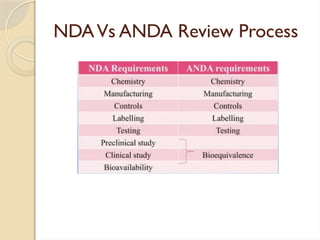
NDAVs ANDA Review Process
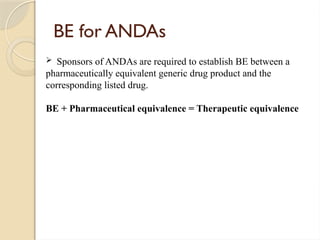
BE for ANDAs
 Sponsors of ANDAs are required to establish BE between a
pharmaceutically equivalent generic drug product and the
corresponding listed drug.
BE + Pharmaceutical equivalence = Therapeutic equivalence
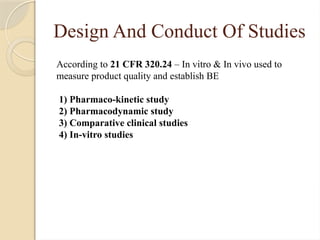
Design And Conduct Of Studies
According to 21 CFR 320.24 – In vitro & In vivo used to
measure product quality and establish BE
1) Pharmaco-kinetic study
2) Pharmacodynamic study
3) Comparative clinical studies
4) In-vitro studies
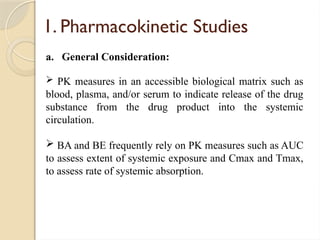
1. Pharmacokinetic Studies
a. General Consideration:
 PK measures in an accessible biological matrix such as
blood, plasma, and/or serum to indicate release of the drug
substance from the drug product into the systemic
circulation.
 BA and BE frequently rely on PK measures such as AUC
to assess extent of systemic exposure and Cmax and Tmax,
to assess rate of systemic absorption.
 The study should be designed in such a manner that the
formulation effect can be distinguished from other effects.
 The basic design of an in-vivo bioavailability study is
determined by the following:
a. What is the scientific question(s) to be answered.
b. The nature of the reference material and the dosage form
to be tested.
c. The availability of analytical methods.
b. Study design:
c. Pilot Study:
 A small number of subjects can be carried out before
proceeding with a full-scale BA or BE study.
 It is used to validate analytical methodology, assess PK
variability, determine sample size to achieve adequate power,
optimize sample collection time intervals.
d. Full-scale study:
Non replicate crossover study designs are recommended for BA
and BE studies of immediate-release and modified-release dosage
forms.
 Replicate crossover designs are used to allow estimation of
1. Within-subject variance for the reference product, or for
both the test and reference products, and
2. The subject by formulation interaction variance component.
e. Study Population:
BA or BE studies should be 18 years of age or older and capable
of giving informed consent.
 BA and BE studies should be conducted in healthy volunteers if
the product can be safely administered to this population.
f. Bioanalytical methodology:
Sponsors ensure that bioanalytical methods for BA and BE
studies be accurate, precise, specific, sensitive, and reproducible.
 A separate FDA guidance, bioanalytical method validation, is
available to assist sponsors in validating bioanalytical methods.
2. Pharmacodynamics Study
 Measurement of effect on a Patho-physiological pr me, after
administration of two different products.
PD studies are not recommended for orally administered drug
products when the drug is absorbed into systemic circulation and
a PK approach can be used to evaluate BA or BE.
 PK endpoints are preferred because they are generally the most
accurate, sensitive, and reproducible. However, in instances where
a PK endpoint is not possible, a well justified PD endpoint can be
used to demonstrate BA or BE.
3. Comparative clinical studies
 Clinical endpoints can be used in limited circumstances
 This study is necessary for both pharmacokinetic &
Pharmacodynamic properly measurable.
 For example, for orally administered drug products when the
measurement of the active ingredients in an accessible biological
fluid (PK approach) or PD approach is not possible because
these circumstances do not occur that's why use of this approach
is expected to be rare.
4. In vitro studies
 BA and BE can be evaluated using in vitro approval phases
approaches (e.g., Dissolution/drug-release testing) during the
preapproval and post approval phases.
 For example, orally drugs that are highly soluble and highly
permeable, and for Which the drug product is rapidly
dissolving, documentation of BE using an in vitro approach
may be appropriate based on the BCS system.
Documentation of Bioavailability and
Bioequivalence
With respect to the conduct of bioequivalence/bioavailability
studies following important documents must be maintained:
1. Clinical data:
a. All relevant documents as required to be maintained for
compliance with GCP guidelines
b. Details of the analytical method validation including the
following:
a) System suitability test
b) Linearity range
c) Lowest limit of quantitation
d) QC sample analysis
e) Stability sample analysis
f) Recovery experiment result
4. Raw data
5. All comments of the chief investigator regarding the
data of the study submitted for review.
6. A copy of the final report
STUDY REPORT
The report should include (as a minimum) the following
information:
a) Table of contents
b) Title of the study
c) Names and credentials of responsible investigators
d) Signatures of the principal and other responsible
investigators authenticating their respective sections of the
report e. Site of the study and facilities used.
e) Site of the study and facilities used
f) Names and batch numbers of the products compared
g) Names and batch numbers of the products compared
h) A signed declaration that this was identical to that intended
for marketing.
i) Results of assays and other pharmaceutical tests (e.g.,
Physical description, dimensions, mean weight, weight
uniformity, comparative dissolution)
j) Report of protocol deviations, violations
k) Demographic data of subjects
l) Names and addresses of subjects
m) Details of and justifications for protocol deviations
n) Details of how pharmacokinetic parameters were
calculated.
FACILITIES FOR CONDUCTING BA/BE
STUDIES
1. Legal identity:
The organization, conducting the bioequivalence /
bioavailability studies must be Legally constituted body with
appropriate statutory registrations.
2. Impartiality, confidentiality, independence and
integrity:
a) Have managerial staff with the authority and the resources
needed to discharge their duties.
b) Have arrangements to ensure that its personnel are free from
any commercial, financial and other pressures which might
adversely affect the quality of their work.
3. Organization and management:
1) An investigator who has the overall responsibility to
provide of the human subjects. The investigator(s) should
possess appropriate medical qualifications and relevant
experience for conducting pharmacokinetic studies.
2) The site should have identified adequately qualified and
trained personnel to perform the following functions:
i. clinical pharmacological unit (CPU) management.
ii. analytical laboratory management
iii. data handling and interpretation
iv. documentation and report preparation
4. Documented standard operating procedures:
A partial list of procedures for which documented standard
operating procedures should be available includes:
a. Maintenance of working standards (pure substances) and
respective documentation.
b. Withdrawal, storage and handling of biological samples.
c. Maintenance, calibration and validation of instruments.
d. Managing medical as well as non-medical emergency
situations
e. Handling of biological fluids
f. Managing laboratory hazards
g. Disposal procedures for clinical samples and laboratory
wastes
h. Documentation of clinical pharmacology unit
observations, volunteer data and analytical data
i. Obtaining informed consent from volunteers j
j. Volunteer screening and recruitment and management of
ineligible volunteers
MAINTENANCE OF RECORDS OF
BA/BE STUDIES
All records of in vivo or in vitro tests conducted on any
marketed batch of a drug product to assure that the product
meets a bioequivalence requirement shall be maintained by
the sponsor for at least 2 years after the expiration date
of the batch and submitted to CDSCO on request.
REFERENCES
1. https://dineshthakur.com/wp-content/uploads/2016/06/be-gu
idelines-draft-
ver10-march-16-05.Pdf
2. https://www.fda.gov/regulatory-information/search-fda-guid
ance-
documents/bioavailability-and-bioequivalence-studies-
submitted-ndas-or-inds- general-considerations
3. Mastan S, latha TB, ajay S. The basic regulatory
considerations and prospects for conducting
bioavailability/bioequivalence (BA/BE) studies–an
overview. Comp eff res. 2011 mar 22;1:1-25.
4. Chen ML, shah V, patnaik R, adams W, hussain A, conner
D, mehta M, malinowski H, lazor J, huang SM, hare D.
Bioavailability and bioequivalence: an FDA regulatory
overview. Pharmaceutical research. 2001 dec;18(12):1645-
50.
Regulatory Requirements for Bioequivalence study.pptx

Regulatory Requirements for Bioequivalence study.pptx

  • 1.
    Regulatory Requirements for Bioequivalence study PresentedBy: Khushi H.Gor M.Pharm Sem-1 (Regulatory Affairs) K.B. Institute of Pharmaceutical Education and Research
  • 2.
    CONTENTS  Introduction  Requirementsof BA/BE  Design And Conduct Of Studies  Documentation of Bioavailability and Bioequivalence  Facilities for conducting bioavailability and bioequivalence studies  Maintenance of record of BA/BE studies.
  • 3.
    Introduction  This studyprovides recommendations to sponsors and/or applicants planning to include bioavailability (BA) and bioequivalence (BE) information for drug products in Investigational new drug applications (INDS), New drug applications (NDAS), and NDA supplements.  The guidance should be helpful for applicants conducting BA and BE studies during the IND period for an NDA and also for applicants conducting BE studies during the post approval period.  FDA's regulations at 21 CFR 320.25 set forth guidelines for in vivo BA studies .
  • 4.
    Requirements of BA/BE For IND/NDAS: To establish equivalence between: 1) Early And Late Clinical Trial Formulations 2) Formulations Used In Clinical Studies And Stability Studies, If Different 3) Clinical Trial Formulations And The To-be-marketed Drug Product.  ANDA for a generic drug product  Change In Components, Composition, & Manufacturing Process  Change In Dosage Form (Capsules To Tablet)
  • 5.
  • 6.
    BE for ANDAs Sponsors of ANDAs are required to establish BE between a pharmaceutically equivalent generic drug product and the corresponding listed drug. BE + Pharmaceutical equivalence = Therapeutic equivalence
  • 7.
    Design And ConductOf Studies According to 21 CFR 320.24 – In vitro & In vivo used to measure product quality and establish BE 1) Pharmaco-kinetic study 2) Pharmacodynamic study 3) Comparative clinical studies 4) In-vitro studies
  • 8.
    1. Pharmacokinetic Studies a.General Consideration:  PK measures in an accessible biological matrix such as blood, plasma, and/or serum to indicate release of the drug substance from the drug product into the systemic circulation.  BA and BE frequently rely on PK measures such as AUC to assess extent of systemic exposure and Cmax and Tmax, to assess rate of systemic absorption.
  • 9.
     The studyshould be designed in such a manner that the formulation effect can be distinguished from other effects.  The basic design of an in-vivo bioavailability study is determined by the following: a. What is the scientific question(s) to be answered. b. The nature of the reference material and the dosage form to be tested. c. The availability of analytical methods. b. Study design: c. Pilot Study:  A small number of subjects can be carried out before proceeding with a full-scale BA or BE study.  It is used to validate analytical methodology, assess PK variability, determine sample size to achieve adequate power, optimize sample collection time intervals.
  • 10.
    d. Full-scale study: Nonreplicate crossover study designs are recommended for BA and BE studies of immediate-release and modified-release dosage forms.  Replicate crossover designs are used to allow estimation of 1. Within-subject variance for the reference product, or for both the test and reference products, and 2. The subject by formulation interaction variance component. e. Study Population: BA or BE studies should be 18 years of age or older and capable of giving informed consent.  BA and BE studies should be conducted in healthy volunteers if the product can be safely administered to this population. f. Bioanalytical methodology: Sponsors ensure that bioanalytical methods for BA and BE studies be accurate, precise, specific, sensitive, and reproducible.  A separate FDA guidance, bioanalytical method validation, is available to assist sponsors in validating bioanalytical methods.
  • 11.
    2. Pharmacodynamics Study Measurement of effect on a Patho-physiological pr me, after administration of two different products. PD studies are not recommended for orally administered drug products when the drug is absorbed into systemic circulation and a PK approach can be used to evaluate BA or BE.  PK endpoints are preferred because they are generally the most accurate, sensitive, and reproducible. However, in instances where a PK endpoint is not possible, a well justified PD endpoint can be used to demonstrate BA or BE.
  • 12.
    3. Comparative clinicalstudies  Clinical endpoints can be used in limited circumstances  This study is necessary for both pharmacokinetic & Pharmacodynamic properly measurable.  For example, for orally administered drug products when the measurement of the active ingredients in an accessible biological fluid (PK approach) or PD approach is not possible because these circumstances do not occur that's why use of this approach is expected to be rare.
  • 13.
    4. In vitrostudies  BA and BE can be evaluated using in vitro approval phases approaches (e.g., Dissolution/drug-release testing) during the preapproval and post approval phases.  For example, orally drugs that are highly soluble and highly permeable, and for Which the drug product is rapidly dissolving, documentation of BE using an in vitro approach may be appropriate based on the BCS system.
  • 14.
    Documentation of Bioavailabilityand Bioequivalence With respect to the conduct of bioequivalence/bioavailability studies following important documents must be maintained: 1. Clinical data: a. All relevant documents as required to be maintained for compliance with GCP guidelines b. Details of the analytical method validation including the following: a) System suitability test b) Linearity range c) Lowest limit of quantitation
  • 15.
    d) QC sampleanalysis e) Stability sample analysis f) Recovery experiment result 4. Raw data 5. All comments of the chief investigator regarding the data of the study submitted for review. 6. A copy of the final report
  • 16.
    STUDY REPORT The reportshould include (as a minimum) the following information: a) Table of contents b) Title of the study c) Names and credentials of responsible investigators d) Signatures of the principal and other responsible investigators authenticating their respective sections of the report e. Site of the study and facilities used. e) Site of the study and facilities used f) Names and batch numbers of the products compared g) Names and batch numbers of the products compared h) A signed declaration that this was identical to that intended for marketing. i) Results of assays and other pharmaceutical tests (e.g., Physical description, dimensions, mean weight, weight uniformity, comparative dissolution)
  • 17.
    j) Report ofprotocol deviations, violations k) Demographic data of subjects l) Names and addresses of subjects m) Details of and justifications for protocol deviations n) Details of how pharmacokinetic parameters were calculated.
  • 18.
    FACILITIES FOR CONDUCTINGBA/BE STUDIES 1. Legal identity: The organization, conducting the bioequivalence / bioavailability studies must be Legally constituted body with appropriate statutory registrations. 2. Impartiality, confidentiality, independence and integrity: a) Have managerial staff with the authority and the resources needed to discharge their duties. b) Have arrangements to ensure that its personnel are free from any commercial, financial and other pressures which might adversely affect the quality of their work.
  • 19.
    3. Organization andmanagement: 1) An investigator who has the overall responsibility to provide of the human subjects. The investigator(s) should possess appropriate medical qualifications and relevant experience for conducting pharmacokinetic studies. 2) The site should have identified adequately qualified and trained personnel to perform the following functions: i. clinical pharmacological unit (CPU) management. ii. analytical laboratory management iii. data handling and interpretation iv. documentation and report preparation
  • 20.
    4. Documented standardoperating procedures: A partial list of procedures for which documented standard operating procedures should be available includes: a. Maintenance of working standards (pure substances) and respective documentation. b. Withdrawal, storage and handling of biological samples. c. Maintenance, calibration and validation of instruments. d. Managing medical as well as non-medical emergency situations e. Handling of biological fluids f. Managing laboratory hazards g. Disposal procedures for clinical samples and laboratory wastes h. Documentation of clinical pharmacology unit observations, volunteer data and analytical data i. Obtaining informed consent from volunteers j j. Volunteer screening and recruitment and management of ineligible volunteers
  • 21.
    MAINTENANCE OF RECORDSOF BA/BE STUDIES All records of in vivo or in vitro tests conducted on any marketed batch of a drug product to assure that the product meets a bioequivalence requirement shall be maintained by the sponsor for at least 2 years after the expiration date of the batch and submitted to CDSCO on request.
  • 22.
    REFERENCES 1. https://dineshthakur.com/wp-content/uploads/2016/06/be-gu idelines-draft- ver10-march-16-05.Pdf 2. https://www.fda.gov/regulatory-information/search-fda-guid ance- documents/bioavailability-and-bioequivalence-studies- submitted-ndas-or-inds-general-considerations 3. Mastan S, latha TB, ajay S. The basic regulatory considerations and prospects for conducting bioavailability/bioequivalence (BA/BE) studies–an overview. Comp eff res. 2011 mar 22;1:1-25. 4. Chen ML, shah V, patnaik R, adams W, hussain A, conner D, mehta M, malinowski H, lazor J, huang SM, hare D. Bioavailability and bioequivalence: an FDA regulatory overview. Pharmaceutical research. 2001 dec;18(12):1645- 50.