1
BIOEQUIVALENCE
“The absence of a significant difference in the rate and extent to
which the active ingredient or active moiety in pharmaceutical
equivalents or pharmaceutical alternatives becomes available
at the site of drug action when administered at the same
molar dose under similar conditions in an appropriately
designed study.”
2
CDER U.S. Food & Drug Administration
What are Pharmaceutical Equivalents
Drug Products in identical dosage form that contains
the same active ingredients i.e. the same salt or ester
are of the same dosage form
use the same route of administration
identical in strength or concentration
same amount of active ingredient
meet the same or compendial or other applicable standards
They may differ in characteristics such as shape, scoring
configuration, release mechanisms, packaging, excipients
(including color, flavours, preservatives), expiration time and within
certain limits labeling.
3
What are Pharmaceutical alternatives
Drug product that contain the same therapeutic moiety but as
different salts, ester, or complexes. For e.g. Tetracycline
hydrochloride or tetracycline phosphate equivalent to 250 mg
tetracycline base.
Different dosage form and strength within a product line by a single
manufacturer for eg. an extended release and standard immediate
release.
Tablet and capsule containing the same active ingredient in the
same dosage strength.
4
Reasons for Bioequivalence Study
To prove that Generic Drug Products are
bioequivalent to innovators/marketed drug
product (Reference Listed Drugs).
Change in formulations i.e. from capsule to
tablets.
Change in any process or manufacturing site (In
few cases)
To determine the efficacy and safety from the
bioequivalence data.
5
APPROACHES TO DETERMINE BIOEQUIVALENCE
In vivo measurement of active moiety in biological fluid
 Plasma Drug Concentration
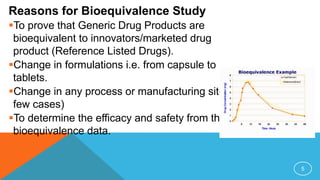
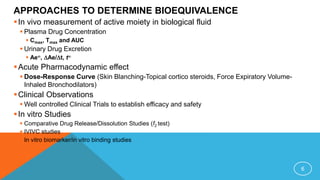
 Cmax, Tmax and AUC
 Urinary Drug Excretion
 Ae, Ae/t, t
Acute Pharmacodynamic effect
 Dose-Response Curve (Skin Blanching-Topical cortico steroids, Force Expiratory Volume-
Inhaled Bronchodilators)
Clinical Observations
 Well controlled Clinical Trials to establish efficacy and safety
In vitro Studies
 Comparative Drug Release/Dissolution Studies (f2 test)
 IVIVC studies
 In vitro biomarker/in vitro binding studies
6
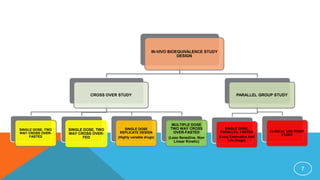
IN-VIVO BIOEQUIVALENCE STUDY
DESIGN
CROSS OVER STUDY
SINGLE DOSE, TWO
WAY CROSS OVER-
FASTED
SINGLE DOSE, TWO
WAY CROSS OVER-
FED
SINGLE DOSE
REPLICATE DESIGN
(Highly variable drugs)
MULTIPLE DOSE
TWO WAY CROSS
OVER-FASTED
(Less Sensitive, Non
Linear Kinetic)
PARALLEL GROUP STUDY
SINGLE DOSE,
PARALLEL, FASTED
(Long Elimination Half
Life Drugs)
CLINICAL END POINT
STUDY
7
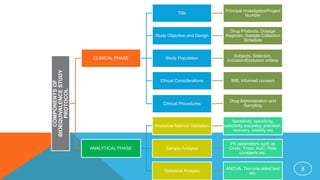
COMPONENTSOF
BIOEQUIVALENCESTUDY
PROTOCOL
CLINICAL PHASE
Title
Principal Invesitgator/Project
Number
Study Objective and Design
Drug Products, Dosage
Regimen, Sample Collection
Schedule
Study Population
Subjects, Selection,
Inclusion/Exclusion criteria
Ethical Considerations IRB, Informed consent
Clinical Procedures
Drug Administration and
Sampling
ANALYTICAL PHASE
Analytical Method Validation
Sensitivity, specificity,
selectivity accuracy, precision,
recovery, stability etc
Sample Analysis
PK parameters such as
Cmax, Tmax, AUC, Rate
constants etc.
Statistical Analysis
ANOVA, Two one sided test
etc.
8
IMPORTANT CONSIDERATION IN BIOEQUIVALENCE STUDY
 Objectives
 Why, Is there any requirement.
 Benefit-Risk and ethical consideration with regard to testing in humans
 Basic Guiding Principle “Do not do unnecessary human research”
 Nature of Reference Material and the dosage form tested
 Study type
 Usually Single Dose, Randomized Cross Over (Occasionally Parallel)
 Volunteers Selection
 Healthy based on clinical examination and lab test
 Male or Female (Usually Male)
 Age group 18-45 years
 Same Average weight group within 10% of the ideal body weight
 No other medication at least 1 weak prior to study
 Non alcoholic/non smokers
 Should sign informed consent containing detailed information about the study
including risks and right to withdraw at anytime
9
Sample size
 Depends on the variability in the PK parameters
 At least 12 (Ideally 24)
Sample Type
 Usually Blood, Plasma/serum
 Urine in some cases if required
Sample Collection schedule
 Test/Reference Dosage form with 250 ml of water from subjects in an
overnight fast condition
 First sample immediately before dose administration (Just before zero time).
 Fasting conditions till 2-4 hrs of the first dose
 At least 10 blood Samples (5-10 ml) upto 7th elimination half lives.
 Three samples from absorption phase, three from distribution, and four from
elimination phase
10
Sample Analysis
 Chromatographic (LC-UV, LC-PDA, LC-MS recommended)
 Validated method i.e. sensitivity, specificity, accuracy, precision and recovery
etc should be done prior to study.
 Method should be sensitive enough to analyze the drug in trace levels (usually
less than 100 ng/ml is required for analytical methods)
 Stability determination of the frozen storage of the study samples
Pharmacokinetic Analysis
 Non compartmental method
 Cmax, Tmax, AUC0-t and AUC0-
11
Statistical Analysis
 Analysis of Variance (ANOVA) explaining different sources of errors in the
calculated PK parameters such as
 Sequence effect (Order effect)
 Subject nested in sequence
 Period Effect (phase effect)
 Treatment Effect (Product Effect)
 Two one sided t test to test BE
 Calculation of 90% Confidence Interval for the ratio (or difference) of the average log-
transformed pharmacokinetic parameters for the test and reference products
 Log transformed Cmax and Tmax as these parameters are not normally distributed (Log
transformed values are normally distributed-log normal distribution)
 90% CI for the ratio of the average log transformed AUC and Cmax should fall within
the BE limit of 80-125%.
12
NEED TO REDUCE OUR RELIANCE ON IN VIVO BE STUDIES – BE THEME
FOR 21ST CENTURY
Ethical reasons
 21 CFR 320.25(a) “… no unnecessary human research should be done.”
 Science continues to provide new methods to identify and eliminate
unnecessary in vivo BE studies
Focus on prevention - “building quality into products” - “right first time”
Time and cost of drug development and review
13
BIOWAIVERS
Termed as In-vitro Bioequivalence Studies
Means in vivo bioavailability and/or bioequivalence studies may
be waived off
Instead of conducting expensive and time consuming in vivo
studies, an in vitro dissolution test could be adopted as the
surrogate basis for the decision as to whether the two
pharmaceutical products are equivalent.
14
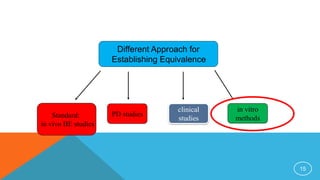
PD studies
clinical
studies
in vitro
methods
Different Approach for
Establishing Equivalence
Standard:
in vivo BE studies
15
HISTORICAL BACKGROUND IN THE DEVELOPMENT OF
DISSOLUTION AS A PROGNOSTIC TOOL FOR ORAL DRUG
ABSORPTION
 In 1985, Amidon and co-workers, using a Pseudoequilibrium Model where
solubility and dose were taken into account for the estimation of the absorption
potential (AP) of a drug.
 Quantitative version of the Absorption potential concept was published which
enabled the estimation of the fraction of dose absorbed as a function of AP
(Macheras and Symillides, 1989).
 Microscopic model publish in 1993 based on mass balance considerations
can be considered as a landmark in the history of oral drug absorption since it
revealed the three fundamental parameters, namely, dissolution, absorption
and dose numbers (Oh et al, 1993)
16
Amidon et al. in 1995 published a revolutionary paper in Pharmaceutical Research i.e. A
theoretical basis for a Biopharmaceutic drug classification—the
correlation of in-vitro drug product dissolution and in-vivo
bioavailability. Classifying drugs on the basis of BCS
Dressman et al in 1998 established correlations between in vitro
dissolution and in vivo absorption using artificial fluids, simulated
gastric and intestinal fluids both in fasted and fed conditions. (i.e.
BIO-RELEVENT Dissolution mediums).
FDA acknowledges Amidon et al 1995 BCS system with the guidance
documents. “FDA, 2000. Guidance for Industry,Waiver of In Vivo
Bioavailability and Bioequivalence Studies for Immediate Release
Solid Oral Dosage Forms based on a Biopharmaceutics Classification
System. FDA/CDER”.
17
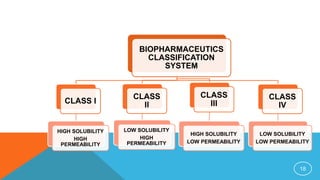
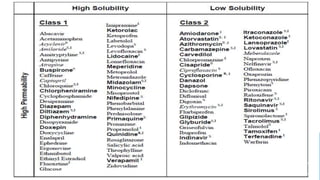
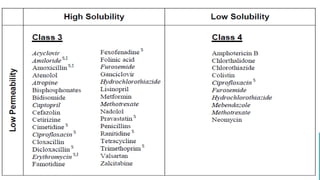
BIOPHARMACEUTICS
CLASSIFICATION
SYSTEM
CLASS I
HIGH SOLUBILITY
HIGH
PERMEABILITY
CLASS
II
LOW SOLUBILITY
HIGH
PERMEABILITY
CLASS
III
HIGH SOLUBILITY
LOW PERMEABILITY
CLASS
IV
LOW SOLUBILITY
LOW PERMEABILITY
18
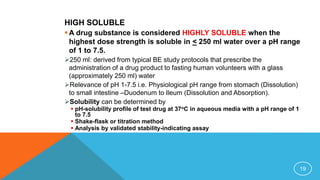
HIGH SOLUBLE
 A drug substance is considered HIGHLY SOLUBLE when the
highest dose strength is soluble in < 250 ml water over a pH range
of 1 to 7.5.
250 ml: derived from typical BE study protocols that prescribe the
administration of a drug product to fasting human volunteers with a glass
(approximately 250 ml) water
Relevance of pH 1-7.5 i.e. Physiological pH range from stomach (Dissolution)
to small intestine –Duodenum to Ileum (Dissolution and Absorption).
Solubility can be determined by
 pH-solubility profile of test drug at 37oC in aqueous media with a pH range of 1
to 7.5
 Shake-flask or titration method
 Analysis by validated stability-indicating assay
19
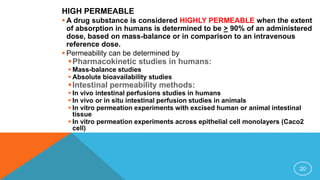
HIGH PERMEABLE
 A drug substance is considered HIGHLY PERMEABLE when the extent
of absorption in humans is determined to be > 90% of an administered
dose, based on mass-balance or in comparison to an intravenous
reference dose.
 Permeability can be determined by
Pharmacokinetic studies in humans:
 Mass-balance studies
 Absolute bioavailability studies
Intestinal permeability methods:
 In vivo intestinal perfusions studies in humans
 In vivo or in situ intestinal perfusion studies in animals
 In vitro permeation experiments with excised human or animal intestinal
tissue
 In vitro permeation experiments across epithelial cell monolayers (Caco2
cell)
20
21
22
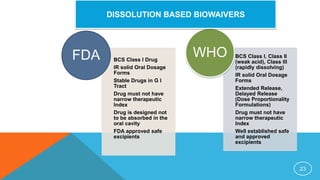
BCS Class I Drug
IR solid Oral Dosage
Forms
Stable Drugs in G I
Tract
Drug must not have
narrow therapeutic
Index
Drug is designed not
to be absorbed in the
oral cavity
FDA approved safe
excipients
FDA BCS Class I, Class II
(weak acid), Class III
(rapidly dissolving)
IR solid Oral Dosage
Forms
Extended Release,
Delayed Release
(Dose Proportionality
Formulations)
Drug must not have
narrow therapeutic
Index
Well established safe
and approved
excipients
WHO
23
DISSOLUTION BASED BIOWAIVERS
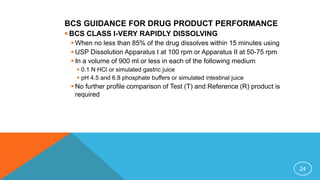
BCS GUIDANCE FOR DRUG PRODUCT PERFORMANCE
 BCS CLASS I-VERY RAPIDLY DISSOLVING
 When no less than 85% of the drug dissolves within 15 minutes using
 USP Dissolution Apparatus I at 100 rpm or Apparatus II at 50-75 rpm
 In a volume of 900 ml or less in each of the following medium
 0.1 N HCl or simulated gastric juice
 pH 4.5 and 6.8 phosphate buffers or simulated intestinal juice
 No further profile comparison of Test (T) and Reference (R) product is
required
24
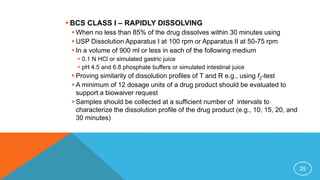
 BCS CLASS I – RAPIDLY DISSOLVING
 When no less than 85% of the drug dissolves within 30 minutes using
 USP Dissolution Apparatus I at 100 rpm or Apparatus II at 50-75 rpm
 In a volume of 900 ml or less in each of the following medium
 0.1 N HCl or simulated gastric juice
 pH 4.5 and 6.8 phosphate buffers or simulated intestinal juice
 Proving similarity of dissolution profiles of T and R e.g., using f2-test
 A minimum of 12 dosage units of a drug product should be evaluated to
support a biowaiver request
 Samples should be collected at a sufficient number of intervals to
characterize the dissolution profile of the drug product (e.g., 10, 15, 20, and
30 minutes)
25
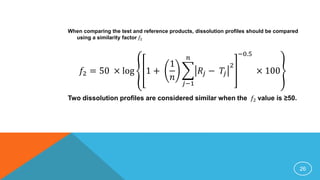
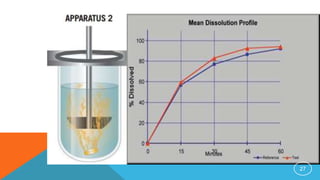
When comparing the test and reference products, dissolution profiles should be compared
using a similarity factor 𝑓2
𝑓2 = 50 × log 1 +
1
𝑛
𝑗−1
𝑛
𝑅𝑗 − 𝑇𝑗
2
−0.5
× 100
Two dissolution profiles are considered similar when the 𝑓2 value is ≥50.
26
27
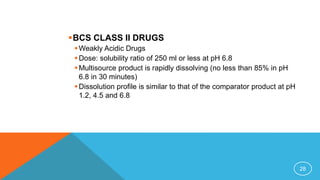
BCS CLASS II DRUGS
Weakly Acidic Drugs
Dose: solubility ratio of 250 ml or less at pH 6.8
Multisource product is rapidly dissolving (no less than 85% in pH
6.8 in 30 minutes)
Dissolution profile is similar to that of the comparator product at pH
1.2, 4.5 and 6.8
28
BCS CLASS III DRUGS
Multisource and comparator product are very rapidly dissolving (no
less than 85% in 15 minutes at pH 1.2, 4.5 and 6.8)
Note: FDA has not allowed Dissolution based biowaivers
for Class II and Class III (VERY CONSERVATIVE said by
WHO)
29
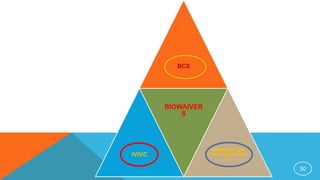
BCS
IVIVC
BIOWAIVER
S
COMPOSITION
PROPORTIONALI
TY
30
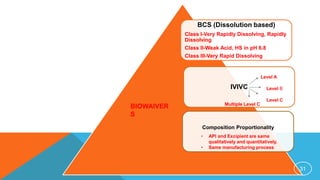
BCS (Dissolution based)
Class I-Very Rapidly Dissolving, Rapidly
Dissolving
Class II-Weak Acid, HS in pH 6.8
Class III-Very Rapid Dissolving
IVIVC
Composition Proportionality
BIOWAIVER
S
Level A
Level B
Level C
Multiple Level C
• API and Excipient are same
qualitatively and quantitatively.
• Same manufacturing process
31
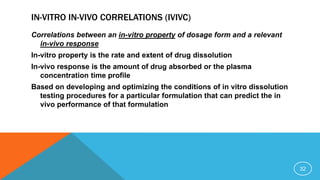
IN-VITRO IN-VIVO CORRELATIONS (IVIVC)
Correlations between an in-vitro property of dosage form and a relevant
in-vivo response
In-vitro property is the rate and extent of drug dissolution
In-vivo response is the amount of drug absorbed or the plasma
concentration time profile
Based on developing and optimizing the conditions of in vitro dissolution
testing procedures for a particular formulation that can predict the in
vivo performance of that formulation
32
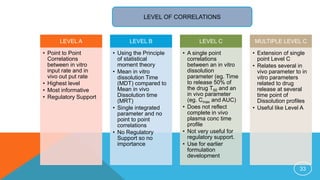
LEVEL A
• Point to Point
Correlations
between in vitro
input rate and in
vivo out put rate
• Highest level
• Most informative
• Regulatory Support
LEVEL B
• Using the Principle
of statistical
moment theory
• Mean in vitro
dissolution Time
(MDT) compared to
Mean in vivo
Dissolution time
(MRT)
• Single integrated
parameter and no
point to point
correlations
• No Regulatory
Support so no
importance
LEVEL C
• A single point
correlations
between an in vitro
dissolution
parameter (eg. Time
to release 50% of
the drug T50 and an
in vivo parameter
(eg. Cmax and AUC)
• Does not reflect
complete in vivo
plasma conc time
profile
• Not very useful for
regulatory support.
• Use for earlier
formulation
development
MULTIPLE LEVEL C
• Extension of single
point Level C
• Relates several in
vivo parameter to in
vitro parameters
related to drug
release at several
time point of
Dissolution profiles
• Useful like Level A
33
LEVEL OF CORRELATIONS
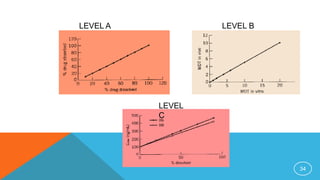
34
LEVEL A LEVEL B
LEVEL
C
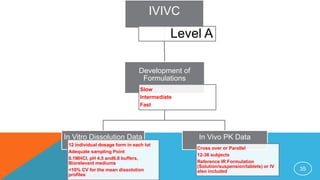
IVIVC
Level A
Development of
Formulations
Slow
Intermediate
Fast
In Vitro Dissolution Data
12 individual dosage form in each lot
Adequate sampling Point
0.1MHCl, pH 4.5 and6.8 buffers,
Biorelevant mediums
<10% CV for the mean dissolution
profiles
In Vivo PK Data
Cross over or Parallel
12-36 subjects
Reference IR Formulation
(Solution/suspension/tablets) or IV
also included 35
36
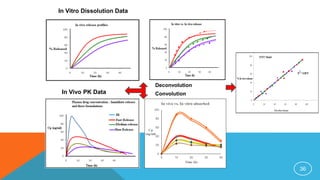
In Vitro Dissolution Data
In Vivo PK Data
0
20
40
60
80
100
0 10 20 30 40
Cp
(ng/ml)
Time (h)
In vivo vs. In vitro absorbed
Deconvolution
Convolution
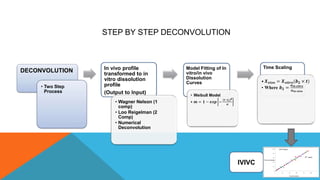
DECONVOLUTION
• Two Step
Process
In vivo profile
transformed to in
vitro dissolution
profile
(Output to Input)
• Wagner Nelson (1
comp)
• Loo Reigelman (2
Comp)
• Numerical
Deconvolution
Model Fitting of In
vitro/in vivo
Dissolution
Curves
• Weibull Model
• 𝒎 = 𝟏 − 𝒆𝒙𝒑 −
𝒕−𝒕 𝒊
𝜷
𝜶
Time Scaling
• 𝑿 𝒗𝒊𝒗𝒐 = 𝑿 𝒗𝒊𝒕𝒓𝒐(𝒃 𝟐 × 𝒕)
• Where 𝒃 𝟐 =
𝜶 𝒊𝒏 𝒗𝒊𝒕𝒓𝒐
𝜶 𝒊𝒏 𝒗𝒊𝒗𝒐
37
STEP BY STEP DECONVOLUTION
IVIVC
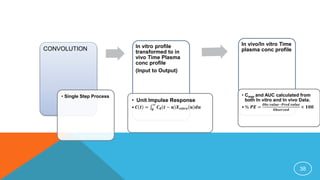
CONVOLUTION
• Single Step Process
In vitro profile
transformed to in
vivo Time Plasma
conc profile
(Input to Output)
• Unit Impulse Response
• 𝑪 𝒕 = 𝟎
∞
𝑪 𝜹 𝒕 − 𝒖 𝑿 𝒗𝒊𝒕𝒓𝒐 𝒖 𝒅𝒖
In vivo/In vitro Time
plasma conc profile
• Cmax and AUC calculated from
both In vitro and In vivo Data.
• % 𝑷𝑬 =
𝑶𝒃𝒔 𝒗𝒂𝒍𝒖𝒆−𝑷𝒓𝒆𝒅 𝒗𝒂𝒍𝒖𝒆
𝑶𝒃𝒔𝒆𝒓𝒗𝒆𝒅
× 𝟏𝟎𝟎
38
39
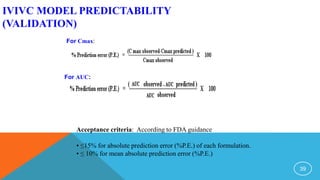
IVIVC MODEL PREDICTABILITY
(VALIDATION)
For Cmax:
For AUC:
Acceptance criteria: According to FDA guidance
• ≤15% for absolute prediction error (%P.E.) of each formulation.
• ≤ 10% for mean absolute prediction error (%P.E.)
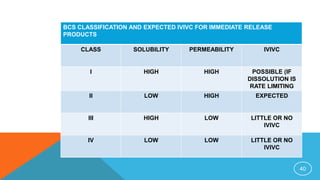
BCS CLASSIFICATION AND EXPECTED IVIVC FOR IMMEDIATE RELEASE
PRODUCTS
CLASS SOLUBILITY PERMEABILITY IVIVC
I HIGH HIGH POSSIBLE (IF
DISSOLUTION IS
RATE LIMITING
II LOW HIGH EXPECTED
III HIGH LOW LITTLE OR NO
IVIVC
IV LOW LOW LITTLE OR NO
IVIVC
40
SOFTWARES FOR BE, BIOWAIVERS AND IVIVC STUDIES
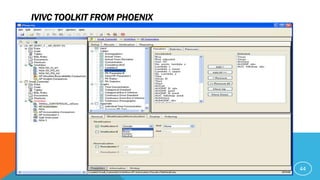
Phoenix Winnonlin (Certara)
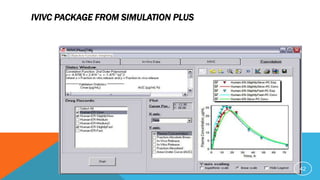
Gastro Plus, IVIVC Plus and DDD Plus (Simulation–Plus)
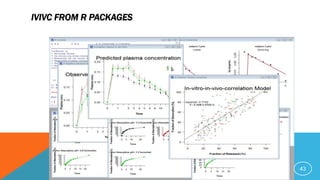
IVIVC for R
DD Solver (Excel Add in)
Equiv Test (Statcon)
Kinetica (Thomson)
41
IVIVC PACKAGE FROM SIMULATION PLUS
42
IVIVC FROM R PACKAGES
43
IVIVC TOOLKIT FROM PHOENIX
44
RESEARCH SCOPE AND BENEFITS
More than 400 manufacturing units involved in Generic Manufacturing
Bioequivalence required for many products
 Areas covered
 Pharmacokinetics
 Pharmacodynamics
 Chromatographic method development and validation
 Understanding Statistical Techniques
Dissolution based biowaivers, an alternative for in vivo BE can be performed within the regulatory framework
IVIVC, another alternative in which a surrogate dissolution medium can be developed
 Areas Covered
 Developing New Formulations
 Optimization Techniques
 Development and understanding of new and existing dissolution mediums
 Development and understanding of new and existing mathematical dissolution models
45
Proper use of these methods leads to
Safe
Cost effective
Less Time consuming
Optimized
Quality Product
46