VALIDATION AND
VERIFICATION OF MEDICAL
DEVICES
RAMD(MRA203T)
CE-II
Gargi Vaghela
22MPH803
Regulatory Aspects of Medical Devices
Contents:
 Introduction
 Verification
 Validation
 ISO 13485 in validation and verification
 Process Validation- IQ,OQ,PQ?
 FDA requirements for process validation
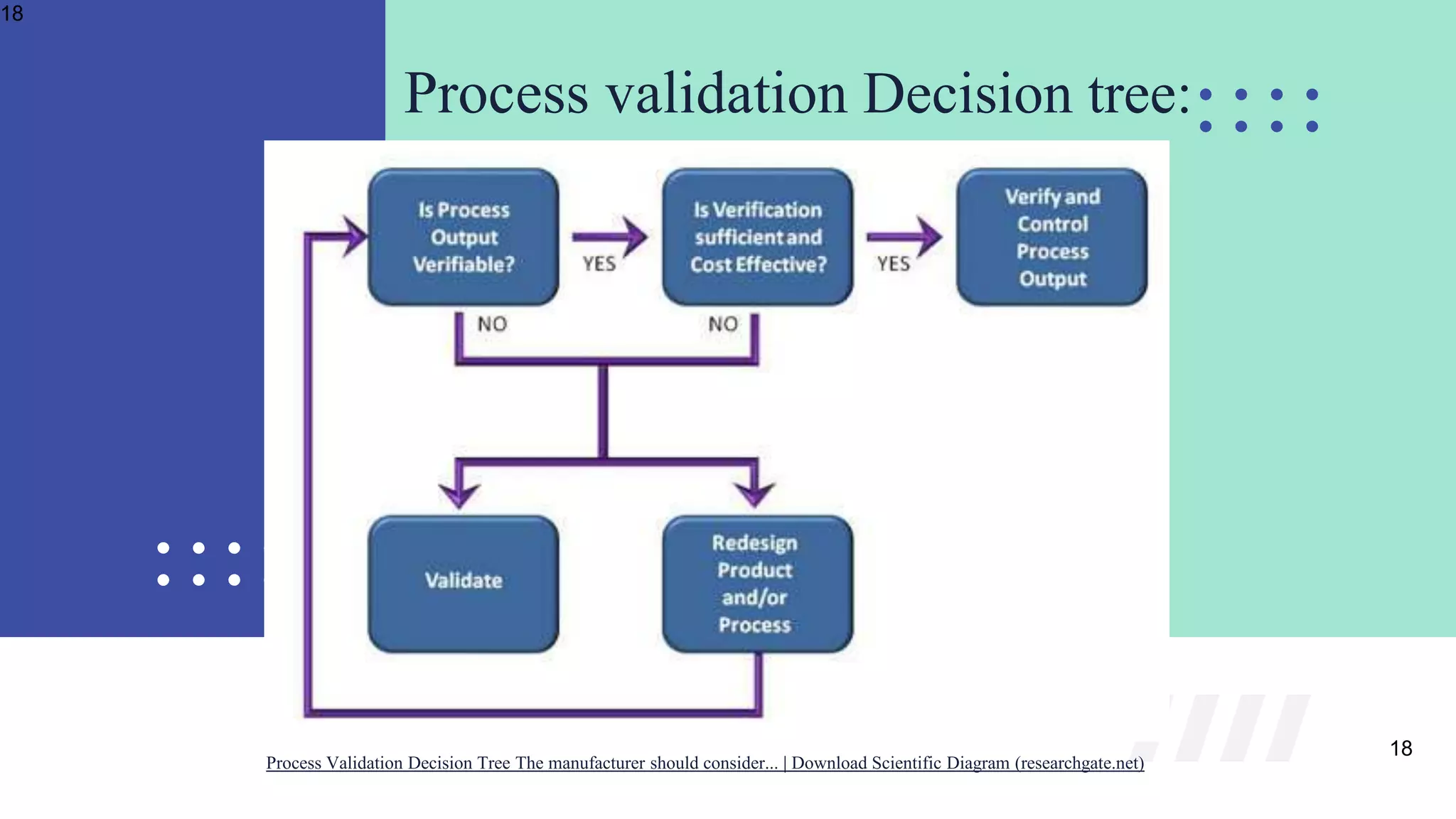
 Process validation Decision tree
 Process validation vs. process verification
 Latest advancement in validation and verification
 Advantages of validation and verification
2
Introduction
• Validation is the process of checking whether the software product is up to
the mark or in other words product has high level requirements.
• Validation reduces the risks of non-compliance with regulatory agencies. It
also can reduce compulsory in-process controls and testing.
• Validation is verifying and documenting with a high degree of assurance that
specific equipment will perform consistently according to predetermined
specifications.
• Verification is the process of checking that a software achieves its goal
without any bugs.
3
Introduction
● The methods of verification and validation (V+V) are wide-spread and used in
various branches.
● In general, verification means to check during the development phase of a
product if it complies with the specified requirements, whereas validation
checks if the intended use has been met and thus usability specifics are
fulfilled.
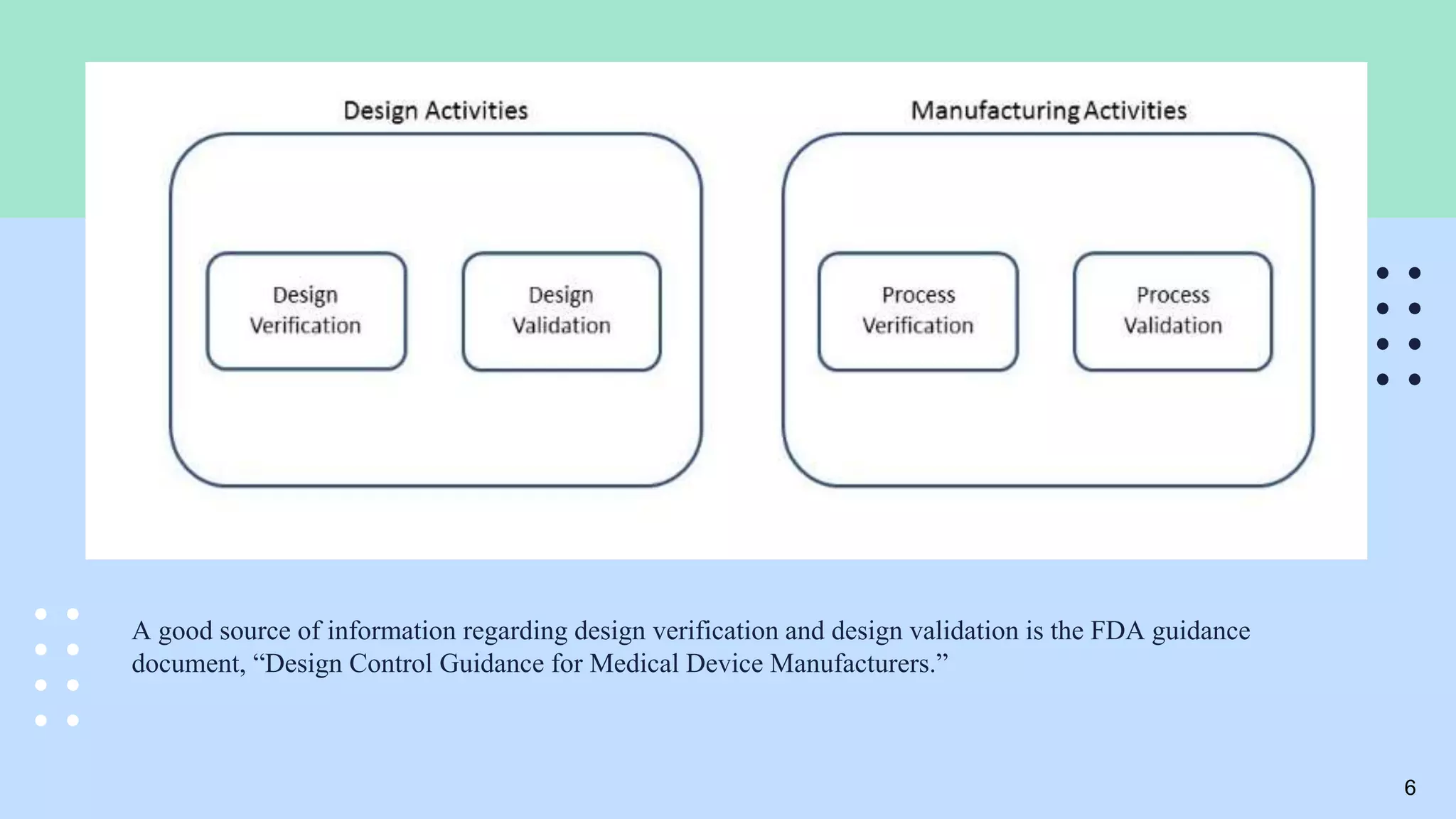
● For the medical device industry, the most common types of verification and
validation are as follows:
1. Design,
2. Process and
3. Software Verification and Validation. 4
https://www.cognidox.com/hubfs/Medical%20Device%20Development%20Design%20Control-1%20(1).webp
DHF is a collection of
documents that
describe the design and
development activities
of a medical device.
Its purpose is to
demonstrate that the
device was developed
using the design
control process needed
to meet FDA
requirements.
5
A good source of information regarding design verification and design validation is the FDA guidance
document, “Design Control Guidance for Medical Device Manufacturers.”
6
Verification:
• Verification means confirmation by examination and provision of objective
evidence that specified requirements have been fulfilled.
• Design Verification shall confirm that the design output meets the design
input requirements. For this purpose, it is necessary to develop a Design
Verification plan. The best point to develop it is when defining the Design
Inputs.
• This entire process requires a careful analysis of materials, processes,
requirements, and test capabilities to determine what exactly can be verified
and what cannot be verified.
• Verification can use tools such as regular examination, tests and inspections.
7
Validation
● Validation means confirmation by examination and provision of objective
evidence that the particular requirements for a specific intended use can be
consistently fulfilled.
1. Process Validation :
That means to establish by objective evidence that a process consistently
produces a result or product meeting its predetermined specifications.
It further sets the optimal range and determines the process control requirements
to ensure long-term success.
8
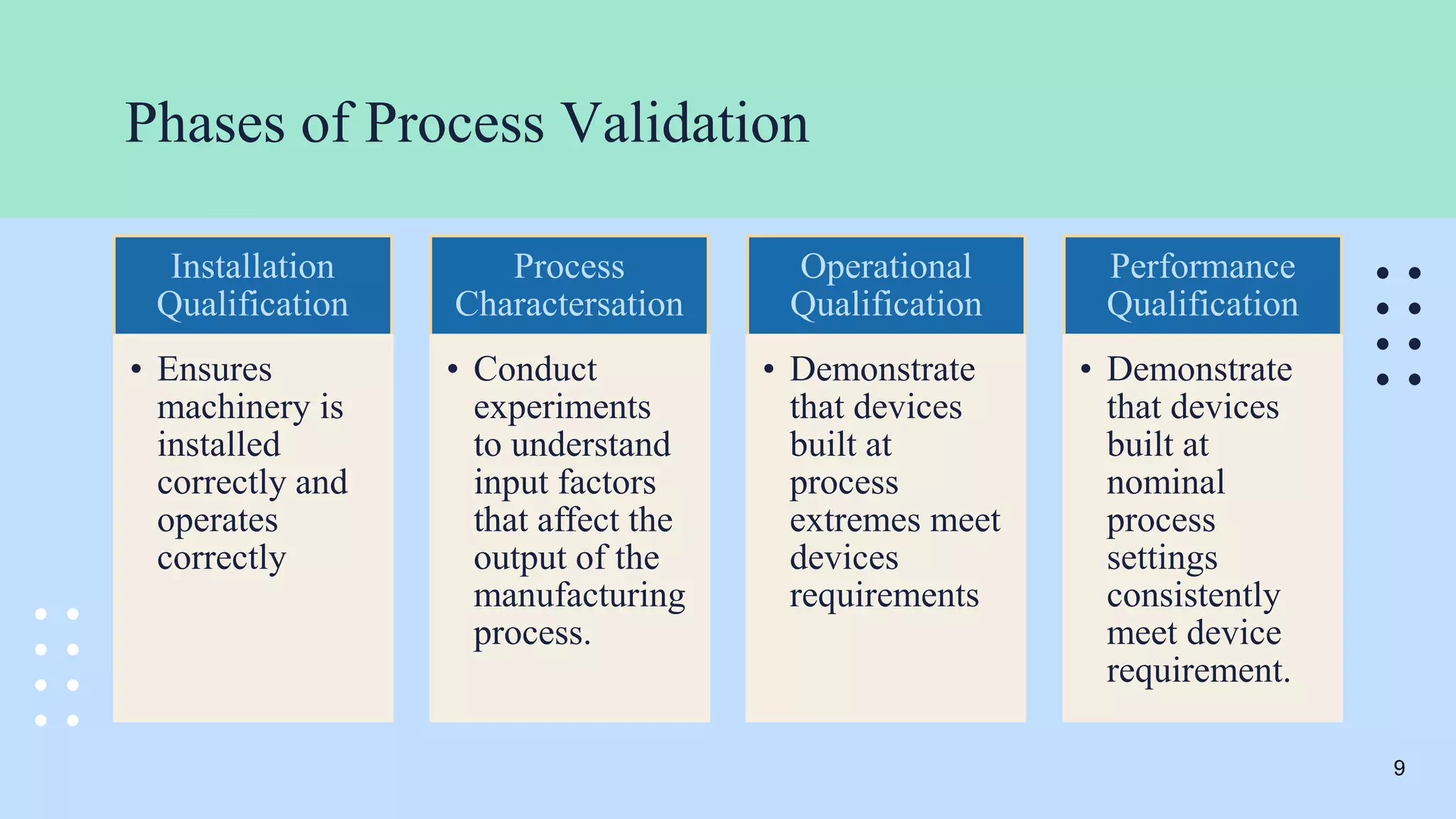
Installation
Qualification
• Ensures
machinery is
installed
correctly and
operates
correctly
Process
Charactersation
• Conduct
experiments
to understand
input factors
that affect the
output of the
manufacturing
process.
Operational
Qualification
• Demonstrate
that devices
built at
process
extremes meet
devices
requirements
Performance
Qualification
• Demonstrate
that devices
built at
nominal
process
settings
consistently
meet device
requirement.
Phases of Process Validation
9
What is IQ, OQ, PQ?
These terms are famous on the Medical Device Industry as this is mainly the process used
for medical device validations.
1. Installation Qualification (IQ): establishing by objective evidence that all key
aspects of the process equipment and ancillary system installation adhere to the
manufacturer’s approved specification and that the recommendation of the supplier of
the equipment are suitably considered.
2. Operational Qualification (OQ): establishing by objective evidence process control
limits and action levels which result in product that meets all predetermined
requirements.
3. Performance Qualification (PQ): Establishing by objective evidence that the
process, under anticipated conditions, consistently produces a product
which meets all predetermined requirements. 10
Validation
2. Design Validation answers the simple question if the right device was
designed. It is supposed to prove by using objective evidence that the medical
device meets the user needs and the intended use.
● Certain aspects must be included in a Design Validation, such as initial
production units, software validation, usability validation and clinical
evaluation and the use under specific environmental conditions.
● It is important to involve the end user through the element of clinical
evaluation and have the device tested under simulated or actual use.
● Therefore, the element of testing is crucial in the process of Design Validation,
for tests demonstrate that the medical device functions as expected and meets
the user needs.
11
Validation
3. Software Validation: The process of evaluating software during or at the end
of the development process to determine whether it satisfies specified
requirements.
● The main purpose of software validation is to ensure that the software meets
the pre-defined and specified business requirements as well as the end
users/customers' demands and expectations.
● Software Validation confirms that software specifications conform to user
needs and the intended use. It is part of the Design Validation of a finished
device.
12
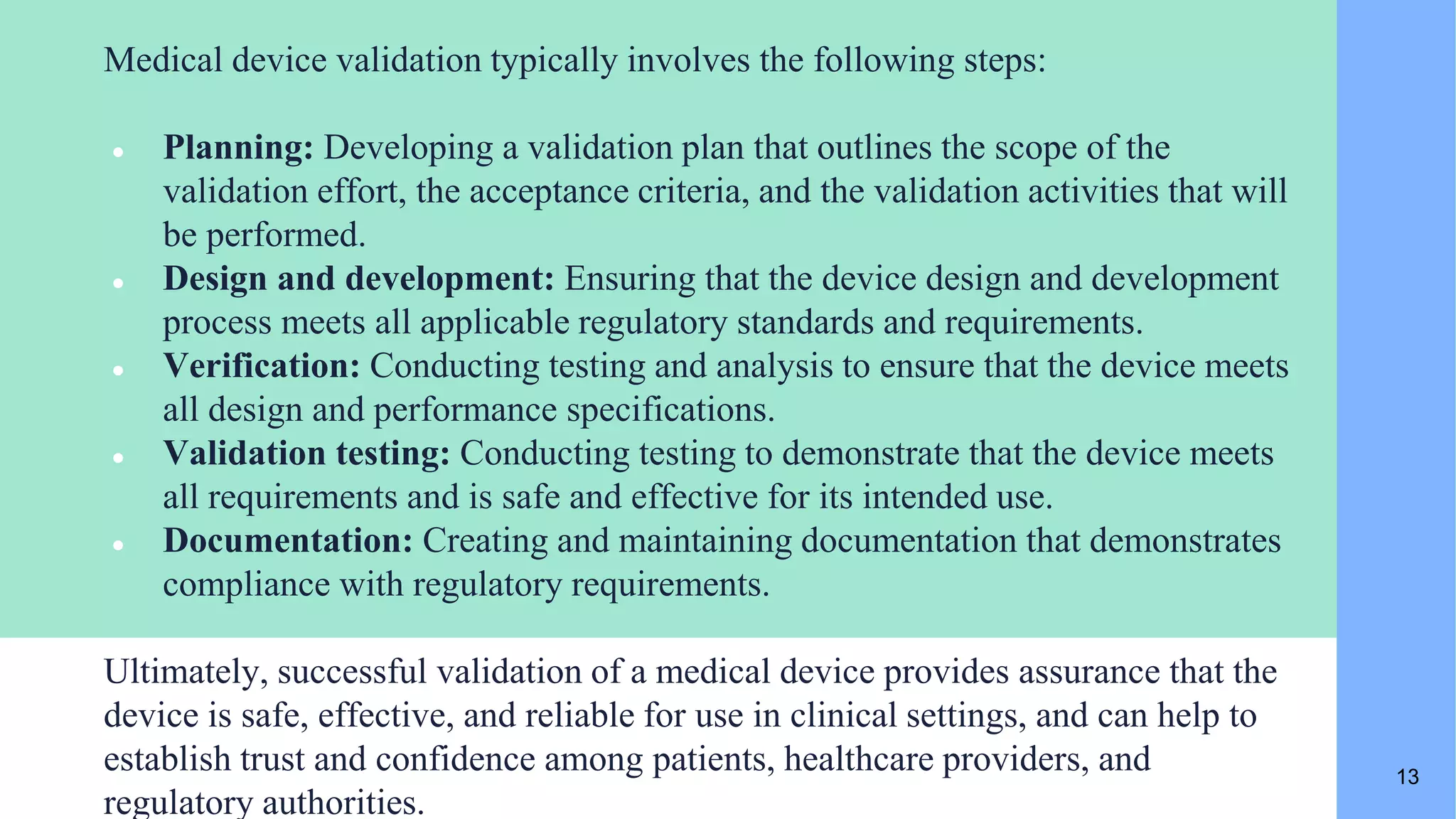
Medical device validation typically involves the following steps:
● Planning: Developing a validation plan that outlines the scope of the
validation effort, the acceptance criteria, and the validation activities that will
be performed.
● Design and development: Ensuring that the device design and development
process meets all applicable regulatory standards and requirements.
● Verification: Conducting testing and analysis to ensure that the device meets
all design and performance specifications.
● Validation testing: Conducting testing to demonstrate that the device meets
all requirements and is safe and effective for its intended use.
● Documentation: Creating and maintaining documentation that demonstrates
compliance with regulatory requirements.
Ultimately, successful validation of a medical device provides assurance that the
device is safe, effective, and reliable for use in clinical settings, and can help to
establish trust and confidence among patients, healthcare providers, and
regulatory authorities.
13
Standards
In the United States, Title 21 of the Code of Federal Regulations (CFR) contains a
section for the design, manufacture and distribution of medical devices (Title 21,
Part 820). Within part 820 is subpart 75 (21CFR820.75), which specifically
addresses process validation requirements.
For medical device manufacturers who follow to the requirements of the
International Standards Organization (ISO), the corresponding requirements for
process validation are found in ISO 13485, Section 7.5.6.
Both 21CFR820 and ISO13485 contain requirements for design verification and
design validation, as well as for process verification and process validation
14
The ISO 13485 gives regulations on the Design and
Development Verification and Validation as well as Process
Validation.
It should be performed according to planned specifications in
order to ensure that the product will meet the requirements and
on the other hand the specified application or the intended use.
Process Validation must be conducted before production starts
and Design Verification and Validation must be completed
before delivering the product. All parts of the processes must
be documented.
ISO 13485 in Validation
and Verification:
15
FDA requirements for process validation:
● Where the results of a process cannot be fully verified by subsequent
inspection and test, the process shall be validated with a high degree of
assurance and approved according to established procedures.
21 CFR 820.75 (a)
● The validation activities and results, including the date and signature of the
individual(s) approving the validation and where appropriate the major
equipment validated, shall be documented.
21 CFR 820.75 (a)
● Each manufacturer shall establish and maintain procedures for monitoring and
control of process parameters for validated processes to ensure that the
specified requirements continue to be met.
21 CFR 820.75(b)
16
● Each manufacturer shall ensure that validated processes are performed by
qualified individual(s).
21 CFR 820.75(b)(1)
● For validated processes, the monitoring and control methods and data, the date
performed, and, where appropriate, the individual(s) performing the process or
the major equipment used shall be documented.
● Revalidation: When changes or process deviations occur, the manufacturer
shall review and evaluate the process and perform revalidation where
appropriate. These activities shall be documented.
21 CFR 820.75(c)
17
Process validation Decision tree:
18
Process Validation Decision Tree The manufacturer should consider... | Download Scientific Diagram (researchgate.net)
18
Latest advancement in validation and
verification:
● V&V activities are more standardized than in the past,
which has streamlined overall manufacturing process and
the approval process.
● V&V is further enhanced by automated testing and
powerful diagnostic and data collection tools.
● Medical-device companies typically follow a formal
development process defined by deliverables at each step.
● Every specification needs evidence of verification and/or
validation. So do risk control measures. 19
Advantages of Validation and Verification:
The benefits of effective verification and validation activities in the medical
device domain include
● increased usability and reliability,
● decreased failure rate and recalls and
● reduced risks to patients and users.
● Assures the fluency of production
● Assures that the product is continuously according to the marketing
authorization
● Decreases the risk of the manufacturing problems
20
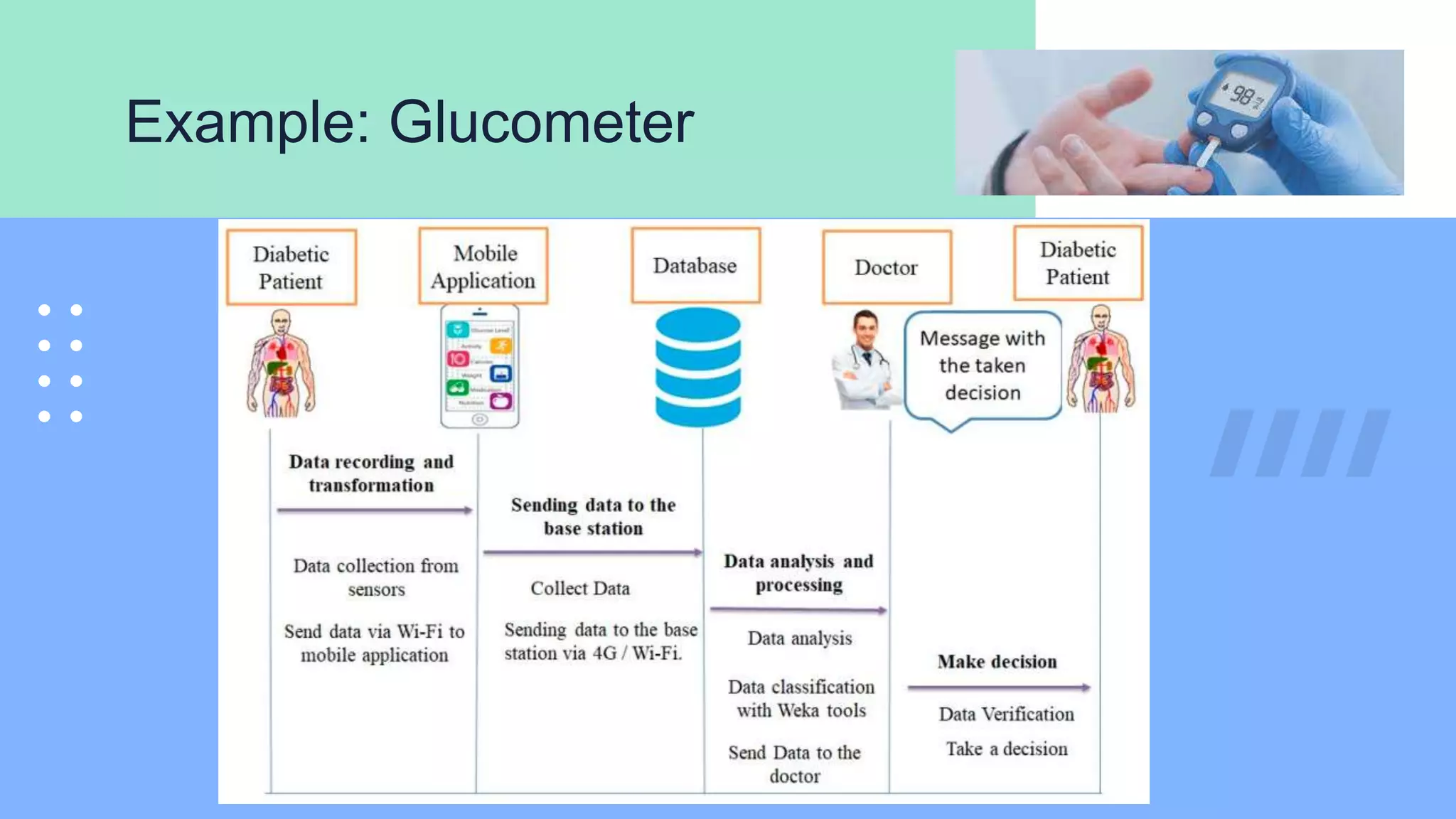
Example: Glucometer
References :
1. download (fda.gov) (Accessed on 23/04/23)
2. Medical Device Validation: What You Need to Know and Why It's Important | RAPS
(Accessed on 23/04/23)
3. Validation and Verification for Medical Devices – ASME (Accessed on 23/04/23)
4. Process Validation Decision Tree The manufacturer should consider... | Download Scientific
Diagram (researchgate.net) (Accessed on 23/04/23)
21
Thank you!
23

validation and verification of medical device.pptx

  • 1.
    VALIDATION AND VERIFICATION OFMEDICAL DEVICES RAMD(MRA203T) CE-II Gargi Vaghela 22MPH803 Regulatory Aspects of Medical Devices
  • 2.
    Contents:  Introduction  Verification Validation  ISO 13485 in validation and verification  Process Validation- IQ,OQ,PQ?  FDA requirements for process validation  Process validation Decision tree  Process validation vs. process verification  Latest advancement in validation and verification  Advantages of validation and verification 2
  • 3.
    Introduction • Validation isthe process of checking whether the software product is up to the mark or in other words product has high level requirements. • Validation reduces the risks of non-compliance with regulatory agencies. It also can reduce compulsory in-process controls and testing. • Validation is verifying and documenting with a high degree of assurance that specific equipment will perform consistently according to predetermined specifications. • Verification is the process of checking that a software achieves its goal without any bugs. 3
  • 4.
    Introduction ● The methodsof verification and validation (V+V) are wide-spread and used in various branches. ● In general, verification means to check during the development phase of a product if it complies with the specified requirements, whereas validation checks if the intended use has been met and thus usability specifics are fulfilled. ● For the medical device industry, the most common types of verification and validation are as follows: 1. Design, 2. Process and 3. Software Verification and Validation. 4
  • 5.
    https://www.cognidox.com/hubfs/Medical%20Device%20Development%20Design%20Control-1%20(1).webp DHF is acollection of documents that describe the design and development activities of a medical device. Its purpose is to demonstrate that the device was developed using the design control process needed to meet FDA requirements. 5
  • 6.
    A good sourceof information regarding design verification and design validation is the FDA guidance document, “Design Control Guidance for Medical Device Manufacturers.” 6
  • 7.
    Verification: • Verification meansconfirmation by examination and provision of objective evidence that specified requirements have been fulfilled. • Design Verification shall confirm that the design output meets the design input requirements. For this purpose, it is necessary to develop a Design Verification plan. The best point to develop it is when defining the Design Inputs. • This entire process requires a careful analysis of materials, processes, requirements, and test capabilities to determine what exactly can be verified and what cannot be verified. • Verification can use tools such as regular examination, tests and inspections. 7
  • 8.
    Validation ● Validation meansconfirmation by examination and provision of objective evidence that the particular requirements for a specific intended use can be consistently fulfilled. 1. Process Validation : That means to establish by objective evidence that a process consistently produces a result or product meeting its predetermined specifications. It further sets the optimal range and determines the process control requirements to ensure long-term success. 8
  • 9.
    Installation Qualification • Ensures machinery is installed correctlyand operates correctly Process Charactersation • Conduct experiments to understand input factors that affect the output of the manufacturing process. Operational Qualification • Demonstrate that devices built at process extremes meet devices requirements Performance Qualification • Demonstrate that devices built at nominal process settings consistently meet device requirement. Phases of Process Validation 9
  • 10.
    What is IQ,OQ, PQ? These terms are famous on the Medical Device Industry as this is mainly the process used for medical device validations. 1. Installation Qualification (IQ): establishing by objective evidence that all key aspects of the process equipment and ancillary system installation adhere to the manufacturer’s approved specification and that the recommendation of the supplier of the equipment are suitably considered. 2. Operational Qualification (OQ): establishing by objective evidence process control limits and action levels which result in product that meets all predetermined requirements. 3. Performance Qualification (PQ): Establishing by objective evidence that the process, under anticipated conditions, consistently produces a product which meets all predetermined requirements. 10
  • 11.
    Validation 2. Design Validationanswers the simple question if the right device was designed. It is supposed to prove by using objective evidence that the medical device meets the user needs and the intended use. ● Certain aspects must be included in a Design Validation, such as initial production units, software validation, usability validation and clinical evaluation and the use under specific environmental conditions. ● It is important to involve the end user through the element of clinical evaluation and have the device tested under simulated or actual use. ● Therefore, the element of testing is crucial in the process of Design Validation, for tests demonstrate that the medical device functions as expected and meets the user needs. 11
  • 12.
    Validation 3. Software Validation:The process of evaluating software during or at the end of the development process to determine whether it satisfies specified requirements. ● The main purpose of software validation is to ensure that the software meets the pre-defined and specified business requirements as well as the end users/customers' demands and expectations. ● Software Validation confirms that software specifications conform to user needs and the intended use. It is part of the Design Validation of a finished device. 12
  • 13.
    Medical device validationtypically involves the following steps: ● Planning: Developing a validation plan that outlines the scope of the validation effort, the acceptance criteria, and the validation activities that will be performed. ● Design and development: Ensuring that the device design and development process meets all applicable regulatory standards and requirements. ● Verification: Conducting testing and analysis to ensure that the device meets all design and performance specifications. ● Validation testing: Conducting testing to demonstrate that the device meets all requirements and is safe and effective for its intended use. ● Documentation: Creating and maintaining documentation that demonstrates compliance with regulatory requirements. Ultimately, successful validation of a medical device provides assurance that the device is safe, effective, and reliable for use in clinical settings, and can help to establish trust and confidence among patients, healthcare providers, and regulatory authorities. 13
  • 14.
    Standards In the UnitedStates, Title 21 of the Code of Federal Regulations (CFR) contains a section for the design, manufacture and distribution of medical devices (Title 21, Part 820). Within part 820 is subpart 75 (21CFR820.75), which specifically addresses process validation requirements. For medical device manufacturers who follow to the requirements of the International Standards Organization (ISO), the corresponding requirements for process validation are found in ISO 13485, Section 7.5.6. Both 21CFR820 and ISO13485 contain requirements for design verification and design validation, as well as for process verification and process validation 14
  • 15.
    The ISO 13485gives regulations on the Design and Development Verification and Validation as well as Process Validation. It should be performed according to planned specifications in order to ensure that the product will meet the requirements and on the other hand the specified application or the intended use. Process Validation must be conducted before production starts and Design Verification and Validation must be completed before delivering the product. All parts of the processes must be documented. ISO 13485 in Validation and Verification: 15
  • 16.
    FDA requirements forprocess validation: ● Where the results of a process cannot be fully verified by subsequent inspection and test, the process shall be validated with a high degree of assurance and approved according to established procedures. 21 CFR 820.75 (a) ● The validation activities and results, including the date and signature of the individual(s) approving the validation and where appropriate the major equipment validated, shall be documented. 21 CFR 820.75 (a) ● Each manufacturer shall establish and maintain procedures for monitoring and control of process parameters for validated processes to ensure that the specified requirements continue to be met. 21 CFR 820.75(b) 16
  • 17.
    ● Each manufacturershall ensure that validated processes are performed by qualified individual(s). 21 CFR 820.75(b)(1) ● For validated processes, the monitoring and control methods and data, the date performed, and, where appropriate, the individual(s) performing the process or the major equipment used shall be documented. ● Revalidation: When changes or process deviations occur, the manufacturer shall review and evaluate the process and perform revalidation where appropriate. These activities shall be documented. 21 CFR 820.75(c) 17
  • 18.
    Process validation Decisiontree: 18 Process Validation Decision Tree The manufacturer should consider... | Download Scientific Diagram (researchgate.net) 18
  • 19.
    Latest advancement invalidation and verification: ● V&V activities are more standardized than in the past, which has streamlined overall manufacturing process and the approval process. ● V&V is further enhanced by automated testing and powerful diagnostic and data collection tools. ● Medical-device companies typically follow a formal development process defined by deliverables at each step. ● Every specification needs evidence of verification and/or validation. So do risk control measures. 19
  • 20.
    Advantages of Validationand Verification: The benefits of effective verification and validation activities in the medical device domain include ● increased usability and reliability, ● decreased failure rate and recalls and ● reduced risks to patients and users. ● Assures the fluency of production ● Assures that the product is continuously according to the marketing authorization ● Decreases the risk of the manufacturing problems 20
  • 21.
  • 22.
    References : 1. download(fda.gov) (Accessed on 23/04/23) 2. Medical Device Validation: What You Need to Know and Why It's Important | RAPS (Accessed on 23/04/23) 3. Validation and Verification for Medical Devices – ASME (Accessed on 23/04/23) 4. Process Validation Decision Tree The manufacturer should consider... | Download Scientific Diagram (researchgate.net) (Accessed on 23/04/23) 21
  • 23.