
BIOEQUIVALENCE STUDIES
Prepared By,
Sujitha Mary
II Sem M.Pharm
St Joseph College Of Pharmacy
content2
 BIOEQUIVALENCE STUDIES
 BIOEQUIVALENCE PROTOCOL
 DESIGN
 EVALUATION OF THE DATA
 STUDY SUBMISSION AND DRUG REVIEW
PROCESS
 CONCLUSION
 REFERENCE
1.BIOEQUIVALENCE STUDIES
3
o To compare the bioavailability of the generic drug
product to the brand-name product.
o Bioequivalence may be defined as the
bioavailability of the generic drug is compared
with the measured parameter of from that of the
reference drug hen administered at the same molar
dose of active moiety either in single or multiple
doses.
.
4
o Chemical equivalence indicates that two or more
dosage forms contain the labelled quantities of drug
o Therapeutic equivalence implies that one
structurally different chemical can yield the same
clinical result as another chemical
o Pharmaceutical equivalents: Drug products in
identical dosage forms that contain same active
ingredient(s),the same salt or ester, are of the same
dosage form, use the same route of administration,
and are identical in strength or concentration.
Necessity to Establish Bioequivalence
5
o Marketed drug products do not give comparable
therapeutic effects.
o Active drug absorbed in particular segment of the GI
tract .
o Absorption is less than 50%.
o Rapid first-pass metabolism.
o Drug is subject to dose-dependent kinetics.
o Drug is rapidly metabolized or excreted.
o Drug requires special coatings such as enteric
coating.
2. BIOEQUIVALENCE PROTOCOL
I. Title
A Principal investigator (study director)
B. Project/protocol number and date
II. Study objective
III. Study design
A. Design
B. Drug products
1. Test product(s)
2. Reference product
C. Dosage regimen
D. Sample collection schedule
E. Housing/confinement
F. Fasting/meals schedule
G. Analytical methods
IV. Study population
A. Subjects
B. Subject selection
1. Medical history
2. Physical examination
3. Laboratory tests
.
6
.
7 C. Inclusion/exclusion criteria
1. Inclusion criteria
2. Exclusion criteriaD. Restrictions/prohibitions
V. Clinical procedures
A.Dosage and drug administration
B.Biological sampling schedule and handling procedures
C. Activity of subjects
VI. Ethical considerations
A. Basic principles
B. Institutional review board
C. Informed consent
D. Indications for subject withdrawal
E. Adverse reactions and emergency procedures
VII. Facilities
VIII. Data analysis
A. Analytical validation procedure
B. Statistical treatment of data
VII. Drug accountability
VIII. Appendix
1.TITLE
8
o Name of the principle investigator, other person responsible
for conducting the study.
o Name of the laboratory and clinical pharmacology where
the study will be conduct.
o Complete official address of the premises of the lab and
contact number of the person in charge of the study, with
time for contact
o Name of the sponsor and other person responsible for
monitoring the study should be mentioned along with
complete official as well as residential addresses and phone
number with contact times
2. Study Objective
9
 : The objective for a bioequivalence study is that
the drug bio availability from test and reference
products are not statically different when
administered to patients are subjects at same molar
dose under similar experimental conditions
3.Study design
10
A. Fasting study
o Done for immediate-release and modified-release oral dosage
forms.
o Male and female subjects may be used.
o Blood sampling is done at appropriate intervals to obtain plasma
drug concentration—time profile.
o Subjects should be in fasting condition—at least 10 hrs. before
drug administration and 4 hrs. after administration.
.
11
B. Food Intervention Study
o Studies are conducted after high-fat and high-calorie meal.
o Subjects should be in fasting condition at least 10 hrs. before drug
administration.
o Meal is given 30 minutes before dosing.
o No food given for at least 4 hrs. after administration.
o Done for modified-release dosage forms.
o And for immediate-release forms if bioavailability is affected by food
(e.g.. Ibuprofen, naproxen).
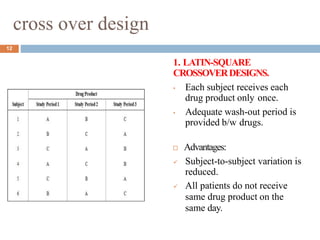
cross over design
.
1. LATIN-SQUARE
CROSSOVERDESIGNS.
• Each subject receives each
drug product only once.
• Adequate wash-out period is
provided b/w drugs.
 Advantages:
 Subject-to-subject variation is
reduced.
 All patients do not receive
same drug product on the
same day.
12
.
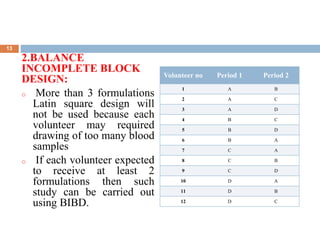
2.BALANCE
INCOMPLETE BLOCK
DESIGN:
o More than 3 formulations
Latin square design will
not be used because each
volunteer may required
drawing of too many blood
samples
o If each volunteer expected
to receive at least 2
formulations then such
study can be carried out
using BIBD.
Volunteer no Period 1 Period 2
1 A B
2 A C
3 A D
4 B C
5 B D
6 B A
7 C A
8 C B
9 C D
10 D A
11 D B
12 D C
13
.
14
SUBJECT
PERIOD
1 2
1 A B
2 B A
3 A B
4 B A
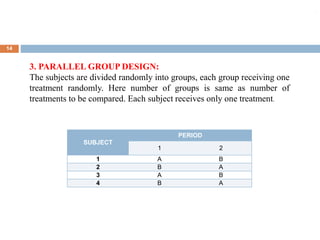
3. PARALLEL GROUP DESIGN:
The subjects are divided randomly into groups, each group receiving one
treatment randomly. Here number of groups is same as number of
treatments to be compared. Each subject receives only one treatment.
.
15
SEQUENCE
PERIOD
1 2 3 4
1 T R T R
2 R T R T
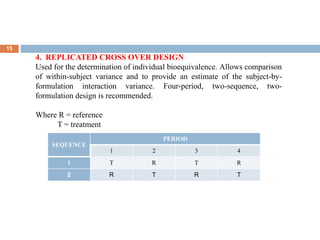
4. REPLICATED CROSS OVER DESIGN
Used for the determination of individual bioequivalence. Allows comparison
of within-subject variance and to provide an estimate of the subject-by-
formulation interaction variance. Four-period, two-sequence, two-
formulation design is recommended.
Where R = reference
T = treatment
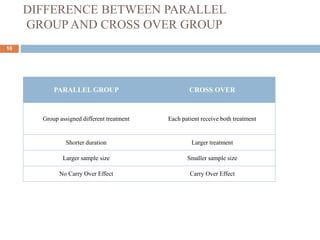
DIFFERENCE BETWEEN PARALLEL
GROUP AND CROSS OVER GROUP
16
PARALLEL GROUP CROSS OVER
Group assigned different treatment Each patient receive both treatment
Shorter duration Larger treatment
Larger sample size Smaller sample size
No Carry Over Effect Carry Over Effect
4.Evaluation of the data
17
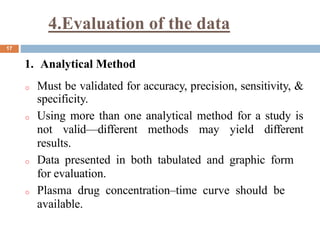
1. Analytical Method
o Must be validated for accuracy, precision, sensitivity, &
specificity.
o Using more than one analytical method for a study is
not valid—different methods may yield different
results.
o Data presented in both tabulated and graphic form
for evaluation.
o Plasma drug concentration–time curve should be
available.
.
18
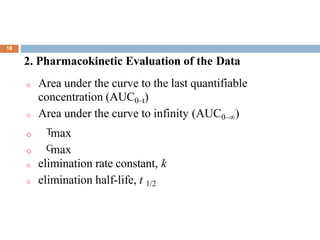
2. Pharmacokinetic Evaluation of the Data
o Area under the curve to the last quantifiable
concentration (AUC0–t)
o Area under the curve to infinity (AUC0–∞)
o Tmax
o Cmax
o elimination rate constant, k
o elimination half-life, t 1/2
.
19
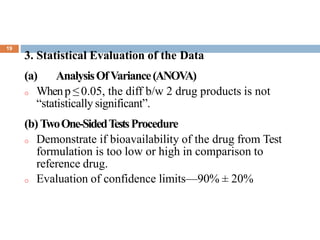
3. Statistical Evaluation of the Data
(a) AnalysisOfVariance(ANOVA)
o Whenp ≤0.05, the diff b/w 2 drug products is not
“statistically significant”.
(b) TwoOne-SidedTestsProcedure
o Demonstrate if bioavailability of the drug from Test
formulation is too low or high in comparison to
reference drug.
o Evaluation of confidence limits—90% ± 20%
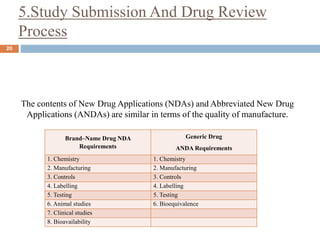
5.Study Submission And Drug Review
Process
20
Brand–Name Drug NDA
Requirements
Generic Drug
ANDA Requirements
1. Chemistry 1. Chemistry
2. Manufacturing 2. Manufacturing
3. Controls 3. Controls
4. Labelling 4. Labelling
5. Testing 5. Testing
6. Animal studies 6. Bioequivalence
7. Clinical studies
8. Bioavailability
The contents of New Drug Applications (NDAs) and Abbreviated New Drug
Applications (ANDAs) are similar in terms of the quality of manufacture.
.
21
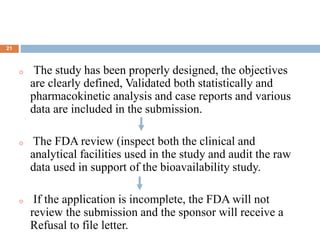
o The study has been properly designed, the objectives
are clearly defined, Validated both statistically and
pharmacokinetic analysis and case reports and various
data are included in the submission.
o The FDA review (inspect both the clinical and
analytical facilities used in the study and audit the raw
data used in support of the bioavailability study.
o If the application is incomplete, the FDA will not
review the submission and the sponsor will receive a
Refusal to file letter.
6.CONCLUSION
22
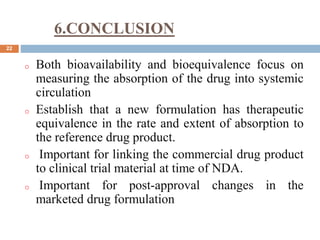
o Both bioavailability and bioequivalence focus on
measuring the absorption of the drug into systemic
circulation
o Establish that a new formulation has therapeutic
equivalence in the rate and extent of absorption to
the reference drug product.
o Important for linking the commercial drug product
to clinical trial material at time of NDA.
o Important for post-approval changes in the
marketed drug formulation
7. REFERENCE
23
 Leon Shargel and Andrew BC Yu; Applied Biopharmaceutical and
Pharmacokinetics; Drug Product Performance, In vivo: Bioavailability and
Bioequivalence; 7th Edition; MC Graw Hill Publication ; 2016; page no:
482-502
 DM. Brahmankar and Sunil B Jaiswal; textbook Biopharmaceutical and
Pharmacokinetics ; bioavailability and bioequivalence ;3rd Edition; Vallabh
Prakashan publication, Delhi; 2015; page no: 329-360
 www.slideshare.com
THANKYOU…..
.

bioequivalence studies - advanced biopharmaceutics

  • 1.
    BIOEQUIVALENCE STUDIES Prepared By, SujithaMary II Sem M.Pharm St Joseph College Of Pharmacy
  • 2.
    content2  BIOEQUIVALENCE STUDIES BIOEQUIVALENCE PROTOCOL  DESIGN  EVALUATION OF THE DATA  STUDY SUBMISSION AND DRUG REVIEW PROCESS  CONCLUSION  REFERENCE
  • 3.
    1.BIOEQUIVALENCE STUDIES 3 o Tocompare the bioavailability of the generic drug product to the brand-name product. o Bioequivalence may be defined as the bioavailability of the generic drug is compared with the measured parameter of from that of the reference drug hen administered at the same molar dose of active moiety either in single or multiple doses.
  • 4.
    . 4 o Chemical equivalenceindicates that two or more dosage forms contain the labelled quantities of drug o Therapeutic equivalence implies that one structurally different chemical can yield the same clinical result as another chemical o Pharmaceutical equivalents: Drug products in identical dosage forms that contain same active ingredient(s),the same salt or ester, are of the same dosage form, use the same route of administration, and are identical in strength or concentration.
  • 5.
    Necessity to EstablishBioequivalence 5 o Marketed drug products do not give comparable therapeutic effects. o Active drug absorbed in particular segment of the GI tract . o Absorption is less than 50%. o Rapid first-pass metabolism. o Drug is subject to dose-dependent kinetics. o Drug is rapidly metabolized or excreted. o Drug requires special coatings such as enteric coating.
  • 6.
    2. BIOEQUIVALENCE PROTOCOL I.Title A Principal investigator (study director) B. Project/protocol number and date II. Study objective III. Study design A. Design B. Drug products 1. Test product(s) 2. Reference product C. Dosage regimen D. Sample collection schedule E. Housing/confinement F. Fasting/meals schedule G. Analytical methods IV. Study population A. Subjects B. Subject selection 1. Medical history 2. Physical examination 3. Laboratory tests . 6
  • 7.
    . 7 C. Inclusion/exclusioncriteria 1. Inclusion criteria 2. Exclusion criteriaD. Restrictions/prohibitions V. Clinical procedures A.Dosage and drug administration B.Biological sampling schedule and handling procedures C. Activity of subjects VI. Ethical considerations A. Basic principles B. Institutional review board C. Informed consent D. Indications for subject withdrawal E. Adverse reactions and emergency procedures VII. Facilities VIII. Data analysis A. Analytical validation procedure B. Statistical treatment of data VII. Drug accountability VIII. Appendix
  • 8.
    1.TITLE 8 o Name ofthe principle investigator, other person responsible for conducting the study. o Name of the laboratory and clinical pharmacology where the study will be conduct. o Complete official address of the premises of the lab and contact number of the person in charge of the study, with time for contact o Name of the sponsor and other person responsible for monitoring the study should be mentioned along with complete official as well as residential addresses and phone number with contact times
  • 9.
    2. Study Objective 9 : The objective for a bioequivalence study is that the drug bio availability from test and reference products are not statically different when administered to patients are subjects at same molar dose under similar experimental conditions
  • 10.
    3.Study design 10 A. Fastingstudy o Done for immediate-release and modified-release oral dosage forms. o Male and female subjects may be used. o Blood sampling is done at appropriate intervals to obtain plasma drug concentration—time profile. o Subjects should be in fasting condition—at least 10 hrs. before drug administration and 4 hrs. after administration.
  • 11.
    . 11 B. Food InterventionStudy o Studies are conducted after high-fat and high-calorie meal. o Subjects should be in fasting condition at least 10 hrs. before drug administration. o Meal is given 30 minutes before dosing. o No food given for at least 4 hrs. after administration. o Done for modified-release dosage forms. o And for immediate-release forms if bioavailability is affected by food (e.g.. Ibuprofen, naproxen).
  • 12.
    cross over design . 1.LATIN-SQUARE CROSSOVERDESIGNS. • Each subject receives each drug product only once. • Adequate wash-out period is provided b/w drugs.  Advantages:  Subject-to-subject variation is reduced.  All patients do not receive same drug product on the same day. 12
  • 13.
    . 2.BALANCE INCOMPLETE BLOCK DESIGN: o Morethan 3 formulations Latin square design will not be used because each volunteer may required drawing of too many blood samples o If each volunteer expected to receive at least 2 formulations then such study can be carried out using BIBD. Volunteer no Period 1 Period 2 1 A B 2 A C 3 A D 4 B C 5 B D 6 B A 7 C A 8 C B 9 C D 10 D A 11 D B 12 D C 13
  • 14.
    . 14 SUBJECT PERIOD 1 2 1 AB 2 B A 3 A B 4 B A 3. PARALLEL GROUP DESIGN: The subjects are divided randomly into groups, each group receiving one treatment randomly. Here number of groups is same as number of treatments to be compared. Each subject receives only one treatment.
  • 15.
    . 15 SEQUENCE PERIOD 1 2 34 1 T R T R 2 R T R T 4. REPLICATED CROSS OVER DESIGN Used for the determination of individual bioequivalence. Allows comparison of within-subject variance and to provide an estimate of the subject-by- formulation interaction variance. Four-period, two-sequence, two- formulation design is recommended. Where R = reference T = treatment
  • 16.
    DIFFERENCE BETWEEN PARALLEL GROUPAND CROSS OVER GROUP 16 PARALLEL GROUP CROSS OVER Group assigned different treatment Each patient receive both treatment Shorter duration Larger treatment Larger sample size Smaller sample size No Carry Over Effect Carry Over Effect
  • 17.
    4.Evaluation of thedata 17 1. Analytical Method o Must be validated for accuracy, precision, sensitivity, & specificity. o Using more than one analytical method for a study is not valid—different methods may yield different results. o Data presented in both tabulated and graphic form for evaluation. o Plasma drug concentration–time curve should be available.
  • 18.
    . 18 2. Pharmacokinetic Evaluationof the Data o Area under the curve to the last quantifiable concentration (AUC0–t) o Area under the curve to infinity (AUC0–∞) o Tmax o Cmax o elimination rate constant, k o elimination half-life, t 1/2
  • 19.
    . 19 3. Statistical Evaluationof the Data (a) AnalysisOfVariance(ANOVA) o Whenp ≤0.05, the diff b/w 2 drug products is not “statistically significant”. (b) TwoOne-SidedTestsProcedure o Demonstrate if bioavailability of the drug from Test formulation is too low or high in comparison to reference drug. o Evaluation of confidence limits—90% ± 20%
  • 20.
    5.Study Submission AndDrug Review Process 20 Brand–Name Drug NDA Requirements Generic Drug ANDA Requirements 1. Chemistry 1. Chemistry 2. Manufacturing 2. Manufacturing 3. Controls 3. Controls 4. Labelling 4. Labelling 5. Testing 5. Testing 6. Animal studies 6. Bioequivalence 7. Clinical studies 8. Bioavailability The contents of New Drug Applications (NDAs) and Abbreviated New Drug Applications (ANDAs) are similar in terms of the quality of manufacture.
  • 21.
    . 21 o The studyhas been properly designed, the objectives are clearly defined, Validated both statistically and pharmacokinetic analysis and case reports and various data are included in the submission. o The FDA review (inspect both the clinical and analytical facilities used in the study and audit the raw data used in support of the bioavailability study. o If the application is incomplete, the FDA will not review the submission and the sponsor will receive a Refusal to file letter.
  • 22.
    6.CONCLUSION 22 o Both bioavailabilityand bioequivalence focus on measuring the absorption of the drug into systemic circulation o Establish that a new formulation has therapeutic equivalence in the rate and extent of absorption to the reference drug product. o Important for linking the commercial drug product to clinical trial material at time of NDA. o Important for post-approval changes in the marketed drug formulation
  • 23.
    7. REFERENCE 23  LeonShargel and Andrew BC Yu; Applied Biopharmaceutical and Pharmacokinetics; Drug Product Performance, In vivo: Bioavailability and Bioequivalence; 7th Edition; MC Graw Hill Publication ; 2016; page no: 482-502  DM. Brahmankar and Sunil B Jaiswal; textbook Biopharmaceutical and Pharmacokinetics ; bioavailability and bioequivalence ;3rd Edition; Vallabh Prakashan publication, Delhi; 2015; page no: 329-360  www.slideshare.com
  • 24.