CTD and eCTD Format
Prepared By-Nikhil Thorane (M.pharm 1st Year)
Priyadarshini college of pharmacy, nagpur.
CTD
 Common Technical Document [CTD]: It is an format set by ICH which was agreed by the
Regulatory Agencies of Europe , Japan & the U.S.
 The FDA characterized the CTD as “An information package of clinical, non clinical,
manufacturing, technical data in the same content that would be submitted for registering
new drugs in all 3 ICH regions i.e. U.S,European Union and Japan.
History of CTD
 The Concept of CTD was introduced by ICH in the year of 2000 for the public
consultation.
 Before 2000 there was no uniformity to submit dossier in regulatory authority. This
creates many hassles for applicant as well as auditors to submit and reviewing the
dossier information in an organized manner. Hence concept of CTD was come for
harmonization in dossier submission.
 It is important to note that on July 1, 2003 use of the CTD format will become
mandatory across all three regions like EU, FDA and Japan.
Impact of CTD
 The ICH CTD represents one of the most ambitious and successful international
harmonization activities undertaken for medicines product of human use.
 It will significantly reduce time and resources needed by industry to compile applications
for global registration.
 Applies to all NDAs, ANDAs, BLAs and INDs application.
Benefits of CTD
 Easy “Reviewable” applications.
 Complete, well-organized submission.
 More predictable format.
 More consistent reviews.
 Easier analysis across application.
 Easier Exchange of information.
 Facilitates electronic submission.
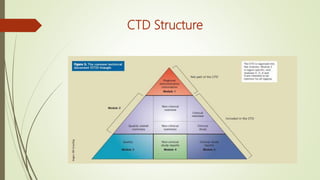
CTD Structure
Module 1
Administrative Information [Region specific]
 This module should contain documents specific to each region
 The content & format of this module can be specified by the relevant regulatory
authorities.
Module 2
CTD Summaries [QOS]
 It should begin with a general introduction to the pharmaceutical , including its pharmacological
class , mode of action & proposed clinical use. i.e. information should not exceed one page
 It contain 7 sections in the following order:
-2.1 CTD TOC [Module 2 – 5] [Table Of Content]
-2.2 CTD Introduction
- 2.3 Quality Overall Summary
-2.4 Nonclinical overview
- 2.5 Clinical overview
- 2.6 Non clinical summary
- 2.7 Clinical summary
 The organization of these summaries is described in 3 separate documents:
A] M4 Q – The CTD quality
B] M4 S – The CTD Safety
C] M4 E – The CTD Efficacy
Module 3
Quality [CMC]
 3.1 TOC of Module 3
 3.2 Body of Data
 - 3.2. Drug substance
-Generall information
-Manufacture
-Characterisation
-Control of Drug Substance
-Reference Standards or Materials
-Stability
 3.4 DRUG PRODUCT
-Descriptionnn and Composition of the Drug Product
-Pharmaceutical Development
-Manufacture
-Control of Excipients
-Control of Drug Product
- Reference Standards or Materials
-Stability
 APPENDICES
Facilitiess and Equipment
Novel Excipients
 LITERATURE REFERENCES
Module 4
Non Clinical Study Reports
 TOC of Module 4
 4.2 Study reports
- 4.2.1 pharmacology
- 4.2.2 pharmacokinetics
- 4.2.3 Toxicology
 4.3 Literature References
Module 5
Clinical Study Reports
 TOC of Module 5
 5.2 Tabular listing of clinical studies
 5.3 Clinical study reports
-5.3.1 Repots of biopharmaceutical study[BA-BE]
-5.3.2 Reports of PK [biomaterial] study
-5.3.3 Reports of PK studies
-5.3.4 Reports of PD studies
-5.3.5 Reports of Efficacy and safety studies
-5.3.6 Reports of Post marketing experience
-5.3.7 Case Report forms & Individual patient listings
 5.4 Literature References
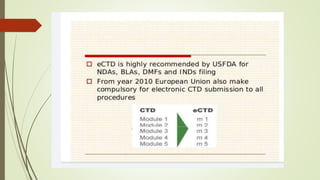
e CTD
 It is electronic version of CTD, so called as electronicc common technical document [e
CTD]
 e CTD composed of 2 types of specification
- Content specification – As defined by ICH
- Technical specification- Electronic softwares
CTD (pdf) (Paper)
eCTD XML backbone
e CTD Characteristics
 All Modules 1 to 5 have granularity options[ level of detail a document has ]
 PDF documents linked via XML backbone
 Increased document granularity.
 Transparency of entire submission
 Ease of navigation and review
Benefit of eCTD
 Improve the submission and review process.
 Increase accuracy of the Submission.
 Decrease total costs.
 Immediate access to complete and Up to date information.
 Reduced Workload.
 Better communication with industry.
Example of eCTD Software:
 ROSETTA Regulatory Software
 Pharmaready eCTD Product which is fully validated, international regulatory Compliant
software
Thank you

CTD and eCTD Format

  • 1.
    CTD and eCTDFormat Prepared By-Nikhil Thorane (M.pharm 1st Year) Priyadarshini college of pharmacy, nagpur.
  • 2.
    CTD  Common TechnicalDocument [CTD]: It is an format set by ICH which was agreed by the Regulatory Agencies of Europe , Japan & the U.S.  The FDA characterized the CTD as “An information package of clinical, non clinical, manufacturing, technical data in the same content that would be submitted for registering new drugs in all 3 ICH regions i.e. U.S,European Union and Japan.
  • 3.
    History of CTD The Concept of CTD was introduced by ICH in the year of 2000 for the public consultation.  Before 2000 there was no uniformity to submit dossier in regulatory authority. This creates many hassles for applicant as well as auditors to submit and reviewing the dossier information in an organized manner. Hence concept of CTD was come for harmonization in dossier submission.  It is important to note that on July 1, 2003 use of the CTD format will become mandatory across all three regions like EU, FDA and Japan.
  • 4.
    Impact of CTD The ICH CTD represents one of the most ambitious and successful international harmonization activities undertaken for medicines product of human use.  It will significantly reduce time and resources needed by industry to compile applications for global registration.  Applies to all NDAs, ANDAs, BLAs and INDs application.
  • 5.
    Benefits of CTD Easy “Reviewable” applications.  Complete, well-organized submission.  More predictable format.  More consistent reviews.  Easier analysis across application.  Easier Exchange of information.  Facilitates electronic submission.
  • 6.
  • 7.
    Module 1 Administrative Information[Region specific]  This module should contain documents specific to each region  The content & format of this module can be specified by the relevant regulatory authorities.
  • 8.
    Module 2 CTD Summaries[QOS]  It should begin with a general introduction to the pharmaceutical , including its pharmacological class , mode of action & proposed clinical use. i.e. information should not exceed one page  It contain 7 sections in the following order: -2.1 CTD TOC [Module 2 – 5] [Table Of Content] -2.2 CTD Introduction - 2.3 Quality Overall Summary -2.4 Nonclinical overview - 2.5 Clinical overview - 2.6 Non clinical summary - 2.7 Clinical summary
  • 9.
     The organizationof these summaries is described in 3 separate documents: A] M4 Q – The CTD quality B] M4 S – The CTD Safety C] M4 E – The CTD Efficacy
  • 10.
    Module 3 Quality [CMC] 3.1 TOC of Module 3  3.2 Body of Data  - 3.2. Drug substance -Generall information -Manufacture -Characterisation -Control of Drug Substance -Reference Standards or Materials -Stability
  • 11.
     3.4 DRUGPRODUCT -Descriptionnn and Composition of the Drug Product -Pharmaceutical Development -Manufacture -Control of Excipients -Control of Drug Product - Reference Standards or Materials -Stability
  • 12.
     APPENDICES Facilitiess andEquipment Novel Excipients  LITERATURE REFERENCES
  • 13.
    Module 4 Non ClinicalStudy Reports  TOC of Module 4  4.2 Study reports - 4.2.1 pharmacology - 4.2.2 pharmacokinetics - 4.2.3 Toxicology  4.3 Literature References
  • 14.
    Module 5 Clinical StudyReports  TOC of Module 5  5.2 Tabular listing of clinical studies  5.3 Clinical study reports -5.3.1 Repots of biopharmaceutical study[BA-BE] -5.3.2 Reports of PK [biomaterial] study -5.3.3 Reports of PK studies -5.3.4 Reports of PD studies -5.3.5 Reports of Efficacy and safety studies -5.3.6 Reports of Post marketing experience -5.3.7 Case Report forms & Individual patient listings  5.4 Literature References
  • 15.
    e CTD  Itis electronic version of CTD, so called as electronicc common technical document [e CTD]  e CTD composed of 2 types of specification - Content specification – As defined by ICH - Technical specification- Electronic softwares CTD (pdf) (Paper) eCTD XML backbone
  • 17.
    e CTD Characteristics All Modules 1 to 5 have granularity options[ level of detail a document has ]  PDF documents linked via XML backbone  Increased document granularity.  Transparency of entire submission  Ease of navigation and review
  • 18.
    Benefit of eCTD Improve the submission and review process.  Increase accuracy of the Submission.  Decrease total costs.  Immediate access to complete and Up to date information.  Reduced Workload.  Better communication with industry.
  • 19.
    Example of eCTDSoftware:  ROSETTA Regulatory Software  Pharmaready eCTD Product which is fully validated, international regulatory Compliant software
  • 21.