Bioavailability
&
Bioequivalence Data
Presented By: Khushi H.Gor
M.Pharm Sem-1 (Regulatory Affairs)
K.B. Institute of Pharmaceutical Education and Research
CONTENTS
 Definitions
 Objectives of Bioavailability studies
 Types of Bioavailability studies
 Methods of Bioavailability measurement
--Pharmacokinetic methods:
1. Plasma level time studies
2. Urinary excretion studies
--Pharmacodynamics methods:
1. Acute pharmacological response
2. Therapeutic response
 In vitro dissolution studies and bioavailability
 IVIVC Correlation
 Bioequivalence experimental study designs
1. Completely randomized designs
2. Randomized block designs
3. Repeated measures, cross over, carry-over designs
4. Latin square designs
Definitions
Bioavailability:
It is rate and extent of absorption of unchanged drug from its
dosage form.
Rate- acute conditions- asthma, pain etc
Extent( amount ) – chronic conditions- hypertension.
Influence of route of administration
PARENTRAL> ORAL> RECTAL>TOPICAL
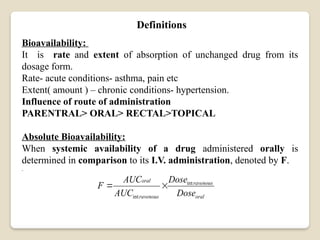
Absolute Bioavailability:
When systemic availability of a drug administered orally is
determined in comparison to its I.V. administration, denoted by F.
oral
ravenous
ravenous
oral
Dose
Dose
AUC
AUC
F int
int


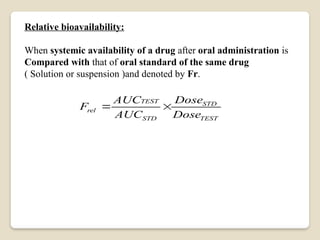
Relative bioavailability:
When systemic availability of a drug after oral administration is
Compared with that of oral standard of the same drug
( Solution or suspension )and denoted by Fr.
TEST
STD
STD
TEST
rel
Dose
Dose
AUC
AUC
F 

Chemical equivalence:
When two or more drug products contain the same chemical
substance as an active ingredient in the same amount it is called
chemical equivalence.
Pharmaceutical equivalents:
These are the drug products containing same API and are identical
in strength, dosage form and route of administration but they
might differ in inactive ingredients (excipients).
Therapeutic equivalence:
These are the drug products that are pharmaceutics equivalents
that can be expected to have same clinical effect in-vivo.
Bioequivalence:
It is relative term that denotes drug substance in two or more
identical dosage forms reaches the systemic circulation at the
same relative rate to the same relative extent.
i.e. plasma concentration-time profiles will be identical without
significant statistical differences.
Objectives of Bioavailability studies
It is important in the
 Primary stages of development of dosage form of new drug
entity to find its therapeutic utility.
 Determination of influence of excipients on absorption.
 Development of new formulations of existing drugs.
 Control of quality of drug products and influence of
processing factors , storage and stability on absorption.
 Comparison of drug in different dosage forms or same
dosage form of different manufacturer.
Types of Bioavailability studies
 Single Dose Versus Multiple Dose Studies:
 Single dose bioavailability studies are very common, easy, less
exposure to drugs, less tedious.
 However it is difficult to predict the steady state characteristics
and inter subject variability with these studies.
Multiple Dose Study:
 Accurately reflects manner in which drug will be used
clinically.
 Requires collection of few blood samples.
 Drug levels are higher due to cumulative effect and useful for
less sensitive analytical methods
 Better evaluation of controlled released formulation.
 Nonlinearity if present , can be easily determined.
 No need of long wash out periods.
 Healthy subjects versus Patients
Generally bioavailability study should be carried out in patients,
 As patient get benefited from the study,
 Reflects better therapeutic efficacy,
 Drug absorption pattern in disease state can be studied,
 Avoids ethical quandary of administering drug to healthy
subjects.
 But there are also various drawbacks like
• Diseases,
• other drugs,
• Physiological changes,
• Fasting state is difficult etc.
• Hence usually these studies performed on young (20-
40yrs) healthy male adult volunteers( body weight
±10%) under restricted dietary and fixed activity
conditions.
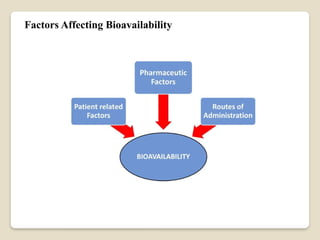
Factors Affecting Bioavailability
1. Patient-Related Factors
 Physiological Factors
Age, gastric pH, GI motility, enzymatic activity
 Pathological Conditions
Diseases (e.g., GI disorders, liver conditions)
 Genetic Factors
Enzyme polymorphisms affecting metabolism, Food and Dietary Habits, Fatty
meals, pH-altering foods
 Drug Tolerance and Compliance
 Patient adherence to medication schedules
2. Pharmaceutical Factors
 Physicochemical Properties
Solubility, particle size, lipophilicity, Polymorphism affecting
dissolution rates
 Drug Stability
 Formulation and Excipients
3. Route of Administration
 Oral: First-pass metabolism, enzymatic degradation
 Parenteral: IV (100% bioavailability), IM, subcutaneous
 Sublingual/ Buccal: Avoids first-pass metabolism
 Rectal: Partial avoidance of first-pass metabolism
Topical/ Transdermal: Requires sufficient skin permeability
 Inhalation: Rapid absorption via lungs
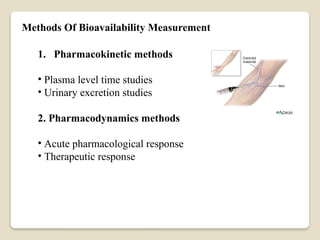
Methods Of Bioavailability Measurement
1. Pharmacokinetic methods
• Plasma level time studies
• Urinary excretion studies
2. Pharmacodynamics methods
• Acute pharmacological response
• Therapeutic response
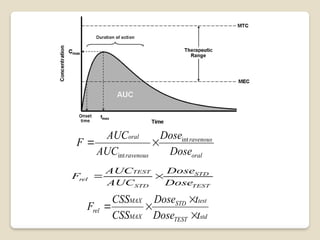
1.Plasma level time studies:
 Most reliable method of choice comparison to urine data method
 Single dose: serial blood samples collection – 2-3 half lifes
 Plot concentration vs. time
 For I.V. Sampling started within 5 min and subsequent 15 min
intervals.
 For oral dose at least 3 points taken on absorption curve
(ascending part).
Parameters considered important in plasma level time studies
 Cmax:It is peak plasma concentration. It increases with dose as
well as increase in rate of absorption
 Tmax: The peak time at which Cmax attained.
 AUC: Area under curve explains about amount of drug.
Pharmacokinetic methods
oral
ravenous
ravenous
oral
Dose
Dose
AUC
AUC
F int
int


TEST
STD
STD
TEST
rel
Dose
Dose
AUC
AUC
F 

std
TEST
test
STD
MAX
MAX
rel
t
Dose
t
Dose
CSS
CSS
F




2. Urinary excretion studies:
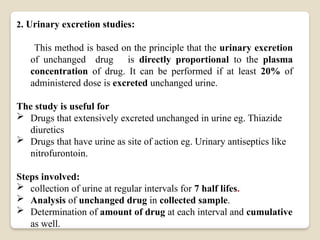
This method is based on the principle that the urinary excretion
of unchanged drug is directly proportional to the plasma
concentration of drug. It can be performed if at least 20% of
administered dose is excreted unchanged urine.
The study is useful for
 Drugs that extensively excreted unchanged in urine eg. Thiazide
diuretics
 Drugs that have urine as site of action eg. Urinary antiseptics like
nitrofurontoin.
Steps involved:
 collection of urine at regular intervals for 7 half lifes.
 Analysis of unchanged drug in collected sample.
 Determination of amount of drug at each interval and cumulative
as well.
Criteria's must be followed
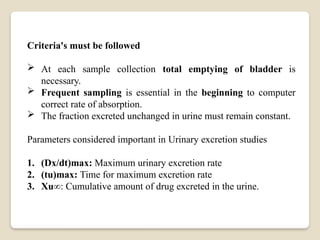
 At each sample collection total emptying of bladder is
necessary.
 Frequent sampling is essential in the beginning to computer
correct rate of absorption.
 The fraction excreted unchanged in urine must remain constant.
Parameters considered important in Urinary excretion studies
1. (Dx/dt)max: Maximum urinary excretion rate
2. (tu)max: Time for maximum excretion rate
3. Xu∞: Cumulative amount of drug excreted in the urine.
Pharmacodynamics methods
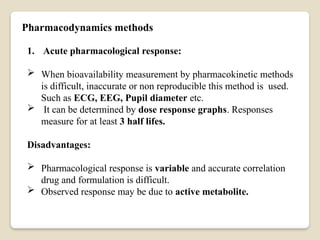
1. Acute pharmacological response:
 When bioavailability measurement by pharmacokinetic methods
is difficult, inaccurate or non reproducible this method is used.
Such as ECG, EEG, Pupil diameter etc.
 It can be determined by dose response graphs. Responses
measure for at least 3 half lifes.
Disadvantages:
 Pharmacological response is variable and accurate correlation
drug and formulation is difficult.
 Observed response may be due to active metabolite.
2. Therapeutic response:
This method is based on observing clinical response in patients.
Drawbacks:
 Quantitation of observed response is too improper.
 The physiological status of subject assumed that does not
change significantly over duration of study.
 If multiple dose protocols are not involved. Patient receive only
single dose for few days or a week
 The patient s receiving more than one drug treatment may be
compromised due to drug-drug interaction.
In vitro dissolution studies and bioavailability:
The physicochemical property of most drugs that has greatest
influence on absorption from GIT is dissolution rate.
However in vitro dissolution is good substitute for in vivo
study in terms of saving cost and time. The best available tool
today which can at least quantitatively assure about the
bioavailability of drug from its formulation is in vitro
dissolution test.
In vitro- in vivo correlation ( IVIVC):
It is defined as the predictive mathematical model that describes
the relationship between in vitro property ( rate & extent of
dissolution) and in vivo response ( plasma drug concentration).
The main objective of developing and evaluating IVIVC is to use
dissolution test to serve as alternate for in vivo study in human
beings.
IVIVC Levels:
Level A: The highest category of correlation. It represents point to
point correlation between in vitro dissolution and in vivo rate of
absorption.
Advantages:
serves as alternate for in vivo study, change in manf. Procedure or
formula can be justified without human studies
Level B:
The mean in vitro dissolution time is compare with mean in vivo
residence time. It is not point to point correlation . Data can be used for
quality control standards.
Level C:
It is single point correlation. e.g. t50%, Tmax, Cmax. This level is only
useful as guide for formulation development or quality control
Bioequivalence Studies
If a new product is intended to be a substitute for approved
medicinal product, then Equivalence must be shown.
To ensure the clinical performance of such products,
Bioequivalence studies are carried out.
To compare the Bioavailability of generic products. with the
brand products.
Types Of Bioequivalence Studies
In vivo bioequivalence studies: when needed,
1. Oral immediate release product with systemic action
-Indicated for serious conditions requiring assured response.
-Narrow therapeutic window.
- complicated pharmacokinetic, absorption <70%, pre
systemic elimination>70%, nonlinear kinetics.
2. Non-oral immediate release products
3. Modified release products with systemic action.
In vitro bioequivalence studies: If none of the above criteria is
applicable comparative in vitro dissolution studies can be done.
Biowaivers: In vivo studies can be exempted under certain conditions.
1. Drug product only differ in strength of drug provided,
- Their pharmacokinetics are linear, Drug & excipient ratio is
same,
- both products manufactured by same manuf. at same site.
- BA/BE study done for original product, disso. rate same under
same conditions.
2. The method of production slightly modified in a way that not affect
bioavailability
3. The drug product meet following requirements: The product is in
solubilised form, no excipients affecting absorption, Topical use,
Oral but not absorbed, inhalation as gas or vapour.
Bioequivalence experimental study designs
1.Completely randomized designs
2.Randomized block designs
3.Repeated measures, cross over designs
4.Latin square designs
1. Completely randomized designs:
 All treatments are randomly allocated among all experimental subjects.
 e.g. If there are 20 subjects, number the from 1 to 20. randomly select
non repeating numbers among these labels for the first treatment. And
then repeat for all other treatments .
Advantages:
Easy to construct
 Can accommodate any number of treatment and subjects, Simple to
analyze.
Disadvantages:
Although can be used for number of treatments, but suited for few
treatments.
All subjects must be homogenous or random error will occur.
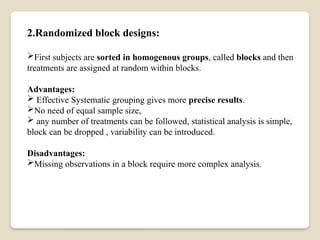
2.Randomized block designs:
First subjects are sorted in homogenous groups, called blocks and then
treatments are assigned at random within blocks.
Advantages:
 Effective Systematic grouping gives more precise results.
No need of equal sample size,
 any number of treatments can be followed, statistical analysis is simple,
block can be dropped , variability can be introduced.
Disadvantages:
Missing observations in a block require more complex analysis.
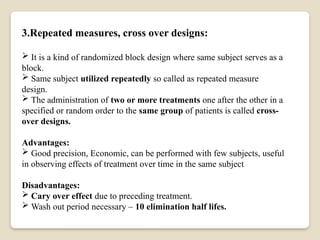
3.Repeated measures, cross over designs:
 It is a kind of randomized block design where same subject serves as a
block.
 Same subject utilized repeatedly so called as repeated measure
design.
 The administration of two or more treatments one after the other in a
specified or random order to the same group of patients is called cross-
over designs.
Advantages:
 Good precision, Economic, can be performed with few subjects, useful
in observing effects of treatment over time in the same subject
Disadvantages:
 Cary over effect due to preceding treatment.
 Wash out period necessary – 10 elimination half lifes.
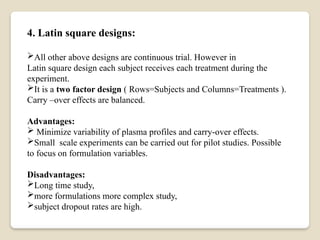
4. Latin square designs:
All other above designs are continuous trial. However in
Latin square design each subject receives each treatment during the
experiment.
It is a two factor design ( Rows=Subjects and Columns=Treatments ).
Carry –over effects are balanced.
Advantages:
 Minimize variability of plasma profiles and carry-over effects.
Small scale experiments can be carried out for pilot studies. Possible
to focus on formulation variables.
Disadvantages:
Long time study,
more formulations more complex study,
subject dropout rates are high.
References
1. Biopharmaceutics and pharmacokinetics – TreatiseD.M.
Brahmankar, Sunil B.Jaiswal. Vallabhprakashan IInd edition,
pp- 315-366.
2. Basics of Pharmaokinetics, Leon Shargel, fifth edition,
willey publications, pp- 453-490.
3.Internet sources.
Bioavailability & Bioequivalence Studies.pptx

Bioavailability & Bioequivalence Studies.pptx

  • 1.
    Bioavailability & Bioequivalence Data Presented By:Khushi H.Gor M.Pharm Sem-1 (Regulatory Affairs) K.B. Institute of Pharmaceutical Education and Research
  • 2.
    CONTENTS  Definitions  Objectivesof Bioavailability studies  Types of Bioavailability studies  Methods of Bioavailability measurement --Pharmacokinetic methods: 1. Plasma level time studies 2. Urinary excretion studies --Pharmacodynamics methods: 1. Acute pharmacological response 2. Therapeutic response  In vitro dissolution studies and bioavailability  IVIVC Correlation  Bioequivalence experimental study designs 1. Completely randomized designs 2. Randomized block designs 3. Repeated measures, cross over, carry-over designs 4. Latin square designs
  • 3.
    Definitions Bioavailability: It is rateand extent of absorption of unchanged drug from its dosage form. Rate- acute conditions- asthma, pain etc Extent( amount ) – chronic conditions- hypertension. Influence of route of administration PARENTRAL> ORAL> RECTAL>TOPICAL Absolute Bioavailability: When systemic availability of a drug administered orally is determined in comparison to its I.V. administration, denoted by F. oral ravenous ravenous oral Dose Dose AUC AUC F int int  
  • 4.
    Relative bioavailability: When systemicavailability of a drug after oral administration is Compared with that of oral standard of the same drug ( Solution or suspension )and denoted by Fr. TEST STD STD TEST rel Dose Dose AUC AUC F  
  • 5.
    Chemical equivalence: When twoor more drug products contain the same chemical substance as an active ingredient in the same amount it is called chemical equivalence. Pharmaceutical equivalents: These are the drug products containing same API and are identical in strength, dosage form and route of administration but they might differ in inactive ingredients (excipients). Therapeutic equivalence: These are the drug products that are pharmaceutics equivalents that can be expected to have same clinical effect in-vivo.
  • 6.
    Bioequivalence: It is relativeterm that denotes drug substance in two or more identical dosage forms reaches the systemic circulation at the same relative rate to the same relative extent. i.e. plasma concentration-time profiles will be identical without significant statistical differences.
  • 7.
    Objectives of Bioavailabilitystudies It is important in the  Primary stages of development of dosage form of new drug entity to find its therapeutic utility.  Determination of influence of excipients on absorption.  Development of new formulations of existing drugs.  Control of quality of drug products and influence of processing factors , storage and stability on absorption.  Comparison of drug in different dosage forms or same dosage form of different manufacturer.
  • 8.
    Types of Bioavailabilitystudies  Single Dose Versus Multiple Dose Studies:  Single dose bioavailability studies are very common, easy, less exposure to drugs, less tedious.  However it is difficult to predict the steady state characteristics and inter subject variability with these studies. Multiple Dose Study:  Accurately reflects manner in which drug will be used clinically.  Requires collection of few blood samples.  Drug levels are higher due to cumulative effect and useful for less sensitive analytical methods  Better evaluation of controlled released formulation.  Nonlinearity if present , can be easily determined.  No need of long wash out periods.
  • 9.
     Healthy subjectsversus Patients Generally bioavailability study should be carried out in patients,  As patient get benefited from the study,  Reflects better therapeutic efficacy,  Drug absorption pattern in disease state can be studied,  Avoids ethical quandary of administering drug to healthy subjects.  But there are also various drawbacks like • Diseases, • other drugs, • Physiological changes, • Fasting state is difficult etc. • Hence usually these studies performed on young (20- 40yrs) healthy male adult volunteers( body weight ±10%) under restricted dietary and fixed activity conditions.
  • 10.
  • 11.
    1. Patient-Related Factors Physiological Factors Age, gastric pH, GI motility, enzymatic activity  Pathological Conditions Diseases (e.g., GI disorders, liver conditions)  Genetic Factors Enzyme polymorphisms affecting metabolism, Food and Dietary Habits, Fatty meals, pH-altering foods  Drug Tolerance and Compliance  Patient adherence to medication schedules 2. Pharmaceutical Factors  Physicochemical Properties Solubility, particle size, lipophilicity, Polymorphism affecting dissolution rates  Drug Stability  Formulation and Excipients
  • 12.
    3. Route ofAdministration  Oral: First-pass metabolism, enzymatic degradation  Parenteral: IV (100% bioavailability), IM, subcutaneous  Sublingual/ Buccal: Avoids first-pass metabolism  Rectal: Partial avoidance of first-pass metabolism Topical/ Transdermal: Requires sufficient skin permeability  Inhalation: Rapid absorption via lungs
  • 13.
    Methods Of BioavailabilityMeasurement 1. Pharmacokinetic methods • Plasma level time studies • Urinary excretion studies 2. Pharmacodynamics methods • Acute pharmacological response • Therapeutic response
  • 14.
    1.Plasma level timestudies:  Most reliable method of choice comparison to urine data method  Single dose: serial blood samples collection – 2-3 half lifes  Plot concentration vs. time  For I.V. Sampling started within 5 min and subsequent 15 min intervals.  For oral dose at least 3 points taken on absorption curve (ascending part). Parameters considered important in plasma level time studies  Cmax:It is peak plasma concentration. It increases with dose as well as increase in rate of absorption  Tmax: The peak time at which Cmax attained.  AUC: Area under curve explains about amount of drug. Pharmacokinetic methods
  • 15.
  • 16.
    2. Urinary excretionstudies: This method is based on the principle that the urinary excretion of unchanged drug is directly proportional to the plasma concentration of drug. It can be performed if at least 20% of administered dose is excreted unchanged urine. The study is useful for  Drugs that extensively excreted unchanged in urine eg. Thiazide diuretics  Drugs that have urine as site of action eg. Urinary antiseptics like nitrofurontoin. Steps involved:  collection of urine at regular intervals for 7 half lifes.  Analysis of unchanged drug in collected sample.  Determination of amount of drug at each interval and cumulative as well.
  • 17.
    Criteria's must befollowed  At each sample collection total emptying of bladder is necessary.  Frequent sampling is essential in the beginning to computer correct rate of absorption.  The fraction excreted unchanged in urine must remain constant. Parameters considered important in Urinary excretion studies 1. (Dx/dt)max: Maximum urinary excretion rate 2. (tu)max: Time for maximum excretion rate 3. Xu∞: Cumulative amount of drug excreted in the urine.
  • 18.
    Pharmacodynamics methods 1. Acutepharmacological response:  When bioavailability measurement by pharmacokinetic methods is difficult, inaccurate or non reproducible this method is used. Such as ECG, EEG, Pupil diameter etc.  It can be determined by dose response graphs. Responses measure for at least 3 half lifes. Disadvantages:  Pharmacological response is variable and accurate correlation drug and formulation is difficult.  Observed response may be due to active metabolite.
  • 19.
    2. Therapeutic response: Thismethod is based on observing clinical response in patients. Drawbacks:  Quantitation of observed response is too improper.  The physiological status of subject assumed that does not change significantly over duration of study.  If multiple dose protocols are not involved. Patient receive only single dose for few days or a week  The patient s receiving more than one drug treatment may be compromised due to drug-drug interaction.
  • 20.
    In vitro dissolutionstudies and bioavailability: The physicochemical property of most drugs that has greatest influence on absorption from GIT is dissolution rate. However in vitro dissolution is good substitute for in vivo study in terms of saving cost and time. The best available tool today which can at least quantitatively assure about the bioavailability of drug from its formulation is in vitro dissolution test.
  • 21.
    In vitro- invivo correlation ( IVIVC): It is defined as the predictive mathematical model that describes the relationship between in vitro property ( rate & extent of dissolution) and in vivo response ( plasma drug concentration). The main objective of developing and evaluating IVIVC is to use dissolution test to serve as alternate for in vivo study in human beings. IVIVC Levels: Level A: The highest category of correlation. It represents point to point correlation between in vitro dissolution and in vivo rate of absorption. Advantages: serves as alternate for in vivo study, change in manf. Procedure or formula can be justified without human studies
  • 22.
    Level B: The meanin vitro dissolution time is compare with mean in vivo residence time. It is not point to point correlation . Data can be used for quality control standards. Level C: It is single point correlation. e.g. t50%, Tmax, Cmax. This level is only useful as guide for formulation development or quality control
  • 23.
    Bioequivalence Studies If anew product is intended to be a substitute for approved medicinal product, then Equivalence must be shown. To ensure the clinical performance of such products, Bioequivalence studies are carried out. To compare the Bioavailability of generic products. with the brand products. Types Of Bioequivalence Studies In vivo bioequivalence studies: when needed, 1. Oral immediate release product with systemic action -Indicated for serious conditions requiring assured response. -Narrow therapeutic window. - complicated pharmacokinetic, absorption <70%, pre systemic elimination>70%, nonlinear kinetics.
  • 24.
    2. Non-oral immediaterelease products 3. Modified release products with systemic action. In vitro bioequivalence studies: If none of the above criteria is applicable comparative in vitro dissolution studies can be done. Biowaivers: In vivo studies can be exempted under certain conditions. 1. Drug product only differ in strength of drug provided, - Their pharmacokinetics are linear, Drug & excipient ratio is same, - both products manufactured by same manuf. at same site. - BA/BE study done for original product, disso. rate same under same conditions. 2. The method of production slightly modified in a way that not affect bioavailability 3. The drug product meet following requirements: The product is in solubilised form, no excipients affecting absorption, Topical use, Oral but not absorbed, inhalation as gas or vapour.
  • 25.
    Bioequivalence experimental studydesigns 1.Completely randomized designs 2.Randomized block designs 3.Repeated measures, cross over designs 4.Latin square designs
  • 26.
    1. Completely randomizeddesigns:  All treatments are randomly allocated among all experimental subjects.  e.g. If there are 20 subjects, number the from 1 to 20. randomly select non repeating numbers among these labels for the first treatment. And then repeat for all other treatments . Advantages: Easy to construct  Can accommodate any number of treatment and subjects, Simple to analyze. Disadvantages: Although can be used for number of treatments, but suited for few treatments. All subjects must be homogenous or random error will occur.
  • 27.
    2.Randomized block designs: Firstsubjects are sorted in homogenous groups, called blocks and then treatments are assigned at random within blocks. Advantages:  Effective Systematic grouping gives more precise results. No need of equal sample size,  any number of treatments can be followed, statistical analysis is simple, block can be dropped , variability can be introduced. Disadvantages: Missing observations in a block require more complex analysis.
  • 28.
    3.Repeated measures, crossover designs:  It is a kind of randomized block design where same subject serves as a block.  Same subject utilized repeatedly so called as repeated measure design.  The administration of two or more treatments one after the other in a specified or random order to the same group of patients is called cross- over designs. Advantages:  Good precision, Economic, can be performed with few subjects, useful in observing effects of treatment over time in the same subject Disadvantages:  Cary over effect due to preceding treatment.  Wash out period necessary – 10 elimination half lifes.
  • 29.
    4. Latin squaredesigns: All other above designs are continuous trial. However in Latin square design each subject receives each treatment during the experiment. It is a two factor design ( Rows=Subjects and Columns=Treatments ). Carry –over effects are balanced. Advantages:  Minimize variability of plasma profiles and carry-over effects. Small scale experiments can be carried out for pilot studies. Possible to focus on formulation variables. Disadvantages: Long time study, more formulations more complex study, subject dropout rates are high.
  • 30.
    References 1. Biopharmaceutics andpharmacokinetics – TreatiseD.M. Brahmankar, Sunil B.Jaiswal. Vallabhprakashan IInd edition, pp- 315-366. 2. Basics of Pharmaokinetics, Leon Shargel, fifth edition, willey publications, pp- 453-490. 3.Internet sources.