S.Susena
Pharmaceutical analysis &QA
SSJ COLLEGE OF PHARMACY,
HYDERABAD
 INTRODUCTION TO GLP
 WHY WAS GLP CREATED??
 NEED OF NON-CLINICAL TESTING??
 GLP & USFDA..
 USFDA GUIDELINES OF GLP FOR NON-
CLINICAL TRAILS….
 GLP is an FDA regulation.
 It is defined in OECD principles as ―a quality
system concerned with organisational
process and the conditions under which
non-clinical health and environmental
safety studies are planned,performed,
monitored,recorded,archived and reported.
 GLP is a formal regulation that was created by the FDA
(United states food and drug administration) in 1978.
 Although GLP originated in the United States , it had a world
wide impact.
 Non-US companies that wanted to do business with the
United states or register their pharmacies in the United States
had to comply with the United States GLP regulations.
 They eventually started making GLP regulations in their home
countries.
 In 1981 an organization named OECD (organization for
economic co-operation and development ) produced GLP
principles that are international standard.
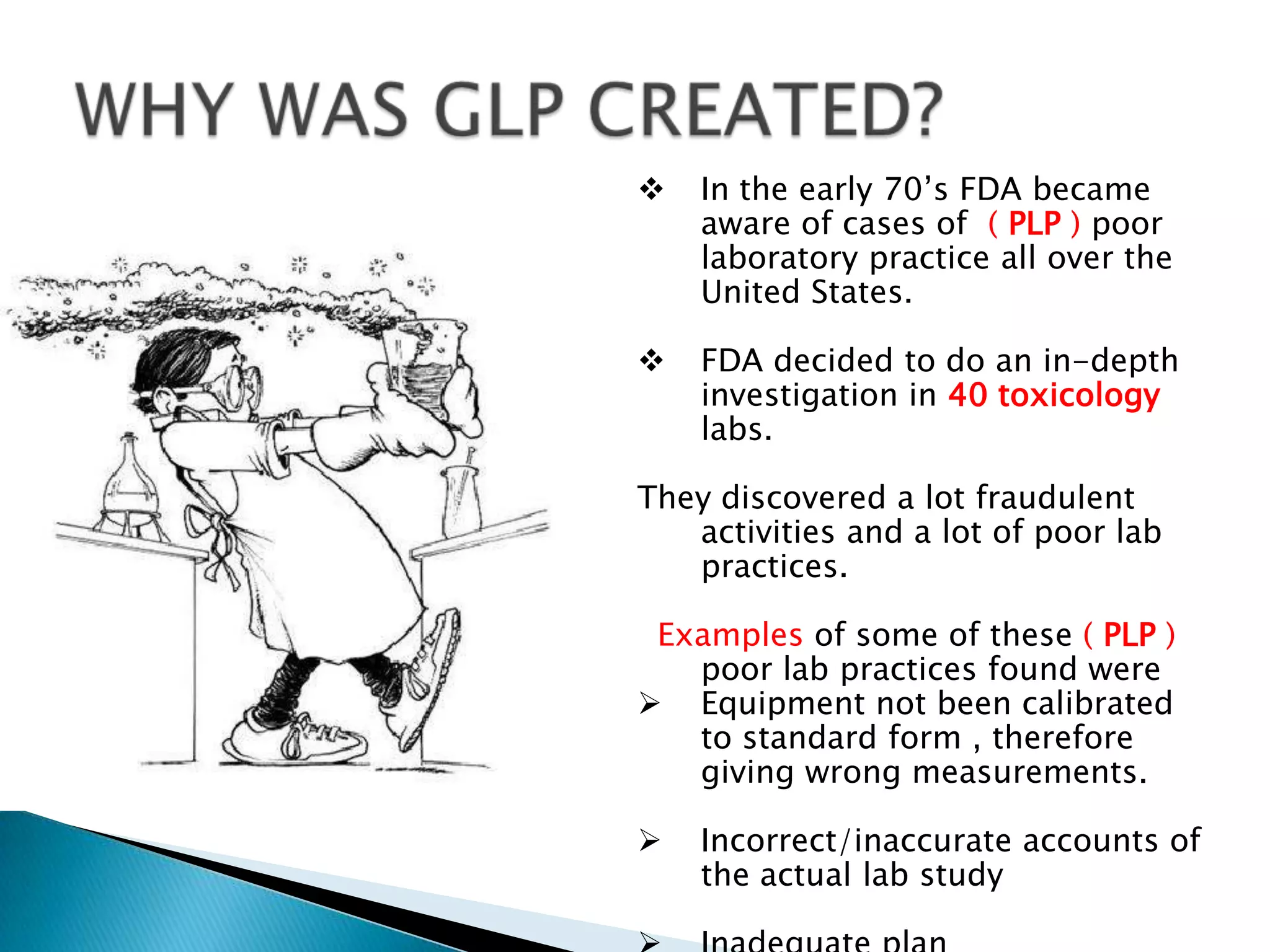
 In the early 70’s FDA became
aware of cases of ( PLP ) poor
laboratory practice all over the
United States.
 FDA decided to do an in-depth
investigation in 40 toxicology
labs.
They discovered a lot fraudulent
activities and a lot of poor lab
practices.
Examples of some of these ( PLP )
poor lab practices found were
 Equipment not been calibrated
to standard form , therefore
giving wrong measurements.
 Incorrect/inaccurate accounts of
the actual lab study
 One of the labs that went
under such an investigation
made headline news.
 The name of the Lab was
Industrial Bio Test. This was a
big lab that ran tests for big
companies such as Procter and
Gamble.
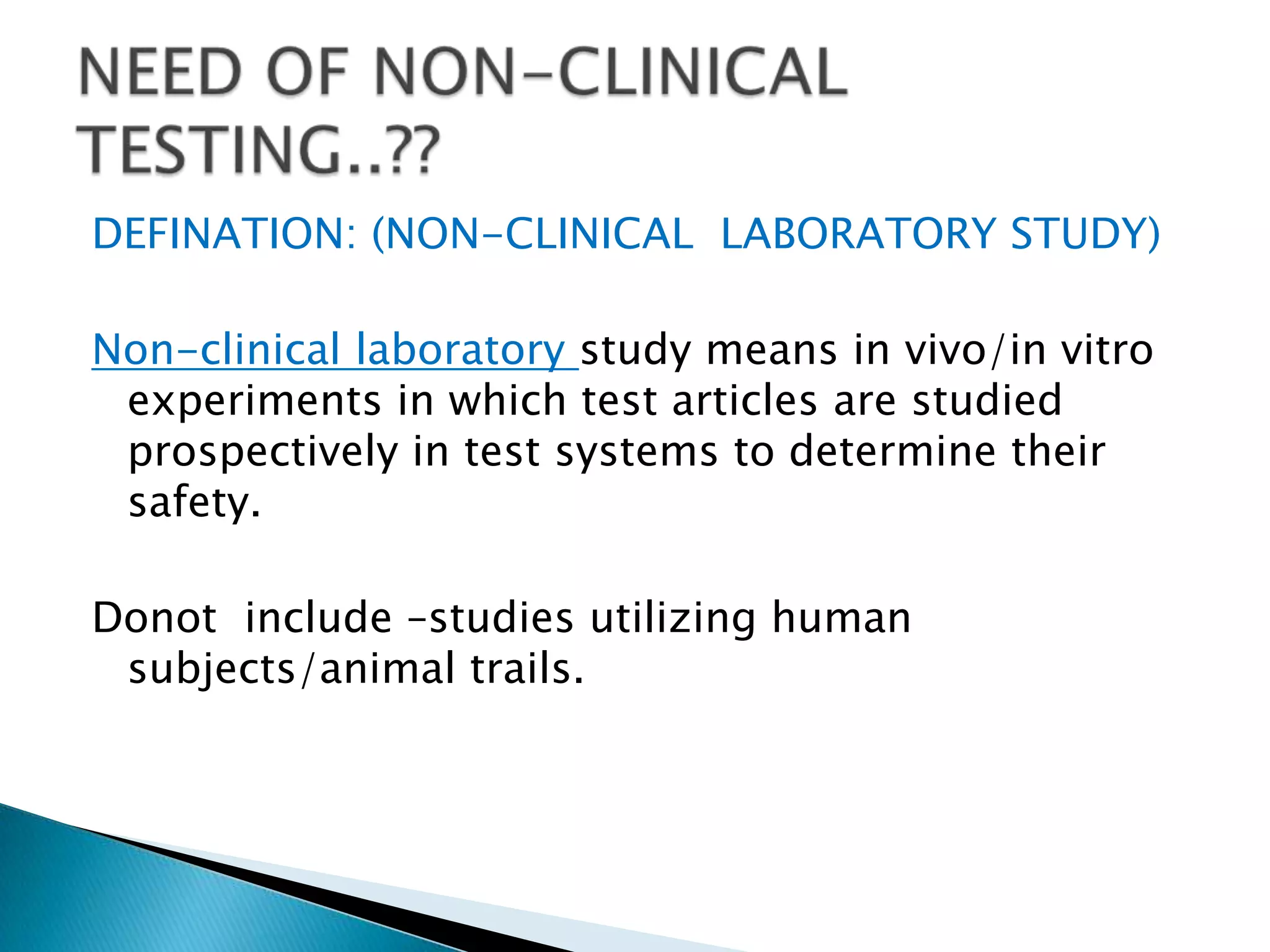
 It was discovered that mice
that they had used to test
lotion and deodorants had
developed cancer and died
 To promote the development of
quality test data..
 Set standards for ensuring the
quality,reliability & integrity of
studies...
 To ensure good operational
management…
 Focus on aspects of study
execution(planning,monitoring,rec
ording, reporting, archiving).
DEFINATION: (NON-CLINICAL LABORATORY STUDY)
Non-clinical laboratory study means in vivo/in vitro
experiments in which test articles are studied
prospectively in test systems to determine their
safety.
Donot include –studies utilizing human
subjects/animal trails.
 Characterisation of toxic effects with respect to
target organs.
 Dose dependence
 To estimate an initial safe starting dose & dose
range for human trials
 To identify parameters for clinical monitoring to
characterise potential adverse effects that might
occur during clinical trial
 The united states FDA has rules
for GLP in 21CFR58.
 Non-clinical trials use these rules
prior to clinical research in
humans.
 Research not conducted under
these restrictions or research
done outside US not conducted
accordingly to the FDA rules
might be inadmissible in support
of NDA in US.
[code of Federal Regulations]
[Title 21, volume 1]
[CITE:21CFR58]
TITLE 21—FOOD AND DRUGS
CHAPTER 1—FOOD AND DRUG ADMINISTRATION
DEPARTMENT OF HEALTH AND HUMAN SERVICES
SUB CHAPTER A-- GENERAL
21 CFR PART 58:
GOOD LABORATORY PRACTICES (GLP) FOR NON-CLINICAL
LABORATORY STUDIES.
Subpart A: General Provisions
Subpart B: Organization and Personnel
Subpart C: Facilities
Subpart D: Equipment
Subpart E: Testing Facilities Operation
Subpart F: Test and Control Articles
Subpart G: Protocol for and Conduct of a
Non-Clinical Laboratory Study
Subpart J: Records and Reports
Subpart K: Disqualification of Testing
Facilities
 Sec58.1:SCOPE
Sec58.3:DEFINATIONS
Sec58.10:APPLICABILITY TO STUDIES PERFORMED
UNDER GRANTS & CONTRACTS
Sec58.15:INSPECTION OF A TESTING FACILITY
 This part includes good laboratory practices for
conducting non-clinical laboratory studies that support
/intended to support applications for research or
marketing permits for products regulated by FDA
including
food and colour additives,
animal food additives,
human and animal drugs,
medical devices for human use,
biological products and electronic products.
 Compilance with this part is intended to assure the
quality and integrity of the safety data filed under
sections of Food,Drug and Cosmetics Act.
a) Act
b) Test article
c) Control article
d) Non-clinical laboratory study
e) Application for research or marketing permit
Sec. 58.10 Applicability to studies performed under
grants and contracts
 When a sponsor conducting a nonclinical
laboratory study intended to be submitted to or
reviewed by the FDA utilizes the services of a
consulting laboratory, contractor, or grantee to
perform an analysis or other service, it shall
notify the consulting laboratory, contractor, or
grantee that the service is part of a nonclinical
laboratory study that must be conducted in
compliance with the provisions of this part.
16
Sec. 58.15 Inspection of a testing
facility
A testing facility shall permit an authorized
employee of the FDA, at reasonable times and in a
reasonable manner, to inspect the facility and to
inspect all records and specimens required to be
maintained regarding studies within the scope of
this part.
The records inspection and copying requirements
shall not apply to quality assurance unit records of
findings and problems, or to actions recommended
and taken.
The FDA will not consider a nonclinical laboratory
study in support of an application for a research or
marketing permit if the testing facility refuses to
permit inspection.
17
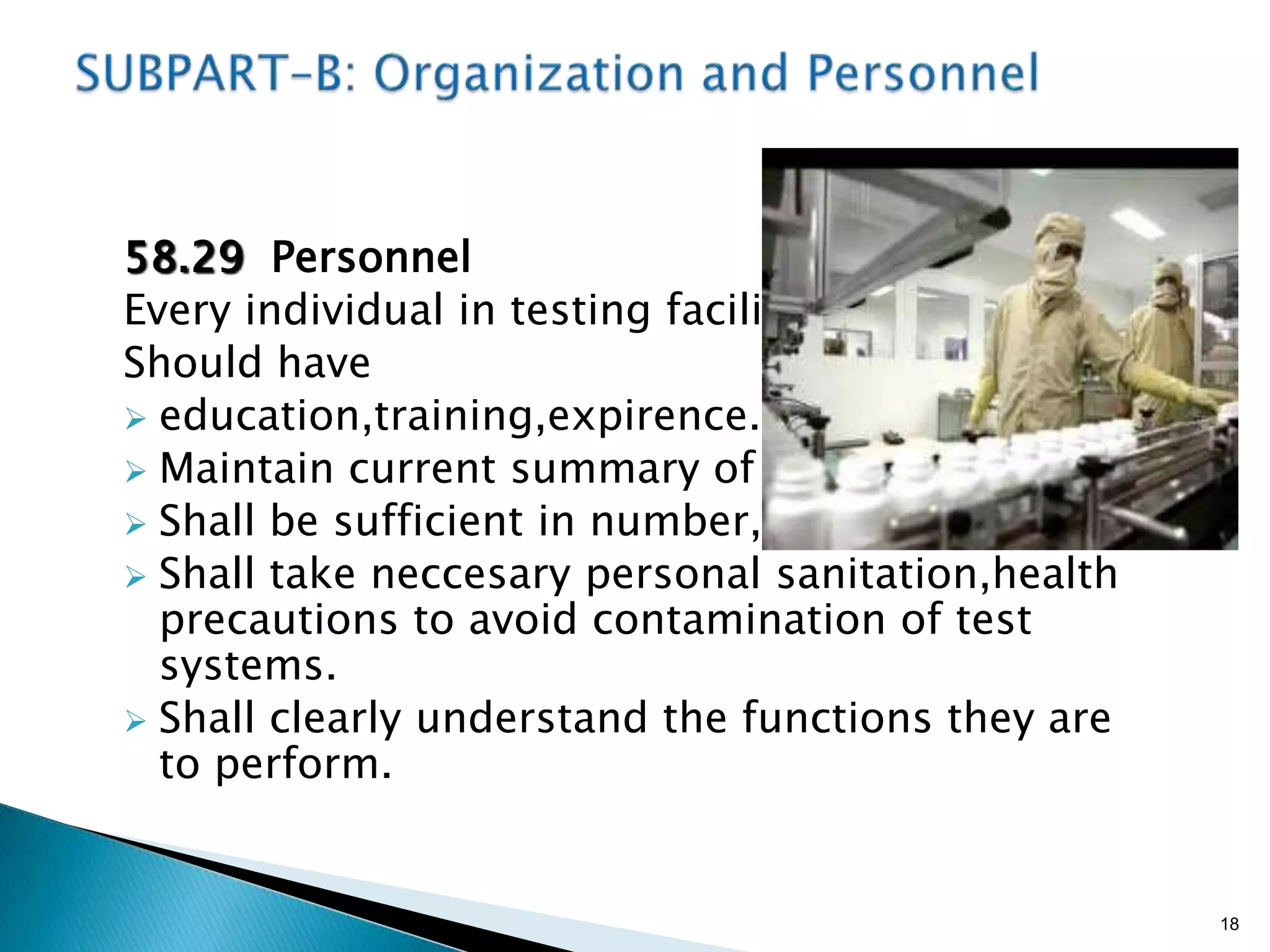
58.29 Personnel
Every individual in testing facility
Should have
 education,training,expirence.
 Maintain current summary of job ,
 Shall be sufficient in number,
 Shall take neccesary personal sanitation,health
precautions to avoid contamination of test
systems.
 Shall clearly understand the functions they are
to perform.
18
58.33 Study Director 58.35 Quality Assurance Unit
 ―A scientist /proffesional of
appropriate
education,training,
experience‖
 Responsible for overall
technical conduct of the
study,
Interpretation,
analysis,
documentation &
reporting of results.
 Single point of study control.
 ―A independent personal
responsible to assure the
management(I,e-facilities,
equipment, personnel,
methods,practices,records
and controls are in
conformance with the
regulations in that part.‖
19
FACILITIES…
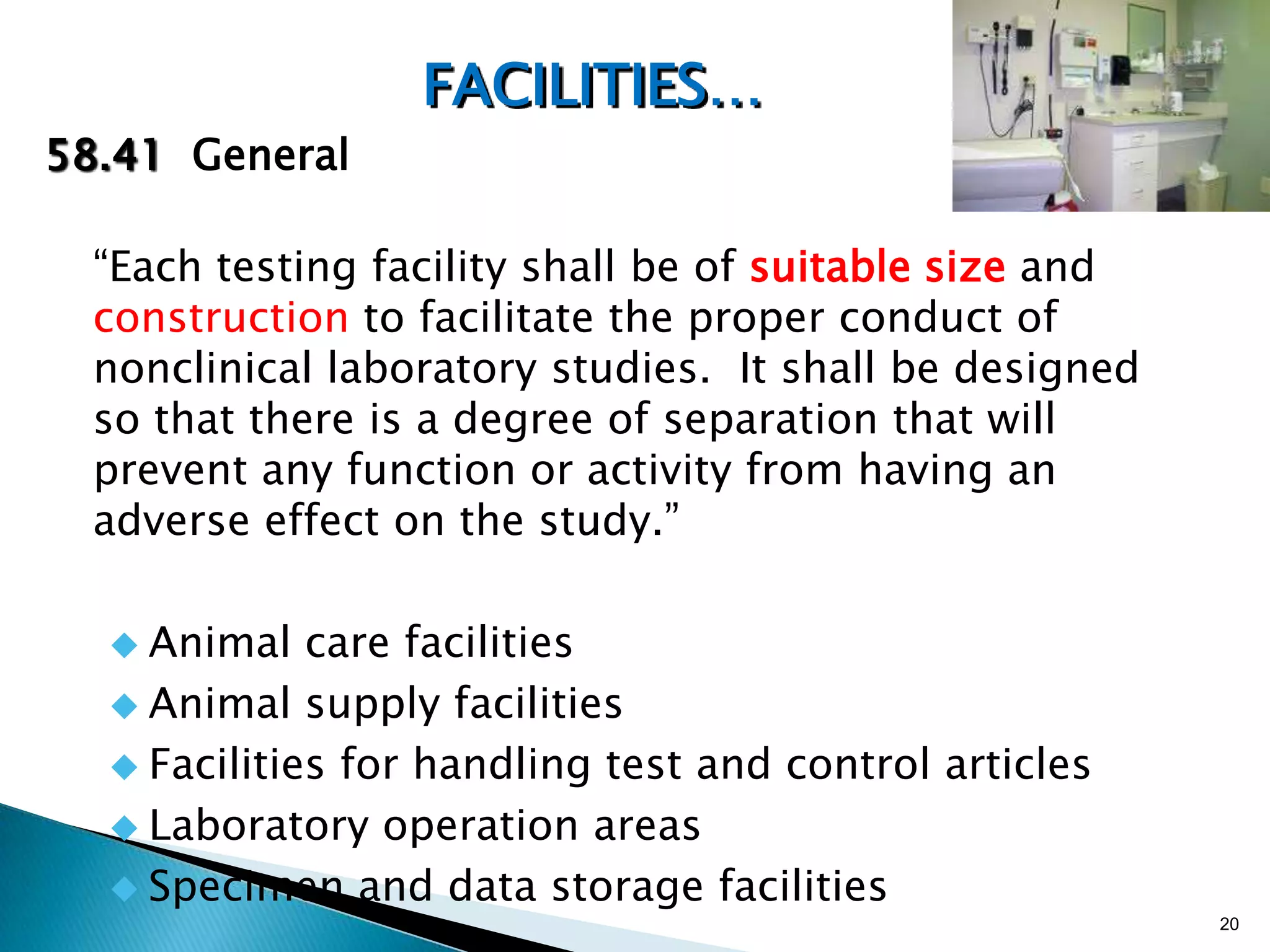
58.41 General
―Each testing facility shall be of suitable size and
construction to facilitate the proper conduct of
nonclinical laboratory studies. It shall be designed
so that there is a degree of separation that will
prevent any function or activity from having an
adverse effect on the study.‖
 Animal care facilities
 Animal supply facilities
 Facilities for handling test and control articles
 Laboratory operation areas
 Specimen and data storage facilities
20
EQUIPMENT…
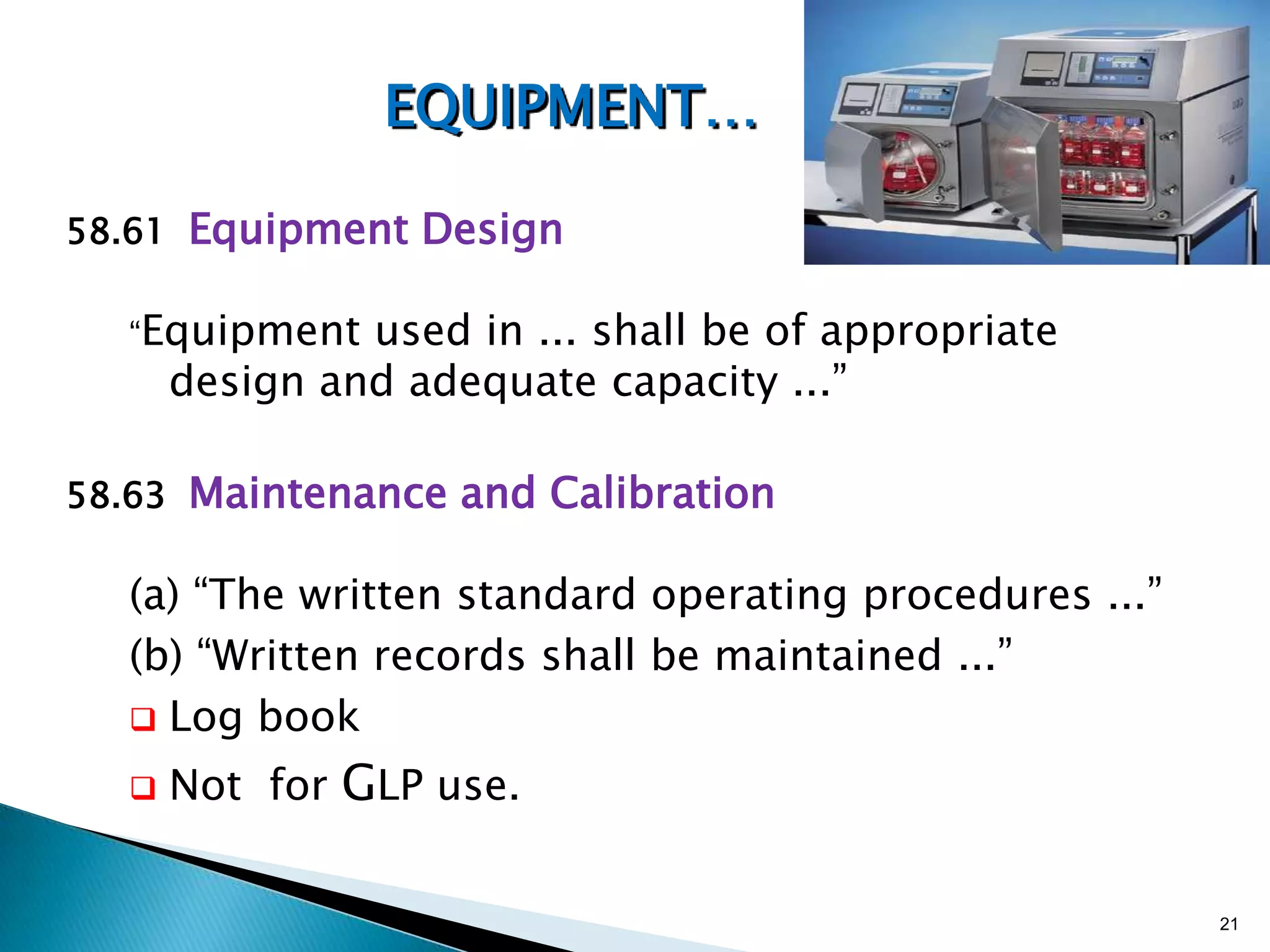
58.61 Equipment Design
―Equipment used in ... shall be of appropriate
design and adequate capacity ...‖
58.63 Maintenance and Calibration
(a) ―The written standard operating procedures ...‖
(b) ―Written records shall be maintained ...‖
 Log book
 Not for GLP use.
21
• Verification (Testing):
external check of
equipment accuracy
(e.g. check balance
accuracy against
weights at laboratory-
no adjustment)
• Calibration: equipment
is adjusted based on
comparison to
certified or known
reference materials
(e.g. balance adjusted
after comparison to
certified weights by
trained professional)
• Standardization:
comparison with
similar equipment
(e.g. use two
thermometers of
similar design to
compare readings) 22
Verification??
Calibration ? Standardization?
23
Sec 58.81: STANDARD OPERATING
PROCEDURES:
(a) A testing facility shall have standard
operating procedures in writing setting
forth study methods that management is
satisfied are adequate to insure the
quality and integrity of the data generated
in the course of a study.‖
 Written procedures for a laboratories
program.
 They define how to carry out protocol-
specified activities.
 Most often written in a chronological
listing of action steps.
 They are written to explain how the
procedures are suppose to work.
SUBPART E- FACILITIES TESTING OPERATION:
24
 SOPs should accurately reflect how
routine tasks are performed
 Routine inspection, cleaning,
maintenance, testing and
calibration.
 Actions to be taken in response to
equipment failure.
 Reviewed on regular basis.
 There should be SOP’s for housing, feeding,
handling and caring of animals.
 Diagnosis, authorizations of treatment of
treatment, description of treatment, each date of
treatment shall be documented & retained.
REAGENTS and SOLUTIONS:
 Reagents and solutions in laboratory areas shall be
labelled to indicate identity, titer or concentrations,
storage requirements and expiration date.
Test and control article characterisation:
 the identity , strength, purity and composition or other
characteristics which will define the test or control articles
shall be determined for each batch & documented.
 Method of synthesis, fabrication, derivation of the articles
shall be documented by sponsor /testing facility.
 Procedures shall be established for proper handling.
 Distribution is made in a designed manner to prevent
possibility of contamination,deteriotation and damage.
SUBPART G- PROTOCOL FOR AND
CONDUCT OF A NON-CLINICAL
LABORATORY STUDY:
58.120 Protocol
―Each study shall have an approved written protocol that clearly
indicates the objectives and all methods for the conduct of the
study.‖
58.130 Conduct of a Non-clinical Laboratory Study
―The nonclinical laboratory study shall be conducted in accordance with
the protocol‖
27
58.185 Reporting of Non-clinical Laboratory Study
Results
―A final report shall be prepared for each nonclinical
laboratory study Which include a detailed documentation of
how whole study carried out by the testing facility ...‖
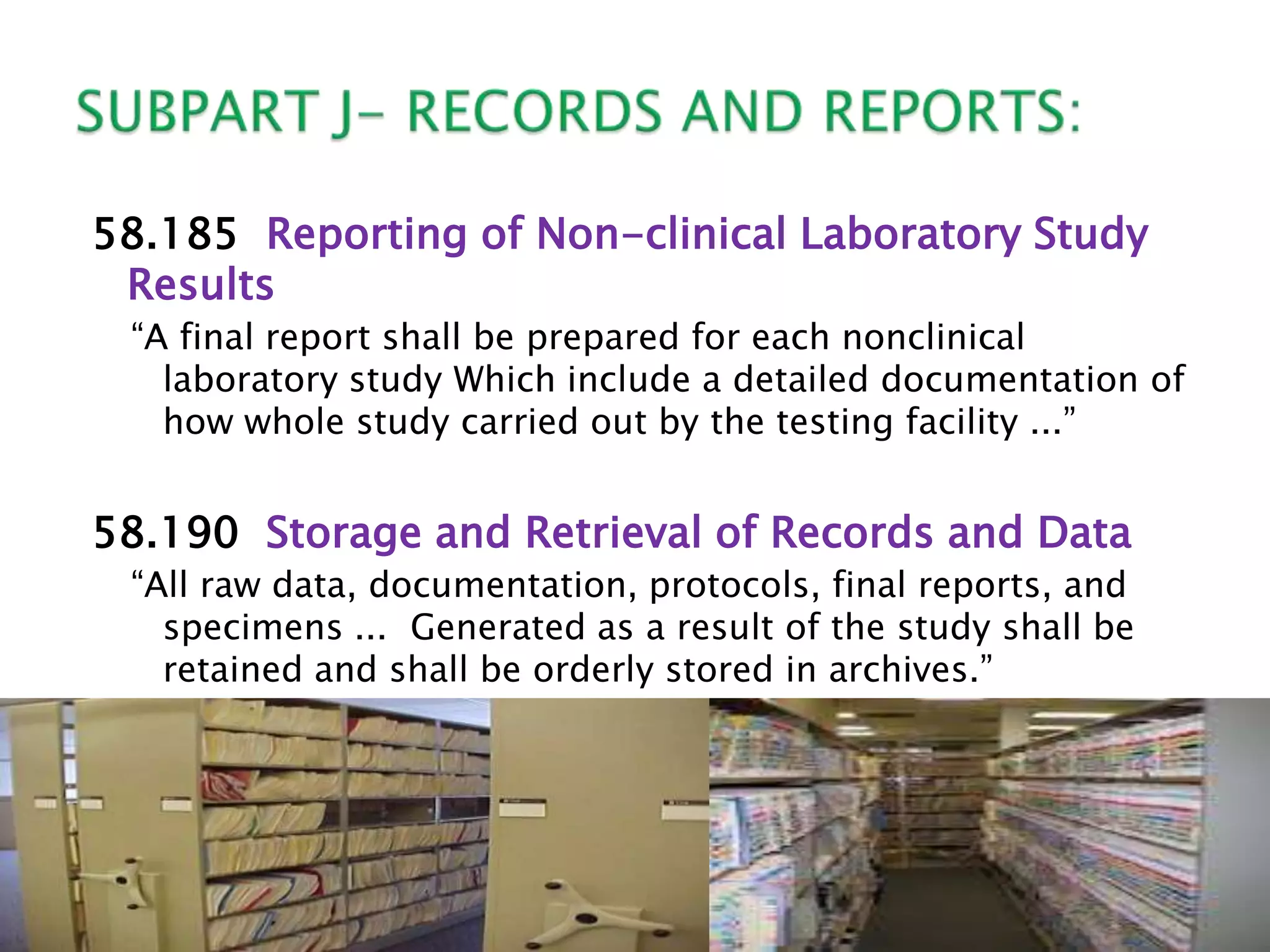
58.190 Storage and Retrieval of Records and Data
―All raw data, documentation, protocols, final reports, and
specimens ... Generated as a result of the study shall be
retained and shall be orderly stored in archives.‖
29
 Grounds of disqualification:
The commissioner may disqualify a testing facility
upon finding:
 The testing facility failed to comply with one or
more of the regulations.
 Non-compliance adversely affected the validity of
the non-clinical laboratory study.
31
The FDA states the following
consequences of noncompliance:
 The commissioner will send a written
proposal of disqualification to the testing
facility
 A regulatory hearing on the disqualification
will be scheduled
 If the commissioner finds that after the
hearing, the facility has complied, then a
written statement with an explanation of
termination of disqualification will be sent
to the facility
 Thus, if it can be shown that such
disqualifications did not affect the integrity
and outcome of the study itself, or did not
32
If the commissioner finds that the facility showed a
noncompliance, any of the grounds after the hearing, then
a final order of noncompliance will be sent to the facility
with explanations
 If a testing facility has been disqualified, any studies done
before of after the disqualification will need to be determined
as essential to a decision (acceptable or not)
 If the study is determined unacceptable, then the facility
itself may need to show that the study was not affected by
the noncompliance that led to the disqualification
 Once finally disqualified, the facility may not receive or be
considered for a research or marketing permit and the study
is rejected.
33
 The commissioner may notify the public and all interested
persons, including other federal agencies the facility may
have contacted
 The FDA may ask the other agencies to consider whether to
support the facility or not under the disqualification
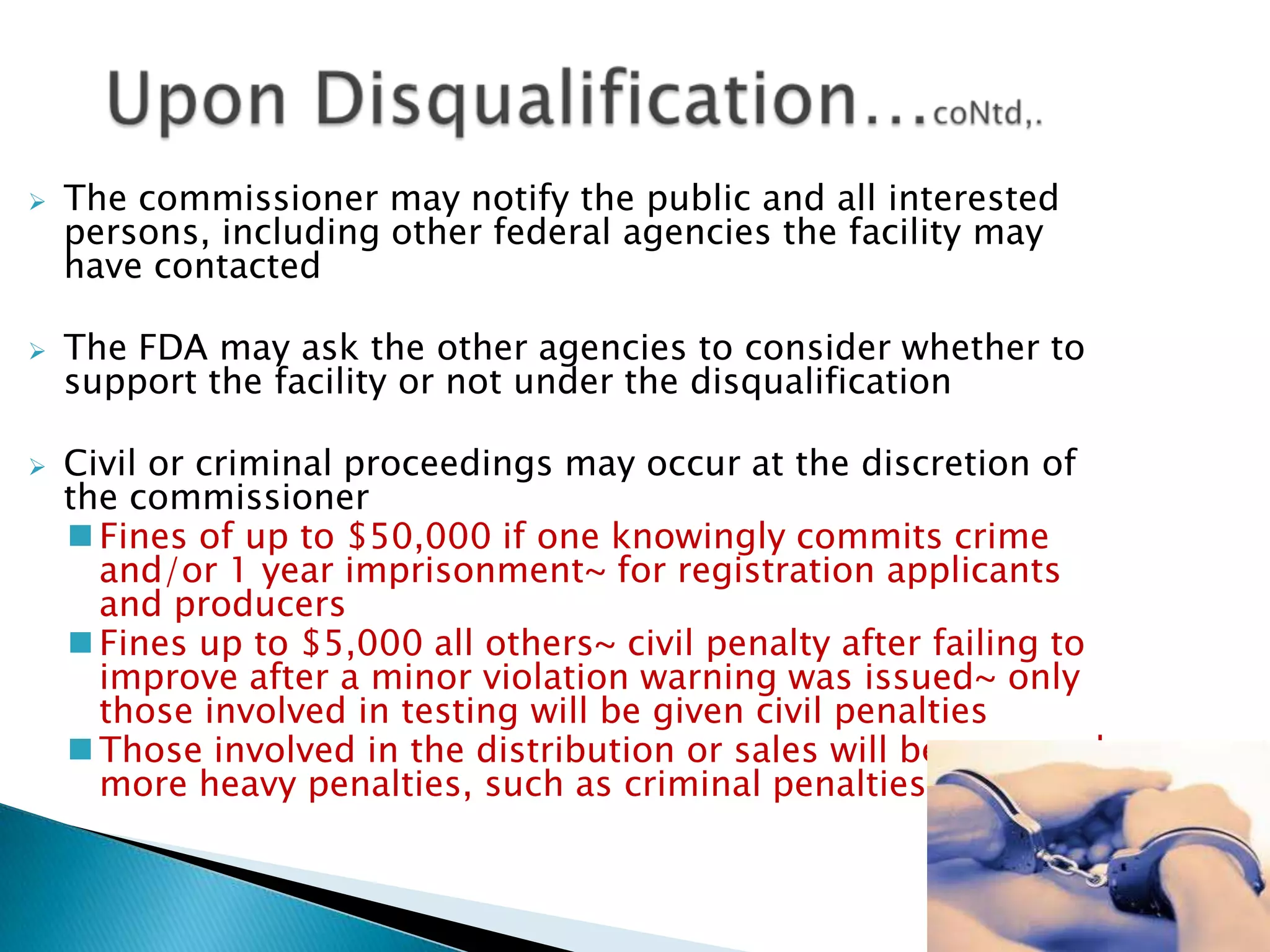
 Civil or criminal proceedings may occur at the discretion of
the commissioner
 Fines of up to $50,000 if one knowingly commits crime
and/or 1 year imprisonment~ for registration applicants
and producers
 Fines up to $5,000 all others~ civil penalty after failing to
improve after a minor violation warning was issued~ only
those involved in testing will be given civil penalties
 Those involved in the distribution or sales will be assessed
more heavy penalties, such as criminal penalties
34
 The FDA may turn it over to the federal, state or local
law enforcement
 The facility’s sponsor may terminate or suspend the
facility from doing any non- clinical study for a permit
 The sponsor is required to notify the FDA in writing
within 15 working days that the facility is to be
suspended or terminated and why
35
 The commissioner will inspect the facility and
determine if it shall be reinstated
 If it is reinstated, the commissioner is required to
notify all persons that were notified of the
disqualification including the facility itself
 These Regulations specify minimum standards for the
conduct of safety testing to achieve great results with
minimal adverse effects.
 The Principles may be considered as a set of criteria to be
satisfied as a basis for ensuring the quality, reliability and
integrity of studies, the reporting of verifiable conclusions,
and the traceability of data.
 http://www.fda.gov/oc/gcp/guidance.htm
 http://www.clinicaltrials.gov/
 http://www.fda.gov/oc/ohrt/irbs/websites.html
 http://ohrp.osophs.dhhs.gov/
 http://privacyruleandresearch.nih.gov/
 http://en.wikipedia.org/wiki/ICH-GCP
 Handbook: good laboratory practice (GLP): quality practices for
regulated non-clinical research and development -2nd ed., WHO
Library Cataloguing-in-Publication Data, 2nd ed., 7,15-20OECD
Principles of Good Laboratory Practice (as revised in 1997)".
OECD Environmental Health and Safety Publications (OECD) 1.
1998.
http://www.oecd.org/document/63/0,2340,en_2649_34381_234
6175_1_1_1_37465,00.html.
 Schneider, K (1983(Spring)). "Faking it: The case against
Industrial Bio-Test Laboratories". Amicus Journal (Natural
Resources Defence Council): 14-26.
USFDA guidelines of glp for non clinical testing laboratories

USFDA guidelines of glp for non clinical testing laboratories

  • 1.
    S.Susena Pharmaceutical analysis &QA SSJCOLLEGE OF PHARMACY, HYDERABAD
  • 2.
     INTRODUCTION TOGLP  WHY WAS GLP CREATED??  NEED OF NON-CLINICAL TESTING??  GLP & USFDA..  USFDA GUIDELINES OF GLP FOR NON- CLINICAL TRAILS….
  • 3.
     GLP isan FDA regulation.  It is defined in OECD principles as ―a quality system concerned with organisational process and the conditions under which non-clinical health and environmental safety studies are planned,performed, monitored,recorded,archived and reported.
  • 4.
     GLP isa formal regulation that was created by the FDA (United states food and drug administration) in 1978.  Although GLP originated in the United States , it had a world wide impact.  Non-US companies that wanted to do business with the United states or register their pharmacies in the United States had to comply with the United States GLP regulations.  They eventually started making GLP regulations in their home countries.  In 1981 an organization named OECD (organization for economic co-operation and development ) produced GLP principles that are international standard.
  • 5.
     In theearly 70’s FDA became aware of cases of ( PLP ) poor laboratory practice all over the United States.  FDA decided to do an in-depth investigation in 40 toxicology labs. They discovered a lot fraudulent activities and a lot of poor lab practices. Examples of some of these ( PLP ) poor lab practices found were  Equipment not been calibrated to standard form , therefore giving wrong measurements.  Incorrect/inaccurate accounts of the actual lab study
  • 6.
     One ofthe labs that went under such an investigation made headline news.  The name of the Lab was Industrial Bio Test. This was a big lab that ran tests for big companies such as Procter and Gamble.  It was discovered that mice that they had used to test lotion and deodorants had developed cancer and died
  • 7.
     To promotethe development of quality test data..  Set standards for ensuring the quality,reliability & integrity of studies...  To ensure good operational management…  Focus on aspects of study execution(planning,monitoring,rec ording, reporting, archiving).
  • 8.
    DEFINATION: (NON-CLINICAL LABORATORYSTUDY) Non-clinical laboratory study means in vivo/in vitro experiments in which test articles are studied prospectively in test systems to determine their safety. Donot include –studies utilizing human subjects/animal trails.
  • 9.
     Characterisation oftoxic effects with respect to target organs.  Dose dependence  To estimate an initial safe starting dose & dose range for human trials  To identify parameters for clinical monitoring to characterise potential adverse effects that might occur during clinical trial
  • 10.
     The unitedstates FDA has rules for GLP in 21CFR58.  Non-clinical trials use these rules prior to clinical research in humans.  Research not conducted under these restrictions or research done outside US not conducted accordingly to the FDA rules might be inadmissible in support of NDA in US.
  • 11.
    [code of FederalRegulations] [Title 21, volume 1] [CITE:21CFR58] TITLE 21—FOOD AND DRUGS CHAPTER 1—FOOD AND DRUG ADMINISTRATION DEPARTMENT OF HEALTH AND HUMAN SERVICES SUB CHAPTER A-- GENERAL 21 CFR PART 58: GOOD LABORATORY PRACTICES (GLP) FOR NON-CLINICAL LABORATORY STUDIES.
  • 12.
    Subpart A: GeneralProvisions Subpart B: Organization and Personnel Subpart C: Facilities Subpart D: Equipment Subpart E: Testing Facilities Operation Subpart F: Test and Control Articles Subpart G: Protocol for and Conduct of a Non-Clinical Laboratory Study Subpart J: Records and Reports Subpart K: Disqualification of Testing Facilities
  • 13.
     Sec58.1:SCOPE Sec58.3:DEFINATIONS Sec58.10:APPLICABILITY TOSTUDIES PERFORMED UNDER GRANTS & CONTRACTS Sec58.15:INSPECTION OF A TESTING FACILITY
  • 14.
     This partincludes good laboratory practices for conducting non-clinical laboratory studies that support /intended to support applications for research or marketing permits for products regulated by FDA including food and colour additives, animal food additives, human and animal drugs, medical devices for human use, biological products and electronic products.  Compilance with this part is intended to assure the quality and integrity of the safety data filed under sections of Food,Drug and Cosmetics Act.
  • 15.
    a) Act b) Testarticle c) Control article d) Non-clinical laboratory study e) Application for research or marketing permit
  • 16.
    Sec. 58.10 Applicabilityto studies performed under grants and contracts  When a sponsor conducting a nonclinical laboratory study intended to be submitted to or reviewed by the FDA utilizes the services of a consulting laboratory, contractor, or grantee to perform an analysis or other service, it shall notify the consulting laboratory, contractor, or grantee that the service is part of a nonclinical laboratory study that must be conducted in compliance with the provisions of this part. 16
  • 17.
    Sec. 58.15 Inspectionof a testing facility A testing facility shall permit an authorized employee of the FDA, at reasonable times and in a reasonable manner, to inspect the facility and to inspect all records and specimens required to be maintained regarding studies within the scope of this part. The records inspection and copying requirements shall not apply to quality assurance unit records of findings and problems, or to actions recommended and taken. The FDA will not consider a nonclinical laboratory study in support of an application for a research or marketing permit if the testing facility refuses to permit inspection. 17
  • 18.
    58.29 Personnel Every individualin testing facility Should have  education,training,expirence.  Maintain current summary of job ,  Shall be sufficient in number,  Shall take neccesary personal sanitation,health precautions to avoid contamination of test systems.  Shall clearly understand the functions they are to perform. 18
  • 19.
    58.33 Study Director58.35 Quality Assurance Unit  ―A scientist /proffesional of appropriate education,training, experience‖  Responsible for overall technical conduct of the study, Interpretation, analysis, documentation & reporting of results.  Single point of study control.  ―A independent personal responsible to assure the management(I,e-facilities, equipment, personnel, methods,practices,records and controls are in conformance with the regulations in that part.‖ 19
  • 20.
    FACILITIES… 58.41 General ―Each testingfacility shall be of suitable size and construction to facilitate the proper conduct of nonclinical laboratory studies. It shall be designed so that there is a degree of separation that will prevent any function or activity from having an adverse effect on the study.‖  Animal care facilities  Animal supply facilities  Facilities for handling test and control articles  Laboratory operation areas  Specimen and data storage facilities 20
  • 21.
    EQUIPMENT… 58.61 Equipment Design ―Equipmentused in ... shall be of appropriate design and adequate capacity ...‖ 58.63 Maintenance and Calibration (a) ―The written standard operating procedures ...‖ (b) ―Written records shall be maintained ...‖  Log book  Not for GLP use. 21
  • 22.
    • Verification (Testing): externalcheck of equipment accuracy (e.g. check balance accuracy against weights at laboratory- no adjustment) • Calibration: equipment is adjusted based on comparison to certified or known reference materials (e.g. balance adjusted after comparison to certified weights by trained professional) • Standardization: comparison with similar equipment (e.g. use two thermometers of similar design to compare readings) 22 Verification?? Calibration ? Standardization?
  • 23.
    23 Sec 58.81: STANDARDOPERATING PROCEDURES: (a) A testing facility shall have standard operating procedures in writing setting forth study methods that management is satisfied are adequate to insure the quality and integrity of the data generated in the course of a study.‖  Written procedures for a laboratories program.  They define how to carry out protocol- specified activities.  Most often written in a chronological listing of action steps.  They are written to explain how the procedures are suppose to work. SUBPART E- FACILITIES TESTING OPERATION:
  • 24.
    24  SOPs shouldaccurately reflect how routine tasks are performed  Routine inspection, cleaning, maintenance, testing and calibration.  Actions to be taken in response to equipment failure.  Reviewed on regular basis.
  • 25.
     There shouldbe SOP’s for housing, feeding, handling and caring of animals.  Diagnosis, authorizations of treatment of treatment, description of treatment, each date of treatment shall be documented & retained. REAGENTS and SOLUTIONS:  Reagents and solutions in laboratory areas shall be labelled to indicate identity, titer or concentrations, storage requirements and expiration date.
  • 26.
    Test and controlarticle characterisation:  the identity , strength, purity and composition or other characteristics which will define the test or control articles shall be determined for each batch & documented.  Method of synthesis, fabrication, derivation of the articles shall be documented by sponsor /testing facility.  Procedures shall be established for proper handling.  Distribution is made in a designed manner to prevent possibility of contamination,deteriotation and damage.
  • 27.
    SUBPART G- PROTOCOLFOR AND CONDUCT OF A NON-CLINICAL LABORATORY STUDY: 58.120 Protocol ―Each study shall have an approved written protocol that clearly indicates the objectives and all methods for the conduct of the study.‖ 58.130 Conduct of a Non-clinical Laboratory Study ―The nonclinical laboratory study shall be conducted in accordance with the protocol‖ 27
  • 28.
    58.185 Reporting ofNon-clinical Laboratory Study Results ―A final report shall be prepared for each nonclinical laboratory study Which include a detailed documentation of how whole study carried out by the testing facility ...‖ 58.190 Storage and Retrieval of Records and Data ―All raw data, documentation, protocols, final reports, and specimens ... Generated as a result of the study shall be retained and shall be orderly stored in archives.‖
  • 29.
  • 30.
     Grounds ofdisqualification: The commissioner may disqualify a testing facility upon finding:  The testing facility failed to comply with one or more of the regulations.  Non-compliance adversely affected the validity of the non-clinical laboratory study.
  • 31.
    31 The FDA statesthe following consequences of noncompliance:  The commissioner will send a written proposal of disqualification to the testing facility  A regulatory hearing on the disqualification will be scheduled  If the commissioner finds that after the hearing, the facility has complied, then a written statement with an explanation of termination of disqualification will be sent to the facility  Thus, if it can be shown that such disqualifications did not affect the integrity and outcome of the study itself, or did not
  • 32.
    32 If the commissionerfinds that the facility showed a noncompliance, any of the grounds after the hearing, then a final order of noncompliance will be sent to the facility with explanations  If a testing facility has been disqualified, any studies done before of after the disqualification will need to be determined as essential to a decision (acceptable or not)  If the study is determined unacceptable, then the facility itself may need to show that the study was not affected by the noncompliance that led to the disqualification  Once finally disqualified, the facility may not receive or be considered for a research or marketing permit and the study is rejected.
  • 33.
    33  The commissionermay notify the public and all interested persons, including other federal agencies the facility may have contacted  The FDA may ask the other agencies to consider whether to support the facility or not under the disqualification  Civil or criminal proceedings may occur at the discretion of the commissioner  Fines of up to $50,000 if one knowingly commits crime and/or 1 year imprisonment~ for registration applicants and producers  Fines up to $5,000 all others~ civil penalty after failing to improve after a minor violation warning was issued~ only those involved in testing will be given civil penalties  Those involved in the distribution or sales will be assessed more heavy penalties, such as criminal penalties
  • 34.
    34  The FDAmay turn it over to the federal, state or local law enforcement  The facility’s sponsor may terminate or suspend the facility from doing any non- clinical study for a permit  The sponsor is required to notify the FDA in writing within 15 working days that the facility is to be suspended or terminated and why
  • 35.
    35  The commissionerwill inspect the facility and determine if it shall be reinstated  If it is reinstated, the commissioner is required to notify all persons that were notified of the disqualification including the facility itself
  • 36.
     These Regulationsspecify minimum standards for the conduct of safety testing to achieve great results with minimal adverse effects.  The Principles may be considered as a set of criteria to be satisfied as a basis for ensuring the quality, reliability and integrity of studies, the reporting of verifiable conclusions, and the traceability of data.
  • 37.
     http://www.fda.gov/oc/gcp/guidance.htm  http://www.clinicaltrials.gov/ http://www.fda.gov/oc/ohrt/irbs/websites.html  http://ohrp.osophs.dhhs.gov/  http://privacyruleandresearch.nih.gov/  http://en.wikipedia.org/wiki/ICH-GCP  Handbook: good laboratory practice (GLP): quality practices for regulated non-clinical research and development -2nd ed., WHO Library Cataloguing-in-Publication Data, 2nd ed., 7,15-20OECD Principles of Good Laboratory Practice (as revised in 1997)". OECD Environmental Health and Safety Publications (OECD) 1. 1998. http://www.oecd.org/document/63/0,2340,en_2649_34381_234 6175_1_1_1_37465,00.html.  Schneider, K (1983(Spring)). "Faking it: The case against Industrial Bio-Test Laboratories". Amicus Journal (Natural Resources Defence Council): 14-26.