1
Quality by Design (QBD)
Prepared By: Khushi Gor
M.Pharm Semester-1 (Regulatory Affairs)
K.B. INSTITUTE OF PHARMACEUTICAL EDUCATION AND RESEARCH
2
List of content
 Introduction
 Concept and background of QBD
 Advantages of QBD
 Objectives of QBD
 Key aspects of QBD
 Significance of QBD
3
Introduction
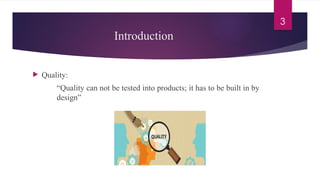
 Quality:
“Quality can not be tested into products; it has to be built in by
design”
4
Conti….
 Definition of QBD:
“Systemic approach to development that begins with predefined
objectives and emphasizes product and process understanding and process
control, based on sound science and quality risk management”
5
Concepts and Background of QBD
 Quality by Design (QBD) is a concept first outlined by Joseph M. juran in
various publications.
 He supposed that quality could be planned.
 The concept of QBD was mention in ICH Q8 guidelines, which states that,
“To Identify quality should be built in to product by design.”
6
Advantages of QBD
 Benefits for Industry:
• Better Understanding of the process.
• Less batch failure.
• More efficient and effective control of change.
• Return on investment / cost savings.
7
Conti….
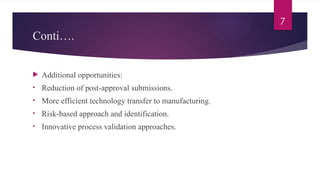
 Additional opportunities:
• Reduction of post-approval submissions.
• More efficient technology transfer to manufacturing.
• Risk-based approach and identification.
• Innovative process validation approaches.
8
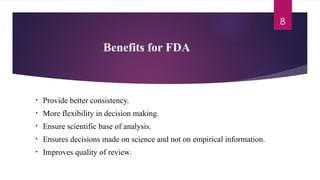
Benefits for FDA
• Provide better consistency.
• More flexibility in decision making.
• Ensure scientific base of analysis.
• Ensures decisions made on science and not on empirical information.
• Improves quality of review.
9
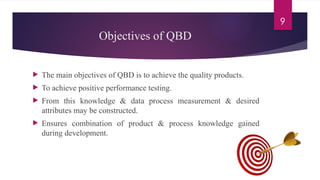
Objectives of QBD
 The main objectives of QBD is to achieve the quality products.
 To achieve positive performance testing.
 From this knowledge & data process measurement & desired
attributes may be constructed.
 Ensures combination of product & process knowledge gained
during development.
10
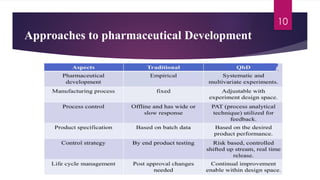
Approaches to pharmaceutical Development
11
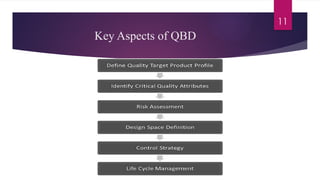
Key Aspects of QBD
12
Conti….
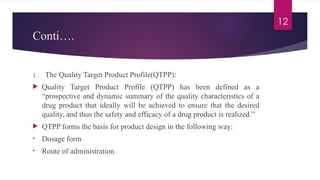
1. The Quality Target Product Profile(QTPP):
 Quality Target Product Profile (QTPP) has been defined as a
“prospective and dynamic summary of the quality characteristics of a
drug product that ideally will be achieved to ensure that the desired
quality, and thus the safety and efficacy of a drug product is realized.”
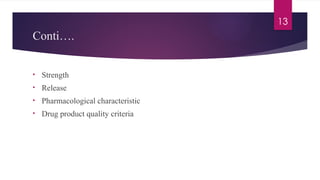
 QTPP forms the basis for product design in the following way:
• Dosage form
• Route of administration
13
Conti….
• Strength
• Release
• Pharmacological characteristic
• Drug product quality criteria
14
Conti….
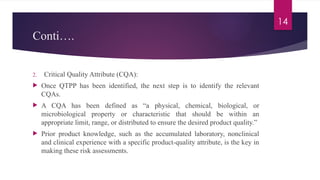
2. Critical Quality Attribute (CQA):
 Once QTPP has been identified, the next step is to identify the relevant
CQAs.
 A CQA has been defined as “a physical, chemical, biological, or
microbiological property or characteristic that should be within an
appropriate limit, range, or distributed to ensure the desired product quality.”
 Prior product knowledge, such as the accumulated laboratory, nonclinical
and clinical experience with a specific product-quality attribute, is the key in
making these risk assessments.
15
Conti….
3. Critical Process Parameter (CPPs):
 Critical process parameters (CPPs) are defined as “ parameters
whose variability have an impact on a CQA and therefore should be
monitored or controlled to ensure the process produces the desired
quality.”
 Process robustness is defined as the ability of a process to
demonstrate acceptable quality and performance and tolerate
variability in inputs at the same time.
16
Conti….
4. Risk Assessment:
 Quality risk management is a systematic process for the
assessment, control, communication and review of risks to the
quality of the drug (medicinal) product across the product lifecycle.
 The initial list of potential parameters which can affect CQAs can
be quite extensive but can be reduced by quality risk assessment
(QRA).
17
Conti….
5. Design Space:
 The ICH Q8(R2) States that the design space is multi dimensional
combination and interaction of input variables and process
parameters that have been demonstrated to provide assurance of
quality.
 Working within the design space is not considered as a change.
 Movement out of the design space is considered to be a change and
would normally initiate a regulatory post approval change process.
18
Conti….
6. Control Strategy:
 Control strategy is defined as “ a planned set of controls, derived from current
product and process understanding that assures process performance and product
quality.
 The ability to evaluate and ensure the quality of in-process and/or final product
based on process data which typically include a valid combination of measured
material attributes and process controls.
 The control strategy can include the following elements: procedural controls, in
process controls, lot release testing, process monitoring, characterization testing
and stability testing.
19
Conti….
7. Life Cycle Management:
 In the QBD paradigm, process changes within the design space will
not require review or approval.
 Therefore, process improvements during the product life cycle with
regard to process consistency and throughout could take place with
fewer post approval submissions.
20
Significance of QBD
 Quality by design means designing and developing formulations
and manufacturing processes to ensure a predefined quality.
 Quality by design requires understanding how formulation and
manufacturing process variables influence product quality.
 Quality by design ensures product quality with effective control
strategy.
21
References
 piramalpharmasolutions.com
 Gandhi A, Roy C; Quality by Design (QbD) in Pharmaceutical Industry: Tools, Perspectives and
Challenges; Pharma Tutor; 2016; 4(11); 12-20.
 Sushila D. Chavan, Nayana V. Pimpodkar, Amruta S. Kadam, Puja S.Gaikwad. Quality by Design :
Research and Reviews: Journal of Pharmaceutical Quality Assurance|Volume 1 | Issue 2 | October-
December, 2015.
 D. M. Patwardhan, S. S. Amrutkar , T. S. Kotwal and M. P. Wagh , APPLICATION OF QUALITY BY
DESIGN TO DIFFERENT ASPECTS OF PHARMACEUTICAL TECHNOLOGIES : IJPSR, 2017; Vol.
8(9): 3649-3662.
22
Thank you🙏

Quality by Design (Qbd) a modern approach .pptx

  • 1.
    1 Quality by Design(QBD) Prepared By: Khushi Gor M.Pharm Semester-1 (Regulatory Affairs) K.B. INSTITUTE OF PHARMACEUTICAL EDUCATION AND RESEARCH
  • 2.
    2 List of content Introduction  Concept and background of QBD  Advantages of QBD  Objectives of QBD  Key aspects of QBD  Significance of QBD
  • 3.
    3 Introduction  Quality: “Quality cannot be tested into products; it has to be built in by design”
  • 4.
    4 Conti….  Definition ofQBD: “Systemic approach to development that begins with predefined objectives and emphasizes product and process understanding and process control, based on sound science and quality risk management”
  • 5.
    5 Concepts and Backgroundof QBD  Quality by Design (QBD) is a concept first outlined by Joseph M. juran in various publications.  He supposed that quality could be planned.  The concept of QBD was mention in ICH Q8 guidelines, which states that, “To Identify quality should be built in to product by design.”
  • 6.
    6 Advantages of QBD Benefits for Industry: • Better Understanding of the process. • Less batch failure. • More efficient and effective control of change. • Return on investment / cost savings.
  • 7.
    7 Conti….  Additional opportunities: •Reduction of post-approval submissions. • More efficient technology transfer to manufacturing. • Risk-based approach and identification. • Innovative process validation approaches.
  • 8.
    8 Benefits for FDA •Provide better consistency. • More flexibility in decision making. • Ensure scientific base of analysis. • Ensures decisions made on science and not on empirical information. • Improves quality of review.
  • 9.
    9 Objectives of QBD The main objectives of QBD is to achieve the quality products.  To achieve positive performance testing.  From this knowledge & data process measurement & desired attributes may be constructed.  Ensures combination of product & process knowledge gained during development.
  • 10.
  • 11.
  • 12.
    12 Conti…. 1. The QualityTarget Product Profile(QTPP):  Quality Target Product Profile (QTPP) has been defined as a “prospective and dynamic summary of the quality characteristics of a drug product that ideally will be achieved to ensure that the desired quality, and thus the safety and efficacy of a drug product is realized.”  QTPP forms the basis for product design in the following way: • Dosage form • Route of administration
  • 13.
    13 Conti…. • Strength • Release •Pharmacological characteristic • Drug product quality criteria
  • 14.
    14 Conti…. 2. Critical QualityAttribute (CQA):  Once QTPP has been identified, the next step is to identify the relevant CQAs.  A CQA has been defined as “a physical, chemical, biological, or microbiological property or characteristic that should be within an appropriate limit, range, or distributed to ensure the desired product quality.”  Prior product knowledge, such as the accumulated laboratory, nonclinical and clinical experience with a specific product-quality attribute, is the key in making these risk assessments.
  • 15.
    15 Conti…. 3. Critical ProcessParameter (CPPs):  Critical process parameters (CPPs) are defined as “ parameters whose variability have an impact on a CQA and therefore should be monitored or controlled to ensure the process produces the desired quality.”  Process robustness is defined as the ability of a process to demonstrate acceptable quality and performance and tolerate variability in inputs at the same time.
  • 16.
    16 Conti…. 4. Risk Assessment: Quality risk management is a systematic process for the assessment, control, communication and review of risks to the quality of the drug (medicinal) product across the product lifecycle.  The initial list of potential parameters which can affect CQAs can be quite extensive but can be reduced by quality risk assessment (QRA).
  • 17.
    17 Conti…. 5. Design Space: The ICH Q8(R2) States that the design space is multi dimensional combination and interaction of input variables and process parameters that have been demonstrated to provide assurance of quality.  Working within the design space is not considered as a change.  Movement out of the design space is considered to be a change and would normally initiate a regulatory post approval change process.
  • 18.
    18 Conti…. 6. Control Strategy: Control strategy is defined as “ a planned set of controls, derived from current product and process understanding that assures process performance and product quality.  The ability to evaluate and ensure the quality of in-process and/or final product based on process data which typically include a valid combination of measured material attributes and process controls.  The control strategy can include the following elements: procedural controls, in process controls, lot release testing, process monitoring, characterization testing and stability testing.
  • 19.
    19 Conti…. 7. Life CycleManagement:  In the QBD paradigm, process changes within the design space will not require review or approval.  Therefore, process improvements during the product life cycle with regard to process consistency and throughout could take place with fewer post approval submissions.
  • 20.
    20 Significance of QBD Quality by design means designing and developing formulations and manufacturing processes to ensure a predefined quality.  Quality by design requires understanding how formulation and manufacturing process variables influence product quality.  Quality by design ensures product quality with effective control strategy.
  • 21.
    21 References  piramalpharmasolutions.com  GandhiA, Roy C; Quality by Design (QbD) in Pharmaceutical Industry: Tools, Perspectives and Challenges; Pharma Tutor; 2016; 4(11); 12-20.  Sushila D. Chavan, Nayana V. Pimpodkar, Amruta S. Kadam, Puja S.Gaikwad. Quality by Design : Research and Reviews: Journal of Pharmaceutical Quality Assurance|Volume 1 | Issue 2 | October- December, 2015.  D. M. Patwardhan, S. S. Amrutkar , T. S. Kotwal and M. P. Wagh , APPLICATION OF QUALITY BY DESIGN TO DIFFERENT ASPECTS OF PHARMACEUTICAL TECHNOLOGIES : IJPSR, 2017; Vol. 8(9): 3649-3662.
  • 22.