Presented By:-
Sridhar S
1st M.Pharmacy
Pharmaceutical Regulatory
Affairs
JSS College Of Pharmacy
Mysuru-15
DEFINITION
 An FDA warning letter is an official message from the United
states Food & Drugs Administration (FDA) that it has found
that a manufacturer has violated some rule in a regulated
activity.
 While the FDA generally determines violations through its own
inspections, they can also issue one based on evidence from
state personnel
 the FDA does not consider a warning letter a final action on
which it can be issued
The FDA defines an FDA warning letter as:-
 “A correspondence that notifies regulated industry about violations
that FDA has documented during its inspections or investigations.
 Typically, a Warning Letter notifies a responsible individual or firm
that the Agency considers one or more products, practices, processes,
or other activities to be in violation of the Federal Food, Drug, and
Cosmetic Act (the Act), its implementing regulations and other
federal statutes.
 Warning Letters should only be issued for violations of regulatory
significance, i.e., those that may actually lead to an enforcement
action if the documented violations are not promptly and adequately
corrected. A Warning Letter is one of the Agency’s principal means
of achieving prompt voluntary compliance with the Act.
 The agency has a computer application called the Compliance
Management System (CMS) that district offices use to
electronically submit warning letter recommendations to FDA
Centers.
 All district office must use the CMS to submit the warning
letter recommendation, the Form FDA 483 that supports the
alleged violations, the Establishment Inspection Report (EIR),
and any written response from the firm.
WHY FDA COMES FOR INSPECTION
 The person who involved in the manufacturing of bulk
API or involved in the formulation of product are willing
to sale or market there product in the regions of the united
states
 The dossier is submitted according NDA for new product
and ANDA for generic drug and 502(f)(1) for
an API or bulk chemical
 After the dossier or application is accepted by the USFDA and
send a reply for the inspection of the premises
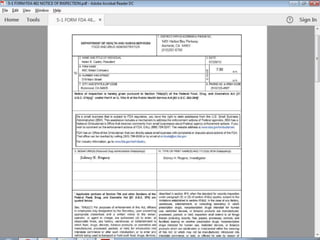
 FDA FORM 482- Notice Of Inspection
 It is an official notice of FDA for inspection signed by the FDA
officials. It is produced by the inspector and has the authority
to inspect the manufacturing facility
 Inspection coordinator will receive the notice and manage the
inspection accordingly
 Coordinator should ask for notice, if it is not presented by
the FDA inspector
 A copy of this shall be attached with the inspection file
FORM 482 shows that inspector has authorization from
FDA to inspect the facility
 An inspector can ask for the manufacturing records of the
regulated product and can enter in the area where the
product is being manufactured.
 He can review online records, collect samples and
interview the personnel working in area
 An inspector cant review the product price list, financial
data of firm, product marketing data, research documents
and employee data excluding the training records.
 These documents are considered as firms confidential
documents
 FDA FORM 483 – Observations of inspection
 Inspector shall provide the list of his observations about
inspection on FORM 483
 It has all the points noticed by the FDA inspectors. An
observation made in previous inspection or as mentioned in the
GMP are not followed or corrected can be added in 483
 The original copy of the FDA Form 483 is presented to the
form management, generally to the person who had received
the notice of inspection
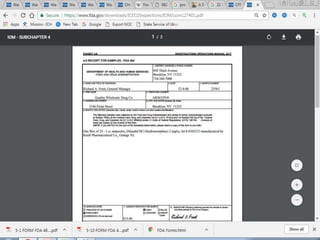
 FDA Form 484- recipient of Samples
 During the inspection if FDA inspectors want to take any
sample they have to issue a receipt of those samples on
Form 484
 It has a quantity of simple with the lot number of the
product sampled Form 484 is used for samples only but
not for promotional material, labels, photographs or any
record taken by FDA investigators
TYPES OF WARNING LETTERS
 General FDA Warning Letters
 Tobacco Retailer Warning Letters
 Drug Marketing and Advertising Warning Letters (and
Untitled Letters to Pharmaceutical Companies)
General FDA Warning Letters
 When FDA finds that a manufacturer has significantly violated
FDA regulations, FDA notifies the manufacturer. This
notification is often in the form of a Warning Letter.
 The Warning Letter identifies the violation, such as poor
manufacturing practices, problems with claims for what a
product can do, or incorrect directions for use.
 The letter also makes clear that the company must correct the
problem and provides directions and a timeframe for the
company to inform FDA of its plans for correction.
 FDA then checks to ensure that the company’s
corrections are adequate. Matters described in FDA
warning letters may have been subject to subsequent
interaction between FDA and the recipient of the letter
that may have changed the regulatory status of the issues
discussed in the letter.
Tobacco Retail Warning Letters
 Compliance check inspections of tobacco retailers occur
periodically, and are conducted to determine a retail
establishment’s compliance with the Federal Food, Drug, and
Cosmetic Act, as amended by the Family Smoking Prevention
and Tobacco Control Act (Tobacco Control Act) and its
regulations in effect
 such as the Regulations Restricting the Sale and Distribution of
Cigarettes and Smokeless Tobacco to Protect Children and
Adolescents, found at Title 21 of the Code of Federal
Regulations, Part 1140
 21 C.F.R. Part 1140
CIGARETTES, SMOKELESS TOBACCO, AND COVERED
TOBACCO PRODUCTS
Prohibition of sale and distribution to the persons younger then
18yrs of age and Format and content requirements for labeling
and advertising.
 Tobacco products covered in compliance check inspections of
tobacco retailers include cigarettes and smokeless tobacco.
 All other Warning Letters issued by CTP for violations of the
Federal Food, Drug, and Cosmetic Act, as amended by the
Tobacco Control Act and its applicable regulations, can be
found at FDA’s main Warning Letter page at the Inspections,
Compliance, Enforcement, and Criminal Investigations -
Warning Letters page.
Drug Marketing and Advertising Warning
Letters
 These letters are supplied by the CDER Freedom
of Information Office (FOI). This page only covers letters
issued by Headquarters and the Office of Prescription Drug
Promotion (formerly the Division of Drug Marketing,
Advertising, and Communications).
 "Cyber" letters are sent electronically via the Internet to web
sites that offer to sell online prescription drugs that may be
illegal. The letters warn these web site operators that they may
be engaged in illegal activities and informs them of the laws
that govern prescription drug sales.
Warning Letter Close-Out Letter Program
 (Applies to letters issued on or after Sept. 1, 2009)
 FDA may issue a Warning Letter close-out letter ("close-out
letter") once the Agency has completed an evaluation of
corrective actions undertaken by a firm in response to a
Warning Letter.
 A close-out letter may issue when, based on FDA’s evaluation,
the firm has taken corrective action to address the violations
contained in the Warning Letter. This procedure applies to
Warning Letters issued on or after September 1, 2009.
 A close-out letter will not be issued based on representations
that some action will or has been taken. The corrective actions
must actually have been made and verified by FDA.
 If the Warning Letter contains violations that by their nature are
not correctable, then no close-out letter will issue.
 Future FDA inspections and regulatory activities may further
assess the adequacy and sustainability of these corrections.
Should violations be observed during a subsequent inspection
or through other means, enforcement action may be taken
without further notice
HOW TO BROWSE WARNING LETTERS
 Use any of these "Browse" functions:
 Browse Warning Letters by Company
 Browse Warning Letters by Issuing Office
 Browse Warning Letters by Subject
 Browse Warning Letters with Response Letters
 Browse Warning Letters with Closeout Letters
REFERENCE
 https://en.wikipedia.org/wiki/Form_FDA_483
 http://www.pharmaguideline.com/2014/11/fda-
forms-issued-in-inspections.html
 https://www.fda.gov/ICECI/EnforcementActions/Wa
rningLetters/ucm278624.htm
 https://www.accessdata.fda.gov/scripts/cdrh/cfdocs/c
fcfr/CFRSearch.cfm?CFRPart=1140

FDA Warning letter

  • 1.
    Presented By:- Sridhar S 1stM.Pharmacy Pharmaceutical Regulatory Affairs JSS College Of Pharmacy Mysuru-15
  • 2.
    DEFINITION  An FDAwarning letter is an official message from the United states Food & Drugs Administration (FDA) that it has found that a manufacturer has violated some rule in a regulated activity.  While the FDA generally determines violations through its own inspections, they can also issue one based on evidence from state personnel  the FDA does not consider a warning letter a final action on which it can be issued
  • 3.
    The FDA definesan FDA warning letter as:-  “A correspondence that notifies regulated industry about violations that FDA has documented during its inspections or investigations.  Typically, a Warning Letter notifies a responsible individual or firm that the Agency considers one or more products, practices, processes, or other activities to be in violation of the Federal Food, Drug, and Cosmetic Act (the Act), its implementing regulations and other federal statutes.  Warning Letters should only be issued for violations of regulatory significance, i.e., those that may actually lead to an enforcement action if the documented violations are not promptly and adequately corrected. A Warning Letter is one of the Agency’s principal means of achieving prompt voluntary compliance with the Act.
  • 4.
     The agencyhas a computer application called the Compliance Management System (CMS) that district offices use to electronically submit warning letter recommendations to FDA Centers.  All district office must use the CMS to submit the warning letter recommendation, the Form FDA 483 that supports the alleged violations, the Establishment Inspection Report (EIR), and any written response from the firm.
  • 5.
    WHY FDA COMESFOR INSPECTION  The person who involved in the manufacturing of bulk API or involved in the formulation of product are willing to sale or market there product in the regions of the united states  The dossier is submitted according NDA for new product and ANDA for generic drug and 502(f)(1) for an API or bulk chemical
  • 6.
     After thedossier or application is accepted by the USFDA and send a reply for the inspection of the premises  FDA FORM 482- Notice Of Inspection  It is an official notice of FDA for inspection signed by the FDA officials. It is produced by the inspector and has the authority to inspect the manufacturing facility  Inspection coordinator will receive the notice and manage the inspection accordingly
  • 7.
     Coordinator shouldask for notice, if it is not presented by the FDA inspector  A copy of this shall be attached with the inspection file FORM 482 shows that inspector has authorization from FDA to inspect the facility  An inspector can ask for the manufacturing records of the regulated product and can enter in the area where the product is being manufactured.
  • 8.
     He canreview online records, collect samples and interview the personnel working in area  An inspector cant review the product price list, financial data of firm, product marketing data, research documents and employee data excluding the training records.  These documents are considered as firms confidential documents
  • 10.
     FDA FORM483 – Observations of inspection  Inspector shall provide the list of his observations about inspection on FORM 483  It has all the points noticed by the FDA inspectors. An observation made in previous inspection or as mentioned in the GMP are not followed or corrected can be added in 483  The original copy of the FDA Form 483 is presented to the form management, generally to the person who had received the notice of inspection
  • 11.
     FDA Form484- recipient of Samples  During the inspection if FDA inspectors want to take any sample they have to issue a receipt of those samples on Form 484  It has a quantity of simple with the lot number of the product sampled Form 484 is used for samples only but not for promotional material, labels, photographs or any record taken by FDA investigators
  • 13.
    TYPES OF WARNINGLETTERS  General FDA Warning Letters  Tobacco Retailer Warning Letters  Drug Marketing and Advertising Warning Letters (and Untitled Letters to Pharmaceutical Companies)
  • 14.
    General FDA WarningLetters  When FDA finds that a manufacturer has significantly violated FDA regulations, FDA notifies the manufacturer. This notification is often in the form of a Warning Letter.  The Warning Letter identifies the violation, such as poor manufacturing practices, problems with claims for what a product can do, or incorrect directions for use.  The letter also makes clear that the company must correct the problem and provides directions and a timeframe for the company to inform FDA of its plans for correction.
  • 15.
     FDA thenchecks to ensure that the company’s corrections are adequate. Matters described in FDA warning letters may have been subject to subsequent interaction between FDA and the recipient of the letter that may have changed the regulatory status of the issues discussed in the letter.
  • 16.
    Tobacco Retail WarningLetters  Compliance check inspections of tobacco retailers occur periodically, and are conducted to determine a retail establishment’s compliance with the Federal Food, Drug, and Cosmetic Act, as amended by the Family Smoking Prevention and Tobacco Control Act (Tobacco Control Act) and its regulations in effect  such as the Regulations Restricting the Sale and Distribution of Cigarettes and Smokeless Tobacco to Protect Children and Adolescents, found at Title 21 of the Code of Federal Regulations, Part 1140
  • 17.
     21 C.F.R.Part 1140 CIGARETTES, SMOKELESS TOBACCO, AND COVERED TOBACCO PRODUCTS Prohibition of sale and distribution to the persons younger then 18yrs of age and Format and content requirements for labeling and advertising.  Tobacco products covered in compliance check inspections of tobacco retailers include cigarettes and smokeless tobacco.  All other Warning Letters issued by CTP for violations of the Federal Food, Drug, and Cosmetic Act, as amended by the Tobacco Control Act and its applicable regulations, can be found at FDA’s main Warning Letter page at the Inspections, Compliance, Enforcement, and Criminal Investigations - Warning Letters page.
  • 18.
    Drug Marketing andAdvertising Warning Letters  These letters are supplied by the CDER Freedom of Information Office (FOI). This page only covers letters issued by Headquarters and the Office of Prescription Drug Promotion (formerly the Division of Drug Marketing, Advertising, and Communications).  "Cyber" letters are sent electronically via the Internet to web sites that offer to sell online prescription drugs that may be illegal. The letters warn these web site operators that they may be engaged in illegal activities and informs them of the laws that govern prescription drug sales.
  • 19.
    Warning Letter Close-OutLetter Program  (Applies to letters issued on or after Sept. 1, 2009)  FDA may issue a Warning Letter close-out letter ("close-out letter") once the Agency has completed an evaluation of corrective actions undertaken by a firm in response to a Warning Letter.  A close-out letter may issue when, based on FDA’s evaluation, the firm has taken corrective action to address the violations contained in the Warning Letter. This procedure applies to Warning Letters issued on or after September 1, 2009.
  • 20.
     A close-outletter will not be issued based on representations that some action will or has been taken. The corrective actions must actually have been made and verified by FDA.  If the Warning Letter contains violations that by their nature are not correctable, then no close-out letter will issue.  Future FDA inspections and regulatory activities may further assess the adequacy and sustainability of these corrections. Should violations be observed during a subsequent inspection or through other means, enforcement action may be taken without further notice
  • 21.
    HOW TO BROWSEWARNING LETTERS  Use any of these "Browse" functions:  Browse Warning Letters by Company  Browse Warning Letters by Issuing Office  Browse Warning Letters by Subject  Browse Warning Letters with Response Letters  Browse Warning Letters with Closeout Letters
  • 22.
    REFERENCE  https://en.wikipedia.org/wiki/Form_FDA_483  http://www.pharmaguideline.com/2014/11/fda- forms-issued-in-inspections.html https://www.fda.gov/ICECI/EnforcementActions/Wa rningLetters/ucm278624.htm  https://www.accessdata.fda.gov/scripts/cdrh/cfdocs/c fcfr/CFRSearch.cfm?CFRPart=1140